Spring Poetry

Spring Poetry (3)

With all the spring produce bursting out of our recipes lately, today Travis and I used the season as inspiration for poetry! This fun lesson from Raddish Kids is a great excuse to get outside in spring weather, not to mention a nice addition to your lesson plan if you’re home schooling.

So off we headed to the park, taking along a notebook and pencils!

Spring Poetry (1)

We ran around first, and once we paused back on our blanket I asked Travis to reflect on what he’d noticed as he played. Bees, and grass, and wind, he replied.

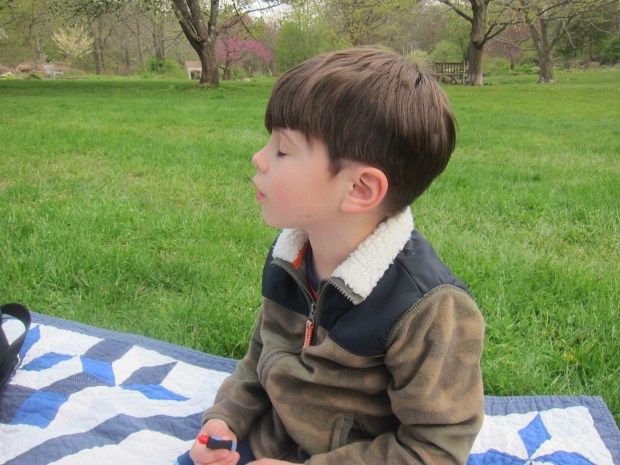
Next I had him close his eyes to focus on sounds. He particularly noticed birds chirping.
Spring Poetry (2)

Once he opened his eyes, I asked him to point out the signs of spring he could see. Flowers, green, and white, were his answers.

Working together, it was now time to write poetry! Older students can compose their own poems, but the goal here is for an adult to guide a younger student through shared writing. I relied on the words he’d used in the exercise above, but guided him through various poetry formats.

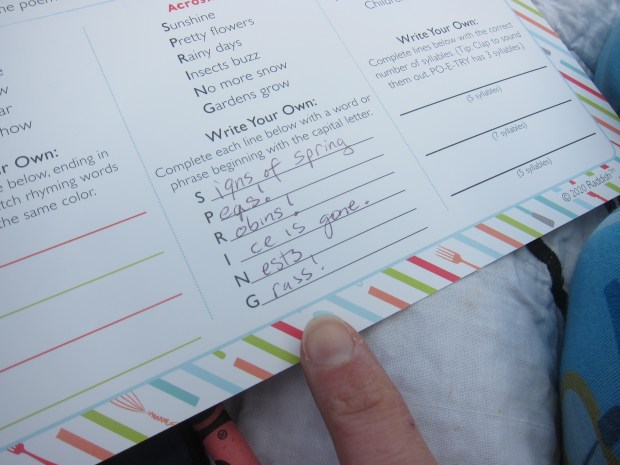
First up was an acrostic. After reading Raddish’s explanation of the form, Travis and I composed the following:

Signs of spring

Peas!

Robins!

Ice is gone.

Nests,

Grass!

We then composed a few lines of rhyming poetry about spring, as well as a haiku. It was helpful for him to clap along, to understand the 5 syllable-7 syllable-5 syllable format.

Spring Poetry (4)

His haiku was:

Flowers are pretty.

Flowers are so beautiful.

But the bees scare me.

Next up was a diamente – new even to me! – a poem that makes a diamond shape through the progression of: noun, adjective, verb, noun, verb, adjective, noun. We composed the following:

Spring Poetry (6)

I then took his words from our initial brainstorming and showed him how to write concrete poetry i.e. a poem in the shape of what it talks about. Here’s a spring flower!

Spring Poetry (5)

All in all, this lesson made for a nice rumination on spring, plus gave us a welcome pause in the sunshine.

Poetry Traditions

Poetry Traditions (1)

‘Twas the night before Christmas and all through the house… we were having a quick poetry lesson before bed!

The Night Before Christmas wasn’t actually written as a book, of course, but as a poem, with a classic AABB rhyme scheme (lines 1 and 2 rhyme, and lines 3 and 4 rhyme). Thus it’s a great work for talking with kids about Christmas traditions, how Christmas has changed over the years, and for a mini poetry lesson, too.

First we read the book, and then laughed as we turned the pages along to a version sung by the University of Utah choir.

Poetry Traditions (2)

As we read, I paused over vocabulary that was old-fashioned or unfamiliar to Travis, words like sash, prancing, lustre, and stirring. He instantly pinpointed that the poem was old-fashioned, based on the drawings and the language. We discussed how this “Saint Nick” differed from the Santa Claus he’s familiar with.

Do a close reading of the poem, asking questions like: ‘who were the characters’ (“The kids, the mom, the dad, and Santa Claus!”) and ‘what happens in the middle’ (“The sleigh appears!”) etc.

Poetry Traditions (3)

Then we went through and identified some of the rhymes, like house and mouse. I gave him a word from the poem (for example ‘bed’) and challenged him to come up with his own rhymes.

Poetry Traditions (5)

Big kids can go on from here to write their own holiday poem. For my kindergartner, I simply helped Travis compose a silly line or two about our family holidays.

Poetry Traditions (4)

Fun extensions might include acting out the poem before bed!

Valentine’s Poetry & Signs

Raddish Valentine (8)

With a clever little template to follow from Raddish Kids, Travis wrote his first poems this Valentine’s Day! I loved guiding him through the project, and the final result makes the perfect Valentine’s gift for a teacher, family member, or friend.

First, we brainstormed a list of three categories: things that were red; things that were blue; and things that were sweet. He had some very definite opinions about what to include i.e. blackberries are bluish purple, not black, so they could go on the list.

Raddish Valentine (4)

What ensued was a sort of Mad Libs game. I read the original poem to him first:

Roses are red,

Violets are blue,

Sugar is sweet,

And so are you.

Using the lists he’d made, we slotted in a new word for each line.

Raddish Valentine (3)

The results were adorably hilarious, and will likely be so different from anything you’d come up with!

Raddish Valentine (5)

Overall, this was a great way to introduce poetry to my four-year-old, and a fun way to make some last-minute Valentine’s cards.

Raddish Valentine (6)

For still more language fun this holiday, teach your kids to sign ‘I love you’ in American Sign Language. Here’s his super excited face working out how to properly make the sign with his fingers!

Raddish Valentine (1)

Travis and I decided this can be our secret way to say the words at school drop off, now.