Balloon Propeller

Balloon Propeller (6)

We were dealing with big stuff for a four-year-old today! After our disk launchers from Kiwi Co introduced Travis to physics in a way even a preschooler could grasp, now we were talking about Newton’s laws of motion. Full disclosure: this required some review for mommy, who hasn’t touched this kind of material since college!

Here’s my quick recap: Newton’s third law of motion states that for every reaction, there is an equal and opposite reaction. So if the air from a balloon is escaping in one direction, the balloon will try and move forward in the opposite direction, making it spin, in this case.

Here’s how we set it up:

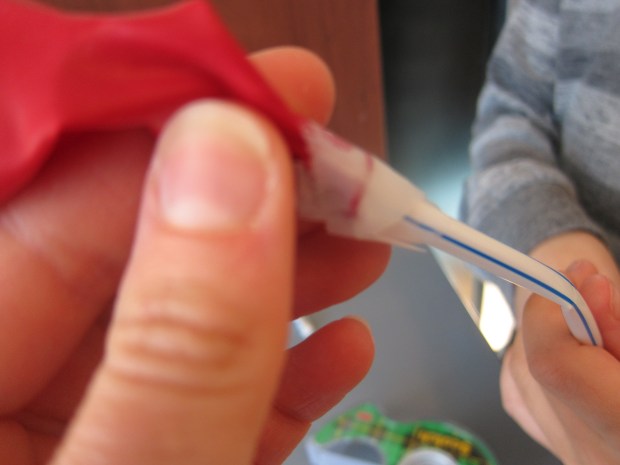
Slightly tug on a balloon and partially inflate it, just to loosen it up – don’t tie off. Now tape the balloon securely to the end of a straw (on the non-bendy side).

Balloon Propeller (1)

Travis immediately wanted to test out if he could blow up the balloon through the straw – neat!

Balloon Propeller (2)

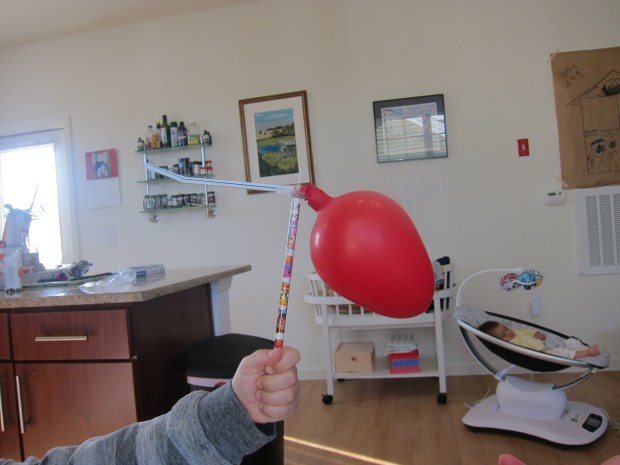
Hold the straw on your fingers to identify the point where the straw balances. This is where you’ll insert a straight pin. Poke the pin all the way through the straw, then down into the eraser of a pencil.

Balloon Propeller (3)

Now blow up the balloon. Have your child hold the pencil, making sure their hand and arm won’t interfere with the motion of the balloon.

Balloon Propeller (5)

Let go and watch! The balloon will deflate, which causes it to spin around on the pin (Note: You may have to tug on the pin or spin the propeller by hand a few times to loosen things up enough).

Balloon Propeller (7)

We did this experiment over and over – a great visual of forces and energy, understandable even at the preschool level!

Balloon Propeller (8)

Rainbow Science

Make a Rainbow (8).JPG

With all the talk about rainbows this month, whether cooking or crafting, it was time to get scientific. What exactly makes a rainbow appear? Today Travis and I answered the question in two ways, one more scientific, and one more artsy!

First, following the lesson plan provided by Raddish Kids, we did a visualization exercise. This was a first for Travis, but with a few prompts he got the idea. I told him to close his eyes and imagine and rainbow. He said he could see his rainbow through the trees in the morning, and it was star-shaped! Guide your child through this: what does the air feel like? Where is the rainbow? What time of day is it?

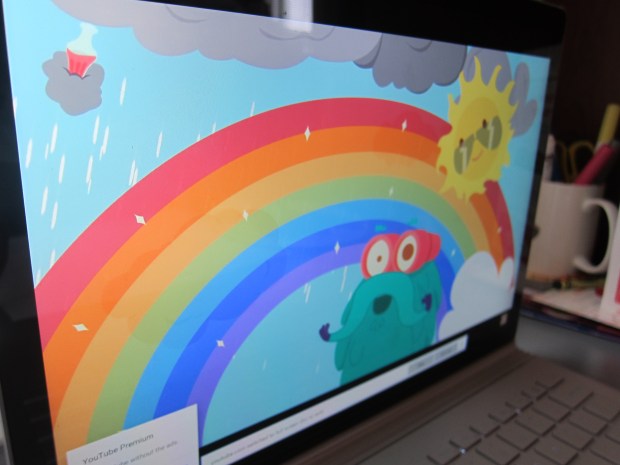
Next we did the quick run-down on the science. Raddish Kids provided two great video links to add some visual fun to hte science.

Make a Rainbow (1).JPG

We watched a few suggested video clips, to understand the science behind refraction. Raddish provides a very detailed write-up that older children can study, too.

Make a Rainbow (2)

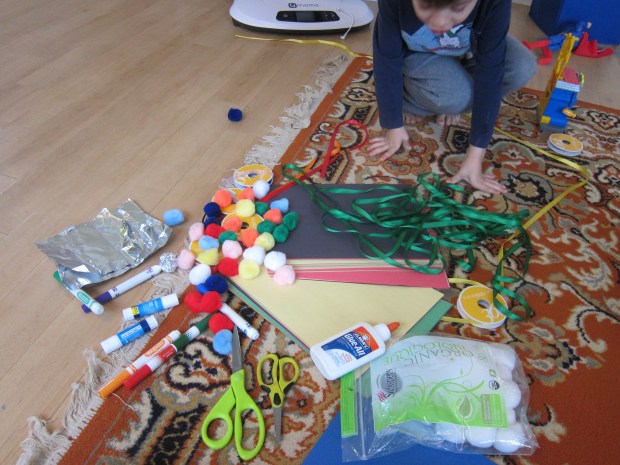
Next up was a challenge: Could Travis make a visual of a rainbow that not only showed all the colors, but also showed how the rainbow is formed? It turns out this is called process art, and I laid down lots of material for Travis to choose from but provided little direction beyond that.

Make a Rainbow (3)

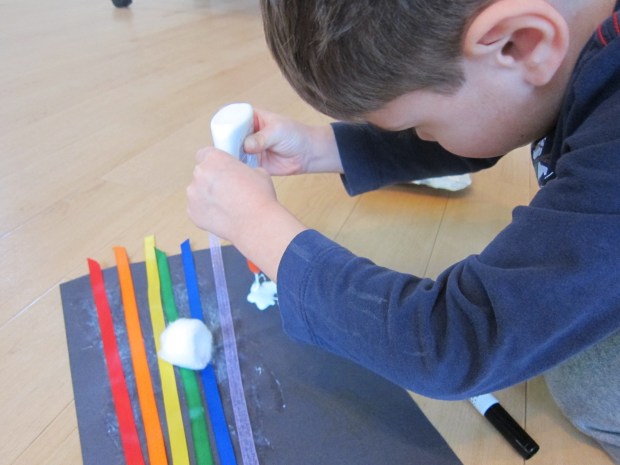
He decided he wanted a ribbon rainbow, so used lots of glue to adhere the lengths.

Make a Rainbow (4)

I was so proud when he realized he was gluing in the wrong order, and fixed things with his red placed first!

Make a Rainbow (5)

Next he needed to add the science part. He chose to use marker for sun and rain drops, and cotton balls for clouds. Now he had all the ingredients necessary for a rainbow to form!

Make a Rainbow (7)

I made a second version alongside him to show him how open-ended this project is: cotton ball clouds, tin foil raindrops, and pom poms for my sun and rainbow.

Make a Rainbow (6)

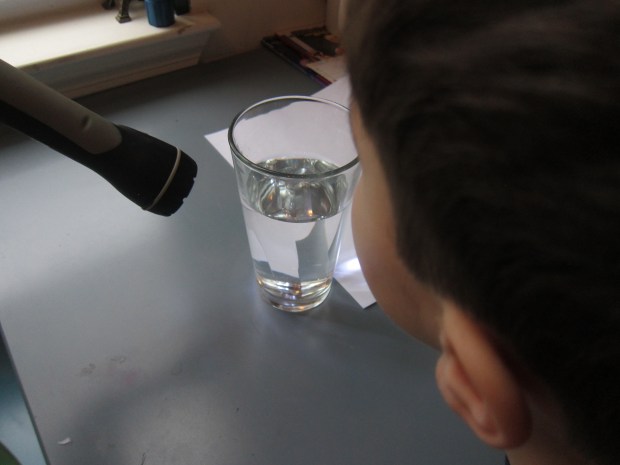
Finally, we formed a rainbow with science! Place a prism in a glass of water. Shine a flashlight or other light source on it.

Make a Rainbow (9)

Hold up a piece of white paper behind the glass, and you should see a rainbow reflected on the paper. It’s a bit tough to see in the photograph, but it was there!

Make a Rainbow (10)


Inertia Kiwi Crate

Kiwi Inertia (7)

Although Kiwi Co. titled Travis’s crate this month as the “Disk Launchers” crate, really it’s all about inertia, so that’s how I’m styling it here. Nomenclature aside, what fun we had with this one!

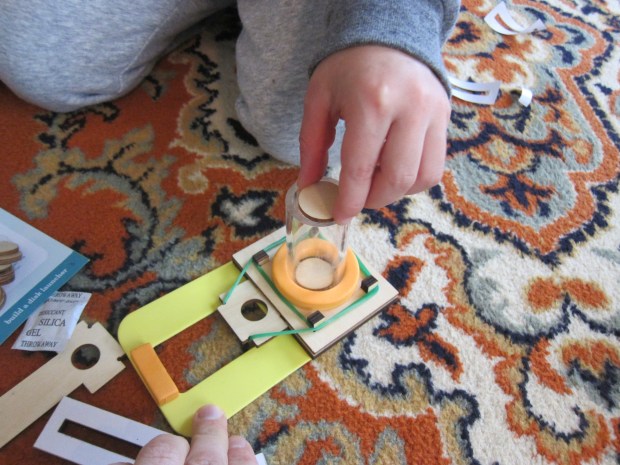
First Travis had to Build a Disk Launcher. As always, the step-by-step here is more complicated than in a Koala Crate, so I will simplify. It was great to sit back and let Travis deal with the fine motor skills of attaching sticky-backed foam pieces to the wooden pieces in the right order.

Kiwi Inertia (1)

Elastics help hold it together.

Kiwi Inertia (2)

And then a tube slots into place.

Kiwi Inertia (5)

Fill the tube with the provided disks (which look like wooden tiddlywinks). Pull back on the pin and – zing! A disk launches out. Travis was unsure what we had been building up toward, and looked so astonished and delighted when he realized how the launcher worked!

Kiwi Inertia (6)

Needless to say, soon some ninja turtles were lined up to be our targets.

Kiwi Inertia (8)

Next we needed to Create Clay Obstacles from the provided air-dry clay. These will become props in games in a moment, so the instruction manual suggested figures like goal posts or even little goalie people.

Kiwi Inertia (12)

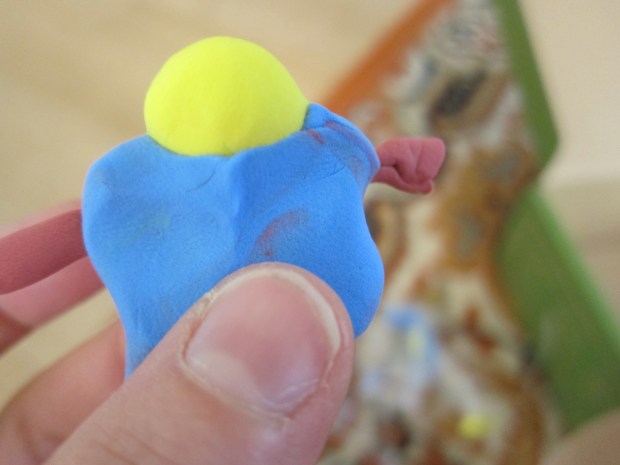
There were also tips on how to make specific artistic touches. We mashed together the blue and yellow clay and made a green clay! Then we tried twisting two colors together for a braided look.

Kiwi Inertia (10)

Three colors rolled together made stripes.

Kiwi Inertia (11)

Travis was mostly content to go his own artistic way with this one, making little blobs. But we especially liked rolling circles that looked like marbles or little planets.

Kiwi Inertia (13)

Leave the clay out to air dry, preferably overnight.

Kiwi Inertia (14)

Now it was time to play Disk Launcher Games.

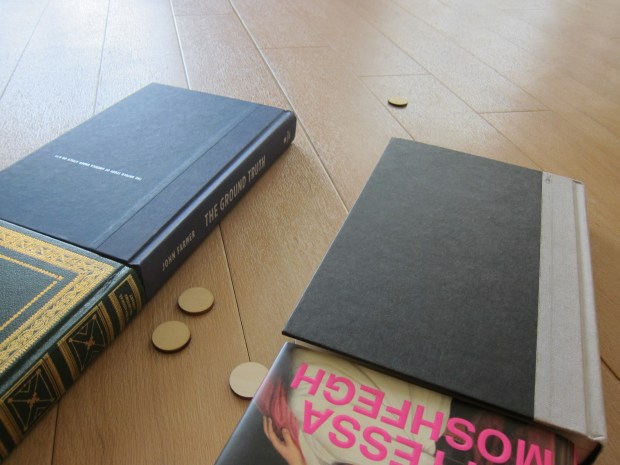
For the first, we unrolled the provided mat for a spin on “curling.” Secure the mat between your Kiwi Crate box and a book.

Kiwi Inertia (15)

Take turns aiming at the target with your launchers, and see who gets the most points!

Kiwi Inertia (16)

Then we tried bowling.

Kiwi Inertia (17)

Travis was thrilled seeing the provided pins get knocked down.

Kiwi Inertia (18)

Now it was time for the final challenge: create your own game! We just went wild, putting up all our clay figures and the bowling pins and seeing if we could knock everything down.

Kiwi Inertia (19)

Older kids may want to get more sophisticated in their game rules, such as actually scoring through one of the clay goal posts, or knocking over a specific type of target. But Travis loved our mayhem, and we needed to play many rounds.

Kiwi Inertia (20)

To bring it back to the science of inertia for a moment, I showed him a quick Disk Physics Experiment: Set up three disks (touching each other) between a set of books and then launch another disk at them. Have your child guess which disk is going to move forward!

Kiwi Inertia (21)

The answer is the furthest disk, which Travis correctly surmised.

Kiwi Inertia (22)

We talked about how the energy transferred from the launched disk all the way to the furthest one. He thought this idea was neat.

To cap it all off, we explored further with two suggested books: Newton and Me by Lynne Mayer, and Oscar and the Cricket by Geoff Waring.

Make Volcano Eggs

Volcano Eggs (7).JPG

Yesterday Travis and I tested out a few ways to dye plastic Easter eggs. We had another batch of eggs (this time more properly ceramic rocks, which are meant to be painted), so although we know the results wouldn’t show up that well, we still wanted to have fun with the process!

In a small bowl, stir together 3 tablespoons baking soda, 10 drops food coloring, and just a bit of water until you have a thick paste.

Volcano Eggs (1)

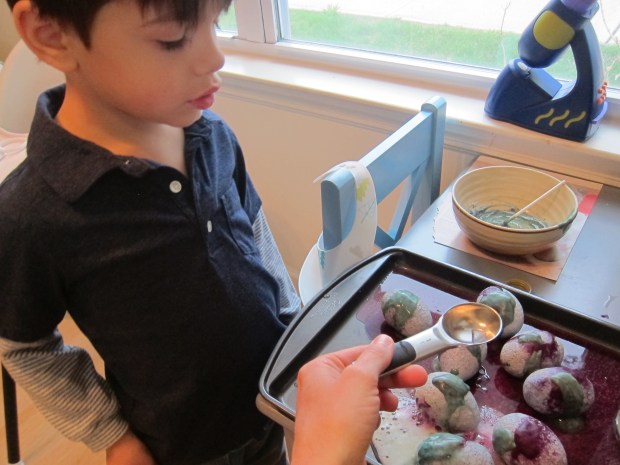
Dribble the paste over the eggs – I recommend using a baking sheet or other craft bin as a base, because you’re about to have a mess!

Volcano Eggs (2)

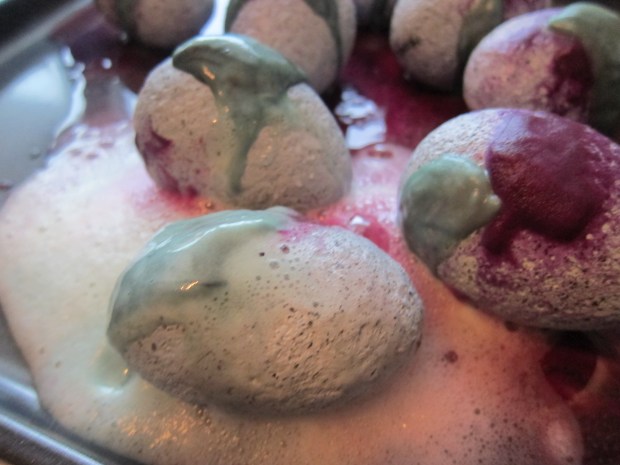
Drizzle 1 tablespoon vinegar over each egg, and watch the colors run!

Volcano Eggs (3)

Travis couldn’t get enough of the fizzing.

Volcano Eggs (4)

This was so fun we mixed up a second bowl of color and repeated the process.

Volcano Eggs (6)

Bubble bubble!

Volcano Eggs (5)

As with our previous egg crafts, the color didn’t really set on the fake ones, but a few streaks were left behind. I’d love to hear if you have great results with real egg shell!

Volcano Eggs (8)

Fingerprint Kit

Fingerprint Kit (10).JPG

Following up on some recent secret agent fun, today Travis got to delve into real forensics! We’ve already talked about how everyone’s fingerprints are unique, and how real detectives use this fact to find “bad guys.” With a few simple tools, we could play detective, too.

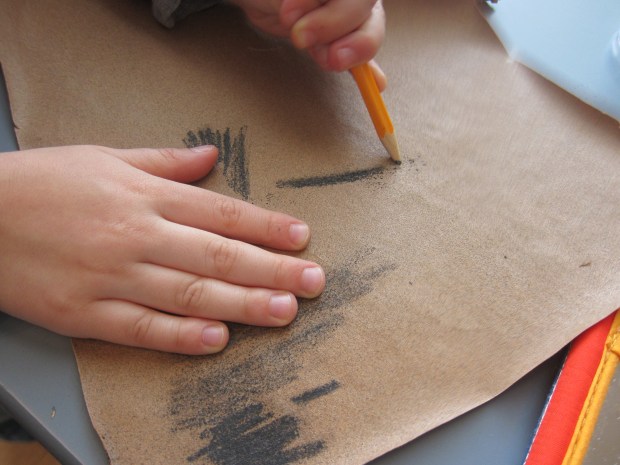
First, make sure you have a few sharp pencils on hand, and rub on sandpaper.

Fingerprint Kit (1)

The graphite will flake off, which Travis thought was neat. As we made piles of it, we dumped it into a small plastic jar until we had a nice amount.

Fingerprint Kit (2)

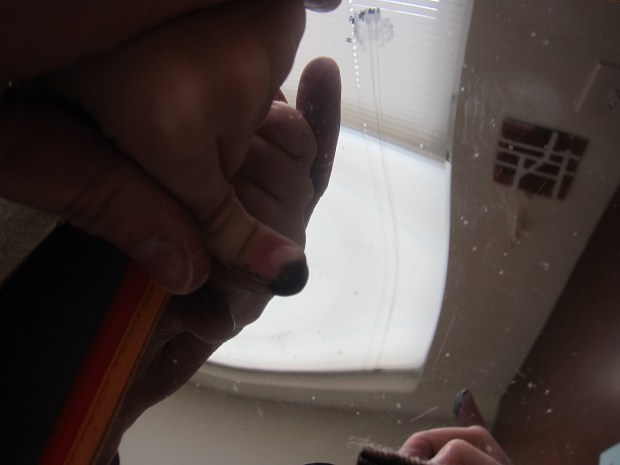
Now invite your suspects (family members or friends, that is!) to press their finger against a piece of glass. We used a baby-safe mirror, but in retrospect I wish we’d used a window pane, as the imprint of a finger would last longer.

Fingerprint Kit (3)

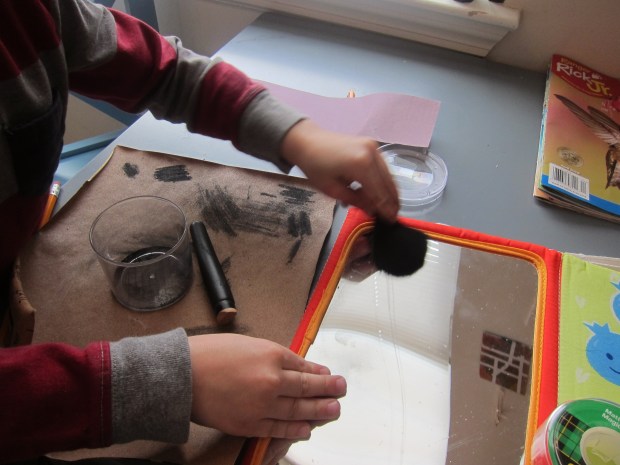
Dip an old make-up brush into the graphite, and then swirl over each print. The black will adhere to the fingerprints.

Fingerprint Kit (5)

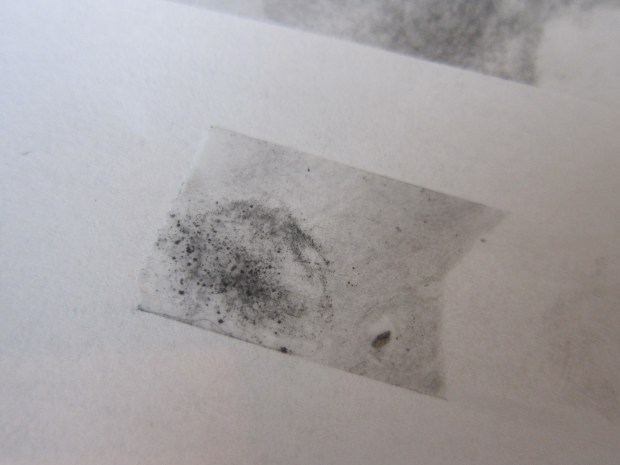
Press a piece of tape over the print, and transfer to paper. You can make circles on the paper in advance and label each with “suspect’s” name, if your child wants to!

Fingerprint Kit (6)

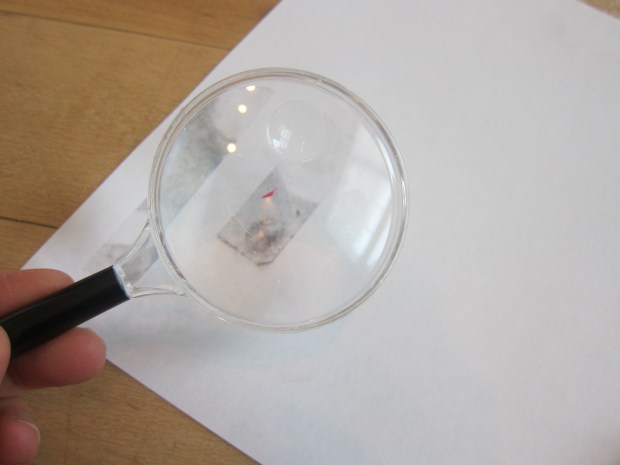
Once the prints were on paper, we could examine them with a magnifying glass, too. Hmm, what case would Travis solve?

Fingerprint Kit (8)

Overall, Travis thought the project was neat, but was most into the brush. This then became a forensic tool to dust all about the house. Let the imagination go wild from here!

Fingerprint Kit (9)


Invisible Ink

Invisible Ink (8)

A few weeks back, Travis and I had fun exploring different ways to hide messages, including revealing lemon juice with a hot iron and exposing white crayon with paint. Today we found an even cooler method; did you know you can reveal a secret message with a flower?

Invisible Ink (4)

First, we wrote messages in two kinds of “ink.” The first was plain lemon juice, and the second was baking soda mixed with a bit of water.

Invisible Ink (1)

Travis made scribbles, but to help illustrate the results better for him, I wrote his name on one piece of paper and a secret map on the other.

Invisible Ink (2)

Be sure to use slightly thick paper, such as construction paper or watercolor paper, or it might tear during the reveal. Let dry.

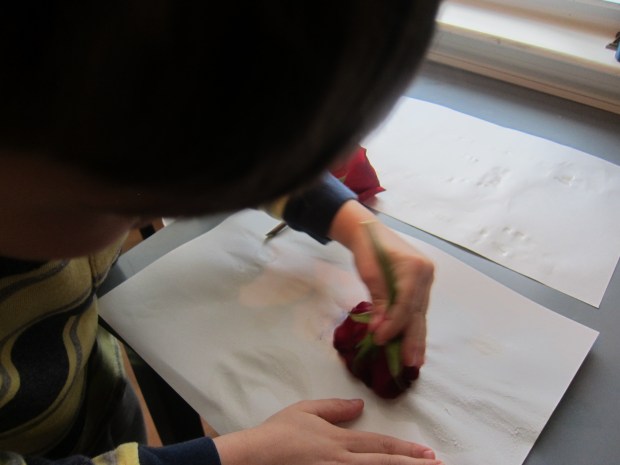
Once dry, we rubbed over the paper with a red rose. Travis loved the forensic feel to the project!

Invisible Ink (10)

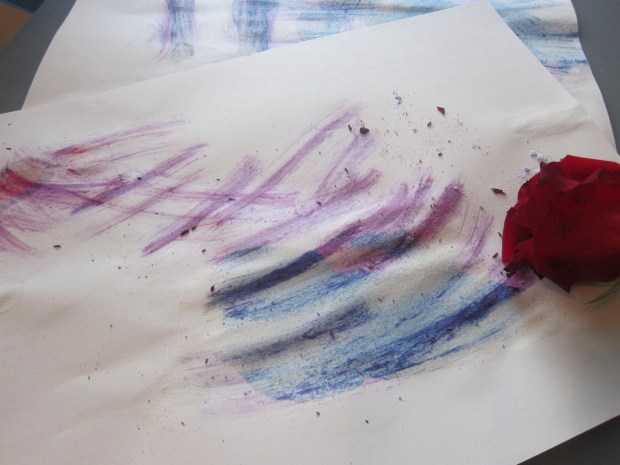
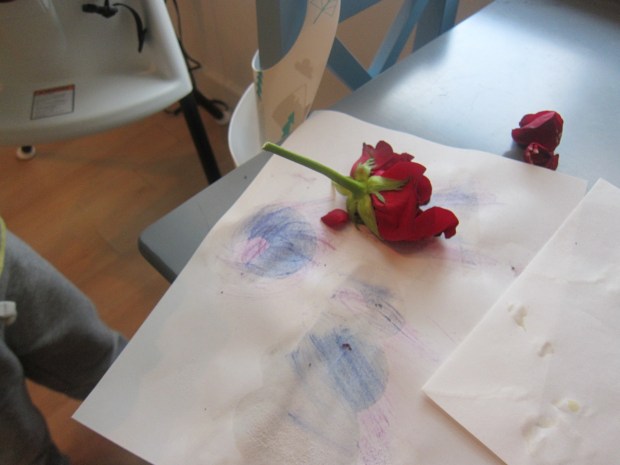
This worked significantly better with the baking soda than with the lemon juice, and we also found that the results are much clearer on on large letters or drawings than small ones.

Invisible Ink (9)

Perhaps the most interesting takeaway was that the baking soda was revealed in blue, and the lemon juice comes out red.

Invisible Ink (7)

In sum, a fun little project for any budding detectives, with results that are both pretty and scientific.

Invisible Ink (6)

Robot Craft Challenge

Robot Challenge (6).JPG

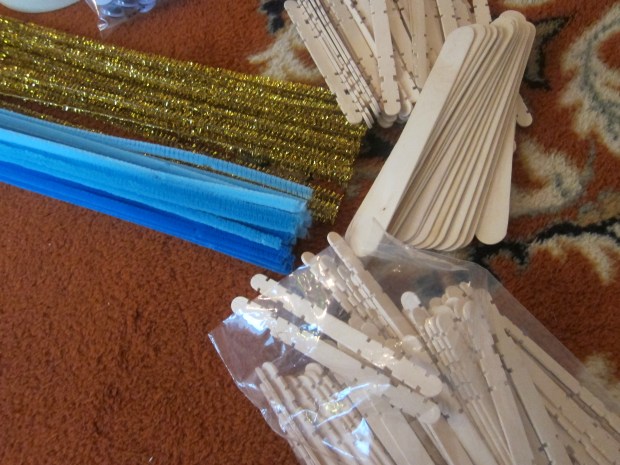
This morning, I challenged Travis’s creativity. Could he make a robot with nothing more than 3 items from our craft bin: craft sticks, pipe cleaners, and googly eyes? He was instantly up for it!

I laid out the materials (we also added tape) and watched him ponder.

Robot Challenge (1)

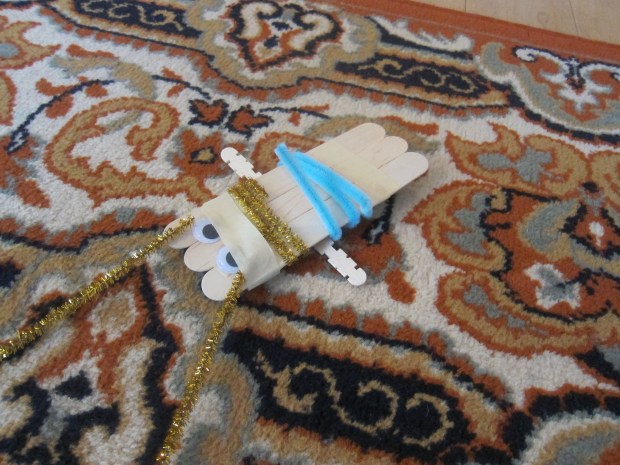
He very quickly decided a few sticks taped together could be the body. “I can do it!” he insisted, ripping the tape and sticking it on by himself. Then of course we added eyes, which Travis wanted to tape on all by himself.

Robot Challenge (8)

Next up came embellishments. He insisted we use shiny gold chenille sticks, since robots are usually shiny metal.

Robot Challenge (2)

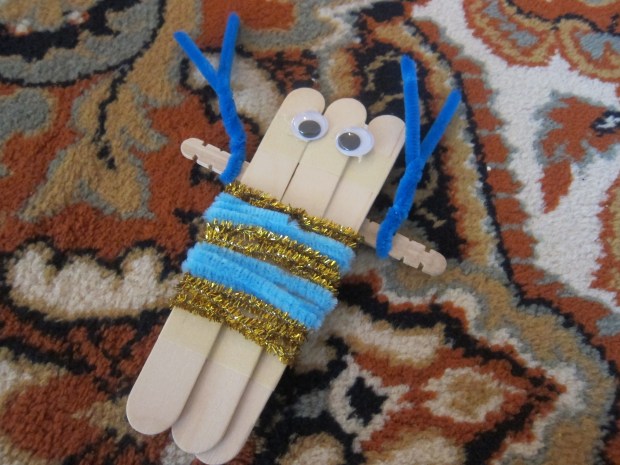
He wanted to add arms, so another craft stick went on crosswise. But then he thought his robot needed wings. Some pipe cleaners twirled around the arm stick did the trick.

Robot Challenge (5)

The fun didn’t end there. We used chenille sticks to twist “bodies” and “arms” of more craft sticks together for baby robots.

Robot Challenge (7)

Then, because Travis is obsessed with all things Spiderman and his villains these days, we added 8 chenille stem pieces to another body as “Dr. Octopus.”

Robot Challenge (3)

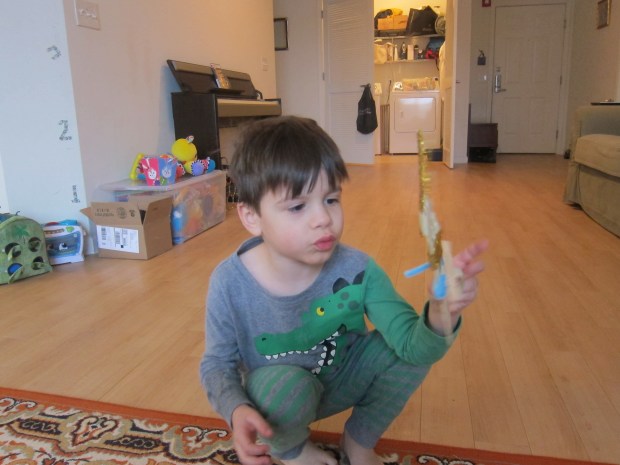
What a great morning of fun we had, using just these three items from the craft bin!

Banana Messages

Banana Message (3).JPG

Here’s an adorable way to leave a message for your kids – and to teach them a tiny science lesson in the process!

Use a toothpick to score a message (whether words or a picture) into the peel of a banana. Thanks to the way this bruises the banana peel, your message will darken over time –  the longer it sits, the more visible it will be!

Note that you barely need to puncture the peel at all. The first time, I figured I needed to etch all the way down to the banana flesh, but this turned brown almost instantly.

Banana Message (1)

A more subtle, gentle scoring of the peel reveals itself slowly.

Banana Message (2)

Regardless, Travis was thrilled when I told him his banana had a secret message for him. He was so surprised!

Banana Message (4)

He then needed to try his own hand at it of course. These would be fun for a kid to put together and slip into mom or dad’s lunch for work!

Banana Message (5)

Heart Pump

Heart Pump (5)

For kids interested in the body and how it works, this visual representation of the heart is fantastic! It’s obviously simplified, but serves as a nice illustration of how this vital body part works.

First, we cut a red balloon in half. Discard the narrow tail, and set aside the other half.

Heart Pump (1)

Fill a mason jar with water until about half full, and add 3 or 4 drops of red food coloring; Travis was thrilled we’d made “blood.”

Heart Pump (2)

Stretch the top part of the balloon over the jar, making sure it lies flat.

Heart Pump (3)

Cut two small slits in the balloon, about 1 inch apart. Insert straws into each, one red and one blue (Note: the color doesn’t really matter, but helps to differentiate). Tape the blue straw shut.

Heart Pump (4)

Now press down on the balloon and your heart will “squeeze” the blood out through the straw “arteries”. Make sure you place the jar on a plate or tray, because the squeezing gets messy!

Heart Pump (7)

Travis absolutely loved this, and had to pump the heart until our jar was all out of “blood.”

Heart Pump (8)

You can wow your kids with quick facts, like how their heart really pumps in a similar way about 70 times per minute.

Here’s a quick clip of the action:

Secret Agent Kiwi Crate

Kiwi Agent (11).JPG

Travis’s current favorite show (Odd Squad), is about a team of kids who solve odd cases. So he couldn’t have been more thrilled than when he discovered his latest Kiwi Crate was all about being a secret agent. Needless to say, I barely had time to glance at the parent manual before we dove right in!

First, every secret agent needs a gadget, so Travis got to Build Your Periscope. This was a matter of folding the provided cardboard base…

Kiwi Agent (12)

…peeling stickers from each of the two mirrors to attach

Kiwi Agent (13)

…and securing it all with rubber bands.

Kiwi Agent (14)

He loved peeking around corners! For a quick STEM lesson, explain to your budding agent how they are seeing the reflection of a reflection, as opposed to a simple mirror reflection straight on. You can also flip one periscope piece to see things upside down, or make it longer or shorter by sliding the pieces together.

Kiwi Agent (15)

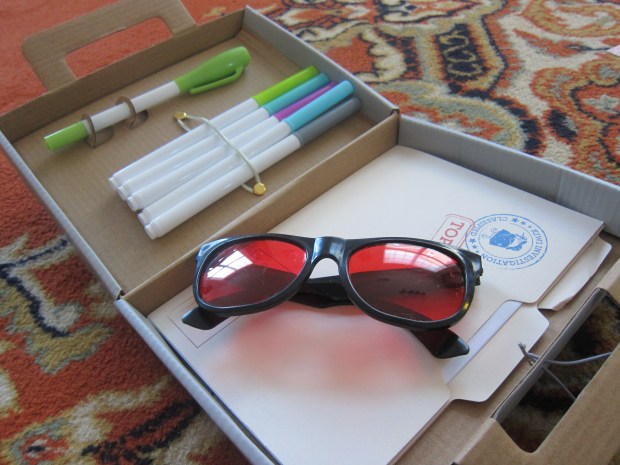
Next up, we got to Explore Secret Messages. There are two folders labeled “top secret”, one containing patterned paper and one with blank white paper. Use the provided markers to write messages on the patterned paper. The secret agent spy glasses (with red lenses) will cancel out the red lines that obscure the page so that messages can be detected.

Kiwi Agent (4)

This was a bit tough to illustrate to a non-reader, but I helped him understand which colors showed up best by drawing a series of lines with the markers, then giving him the glasses.

Kiwi Agent (5)

Next we took turns drawing pictures with the provided invisible ink and UV pen. The latter turns on with a switch, and was by far his favorite item in the kit.

Kiwi Agent (7)

Our booklet recommended making an invisible map, so I sent him off on a hunt around the house. A real secret agent on the move! He soon proudly designed a map for me, leading to a “villain” we had to catch.

Kiwi Agent (9)

Finally, every agent needs to Pack Your Briefcase. Travis helped insert brads and elastics as the clasp, and to set up a cardboard insert with elastic fasteners to hold his agent supplies.

Kiwi Agent (2)

Now your little detective can store their markers (regular and UV!), as well as all the Top Secret folders and spy glasses.

Kiwi Agent (3)

Travis paraded around with this briefcase the entire rest of the day, filling it with other items he deemed necessary for an agent. What fantastic imaginative play it prompted!

Kiwi Agent (16)

We then delved into Explore magazine, which had us learning about other codes and doing fun find-it pages. Next we explored other ways to leave a secret message. First up was white crayon. Because Travis can’t read, this was most easily illustrated for him using his name. We wrote with white crayon on white paper, then painted over it with watercolor for the big reveal.

Kiwi Agent (18)

You can also color over your white crayon with colored pencils.

Kiwi Agent (19)

One neat idea is to send a hidden message to a friend. Wrap up a happy birthday message and give it to a friend with colored pencils so they can uncover the secret.

Kiwi Agent (22)

Travis’s next code was made with lemon juice. First, squeeze a lemon – always fun!

Kiwi Agent (20)

Dip a paintbrush in the lemon juice and write out your message. Once it dries, place a second sheet of paper on top and go over it with a hot iron (grown-up step).

Kiwi Agent (28)

All will be revealed! We had fun making this a secret message for daddy.

Kiwi Agent (21)

Finally, the booklet gave a lesson on fingerprints and the ways that secret agents use them. Travis was quite intrigued, and tested leaving his prints on our window.

Kiwi Agent (24)

He copied the suggested fingerprint art, checking out his unique whirls and swirls.

Kiwi Agent (25)

Then it was time to get creative – this print turned into a long-legged spider!

Kiwi Agent (26)

In sum, Kiwi Co hit it out of the park with this one!