Cardboard Flower Prints

Don’t toss those latest bxoes from Amazon just yet! Flaps of corrugated cardboard curl up to make a print that looks just like a flower, letting even a toddler paint a full spring bouquet or garden! This trick from The Toddler’s Busy Book is so simple to put together, with lovely results.

To start, cut flaps from boxes that are ideally about 10 inches long by 6 inches tall. Rip the cardboard slightly to reveal the corrugated ribs inside, if needed. Don’t worry if it isn’t exact; as long as the corrugated groves are evident along the 10-inch edge, the project will work.

Roll up tightly and secure with a rubber band. You can see already how the cardboard is now the shape of a pretty rose!

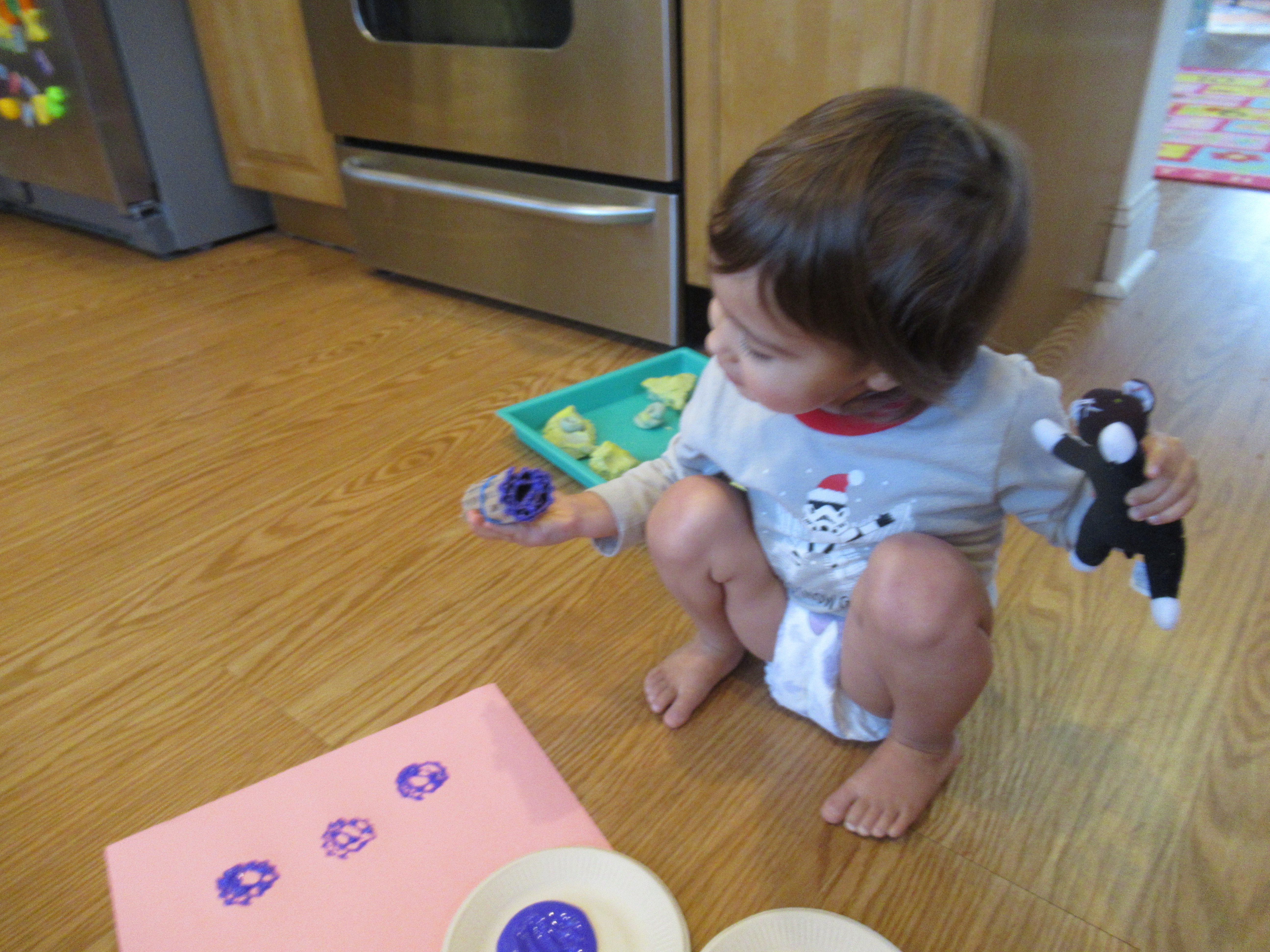
I set out paint for Veronika in red and purple, and then showed her how to dip the rolled edge of the cardboard in the paint before pressing onto construction paper.

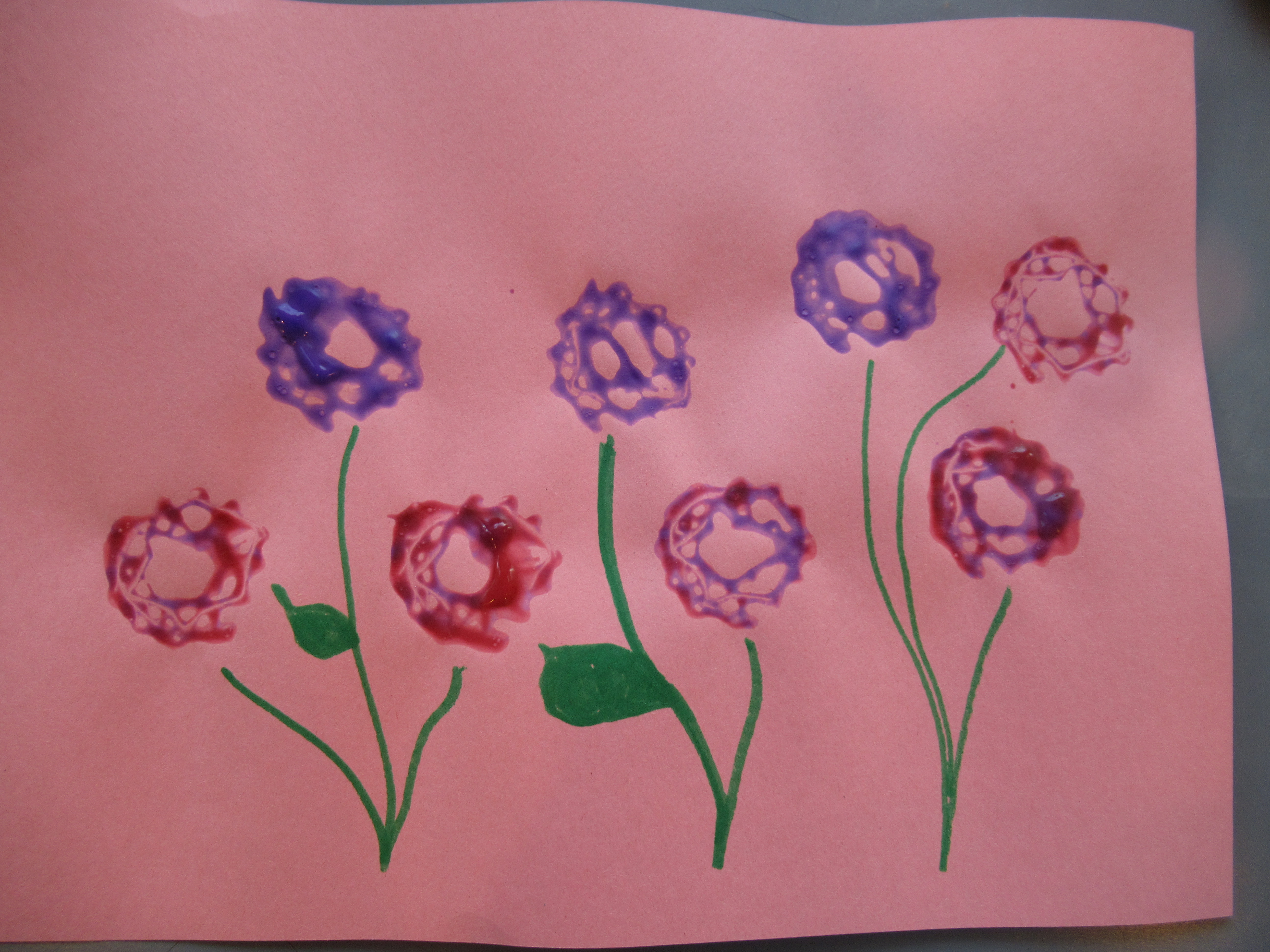
“Flowers!” she said with such delight. She experimented with one color or mixing them, and soon had a field of blossoms.

Once the paint dried, I connected them together with green marker for flower stems, and she was so proud to see the garden take shape up on our fridge.


Earth Day Art: Caterpillars, Snakes, and Worms


Earth Day is just around the corner, and I wanted the kids to engage with the Earth using land art to mark the holiday. We needed an activity that would be simple enough for Veronika as a toddler to follow along, and what could be easier than lines in the dirt? We set off on a walk looking for ways to turn items into nature’s creatures that also come in long linear form: think caterpillars, snakes, and worms.

The game is great because kids can make long lines out of almost anything. First we tried pine cones. Veronika loved helping gather and arrange these.

Big brother Travis pitched in, too!

Next up we made a snake, and for this one we gathered sticks. We left it on a rock to greet the next family that wandered by!

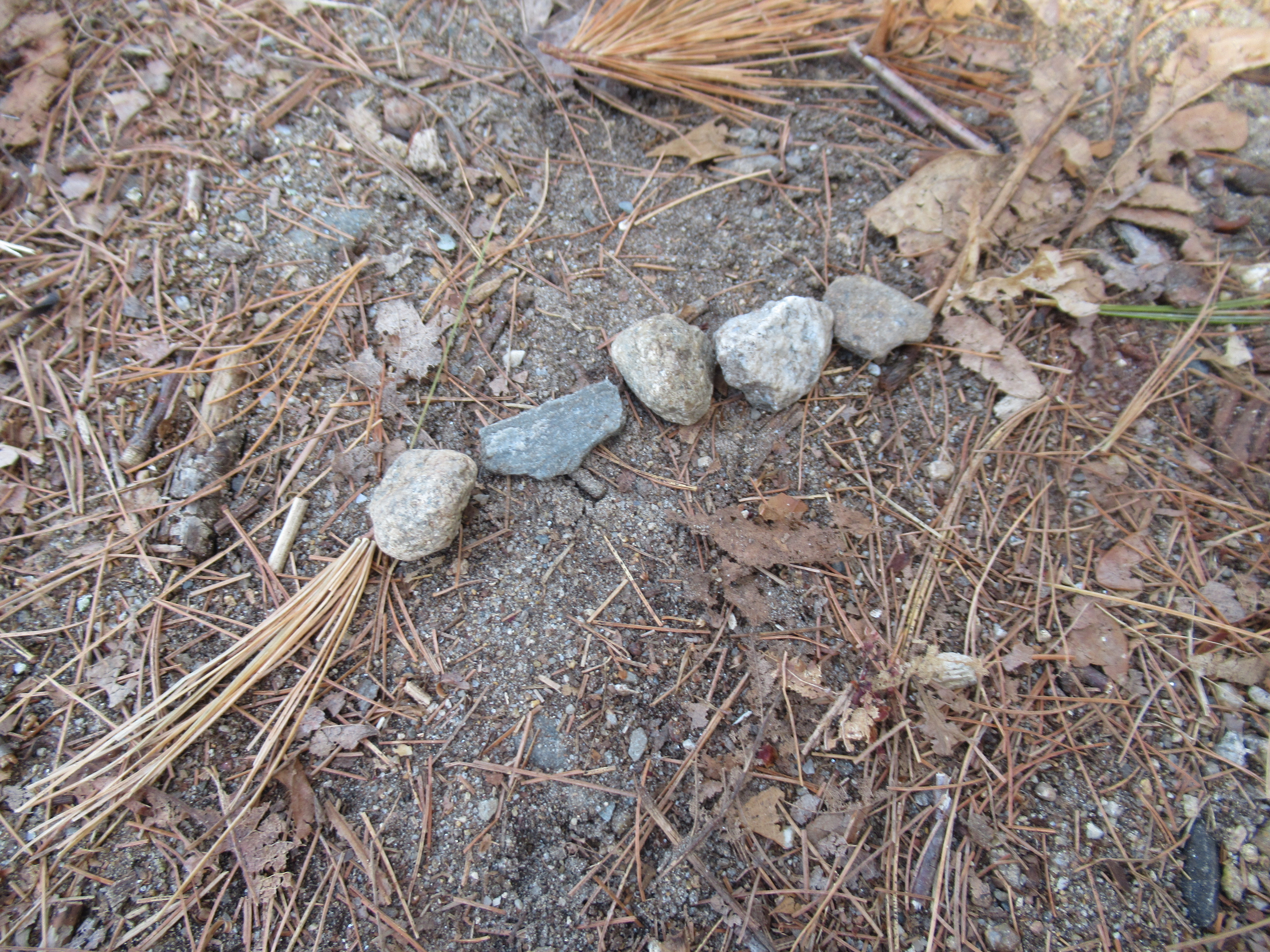
Rocks looked a bit like a cute caterpillar, with a furry tail made from pine needles.

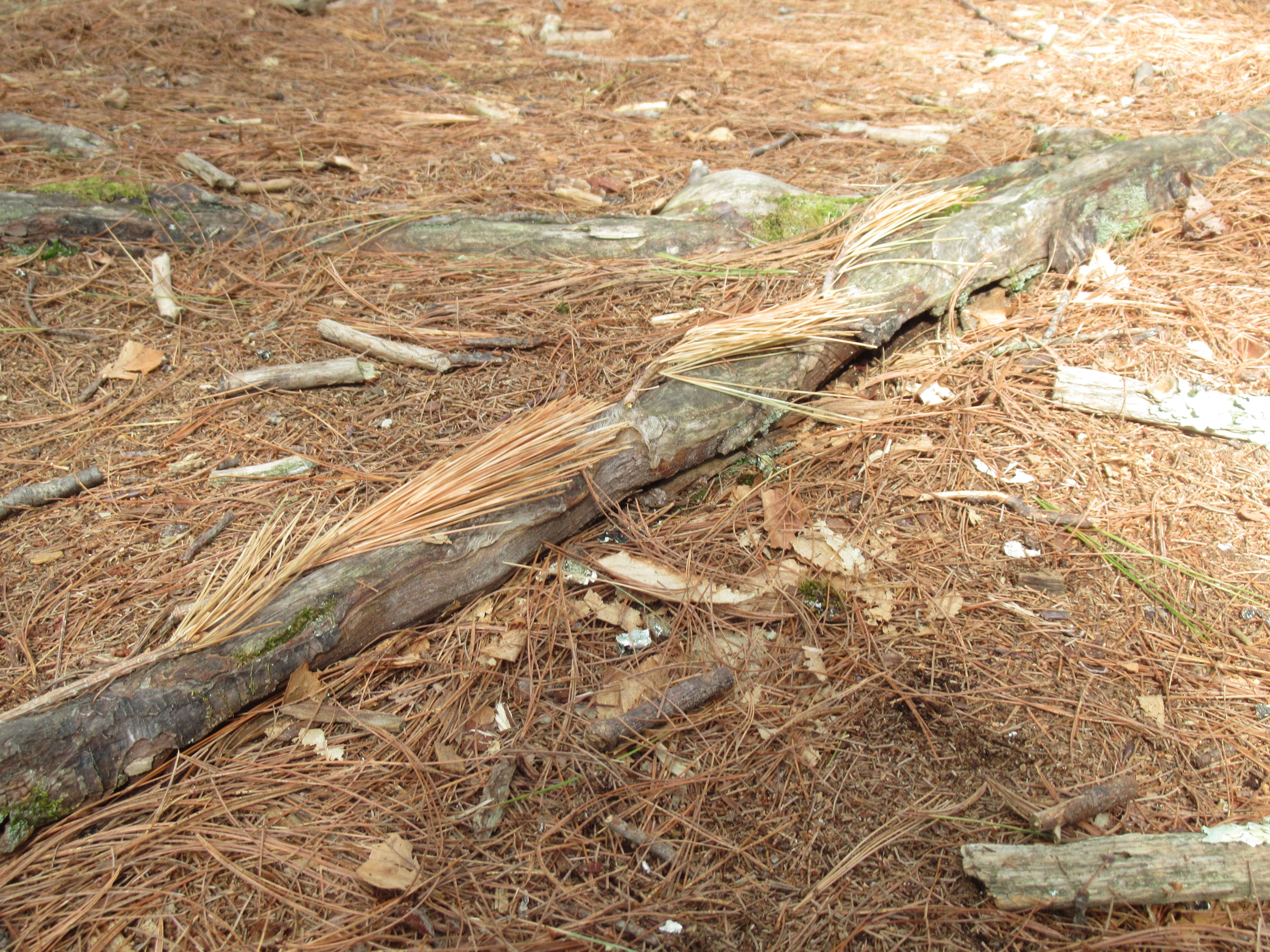
Sometimes, we found elements of nature that already looked like snakes or caterpillars, as with this root. We simply decorated it with some pine needles!

What will your kids use to make earth art this holiday? Please share your in the comments, and happy Earth Day!

Sparkly Spring Tree

Our neighborhood is resplendent right now with the pink trees of spring, dogwoods and magnolias in full bloom. Veronika and I came home from a walk to make our own, thanks to this idea originally spotted at Hands on as We Grow.

First, I drew a brown tree trunk on white paper. Alternatively, you could cut the trunk from brown construction paper and glue down.

Next, Veronika helped tear pieces of pink construction paper to the flower blossoms. You can encourage preschoolers to cut these out with safety scissors, too!

She loved being in charge of the glue for the next step; everywhere she dotted down, we placed a pink “flower”.

We then added a few strands of pink thread for additional flowers.

Of course what’s a spring tree without some glitter? Add a little glue and tap glitter onto it (or in Veronika’s case, dump glitter onto it), then shake off the excess and let dry.

This tree was definitely blooming!

Make a Gift Basket

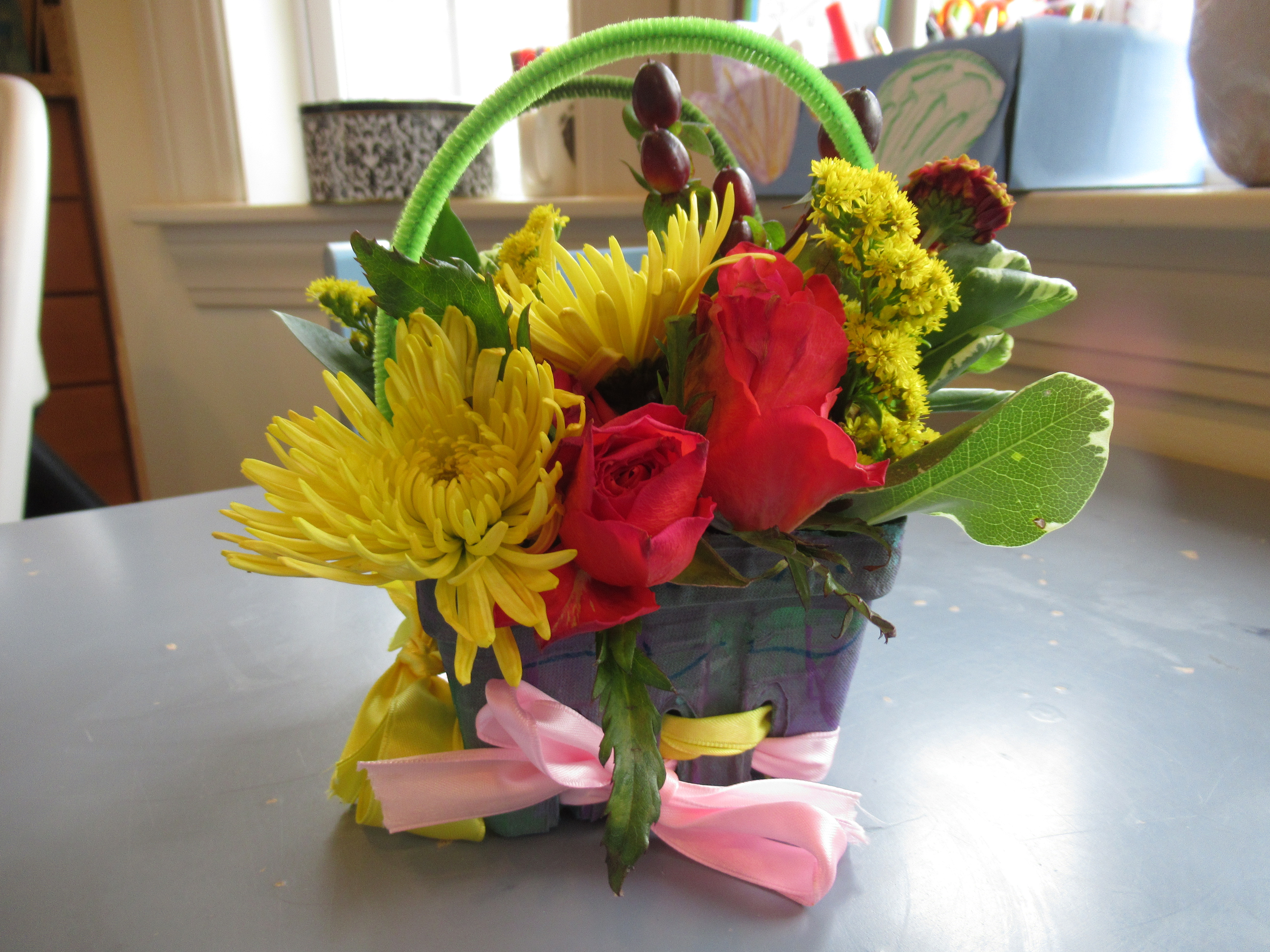
This sweet flower basket makes a beautiful gift to any springtime recipient (hint: Mother’s Day is coming up), and helps elementary school kids hone important fine motor skills, like weaving.

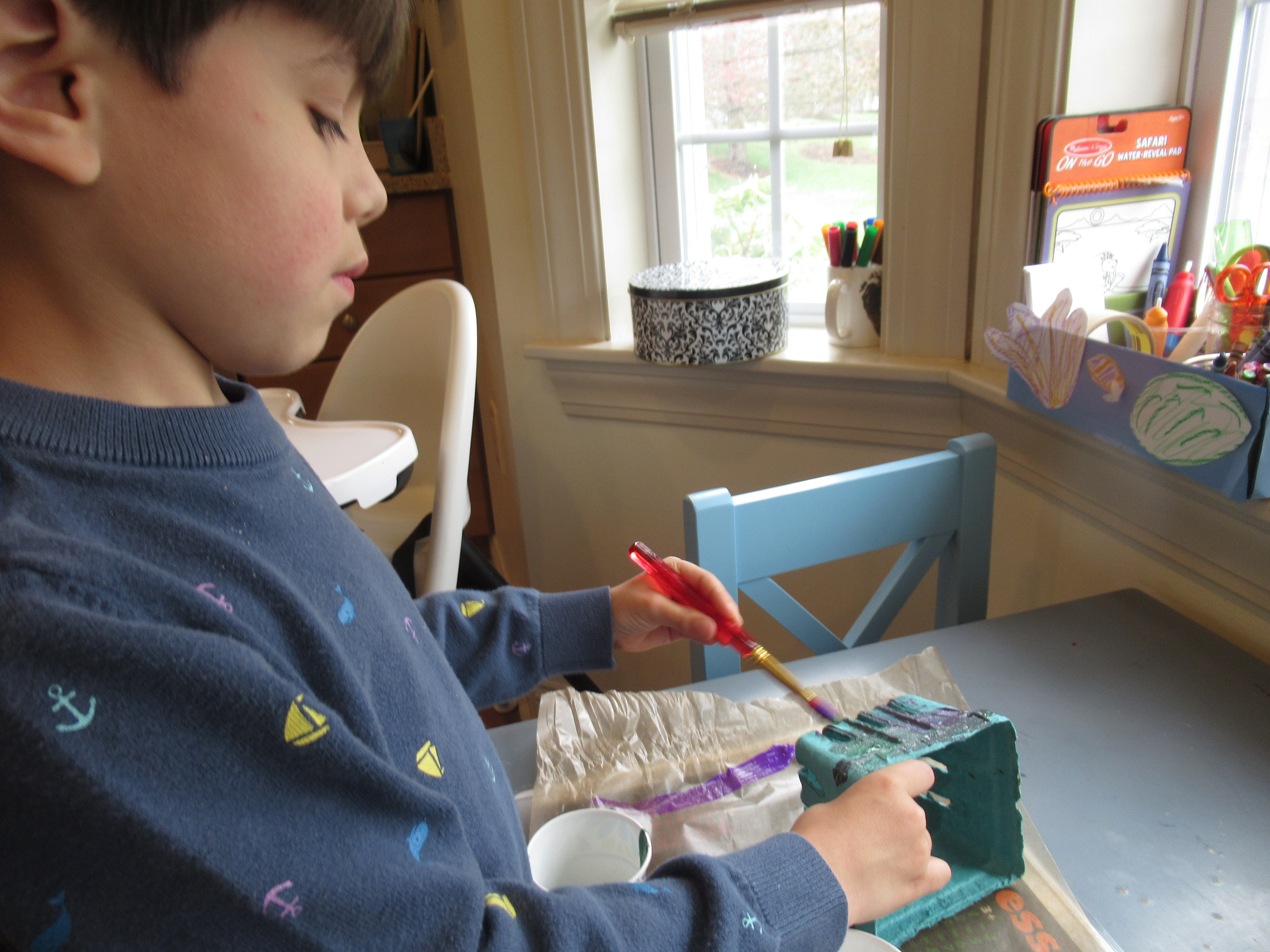
To start, you’ll need a cardboard berry basket, which meant this activity began with a trip to the farm stand to pick out fresh tomatoes and strawberries! After a little snack, the crafting began. Travis chose green and purple paint, which didn’t actually show up that well, but he gave it a proud coating and we left it to dry overnight.

In the morning, he added decorations with marker. Next up was weaving! We used yellow and pink ribbon, and he worked diligently at poking the ribbon through each hole and pulling through.

I helped him tie the end of each ribbon into a bow.

As the final touch, punch holes in the top and loop pipe cleaners through to be the handles.

Fill with a spring bouquet, and give to your lucky recipient!

Decorate a Castle

This might not have been the most intricate castle we’ve ever put together, but a few large boxes are all any child needs to be king or queen of the realm for the day!

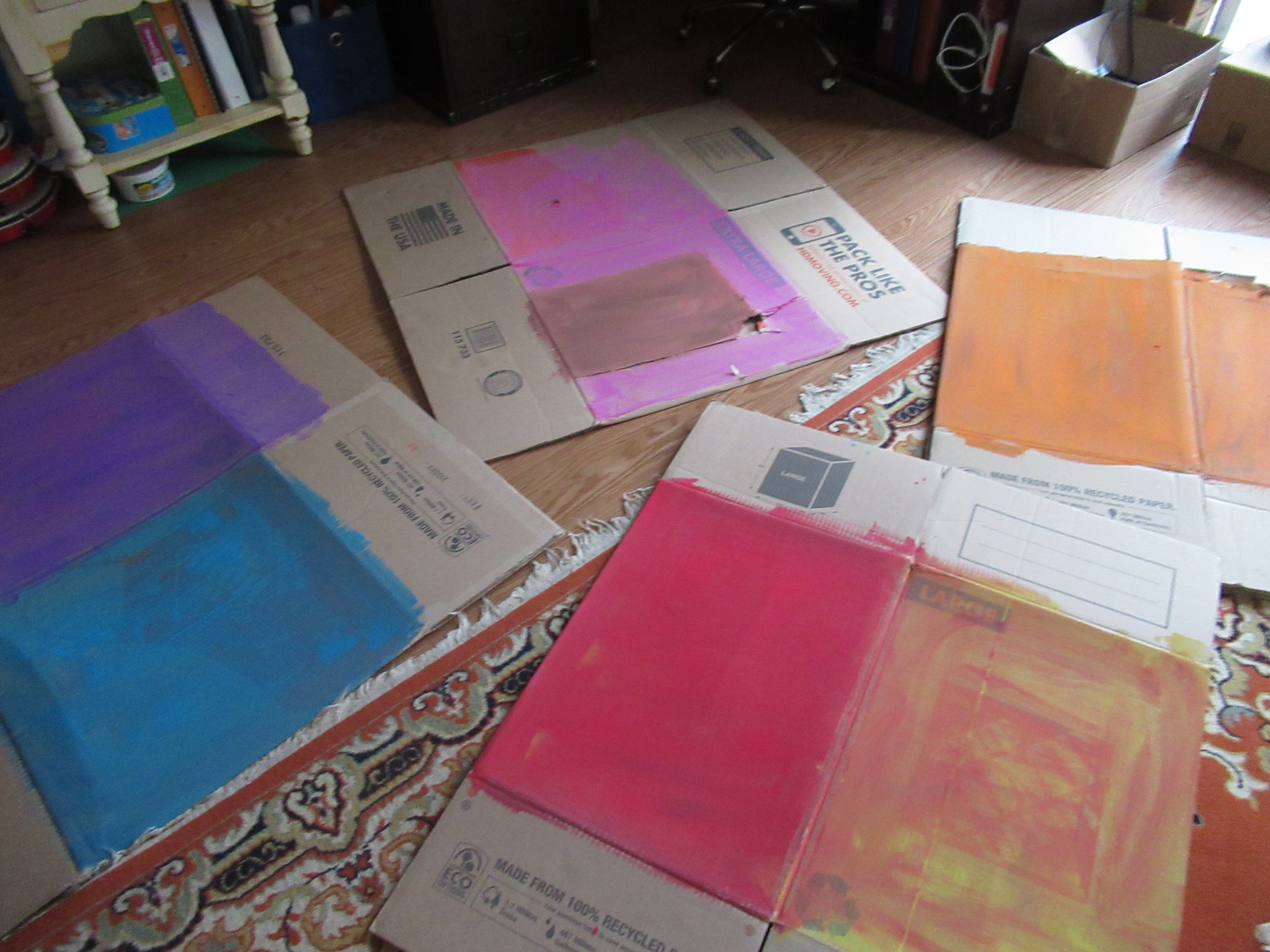
I recommend starting this project the night before, unless you want very impatient kids waiting for paint to dry. We used a big bristle brush to slather the sides of 4 cardboard boxes with paint. Because it was a lot of surface area to cover, this quickly needed to become a multi-colored castle, but the kids loved the result.

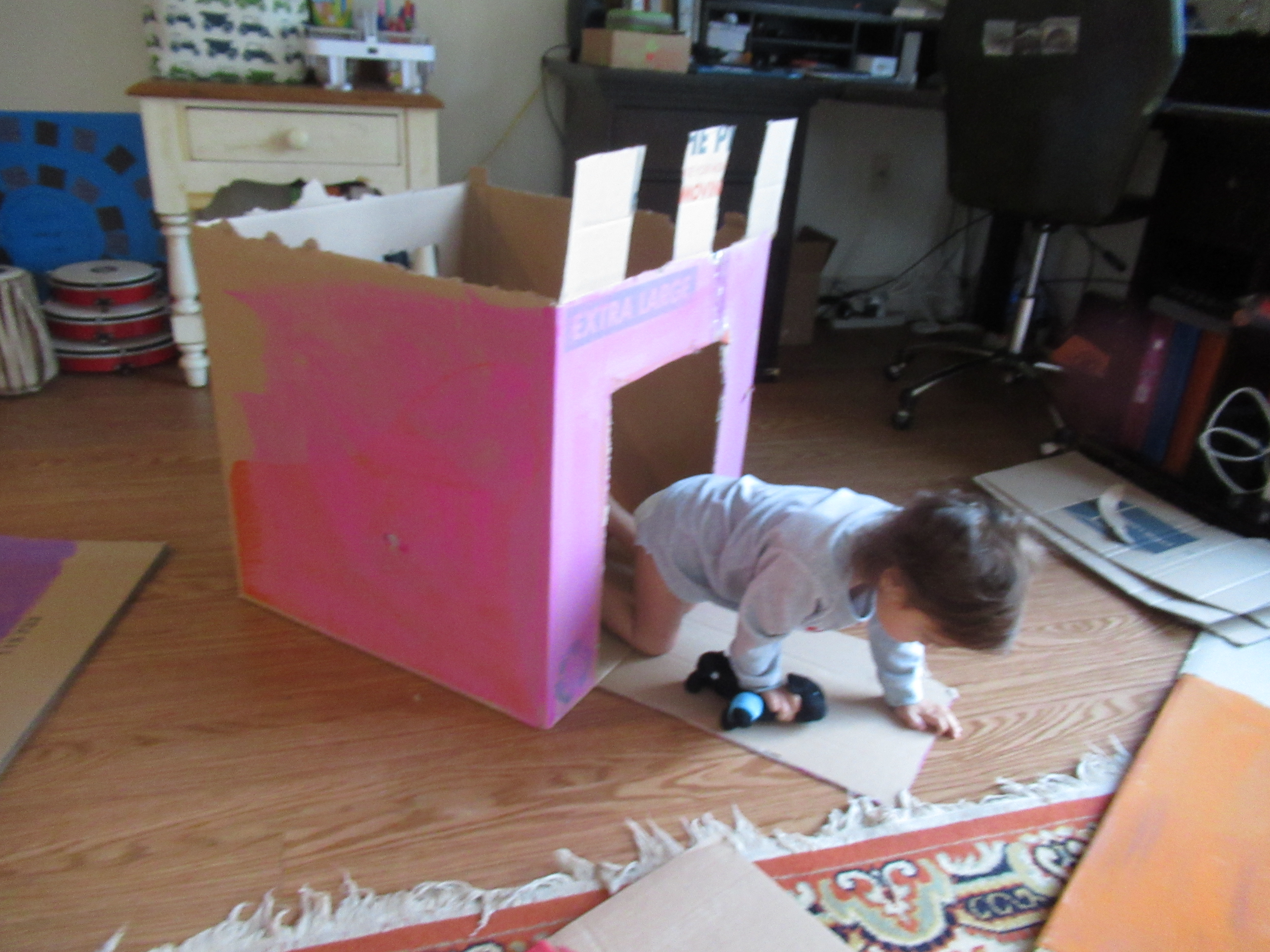
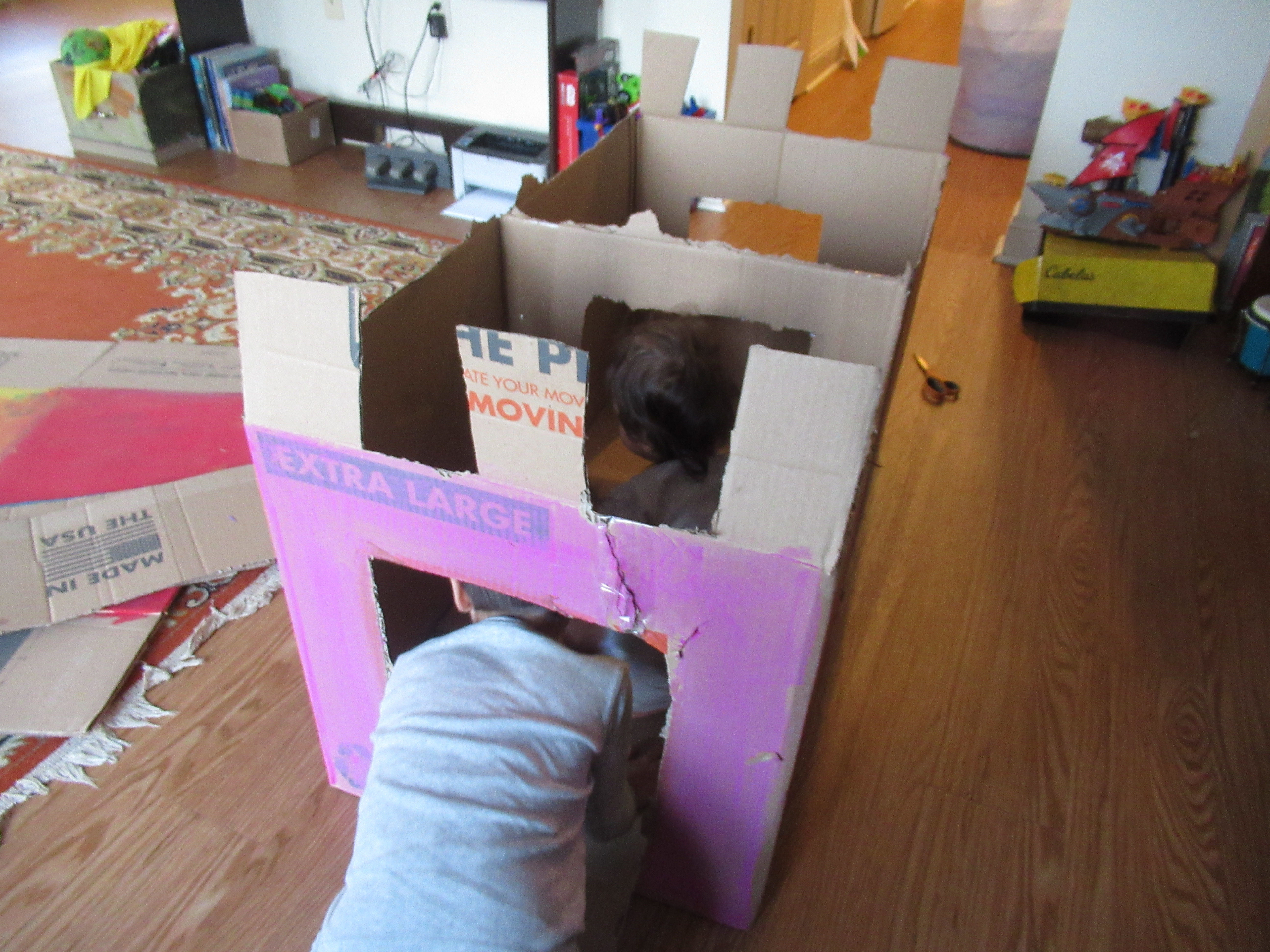
In the morning, it was time to assemble. I cut a few holes in some of the boxes for various purposes; some were small holes to be windows; some were large for Veronika to be able to crawl from box to box; and one was cut out on three sides but still attached at the bottom, to be the drawbridge of course! Be prepared for kids already crawling through and playing while you work. Chances are you won’t be able to keep them away.

You can leave the tops of the boxes straight, or cut out a few crenelations.

To make a working drawbridge, just attach a string or rope to the drawbridge flap that your child can pull on. Now Veronika could safely guard against intruders (like a certain big brother).

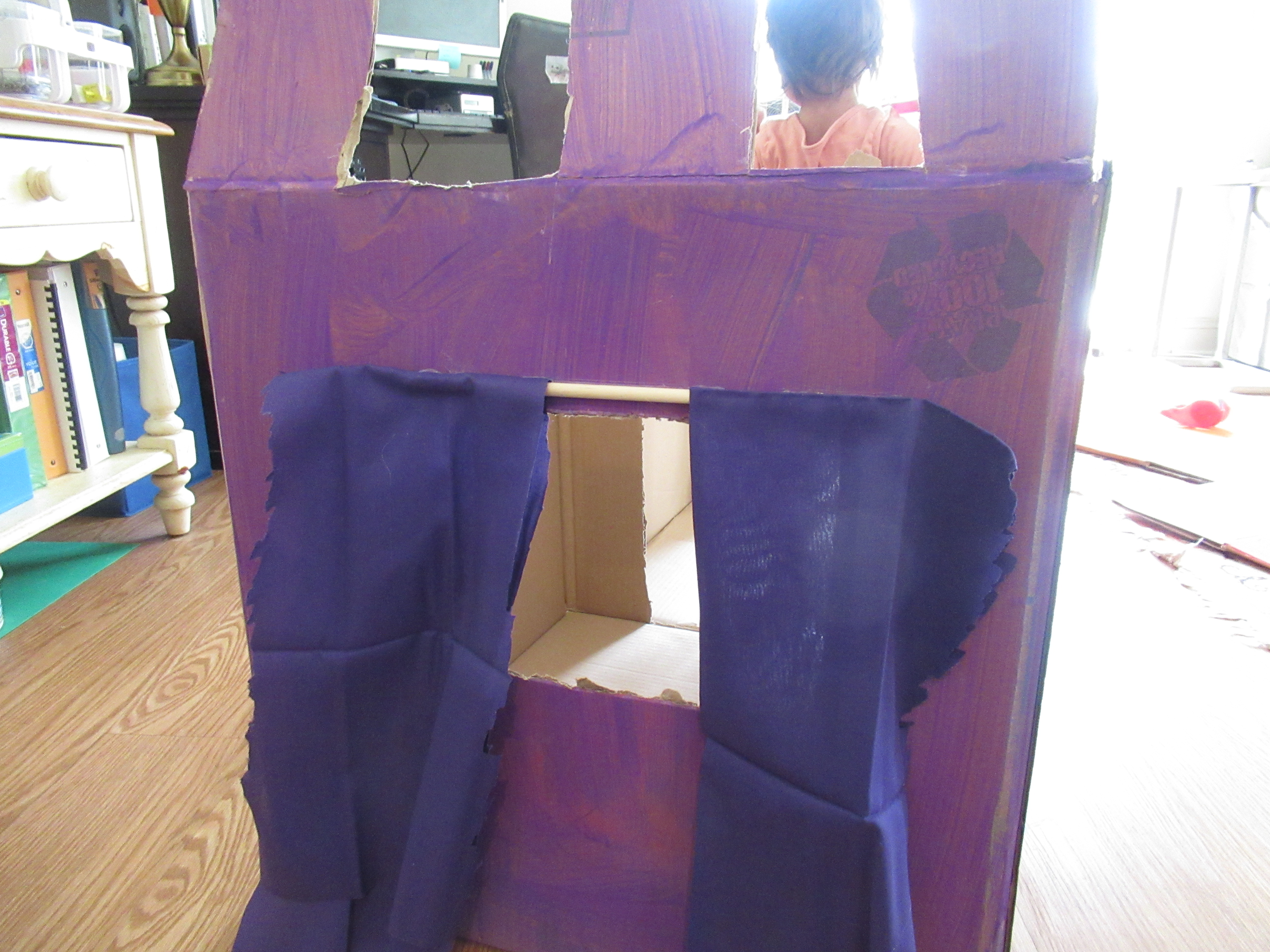
For window curtains, I hot-glued a few fabric scraps to a wooden dowel, then hot-glued the dowel over the smallest cut-out.

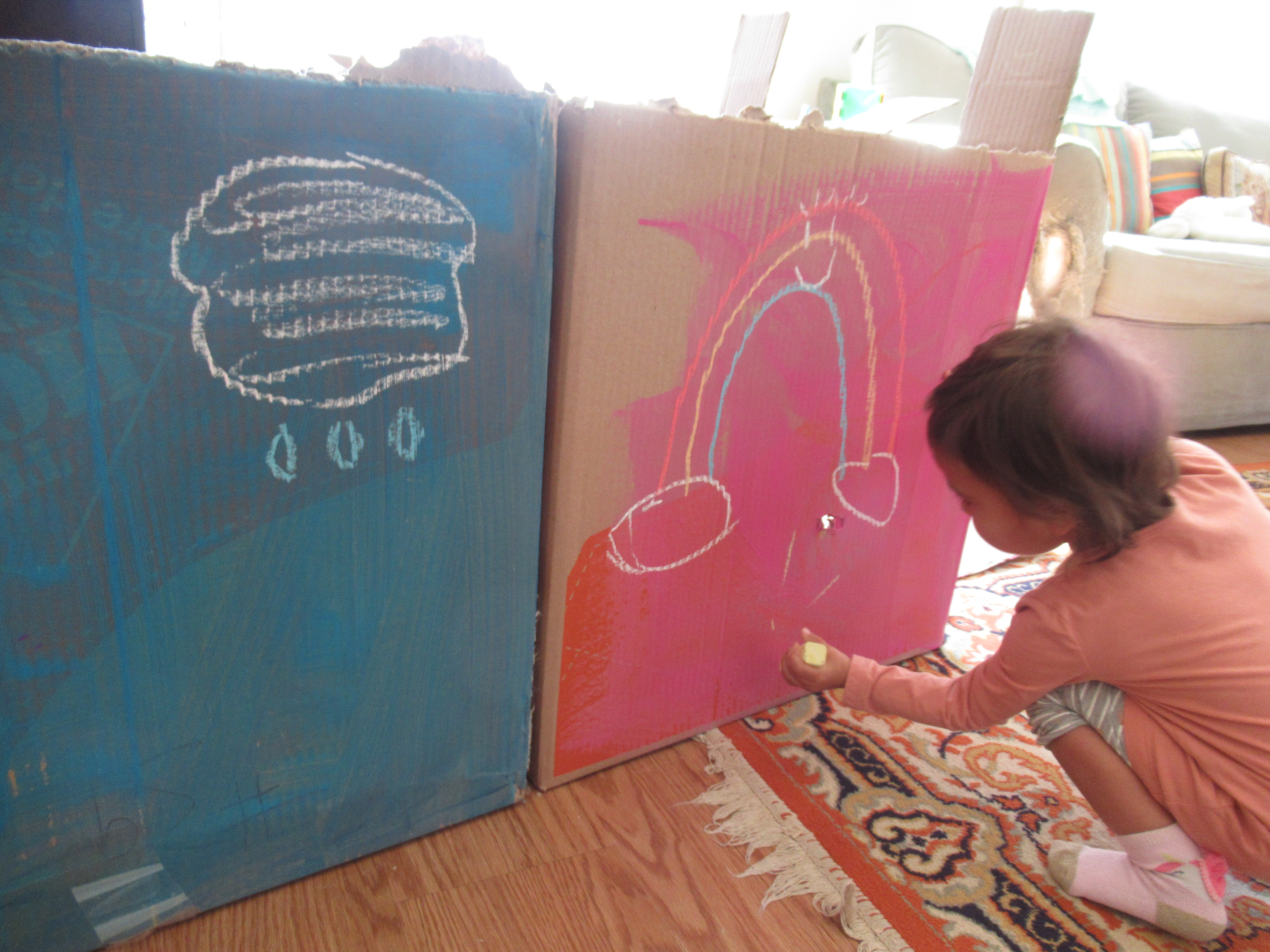
The queen was ready to rule! Having recently discovered that chalk works great for coloring big boxes, this proved to be a much cleaner method for her to decorate than painting. Veronika loved scribbling, and wanted me to add rainbows and sunshine, too.

I loved watching her take charge of the decorations!

I recommend leaving up big creations like this for at least a week, so your child can revisit it, continue to decorate, and play in new ways. What will your child’s castle look like? Please share in the comments!

Colorful Butterflies

We spotted our first butterlfy of spring today, a lovely white one fluttering by! It felt only right to celebrate with a little butterfly craft. This was a riff on coffee filter butterflies, and was great for helping Travis hone some skills from art class this year.

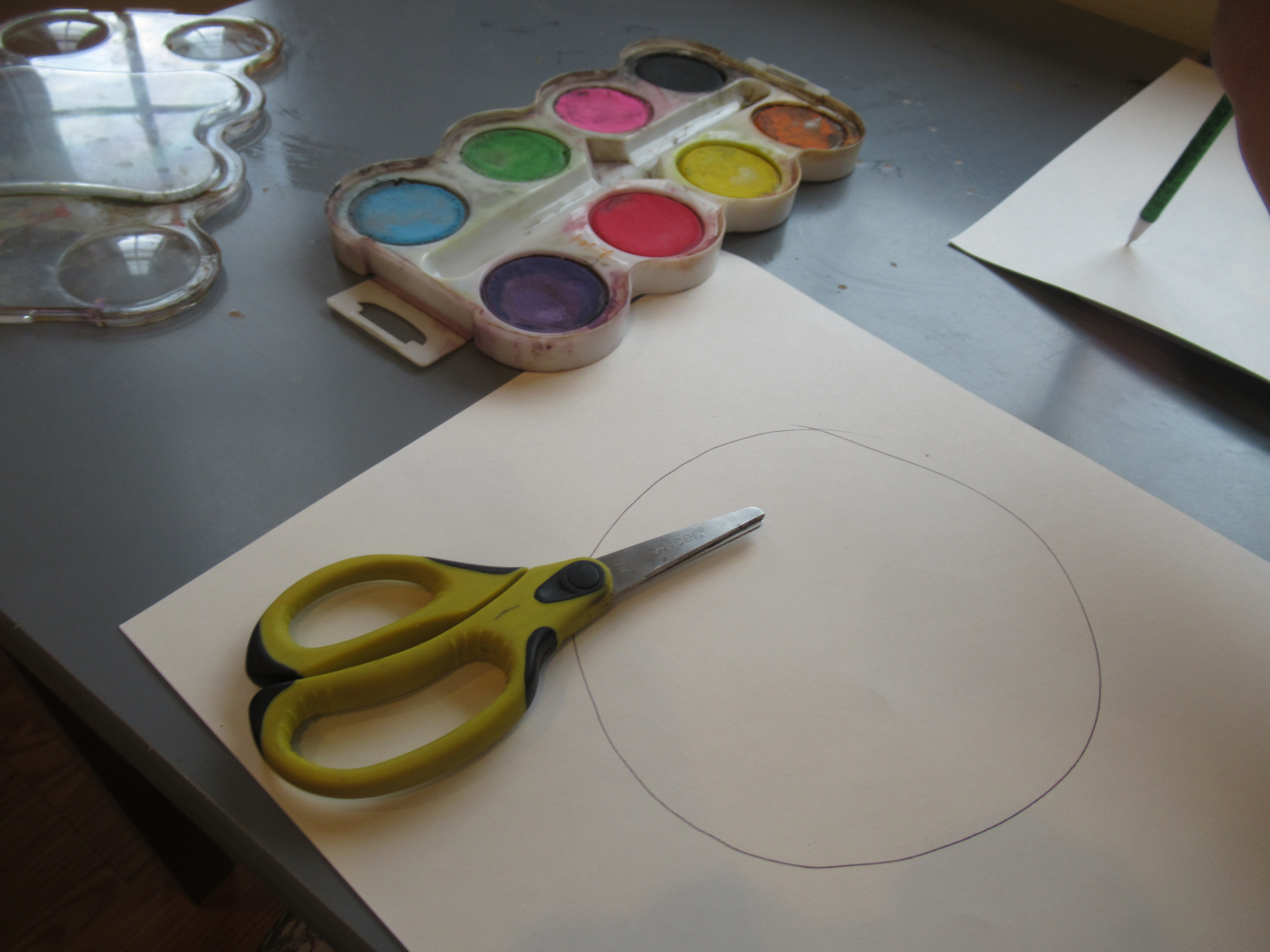
First, I challenged him to cut out an oval. He decided it would be best to draw it first, then cut.

I made a few additional ovals so everyone could paint one with watercolor.

Little sister included!

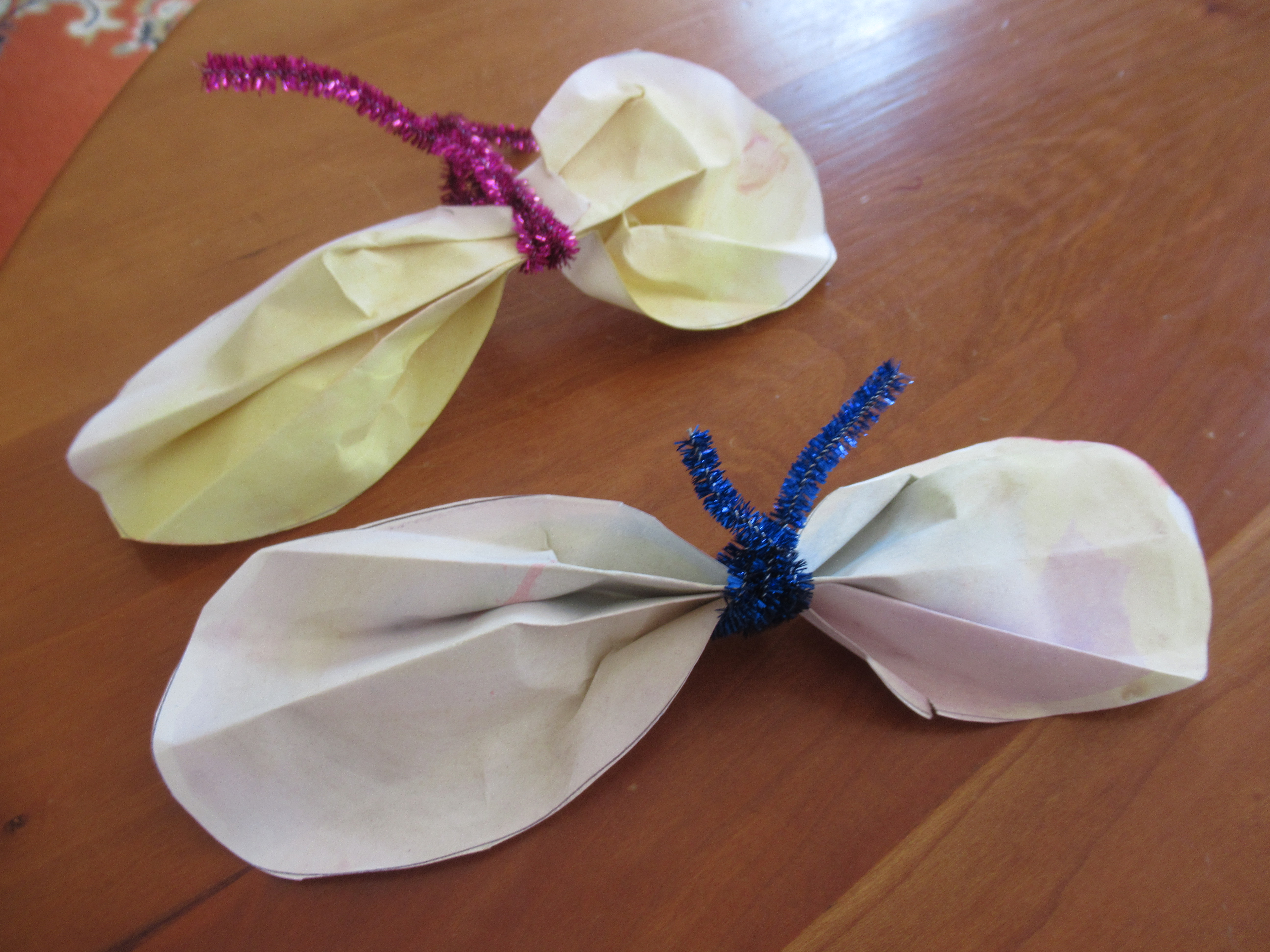
Once the butterflies were dry, I showed Travis how to fold them accordion-style, back and forth until pleated.

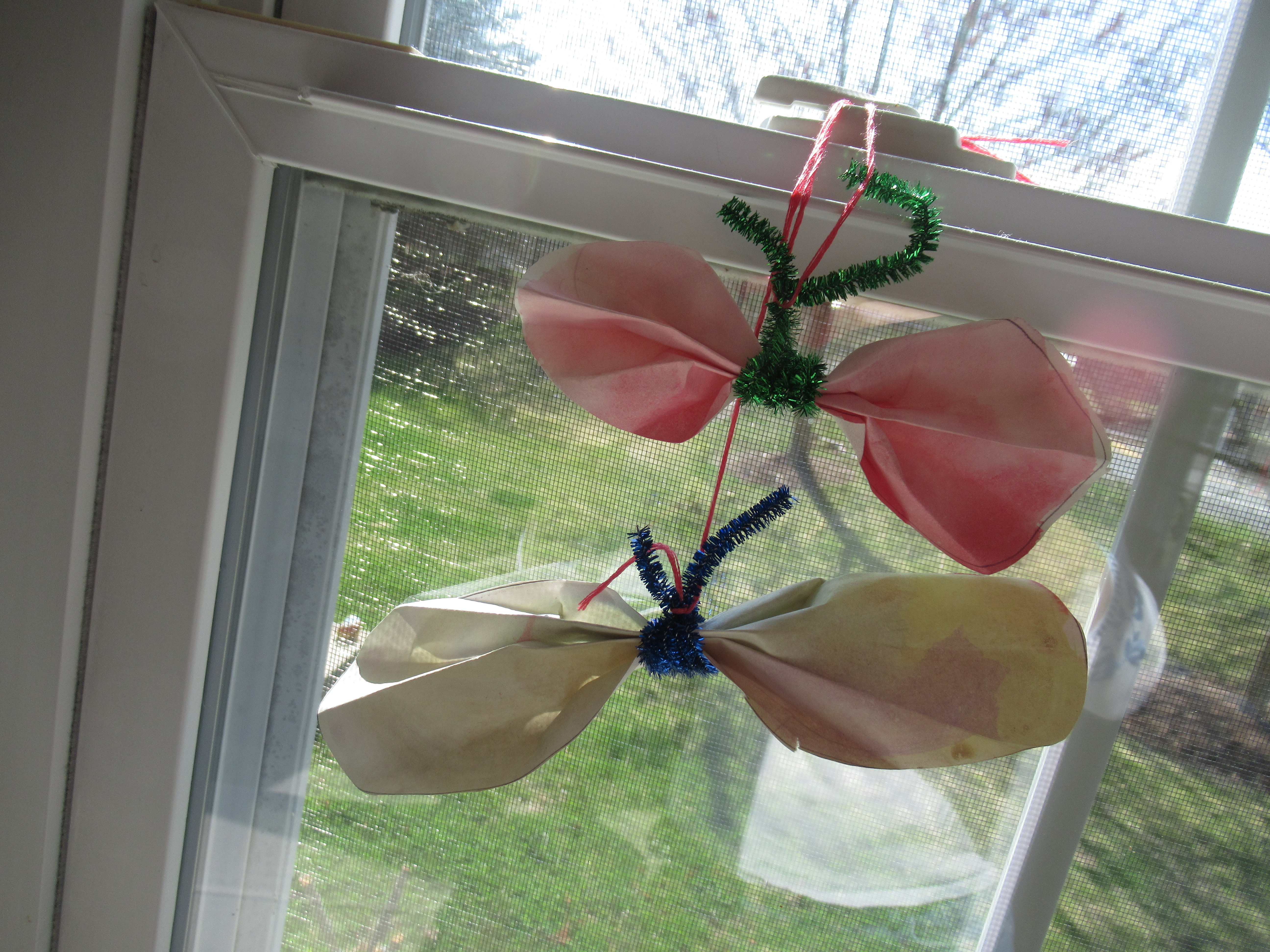
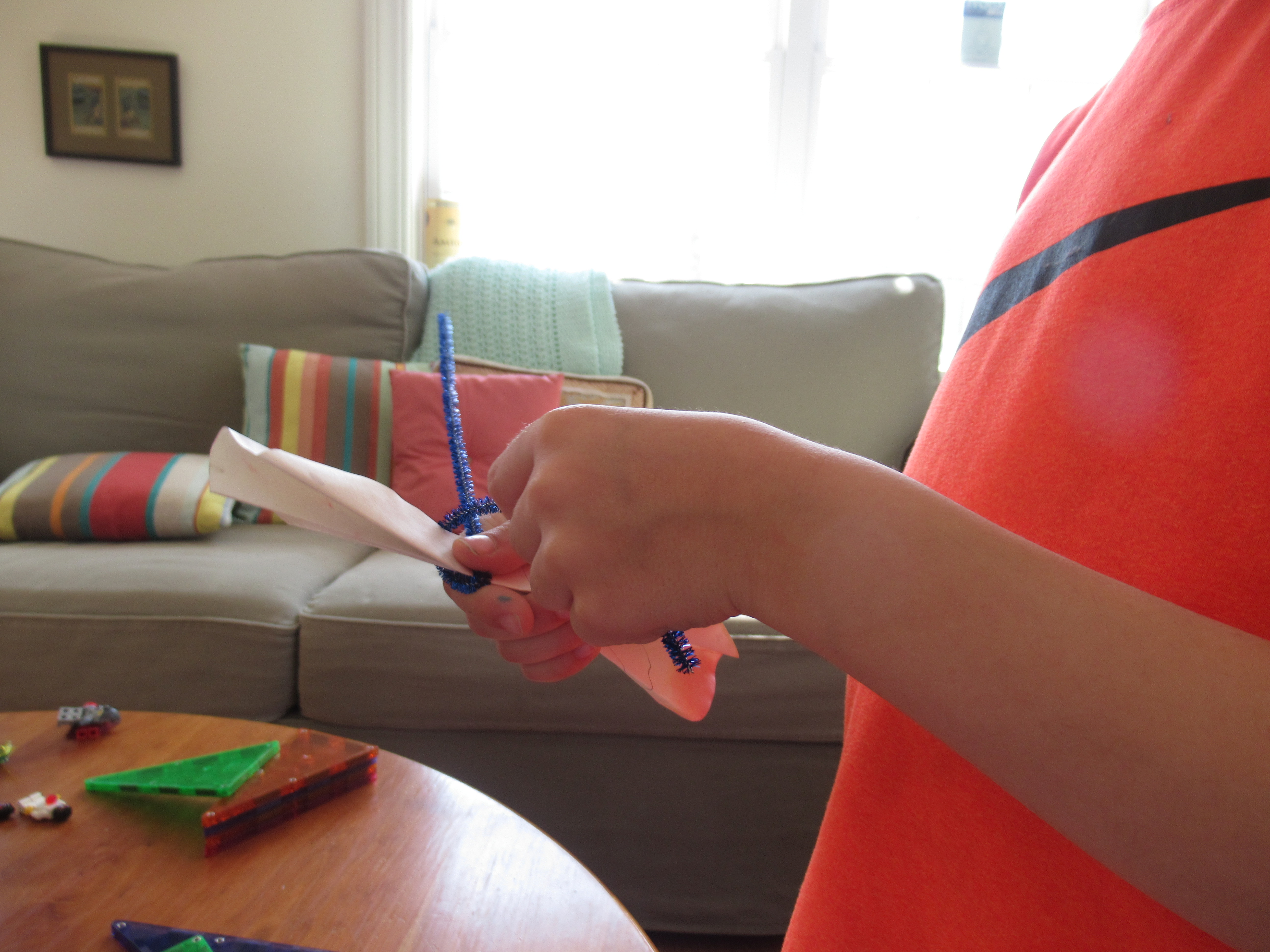
Finally, we wrapped shiny pipe cleaners around the middle of each one as the bodies, leaving the tips sticking up for two antennae on each.

Fan out the wings, then add string or ribbon and let your butterflies flutter in a pretty window. Fun fact: tell your child that a group of butterflies is actually called a flutter, and see if they can guess why!

Q-Tip Painting, 4 Ways

Whenever Veronika spots q-tips in the bathroom, she’s eager to play with them. So today we gave into that urge, and used the cotton swabs for arts & crafts instead! Below are four different methods that she and I tested out.

One: Negative Images

For the first craft, you can use any glass pie plate (or baking dish or loaf pan) as the “canvas”. I spread a little tempera paint thinly in the bottom, then handed Veronika a q-tip as her brush. Any lines that your child makes leave a negative image or etching behind.

The idea was a bit advanced for Veronika, but after she’d done some scribbling, she loved seeing the deliberate images I drew for her, like a sun or puppy.

We even tried making a print of it by pressing down a piece of white paper, although it ended up looking more like abstract art.

Two: Color mixing

Cotton swabs are just right for mixing up colors, giving a chance to teach a little about primary and secondary colors! I poured a little of each primary color (red, yellow, and blue) onto a paper plate, and first showed them to Veronika as we named each.

One at a time, we mixed them! Our red and yellow made orange, yellow and blue made green, and blue and red made purple. Now we had a full palette for…

Three: Pointillism

The tip of a cotton swab is naturally suited for making dots (although Veronika practiced making a few swirls, too), which is a great introduction to the pointillist style of painting.
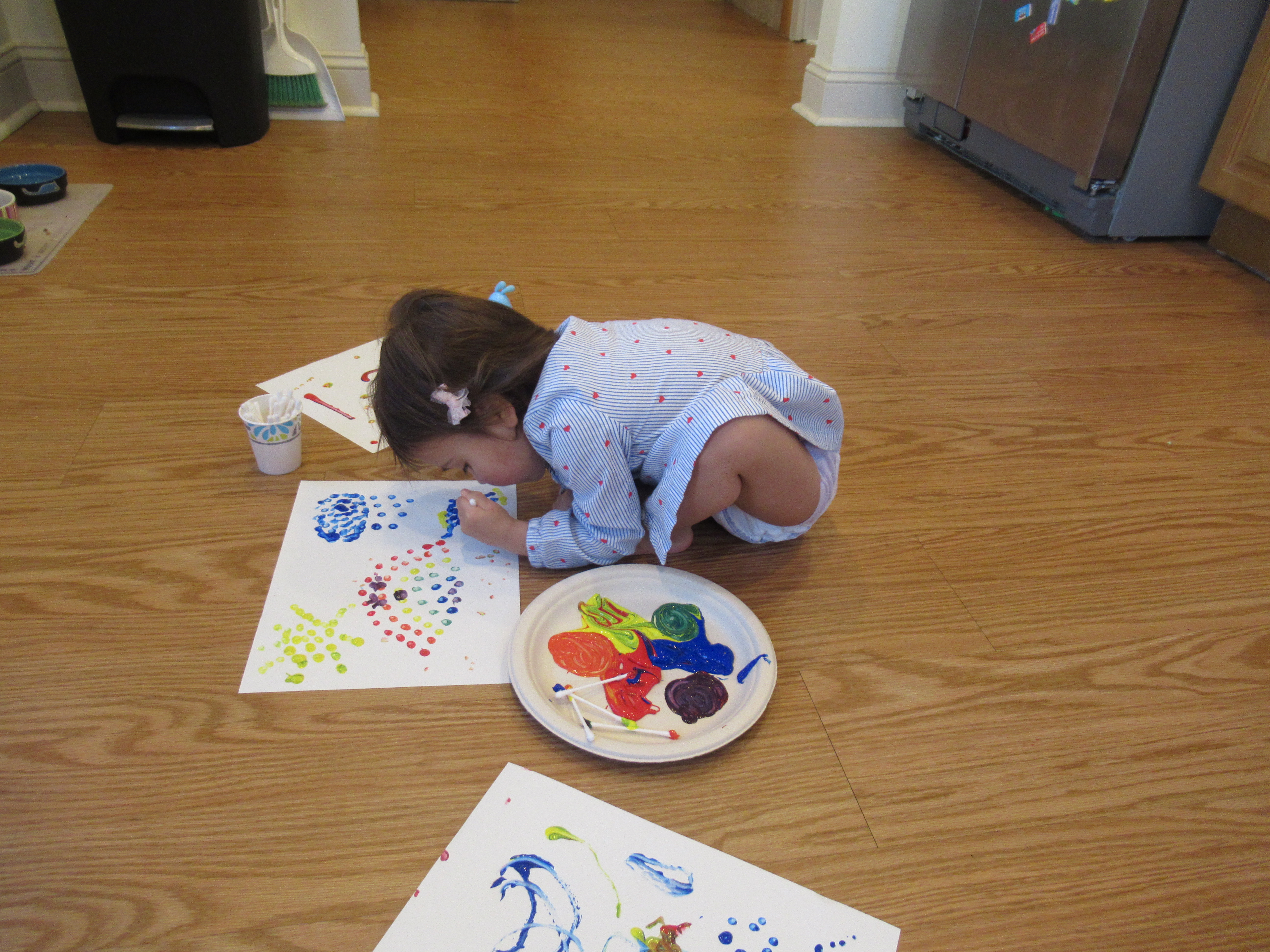
I dotted right alongside her, so pretty soon we had a pointillism rainbow and sun and clouds, with a little blue puppy beneath. Veronika loved adding to the picture I started, making very emphatic dots. My little artist at work!

Four: Counting

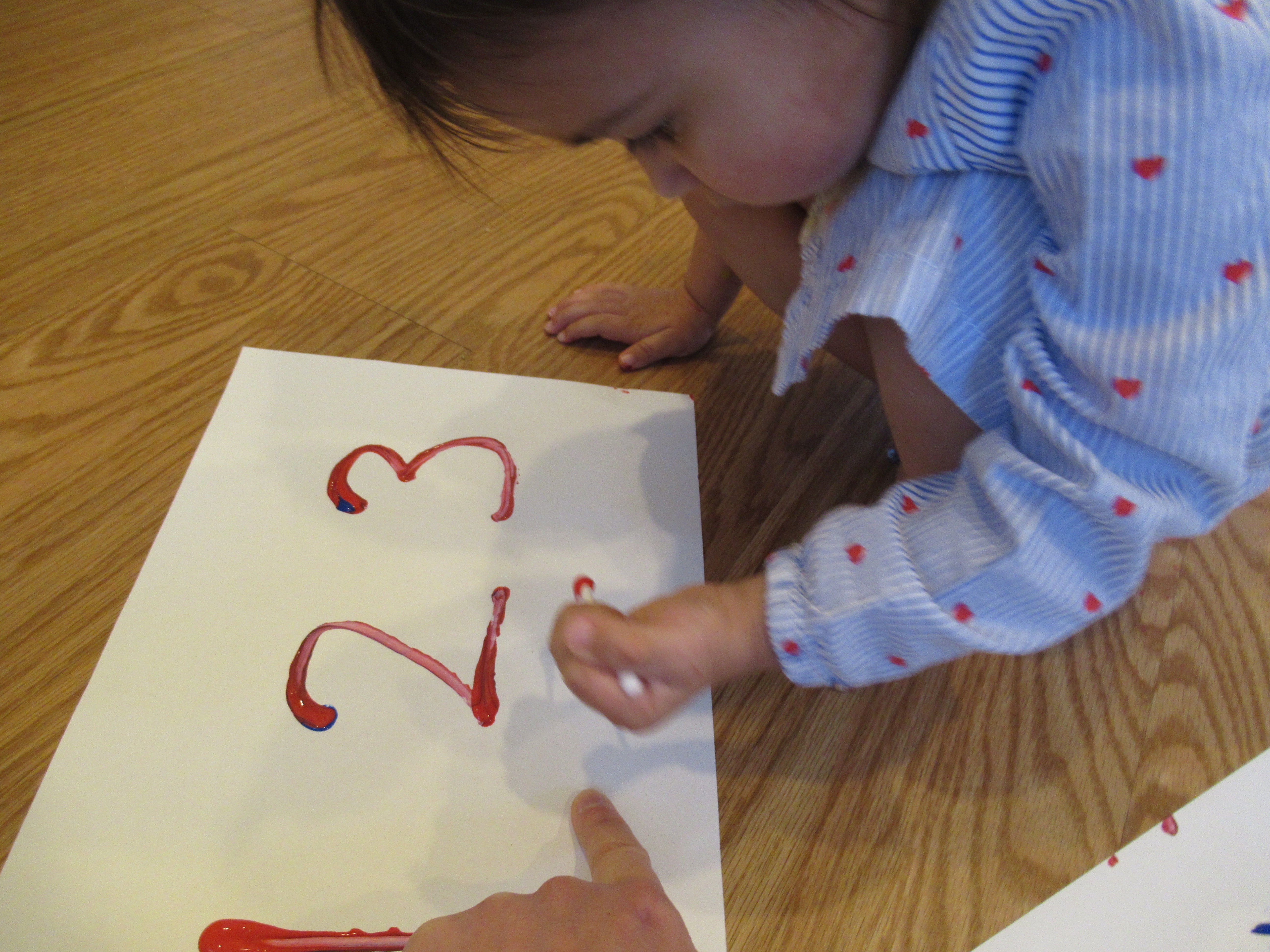
For our final q-tip activity, I wrote out the digits 1, 2, and 3 for Veronika. After encouraging her to name each number, I asked her to make the correct number of dots with her q-tip underneath. “Can you make 1 dot?” I asked her. Dot!

She was also able to do this for number 2. By 3, she just started dotting everywhere. But of course preschoolers can tackle this task all the way up to 10, or higher! For an even greater challenge, stamp out a connect-the-dots with the q-tips, then number them and have your child connect the lines.
Which of these q-tip activities does your child like best? Please share in the comments. Many thanks to Hands on As We Grow for all these q-tip ideas!

Eraser Stamped Sheep

We recently re-read a favorite picture book, The Dot, by Peter H. Reynolds, which had us thinking about other ways to make art from just dots. This sweet craft is easy enough for toddlers to follow along, and felt just right for springtime and baby lamb season!

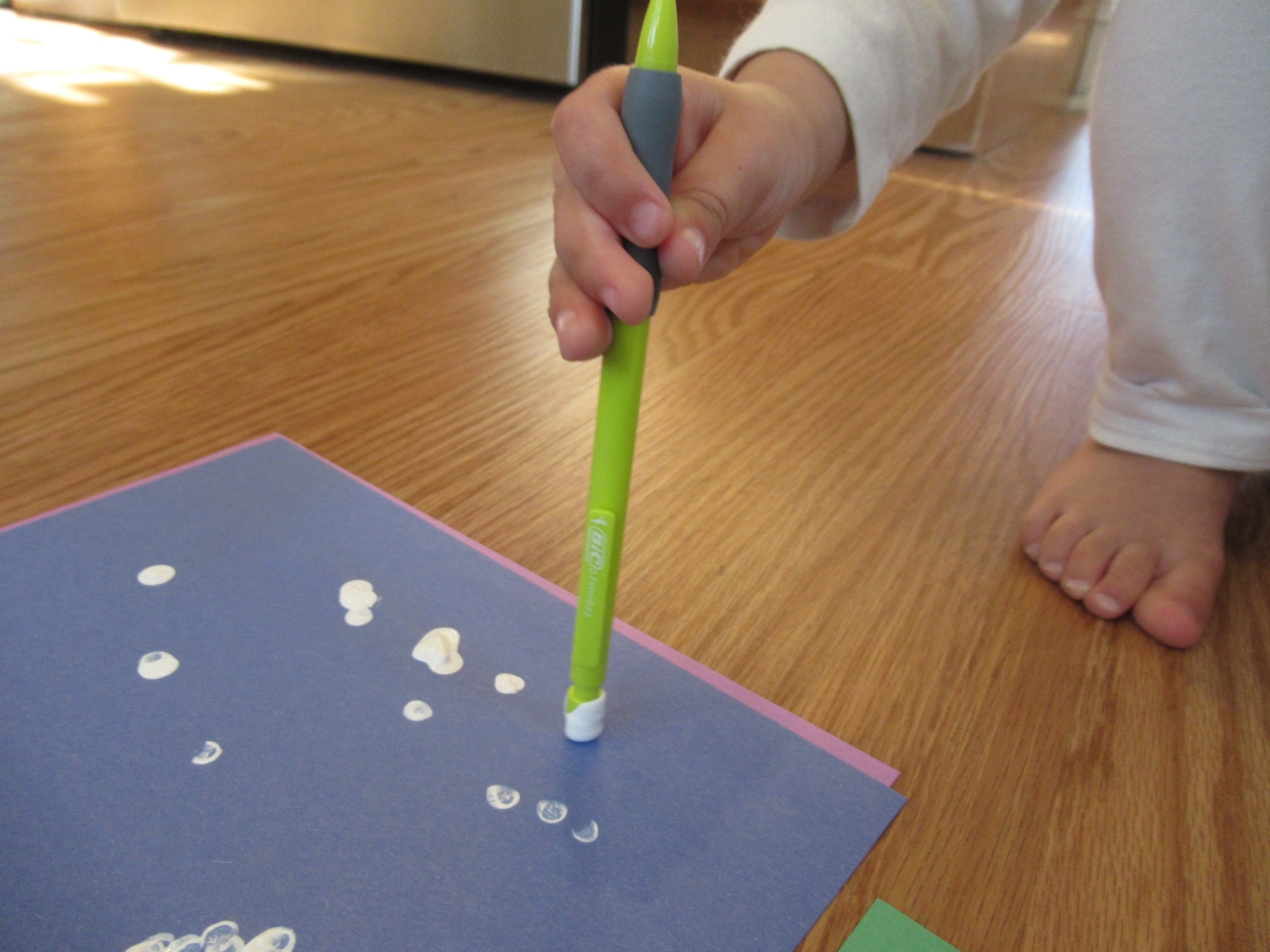
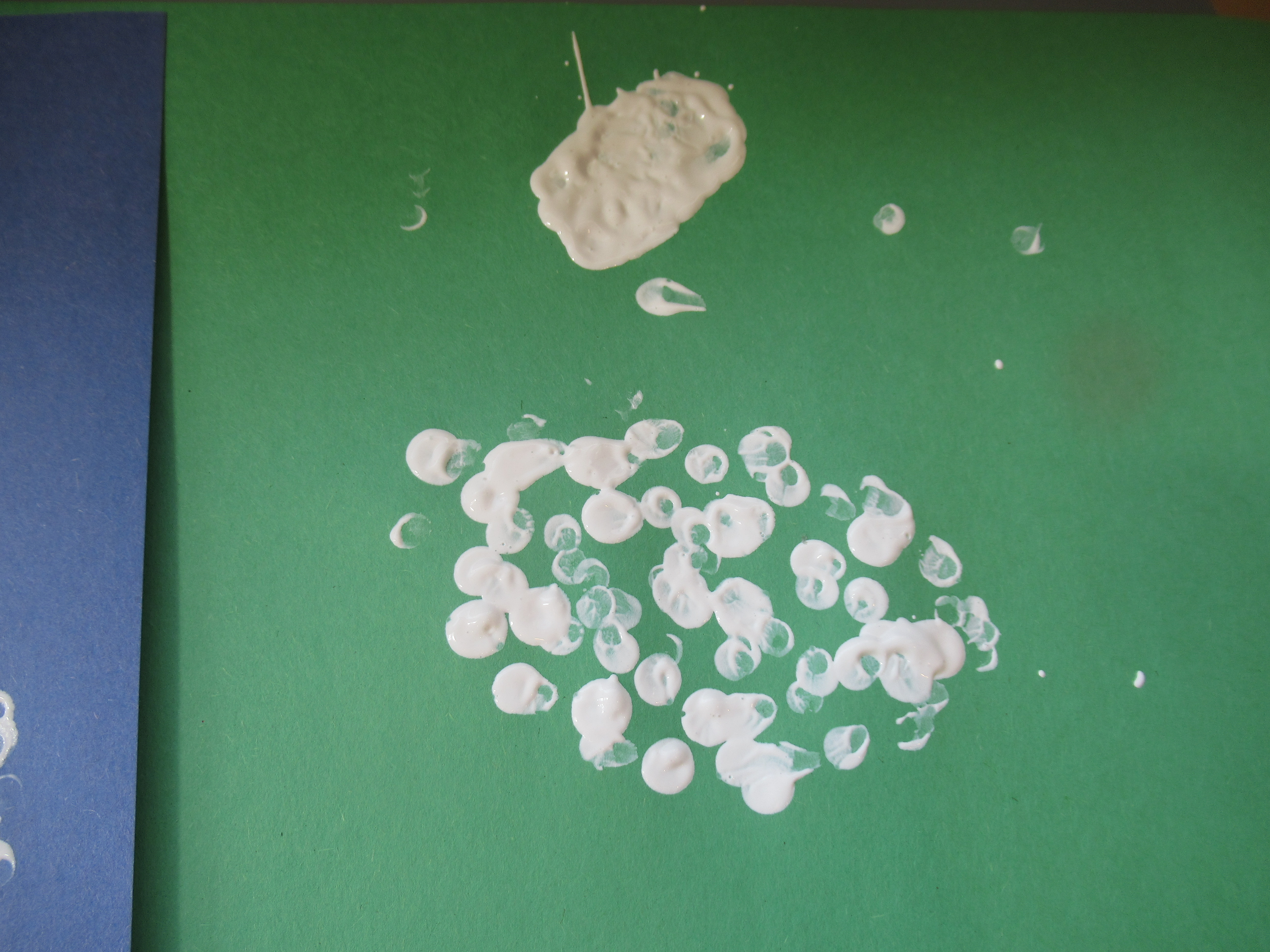
To start, I set out a plate of white paint, along with a few sheets of construction paper and pencils. I handed Veronika one of the pencils and showed her how to dip just the eraser end in the paint, then dot on the paper.

White dots!

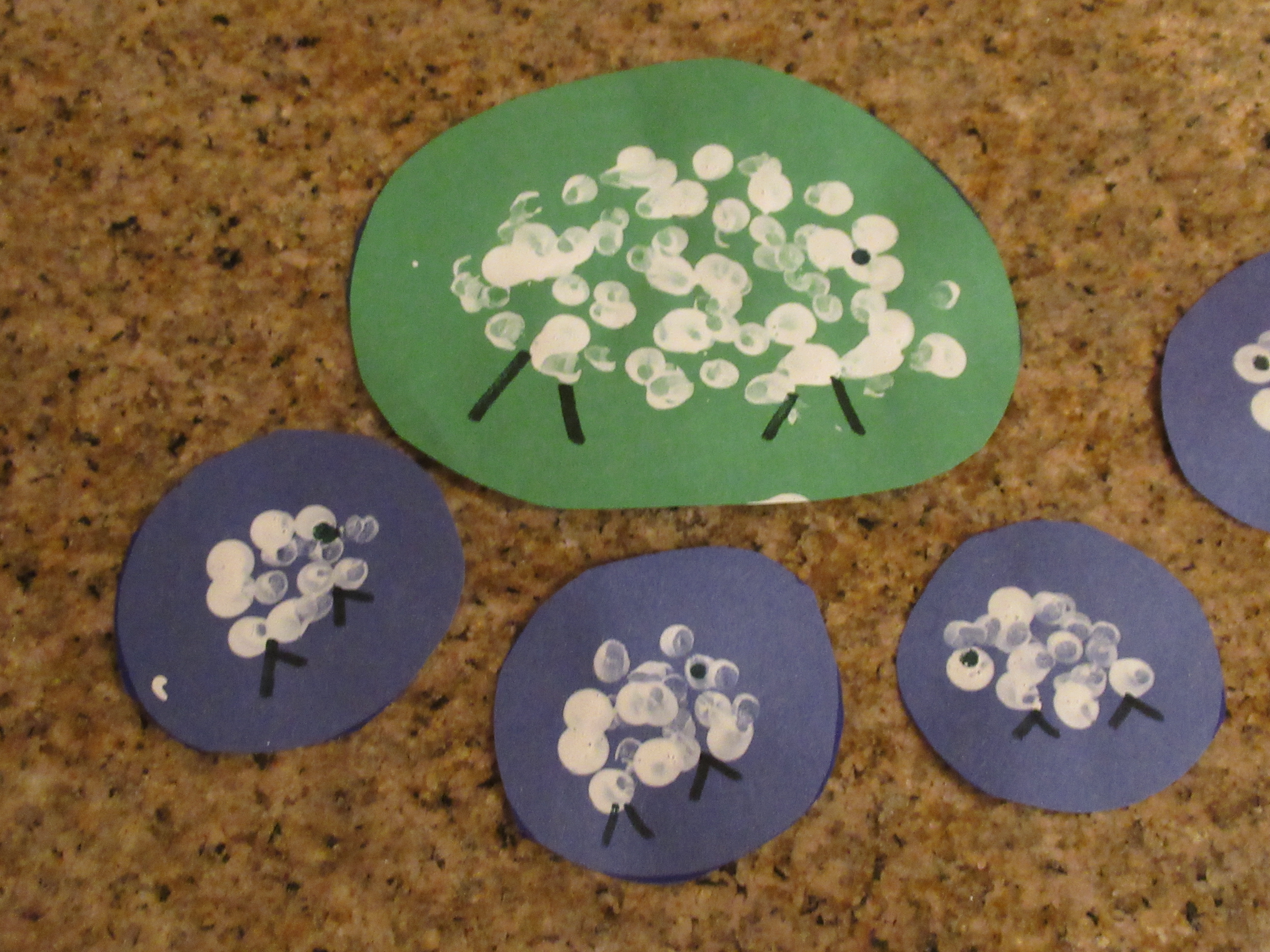
Veronika had fun simply experimenting at first, but then I showed her that if she clustered a few of those white dots together, it began to look like a woolly sheep. She loved seeing the little animals take form.

Of course she couldn’t control her dots exactly, which I wouldn’t have expected from a two year old. Anywhere that gaps needed filling, I added a few extra dots to make the sheep. That meant sometimes we had big mommy sheep, and sometimes baby lambs.

Once the glue dries, just add an eye and four legs for each sheep with black marker.

We loved the ways these looked once we cut them out in individual circles, resulting in a whole little flock.

Toddler Mural

Veronika loves to scribble and draw, and always narrates to me what her scribbles and lines mean, everything from “balloons” to “rainbows” to “dogs”. I keep a small notebook in my purse to pull out at restaurants or waiting rooms and she instantly begins her doodles. Today we made a giant version of that for her to use at home!
I taped a large sheet of craft paper to an empty space on the wall at a height she could easily reach. Already she was intrigued.

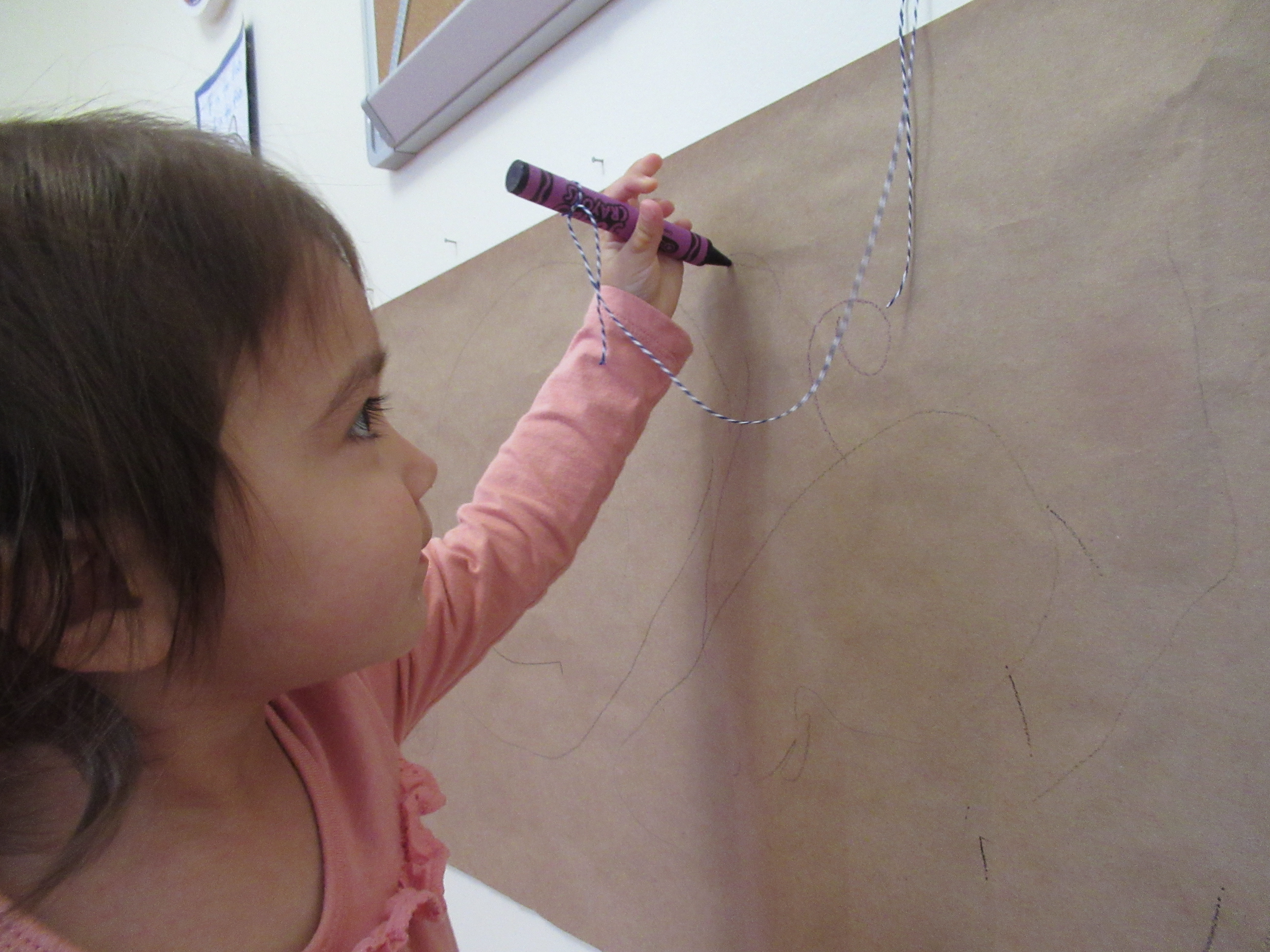
You can simply set out crayons next to the paper, but for extra enticement, I attached some above the mural.

Simply hammer a few nails into the wall, then tie a string from each and secure the other end around a jumbo crayon. “They’re dangling!” Veronika said with excitement. Not only did she immediately grab one of these dangling crayons to draw, she told me she was drawing the dangling crayon.

Needless to say, she paused to scribble on the paper every time she walked by it all day, even if just for a quick line. Other times she stopped and stayed busy for a while. “Up and down, up and down!” I caught her saying for this particular bit of abstract art:

When the paper fills up, simply swap it out for a new piece!

Easter Egg Necklace

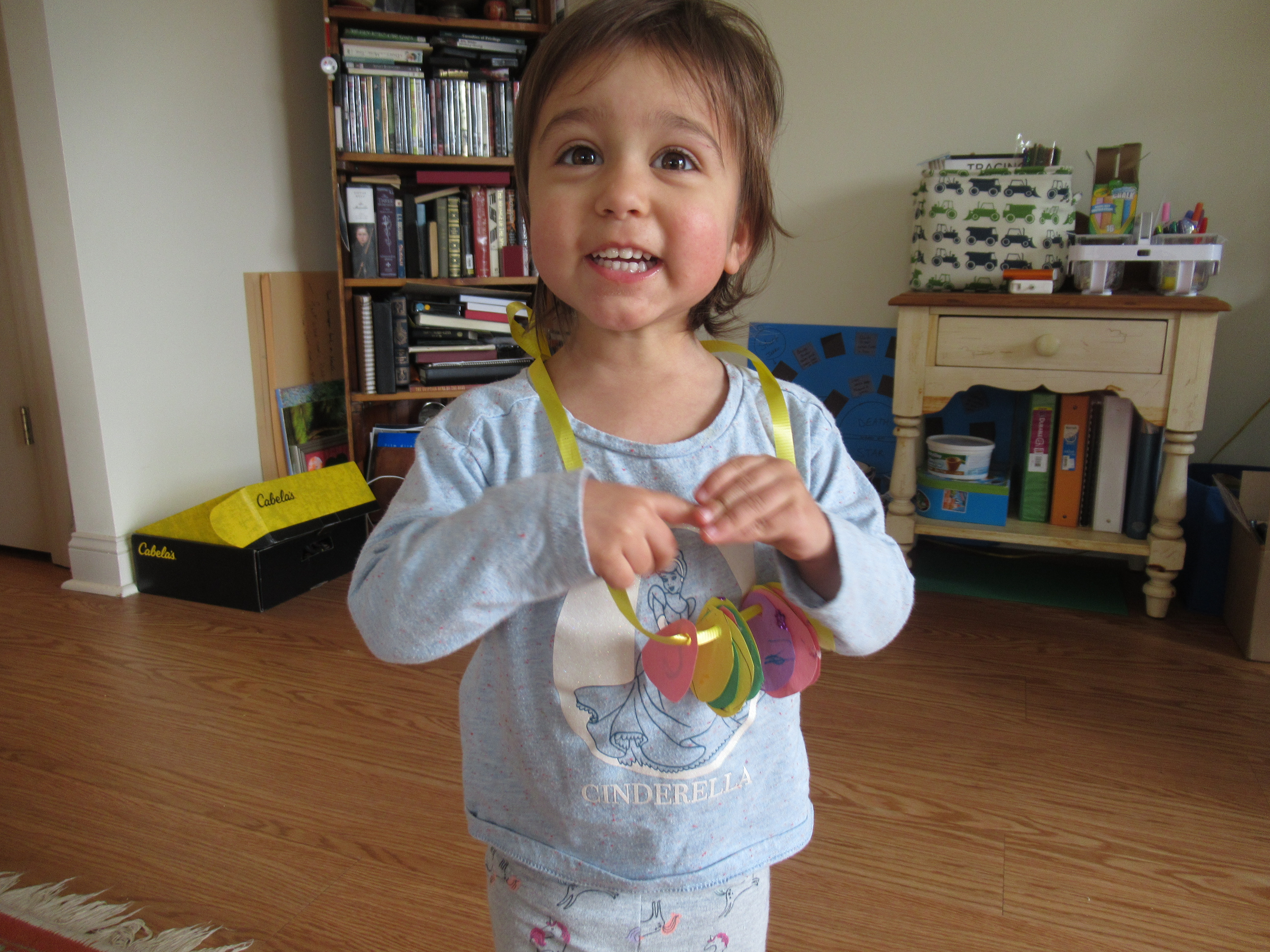
Veronika loves accessorizing, so we made this pretty little necklace for her to wear to Easter brunch this weekend!

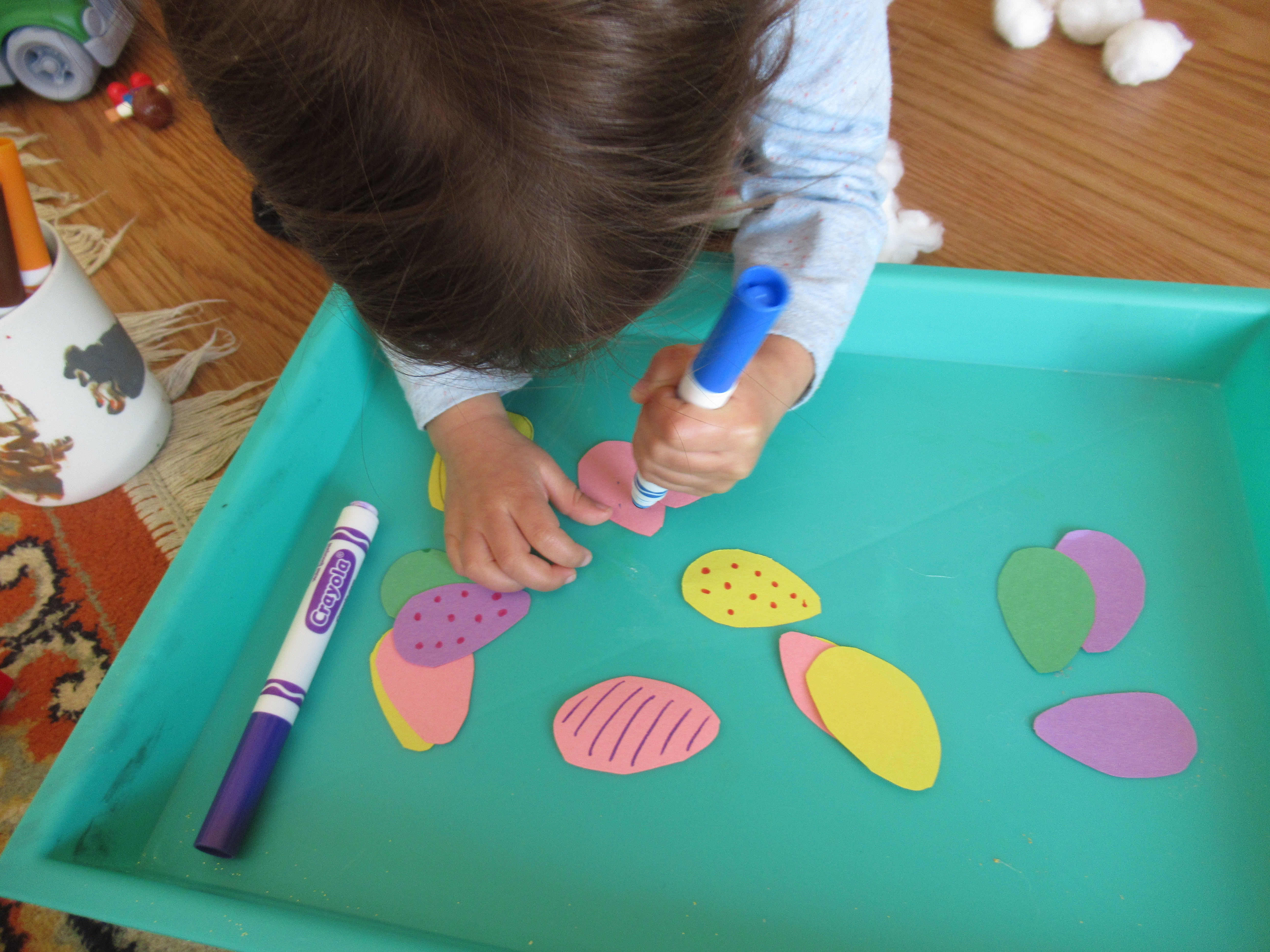
To start, we needed to decorate the “beads”, in this case Easter egg shapes cut from construction paper. I chose a few different springtime shades like purple, green, and pink. She loved decorating with markers, telling me very specifically which ones needed dots, lines, or sometimes silly drawings like “slippers”, and took her work quite seriously!

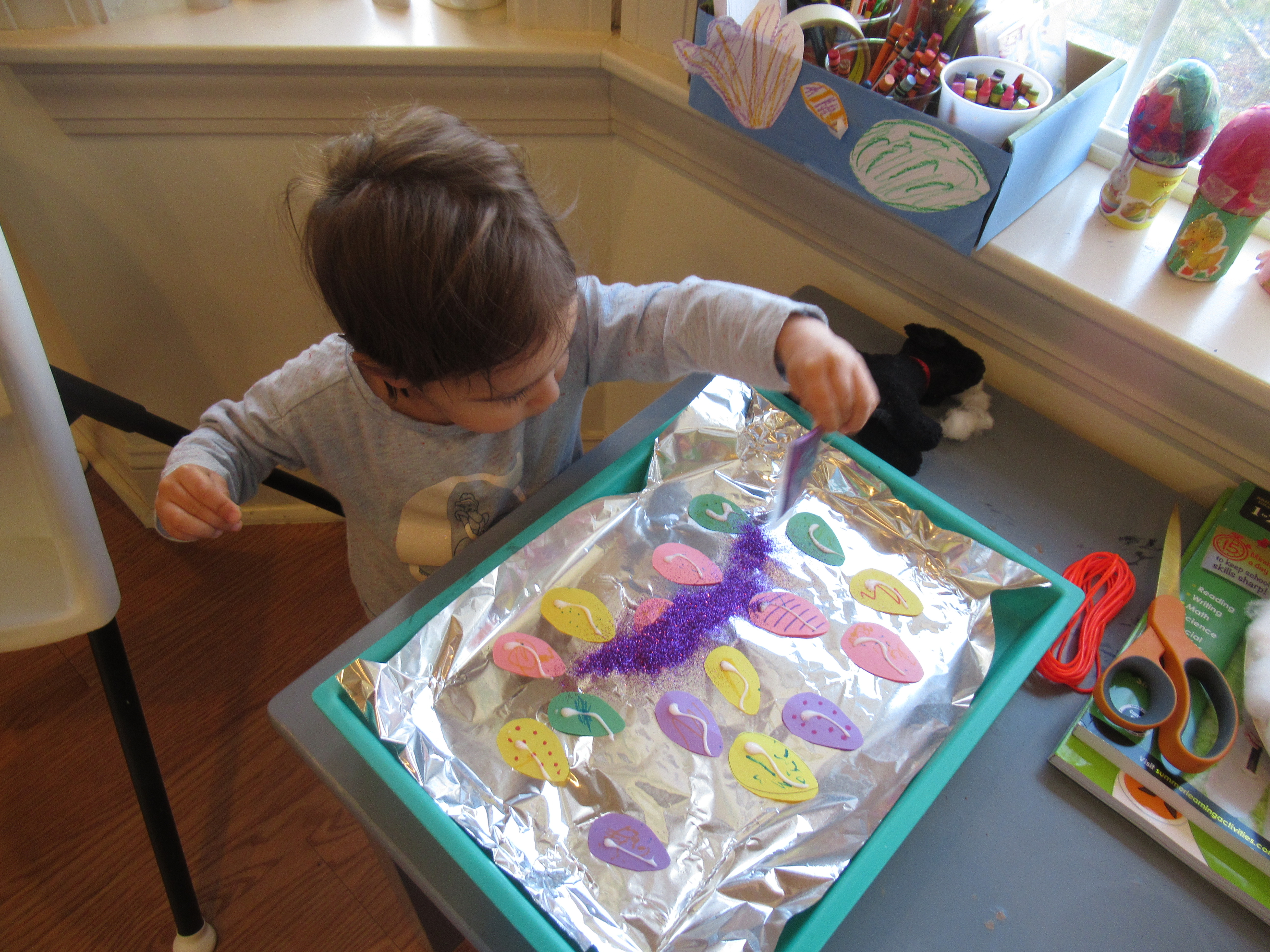
Of course there’s no need to stop at markers. Use crayons, add stickers or sequins, or embellish with whatever else is in your craft bin. To add some sparkle to her jewelry, we squirted a little glue onto each egg and sprinkled with purple glitter. This made the craft significantly more messy, but this girl loves glitter these days.

For some fine motor skills, encourage your child to thread the egg “beads” ribbon to finish the necklace. I punched a hole near the top of each egg, and gave Veronika a yellow ribbon. (Note: You can wrap a bit of tape around the end of a ribbon to make it more like the aglet of a shoelace, for easier threading).

She needed some assistance, but soon was proudly modeling her creation.

“Bunny!” she said with a smile, without any prompting at all.