Make a Weekly Survival Hit List

Weekly Hit List (9)

Today’s activity with baby was another one of those more for the parent; I’m constantly on the hunt for the best and most efficient way to organize my mind, our days, our weeks. I have several methods for planning the family’s week, but it always feels a bit scattered.

For events, there’s my day planner, with a column for each person. I highly recommend this – or at least a color-coded system – so you can quickly see not just what the event is but who needs to be where and when.

Weekly Hit List (2)

Next there’s my method to plan weekly meals. My best advice for menu planning is: don’t wing it! Especially with Veronika now eating a varied menu each week, I plan meals ahead of time in a spreadsheet. When it comes time to make a grocery list, the info is already there!

Weekly Hit List (5)

Then I write up daily meals on a wipe-clean board. No out of sight out of mind here!

Weekly Hit List (1)

But I still don’t have a way to string it all together in one place, and I’ve been searching online for inspiration from the bullet journal (bujo) crowd, which I tested briefly with Veronika’s schedule.

Here is one method I liked, laying everything out on a page:

Weekly Hit List (8)

There’s a column for appointments, housework, blogs or work-related items, a meal section, and then of course the Hit List for the week’s important to-dos.

Weekly Hit List (6)

Each item gets a dash when incomplete, which turns into a plus sign once done.

Weekly Hit List (7)

I’ll test this for a week or so, and see if it manages to combine my disparate organization methods thus far. What does your weekly hit list look like? Please share in the comments!
Baby’s Daily Routine

Daily Routine (5).JPG

Veronika turns three months old tomorrow, which means her “fourth trimester” is at an end. I love the idea that in the first three months, a baby is like a fetus… but outside the womb. Indeed, I found this concept enormously helpful with both my children. It helped me to understand their needs, their lack of a schedule, their reliance on comfort, and so much more.

But by three months of age, it’s normal to see a routine developing. Sussing out that routine now can be super beneficial in the months to come. It might seem like your baby is still all over the place, but I would suggest that if you track feeding and sleeping cycles for about three or four days, you’ll notice patterns.

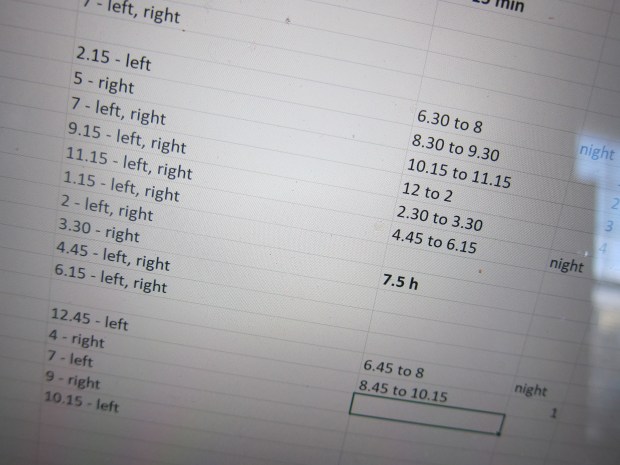
I’ve always been a spreadsheet person, tracking numbers and collecting hard data.

daily routine (4)

But for an interesting experiment, I decided to try a more visual approach to Veronika’s schedule on the eve of her three month birthday.

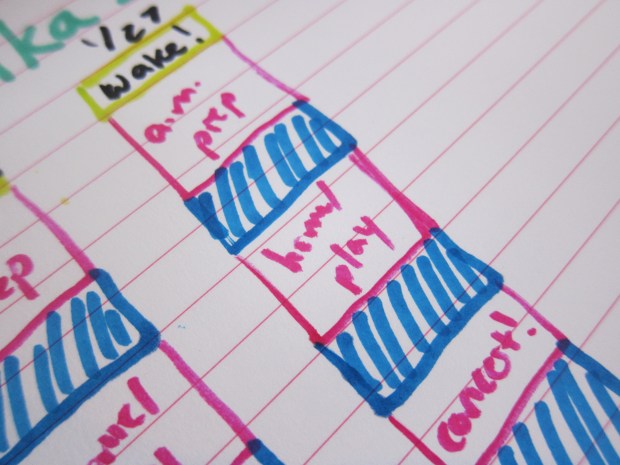
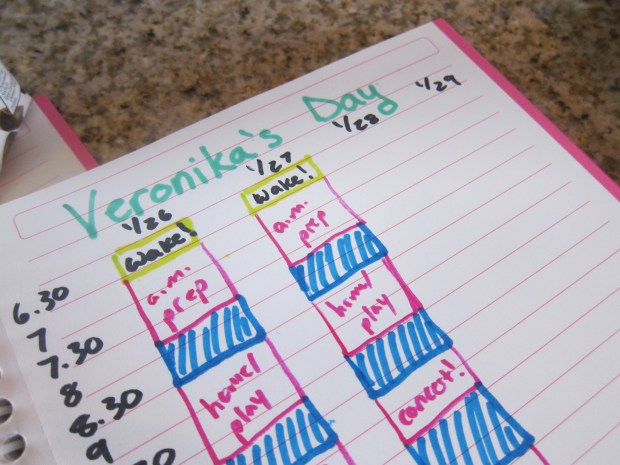
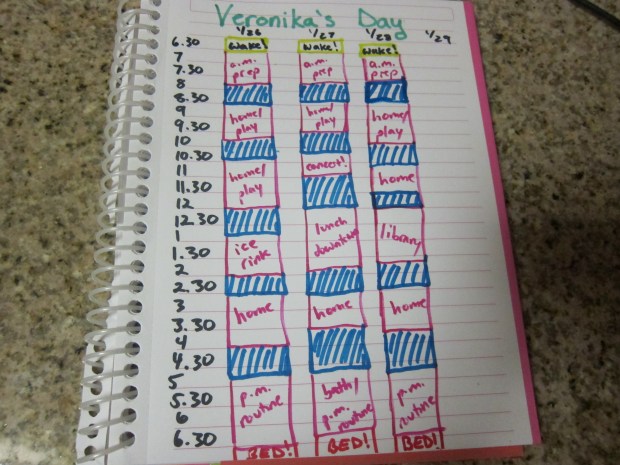
I don’t do bullet journaling (or “bujo” for short), but loved this exercise. For four days, I tracked her wake and sleep intervals in bright bold colors. T

daily routine (1)

Turns out, she reliably does four short naps, interspersed with wake intervals, and the naps are roughly at the same time of day – more so than I would have thought!

daily routine (2)

Your baby’s schedule might look similar (especially if he or she is also being dragged along according to an older sibling’s schedule), or it might look nothing like this at all. What counts is tracking down the patterns in your child’s day.

daily routine (3)

Seeing these patterns can help you decide what your baby needs when, and can also help you organize your day as an adult – you’ll know roughly when to schedule appointments, meetings, or other “grown-up” things that need to get done.

Just don’t forget: babies have a habit of changing things on you, as soon as you think you have it figured out! In which case, pull out the bujo and jot down a few more days to suss out what’s new.