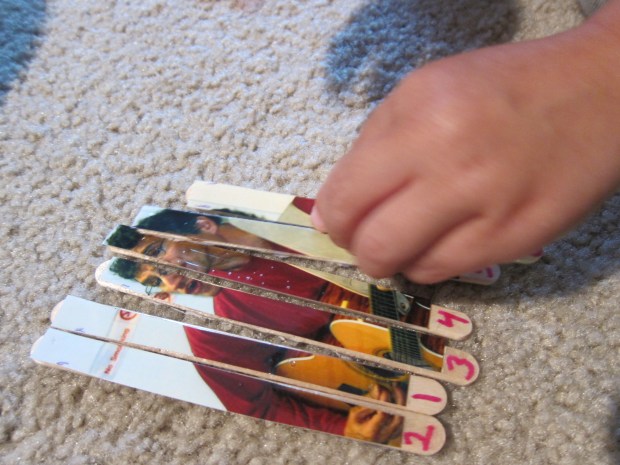
Kindergarten Summer Math Games

There are so many subtle ways to sneak math into your child’s summer to avoid the “summer slide.” Here are just a few Travis has enjoyed this summer, in the bridge between pre-K and Kindergarten, without even realizing I was helping him with his math skills!

Counting: How Many People?

Every once over the course of a day or a week, stop and ask your child to quickly tell you how many people are in the room. You can do this when the number is small (say, at home in our living room), or large, as when we found ourselves in a playspace. The playspace was fantastic because the number kept changing over the hour or so that we played there, making Travis count as high as 12 at one point.

Summer Math (7)

Counting: Toy Pick-Up Challenge

Travis has fought me on requests to clean-up lately, but not so on the day I announced a challenge. Could he pick up ten toys exactly? Immediately, he was racing around and counting out loud. One, two, three went into a toy bin.

Summer Math (16).JPG

A huge battle between action figures and bugs was going on over by the piano. This gave him numbers four, five, six, seven, eight, and nine. He could barely hold them all in his excitement.

Summer Math (17)

“I need one more!” he exclaimed, realizing all his toys were now put away. I told him he could be a super-helper and clean up one of baby sister’s toys. Ten!

Sorting and Estimating: Laundry Sort

I told Travis I needed his help on a recent big laundry day. As each load came out of the dryer, we made piles. Baby sister things, Travis things, mommy things, and daddy things.

Summer Math (3)

It soon became a silly joke, since we seemed to have a load that was almost entirely daddy clothes and very few Travis ones.

Summer Math (2)

“Did you forget to get dressed this week?” I teased him. Well he thought this was just hilarious, and soon was happily tossing clothes into the right piles.

Summer Math (4)

When we had finished, I asked him who had the least clothes. For this load, it turned out to be baby sister. Who had the most? Daddy!

Summer Math (6)

He loved the game so much he couldn’t wait for a repeat as loads two and three came out of the dryer. I plan to enlist him as my helper for as long as I can con him into this!

Summer Math (1)

Money and Coins: Pretend Store

For the occasion, I bought Travis a new toy register (an early birthday gift), which added to his excitement. We grabbed a few real food items from the pantry and added price tags.

Summer Math (10).JPG

Based on the denominations in this particular register set, clearly our grocery store suffered from inflation, ha.

Summer Math (9)

As we played, we talked about prices, and learned which bills or coins added up to which totals.

Summer Math (11)

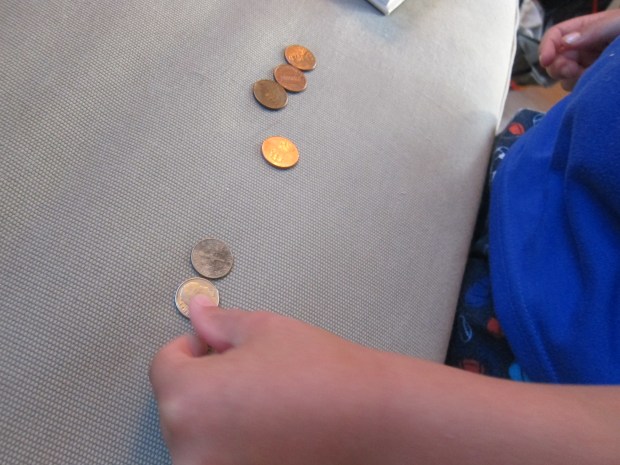
Realizing that things were a bit strange with the fake coins in the register, we next played using real quarters.

Summer Math (12)

You can talk about how there are 100 cents in a dollar, and the value of one, two, three, or four quarters. It was a lot of information to send his way, and I knew all this was a bit over his head, but it never hurts to have an intro!

Summer Math (13)

Shapes: Dinner Quiz

At dinner, do a quick pop quiz. What shape is the plate? A circle!  What shape are the napkins? Rectangles! How about the leftover quesadilla? A crescent!

Summer Math (14)

You can also take this opportunity for some quick counting, i.e. how many green beans are left on your plate or how many utensils.

Summer Math (15)

Shapes: Toy Pick Up

As your child cleans up the room, announce that they have to shout out the shape (and color, too!) of each toy they clean up.

Summer Math (19).JPG

This works particularly well with toys like blocks.

Summer Math (20)

I turned it into a hunt for Travis, and I’ve never seen this set of blocks get so willingly cleaned.

Summer Math (22)

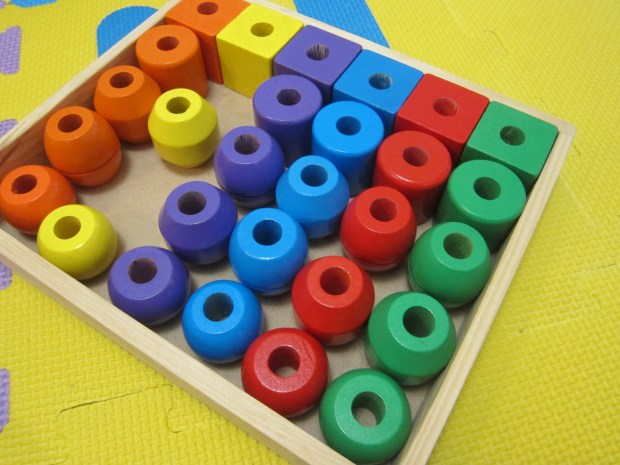
It worked well with baby sister’s beads, too… and even alerted us to the fact that a couple were missing!
Summer Math (23)

Fractions, Measuring and Estimating: Get Cooking!

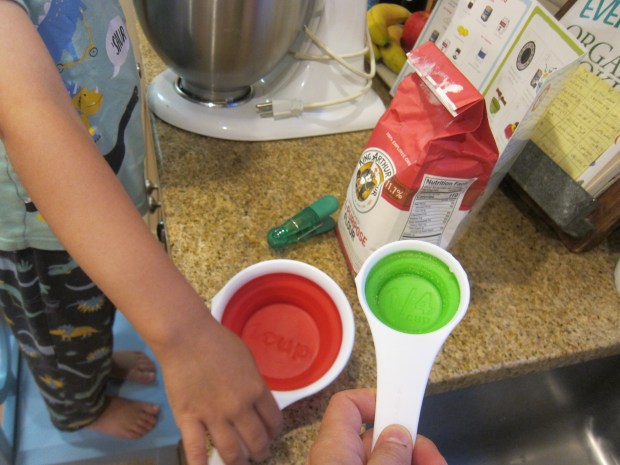
Get kids measuring, scooping, pouring, and leveling in the kitchen, and they’ll be getting a math lesson without even knowing it. Although fractions are a bit advanced for kids entering kindergarten, just hearing the terms “a third of a cup” or “half a cup” will expose them to the idea of dividing one whole into smaller portions.
Summer Math u.JPG

Cooking is also great for learning equivalents (3 teaspoons = 1 tablespoon), relative sizes (a tablespoon is bigger than a teaspoon), and reading larger numbers (350 degree ovens). Here, I asked Travis how long our recipe needed to bake. “20 minutes!” he reported.

summer math u2

Matching: Sock Match-Up

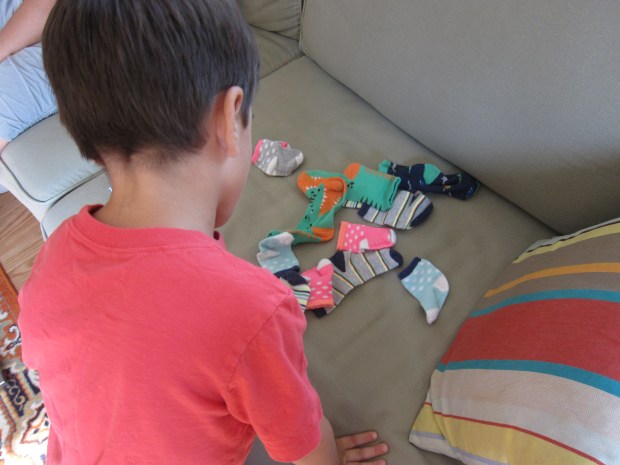
Another great laundry game: Fold your laundry, but leave the socks in a big pile. When Travis came home one afternoon, I said to him, “Oh no, the socks ran away from me!”
Summer Math (28)

He thought the idea of the socks having escaped the laundry pile was very silly. In no time at all, he was matching them up.

Summer Math (29)

A few (similar striped patterns, for example) fooled him but a moment, but then he had things all matched up.

Summer Math (30)

Temperature: Morning Temp

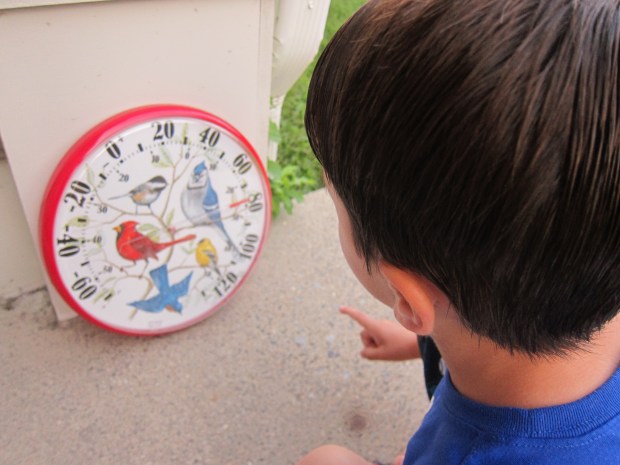
Invest in a thermometer for outside your home or on your patio, and have your child read it every morning.
Summer math (28).JPG

This has become a fun ritual in our house! Because many patio thermometers don’t have all the digits listed, it has become an unintended lesson on skip-counting by twos, with each notch in our dial representing two degrees.

Engineering: Lego Building

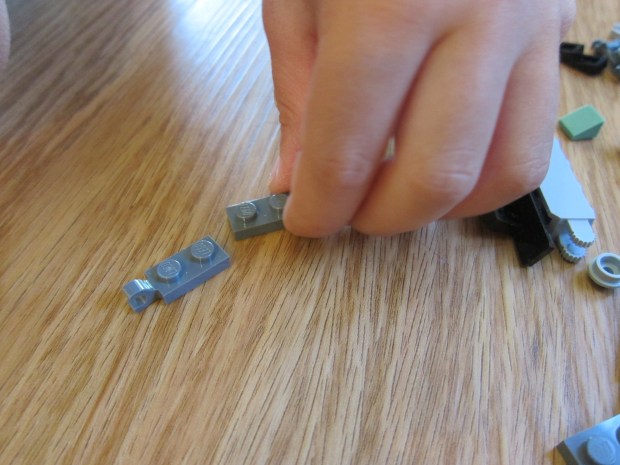
Legos help with fine motor skills, problem solving and planning skills, shape recognition, and so much more. There’s a reason so many towns have Lego building clubs these days!

Summer Math (26)

You don’t need to join a club; just get building at home. Need I say more?
Summer Math (27)

Telling Time: Model Clock Book

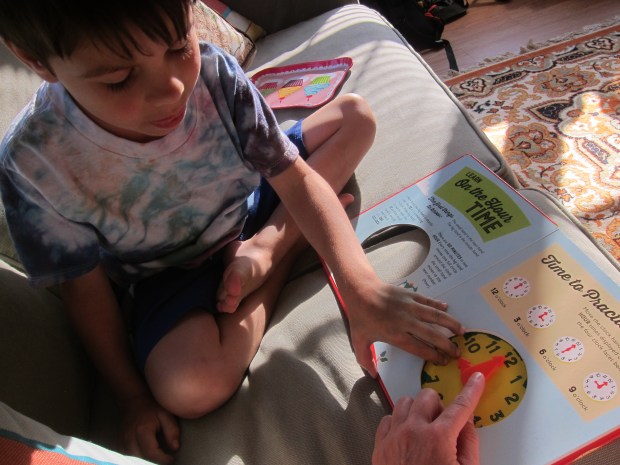
Telling the time is a great skill to work on over the summer. Invest in a good analog clock or a great book about one featuring a clock with hands that your child can manipulate. We love How To… Tell the Time from Cottage Door Press because not only does it give a nice run-down of telling the hour and half hour, but there is a fun section for kids to move the hands based on their activities each day (brush teeth, go to bed etc.).
Summer Math (28).JPG

This gave a real-life scenario way for Travis to think about the time and understand it better. There’s even a model clock to punch out.

Summer Math (29).JPG

(Note: I have yet to find a good book featuring the minutes; many focus on hours and half hours, so I added the minutes in tape to our model clock).

Summer Math (30)

Volume: Measuring Cup Play

Measuring cups are the perfect tool for teaching about volume (and fractions, too!), and if you add colored water, your child will simply think they’re playing and having fun!

Summer Math Volume a

We took clear plastic cups, measuring cups, and food coloring outside one morning. I taught Travis to read the number after the slash on each measuring cup to know how many times he’d need to fill it for one full cup. So two 1/2 cups, three 1/3 cups, and four 1/4 cups. For extra fun, we used food coloring to differentiate between each version.

Summer Math Volume b

Soon he was just happily pouring and mixing and having a blast in the sunshine – vitamin d as an added bonus to math time!

Weight: Fruit and Veggie Weigh

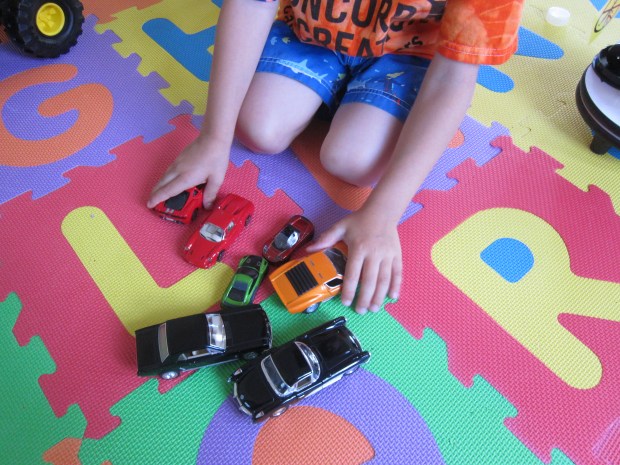
At the grocery store, Travis loves to help weigh our fruits and veggies on the scale. Give a quick lesson on how there are 16 ounces to 1 pound, and let your child read off the weight of each item you place on the scale. It’s a great intro to gently introduce the topic.

Summer Math weigh.jpg

Counting and Sorting

Counting and Sorting (1)

Today Travis took a break from tracing the alphabet and focused instead on summer math skills: counting and sorting.

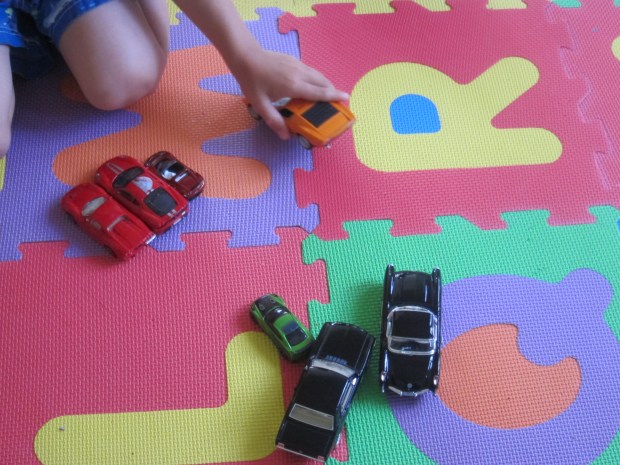
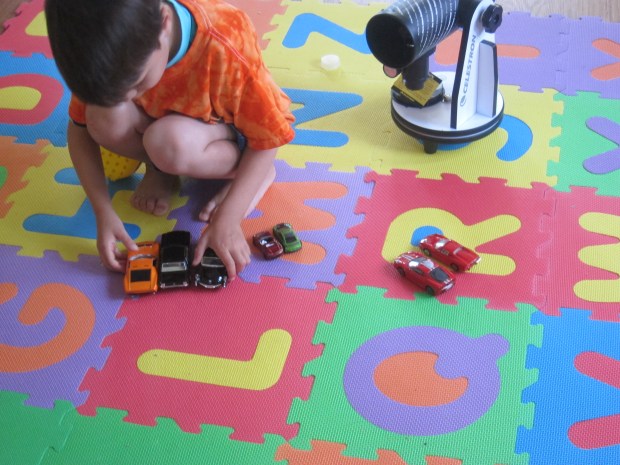
There are so many ways to approach this, and you can tailor it to fit what’s in your home! First up, we pulled out a collection of his toy cars, and I asked him to sort them in two ways. He wanted a quick reminder on what it means to sort, i.e. grouping things by a common characteristic. The first category he came up with was color. Our red pile was the biggest.
Counting and Sorting (2)

I helped him look for a different way to sort this same set of cars and he settled on size. I thought he would do big and small, but he made sure even to include a medium pile!

Counting and Sorting (4)

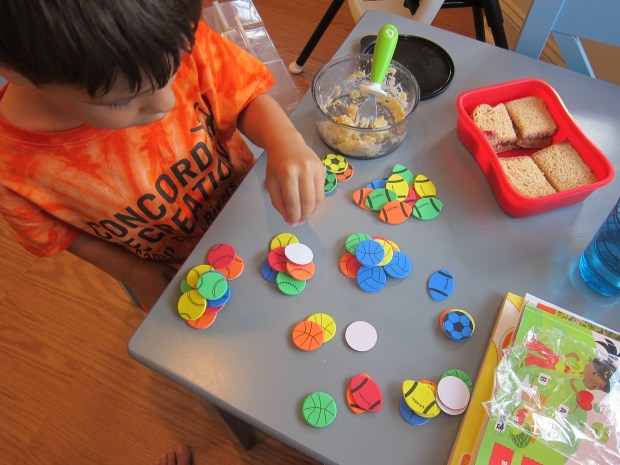
Next we went through our craft bin to find things to sort. Foam stickers in fun sports shapes were a perfect find! At first, I just gave him the pile and set him the task of sorting them (keeping those fingers busy while I prepped dinner).

Counting and Sorting (7)

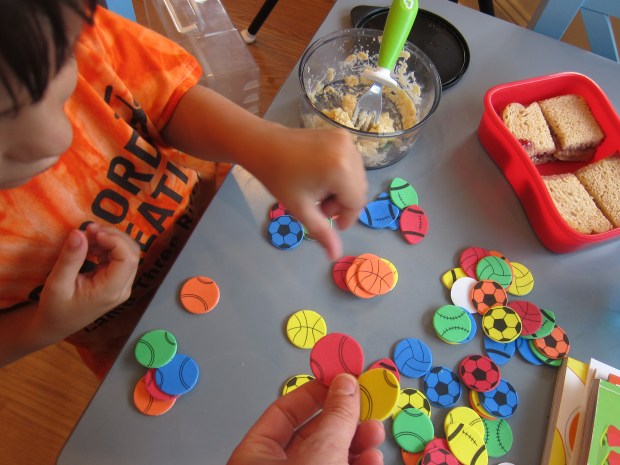
This proved to be a little too open-ended, so I gave him two options: sorting the balls by sport or by color. He opted for sport, and soon was off and running. At the end, we wondered: which pile had the most? He proudly counted out 14 soccer balls, but then loved discovering that there were even more footballs – 15!

Counting and Sorting (6)

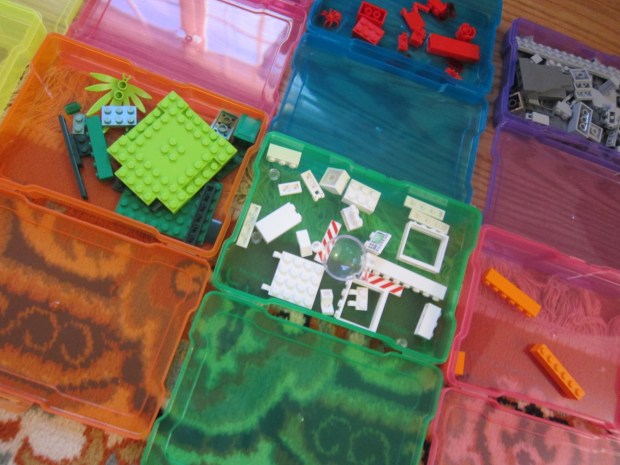
Another great time for sorting is during clean-up! If your house is anything like ours, the Lego sets are all mixed together and a constant mess. I purchased a set of craft bins to sort the Legos by color, which meant Travis was doing “math” while helping me… and didn’t even realize it was a chore.

Counting and Sorting (8)

The possibilities are almost endless. Have your child count out and then sort their markers or crayons.

Or they can sort the coins in your wallet by denomination.

Counting and Sorting (9)

Or just for fun, make a busy box of different dried pasta shapes and have your child sort and then count out piles of each. Either way, counting and sorting are the perfect math activity to prevent the summer slide.


Clothespin Number Match

Clothespin Match (2)

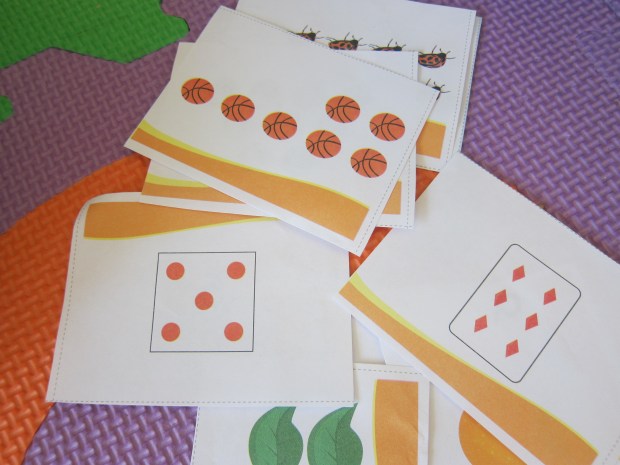
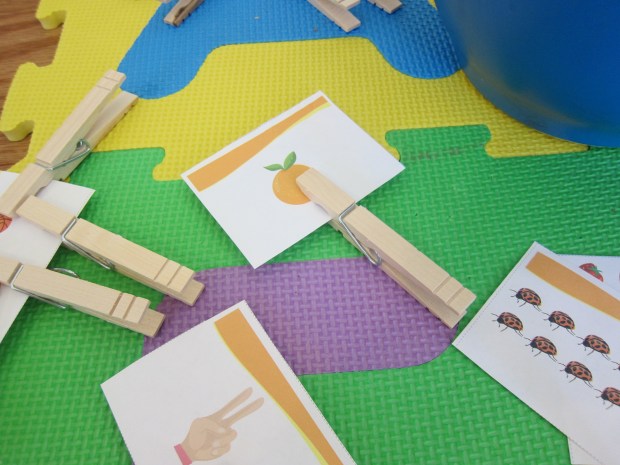
For this quick counting exercise, we used number flashcards from Travis’s summer workbook. You can easily make flashcards at home though featuring a set number of things on one side and the numeral on the other.

If you make your own, I recommend following the lead of the workbook we’re using, which presented novel ways to count things: two fingers, for example; five pips on a dice; or six marks on a playing card.

Clothespin Match (3)

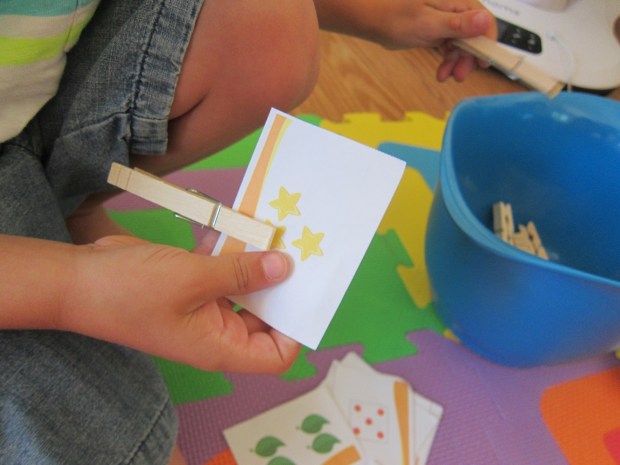
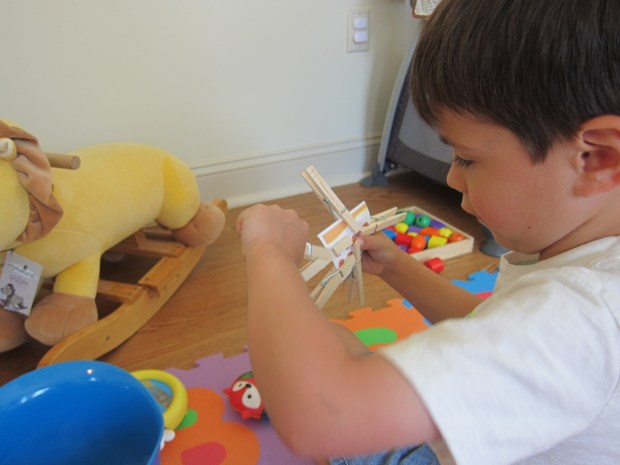
I gave Travis all of the cards in a big pile and a bowl of clothespins. I thought he might consider the activity somewhat tiresome, but he loved the idea of clipping the pins to each card!

Clothespin Match (1)

After counting and telling me what the number on the front was, he checked his answer against the numeral on the back.

Clothespin Match (4)

Then it was time to reach into the bowl of clothespins!

He very carefully added and counted as he went, including for the highest numbers. “Can seven even fit?” he wondered while working on that card, and was thrilled when the answer was yes. Our card with 10 was a tight squeeze.

Clothespin Match (5)

This requires so many clothespins that sometimes we had to steal from finished cards to complete new ones. When there was only 1 clothespin left in the bowl, I challenged Travis to single out the card representing #1. Bingo!

Clothespin Match (6)

Overall, this is simple but good review for counting, and it gets those fine motor skills working, too.

Greater Than and Less Than Gator

Greater Gator (8).JPG

A chomping alligator who can help teach your child the less-than and greater-than symbols? What a cute way to kick off some math for the school year!

This project didn’t work out exactly as planned for us, largely because I had to upcycle egg cartons that were not my own, and as I result used half-dozen cartons, not a full dozen… Needless to say, our final product wasn’t quite a long alligator snout (perhaps more of a hungry dinosaur!) but the lesson remained the same.

Cut apart the tops and bottoms of two egg cartons; paint the tops green and the bottoms white. Let dry completely.

Greater Gator (1)

Here is where things got a little difficult: Punch holes in the green portions, and use yarn to thread first through the holes of the bottom “jaw” and then the holes of the top “jaw.” This is great lacing practice for kids! Tie off with a knot at the end.

Greater Gator (2)

I then hot glued the white “teeth” into each portion of the jaw. (You may need to trim about half a row of the teeth away, for it to nest properly inside the top portion of the carton.

Greater Gator (3)

You now have a hinged puppet who can open and close its mouth to chomp up… numbers!

For our counting game, I affixed block dot stickers to construction paper in various combinations – 2 dots is less than 3; 5 dots is greater than 4; and so on.

Greater Gator (4)

Travis had a bit of difficulty with the actual mechanism of our gator’s jaw, but aside from that, I loved watching him complete each task we put up on the easel. For each, he would count the dots first, then declare which was greater.

Greater Gator (7)

When your child tires of the math lesson, they’ll have a fun gator puppet to play with! Ours was soon involved in superhero games.

Greater Gator (6)

Domino Steal Game

Domino Steal (3)

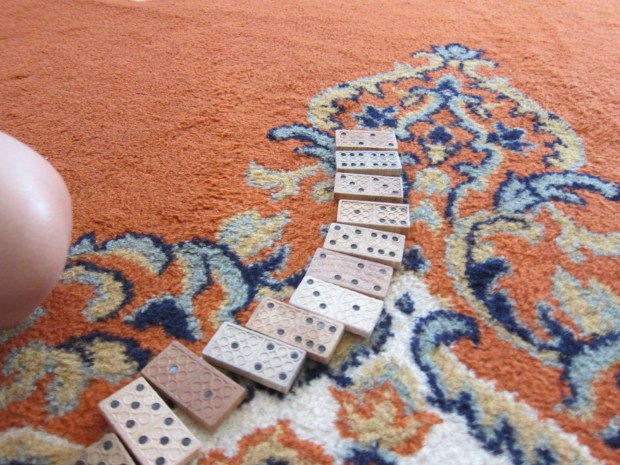
On the heels of our starfish counting game, here’s another great way to reinforce numbers and number recognition before back-to-school. Dominoes lend themselves to any variety of counting games – including just matching up the pips! – but this version involves stealing from the other players. An instant preschooler hit!

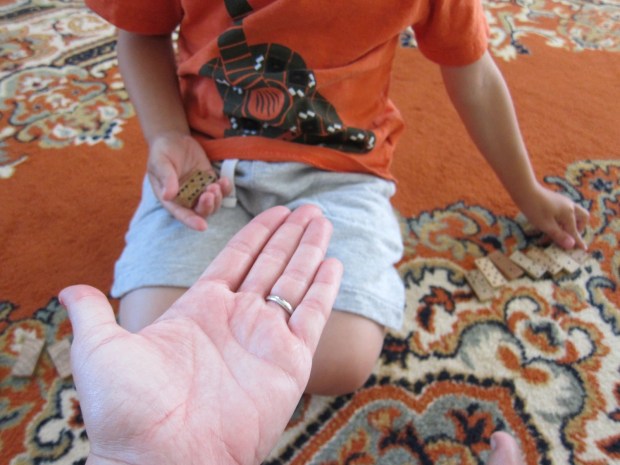
To play, you need two players, whether two kids, or an adult and one child. Pull out two dominoes, and each player counts the number on theirs. This is great not just for learning to count the dots, but also learning to recognize the arrangement of the pips by sight.

Domino Steal (2)

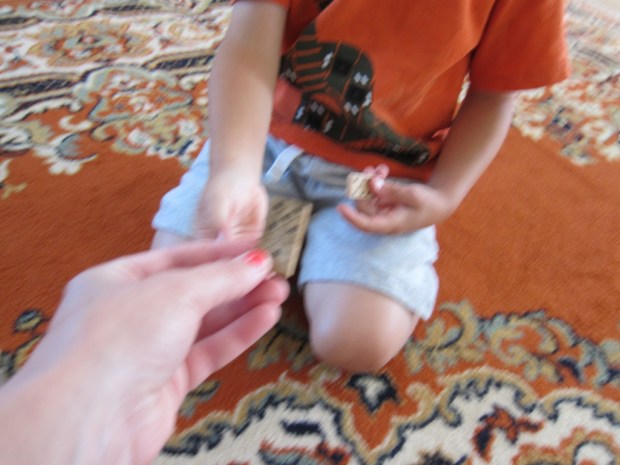
Whoever has the higher number on his or her domino wins that turn, and gets to “steal” the other players domino. Stealing was a big thrill of course! Here’s the thief in action:

Domino Steal (1)

I swear I didn’t rig the game, but Travis ended up with quite the collection.

Domino Steel (4)

When you’re done playing, I recommend leaving the dominoes out… They are a fantastic prompt for kids who want to arrange them, or play make-believe with them, or practice numbers on their own.

Starfish Counting Game

Starfish Count (4)

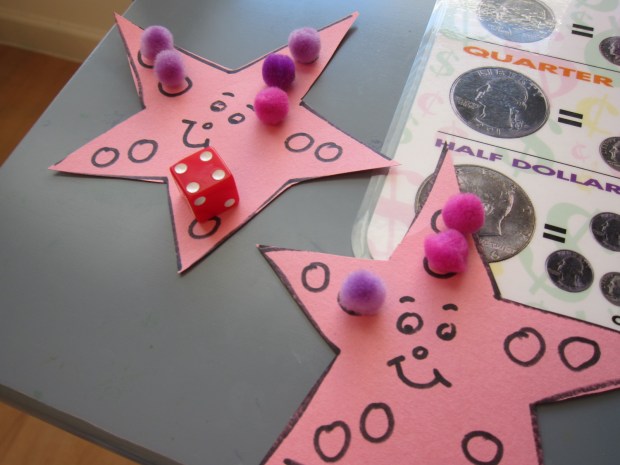
This adorable game is a fun way to get kids counting (or memorizing by rote) the pips on dice. The beach-y starfish theme makes it just right for the end of summer, if you’re helping kids prep for back-to-school!

I drew two starfish free-hand (don’t judge my stars too harshly!) and added smiles and 10 dots to each (to represent the bumps along a true sea star’s arms).

Starfish count (1)

Set out the starfish as your playing boards, along with pom poms and dice.

Starfish count (2)

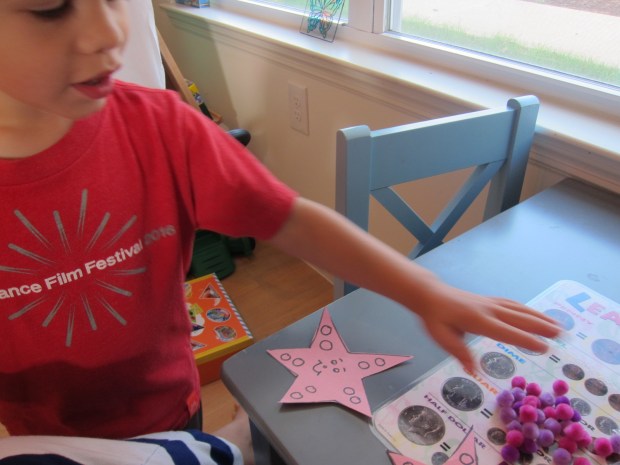
Take turns rolling the die, and add the appropriate number of pom poms to your starfish board. The first player to fill in all their bumps wins!

Starfish Count (3)

In sum, a simple counting game that will boost kids’ confidence as they had back to the classroom.

Starfish Count (5)

Our 100’s Jars Collection

100s Jar (7)

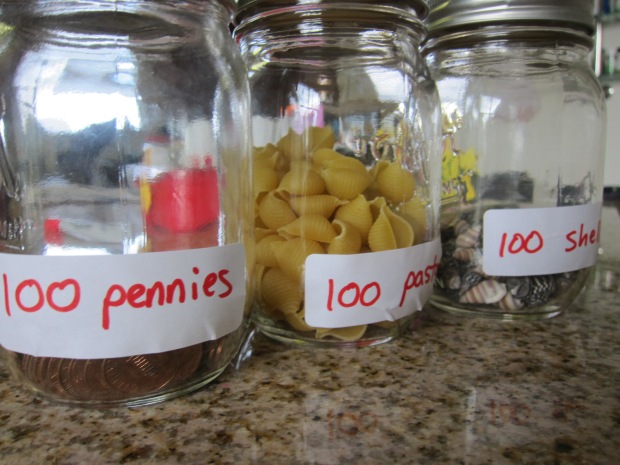
Back-to-school is just around the corner, and this activity is a fantastic way to get preschoolers and kindergartners thinking about numbers up to 100, as well as concepts like counting by 5’s and 10’s. All you need are a few empty glass jars and objects you already have around the house!

First I asked Travis if he could think of anything we had in the house that would number up to 100. He guessed toy cars (which might be true!) but I knew 100 cars wouldn’t fit in a jar.

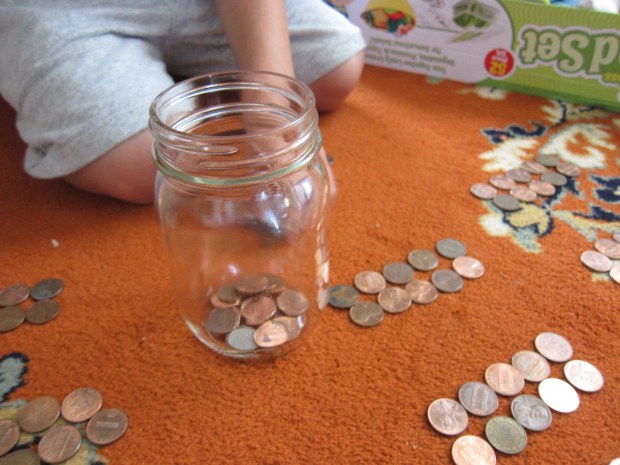
I suggested we try coins, and soon we were emptying out his piggy bank.

100s Jar (1)

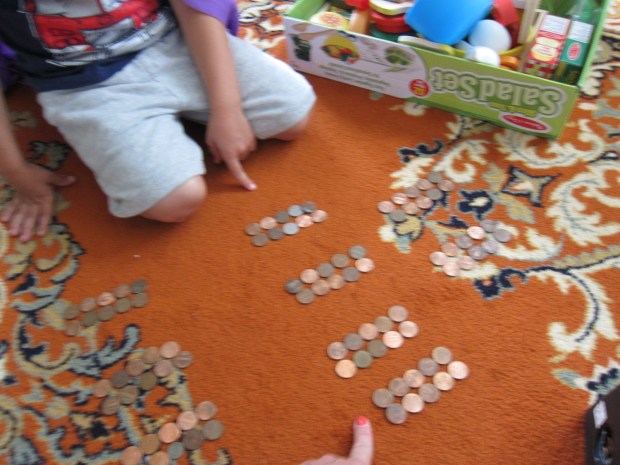
He quickly latched on to the idea that 10 groups of 10 would give us 100. I helped him count out 10 coins into each group, and then we counted the groups up: ten, twenty, thirty, and so on. Filling the jar was super exciting.

100s Jar (2)

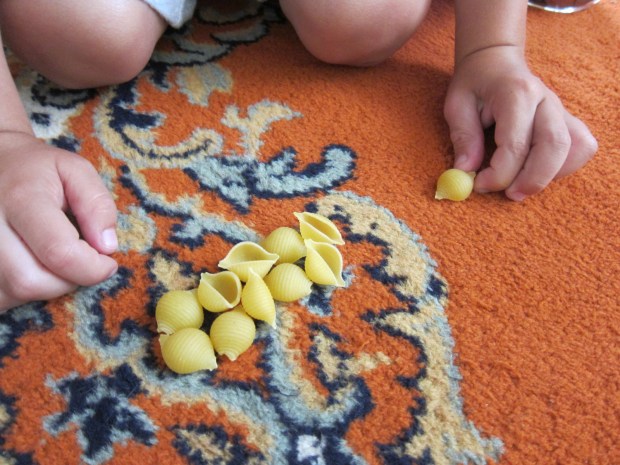
Dried pasta was a bit hit to count for the next jar!

100s Jar (3)

This also showed him that 100 pasta shells took up more space than 100 coins.

100s Jar (4)

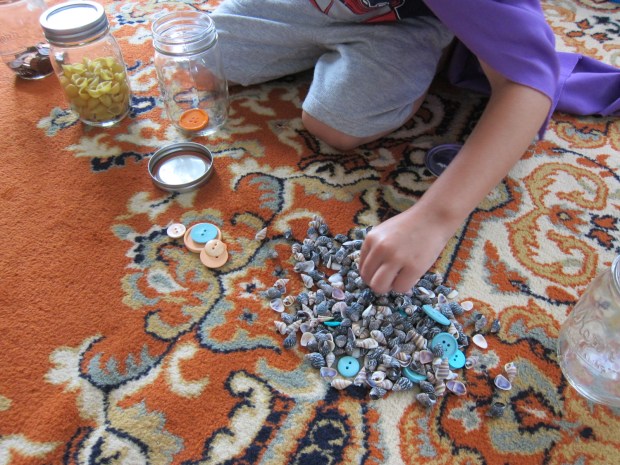
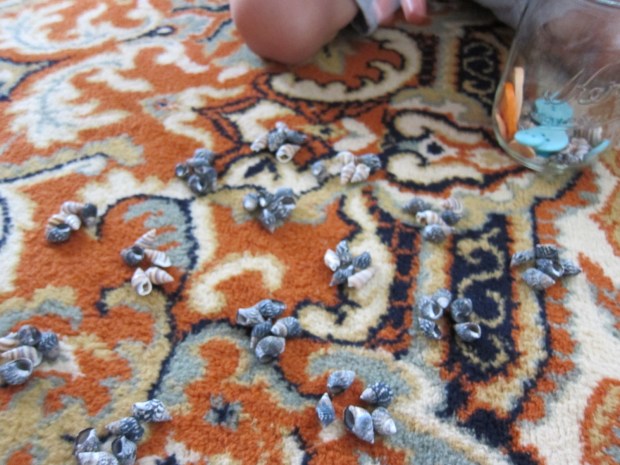
For our final jar, Travis chose shells.

100s Jar (5)

This time we grouped them into 20 groups of 5. He had a hard time following as I counted up by 5’s, but it was a good foundation to lay.

100s Jar (6)

In sum, this is a cute way to get your little one thinking about math, and so easy you can sneak it in between dinner and bath time! What do you have 100 of in your home? Please share in the comments!

Sand Pendulum

Pendulum (5)

We snagged this idea from an old Parents magazine article, highlighting STEM projects for kids. The game provides a neat visual introduction to gravity, using the simple concept of a pendulum. Pendulums – any suspended weight that swings freely from a pivot – will always come to rest at an equilibrium position, because of gravity of course. Using colored sand makes it purely fun for kids!

Make sure to cover your work surface with a roll of craft paper or other paper, both to catch your sand designs, and to save you from a big mess at clean-up time.

To set up the pendulum, tie three strings at even intervals around a thick rubber band. Travis had fun exploring the materials while I put this step together. Older kids can help with the tying!

Pendulum (1)

Fit the rubber band tightly under the lip of a kitchen funnel. Gather the three strings together and tie in the middle so the funnel hangs evenly.

Pendulum (2)

Slip the strings over a dowel – whoops, not quite balanced yet!

Pendulum (3)

The next step was a bit tricky, since it requires two sets of hands, and my three year old had his own agenda. But ideally, have your child plug the hole at the bottom of the funnel with a fingertip while you fill it with colored craft sand.

Give the pendulum a slight push, and watch the sand go back and forth. It will swing in increasingly smaller motions until it comes to rest.

Pendulum (4)

As mentioned, ours didn’t exactly work as planned…but leftover sand sure is fun to play with!

Pendulum (6)

If you capture really pretty sand designs, please share in the comments.

Numbered Photo Puzzles

Number Puzzle (5)

This craft turned out to be the perfect diversion when rain hampered our outdoor plans for a summer day – it takes several hours from start to finish, which suddenly made the afternoon indoors far less daunting!

First, we needed to select photos to become our puzzle pieces, making this a great activity to talk about relatives you haven’t seen in a while, or about your child’s favorite memories.

Make sure it’s a photo you don’t mind cutting up though! Adults: Cut the photo into pieces the width of the craft sticks you will be using. We made 8 piece puzzles, but you can go bigger or smaller.

Number Puzzle (2)

Next we applied a layer of Mod Podge to the craft sticks and adhered our photo pieces. Travis didn’t like how messy his fingers got pressing the slim pieces of photo on so precisely, so soon he was involved with his own (slightly) cleaner Mod Podge game while I finished up the photo gluing.

Number Puzzle (1)

And p.s. YES, Mod Podge is vegan! How have we never used this stuff before?

We had to let the project dry, and then we applied a second layer of Mod Podge on top of the photos to set them completely, which meant another round of waiting for it to dry.

But finally it was puzzle time! Adults: Number the sticks of each puzzle with a sharpie in order 1 through 8. (Or, you know, reverse your 1 and 2 by accident, like I did in the photo below).

NUmber Puzzle (4)

Your child will easily be able to form the image by following along in number order.

Number Puzzle (6)

Travis loved the way each puzzle came together, and was so proud lining up the numbers. A fantastic way to make counting into a game.

Number Puzzles alt.JPG