Leaf Chromatography

Leaf Chroma (9)

You can show your children a visual rainbow of molecules with this simple science experiment. It’s a great way to explore what happens to leaves in the fall!

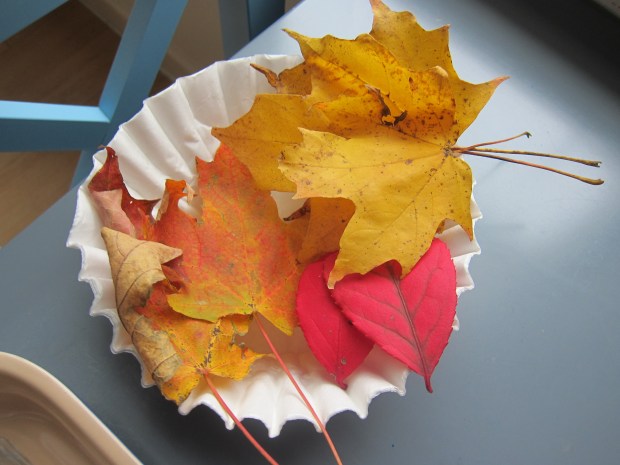
Travis and I had been waiting to do this activity all season, but the leaves were stubbornly slow to change. Finally we spotted a landscape of vibrant reds, oranges,  and yellows, and couldn’t wait to take them home and experiment.

Leaf Chroma (1)

First, tear up the leaves into pieces, and divide into glass bowls, one color per bowl. Travis loved the tearing!

Leaf Chroma (3)

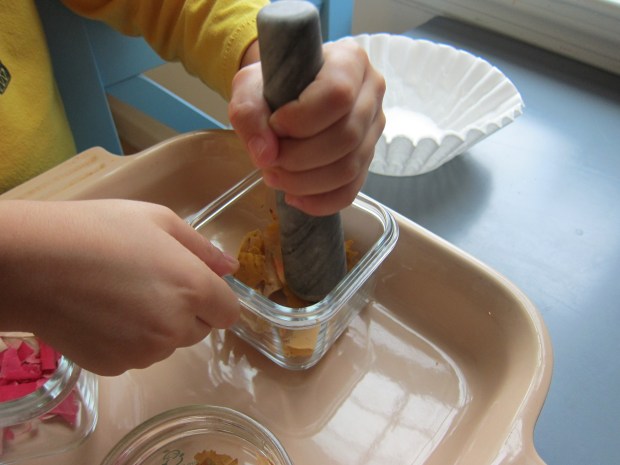
Mash the leaves slightly using a pestle or muddler.

Leaf Chroma (4)

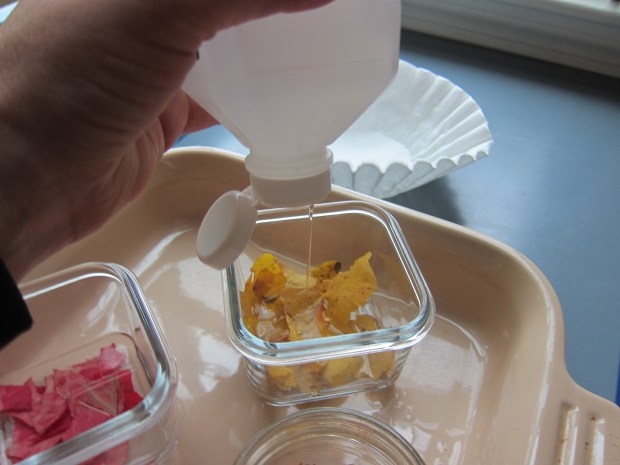
Ooh, next up was a grown-up ingredient: Rubbing alcohol. Travis very carefully helped me pour enough in each bowl just to cover the leaves. Place the bowls in a baking dish and add a few inches of hot water.

Leaf Chroma (6)

Now cut a coffee filter into strips, and drape over chopsticks (or kebab skewers, or pencils – anything long and straight), letting one side dangle down into the rubbing alcohol. Place the entire baking dish some place dark and let sit overnight.

Leaf Chroma (7)

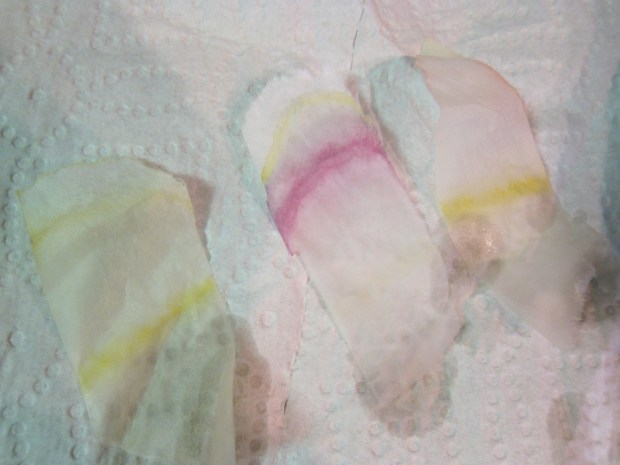
In the morning, you’ll see bands of color on each filter strip! This shows the layers of color that were in each leaf, slowly revealed as chlorophyll breaks down in cold temperatures. To be honest the yellow and orange were a bit underwhelming, but it was neat to see several layers of color exposed in our red leaves.

Leaf Chroma (8)

In sum, a neat science experiment!

Building Sticks

Building Sticks (3)

This project is so simple and yet so great for engaging minds and hands. If you like, you could even throw together a travel set to take these on long car rides!

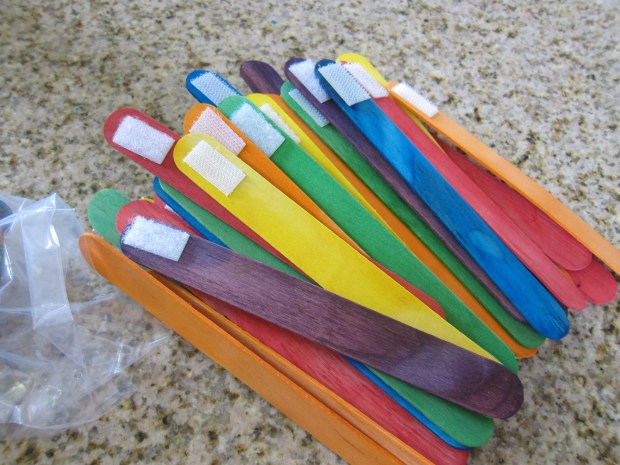
All you need are Velcro dots and craft sticks – plain wood will do, but for added fun, I like the pre-colored craft sticks for this purpose.

When we first set up the game, I only had enough Velcro for one side of each stick. I intended to buy more Velcro in the morning, but this didn’t stop Travis from wanting to build right away.

Building Sticks (2)

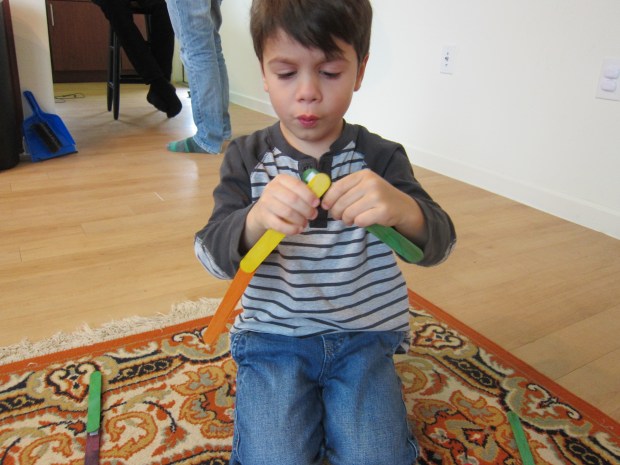
Soon he was making “wands” and “books.” He came up with the idea of using tape himself, to put together some more complicated structures (a teepee!)

Building Sticks (5)

Once we actually had enough Velcro the next day, we made sure each stick had a dot on each end. This enabled much more complicated structures.

Building Sticks (7)

It was still hard to build up (for that you’d need Velcro on both back and front of each stick), but we soon had long complicated structures moving across the carpet.

BUilding Sticks (8)

Travis declared these were machines, and enjoyed the challenge of making sure he was attaching the “fluffy” side of the Velcro to the “scratchy” side.

Building Sticks (9)

A simple activity to keep hands busy!

Tape City

Tape CIty (8).JPG

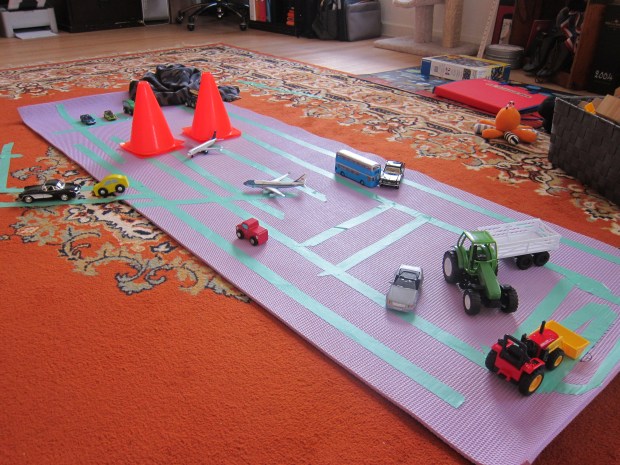
Tape + cars is one of those classic games that never goes out of style. Simply grab a roll of painter’s tape, and turn your floor or carpet into roads and cities. I used to make these roads for Travis when he was a toddler, but this was the first time I put him in charge, and the results were fantastic!

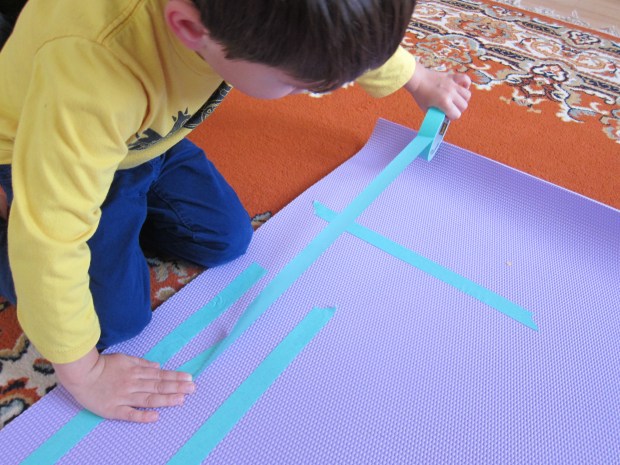
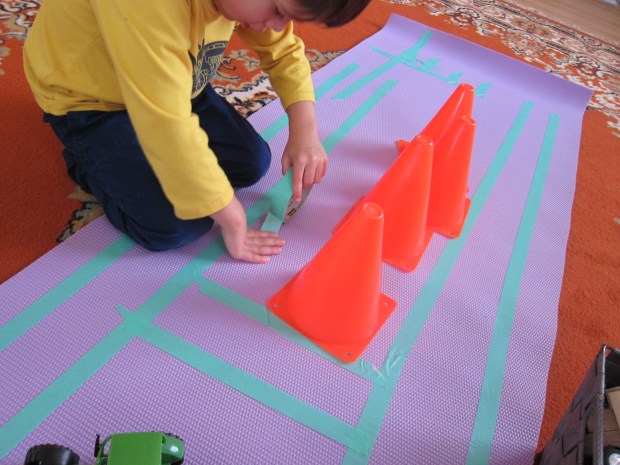
For starters, we decided to lay our city out on mommy’s yoga mat, which added a new feel to the game. Travis began with long roads, and loved unrolling the tape.

Tape City (1)

Then he decided the road ended at a restaurant, so we needed a parking lot.

Tape City (6)

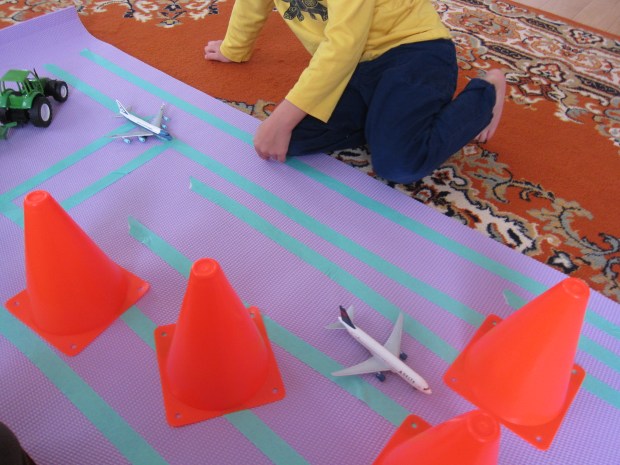
From there, his imagination was off and running! Soon we had an airport runway marked by cones…

Tape City (3)

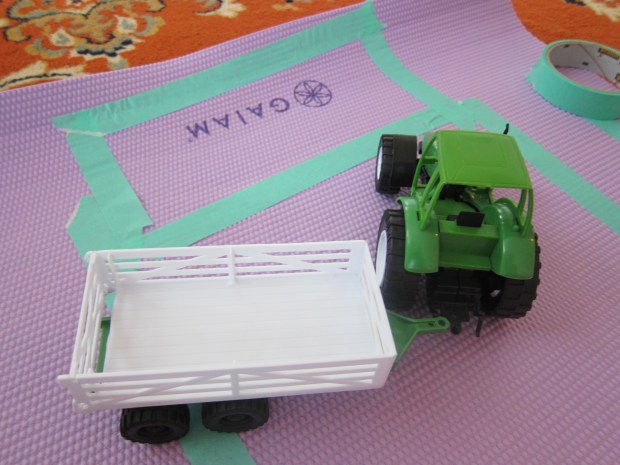
A farm…

Tape City (4)

And he even decided we needed a swamp! Uh oh, hope the cars don’t drive in.

Tape City (5)

He had fun making side streets (venturing boldly off the yoga mat!), which then turned into roads that were blocked off for construction.

Tape City (7)

The tape might not have been as neat or precise as a grown-up’s lay out would be, but I loved seeing his engineering and creativity at work.

Tape City (2)

What will your child add to their tape city? Please share in the comments!

Cityscapes Crate

Koala City (16)

Our latest from Koala Crate was a kit all about “cityscapes,” which introduced great city landmarks (i.e. the Eiffel Tower), as well as the various buildings, modes of transportation, or shapes you might find in a city. The crate used buildings as a leaping off point to talk about colors, patterns, and geometric shapes, making this one of the more STEM-related kits we’ve received to date.

To wit, first up were City Building Blocks. This project is clever, of course – for what is a city if not built up of blocks? Cement, stone, brick, you name it. There are 9 blank wooden blocks in the crate and 9 sheets of stickers with which to cover them.

Koala City (2)

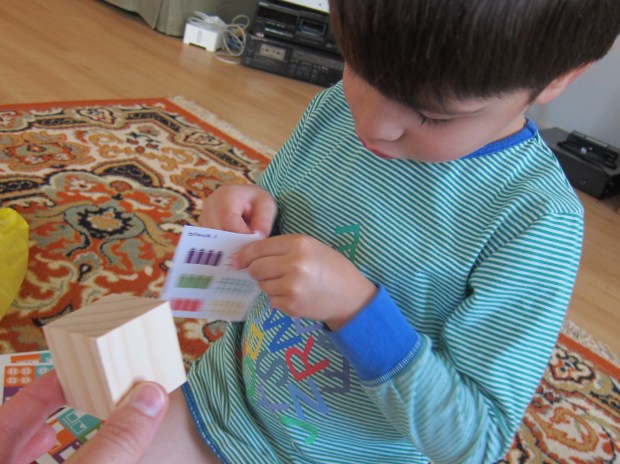
I was proud of Travis for latching onto the idea that each cube had six faces, and making sure to turn to an empty face before he added each new sticker.

Koala CIty (1)

Soon we had trees, walls, doors, windows, rooftops, and more. Your child can simply use the blocks to free-build a city…

Koala City (3)

…or use them in a more educational way. Can you construct an all red building? All purple? An alternating pattern? (We tested out: door, window, door, window etc.). You can also talk about the shapes within the blocks, although we didn’t do much of that.

Koala City (17).JPG

One note of caution: the stickers are a bit tricky to peel off, which may lead to a moment of four-year-old frustration… Hopefully easily diverted!

When Travis spotted the glitter paint in the crate, he couldn’t wait for the next two projects. Because glitter makes everything better of course.

Koala City (7)

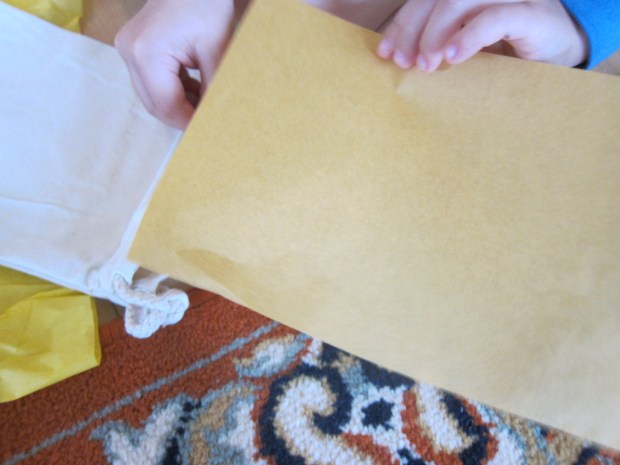
First, we decorated the Stencil Drawstring Pouch, which is fun as a project and then handy later to store the blocks in. Slip the provided wax paper into the provided drawstring bag to prevent the paint from bleeding through.

Koala City (4)

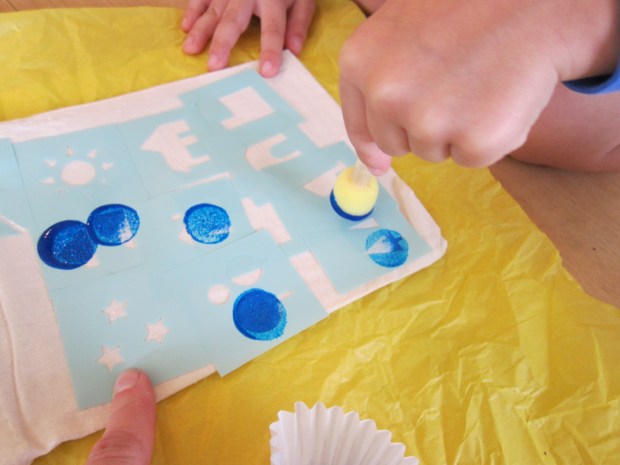
This project relies on stencil stickers. I paused to explain to Travis that the paint would go inside the blue lines, once I realized he was overlapping his shapes a little. He seemed fascinated by this, and most of our buildings turned out just fine. We talked about what went where in the layers of a city – buildings and trees on the bottom, rooftops in the middle, stars and clouds up top.

Koala City (5)

To paint, dip the provided sponge brush into the provided paint cup, and dab inside the blue lines.

Koala City (6)

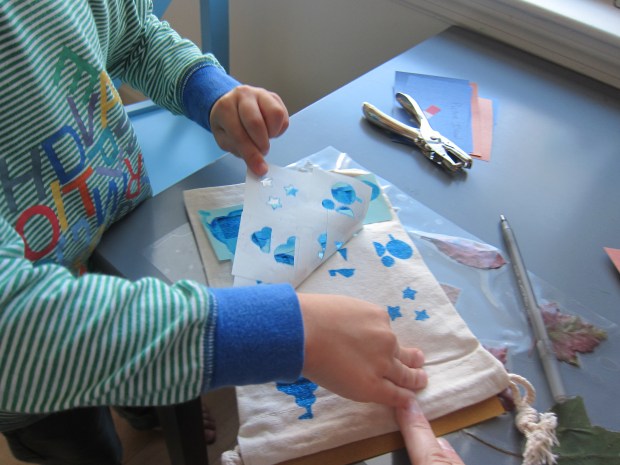
Let dry for about one hour before peeling off the stencils and revealing your city.

Koala CIty (10)

The final project, Skyline Paintings, employed the opposite method from stenciling (i.e. resist painting). I loved watching my engineer at work, talking about all the geometric shapes and what we could make from them: a house from a square and triangle, for example, or a bridge from a semi-circle and rectangles.

Koala City (8)

Then he grew creative and started inventing his own. And of course then there was the fun of paint dabbing.

Koala City (9)

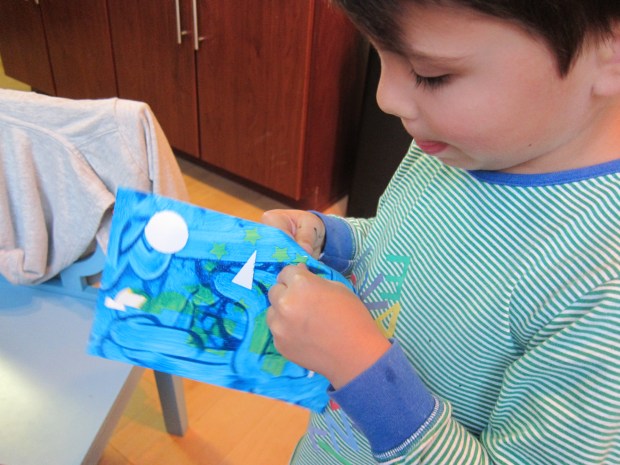
Let the paint dry, then peel off the stickers. “How did it make the shapes?” Travis wondered, marveling at how his houses and towers looked once the stickers had lifted away.

Koala City (11)

We’d used up all the stickers, but took some extra time to make our own neighborhood, talking about what shapes we see near our home. Soon we had a cute collage – rectangle buildings, semi-circle driveways, oval ponds, square windows etc.

Koala City (15)

As you can see, this kit was heavy on the geometry, and on seeing and finding patterns. Happy kid, happy mama. Thanks Koala!

Koala City (13)

Early Explorers Toys & Games

LP Toys (29)

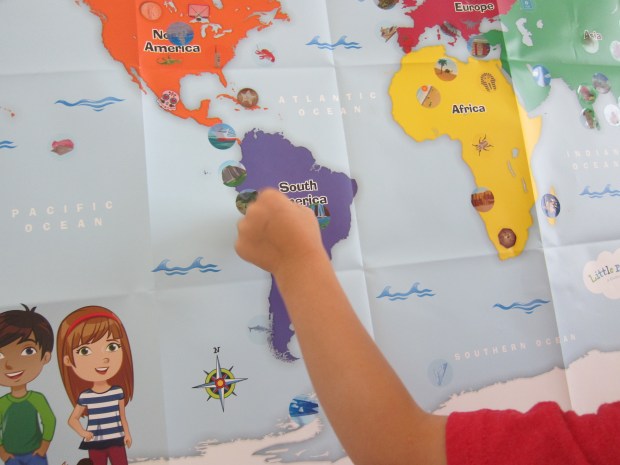
This month’s offering from Travis’s Early Explorers subscription was literally a package devoted to fun – toys and games that is! One look and we knew we were sure to have a good time with this one. We received all the recurring elements, such as an activity booklet, flash cards, postcard, and stickers for Travis’s wall map and suitcase.

LP Toys (1)

Even adults can learn a lot from this one – I sure had never heard of games like turumpo, galimoto, and daruma otoshi from around the world. Then it was time to get busy with the booklet’s additional suggestions.

LP Toys (10)

Toys Craft:

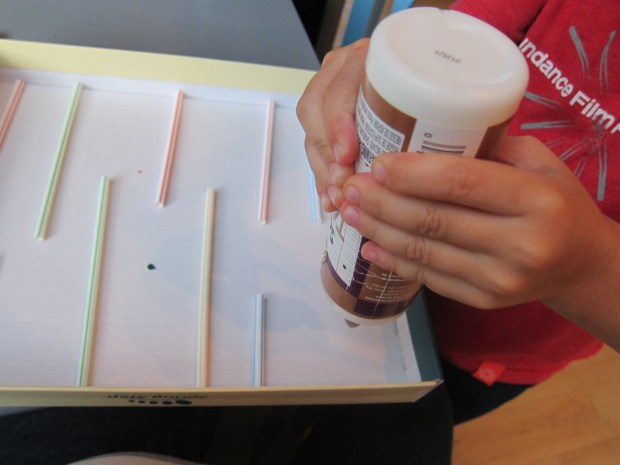
We loved the craft for a homemade marble maze. To construct it, you only need a shoe-box lid and straws. Travis marked a circle in one edge for Start, and a “smiley face” in red at the bottom for Finish. I do love his slightly-glowering smiley faces these days!

LP Toys (5)

Next we cut straws to various lengths, and he helped me decide where each should go. I glued them down and we let it set overnight.

LP Toys (4)

In the morning, it was time to test our toy! Travis loved tilting and learning how to maneuver a marble among the straws.

LP Toys (8)

We had fun with suggestions in the booklet such as: timing ourselves; going backwards from Finish to Start; and testing out ways we could make the maze even harder. When the opening between two straws was narrow, this was the biggest challenge.

LP Toys (9)

You can also try making multiple mazes, or roll something through it other than a marble!

Toys Science:

The booklet challenged us to make a new toy – a STEM endeavor if ever I’ve seen one! I pulled out our craft bin and a few other odds and ends from around the house, and encouraged Travis to come up with anything he wanted.

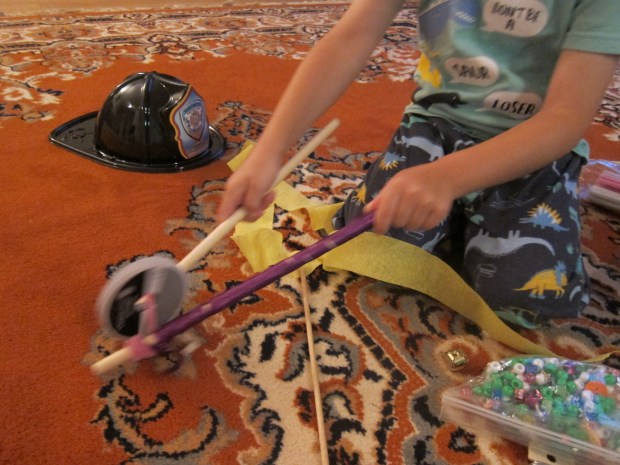
First up was this toy wheelbarrow – a matter of attaching an empty ribbon spool between two dowels.

LP Toys (18)

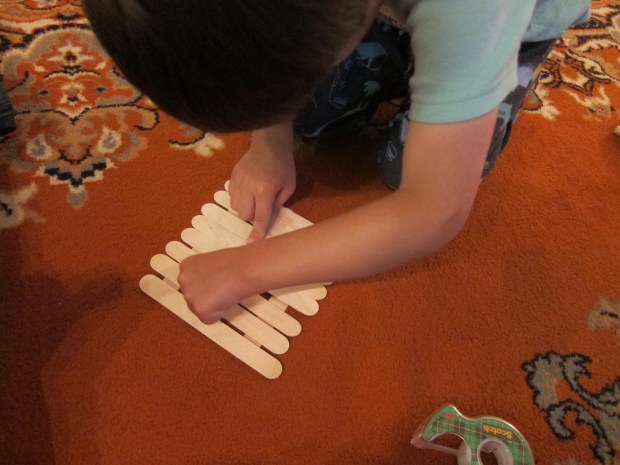
Next he wanted to build with craft sticks, much as you would with building blocks. Lots of tape helped make a sturdy frame.

LP Toys (19)

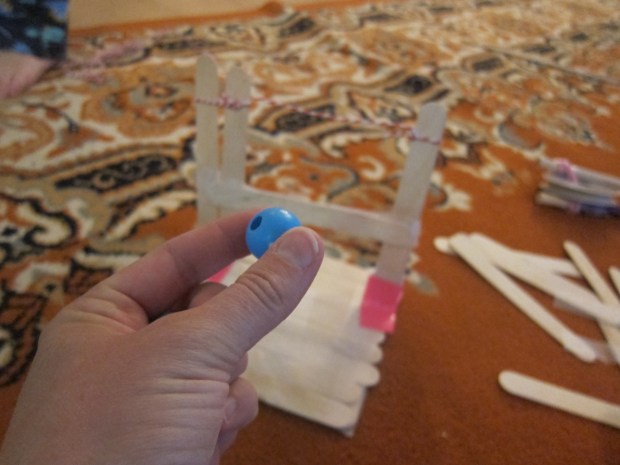
The construction soon turned into a game with a goal post that we could shoot wooden craft beads through for points.

LP Toys (20)

I loved watching his creativity through this whole process, involving at various points: black dot stickers; floral wire; Velcro stickers; and more. Some “toys” worked and some didn’t, but he had a blast and it filled a morning. I’d love to hear what your child makes in the comments! What will you name your new game?

Toys Keepsake:

Travis loved the keepsake in this package, a felt tic-tac-toe pouch with x’s and o’s that handily store inside the pouch when not in use. He needed a few games right away.

LP Toys (3)

Toys Field Trip:

If you’re lucky enough to live near a toy factory of some sort – the Crayola Experience in Easton, PA perhaps, or the Vermont Teddy Bear factory in Shelburne, VT – then there’s your ideal field trip to accompany this theme! Failing that, seek out local exhibits that feature a specific toy. We were lucky enough to find two such exhibits near us.

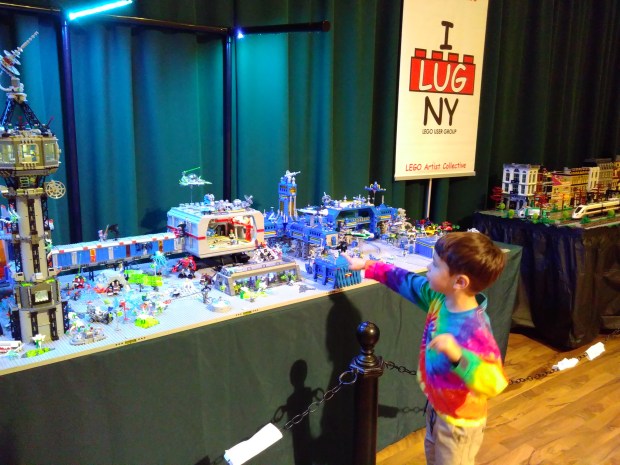
lego (4)

First up, a Lego building competition at a local cultural center, where we got to see fantastic creations, vote on our favorite, and try our hand at building our own.

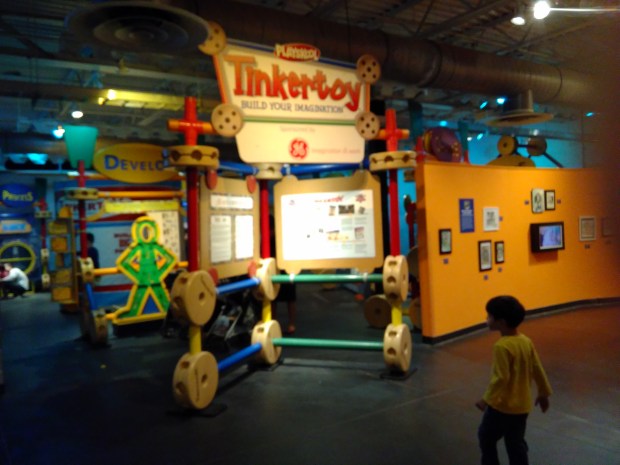
lego (7)

Then, our local children’s museum hosted a Tinkertoy exposition, which was a fun chance to check out this classic.

LP Toys (26)

While we were there, we got to see other traditional toys too, like this decorated doll house.

LP Toys (15)

What do you find in your area?

Toys Further Activities:

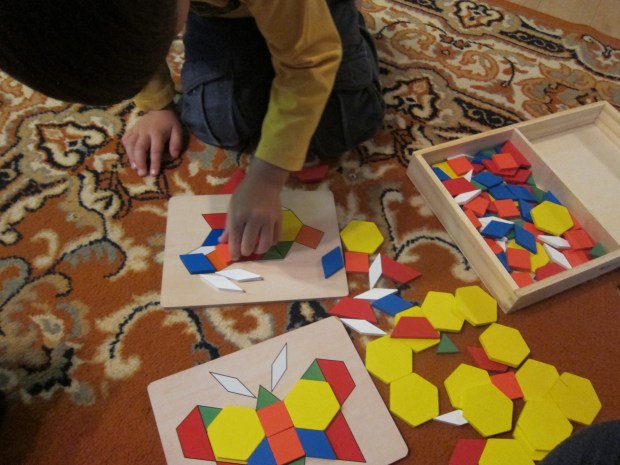
We used the booklet as a jumping off point for further, well, games! I have a set of tangrams (from Melissa and Doug) so it was fun to try and recreate the patterns in the booklet (although our shapes differed from the classic Chinese version).

LP Toys (16)

But Travis loved the activity so much he spent a whole evening busy at work!

LP Toys (17)

Then we headed outside to play the French version of hopscotch, called escaragot (snail), in which the board is curved, not the traditional American line.

LP Toys (28)

We had fun experimenting with other animal forms, including a turtle and a crab!

LP Toys (27)

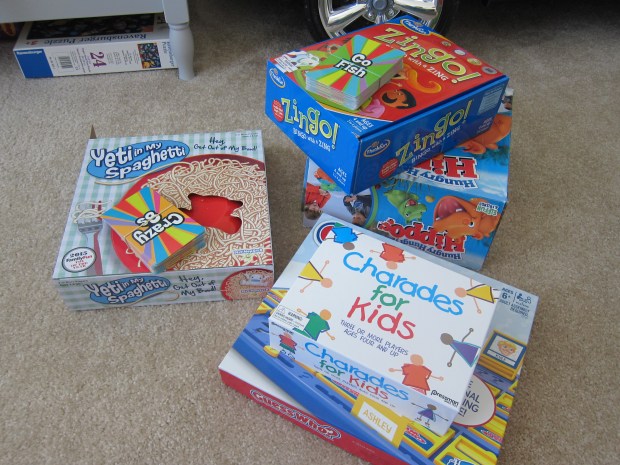
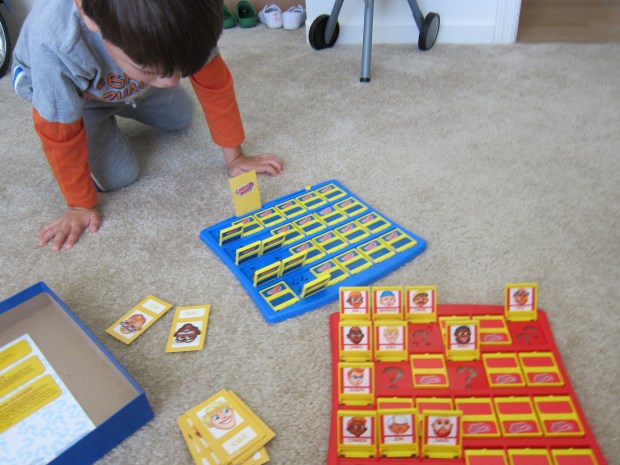
Then we had a tabletop board game “tournament.” Pull out all your board or card games, and make it family game night!

LP Toys (21)

The extent to which this is actually a “tournament” may depend on your kids’ ages. For Travis, we’re still just getting used to learning rules and turn-taking, but he had fun with Guess Who? Go Fish, Charades, Yeti in my Spaghetti, and more.

LP Toys (22)

Bigger kids or larger families can actually keep a scoresheet and turn it into a true tournament.

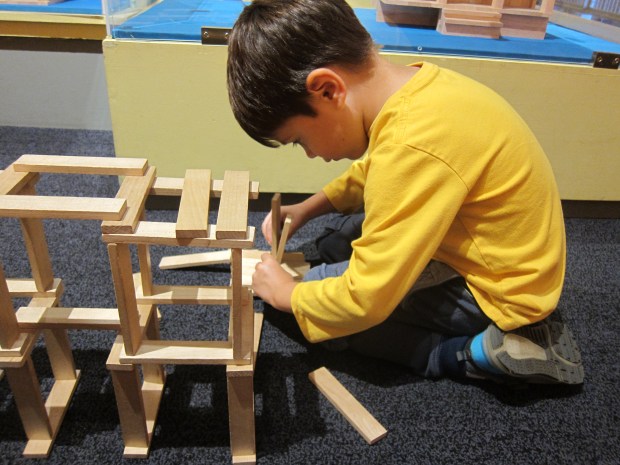
Then of course there’s good old block building. Make it special by trying to recreate buildings you’ve visited, or famous landmarks.

LP Toys (14)

Since we’d had a recent trip into the city, we tried to build skyscrapers. Keva blocks are great for this purpose, but any wooden block set (or plastic) would also work well.

LP Toys (13)

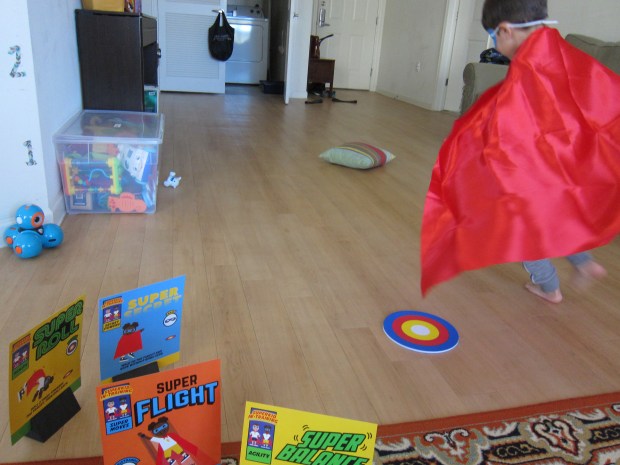
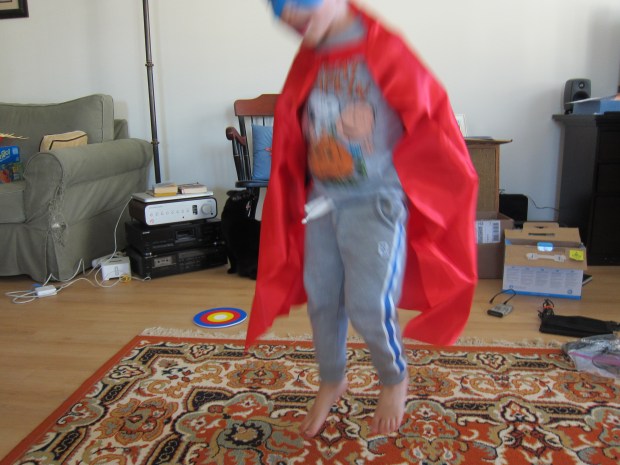
Finally, we chose to purchase the kit’s optional add-on this month, which was a Superhero game – not just dressing up like one, but training to be one. Needless to say, Travis was in heaven.

LP Toys (24)

Soon we were jumping hard enough to shake the Earth, flying around the room, leaping over targets, and more.

LP Toys (25)

Greater Than and Less Than Gator

Greater Gator (8).JPG

A chomping alligator who can help teach your child the less-than and greater-than symbols? What a cute way to kick off some math for the school year!

This project didn’t work out exactly as planned for us, largely because I had to upcycle egg cartons that were not my own, and as I result used half-dozen cartons, not a full dozen… Needless to say, our final product wasn’t quite a long alligator snout (perhaps more of a hungry dinosaur!) but the lesson remained the same.

Cut apart the tops and bottoms of two egg cartons; paint the tops green and the bottoms white. Let dry completely.

Greater Gator (1)

Here is where things got a little difficult: Punch holes in the green portions, and use yarn to thread first through the holes of the bottom “jaw” and then the holes of the top “jaw.” This is great lacing practice for kids! Tie off with a knot at the end.

Greater Gator (2)

I then hot glued the white “teeth” into each portion of the jaw. (You may need to trim about half a row of the teeth away, for it to nest properly inside the top portion of the carton.

Greater Gator (3)

You now have a hinged puppet who can open and close its mouth to chomp up… numbers!

For our counting game, I affixed block dot stickers to construction paper in various combinations – 2 dots is less than 3; 5 dots is greater than 4; and so on.

Greater Gator (4)

Travis had a bit of difficulty with the actual mechanism of our gator’s jaw, but aside from that, I loved watching him complete each task we put up on the easel. For each, he would count the dots first, then declare which was greater.

Greater Gator (7)

When your child tires of the math lesson, they’ll have a fun gator puppet to play with! Ours was soon involved in superhero games.

Greater Gator (6)

Baking Crate

Koala Baking (7)

For my boy who loves helping in the kitchen, our latest crate from Koala Crate may have been the favorite of all we’ve received in 2 years of our subscription. A quick warning though: This crate is messy! But in the best way, of course. So grab some newspaper to cover your work surface and get “baking.”

First up, every chef needs a toque, so we decorated the Chef Hat that was project #1.  Squeeze the provided paint pens onto a paper plate, and use the provided foam shapes to decorate.

Koala Baking (2)

Travis had fun dotting the stamps here and there, but I showed him a few of the suggestions in the instructions, too, combining shapes to make ice cream cones, lemons, or apples.

Koala Baking (6)

More fun than the decorating was simply wearing it. Look at that baker’s joy!

Koala Baking (1)

Next up was frosting the Pretend Cake project.

Squeeze out air-dry clay (from adorable little “pastry bags”) onto the provided foam triangles, and spread your frosting with a craft stick.

Koala Baking (3)

Travis loved that this was just like a Daniel Tiger episode he had seen, and frosted all 8 pieces so seriously and carefully. I showed him how to stack them into a layer cake, and then we used the provided punch-out decorations to add berries and candles.

Koala Baking (5)

Another quick note of warning: The toque and cake will both need to dry for several hours, so make sure your children know there will be a waiting period, to avoid disappointment! Travis was so happy once he could finally play.

Koala Baking (8)

Next up was Measuring Fun, a far more technical and mathematical lesson about cooking, with almost endless variations. First, encourage your child to line up the cups by size.

Koala Baking (9)

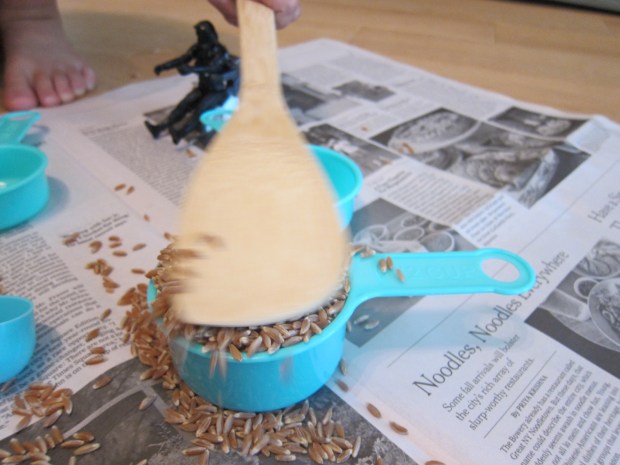
Then try filling the cups (which came in 1/2 cup, 1/3 cup, 1/4 cup and tablespoon denominations) with rice or another dried grain. Travis loved leveling with a spoon!
Koala Baking (10)

We moved on to a wet ingredient (water). Get down at belly level and see the meniscus.

Koala Baking (12)

Show your child how you need different numbers of each cup to make 1 cup of water – 2 of the 1/2 cup, 3 of the 1/3 cup and so on. And a whopping 16 tablespoons!
Koala Baking (13)

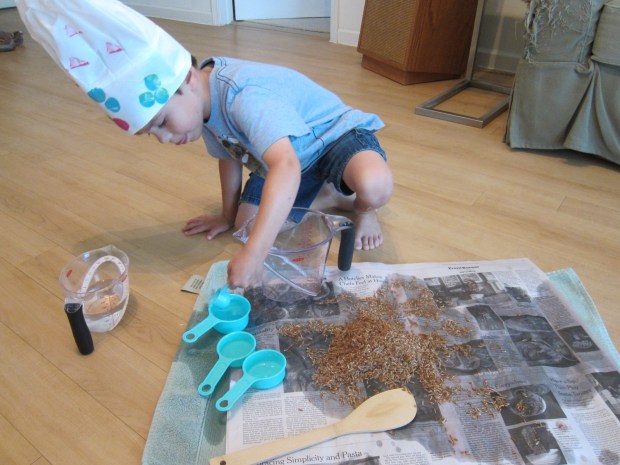
I sort of lost Travis at this point, because he had his own game going, spooning the water into the dried grains and mixing up a “recipe” – a true chef!

There are 3 activity cards that go with the measuring cups, meaning we played for days thereafter. First up was the yellow card, with two color mixing activities: Rainbow Color Mixing and Shades of Colors.

For the former, we squirted our paint pens into three cups of plain water to make red, yellow, and blue, the primary colors.

Koala Baking (14)

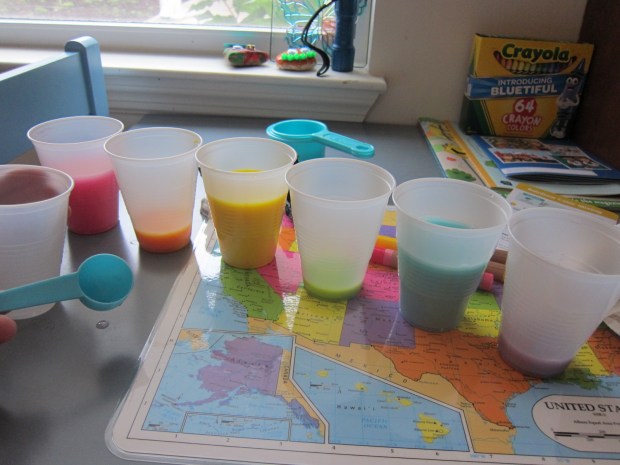
To make the secondary colors, we mixed these primary colors at a 1:1 ratio (using our tablespoon as a guide), and soon had a full rainbow!
Koala Baking (15)

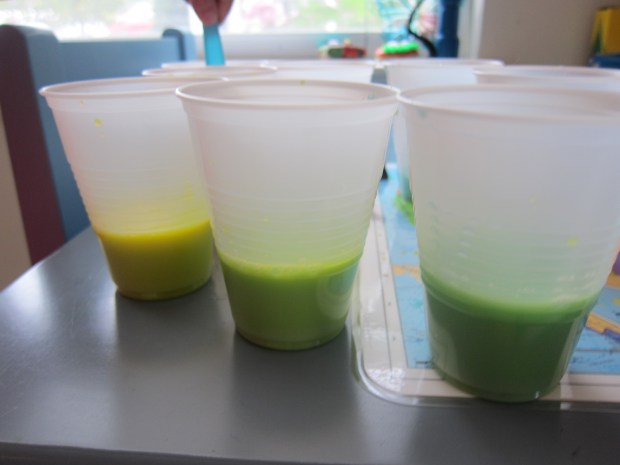
For the latter, we used different ratios of colors to make varying shades. 1 tablespoon of yellow + 8 blue made a very bluish-green, whereas the reverse (1 blue + 8 yellow) made a lime green. Travis loved this, and soon was mixing up oranges, purples and more.
Koala Baking (17)

After lots of playing mixologist, we only had variations of beige and brown.

Koala Baking (21)

While he gleefully poured colors back and forth, we talked about how chefs use this same method – measuring ingredients in varying combinations – to make a recipe.

Koala Baking (19)

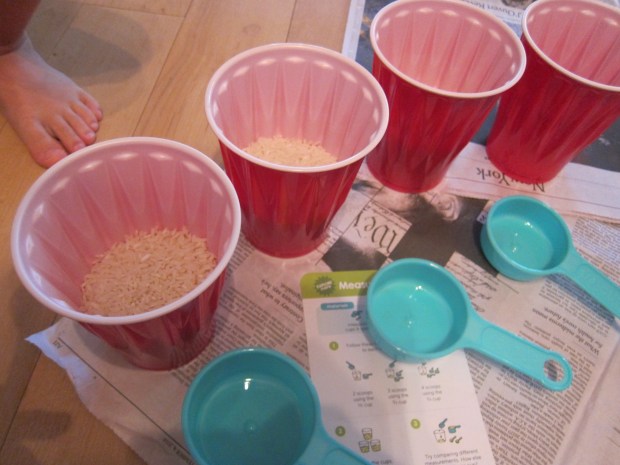
Next up was the green card: Measuring Fractions and Measuring Volume. For the former, line up 3 cups of identical size, and show your child that you can make 1 cup of rice in each by using: two 1/2 cups, three 1/3 cups, four 1/4 cups, or 16 tablespoons.
Koala Baking (23)

A neat trick is to show them that the second (bottom) number on the cup (i.e. the denominator) is the number of times they’ll need to use that cup to make 1 full cup. Travis loved helping count out, especially the full 16!

Koala Baking (22)

Then we played around with volume. I poured 1 cup or rice into each of three containers – a tall cup, a short cup, and a wide bowl. Just like most kids will, Travis guessed that the tall glass had the most rice, a cute first lesson on volume. You can try this with different containers and water, too!

Koala Baking (24)

For a final day of fun, we played with the red card. Now it was time to make recipes, one edible and one not.

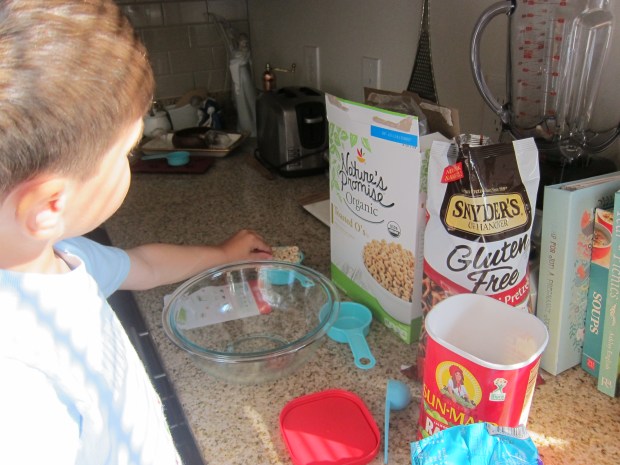
For Trail Mix, use your cups to combine the following: 1/2 cup cereal, 1/3 cup pretzel twists, 3 tablespoons raisins, and 1 tablespoon chocolate chips.
Koala Baking (28)

Yum!

Koala Baking (29)

Then we mixed up Bubble Water. Use the measuring cups to combine 4 cups water (8 of your child’s 1/2 cup), 1/4 cup dish soap, and 2 tablespoons sugar.

Koala Baking (30)

Not only was this fun to mix…

Koala Baking (31)

…but it made for fantastic end-of-summer play outside on our patio, blowing bubbles, popping them in the grass, and catching them.

Koala Baking (32)

What else can you do with your measuring cups? We tried whipped up a fruit salad:

Koala Baking (25)

I encouraged Travis to measure each fruit before he added it to the mix, though truth be told he was more interested in eating the fruit than the measuring lesson.

Koala Baking (26)

If you like, write down the recipe you create on an index card so your little chef can repeat it in the future.

Koala Baking (27)

Whew, that was a lot! Apologies for the long post, but thank you for the fun, Koala Crate!

Koala Baking (33)

Which Is Heavier?

Weighs More (5)

We loved this idea for an easy, at-home balancing scale from the September issue of High Five magazine. To make it, you’ll just need a few items you likely already have lying around the house. Then the weighing fun begins!

To set up the scale, punch holes in the sides of two plastic cups – one brand in our cupboard was actually too tough to punch, but we managed to get holes in a second brand – phew!

Weighs More (1)

Thread pipe cleaners through the holes, then loop the pipe cleaners onto a hanger with hooks. Place on a door so the cups hang evenly.

Weighs More (2)

Now it was time to play scientist and test out a few combinations. For each pair of the following, I asked Travis which he guessed would be heavier before we actually weighted.

1 stuffed animal vs. 3 toy cars

5 markers vs. 5 crayons

1 toilet paper tube vs. 4 quarters

Weighs More (3)

When a small toilet paper tube didn’t balance the quarters, he suggested trying a longer paper towel tube – a much closer balance!

Weighs More (4)

He loved it so much he was soon running around the house to test combinations. A rock from his collection was by far the heaviest thing, and we had fun trying to guess what might balance it out. A big set of old car keys came closest.

Weighs More (6)

In sum, a great way to introduce balancing scales to your child, without any complicated work involved. Thanks High Five!
Domino Steal Game

Domino Steal (3)

On the heels of our starfish counting game, here’s another great way to reinforce numbers and number recognition before back-to-school. Dominoes lend themselves to any variety of counting games – including just matching up the pips! – but this version involves stealing from the other players. An instant preschooler hit!

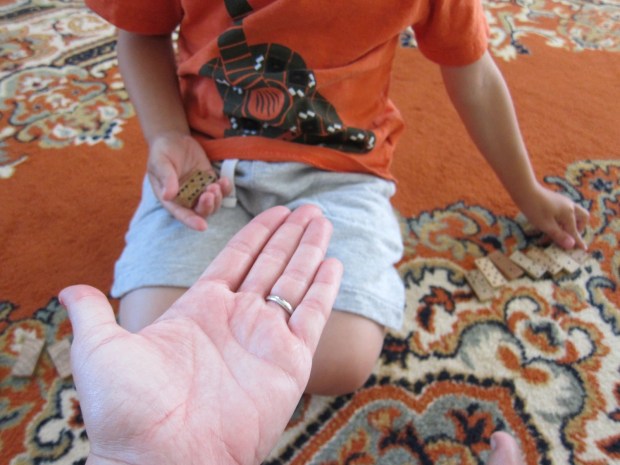
To play, you need two players, whether two kids, or an adult and one child. Pull out two dominoes, and each player counts the number on theirs. This is great not just for learning to count the dots, but also learning to recognize the arrangement of the pips by sight.

Domino Steal (2)

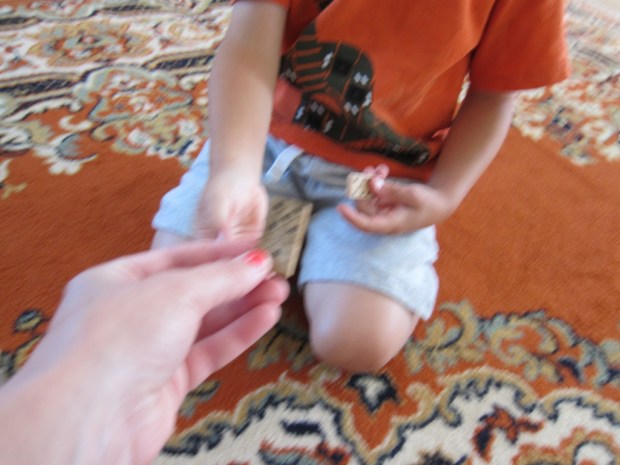
Whoever has the higher number on his or her domino wins that turn, and gets to “steal” the other players domino. Stealing was a big thrill of course! Here’s the thief in action:

Domino Steal (1)

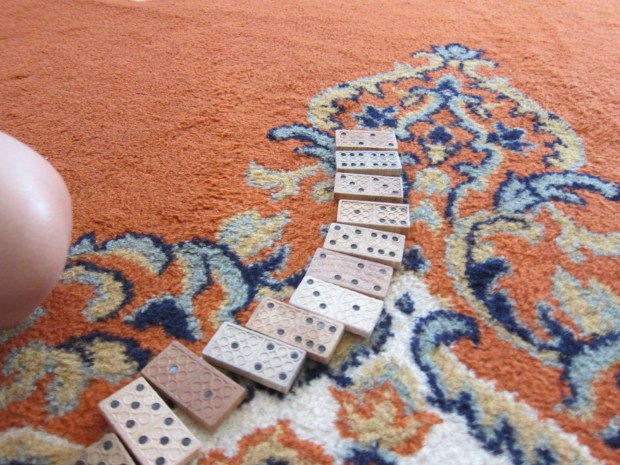
I swear I didn’t rig the game, but Travis ended up with quite the collection.

Domino Steel (4)

When you’re done playing, I recommend leaving the dominoes out… They are a fantastic prompt for kids who want to arrange them, or play make-believe with them, or practice numbers on their own.

Starfish Counting Game

Starfish Count (4)

This adorable game is a fun way to get kids counting (or memorizing by rote) the pips on dice. The beach-y starfish theme makes it just right for the end of summer, if you’re helping kids prep for back-to-school!

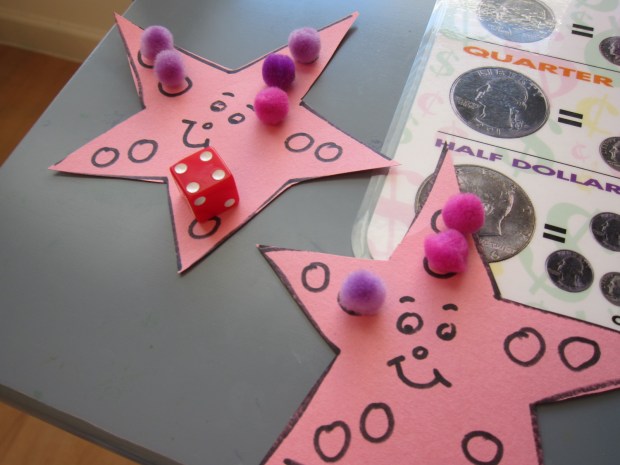
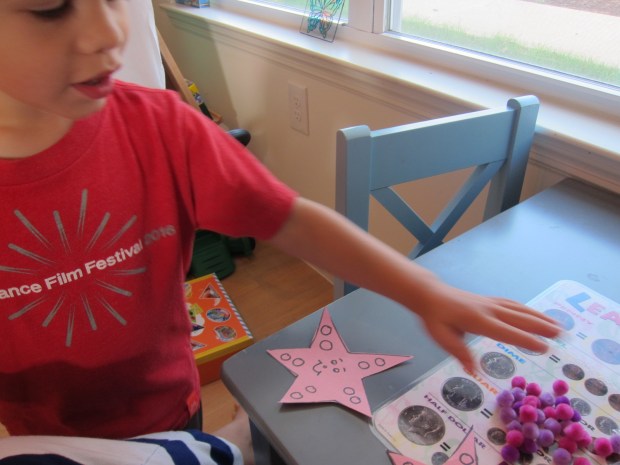
I drew two starfish free-hand (don’t judge my stars too harshly!) and added smiles and 10 dots to each (to represent the bumps along a true sea star’s arms).

Starfish count (1)

Set out the starfish as your playing boards, along with pom poms and dice.

Starfish count (2)

Take turns rolling the die, and add the appropriate number of pom poms to your starfish board. The first player to fill in all their bumps wins!

Starfish Count (3)

In sum, a simple counting game that will boost kids’ confidence as they had back to the classroom.

Starfish Count (5)