Baking Crate

Koala Baking (7)

For my boy who loves helping in the kitchen, our latest crate from Koala Crate may have been the favorite of all we’ve received in 2 years of our subscription. A quick warning though: This crate is messy! But in the best way, of course. So grab some newspaper to cover your work surface and get “baking.”

First up, every chef needs a toque, so we decorated the Chef Hat that was project #1.  Squeeze the provided paint pens onto a paper plate, and use the provided foam shapes to decorate.

Koala Baking (2)

Travis had fun dotting the stamps here and there, but I showed him a few of the suggestions in the instructions, too, combining shapes to make ice cream cones, lemons, or apples.

Koala Baking (6)

More fun than the decorating was simply wearing it. Look at that baker’s joy!

Koala Baking (1)

Next up was frosting the Pretend Cake project.

Squeeze out air-dry clay (from adorable little “pastry bags”) onto the provided foam triangles, and spread your frosting with a craft stick.

Koala Baking (3)

Travis loved that this was just like a Daniel Tiger episode he had seen, and frosted all 8 pieces so seriously and carefully. I showed him how to stack them into a layer cake, and then we used the provided punch-out decorations to add berries and candles.

Koala Baking (5)

Another quick note of warning: The toque and cake will both need to dry for several hours, so make sure your children know there will be a waiting period, to avoid disappointment! Travis was so happy once he could finally play.

Koala Baking (8)

Next up was Measuring Fun, a far more technical and mathematical lesson about cooking, with almost endless variations. First, encourage your child to line up the cups by size.

Koala Baking (9)

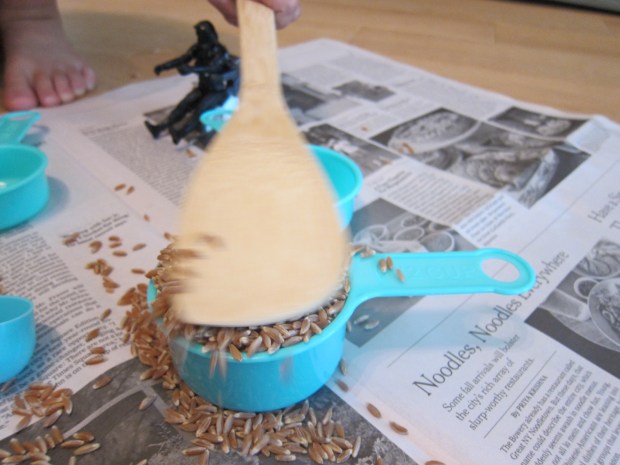
Then try filling the cups (which came in 1/2 cup, 1/3 cup, 1/4 cup and tablespoon denominations) with rice or another dried grain. Travis loved leveling with a spoon!
Koala Baking (10)

We moved on to a wet ingredient (water). Get down at belly level and see the meniscus.

Koala Baking (12)

Show your child how you need different numbers of each cup to make 1 cup of water – 2 of the 1/2 cup, 3 of the 1/3 cup and so on. And a whopping 16 tablespoons!
Koala Baking (13)

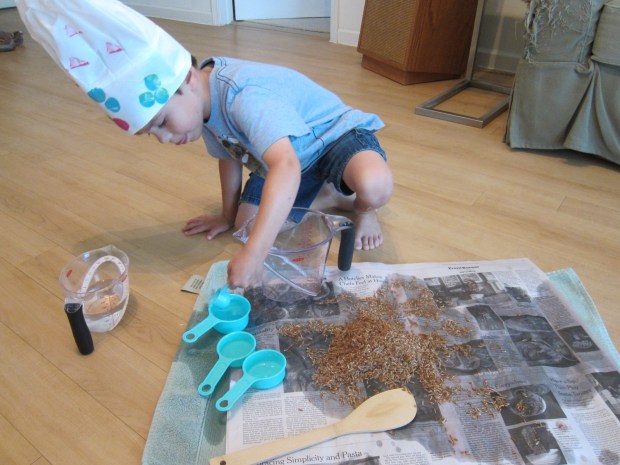
I sort of lost Travis at this point, because he had his own game going, spooning the water into the dried grains and mixing up a “recipe” – a true chef!

There are 3 activity cards that go with the measuring cups, meaning we played for days thereafter. First up was the yellow card, with two color mixing activities: Rainbow Color Mixing and Shades of Colors.

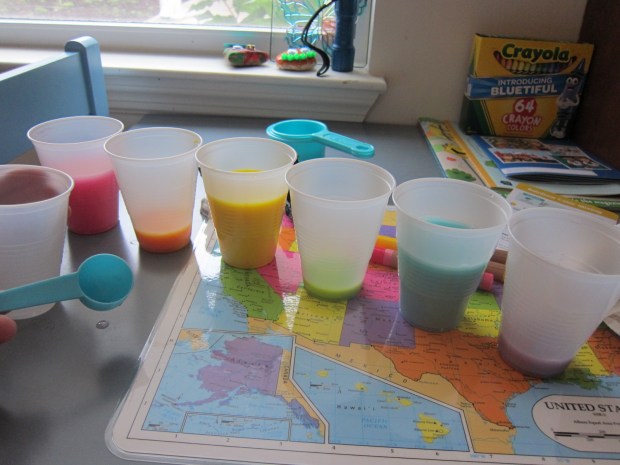
For the former, we squirted our paint pens into three cups of plain water to make red, yellow, and blue, the primary colors.

Koala Baking (14)

To make the secondary colors, we mixed these primary colors at a 1:1 ratio (using our tablespoon as a guide), and soon had a full rainbow!
Koala Baking (15)

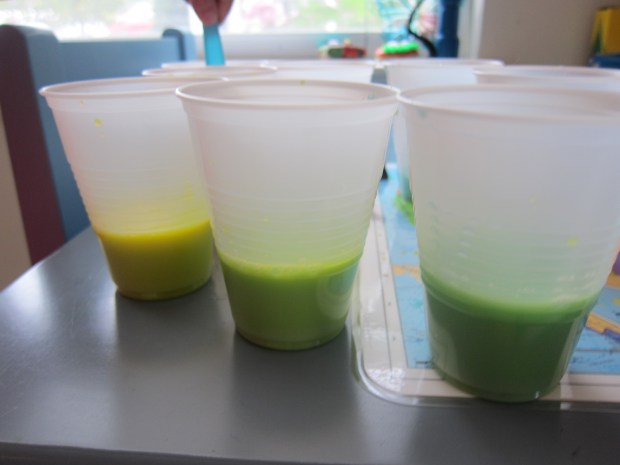
For the latter, we used different ratios of colors to make varying shades. 1 tablespoon of yellow + 8 blue made a very bluish-green, whereas the reverse (1 blue + 8 yellow) made a lime green. Travis loved this, and soon was mixing up oranges, purples and more.
Koala Baking (17)

After lots of playing mixologist, we only had variations of beige and brown.

Koala Baking (21)

While he gleefully poured colors back and forth, we talked about how chefs use this same method – measuring ingredients in varying combinations – to make a recipe.

Koala Baking (19)

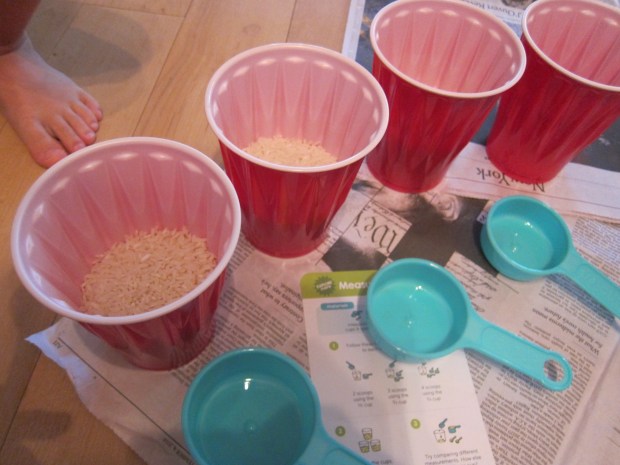
Next up was the green card: Measuring Fractions and Measuring Volume. For the former, line up 3 cups of identical size, and show your child that you can make 1 cup of rice in each by using: two 1/2 cups, three 1/3 cups, four 1/4 cups, or 16 tablespoons.
Koala Baking (23)

A neat trick is to show them that the second (bottom) number on the cup (i.e. the denominator) is the number of times they’ll need to use that cup to make 1 full cup. Travis loved helping count out, especially the full 16!

Koala Baking (22)

Then we played around with volume. I poured 1 cup or rice into each of three containers – a tall cup, a short cup, and a wide bowl. Just like most kids will, Travis guessed that the tall glass had the most rice, a cute first lesson on volume. You can try this with different containers and water, too!

Koala Baking (24)

For a final day of fun, we played with the red card. Now it was time to make recipes, one edible and one not.

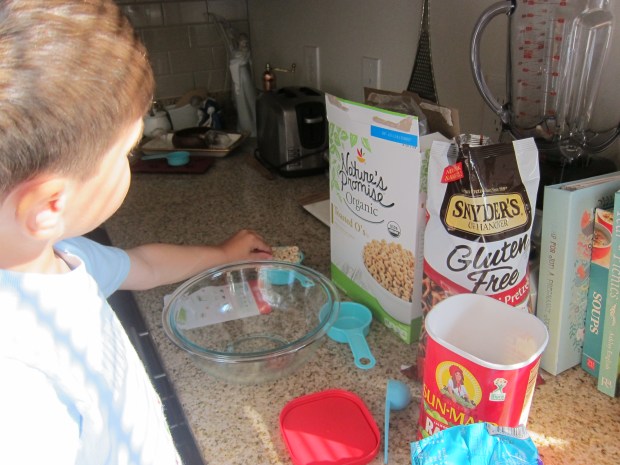
For Trail Mix, use your cups to combine the following: 1/2 cup cereal, 1/3 cup pretzel twists, 3 tablespoons raisins, and 1 tablespoon chocolate chips.
Koala Baking (28)

Yum!

Koala Baking (29)

Then we mixed up Bubble Water. Use the measuring cups to combine 4 cups water (8 of your child’s 1/2 cup), 1/4 cup dish soap, and 2 tablespoons sugar.

Koala Baking (30)

Not only was this fun to mix…

Koala Baking (31)

…but it made for fantastic end-of-summer play outside on our patio, blowing bubbles, popping them in the grass, and catching them.

Koala Baking (32)

What else can you do with your measuring cups? We tried whipped up a fruit salad:

Koala Baking (25)

I encouraged Travis to measure each fruit before he added it to the mix, though truth be told he was more interested in eating the fruit than the measuring lesson.

Koala Baking (26)

If you like, write down the recipe you create on an index card so your little chef can repeat it in the future.

Koala Baking (27)

Whew, that was a lot! Apologies for the long post, but thank you for the fun, Koala Crate!

Koala Baking (33)

Farmers’ Market Fun: Homemade Fruit Leather and Apple Chips

Fruit Leather (4)

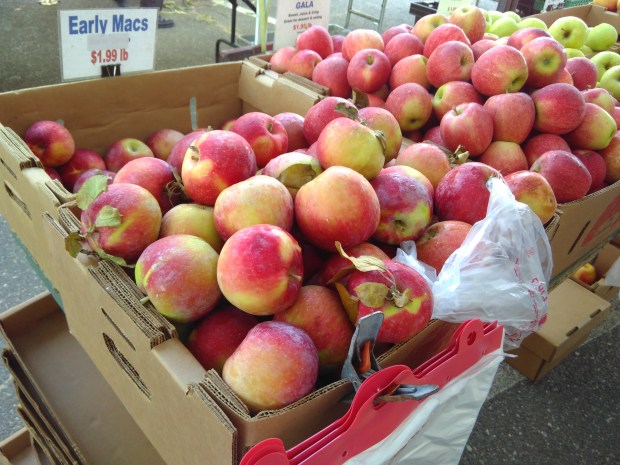
Farmers Markets are fantastic this time of year, featuring the last of the summer fruits (think berries, peaches, and plums) and the first of the fall harvest (apples!). To celebrate the end of summer, we headed to the market on a warm Sunday morning, then brought our bounty home to turn it into delicious fruit leather and other snacks.

Fruit Leather (5)

Bonus: The following recipes are perfect for packing in your kids’ lunch boxes for school.

For our first batch, Travis and I used peaches. He was so proud helping me peel the skin from 4 large peaches (parents, use discretion on whether or not your child needs help with this tool).

LP Jobs (3).JPG

I sliced the peaches and Travis was in charge of transfering them to the blender, so proud to do so!

LP Jobs (4)

We added 2 tablespoons agave nectar and 2 teaspoons lemon juice. It was Travis’s very important job to be the taste tester, and I asked him if it needed either more agave or lemon. Nope, just right!

LP Jobs (5)

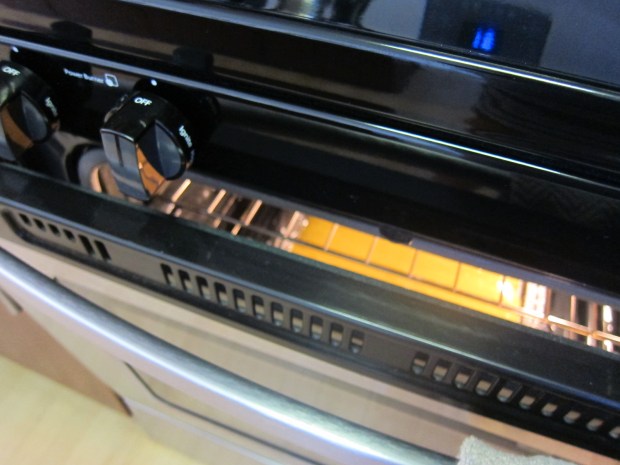
Pour the mixture onto a baking sheet lined with plastic wrap. Bake at 170 degrees F for 4 hours, leaving the door of the oven cracked open just slightly (this step made me slightly nervous, but I guess it can be done!).

Fruit Leather (1)

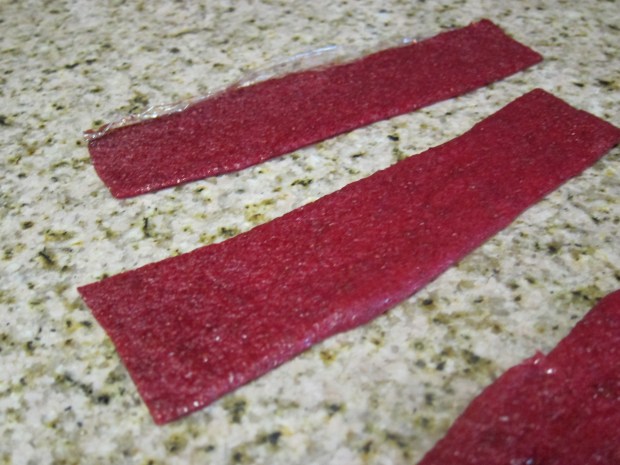
Cut into slices (leave the plastic wrap on for easy backing) and store in an air-tight container.

Fruit Leather (3)

To prepare an apple chip version, we pureed 5 apples (cored but not peeled) with 1/2 cup water until smooth. Note: next time I would use less water.

Apple Chips (1)

Pour into a 13×9-inch baking dish lined with plastic wrap. Again, bake at 170 degrees F for 4 to 5 hours, leaving the door cracked. Because I used too much water, our apples turned out more like another fruit leather, not true apple chips. But still yummy!

Apple Chips (2)

Don’t stop there! Try strawberry fruit leather in late summer, or pear fruit leather as autumn arrives. For the strawberry version, use 4 cups strawberries in place of the peaches. We had to give this one a full 6 hours in the oven!

Fruit Leather alt.JPG

The pear version ended up being our best and favorite! For this one, I used 3 pears and cooked for 4 and 1/2 hours.
Pear Leather (2)

Which Is Heavier?

Weighs More (5)

We loved this idea for an easy, at-home balancing scale from the September issue of High Five magazine. To make it, you’ll just need a few items you likely already have lying around the house. Then the weighing fun begins!

To set up the scale, punch holes in the sides of two plastic cups – one brand in our cupboard was actually too tough to punch, but we managed to get holes in a second brand – phew!

Weighs More (1)

Thread pipe cleaners through the holes, then loop the pipe cleaners onto a hanger with hooks. Place on a door so the cups hang evenly.

Weighs More (2)

Now it was time to play scientist and test out a few combinations. For each pair of the following, I asked Travis which he guessed would be heavier before we actually weighted.

1 stuffed animal vs. 3 toy cars

5 markers vs. 5 crayons

1 toilet paper tube vs. 4 quarters

Weighs More (3)

When a small toilet paper tube didn’t balance the quarters, he suggested trying a longer paper towel tube – a much closer balance!
Weighs More (4)

He loved it so much he was soon running around the house to test combinations. A rock from his collection was by far the heaviest thing, and we had fun trying to guess what might balance it out. A big set of old car keys came closest.

Weighs More (6)

In sum, a great way to introduce balancing scales to your child, without any complicated work involved. Thanks High Five!
Ultimate Lemonade Stand

Lemonade Stand (9).jpg

We couldn’t say farewell to summer without having a lemonade stand!

The inspiration for Travis’s first entrepreneurial venture came when we learned about Alex’s Lemonade Stand Foundation, and were inspired not just to help our neighbors on a hot day, but to send our proceeds to charity, too.

Unfortunately I could not be certain that the beneficiaries of Alex’s Lemonade Stand (in the realm of children’s cancer research) did not test on animals. To get in on the charitable act without harming any living being, I was thrilled to learn that the Children’s Oncology Group does not test on animals. We planned to send our donations to this charity, and then it was time to think about some lemon-tastic fun.

First up were a few recipes! To supplement a few bottles of store-bought lemonade, we also made this homemade version. In a blender, combine the following:

1 (5-pound) watermelon, cubed

8 ounces lemon juice

1/2 cup agave nectar

Process until smooth, then refrigerate until ready to serve.

Lemonade Stand (2)

For a Lemonade Snack Mix to go with our beverages, Travis helped prepare this mix:

  • Melt 2 tablespoons Earth Balance butter with 2 tablespoons sugar in a microwave-safe bowl. Stir in 1/2 teaspoon lemon extract.
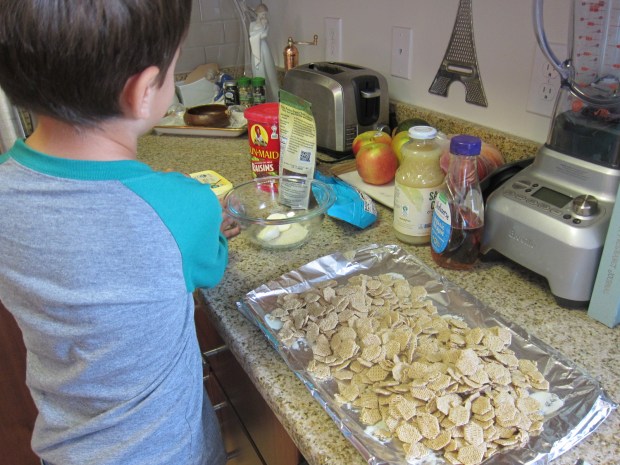
  • Drizzle the butter mixture over 4 cups multi-grain cereal (such as Barbara’s multigrain spoonfuls) on a baking sheet lined with foil. Bake at 300 degrees F for 20 minutes, stirring about halfway through.
  • Once the cereal mix cools, stir in 1 cup raisins and 1 cup dried cranberries.
  • Heat 1 cup chocolate chips in the microwave at 20 second intervals until melted. Transfer to a zip-top plastic bag and drizzle over the cereal mix.
  • Top with your favorite sprinkles (such as Let’s Do Organic). Let cool completely
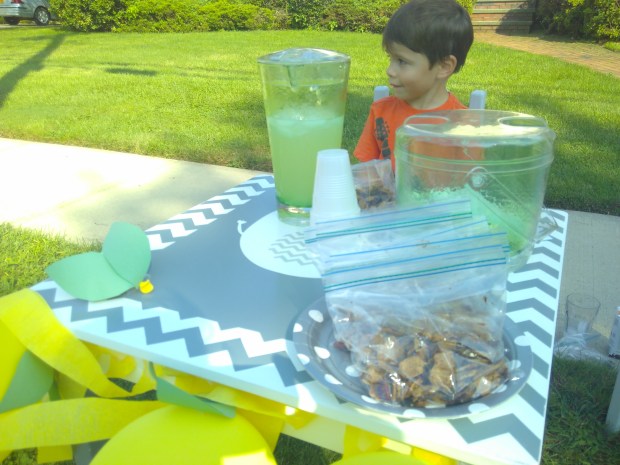
  • Divide the mixture into zip-top plastic bags to sell.

Lemonade Stand (1)

On lemonade stand day, it was set-up time! Travis helped make posters by drawing yellow “lemons” around my words.

Lemonade Stand (3)

Big kids can definitely have fun with the decorations on their posters. Be sure to post them all around the neighborhood so those who might not otherwise pass your house will have a reason to come by.

Lemonade Stand (6)

We adorned our stand with yellow crepe paper and a few yellow balloons; green construction paper “leaves” taped on the tops turn them into instant giant lemons!

Lemonade Stand (5)

Travis took to his new business with more alacrity than I would have guessed, flagging down cars and passers-by, gleefully pouring lemonade from the pitcher, and proudly asking each customers how many cups they wanted.

Lemonade Stand (11)

A couple notes for a hot day: Do try and set up your table in the shade, or your little seller will wilt fairly quickly.

Lemonade Stand (7)

Don’t be afraid to take breaks! You might miss a few customers, but especially for the youngest business-owners, their interest may lag after about half an hour. Try again in an hour or so!

Lemonade Stand (8)

Finally, charge a small amount for each cup and snack, but be aware that folks are surprisingly generous and will often pay you more, whether simply to support a young kid’s actions, or once they learn the proceeds will go to charity.

I knew this was a hit when Travis turned to me and said, “Mom, this was a great idea. Thank you!” And now to proudly send off our donation.


Wild Moves

Animal Moves (6)

I was a bit surprised to find no craft or Green Time in Travis’s latest issue of Ranger Rick Jr., but the magazine was full of fantastic facts and stories about animals, as always. It also included an activity to work those gross motor skills: copying the movements of wild animals.

First up was hopping like a kangaroo. This one was especially neat because the magazine pointed out that a kangaroo can jump 30 feet in one bound (!). We needed to pull out the yard stick to visualize that, and measured our own jumps.

Animal Moves (1)

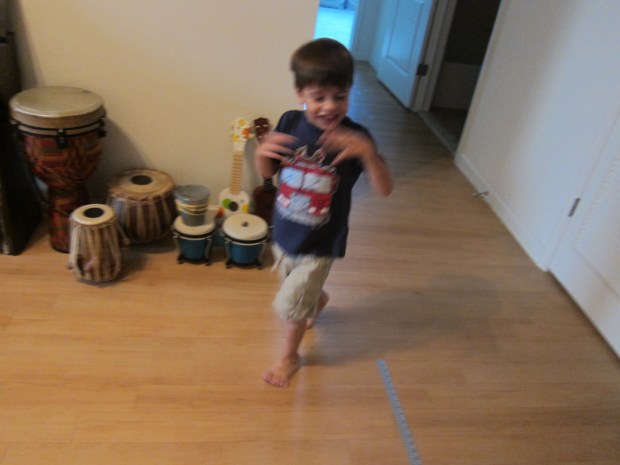
From there, we tried the article’s other suggestions, which had us waddling like a penguin, flapping like a duck, and pouncing like a cat.

Animal Moves (2)

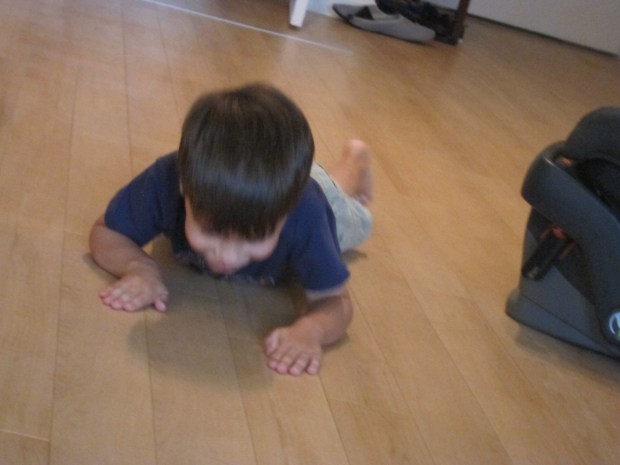
Travis was having so much fun that I encouraged him to decide which animal move he could do next. Soon we had slithering snakes;

Animal Moves (3)

Trumpeting elephants;

Animal Moves (5)

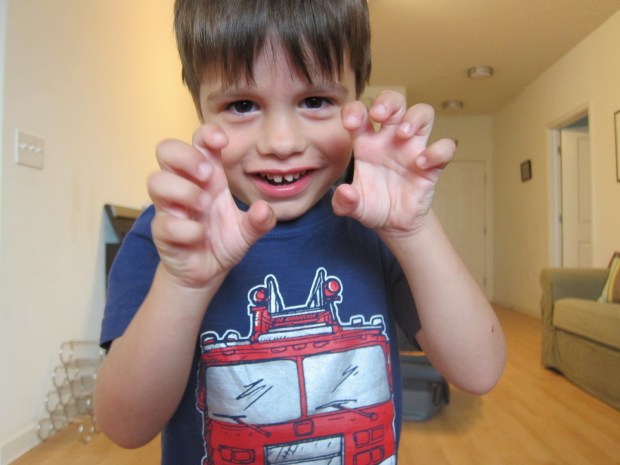
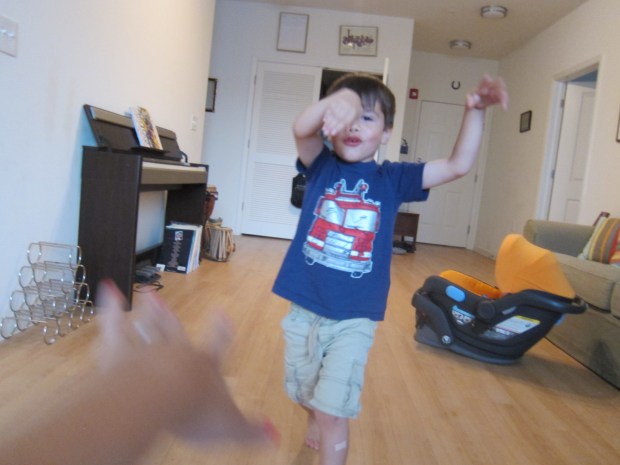
And a very ferocious lion (pictured at the top of this post).

A great prompt for imagination and to get us moving.

Animal Moves (4)


Early Explorers Rocks

LP Rocks (18)

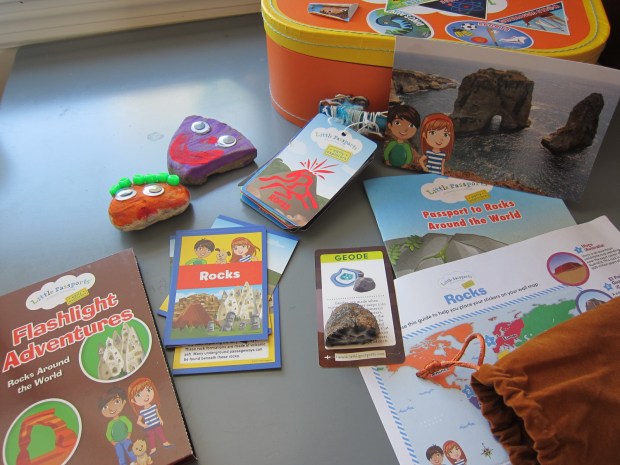
Our latest package from Early Explorers was on the seemingly simple subject of rocks, but there was so much fun to be had! Of course we received the usual: a sticker for Travis’s suitcase, stickers to pinpoint on his map that depicted amazing rocks around the world, flash cards, and an activity booklet. The booklet was heavy on math and tracing activities this month, which made this mama very happy!

LP Rocks (13)

Rocks Craft:

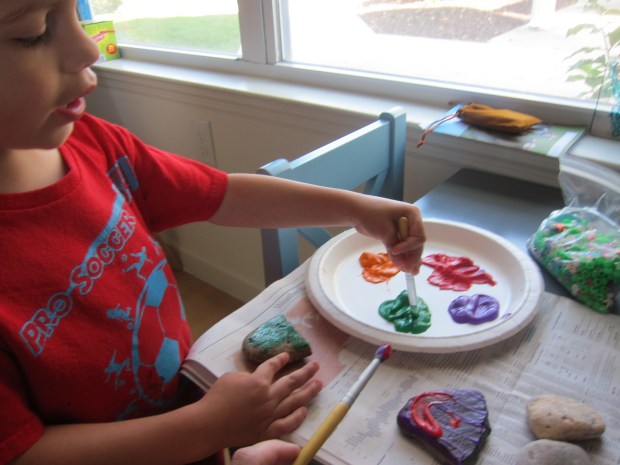
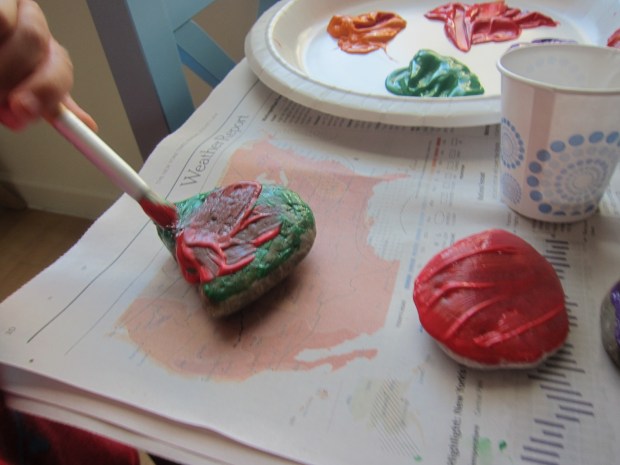
The booklet suggested making pet rocks, something Travis had only recently done in art class, but he was eager to replicate the activity at home. A trip to the beach gave us flat smooth stones that were perfect for turning into “pets.”

LP Rocks (7)

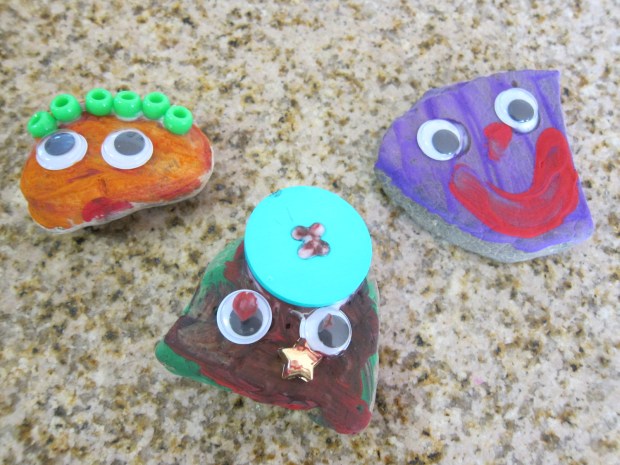
Travis carefully chose his colors, while I painted a smile on a second rock.

LP Rocks (8)

The one with the button hat is entirely his creation! He even named it. If you want to get extra creative, turn your pet rock into a frog.

LP Rocks (9)

Rocks Science:

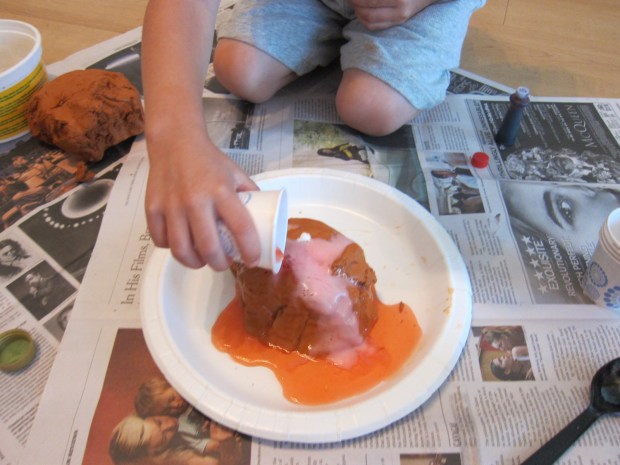
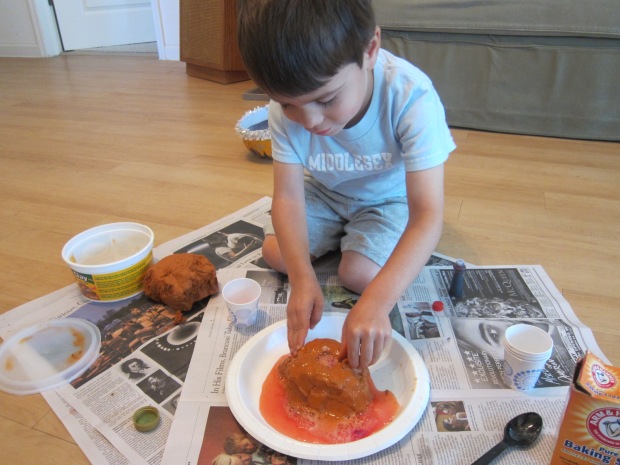
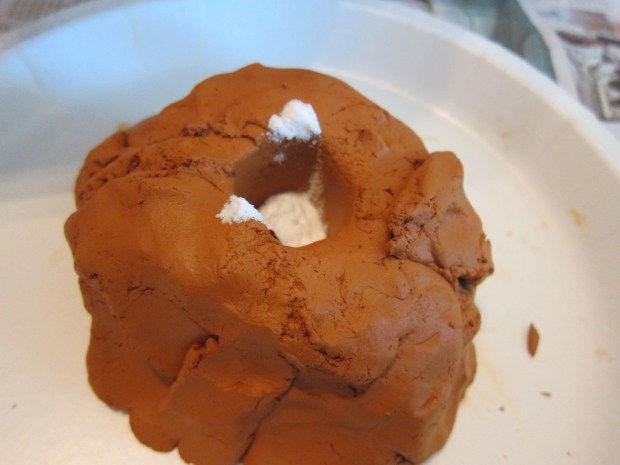
An oldie-but-goodie – make a volcano with baking soda and vinegar. We used terracotta-colored clay for the most realistic appearance, and even added a touch of red food coloring to our vinegar. Make a hole in your volcano, and fill with a little baking soda.

LP Rocks (4)

Pour in the vinegar…

LP Rocks (5)

…and watch it explode! Don’t be surprised if kids want to repeat this one again and again.

LP Rocks (6)

Rocks Keepsake:

The geode Travis received was very pretty, and immediately became part of his “treasure” box, although I’ll admit I was a little disappointed this overlapped with the Natural Wonders pyrite we received in a previous package.

LP Rocks (2)

Rocks Field Trip:

A summer vacation was the perfect chance to search for rocks on the beach. (Or if you’re not near the beach, head to your nearest park and see what kinds of rocks you unearth).

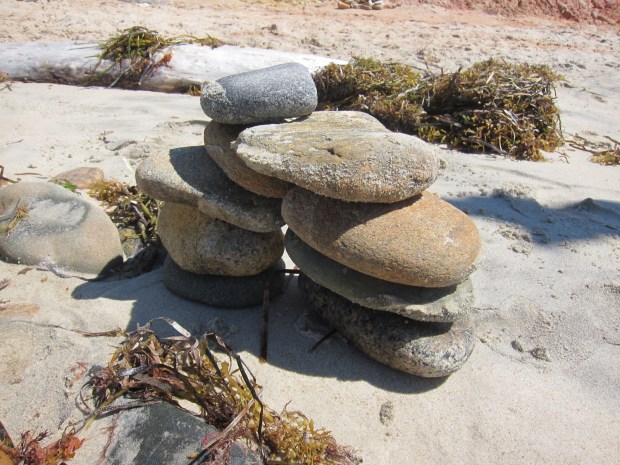
We checked out the cairns other people had stacked, including this wowza of a caterpillar…

LP Rocks (17)

…and tried our hand at our own “inukshuk”!

LP Rocks (15)

Rocks Further Activities:

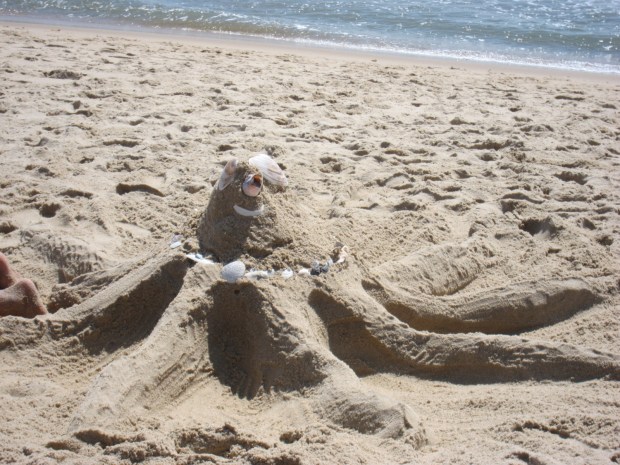
The booklet suggested building a sandcastle in a sandbox (with the scientific reminder that sand is really just broken down rocks and shells)… but we decided to go one better and attend a local sandcastle contest! Travis loved checking out some of the winners, including an octopus and mermaid.

Montauk (1)

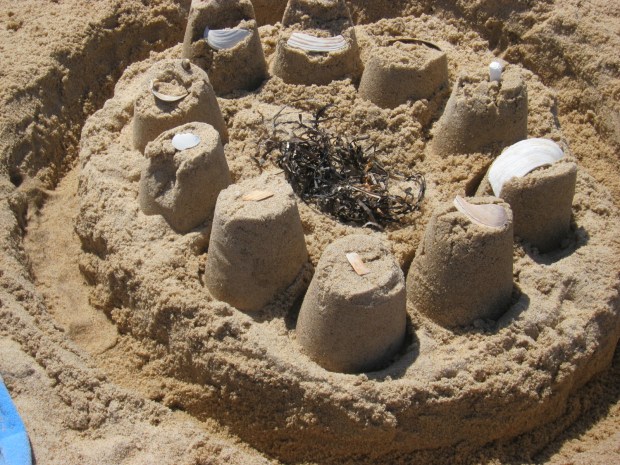
We made our own creation with towers, a moat, and beach finds as decoration.

Montauk (9)

Back at home, a recipe for rock layer parfaits was great fun to put together. Even little kids will get an idea about the layers that make up the earth when they make this recipe, whether or not they’ve seen the Grand Canyon.

LP Rocks (11)

In clear plastic cups, we layered the following:

Graham cracker crumbs (sand)

Banana slices (clay)

Raisins (large rocks)

Jam (lava)

Granola (fossils)

Agave nectar (mud)

Blueberry yogurt (water)

Travis wasn’t wild about eating the parfait, but he enjoyed putting it together!

LP Rocks (12)

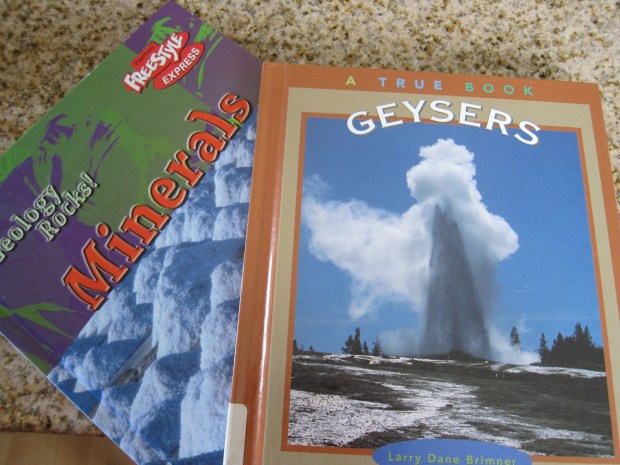
Finally, we headed to the library for books, choosing topics that the booklet had grazed upon like geysers and minerals. These were a bit advanced for Travis, but the pictures were fun!

LP Rocks (14)

We also selected our favorite rocks from the booklet. Travis said his favorite was any of the sparkly geodes.

Sandpaper Leaves

Sandpaper Leaves (7).JPG

We often think of leaf crafts as projects for the autumn, but here’s one that can be done in nearly every season (except winter!). It combines a little bit of nature, a little bit of sensory art, and a little bit of coloring all in one.

After a full family day at the park, we returned home with a collection of leaves. All of them were green this time of year (late summer), but we found leaves in as many different shapes as possible, everything from nearly oval, to trefoil, to pointy.

Sandpaper Leaves (1)

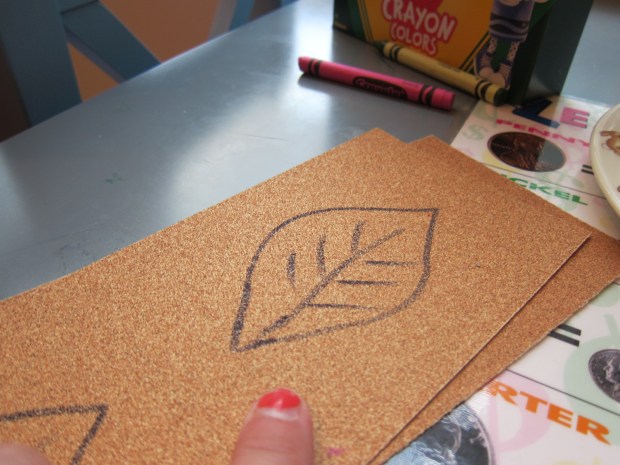
Once home, I traced the leaves in permanent marker on sandpaper, making sure to include lines for the veins (a quick little science lesson on how leaves drink their water!)

Sandpaper Leaves (4)

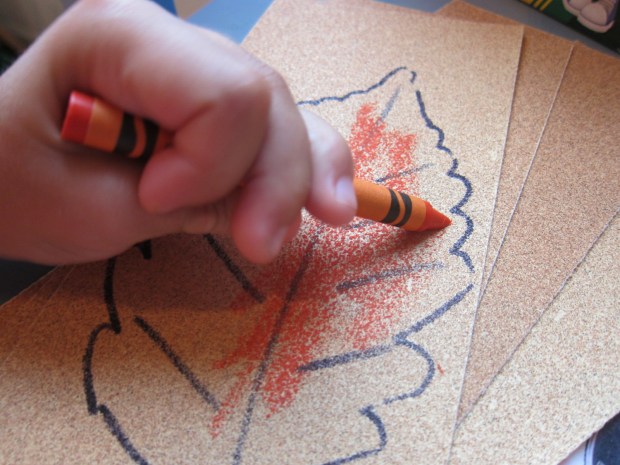
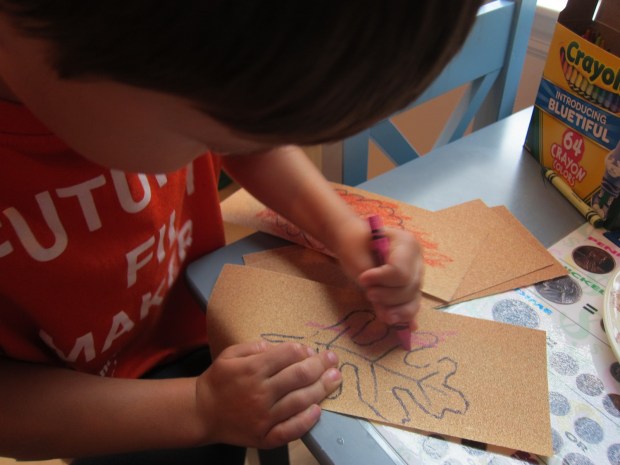
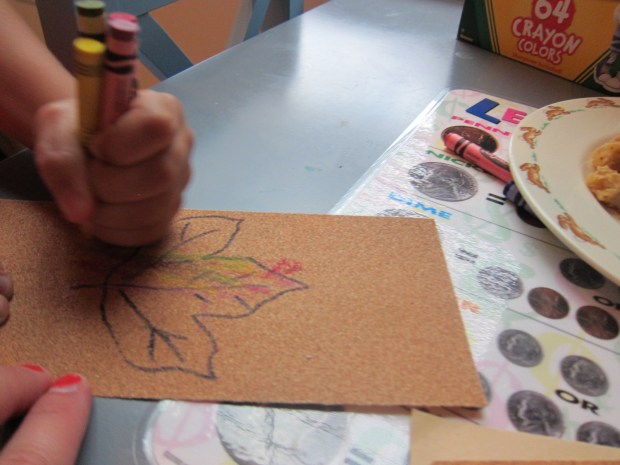
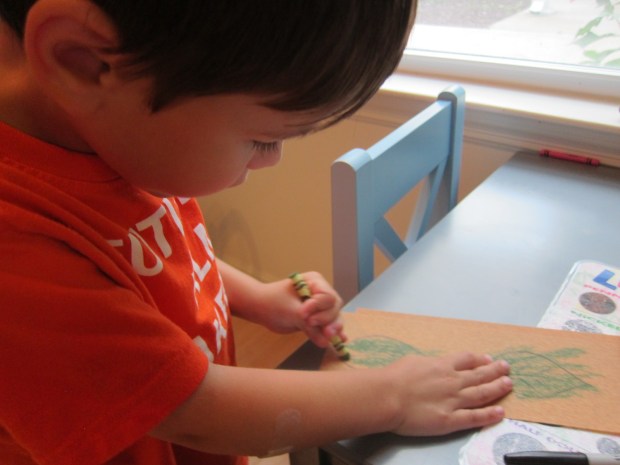
Travis loved selecting colors and filling in each leaf, with the sandpaper adding extra tactile fun.

Sandpaper Leaves (2)

He made some leaves true to life (oranges, greens), and went beyond nature with a few others in vibrant pinks.

Sandpaper Leaves (3)

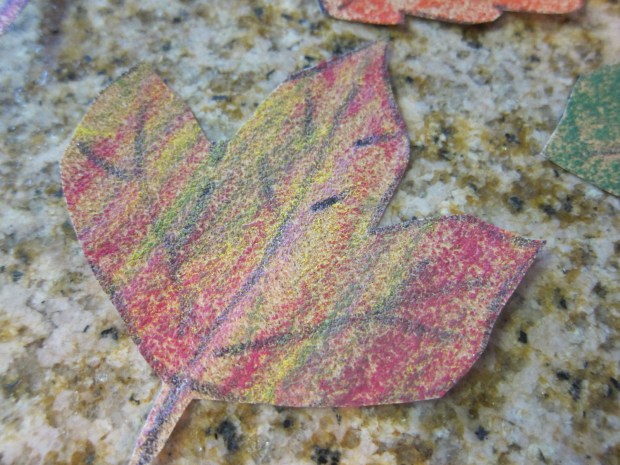
Best of all was when he grabbed a handful of crayons for a rainbow leaf – his own invention.

Sandpaper Leaves (6)

Cut out the leaves and paste up on the walls or use as pretty gift cards the next time you send a loved one something special.

Sandpaper Leaves (5)

We loved this variation on leaf art!

Sandpaper Leaves (8)

Domino Steal Game

Domino Steal (3)

On the heels of our starfish counting game, here’s another great way to reinforce numbers and number recognition before back-to-school. Dominoes lend themselves to any variety of counting games – including just matching up the pips! – but this version involves stealing from the other players. An instant preschooler hit!

To play, you need two players, whether two kids, or an adult and one child. Pull out two dominoes, and each player counts the number on theirs. This is great not just for learning to count the dots, but also learning to recognize the arrangement of the pips by sight.

Domino Steal (2)

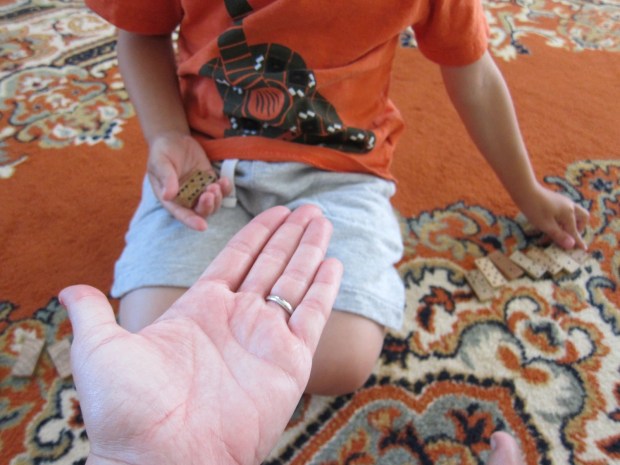
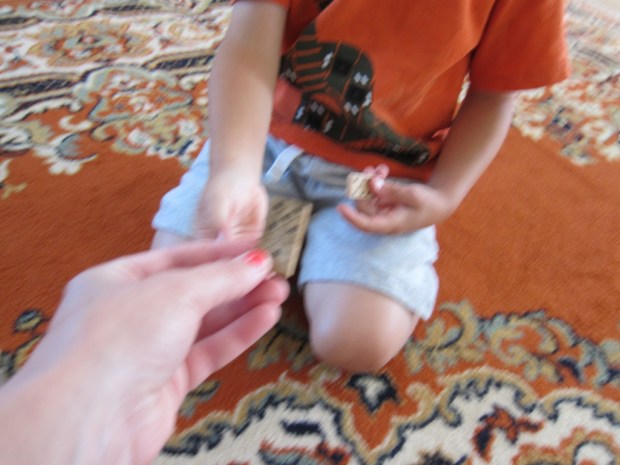
Whoever has the higher number on his or her domino wins that turn, and gets to “steal” the other players domino. Stealing was a big thrill of course! Here’s the thief in action:

Domino Steal (1)

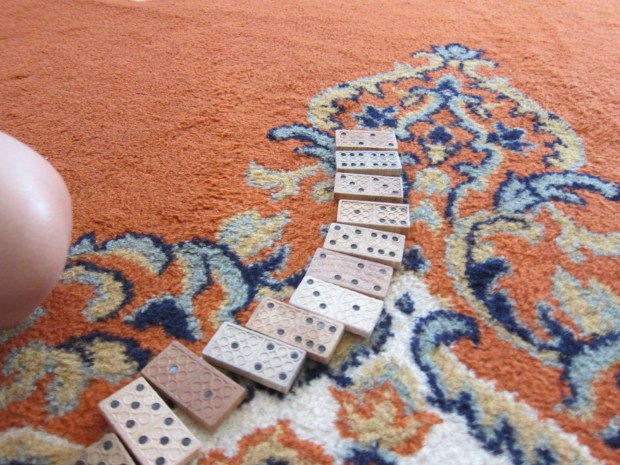
I swear I didn’t rig the game, but Travis ended up with quite the collection.

Domino Steel (4)

When you’re done playing, I recommend leaving the dominoes out… They are a fantastic prompt for kids who want to arrange them, or play make-believe with them, or practice numbers on their own.

Starfish Counting Game

Starfish Count (4)

This adorable game is a fun way to get kids counting (or memorizing by rote) the pips on dice. The beach-y starfish theme makes it just right for the end of summer, if you’re helping kids prep for back-to-school!

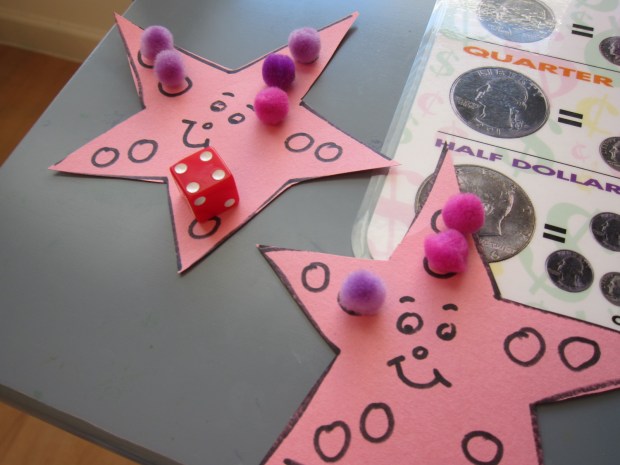
I drew two starfish free-hand (don’t judge my stars too harshly!) and added smiles and 10 dots to each (to represent the bumps along a true sea star’s arms).

Starfish count (1)

Set out the starfish as your playing boards, along with pom poms and dice.

Starfish count (2)

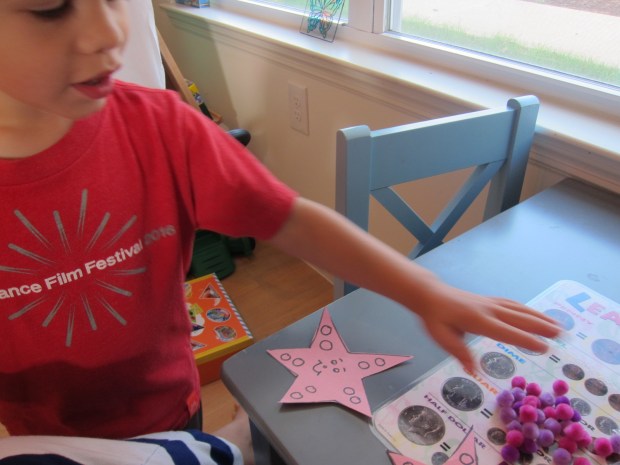
Take turns rolling the die, and add the appropriate number of pom poms to your starfish board. The first player to fill in all their bumps wins!

Starfish Count (3)

In sum, a simple counting game that will boost kids’ confidence as they had back to the classroom.

Starfish Count (5)

DIY Sundial – Two Ways!

Sundial (4)

Summer is the perfect time to give kids a visual of how the sun moves across the sky during the day. Here are two ways to mark off the hours and watch the shadows move!

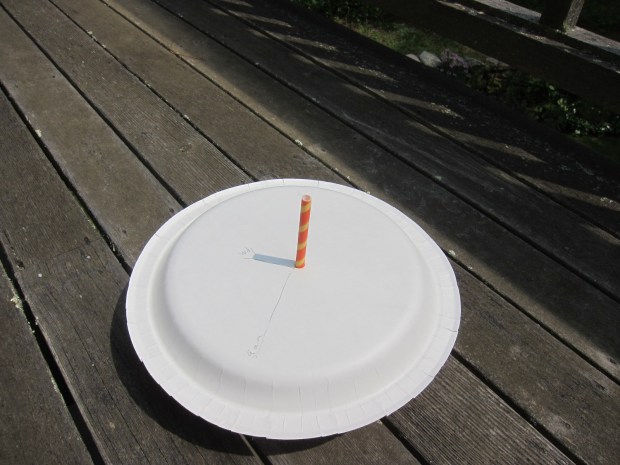
For our first sundial, we poked a straw through a paper plate, and set it securely between two planks of a back deck (alternatively, place in the yard with enough dirt around the straw to hold it firmly in place).

Sundial (1)

It was early when we started, a long 9 a.m. shadow, which Travis helped mark off.

Sundial (3)

We had to work around the sun a little bit (which disappeared behind the clouds a few times), but as we added hours, Travis could see how the shadow not only was shortest at mid-day, but also moved around the plate in a circle.

Sundial (5)

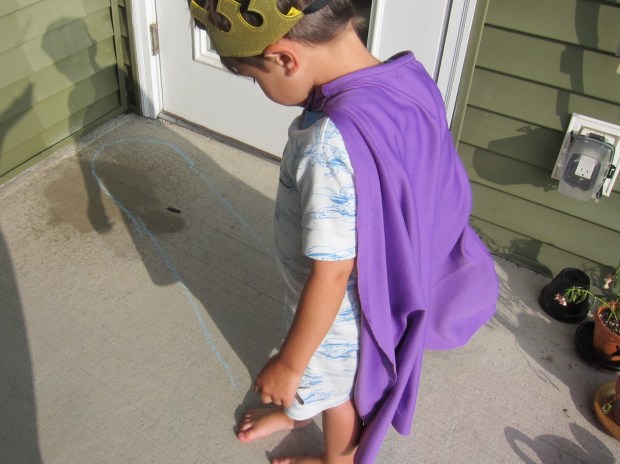
For a full-body experience, turn your child into the sundial! Sketch their outline with chalk at various points of the day, noting both location and length.

Sundial alt

After a full day’s cycle, they’ll be able to see how shadows move.