Ooey-Gluey Colors

Ooey Gooey Colors (5).JPG

It’s not often that I find an art project for my 5-year-old that feels refreshingly new. This artsy idea from Highlights magazine had definite goo factor that appealed to him!

First, drip school glue all over the clear acrylic cover from an empty photo frame. We used an 8×10 frame for maximum work space.

Ooey Gooey Colors (1)

Drip food coloring over the glue, ideally with some restraint, although Travis loved making big puddles of color.

Ooey Gooey Colors (2)

Finally, use a paintbrush to smear it all together.

Ooey Gooey Colors (3)

The colors will swirl and mix in neat ways and make little bubbles on the acrylic. This is a fun chance to experiment with different brushstrokes.

Ooey Gooey Colors (4)

Let dry completely, then insert back into the photo frame (gooey side in) for instant art. These look particular pretty when the sun hits them through a window, acting almost like a suncatcher.

Cactus Toss

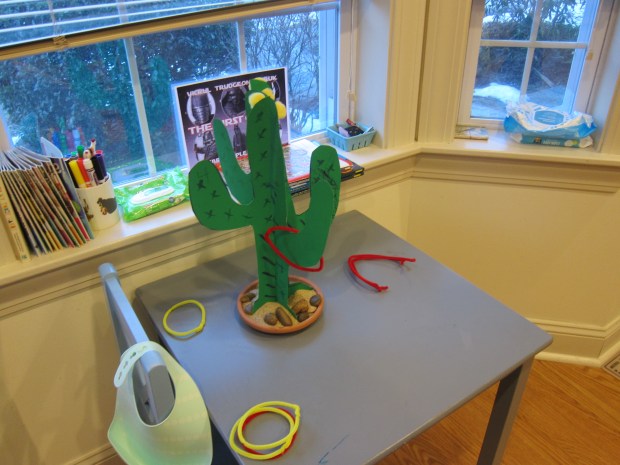
Cactus Toss (8).JPG

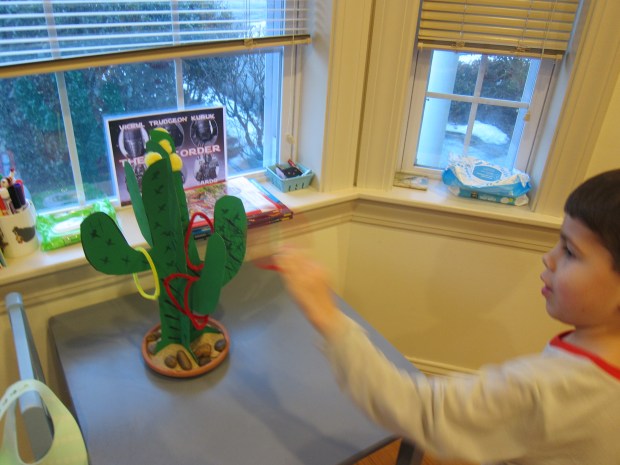
This game is sure to get laughs from your kids, and is a fun craft to boot!

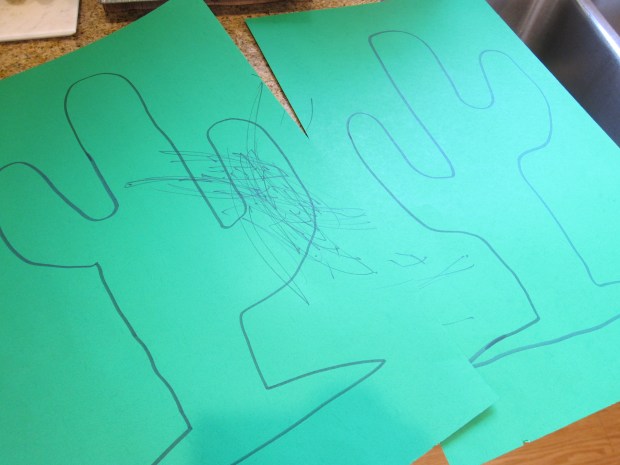
Start by drawing two cactus shapes on green poster board, about 1 foot high. Older kids will have fun drawing these on their own; I did this part for Travis, who declared my cactus “clumsy”, which I thought was just about the best description in the world.

Cactus Toss (1)

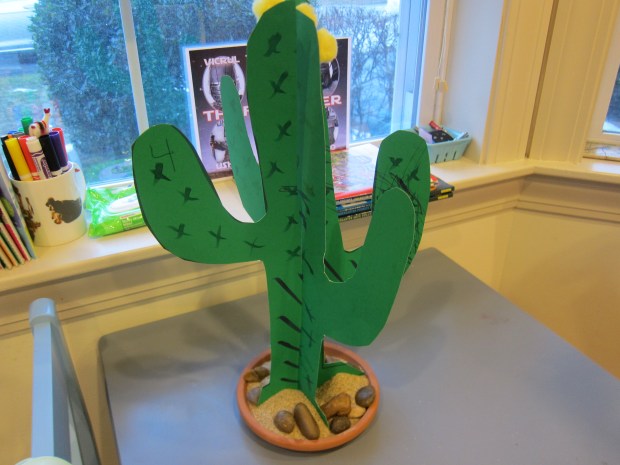
Decorate the cactus with paint markers. I helped Travis think about how we could depict spikes and thorns, with lots of crosses and slash marks.

Cactus Toss (3)

Make a slit in the bottom of one cactus half and a slit in the top of the other so they can slot together. Add point values to each arm of the cactus, and glue pom poms on top.

Cactus Toss (5)

Time to play! To set up the cactus, place it in a clay dish. We added sand and rocks for desert authenticity.

Cactus Toss (6)

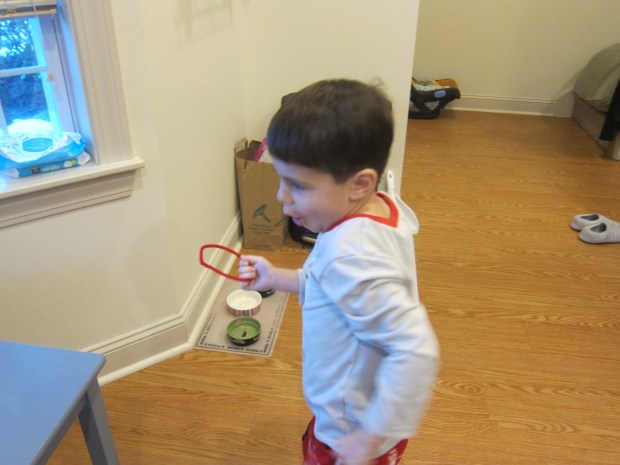
Twist pipe cleaners into circles for your playing pieces. I was yellow and Travis was red. Here’s the wind up…

Cactus Toss (7)

…and the toss!

Cactus Toss (9)

First player to 10 points wins. Travis was so proud when he hooked a 5 pointer on the top!


Chocolate-Eating Game

Chocolate-Eating (2).JPG

Travis learned about this hilarious game from his latest Highlights magazine, traditionally played at birthdays in Germany. It sounded so silly and fun we had to give it a try just for an after-school snack!

If you’re playing with multiple players, you’ll need a dice. Anyone who rolls a 6 quickly puts on a hat, mittens, and scarf, and tries to unwrap a chocolate bar with a knife and fork. The next player to roll a 6 takes that first person’s turn, and if the bar is unwrapped, then whoever rolls a 6 now gets to eat the chocolate with a knife and fork. Silly, right?

Because it was just me and Travis, we took turns donning all the winter gear and working at the wrapper with the utensils.

Chocolate-Eating (1)

Mommy got us in! Time to fork into our chocolate.

Chocolate-Eating (3)

Whoever manages to eat the most chocolate wins, of course! I can see this being just delicious to play with a batch of kids at a party.

Flashlight Word Game

Flashlight Word (4)

Travis can make his way through a few early phonics books, and although I’m not quite ready to call him a “reader”, I know he’s on the cusp. This cute bedtime game can hopefully tip him towards that edge!

Flashlight Word (1)

I wrote out a list of sight words on brightly colored construction paper, and taped them in a pattern along our playroom wall. (Note: you can also make this an “upstairs” game for right before bed, but since I knew we’d want to play after baby sister was asleep, I kept the game downstairs).

Flashlight Word (2)

There are several ways we played the game, all of which boost Travis’s sight reading! In the first version, I shined the flashlight on a word and he had to read it.

Flashlight Word (5)

Then it was his turn to challenge mommy! He shined the light, and laughed if I pretended to have a hard time with a word.

Flashlight Word (4)

For extra literacy fun, have your child first read the word, then put it in a full sentence. This is great for sight words like ‘for’ and ‘four’, or ‘two’ and ‘to’.

Flashlight Word (6)

Finally, you can play a sort of reverse version, calling out a word and then having your child find it with the flashlight.

Little sibs might want to play, too, and can look for letters instead of reading full words!


Can Toss Tumble

Can Tumble (2)

Travis has been having lots of arcade fun recently, and we continued the theme with this homemade carnival game. Play it just with family members or invite friends over for a can tumble tournament!

For about a week, I saved any canned goods we opened up: beans, soup, lentils etc. Rinse each can thoroughly and let dry completely.

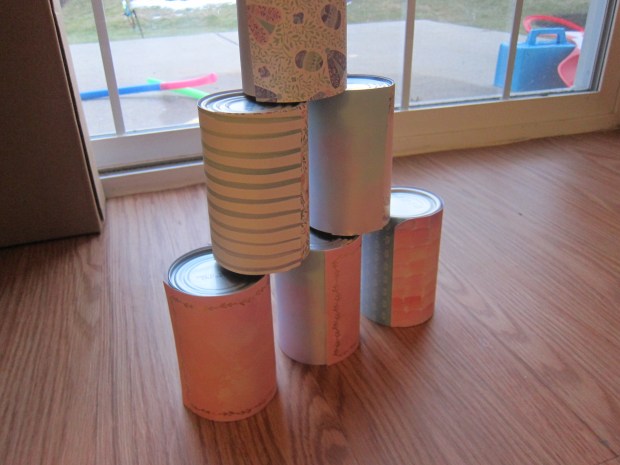
To make the cans more presentable, we went through a pad of brightly-patterned craft paper and selected patterns we liked best.

Can Tumble (1)

Glue the paper to the cans and let dry. If your kids want to get even more decorative, feel free to add other embellishment like glitter glue or stickers.

Now set up the cans in a pyramid and it’s time to compete.

Can Tumble (4)

We used a beanbag, though a ball would also work.

Can Tumble (5)

Travis was gleeful with each tumbling can! This was such simple but great fun for a little after-school “sport”.

Can Tumble (6)

Note: I didn’t worry about sharp can edges with my five year old, but if you play with younger children, make sure to cover any jagged metal edges with masking tape or painter’s tape.

Arcade Kiwi Crate

Kiwi Arcade (8)

Whenever we walk into an arcade, Travis’s favorite game is the claw machine, even though we almost never win. So the instant his Arcade kit arrived from Kiwi Co., I knew it was going to be a huge hit. He got to make his own claw and prizes…and was sure to be a winner this time.

There’s tons of STEM to love about this crate, especially in the first project: The Claw. Start by reading the explanation of how this simple machine works: a string that moves a bolt that pulls a connector that pulls a claw, resulting in the claw opening. The booklet even explains how it closes up again, when stretched-out rubber bands want to revert to their unstretched shape, pulling everything closed again.

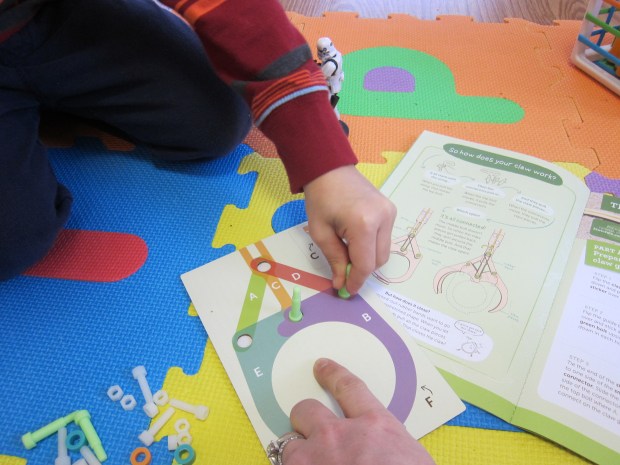
To prepare the Claw, Travis followed along layering bolts, wooden pieces, and nuts in the proper order, using the handy color-coded piece of cardboard that is the guide.
Kiwi Arcade (1)

Once assembled, the claw then lifts right up off the guide. A long wooden handle is attached in the same way with a second guide.

Kiwi Arcade (2)

Travis had to test it out on baby sister’s toys right away, of course!

Kiwi Arcade (3)

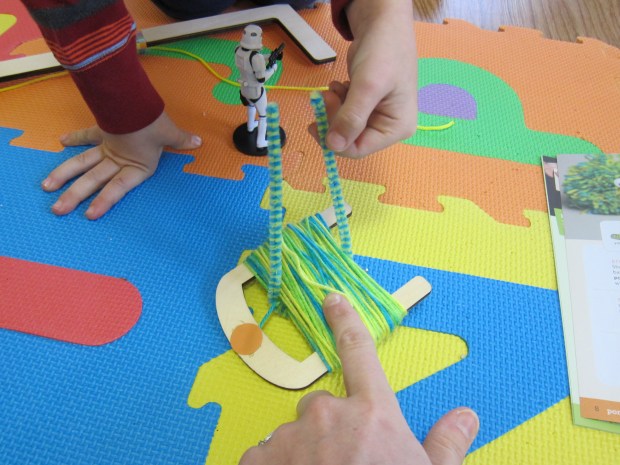
We immediately had to follow up with the next project: Pom-Pom Prizes. This was the artsy part of our STEAM lesson. Attach the end of one provided yarn bundle to a wooden pom-pom winder with a sticker, and loosely wind the yarn around.

Kiwi Arcade (4)

Having made homemade pom-poms, I appreciated how Kiwi took all the guesswork out of this, with yarn that looped along in no tangles. Now secure around the middle with the provided pipe cleaner.
Kiwi Arcade (5)

Slide the yarn off the winder and use scissors to snip open the loops of yarn. Fluff it out and you have a pom-pom! The pipe cleaners now bend down as little antennae and there are sticky-back wiggle eyes to adhere as the final touch. The crate contains enough material to make two. Travis loved these creatures, even before turning them into arcade prizes!

Kiwi Arcade (7)

It was time to put it all together and play the Claw Game. We cut a rectangular hole in the lid of the Kiwi Crate, leaving about a one-inch border, and a second hole on the side, leaving about a 1/2-inch border. Cut a piece of plastic from a gallon plastic bag to fit over the hole in the lid, and tape it on securely.

Kiwi Arcade (9)

We taped on the provided Claw Game decorations, then filled the box with little knickknacks from Travis’s treasure box. And added in the pom-pom prize of course.

Kiwi Arcade (10)
Travis was so proud once he got the hang of it.

Kiwi Arcade (13)

Mommy got the grand prize pom-pom!

Kiwi Arcade (11)

As always, we turned to Explore magazine for extended fun. There is a page filled with “penny arcade” games, a fun riff on the old-fashioned term, where kids can play games on the page with a literal penny.
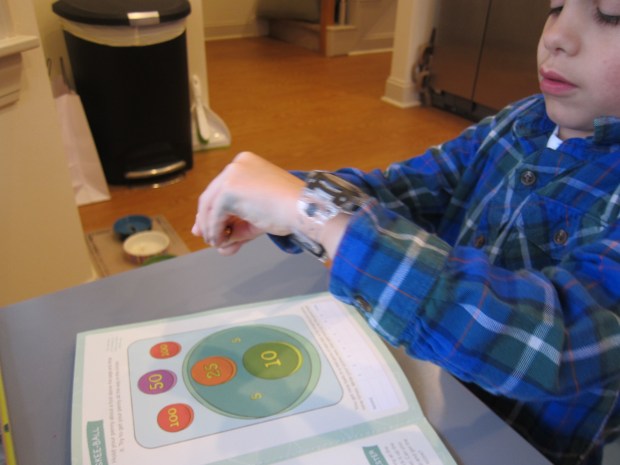
Kiwi Arcade (14)

Next we made a Laser Maze with crepe paper.

Kiwi Arcade (18)

A big fun house challenge!

Kiwi Arcade (17)

Finally, we made the Tilt-to-Win: Cut empty paper towel tubes to various lengths and cover each in a different color construction paper. Glue construction paper to a large flat box as the background, and glue on the tubes.

Kiwi Arcade (20)

Once dry, add a point value to each tube with marker. Put in a small ball, and take turns seeing how many points you can get in one minute.

Kiwi Arcade alt

This is almost like a handheld pinball machine!

Kiwi Arcade var

The two recommended books are worth investing in, as each contains more ideas than we’ll ever get to for gaming fun. Do check out The Kids’ Book of Simple Machines: Cool Projects & Activities That Make Science Fun and Play These Games: 101 Delightful Diversions Using Everyday Items.

Kiwi Arcade (12)

Flavor Bases Around the Globe

Flavor Bases (5).JPG

It can be hard to get kids to try new flavors; Travis might enjoy eating his vegan chick’n nuggets, for example, but he doesn’t want them spiced in a new way! So I appreciated this unit on flavor bases from around the world, part of a lesson to go with the Raddish Kids‘ recipe Travis prepared for chickpea soup, one that used a French mirepoix as the base.

I kept the lesson very light for a kindergartner. We watched a quick video on how to chop a mirepoix (carrots, onion, celery), and then discussed how an aromatic base might differ in other countries, whether with a different fat (coconut oil in parts of Asia) or different aromatics (ginger, garlic).  Older kids can delve into math ratios for the best flavor here!

Flavor Bases (1)

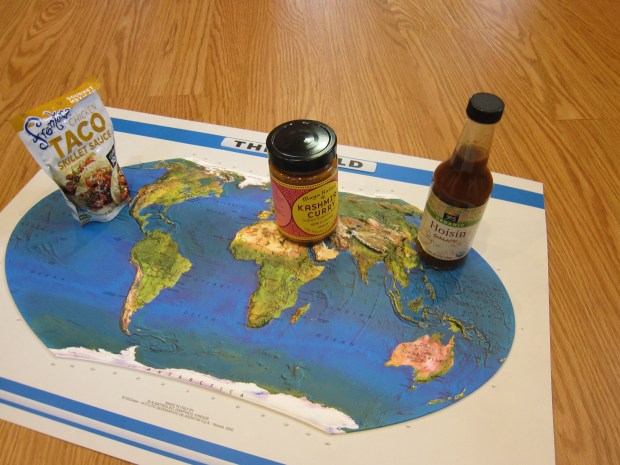
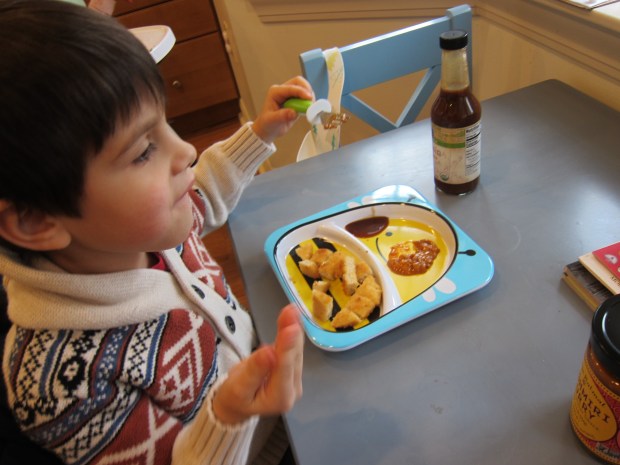
The true challenge was to cook one protein in three different flavor bases. I knew Travis would never have the patience to prepare three recipes, but instead presented him with three sauces to spice his chick’n at lunch. We checked them out on a world map next to their countries, first!

He loved dipping into each. “Not the favorite,” he declared after one bite of Chinese hoisin sauce. Indian masala got a maybe, but Mexican taco sauce was the clear winner. He kept asking for more!

Flavor Bases (4)

Have fun flipping through food magazines or cookbooks as a finale to the lesson. Travis pointed out recipes that interested him, and I helped read the ingredients that went into the flavor base. This is a great way to get your little chef thinking even deeper about food and culture.

Flavor Bases (3)

Gift Your Child an Ornament Every Year

Ornament Year (2)

There are some households where the Christmas tree is color-coordinated or bears a different theme each year. Not so in our house! Our tree is a hodgepodge of homemade and heirlooms and ones we’ve randomly picked up over the years. But here is one nice thing that lends tradition to the tree: making sure to gift each child a special ornament every year.

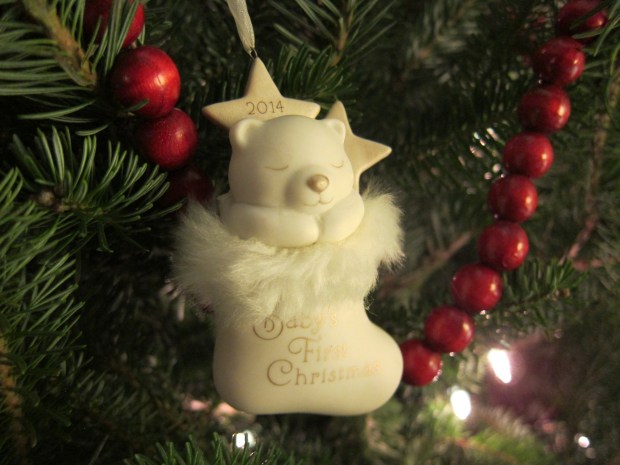
This goes back to both my kids’ first Christmas, when they received one as a commemorative gift.

Ornament Year (3)

Moving forward, we’ve picked one up each year in relation to a holiday excursion. There’s the train from a trip to a holiday train show, for example…

Ornament Year (4)

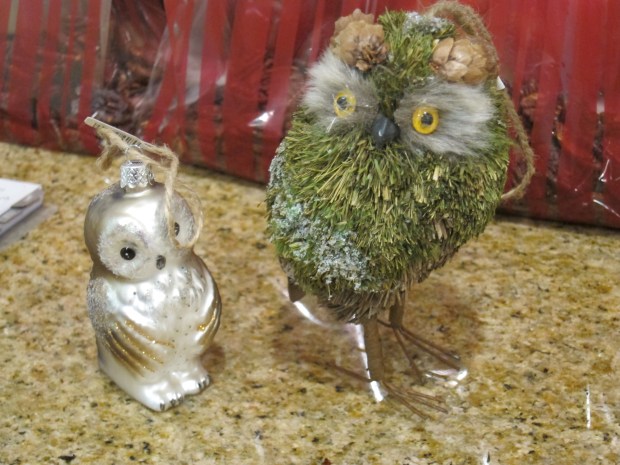
…and this year Travis loved selecting owls from a trip to see holiday lights at a botanical garden.

Ornament Year (1)

This is definitely one of those traditions I intend to keep up, moving forward. How do your kids like to decorate the tree? Please share in the comments!


Poetry Traditions

Poetry Traditions (1)

‘Twas the night before Christmas and all through the house… we were having a quick poetry lesson before bed!

The Night Before Christmas wasn’t actually written as a book, of course, but as a poem, with a classic AABB rhyme scheme (lines 1 and 2 rhyme, and lines 3 and 4 rhyme). Thus it’s a great work for talking with kids about Christmas traditions, how Christmas has changed over the years, and for a mini poetry lesson, too.

First we read the book, and then laughed as we turned the pages along to a version sung by the University of Utah choir.

Poetry Traditions (2)

As we read, I paused over vocabulary that was old-fashioned or unfamiliar to Travis, words like sash, prancing, lustre, and stirring. He instantly pinpointed that the poem was old-fashioned, based on the drawings and the language. We discussed how this “Saint Nick” differed from the Santa Claus he’s familiar with.

Do a close reading of the poem, asking questions like: ‘who were the characters’ (“The kids, the mom, the dad, and Santa Claus!”) and ‘what happens in the middle’ (“The sleigh appears!”) etc.

Poetry Traditions (3)

Then we went through and identified some of the rhymes, like house and mouse. I gave him a word from the poem (for example ‘bed’) and challenged him to come up with his own rhymes.

Poetry Traditions (5)

Big kids can go on from here to write their own holiday poem. For my kindergartner, I simply helped Travis compose a silly line or two about our family holidays.

Poetry Traditions (4)

Fun extensions might include acting out the poem before bed!

Holiday Book Traditions

Holiday Library (1)

Christmas stories have such a special place in my heart, memories of the books that were read year after year when I was a child, and now some that have become family favorites since my own kids were born.

One tradition we’ve started is Advent Christmas Books, a tissue paper-wrapped book under the tree each night of December, whether from our own collection or on loan from the library. Our list this year included old favorites like The Polar Express, as well as new titles, like:

Fa La La

Guess Who’s Coming to Santa’s For Dinner?

Christmas Cookies: Bite-Size Life Lessons

Christmas in the Barn 

and Merry Christmas Mr. Mouse

As a new tradition, I had Travis help pick out a version of The Nutcracker from the library. A special holiday excursion like this will build anticipation for the big day!

Holiday Library (3)

Moving forward, I can’t wait to spend Christmas Eve with each family member reading a new book, perhaps the first gift of Christmas. This is apparently an Icelandic tradition, and we’re only a year or so away from having it be feasible in our home!

Holiday Library (4)

Finally, don’t forget to read the perfect Christmas Eve book as a tradition each year: The Night Before Christmas.

Holiday Library (5)

What books are a must for your family’s holiday? Please share in the comments!