Santa’s Sleigh Automaton

Santas Sleigh (5)

I originally purchased this special holiday crate from Kiwi Co thinking it would be fun to put together with Travis. It turns out that it was so complicated even mommy had trouble with it! But we now have a very cool decoration to last until the holiday is over.

The sleigh works as an automaton, a machine that is pushed into motion, and the instruction booklet included neat STEM learning about other examples of automatons (think jack-in-the-boxes or vending machines), and also a detailed explanation at the end about how you’ve built a “cam”. Here’s a rough outline of what we did:

First we made a frame, slotting together the provided wooden pieces and foam stickers to help hold them in place.

Santas Sleigh (2)

We then needed to build the crank part of our cam by attaching wooden circles to a crank in the proper order.

Next up was the part of the cam that would go up and down. This required fitting plastic rods into the wood stand, securing them onto a paper square at the base, and adding a paper straw and foam donut to hold them in place. Here is where the machine seemed a bit faulty, with the paper squares not staying firmly on the wheels of the crank. Hmmm…

But we forged on, adding the felt reindeer, Santa and sleigh (quite tiny!) to each of the plastic rods. Secure them all with the provided string for a leash.

Santas Sleigh (4)

There is a decorated backdrop with felt houses and trees to attach. Now Santa’s sleigh and team are ready to fly!

Santas Sleigh (3)

Travis does indeed enjoy turning the crank, so there is holiday magic (and science!) to be had in the final product.


Rainbow Paper Experiment

Rainbow Paper (3)

Here’s a quick project that’s equal parts science and art. It was the perfect follow-up to Travis’s Rainbow Optics crate from Kiwi Co.

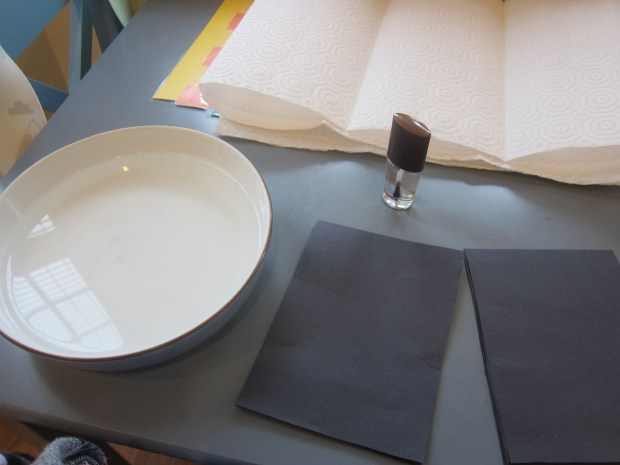
Because it’s a bit messy and you have to work quickly, I gathered all the materials ahead of time. You’ll need paper towels for drying, small squares of black construction paper, a bowl filled with about 1 inch of water, and clear nail polish.

Rainbow Paper (1)

Place one of the black squares in the water, soaking completely. Let float towards the surface. Now it was Travis’s very important job to add 3 drops of the clear nail polish.

Rainbow Paper (2)

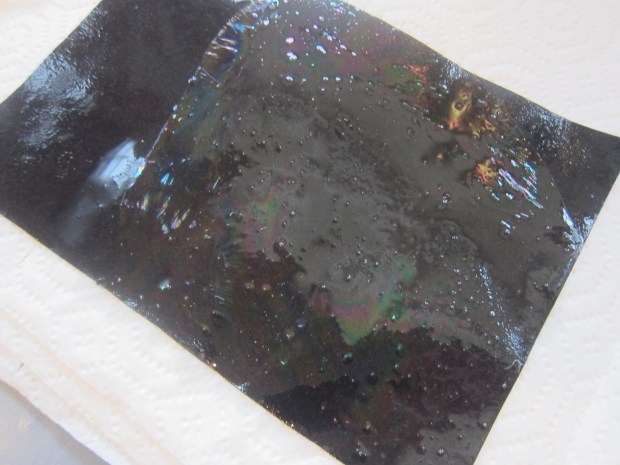
Remove the paper very quickly, pinching it from one corner, and place on the paper towels to dry. Now it was covered in rainbow swirls!

Rainbow Paper (5)

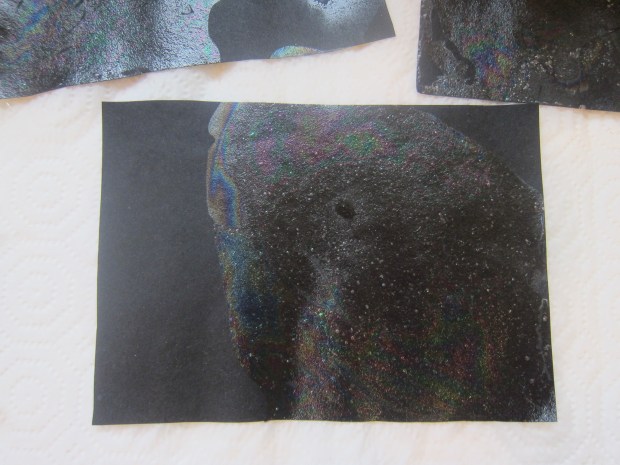
We wanted to make a few more, but found that the nail polish residue made streaks in the water; as a result, each ensuing piece of paper came out a bit messier.

Rainbow Paper (4)

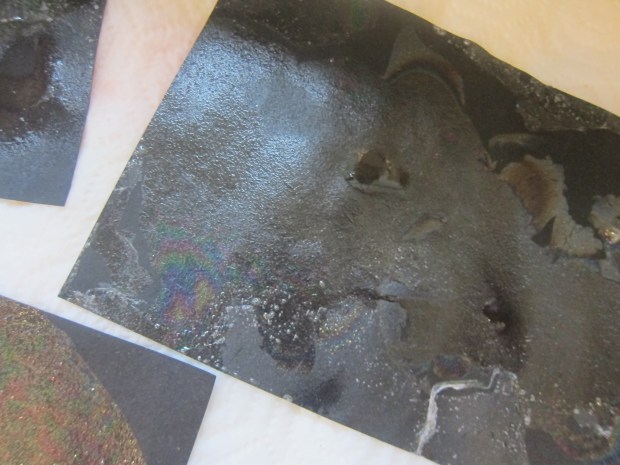
Still, these were quite pretty, and you could glue them onto cardstock for a pretty art print if desired!

Write a Letter to Santa

Letter to Santa (5)

Christmas is 25 days away, and if you want to start the holiday off on a magical note for your kids, consider having them write to Santa!

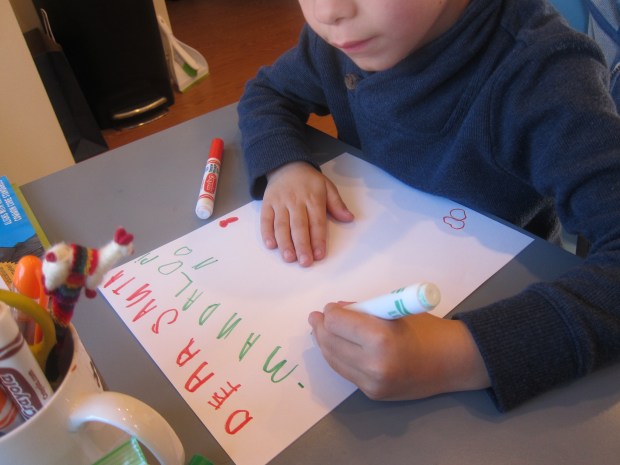
Travis and I sat down with paper and markers (in red and green of course), and talked through his list.

Letter to Santa (2)

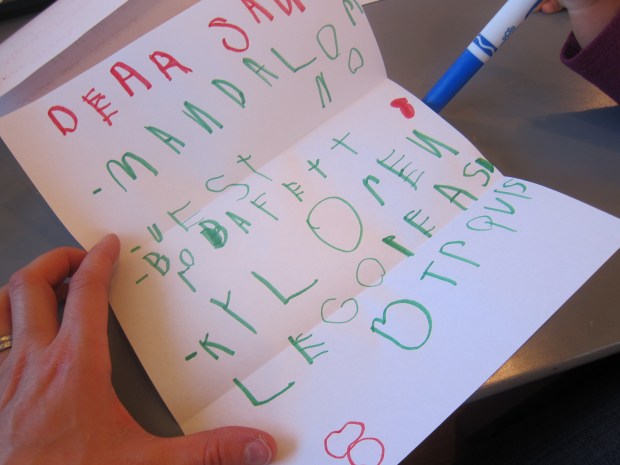
I helped him sound out and spell each item, which was great handwriting practice, too.

Letter to Santa (4)

His list included current favorites like Star Wars figures (Boba Fett, Kylo Ren) and a winter vest.

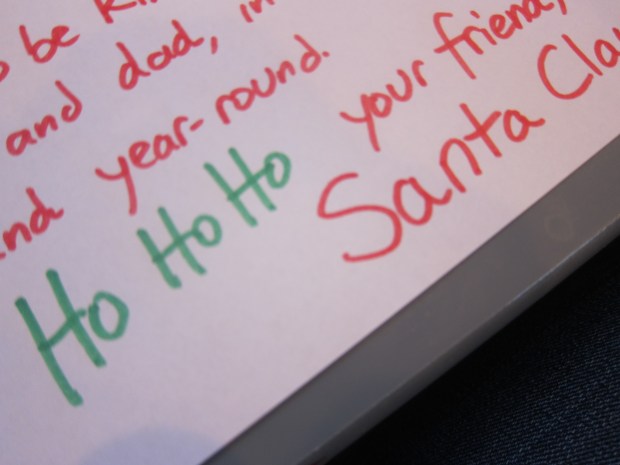
To make the letter truly special requires a little parental trickery. Write back a letter from Santa in response to your child. I used markers to disguise my handwriting.

Letter to Santa (3)

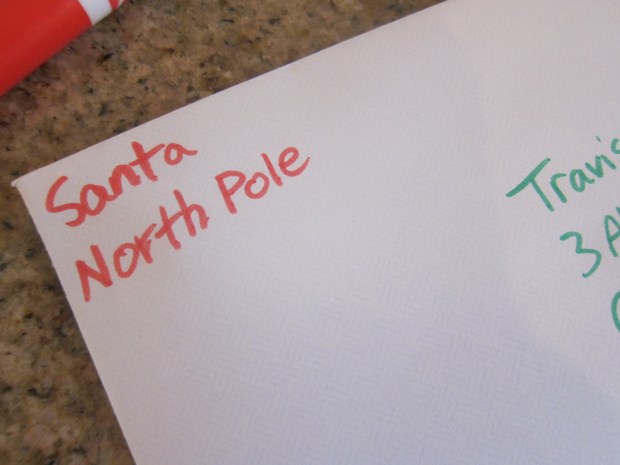
Now seal both letters in an envelope addressed to your child, and mark the return address as “Santa, The North Pole.” Don’t forget a stamp! Place this inside a larger envelope, addressed to the following:

NORTH POLE POSTMARK
POSTMASTER
4141 POSTMARK DR
ANCHORAGE AK 99530-9998

In return, you’ll receive a true North Pole postmark on the return letter from “Santa”. USPS recommends mailing by December 7. So make those lists and check them twice!

Thanksgiving Table Decorations

Decorate Table (4).JPG

Just a quick post tonight on some holiday decor from our table this year! Travis got to help out in a few ways.

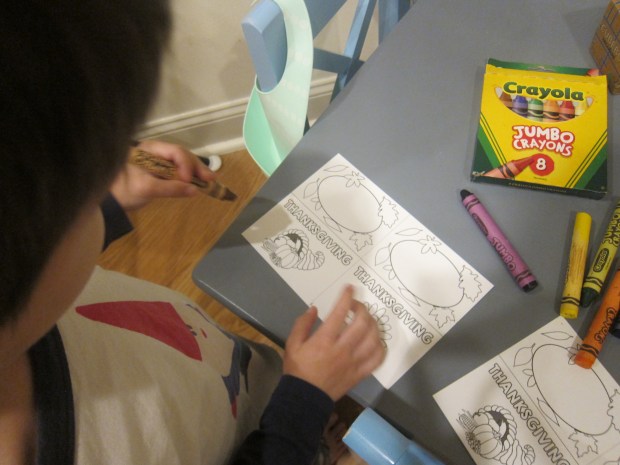
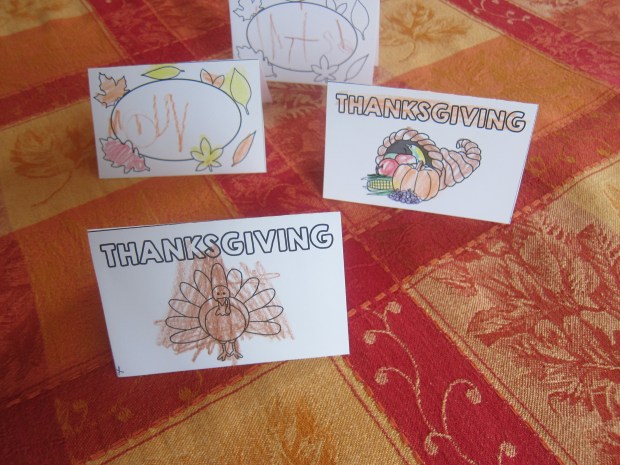
For starters, we colored in the place cards that came with his Thanksgiving Table Raddish Kids.

Decorate the Table (1)

These were good practice for writing names of family members, too!

Decorate Table (1)

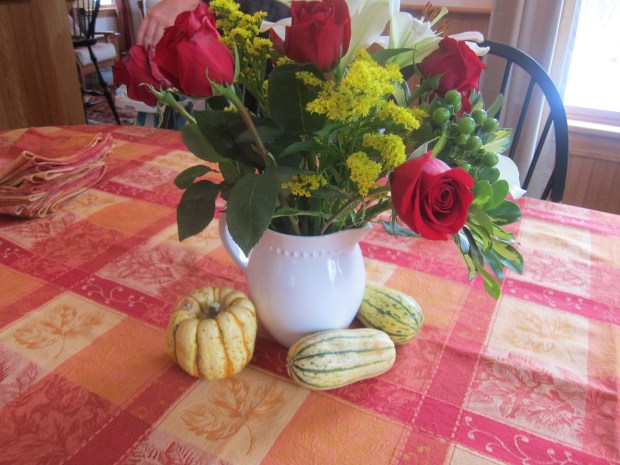
He also helped with the centerpiece, helping to arrange a few decorative gourds next to a bouquet of flowers.

Decorate Table (2)

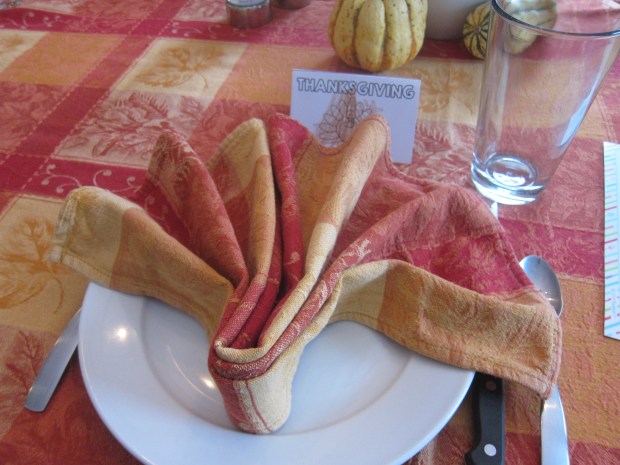
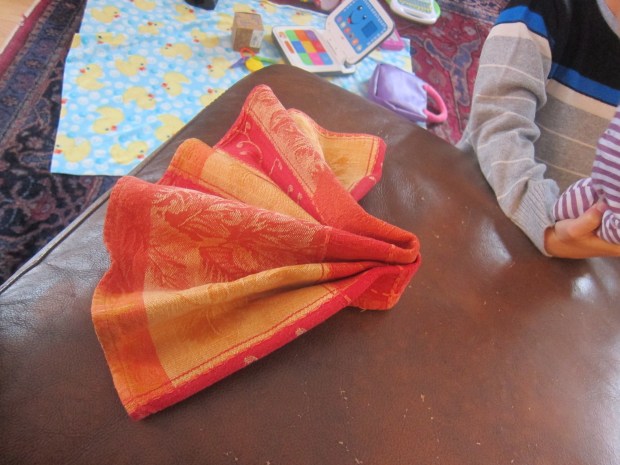
You can also show your child how to fold napkins into “turkey feathers”. Accordion-pleat cloth napkins and arrange on every plate.

Decorate Table (3)

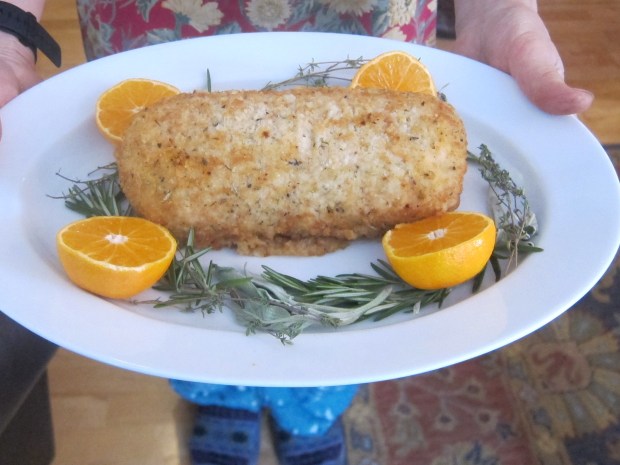
Finally, no vegan table is complete without a celebratory roast.

Decorate Table (5)

We named our roast Hank Williams after the turkey we adopted from Farm Sanctuary this year. Here’s wishing everyone a Happy Thanksgiving!

Spectroscope

Spectroscope (5).JPG

This quick project was a neat follow up to Travis’s exploration with his Rainbow Optics Crate. And to make it, we even got to upcycle the box from Kiwi Co.!

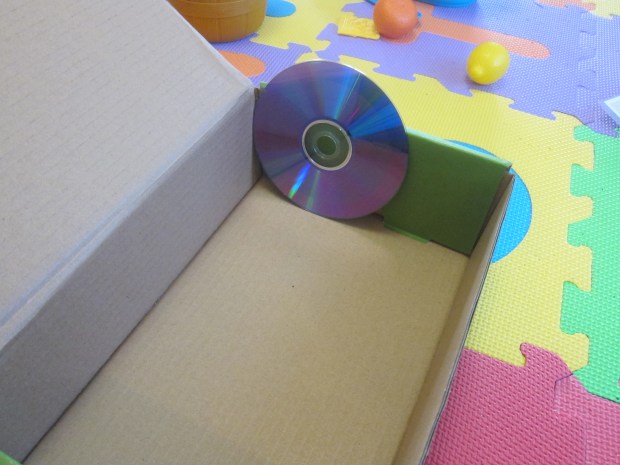
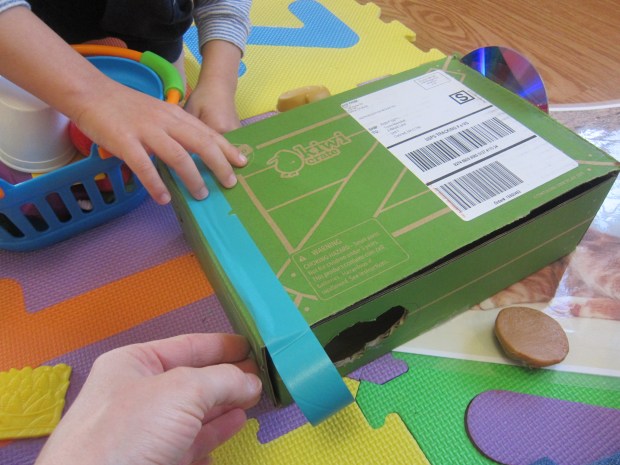
Cut any extra flaps from the box, including those that fold in to the sides and front. Tape a blank CD to the inside of one short end, flush against the back wall. Make sure your box can close!

Spectroscope (1)

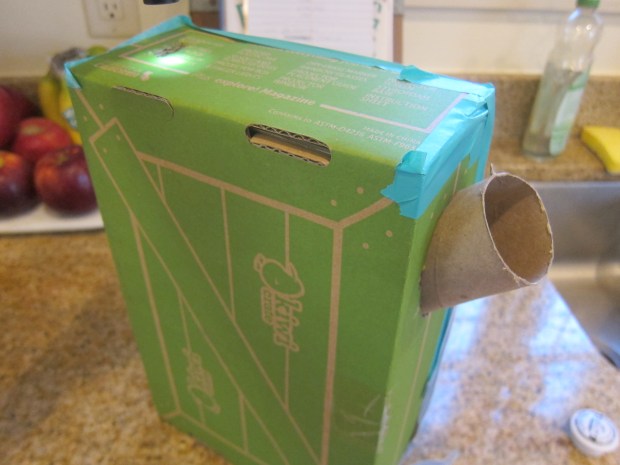
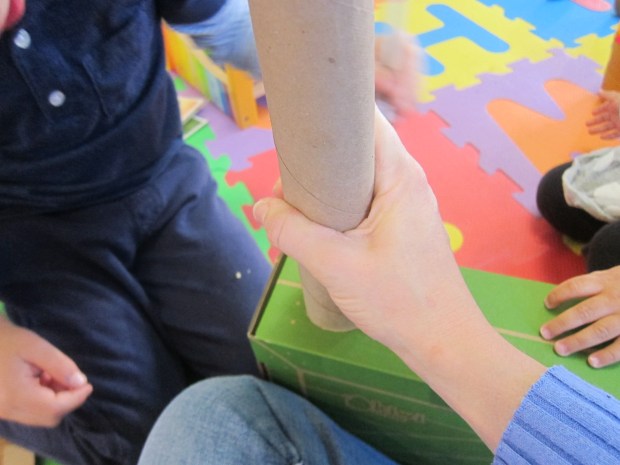
Trace around the end of a paper towel tube twice, in overlapping circles, so you have an opening that’s about 1 and 1/2 times as wide as the tube. Insert the tube at an angle, looking towards the CD.

Spectroscope (2)

Also cut a slit on the short edge directly opposite the CD, to let in light. Tape up any other edges where light might slip in.

Spectroscope (3)

Now take a peak inside! We found this worked best when we shined a flashlight directly into our slit. One person can shine the light while the other person makes sure the tube is aimed properly at the CD; you’ll see the spectrum of the rainbow appear.

Spectroscope (4)

You can also try this with other light sources, including sunlight, and see which one works best!

Rainbow Optics Kiwi Crate

Kiwi Rainbow (4).JPG

On the heels of playing with mirrors and illusions, Travis got to delve further into the science of light with Kiwi’s Rainbow Optics crate. Most of the projects involved mixing or pulling apart colors, to explain the way white light bends to form a rainbow.

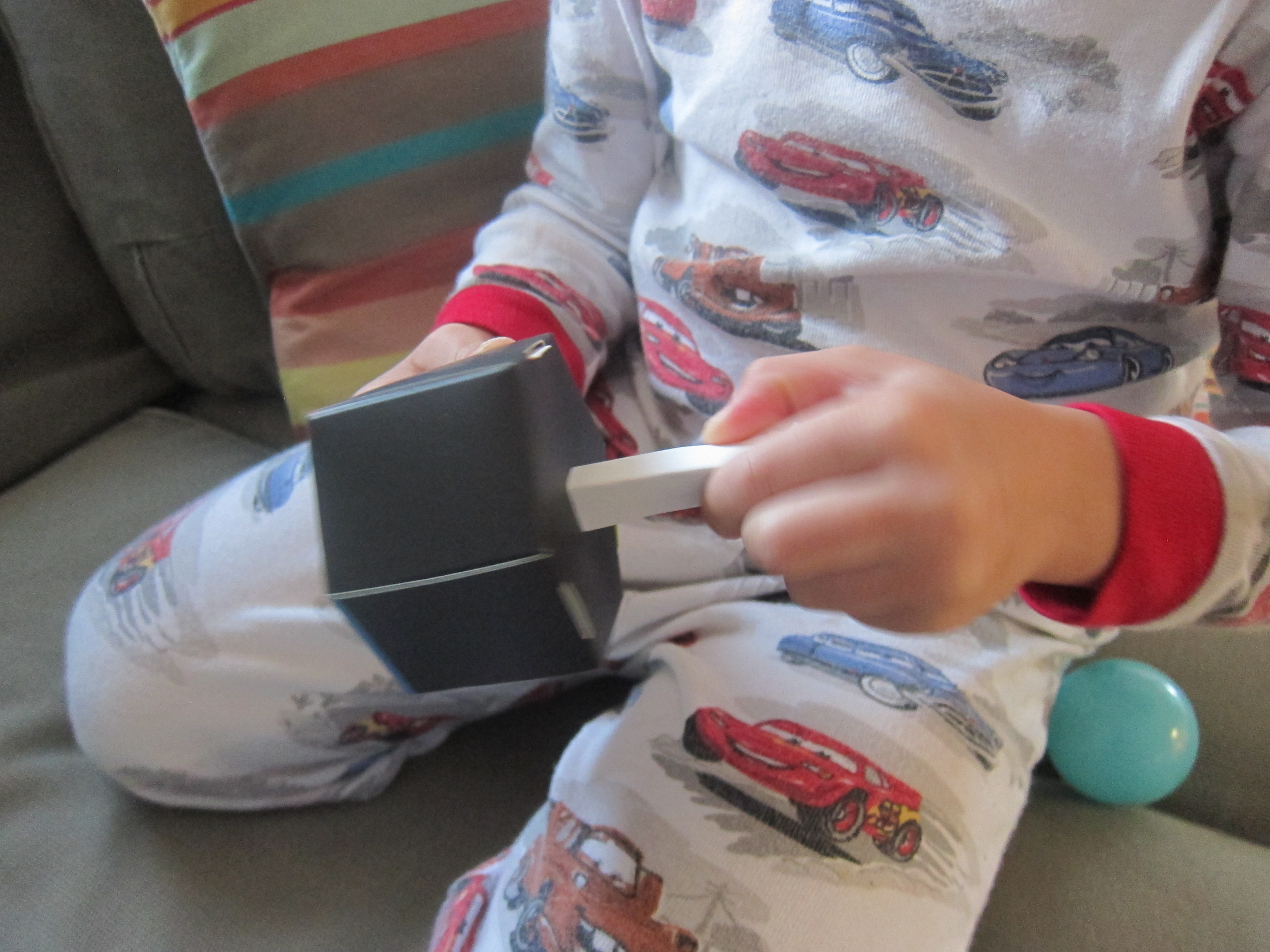
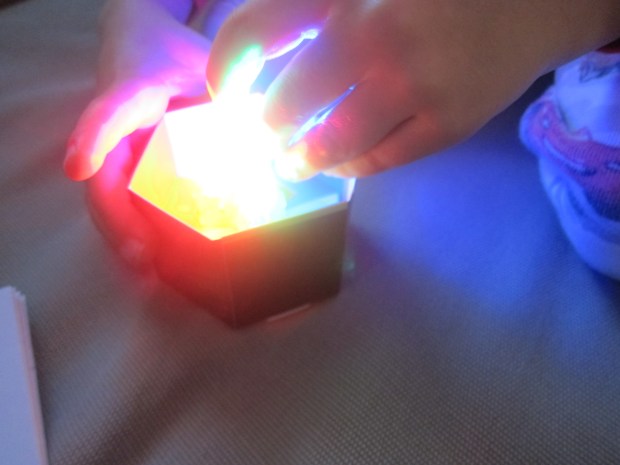
The first project was Mixing Colored Light. Travis helped adhere a wooden hexagon onto the provided box lid, fold up cardboard into a triangle as a support piece, and insert a provided color guide into the base of the hexagon box.
Kiwi Rainbow (1)

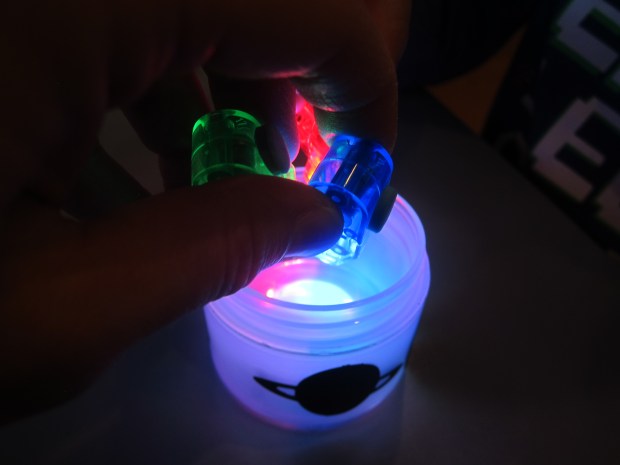
Three neat finger lights (one each in red, green, and blue) then slip into this insert. Travis loved turning these on!
Kiwi Rainbow (2)

Decorate the provided frosted plastic jar with stickers; options include everything from moons and planets to sea creatures. Place an additional black sticker on the bottom of the jar. This has a hole in just one area… And Travis was about to see why!

Place the frosted jar on top of the hexagon box and spin it slowly. Because the bottom sticker only allows one or two lights through at a time, the colors change with each spin, from red, to magenta, to blue, to cyan, to green, to yellow.

Kiwi Rainbow (3)

Travis loved spinning this, and pretending it was a forge in later make-believe games.

Next up was Projecting Colorful Shadows. Again there were lots of little steps, including adhering the Styrofoam base to a paper guide with sticky Velcro dots.

Kiwi Rainbow (5)

Kids can write on the provided projector window screen, which is then Velcroed onto a projector box.

Kiwi Rainbow (6)

Stretch a projector screen onto the other side of the box and secure with blue stickers.

Kiwi Rainbow (7)

Now it was time to set up the projector box on the paper base, and add another set of those fun finger lights to the Styrofoam block. As you shine these, each light hits the drawing at a slightly different angle, casting shadows in multiple colors.

Kiwi Rainbow (8)

We took the booklet’s suggestion to hold other objects between the lights and our projector screen. Our fingers had definite wow factor!

Kiwi Rainbow (10)

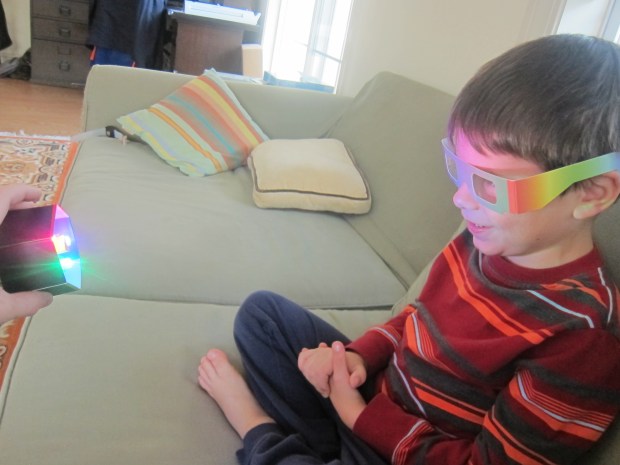
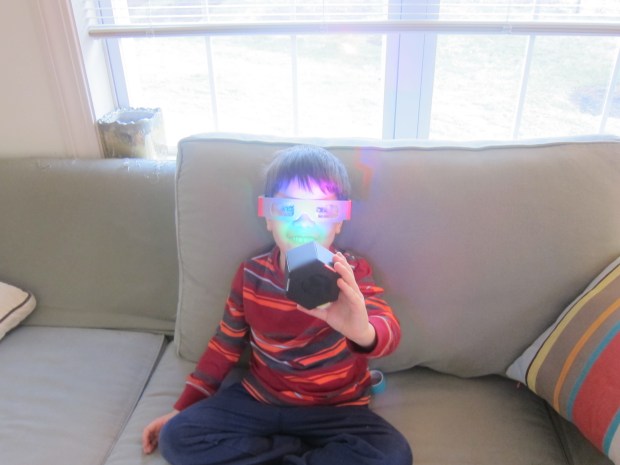
Finally, the kit included Rainbow Glasses, the kind you might remember from childhood! This involved no assembly, just looking around at different light sources.
Kiwi Rainbow (11)

The finger lights, in particular, were fun to look at. Travis wandered all over the house to find his favorite lights, and the booklet helpfully explained how the glasses work through diffraction plastic.
Kiwi Rainbow (12)

Well now we needed to experiment further! We could test out making a rainbow on white paper with a few simple materials: Attach a mirror to a glass pan half filled with water, using modeling clay to attach. Shine a flashlight on the paper mirror where it is under the water. Hold up a piece of white paper, and watch your rainbow appear!

Kiwi Rainbow (22)

It was tricky to get the angle just right, but I was able to hold things steady while Travis manned the camera!

Kiwi Rainbow (23)

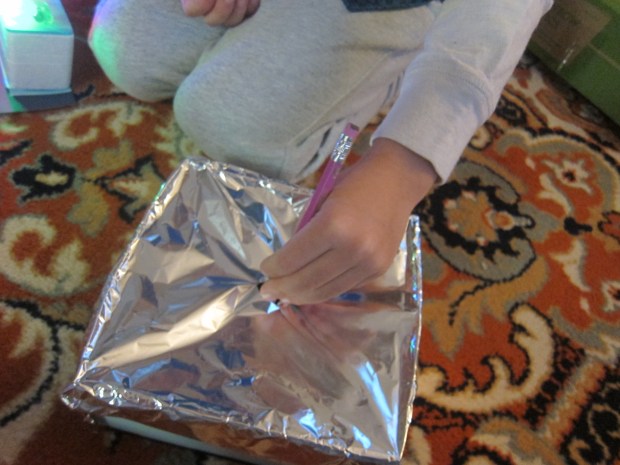
We also tried to overlap colors with a twist on the projector box project. Remove the projector paper, and instead add a sheet of aluminum foil. Poke a quarter-sized hole in the center with a pencil.
Kiwi Rainbow (16)

Shine the finger lights through, and watch for overlapping shades (i.e. red and blue should make magenta). The results of this weren’t obvious to Travis, but it was a neat variation.

Kiwi Rainbow (17)

Interestingly, you can also show how red + blue paint = purple paint, but red + blue light = magenta light.

Kiwi Rainbow (20)

Why? Because the paint colors combine towards black, but the light colors combine to towards white. Neat!
Kiwi Rainbow (21).JPG

We finished with a read of two suggested books: All the Colors of the Rainbow by Allan Fowler and The Rainbow Goblins, by Ul De Rico.

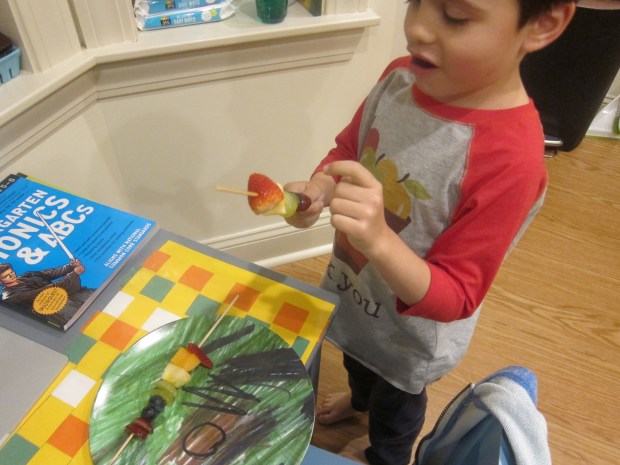
All this rainbow talk had us hungry! So finish your fun with rainbow kabobs made of the following:

  • red strawberries
  • orange cantaloupe
  • yellow pineapple
  • green grapes
  • blue blueberries
  • purple grapes

Rainbow Kebabs (1).JPG

Travis reminded me we really needed indigo grapes. Yes indeed, but tasty nonetheless!
Rainbow Kebabs (2)


Thankful Spelling

Spell Thanks (3).JPG

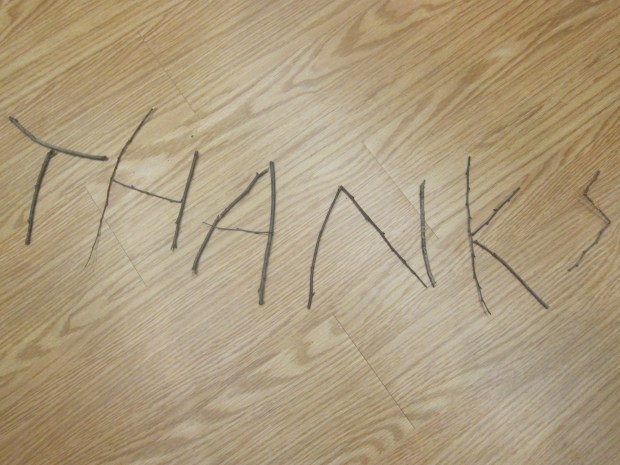
Travis is quite proud of his spelling lately, so the Thanksgiving holiday was the perfect opportunity to practice with stick writing. What an advancement from when he and I made the alphabet in sticks before kindergarten started!

After a quick walk, we returned home with lots of little sticks. Make sure you have some that are long and some that are shorter.

Spell Thanks (1)

I had him carefully sound out the word T-H-A-N-K-S. As we got to each letter, he crafted it from sticks. He loved finding just the right piece, for example shorter sticks to cross his H or A.

Spell Thanks (2)

S was tricky, so we ended up snapping a long stick in such a way that it curved twice. He had so much fun that he continued to make letters on the floor for a while after! And I was thankful for that.

Spell Thanks (4)

Ways to Give Thanks

4 Ways Thanks (6).JPG

Thanksgiving is just around the corner, and I’m encouraging Travis to think about what that means, and ways he can say and give thanks. Here are a few ideas we came up with, along with some suggestions from Highlights magazine!

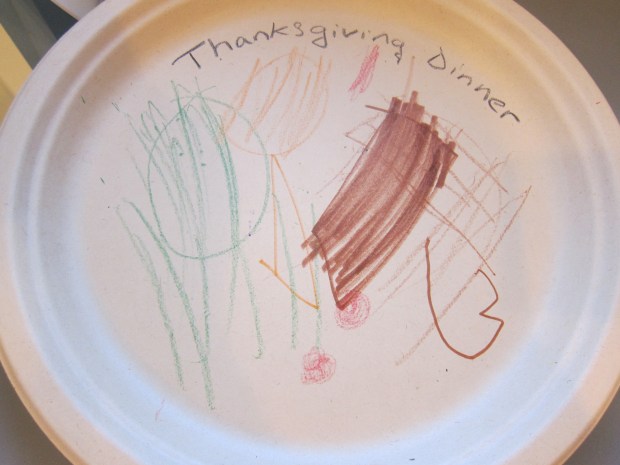
First, we wanted to thank a neighbor who’s done a lot for us this year, whether feeding the cat or just popping in to say hi. Travis drew a classic Thanksgiving meal on a plate for her. He loved picking different colors for sweet potato, green beans, and more.


4 Ways Thanks (1)

He even had little round cranberry sauce.

4 Ways Thanks (2)

On the back, I helped him spell out thanks.

4 Ways Thanks (4)

He was so proud of his writing that he decorated a second plate for me with “thank you mama.” If you’re the grown up, turn this special plate into your breakfast plate over the holiday! Highlights suggests that big kids could even make breakfast for a parent as a way to show thanks.

4 Ways Thanks (3)

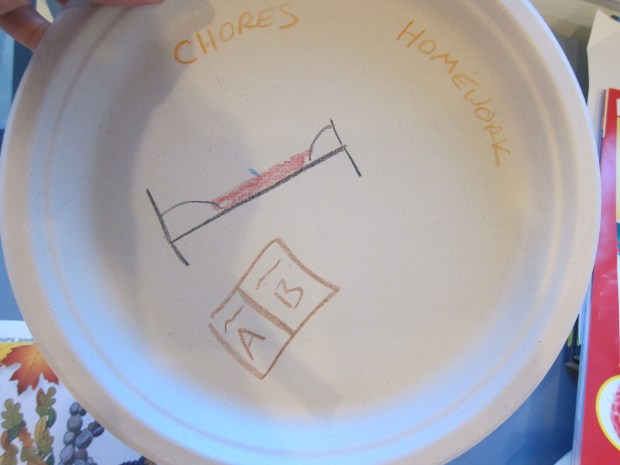
I also challenged him to think about why he’s thankful for harder tasks in life, like chores and school work. I drew a little picture and listened to his answers, which included getting rewards as a result (his allowance) or feeling proud after.

4 Ways Thanks (5)

Another idea from Highlights is to ask your child to donate a toy to younger cousin or neighbor. Because I know we’ll be doing this over the Christmas season, we skipped the activity today.

Finally, instead of eating a turkey on Thanksgiving, every year we adopt one from Farm Sanctuary. This year’s turkey is named Hank Williams, and Travis is so proud to display the adoption certificate!

How will your children give thanks this year? Please share in the comments!

T.H.A.N.K.S. Scavenger Hunt

THANKS spot (2)

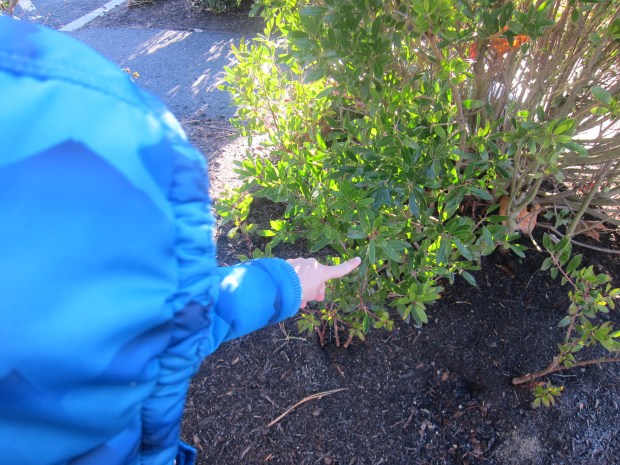
Here’s a cute activity Travis and I did in anticipation of Thanksgiving next week; it turned our regular stroll to the bus stop into a fun hunt! We wanted to find items matching a word that corresponded to each letter of THANKS, so sought out the following:
  • T: Trees
  • H: Holes
  • A: Animals
  • N: Nibbling
  • K: Knobbiness
  • S: Seeds

Trees: This was an easy one, but it had Travis appreciating the trees on our little walk to the bus, whether tall ones or small berry trees.

Holes: Travis is convinced that the hole outside our door is a snake hole. I hope not! Either way, he loves checking it out. Also look for holes up in trees; these might have nests come springtime.

THANKS spot (1)

Animals: We wondered who we would still see this close to winter. Squirrels and chipmunks play and eat in a brier patch on our walk. Here’s one eating an acorn; we even heard him chewing!

THANKS alt

And we heard lots of crows calling out this morning, though I couldn’t capture a picture.

Nibbling: Check for signs of animals fattening up for winter! Travis also checked the leaves for caterpillar nibbling, though I told him it was probably past their season.

THANKS spot (4)

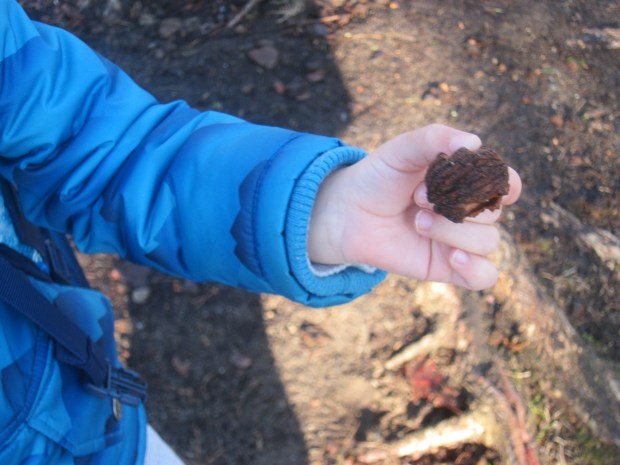
Knobbiness: Look for neat burls in trees. Travis had fun spotting a few of these on the walk.

THANKS spot (3)

Seeds: Acorns are an easy find, but we also found larger seeds. And these showed signs of nibbling! Also keep an eye out for maple keys or other familiar seed pods. 

THANKS spot (6)

I’ll leave you with this stunning frosted leaf Travis found. We are thankful for the beauty of nature!

THANKS spot (5)

Sticky-Treat Sushi

Sticky Sushi (8).JPG

There is an international festival coming up at Travis’s school, which has us talking about food from around the world. Here’s a sweet spin on the classic Japanese dish! This candy sushi was so fun for Travis to put together.

To start, make the “rice”: melt 2 tablespoons Earth Balance butter in a microwave-safe bowl, heating at 10 second intervals for a total for 30 seconds, or until melted.

Add 2 and 1/2 cups mini Dandies marshmallows. Microwave at 15 second intervals until melted (we needed about a minute total), stirring after each interval.

Sticky Sushi (9)

Stir in 3 cups rice cereal. If you need to use your hands, I recommend having a grown-up do so, as the sticky marshmallows will still be hot.

Sticky Sushi (1)

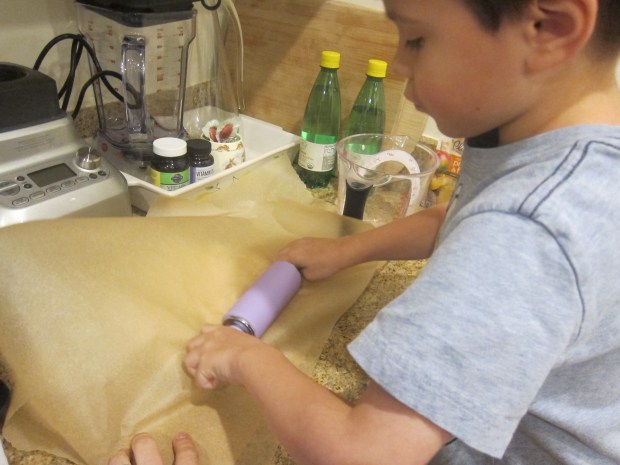
Spoon the mixture onto parchment paper. Cover with additional parchment paper and use a rolling pin to flatten about 1/4-inch thick.

Sticky Sushi (2)

The rolling pin ended up being a little tricky, so we found it easier to pat with our hands.

Use a pizza cutter to cut into rectangles. Travis was so proud I let him use this tool!

Sticky Sushi (3)

Now you can make sashimi or sushi rolls!

For “sashimi”, place a Swedish fish candy (Wholesome DelishFish are vegan) on top of a rice rectangle. Cut a strip of fruit leather with a pizza cutter and wrap around the fish.

Sticky Sushi (4)

For a rolled version, cut a strip of fruit leather and cover with a rice rectangle. Top with pieces of candy (Travis chose organic Red Vines) and roll up.

Sticky Sushi (5)

If you really want to get creative, tint a little vanilla frosting with green food coloring for “wasabi”!

Sticky Sushi (6)