Cartesian Diver

Cartesian Diver (7).JPG

I had no idea until after Travis and I made this little project that this is a classic experiment dating back to… the 1600s! It’s so-named because it was first described in detail by Rene Descartes, and it’s a neat way to show kids some basic principles of pressure and density.

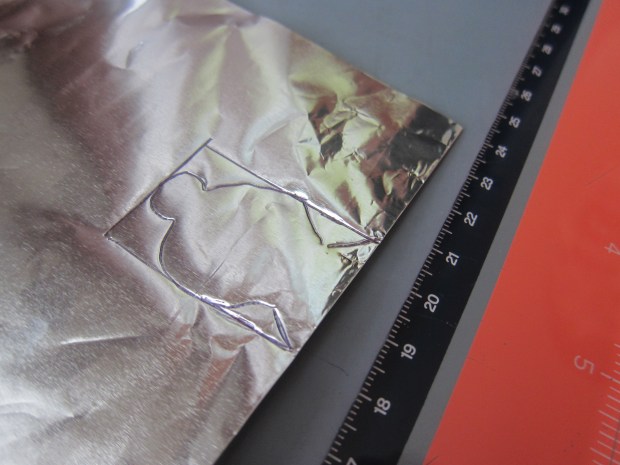
First, we made our little diver – and by little, I mean little! Measure a 1 inch x 1.5 inch rectangle on aluminum foil (we folded our foil double so it was a little thicker and sturdier).

Draw a little diver shape onto this rectangle and cut out.
Cartesian Diver (1)

Travis thought he was so cute!

Cartesian Diver (2)

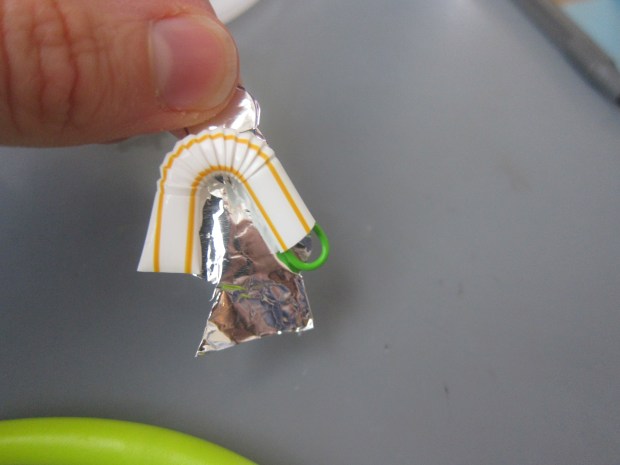
Cut 1.5 inches from a bendy straw. Bend into an upside-down U and attach to your diver with a small paper clip. Be sure to use a small one! Our first was big and so heavy our diver sank right down.
Cartesian Diver (3)

Now add a tiny bit of clay to his feet. Test that he doesn’t sink in a glass of water before you use a bottle; if so, just remove some clay.

Cartesian Diver (4)

If he’s horizontal, you need a little more clay. We made the mistake of skipping this step on our first try, although Travis thought it was hilarious to fish our diver out from the bottle once we realized he was sinking.

Cartesian Diver (5)

Once we had the proper diver who floated just right, we filled an empty 2 liter bottle with water nearly to the top. Screw the cap on tightly.

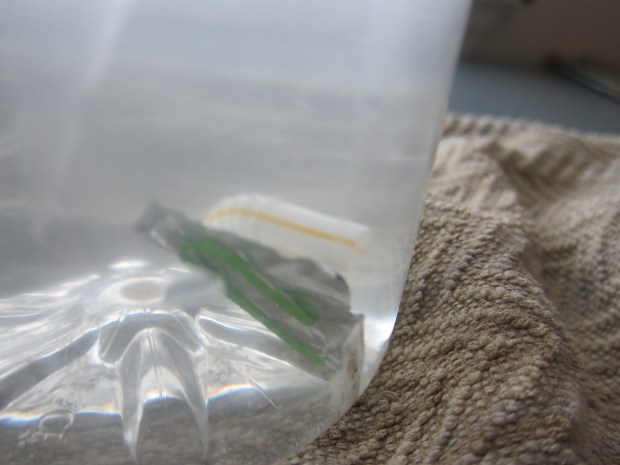
Squeeze the bottle and watch him go up and down! He’ll sink when his straw fills with water, increasing the density just enough, then float when you release the bottle and the water drains out of the straw again.
Cartesian Diver (6)

Ours wasn’t as perfect as some example we saw online, but we had fun!

Cartesian Diver (8)

Rainbow Density Cylinder

Rainbow Density (7)

Here’s a neat visual way for even young kids to grasp the concept of density. You’ll get messy in the kitchen, mix up some colors, and sneak in some science to boot!

Rainbow Density (1)

While Travis was napping, I set up paper cups and all of the liquids we’d be using for the project, in this order of density:

Corn syrup (or carob syrup)

Maple syrup

Water

Almond milk

Vegetable oil

Dish Soap

Rubbing alcohol

Note: Feel free to adapt this list, depending what you have at home, including agave nectar or honey for non-vegan families.

Travis was so intrigued at the set-up, and we talked briefly about how some liquids sit on top of (are less dense) than others. Was he ready to see how it worked? Yes!

Rainbow Density (2)

We tinted a few of our liquids with food color for a better visual effect: green for the water, red for the dish soap, and blue for the rubbing alcohol.

Rainbow Density (3)

Carefully help your child pour the liquids, in order of density, into a glass container. Thinner containers will work better, such as a recycled jam jars or an old dressing jar.

Rainbow Density (6)

It may take your layers a few minutes to settle, making a rather goopey mixture at first!

Rainbow Density (5)

After we gave it a moment, our layers were more apparent – we loved the hit of bright blue from the alcohol at the top!

Oddly, the blue alcohol layer disappeared when we returned to the jar about an hour later, but here you can see some of the layers even more clearly.

Rainbow Density (9)

Travis had so much fun that I gave him extra cups and additional food color to mix up for some time.

Rainbow Density (8)

A fun afternoon in the kitchen!

Salt Water vs. Fresh Water

Salt v Fresh (5)

With so much time spent at the beach over the summer, the topic of salt water is bound to come up – that big ocean contains so much water, but it’s no good for drinking! Here’s a neat way to explore some of the different properties of salt versus fresh water at home.

First, pour a generous amount of salt into a cup of water, and stir to dissolve. Pour a second cup full of fresh water.

Salt v Fresh (!)

Next, we added ice cubes to each.

Salt v Fresh (2)

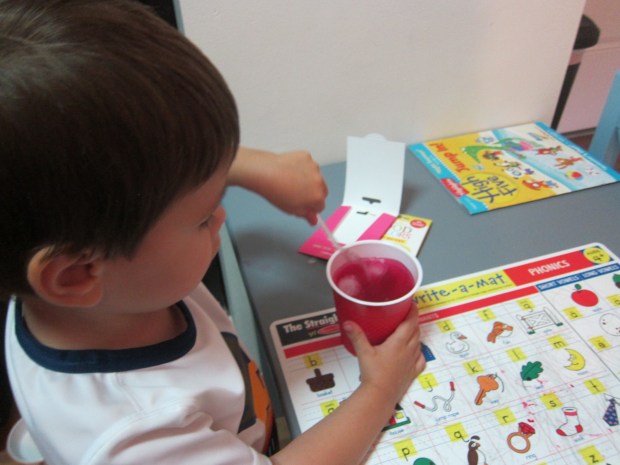
Finally, we mixed up a batch of red food coloring; a dark color is best here, so you can fully see the results.

Salt v Fresh (3)

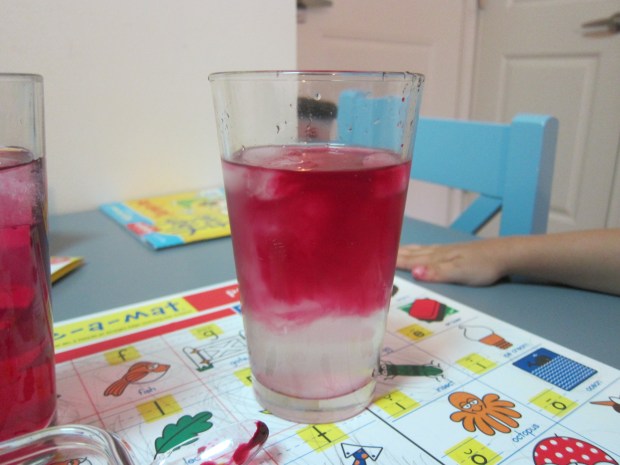
Slowly pour the food coloring into the top of each glass. Your child will see that it sinks in the fresh water, but stays on top of the salt water.

Salt v Fresh (4)

A quick and easy early lesson on density!

Travis had fun playing with leftover colored water and ice cubes for some time, making this activity a big hit.

Salt v Fresh (6)

Sink or Float? Nature Experiment

Sink Float (4)

Spring is finally here, and we are getting outdoors as much as we can! Yesterday we turned it into a treasure hunt, and I posed a question to Travis… what did he think would sink or float, once we returned home?

Sink Float (1)

We returned with our bag of treasures and he couldn’t wait to find out, so I drew a tub of very full water in the middle of the afternoon. This in and of itself was super exciting!

Sink Float (2)

Now it was time to start tossing in our items one by one. Floating pinecones and bark were a big hit…

Sink Float (7)

…as were flowers, pine needles, and bits of grass.

SInk Float (3)

While we collected things, Travis was very into teeny tiny pebbles, and he was quite surprised that these sank! This was a great way to talk about how floating didn’t depend on the size of something, but on its density compared to that of water.

Sink Float (5)

Once all the items were in the tub, it was time to swish them about with a rake for a while. The play only ended once his shirt was soaked! All in all, great fun.

Sink Float (6)