Galactic Art

Galactic Art (7)

Travis isn’t as interested in simple arts and crafts as when he was younger. So I love when I can still find ways to pique his interest, and I thought this quick craft might fit the bill. It involved a novel tool to paint billions of stars in a made-up galaxy: an old toothbrush!

I showed him how to dip the toothbrush in a plate filled with white paint, then scrape his finger along the bristles so little speckles of white jet out.

Galactic Art (1)

Pretty soon we had a whole Milky Way!

Galactic Art (2)

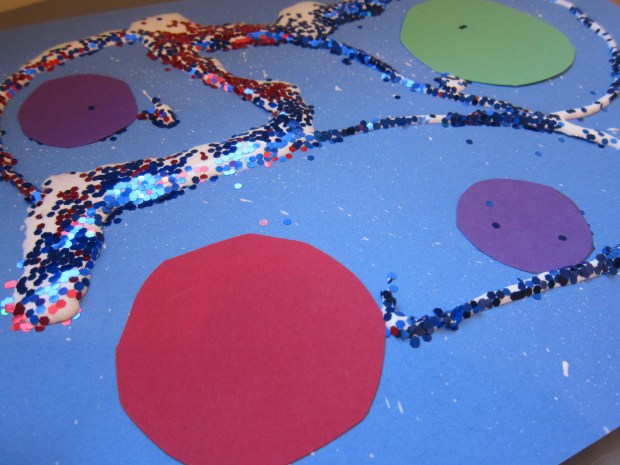
Next we needed to add planets to our galaxy. We definitely weren’t going for an exact replica of the Solar System here, but did have fun rounding up a pile of items that were circular to trace, aiming for a variety of different size circles.

Galactic Art (3)

One of those items happened to be a glitter jar, so then Travis insisted our galaxy needed glitter! Once the planets had all been glued down, we made a thick stream of white glue and sprinkled the glitter over this. Tap off any excess into the trash.

Galactic Art (6)

The glitter sort of eclipsed those original speckles of white “stars” we’d made with the toothbrush. But oh well, Travis was so engaged and happy with the process that I was happy, too.

Galactic Art (8)

Solar System Models

Planets alt

When you’re the only mom who gets her kid up and dressed and backpack packed and lunch made and head to the bus stop and then learn that the Friday before Labor Day is apparently also a day off from school… Well then whoops, you suddenly have a day to fill!

Luckily I had this little project from Raddish Kids up my sleeve, a chance to make two models of the universe: one tiny and one huge!

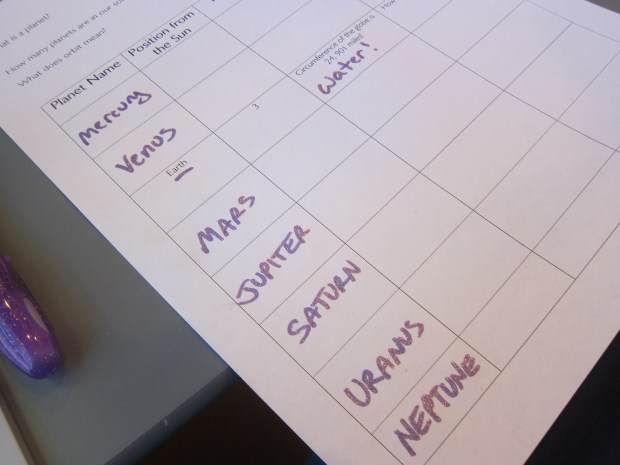
First I asked Travis what planet we live on. He correctly knew Earth, and was able to name a few facts about it, like how its watery.

Raddish provided a chart to name the other planets, all of which my budding astrologer could fill in. He proudly gave me a fact about each, which I wrote down (in glittery galactic pens, of course). Filling in the column with further questions about each planet was a bit harder for him to grasp, but big kids can write in any pending querries here, as well.

Planets (1)

After watching a suggested video that helped him fill in a few new facts about each planet, it was time to model!

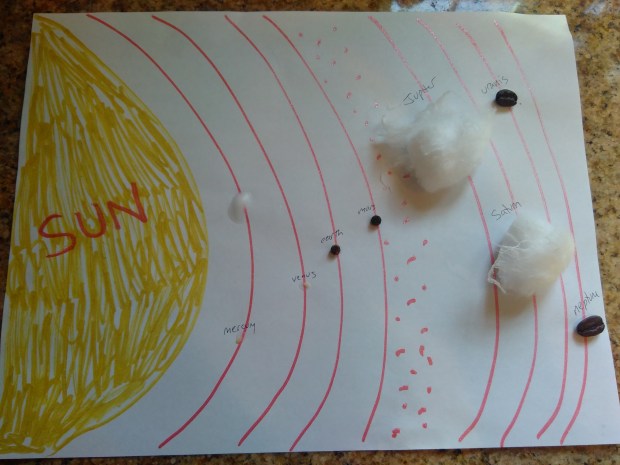
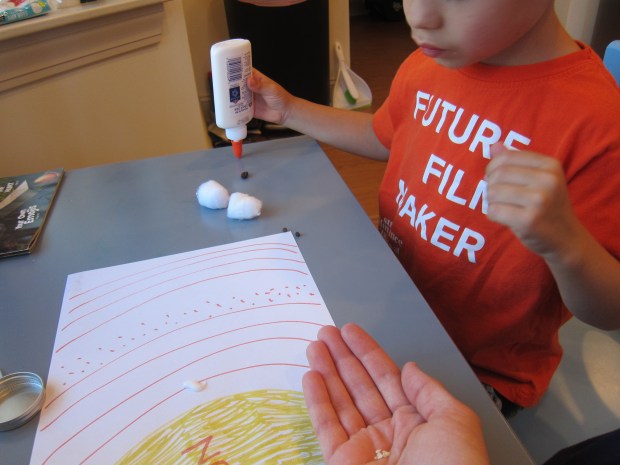
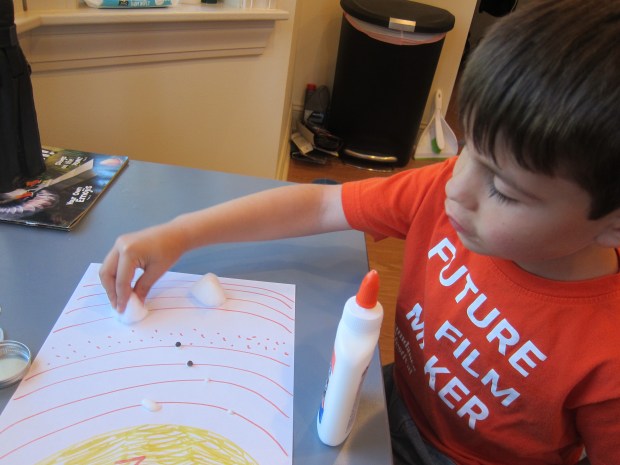
First up was the Tiny Solar System. I drew a half circle on the edge of a piece of white paper and labeled it as the sun. I drew 8 orbits, with an asteroid belt making a wide patch between the fourth and fifth lines.

Planets (2)

For scale models of the planets, we glued on the following:

2 sesame seeds (Mercury and Venus)

2 peppercorns (Earth and Mars)

2 cotton balls (Jupiter and Saturn)

2 coffee beans (Uranus and Neptune)

Planets (3)

Note: the scale obviously isn’t exact, but the idea here is that the relative sizes of the planets (the enormity of Jupiter, the tininess of Mercury) become apparent. This model also didn’t show the distance between orbits to scale.

Planets (4)

Travis marveled at the tiny sesame seeds. In fact they were so small we could barely see them until the glue dried!

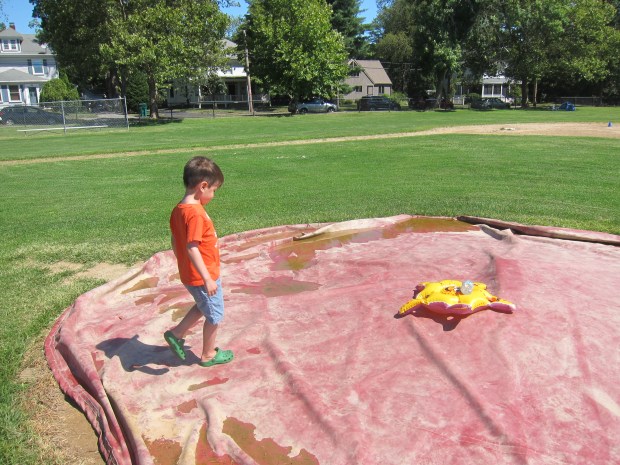
Now for the Large Solar System! We headed out to the playground with a bag full of balls in various sizes. Travis was very curious as I collected these from around the house, but was soon to see why.

I inflated a silly starfish to be the sun and put this right in the center of a baseball diamond. (Note: A beach ball would work, too, but I liked that the starfish was a sun/star shape).

Planets (5)

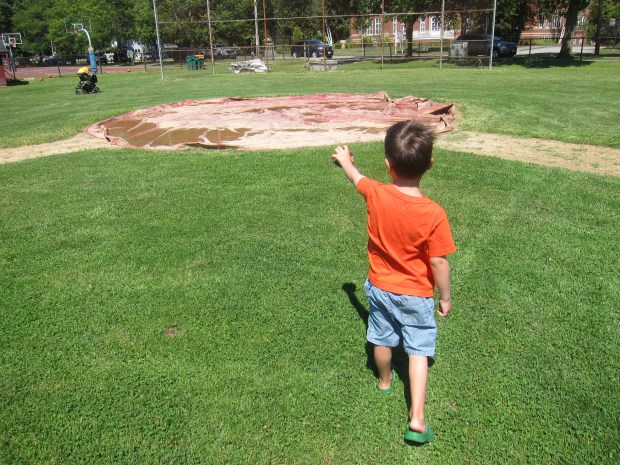
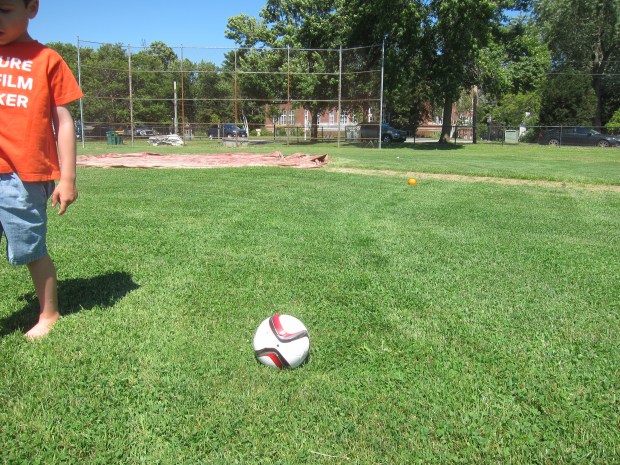
Next we walked out a full 78 steps from the sun holding a wiffle ball as “Neptune.” This took us right to the edge of the baseball field.

Planets (6)

Repeat with the following:

50 steps: wiffle ball (or tennis ball): Uranus

25 steps: soccer ball: Saturn

13 steps: basketball: Jupiter

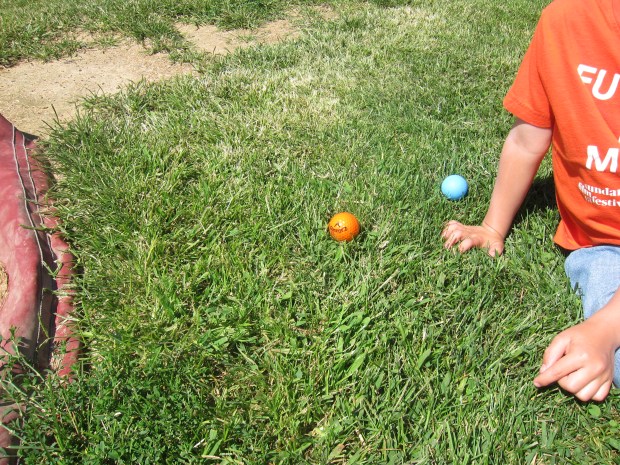
4 steps: ping pong ball (or golf ball): Mars

3 steps: ping pong ball: Earth

2 steps: marble: Venus

1 step: marble: Mercury

Planets (8)

This exercise is eye-opening even for a grown-up, revealing how truly close our rocky neighbor planets are, and how truly vast the distances are between the outer planets.

Planets (9)

I shared these fun facts with Travis to highlight the great distance across the baseball field. Each step we’d taken was equal to 36 million miles. A rover took 6 months to reach Mars, that “one step” away, but 12 years to reach Neptune! He seemed impressed, but then wanted to play soccer… There goes Saturn!

On the way home, we made up some corny space jokes.

How did Mars know what Venus was thinking? It red its mind.

Why was Jupiter so stinky? Because it passed gas.

Ha, what space joke will your kid create? Please share in the comments!

Planets (7)

Exploring Stars Kiwi Crate

Kiwi Stars

The topic of Travis’s Kiwi Crate this month (stars and the solar system), is one of his favorite topics, so I had no doubts he would enjoy the projects. The crafts themselves proved to be a little faulty, but we still had galaxies full of fun. What a perfect coincidence that his recipes from Raddish Kids were star-themed this month, too.

First up: a Constellation Lantern. Travis knows quite a bit about constellations, so happily set about making a few pretend versions with the provided black star stickers on the lantern paper.

Kiwi Stars (10)

I made a few real star patterns for him, including Leo the lion (his astrological sign) and some funny ones (Darth Vader’s helmet!).

Kiwi Stars (11)

He popped open the paper lantern frame.

Kiwi Stars (12)

Insert the slots at the bottom of the frame into the provided paper base; fold and then tape to secure shut. Open the paper lantern insert and put this inside the first frame. The pages he had decorated with stars now fit in between these two.

Kiwi Stars (13)

“I can do it myself!” he said confidently, not wanting any assistance.

Adhere the provided foam circle into the bottom of the lantern. Insert the provided tea light (make sure it is on!) and then add the paper lantern lid. A pipe cleaner threaded through holes in the top makes a handle.

Kiwi Stars (14)

From here, we were off to the darkest room we could find in the house to check it out!

Kiwi Stars (16)

Travis loved being in the dark and seeing the stars “glow”.

Kiwi Stars (15)

Next up was a Solar Spinner, a kid-friendly version of an orrery.

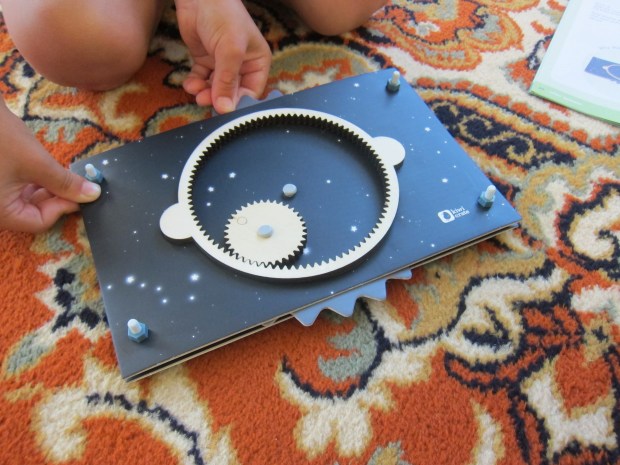
Two interlocking wooden gears are inserted into the provided base and secured with brads. As with the lantern, Travis loved doing all these fine motor skills by himself.

Kiwi Stars (1)

Once the gears were between the two base plates, Travis screwed them together with kid-friendly plastic nuts and bolts.
Kiwi Stars (3)

He gave the machine little test, and watched the wooden gears spin around together. Now we just needed to add the provided sun, Earth, and moon. There are teeny tiny green stickers that kids can add to the blue Earth circle.

Kiwi Stars (5)

The “sun” is a light inserted into a plastic case.

Kiwi Stars (4)

All three orbs attach to the orrery with sticky foam dots.

Kiwi Stars (8)

Travis was smitten with the model he’d made! It also fantastically illustrates to children why sometimes it’s day and sometimes night, as well as why sometimes we see a full moon and sometimes no moon (a new moon). Full moon…

Kiwi Stars (7)

New moon!

Kiwi Stars (6)

Finally, we put together a Making Moonlight model. Stick the sharp end of a pencil onto a Styrofoam ball (not provided in the kit); this will be your moon. Turn on a flashlight; this is your sun!

Making Moonlight (1)

Now we headed into a dark room and I had Travis spin while I held the “sun.”

Making Moonlight (2)

When the flashlight hits the ball, it appears to glow; but of course it’s not really glowing, just reflecting the flashlight. The idea is to show that the moon doesn’t make its own light, but looks “full” when the sun shines on it, and looks “new” when sunlight does not hit it.

Making Moonlight (3)

Travis loved adding lots of “craters” to his moon before he was done with it.

Making Moonlight (4)

As mentioned at the top of this post, the projects were a little faulty in this kit. In order to turn off the lights in both, you had to disassemble them a little. This constant take-apart-and-put-back-together-again meant that neither project lasted long. The top of the lantern and pipe cleaner were soon crumpled and broken, and the model sun no longer adhered to our model solar system.

But we at least got to enjoy both for a short while!

Oddly, there were no suggested books this time around, but it was easy to find some fun reads at the library, including Whose Moon is That by Kim Krans and Zoo in the Sky by Jacqueline Mitton.

Kiwi Stars books

Meanwhile, we can’t wait to explore further with Travis’s real telescope on an upcoming vacation. Our plans include making up our own pictures with what we see in the night sky; comparing how the sky is way out in the countryside versus near a city; and looking for craters on the moon!

All About the Solar System

u-week-8

Travis has been very into the solar system ever since receiving a book on the planets for his birthday. Following a visit to the science museum this past weekend, we had fun continuing the planet-themed games at home!

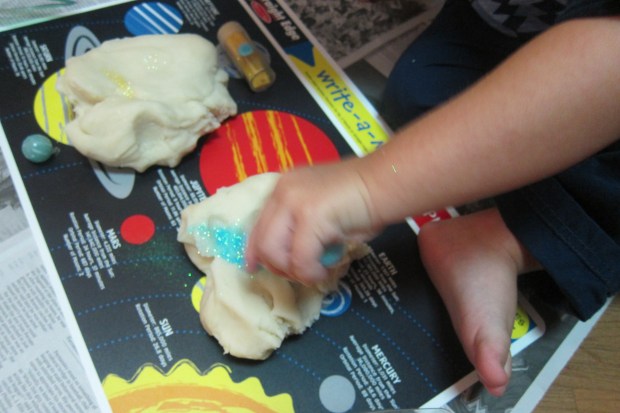
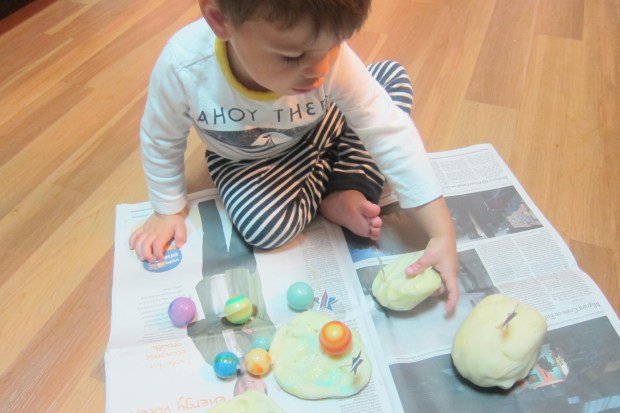
One neat idea is to make “galaxy playdough.” Alas, I did not have black food coloring, but we managed to have fun with the playdough I made following the recipe in the above link, minus the coloring. Then it was time to add “stardust”! Travis loved sprinkling in tons of blue and gold glitter to make our galactic creation.

u-week-12

We used props like model planets and star toothpicks to “explore” our galaxy, making for great fun.

solar-system-5

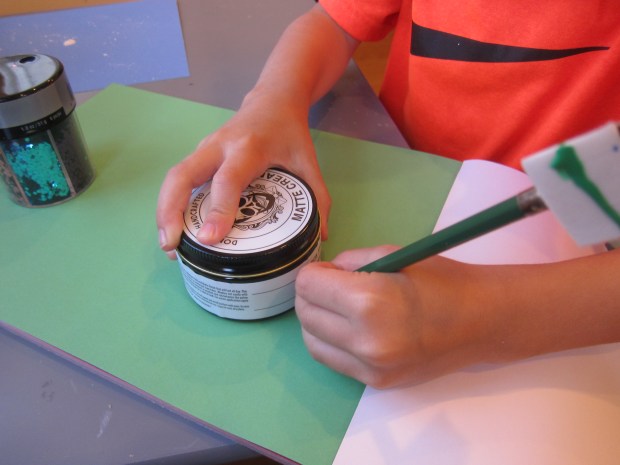
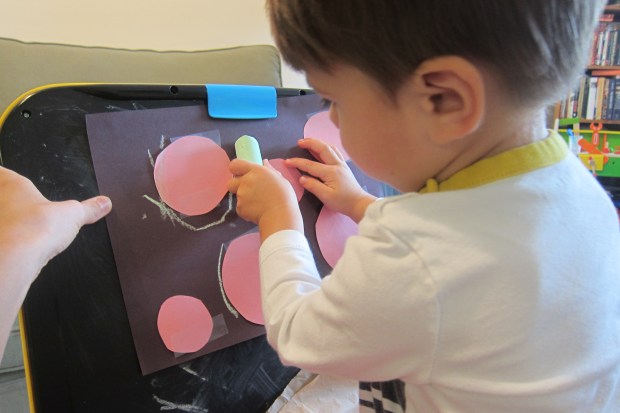
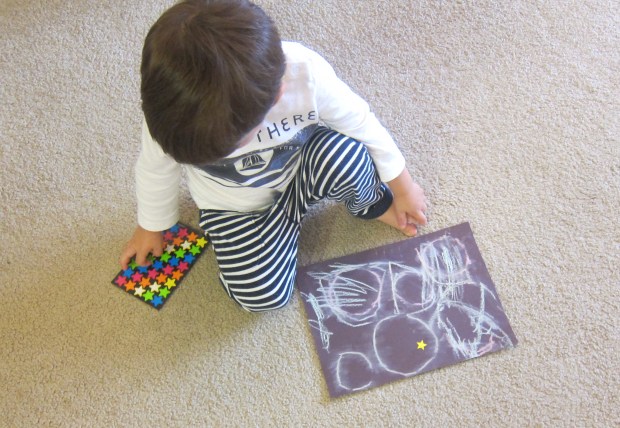
To talk about the relative size of the planets, I set up a simple tracing game. Travis is still getting the hang of tracing, so the result wasn’t as neat as yours will be if your child is preschool aged or up, but we had fun all the same! Cut colored circles from construction paper in various sizes, and tape to a second piece of construction paper, in a different color. Let your child trace around the circles with chalk.

solar-system-1

Remove the circles, leaving only the outline of the planets behind. You can smudge the edges of the chalk with your finger for a pulsing planet effect. We finished our “universe” with star stickers.

solar-system-3

What other fun galaxy games have your played with your child? Please share in the comments!

solar-system-4