Science… Meets Art

Science Meets Art (3)

This project (from our latest High Five issue) exemplifies the STEAM acronym: a little bit of scientific discovery paired with a nifty art creation at the end. You can do both components of the project, or just the science part, or just the art part… but I recommend the whole thing because we enjoyed it from start to finish!

First up, use some science (the S part of STEAM) to make at-home paints. Fill 6 large muffin cups with 1/4 cup baking soda each.

Science Meets Art (1)

Next, add about 15 drops of food coloring to each muffin cup. We only had powdered food coloring at home (from Color Kitchen), so sprinkled about a 1/2 packet of powder per compartment.

Science Meets Art (2)

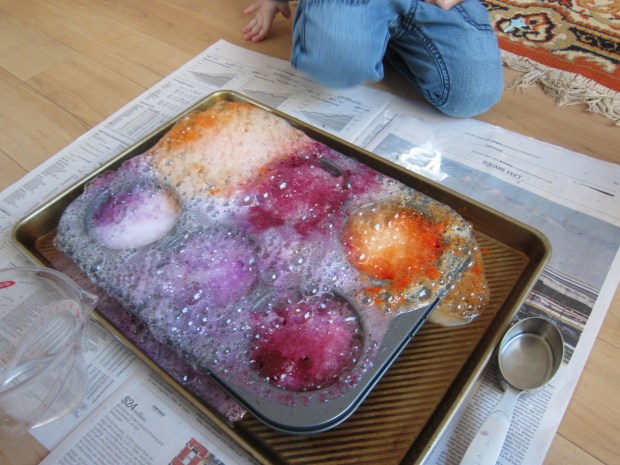
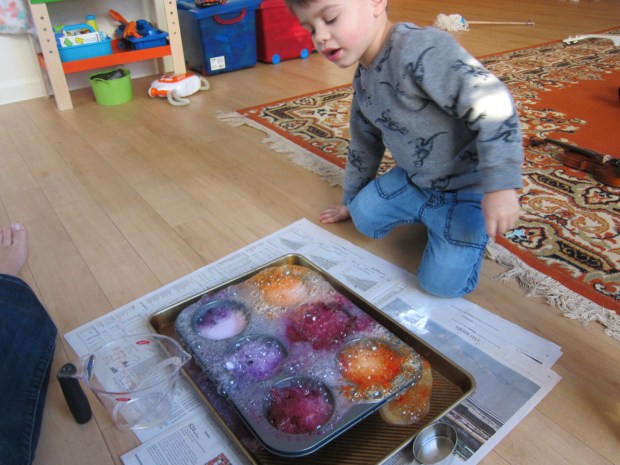
Now you’re going to quickly pour vinegar into each muffin cup, and watch the colorful explosion!
Science Meets Art (4)

Of course this is similar to many baking soda and vinegar projects we’ve done in the past, talking about how the gas created when the two substances touch makes all that foam and bubbles. But this time, we were left with a new product… paint!
Science Meets Art (5)

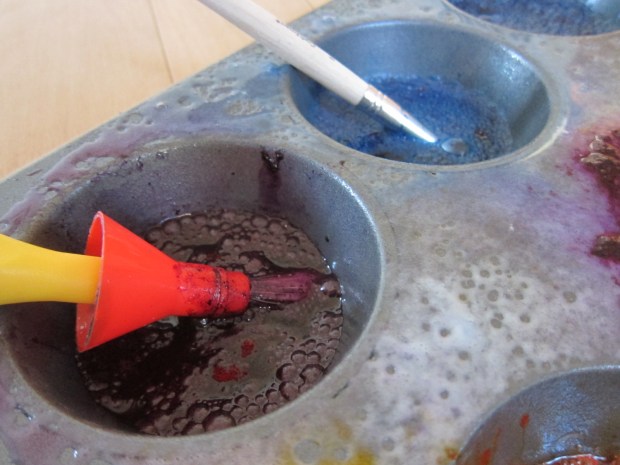
Now it was time to use the paint for the A part of STEAM. We painted white coffee filters, and Travis had a blast, mixing colors and stirring each paint very carefully – a petit artiste!

Science Meets Art (7)

Set the filters aside to dry; these are going to be your flower blossoms.

Science Meets Art (8)

As a small gripe, you’re going to have undissolved baking soda left in each paint mixture, which leaves the coffee filters a bit grainy after they dry. I found it helpful to rub off the excess baking soda over the trash can before Travis and I moved on to the final steps of the project.

Meanwhile, make the flower stems by painting jumbo craft sticks green. The only green paint we had in the house was a dot marker, but this worked in a pinch. Let dry.

Science Meets Art (9)

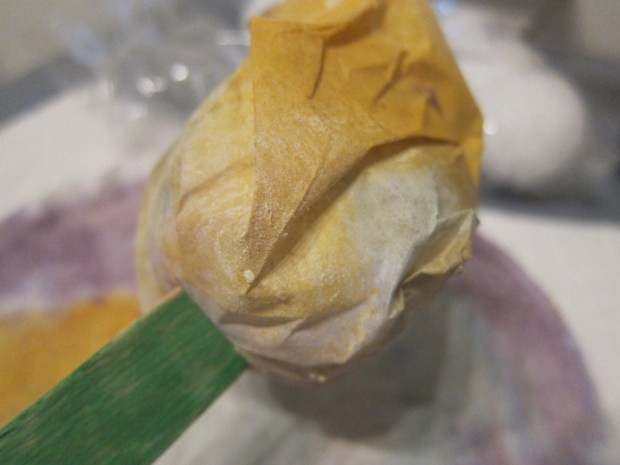
To finish the flowers, wrap each painted filter around a medium-sized Styrofoam ball. Poke one of the green “stems” up through the filter and into the Styrofoam.
Science Meets Art (12)

Glue the tips of the filter together so the ball inside is no longer visible and voila – flowers!

Science Meets Art (11)

We set them in a vase, where we got to enjoy the fruits of our labor: beautiful flowers in the middle of a snowy winter.

Science Meets Art (13)

Thanks High Five!

Science Meets Art (6)

How to Make Pennies Turn Green

Pennies Green (7)

We’re on winter break and the science fun continues! With this easy experiment, you’ll create a simple chemical reaction – and help explain to your kids why the once copper-colored Statue of Liberty is now green!

The project was fun from start to finish because first we had to break into Travis’s piggy bank. This meant using a screwdriver (under careful adult supervision of course). We separated out the pennies from the rest of the coins, making it a quick lesson in currency denominations too.

Pennies Green (1)

Place your pennies in a bowl covered with a paper towel.

Pennies Green (2)

Pour white vinegar into the bowl, making sure the paper towel is completely saturated.

Pennies Green (4)

Now observe! We were surprised when the first penny had green spots after only a few hours.

Pennies Green (6)

The next morning, several of them were quite green!

Pennies Green (8)

I honestly have no idea why some of the pennies turned green and others did not, but here’s what’s happening: The metal copper and the acid in the vinegar react with oxygen, and form a new blue material, called malachite.

Make sure to observe under a magnifying glass, too!

Pennies Green (9).JPG


Erupting Apples

Exploding Apples (3)

We pretty much never tire of making baking soda explode with vinegar around here. To add an autumnal spin to the project, this time we erupted “apples” instead of volcanoes!

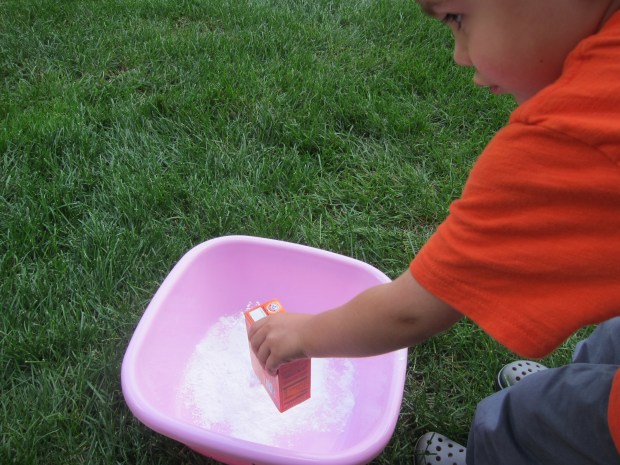
To make your apple mixture, combine 1 cup baking soda, 1 tablespoon dish detergent and 1 tablespoon water. We had everything ready to go in a bin for outside, since we knew this was going to be a messy one…

Exploding Apples (1)

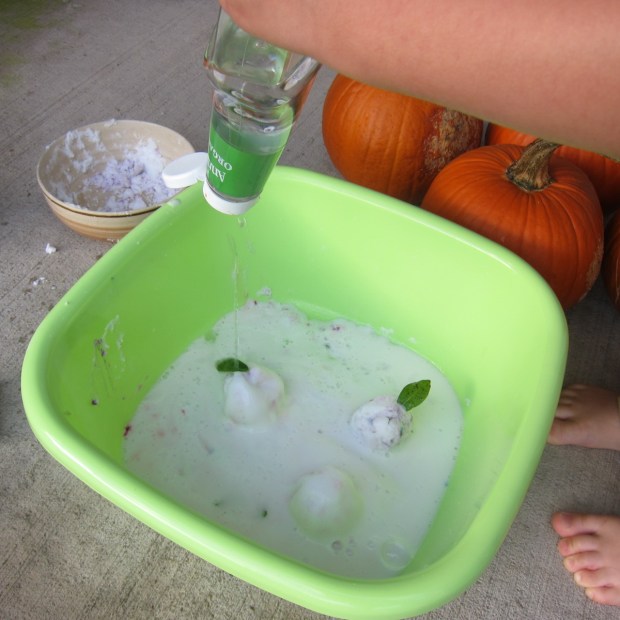
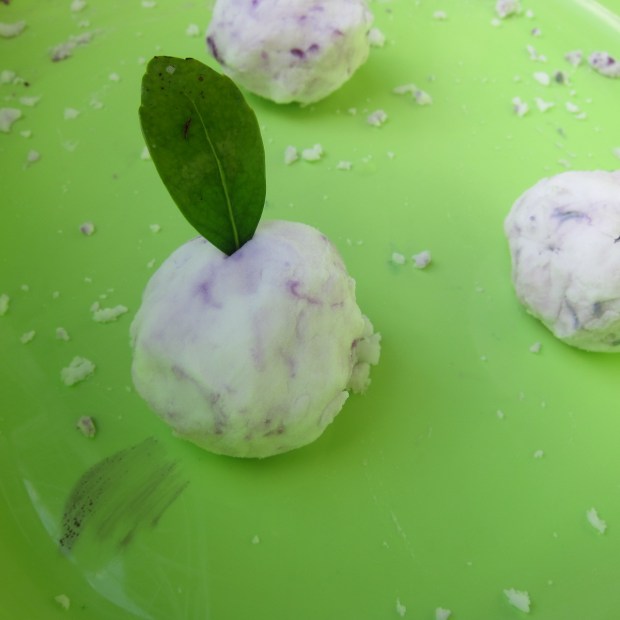
Time to get your hands dirty! Get in there and mush your baking soda mixture around, until you can form it into balls as the apples. We squirted in a little red food coloring, but oddly this made our apples purple, not red! Ah well, a little leaf as the finishing touch made them super cute.

Exploding Apples (2)

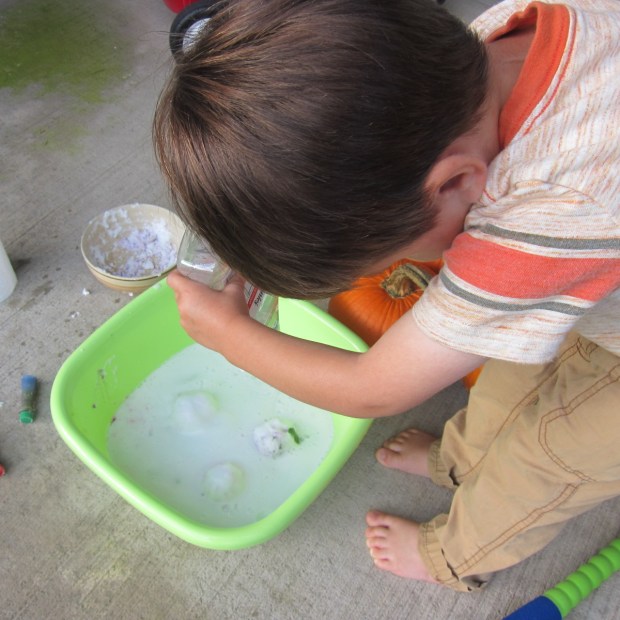
I gave Travis an old ketchup bottle filled with white vinegar, and he went to town squirting onto the apples, delighted by the foamy erupting result.

Exploding Apples (4)

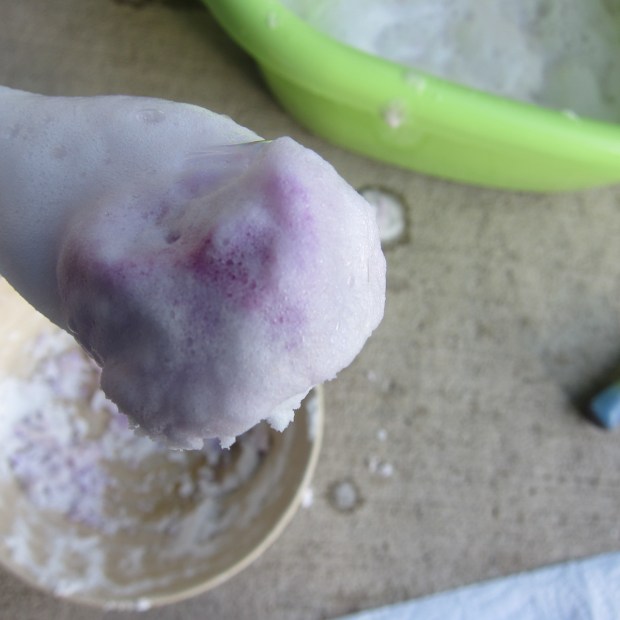
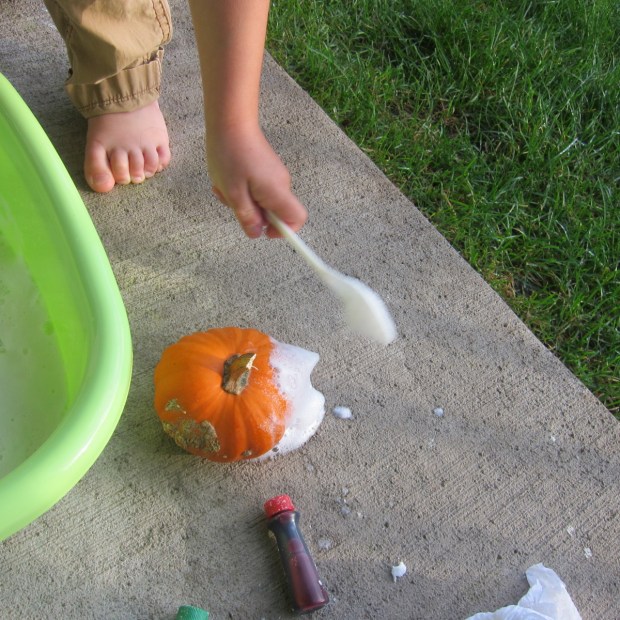
He couldn’t stop there of course; half the fun is stirring around the foamy mixture afterwards. Look, a leftover apple!

Exploding Apples (6)

Travis also decided he wanted to cover one of our gourds with the foam – why not, since this added to the fall feel of the project.

Exploding Apples (7)

As always, this activity is the perfect way to blow off energy when your kids just want to get messy!

Exploding Apples (5)

Vinegar, Baking Soda… and Balloon Eye Droppers

Vinegar Balloons (4)

I used to have pipettes (a.k.a. eye droppers) at home, but can’t find them anywhere these days! Cue this genius idea I spotted on Kiwi Co‘s KiwiCorner app. The perfect way to use up a few balloons we had in our craft box.

This game is pretty much a simplified version of my volcano for toddlers – a big bin of baking soda with vinegar to squirt on top. But the fizzy fun comes from the novelty of squirting out the vinegar through homemade eye droppers.

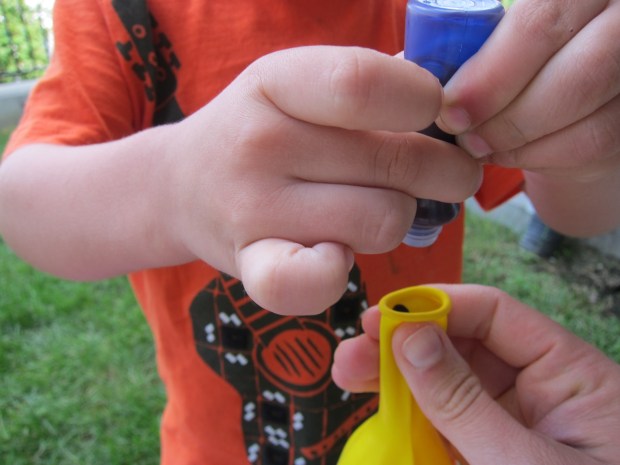
To prepare your eye droppers, fill uninflated balloons with white vinegar. Add a few drops of food coloring to each, so your explosions will be colorful as well.

VInegar Balloons (1)

I knotted off the balloons, after which they look like mini water balloons. Carefully poke a small hole in each (a pin or wooden pick both work fine).

Vinegar Balloons (2)

Travis dumped a container of baking soda into a tray, and then we let the fizzling begin!

Vinegar Balloons (3)

After the first few bubbles, he preferred to stir our mixture while I squirted additional vinegar from the “eye droppers.”

VInegar Balloons (5)

Overall, cute and messy fun, and a nice way to improvise when you can’t find real pipettes.