Dirt Day!


Armed with a giant bag of potting soil, Veronika and I had a day all about dirt! Here are three ways we played.

We started out inside, with a giant Mud and Dirt Sensory Box. Pour in dirt (or the above-mentioned potting soil), and add a few items that are fun to get, well, dirty! That meant a few of Veronika’s toy construction trucks, plastic cups for scooping and dumping, and some marbles.

First she explored with the trucks. She loved digging through the dirt with the bulldozer and then dumping into one of the cups.

We then pretended that the marbles were little seeds for planting, perfect imaginative play for springtime! She loved digging holes with a spade and pressing the marbles down in the dirt. Then we decided to make some of the dirt into mud; simply pour in a few cups of water and stir. Veronika marveled at the new consistency, as well as the earthy smell that resulted right away! When you’re done, take that sensory bin outside for a rinse down with a hose.

But we weren’t done yet with the dirt! I made a few circles with chalk on the back patio, labeled with point values. Older kids can play a classic game of bullseye, with concentric circles. For Veronika, I spaced the circles all over the patio with different point values based on their size.

Now we needed mud! I scooped some potting soil into a cup and we poured in water. Veronika was in charge of stirring until it was thick and goopy.

Big kids can now stand back, pick up handfuls, and take aim!

Veronika preferred to scoop up the mud with our spade and dribble it over the point values, delighting in the splat of the mud hitting the patio.

Bullseye!

Finally, we took some of that mud and decided to make art! I divided the mixture among 4 plastic cups and we squirted a generous amount of food coloring into each.

Dip in paintbrushes, and brush onto thick white paper. This made surprisingly beautiful colors, from vivid yellow…

…to a deep blue.

Veronika loved pouring and mixing the “paints”, too, or sometimes pouring them directly over the paper and then scribbling through with a paintbrush.

Older kids (and grown-ups!) can have fun making artistic paintings, like this little fishy fellow.

In sum, we had fantastic fun on this dirt-y day!

Rice Sensory I Spy Bag

This activity is part sensory bag and part “I Spy” game, and a great option to take in the car for long rides!

The goal is to hide a few trinkets in a bag of rice, but you’ll need to take a picture of those items, first. You can use a variety of items (think buttons, thimbles, pennies etc.), but I decided to make the game about color, too. That meant I used all one item (flower-shaped beads) but in different colors.

Thanks to a recent gift of a Zink jet printer, I snapped a pic and was able to print it right from my phone, saving the need for a trip to the one-hour photo!

Next, I poured 1 cup rice into a small zip-top plastic bag, then added the flower beads from the picture. Press out the air, then seal and shake to distribute. Place this bag inside a second zip-top bag (for security against rips and tears); seal and then add an edge of colored duct tape for a finished look.

Now, I handed the Veronika the bag, along with the picture! She picked a color from the picture, then searched for that matching bead in the rice. Or sometimes she did the reverse, spotting a bead and then looking over at her picture to see which one matched.

To make this easy to take along in the car, punch a hole in the corner of the picture and in a corner of the bag, then attach them together with a small length of yarn or string.

Dinosaur Fossil Excavation

Depending on the age of your child, this game can be either mostly sensory play or mostly STEM play. Either way, it’s sure to delight!

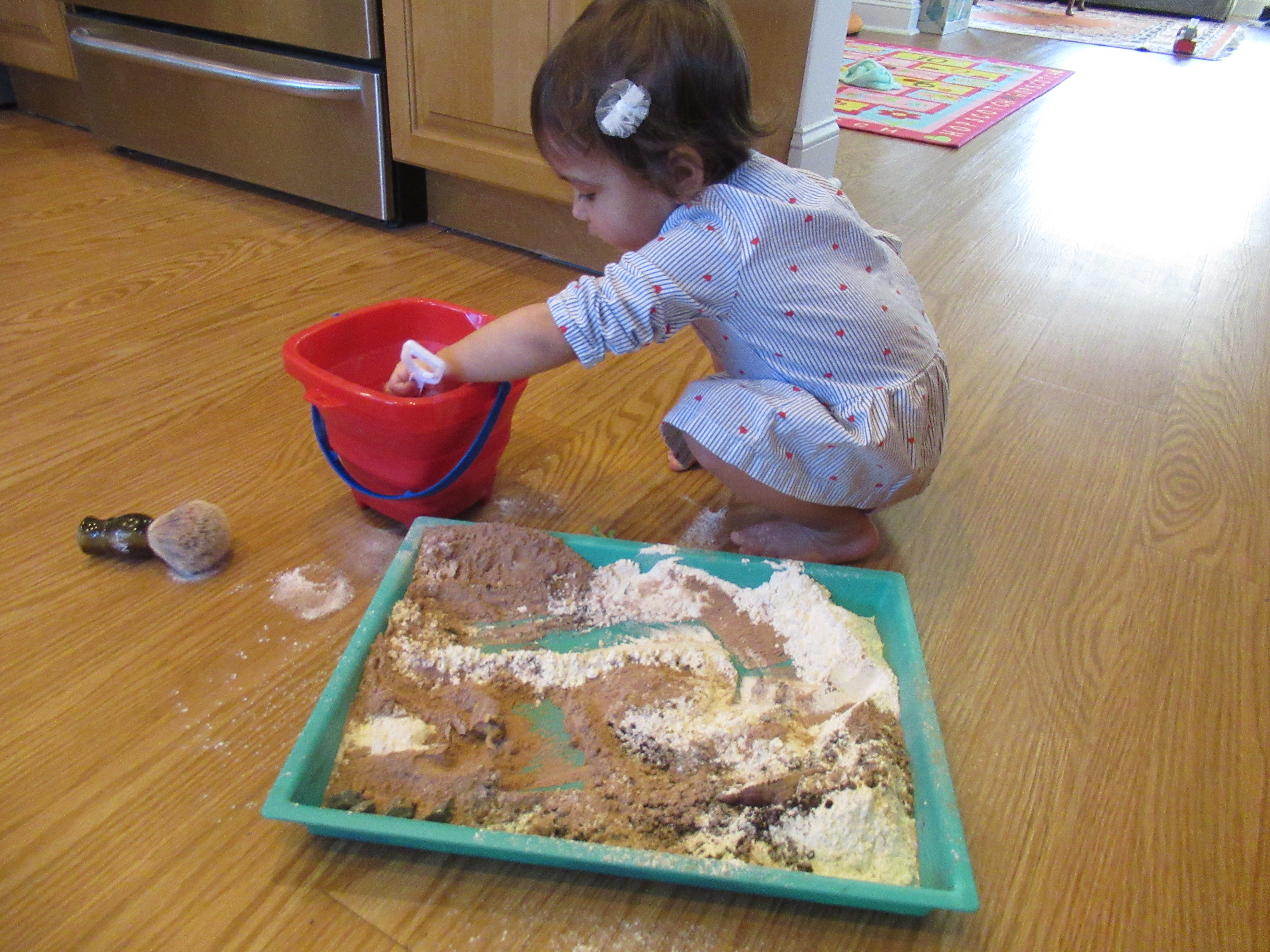
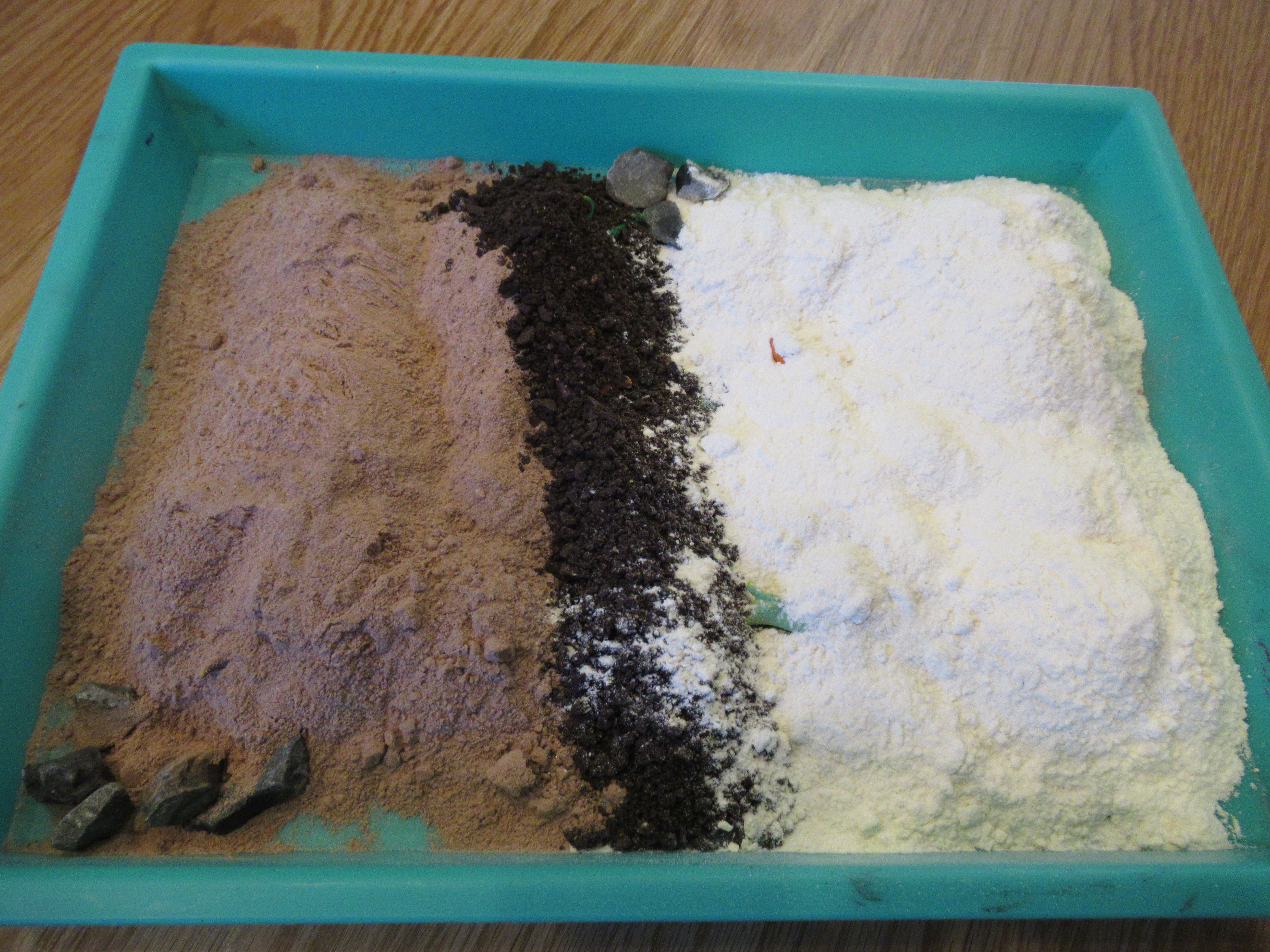
I set up a dinosaur excavation pit for Veronika with three kinds of “dirt”. The first was a box of chocolate cake mix, the second was crushed chocolate cookies, and the third was regular flour (although whole wheat flour probably would have worked better).

Next, I buried a few of our small plastic dinosaurs under the “dirt”. If your children are older, you can use store-toy bones or fossil prints, instead (or even make your own). Since I knew Veronika wouldn’t quite understand what she was seeing with the fossils, we stuck with whole dinosaur bodies. She was about to be a very lucky paleontologist.

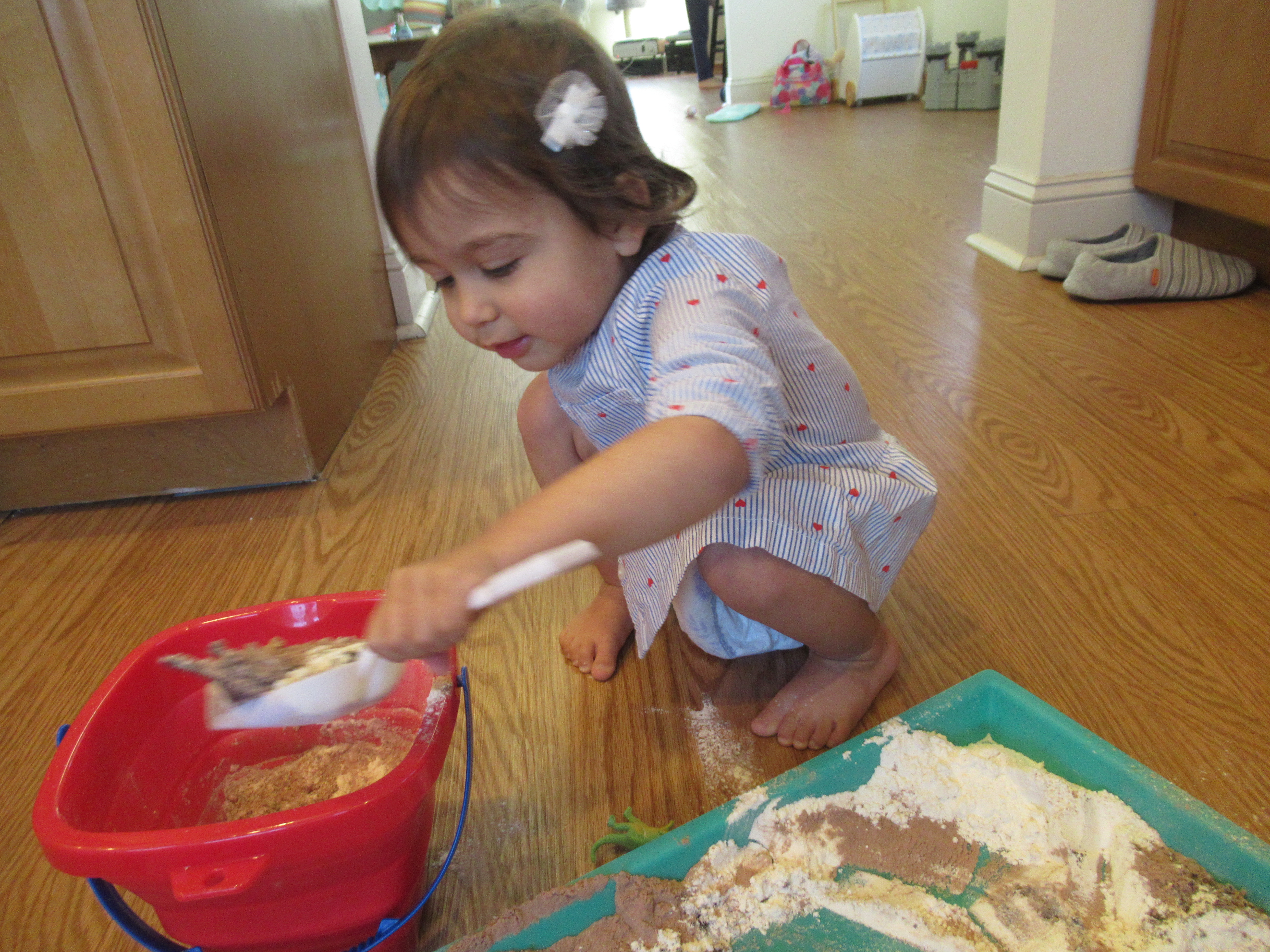
I scattered a few rocks on top for a finishing touch, then set out an old shaving brush, bucket, and shovel. Time to dig!

She immediately took to shoveling up the dirt and transferring to her bucket, a process which she absolutely loved.

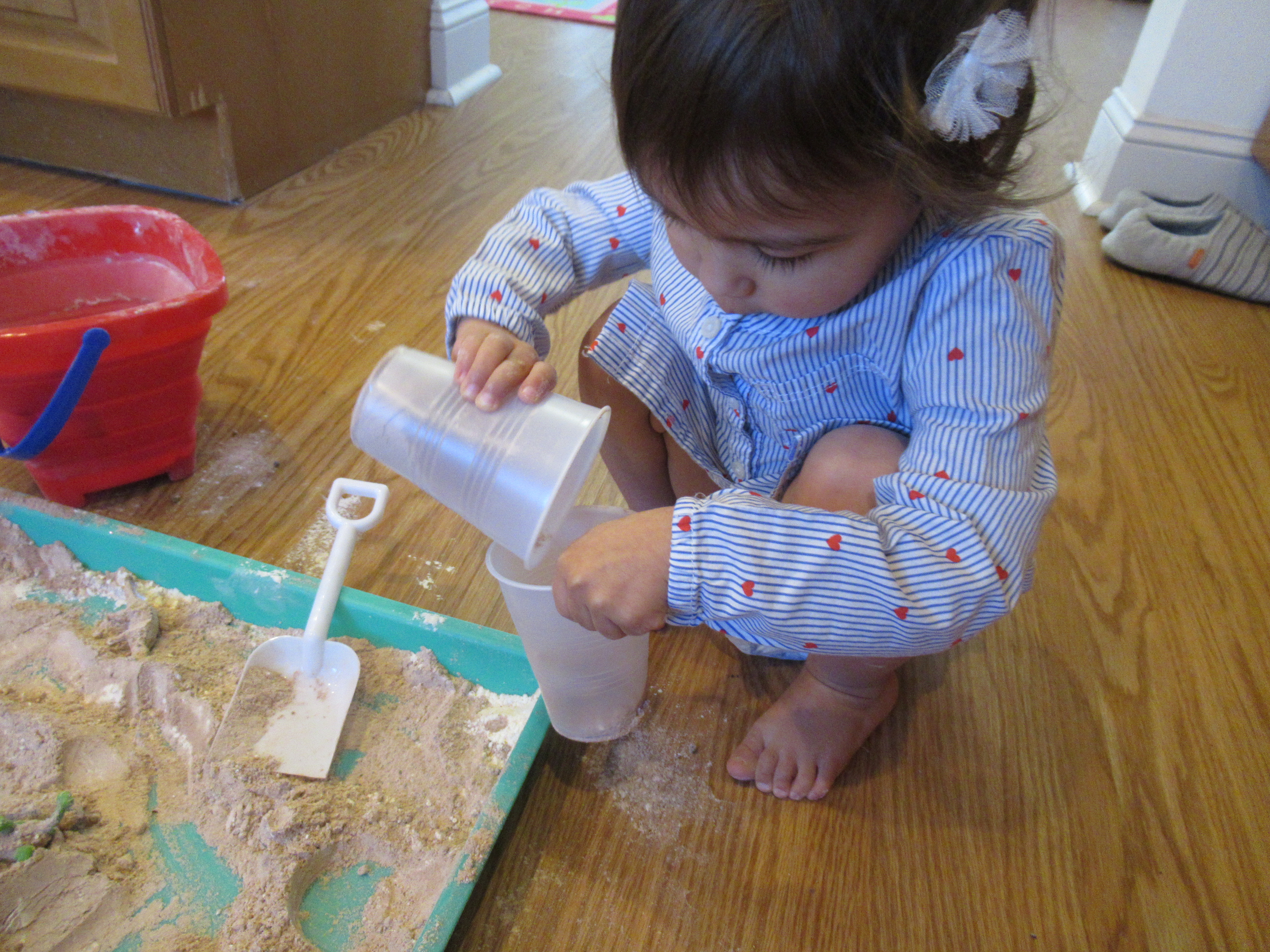
I showed her how to brush the dust and grime off the dinosaurs as she unearthed each one, but honestly she wasn’t much interested. Dinos, rocks, and dirt alike went into her bucket and then were dumped into the tray to start all over. She also enjoyed pouring the “dirt” back and forth between a few small plastic cups.

Don’t fear the clean-up. The mixture sweeps up easily… as long as you don’t get it wet. Trust me: You do not want to deal with wet chocolate cake mix on your floor.

Water Activity with Newspaper

Newspaper and Water (2)

When Travis was a toddler, I once set him loose with a tray of nothing more than newspaper and water and he kept busy for nearly an hour! So when I spotted this morning’s pile of newspaper about to be recycled, I quickly set up a variation for Veronika.

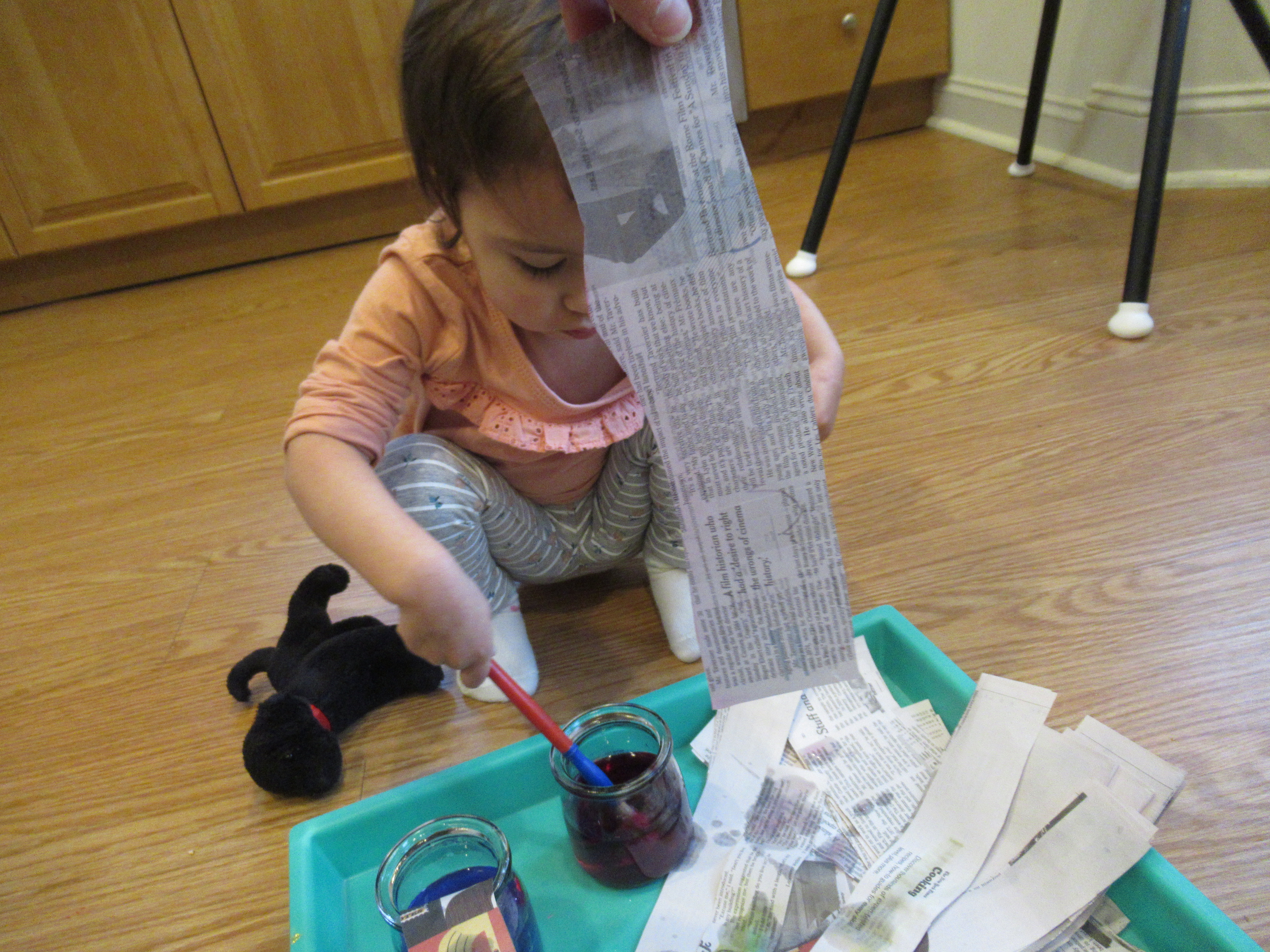
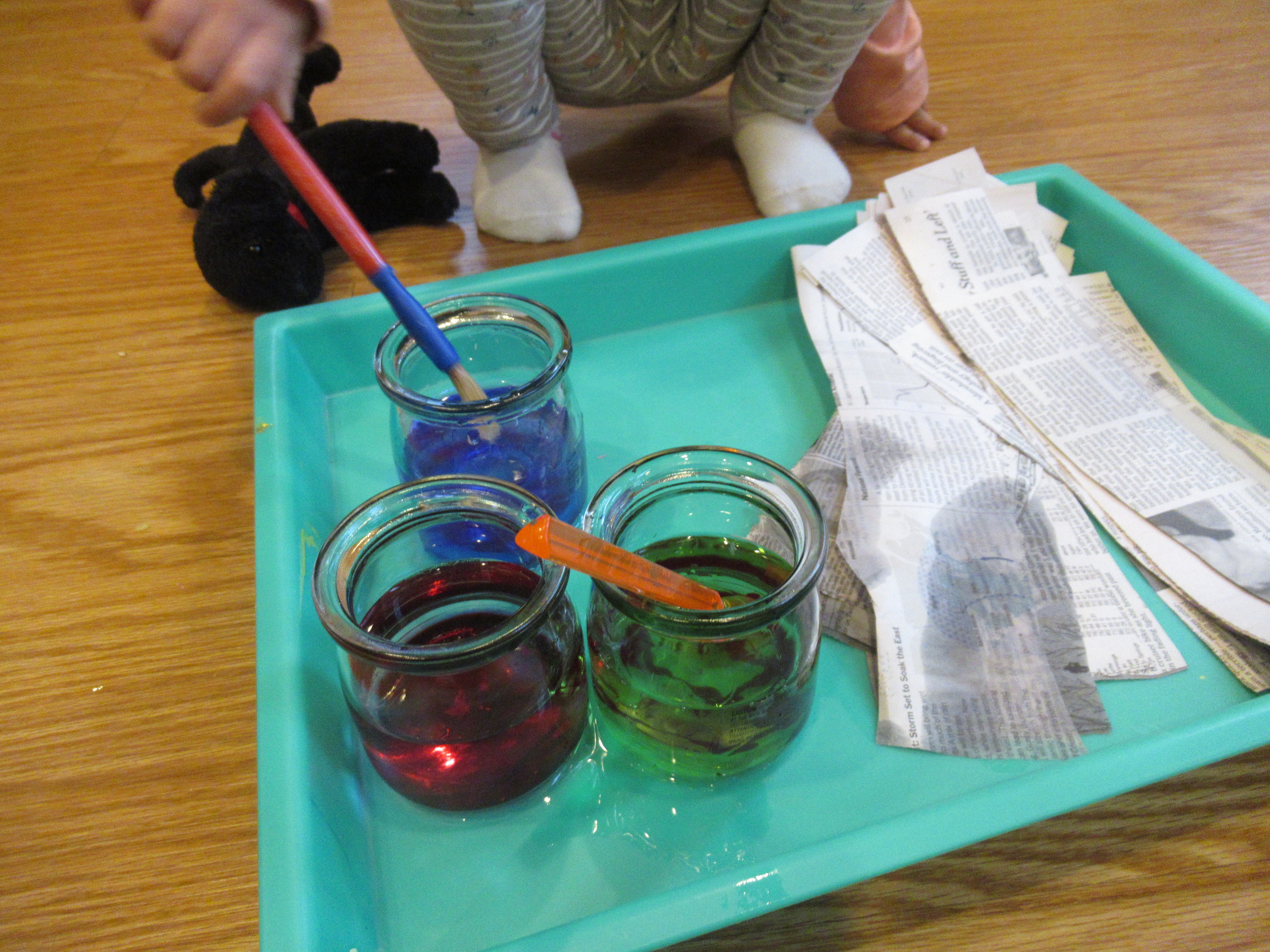
This time, I cut the newspaper into strips and then set out three jars, each filled with a little water dyed with food coloring.

Newspaper and Water (1)

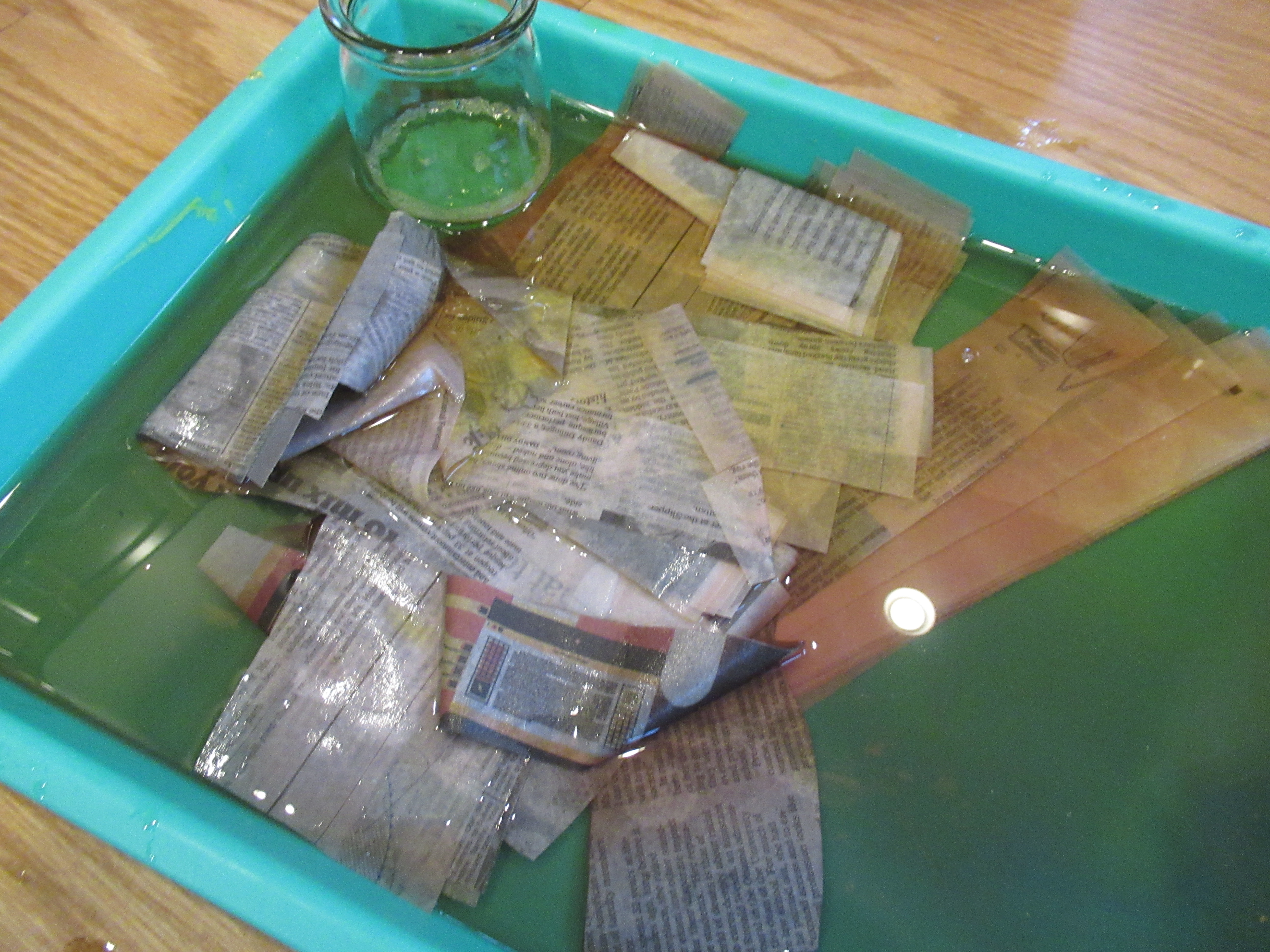
As soon as she saw the pots of colored water, Veronika asked for paintbrushes! She loved brushing lightly over the newspaper, which quickly soaked up water and color both.

Newspaper and Water (3)

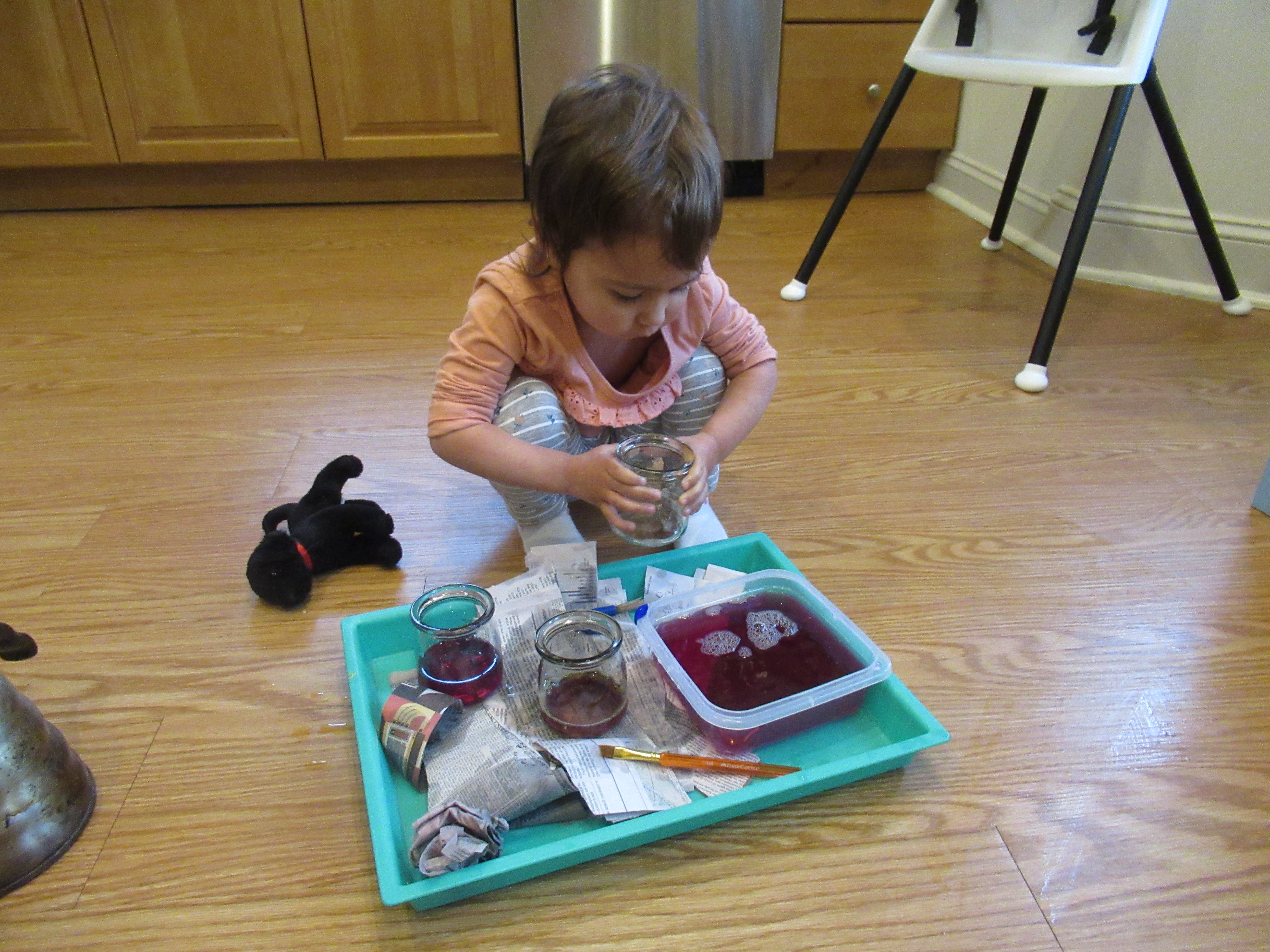
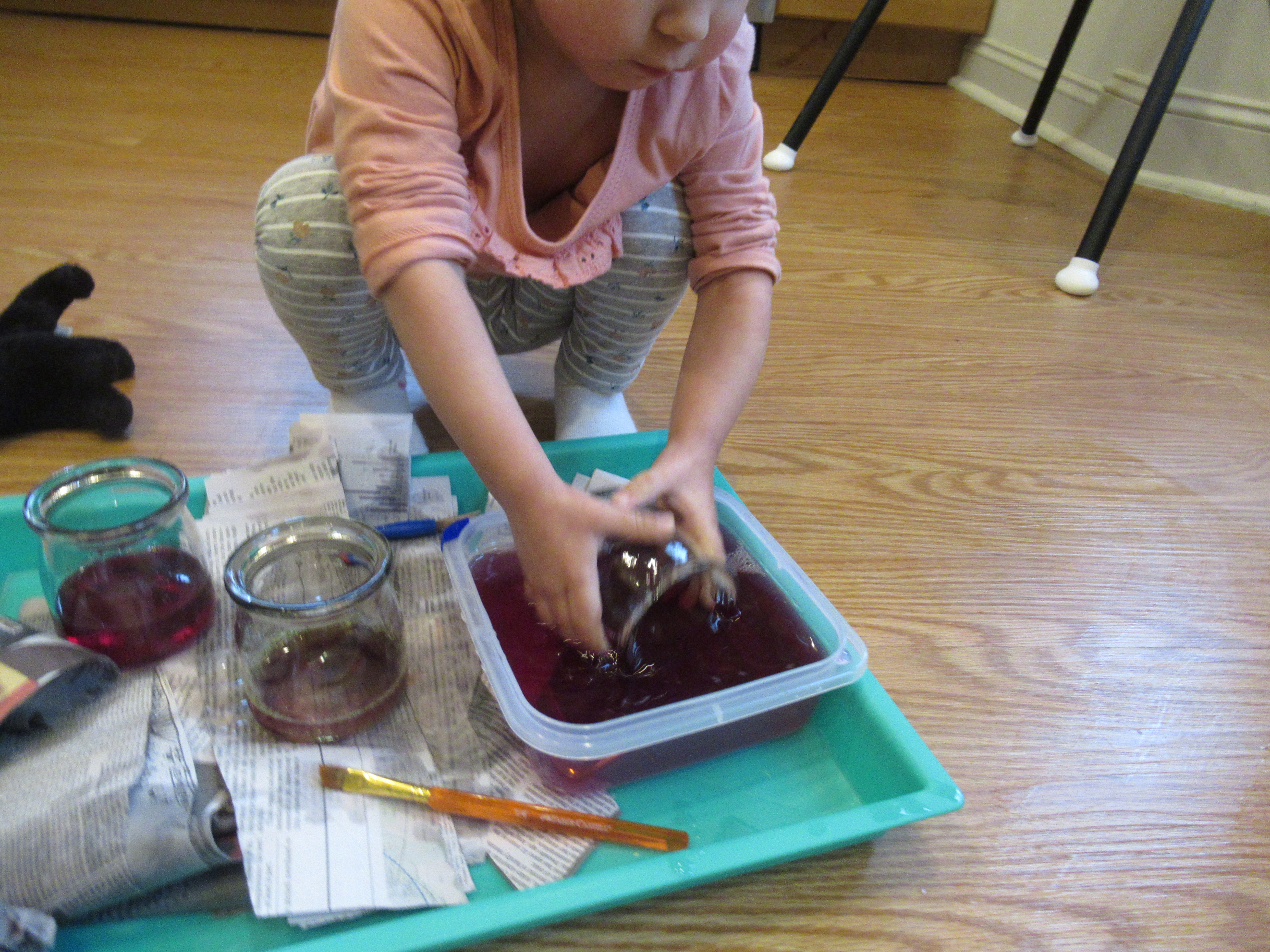
My assumption was that she’d want to drunk the newspaper into the water and see what happened when it got even wetter. It turned out she was much more into the pots of water, and transferring liquid back and forth. But we did pour some over the newspaper and observe how the paper changed from dry to wet.

Newspaper and Water (5)

It was fun to squeeze out the wet newspaper like a sponge, too; it holds surprisingly more than you would think!

Newspaper and Water (4)

The activity was also great practice for scooping water up, to refill her jars.

Newspaper and Water (6)

In sum, she didn’t play quite as long as Travis had as a toddler, but still enjoyed the activity. Prefer your newspaper games dry? Test out our recent fun with indoor newspaper throwing instead!

Newspaper and Water (7)

Rainbow Rice Letter Learning Tray

Rainbow Rice Letter Tray (11)

It’s been all things rainbow in our house this week as we get closer to St. Patrick’s Day. Here was a new spin on an old idea, since we’ve made rainbow rice before, but with some learning thrown in. Today, there were letters hidden in all that rice!

As a reminder, you can make rainbow rice by combining 1 cup white rice, 1 tablespoon white vinegar, and a few drops of food coloring in a zip-top bag, using 1 bag for each color desired. Seal and shake to coat, then pour onto paper plates and let dry overnight.

Rainbow Rice Letter Tray (1)

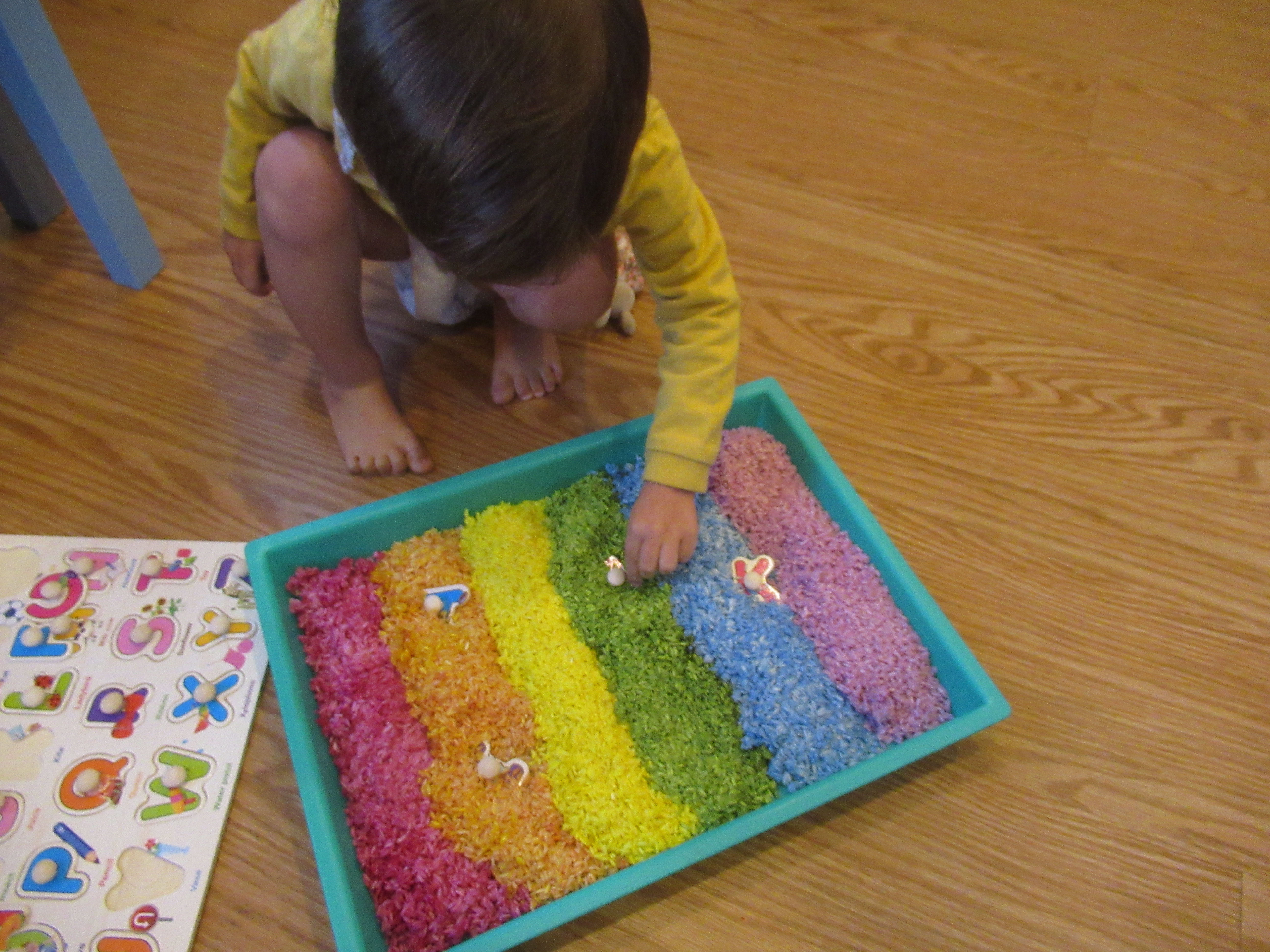
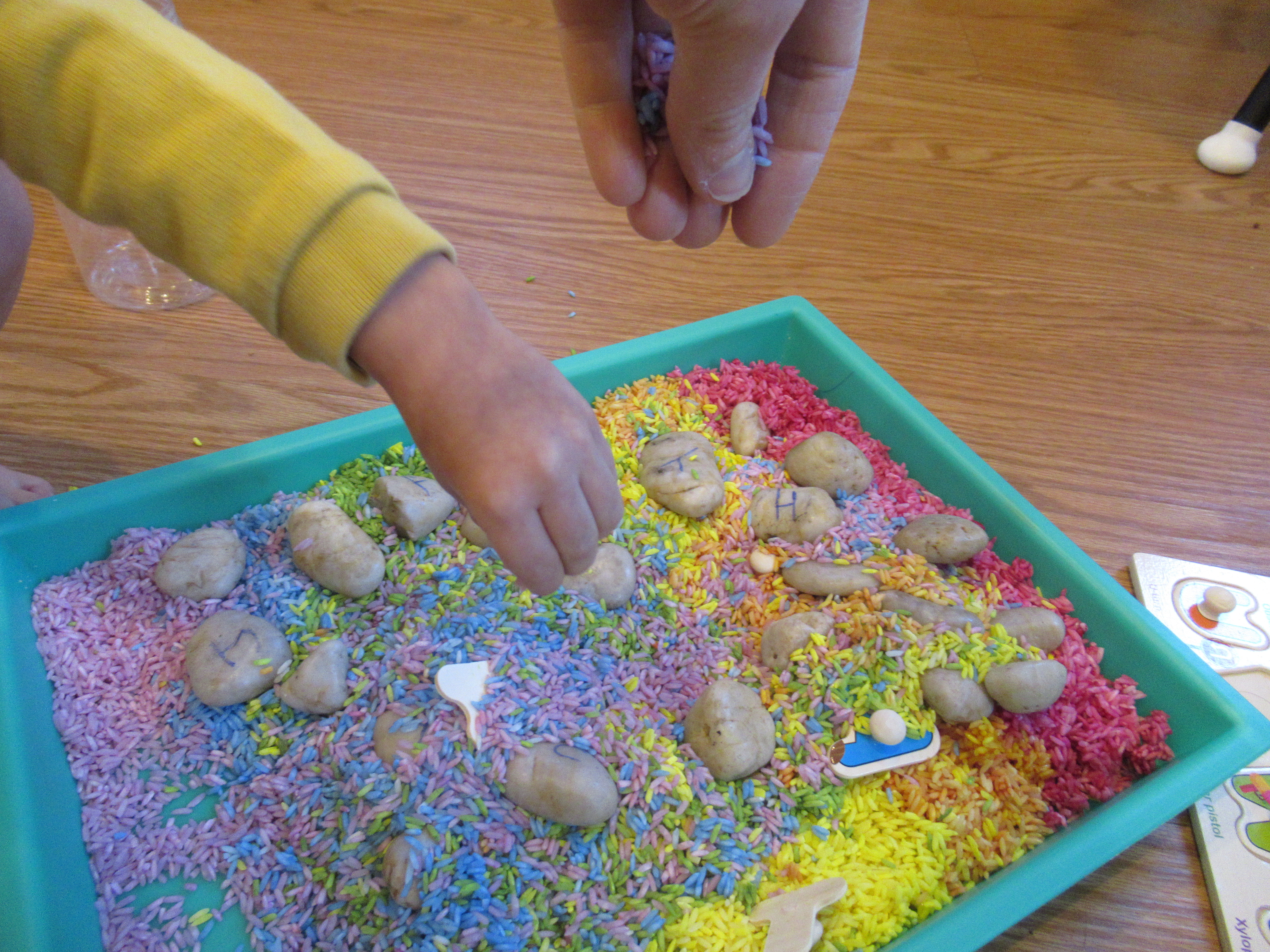
In the morning, I arranged the colors in rainbow order for Veronika. I then set out two sets of letters. The first was smooth rocks, which I had labeled A through Z with a sharpie.

Rainbow Rice Letter Tray (3)

The second were the pieces of a letter puzzle. I recommend working with only a few letters at a time for a toddler, or you risk wearing out your child’s concentration! As always, a great place to start is the letters of your child’s name, so today I placed the puzzle letters V-I-K-A (Veronika’s nickname) in the rice.

Rainbow Rice Letter Tray (5)

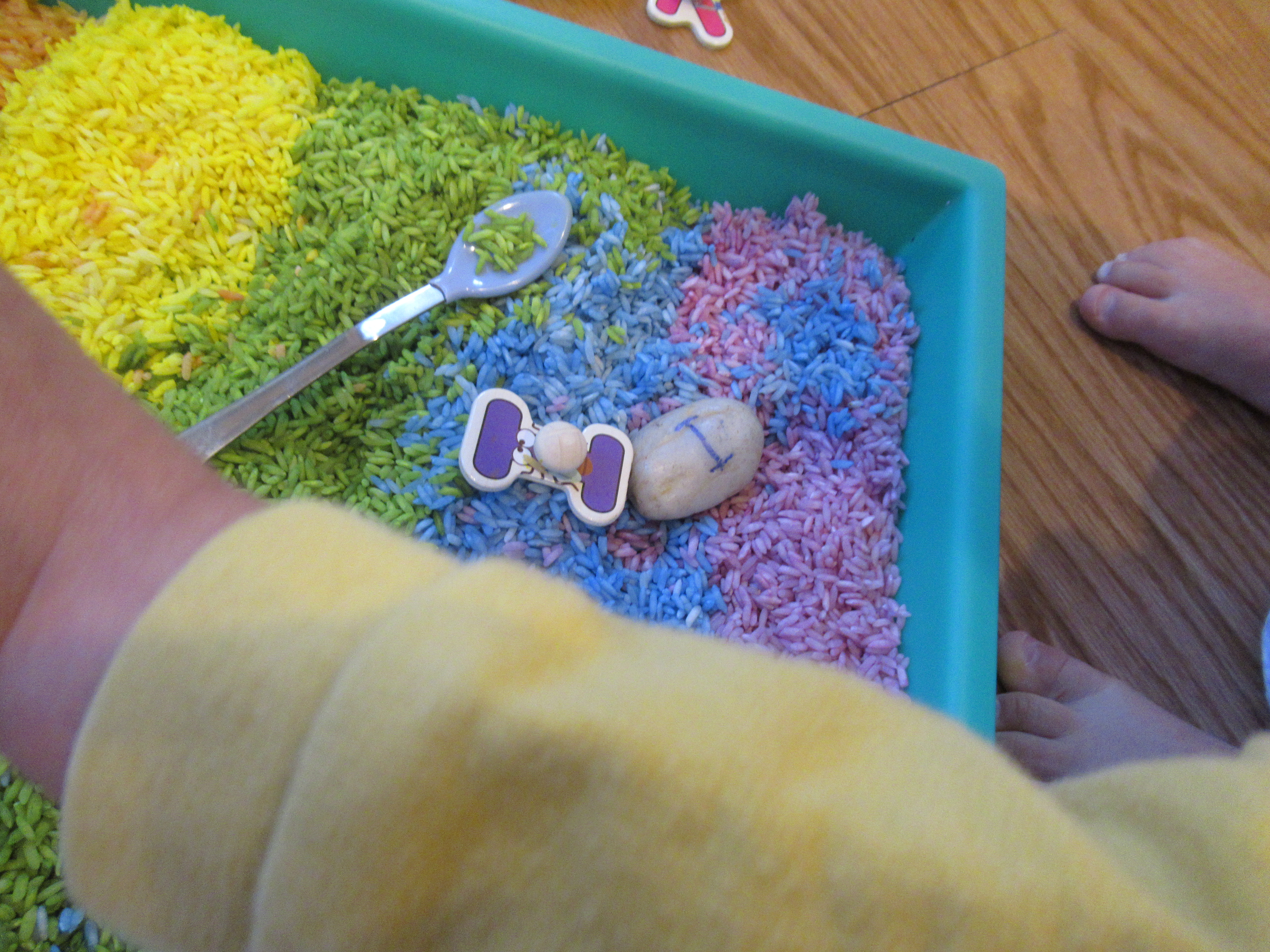
I pulled our each correspondingly lettered rock, and we went hunting for them! “Hmm, where’s k?” Veronika said so seriously, sifting through the rice with a spoon. “Here it is!”

Rainbow Rice Letter Tray (4)

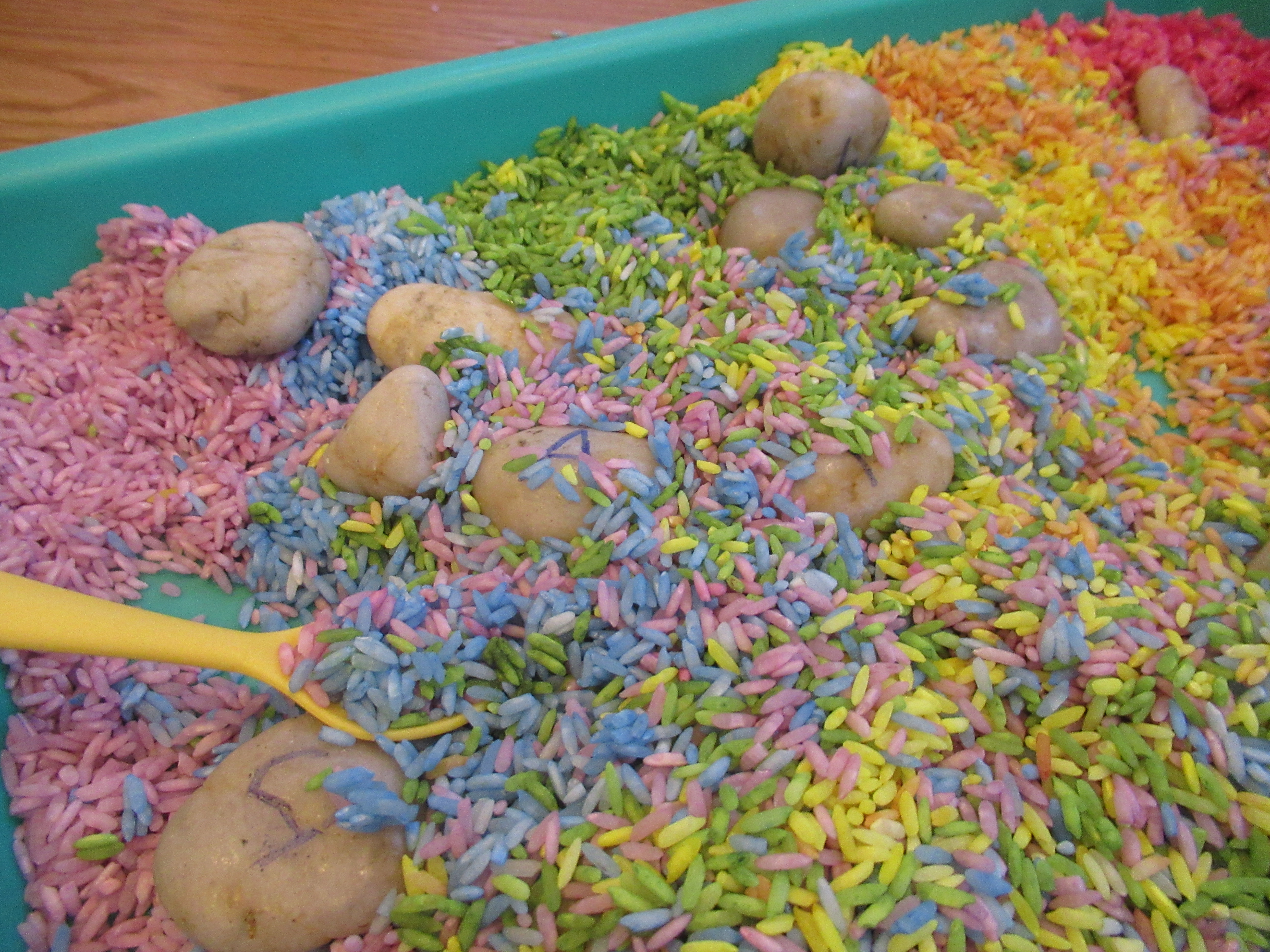
After we had matched these letters, it became more of a free-for-all. She loved putting the rocks in the rice and burying them with the spoon.

Rainbow Rice Letter Tray (10)

Then, as she uncovered each one, we would look over at the puzzle to find the one it matched.

Rainbow Rice Letter Tray (7)

Finally, things turned into regular sensory play, which was just fine. She loved the sound the rice made as we sprinkled it down!

Rainbow Rice Letter Tray (8)

The pastel colors of the rice helped us channel spring, which is less than a week away, a very welcome thought as winter weather continues outside.

Rainbow Rice Letter Tray (6)

DIY Rainbow Salt Tray

DIY Rainbow Salt (3)

This colored salt activity looks beautiful, is great for sensory play, and is guaranteed to keep your toddler busy.

Preparation is remarkably easy. For the best result, you want to use large salt crystals, rather than regular table salt. I used kosher salt, but rock salt would have been even better! I poured a little salt into each of 6 zip-top plastic bags, then added food coloring to each, mixing two colors where needed to result in a full rainbow. Seal the bags and shake to combine. Your toddler might want to help with this part!

DIY Rainbow Salt (1)

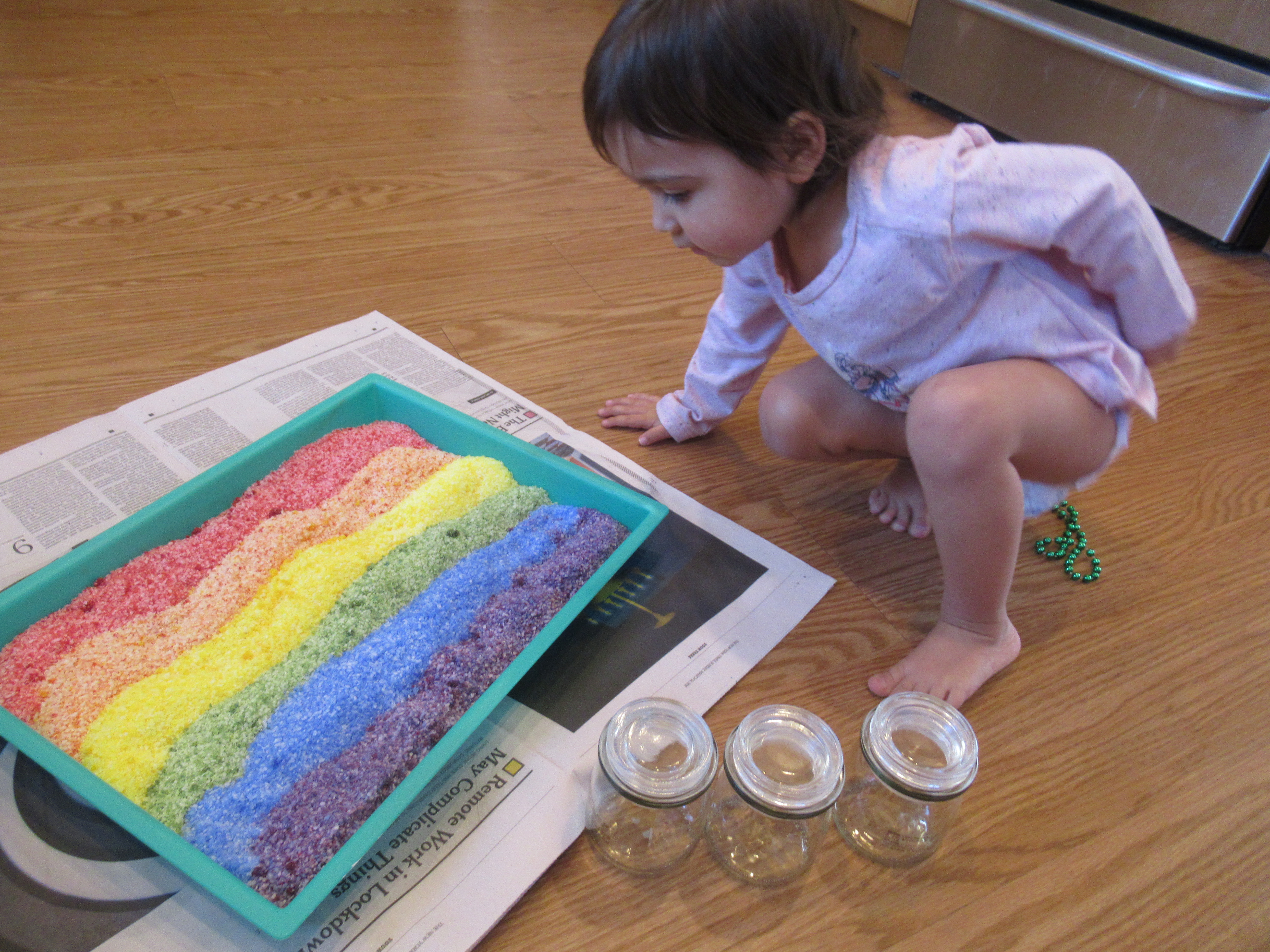
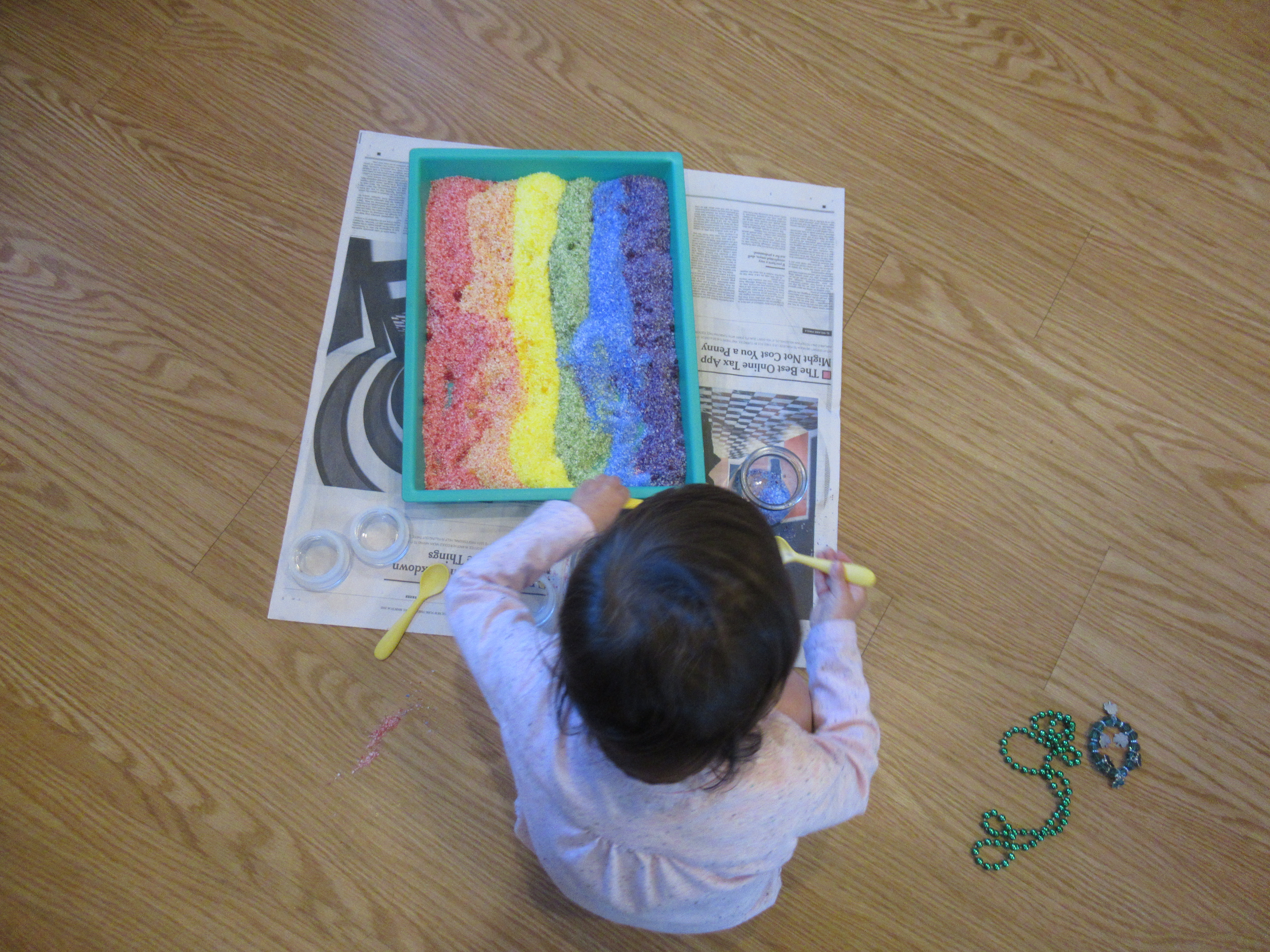
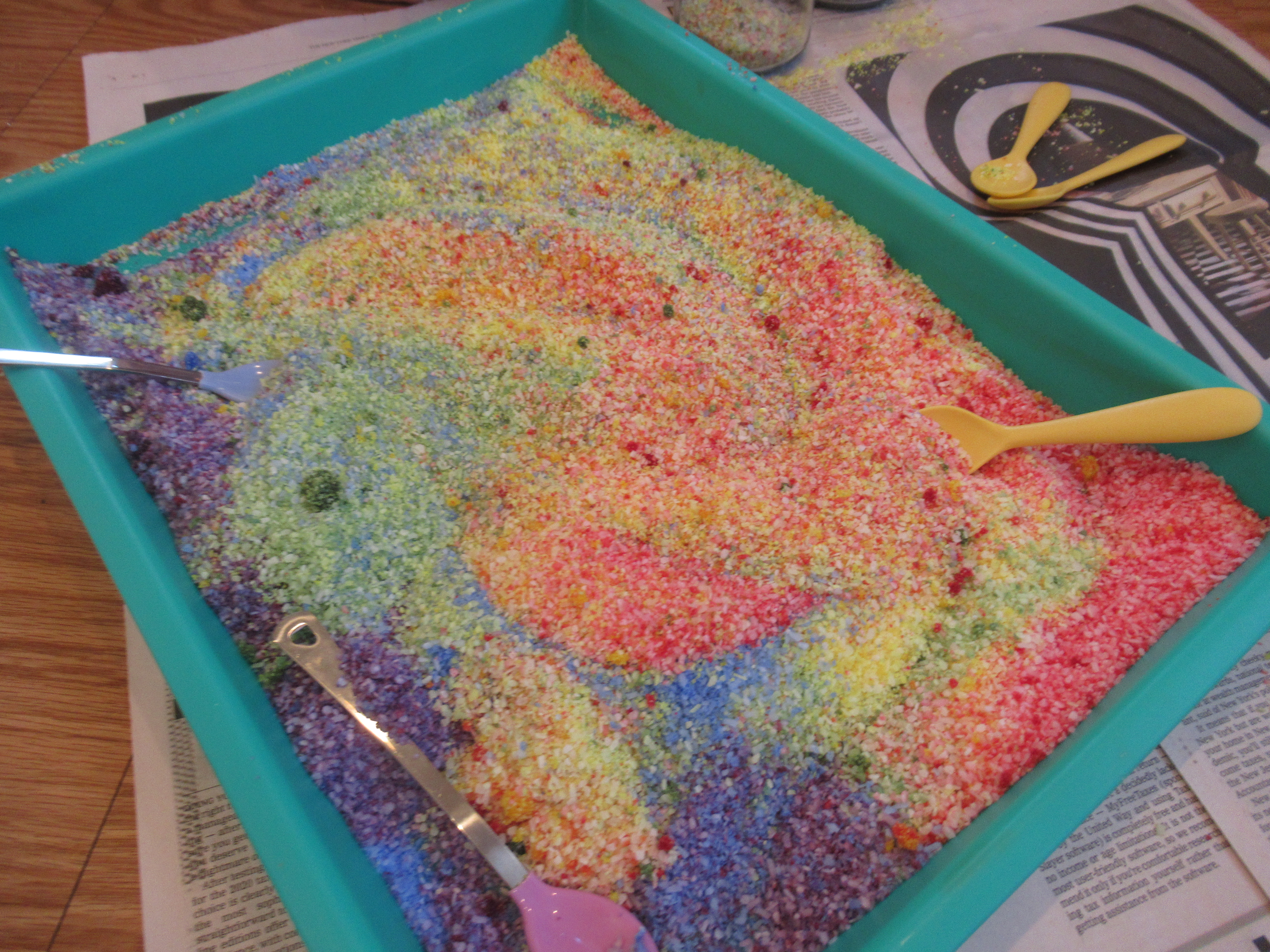
I then arranged the salts in rainbow rows on a craft tray. In remarkably short time (only about 30 minutes), the color on the salt had dried and was ready for play.

DIY Rainbow Salt (2)

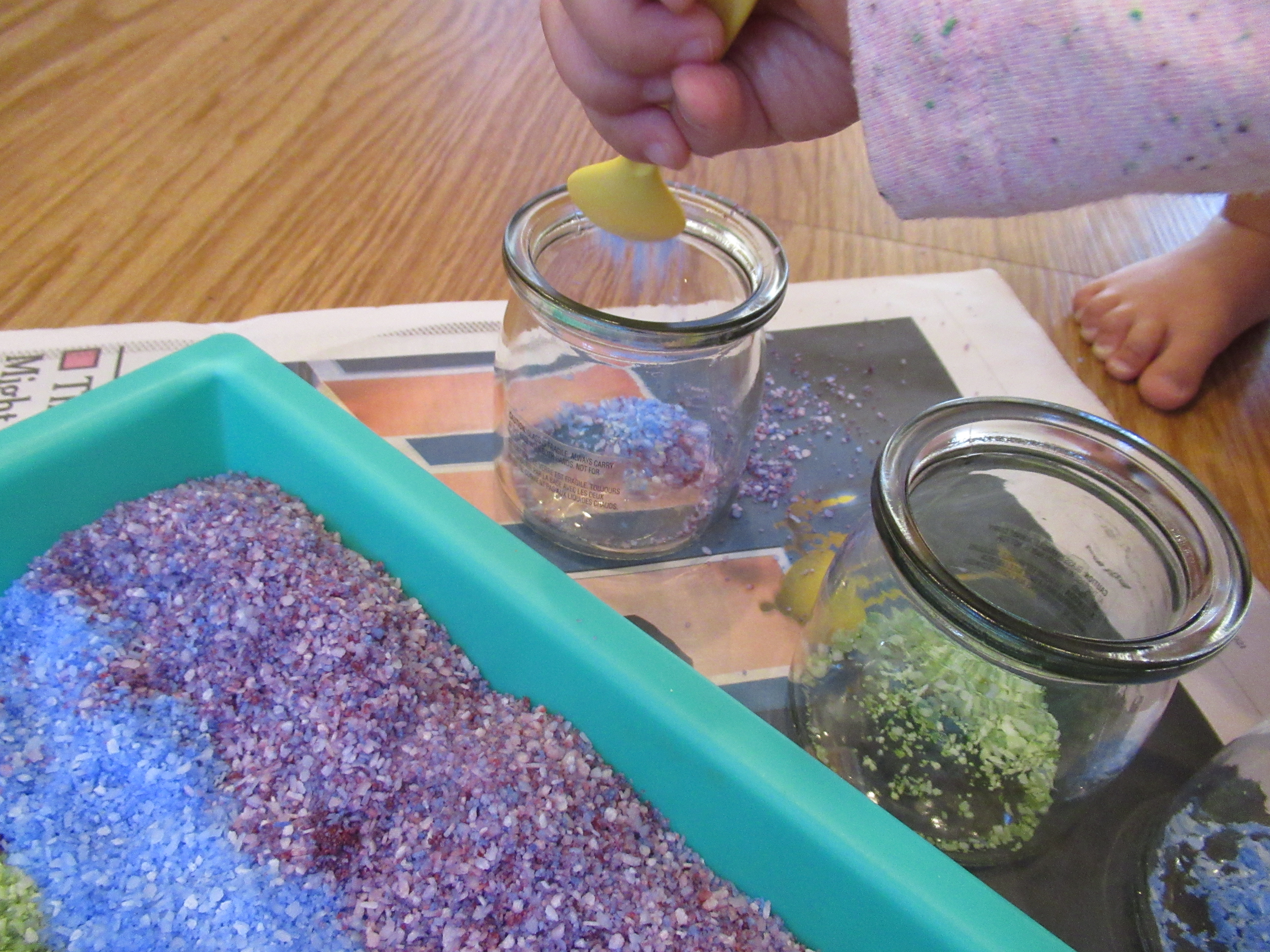
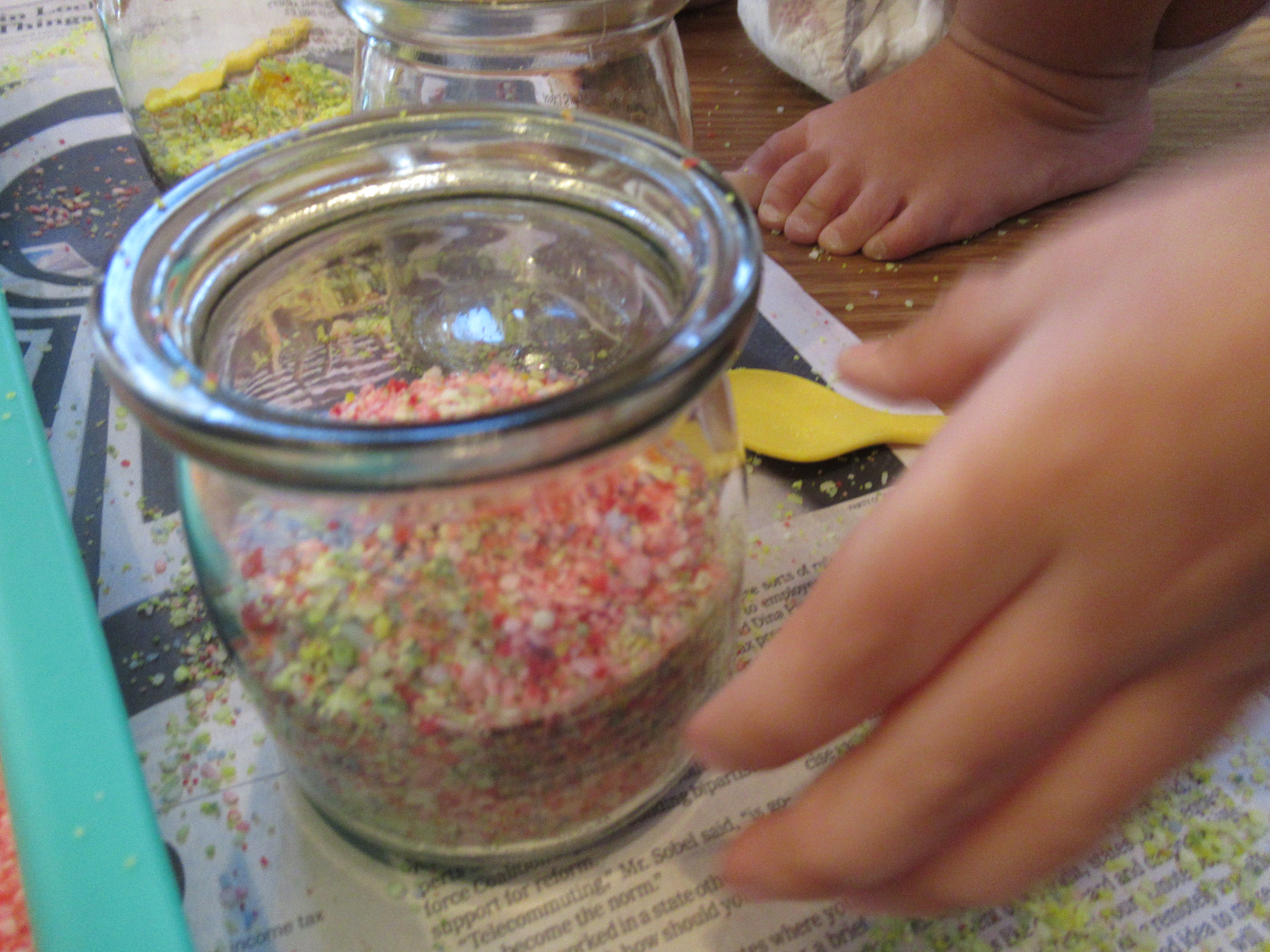
I had no agenda for Veronika other than to enjoy! I set out small glass jars and she immediately was spooning salt into them. She loved seeing or choosing what color was on her spoon…

DIY Rainbow Salt (5)

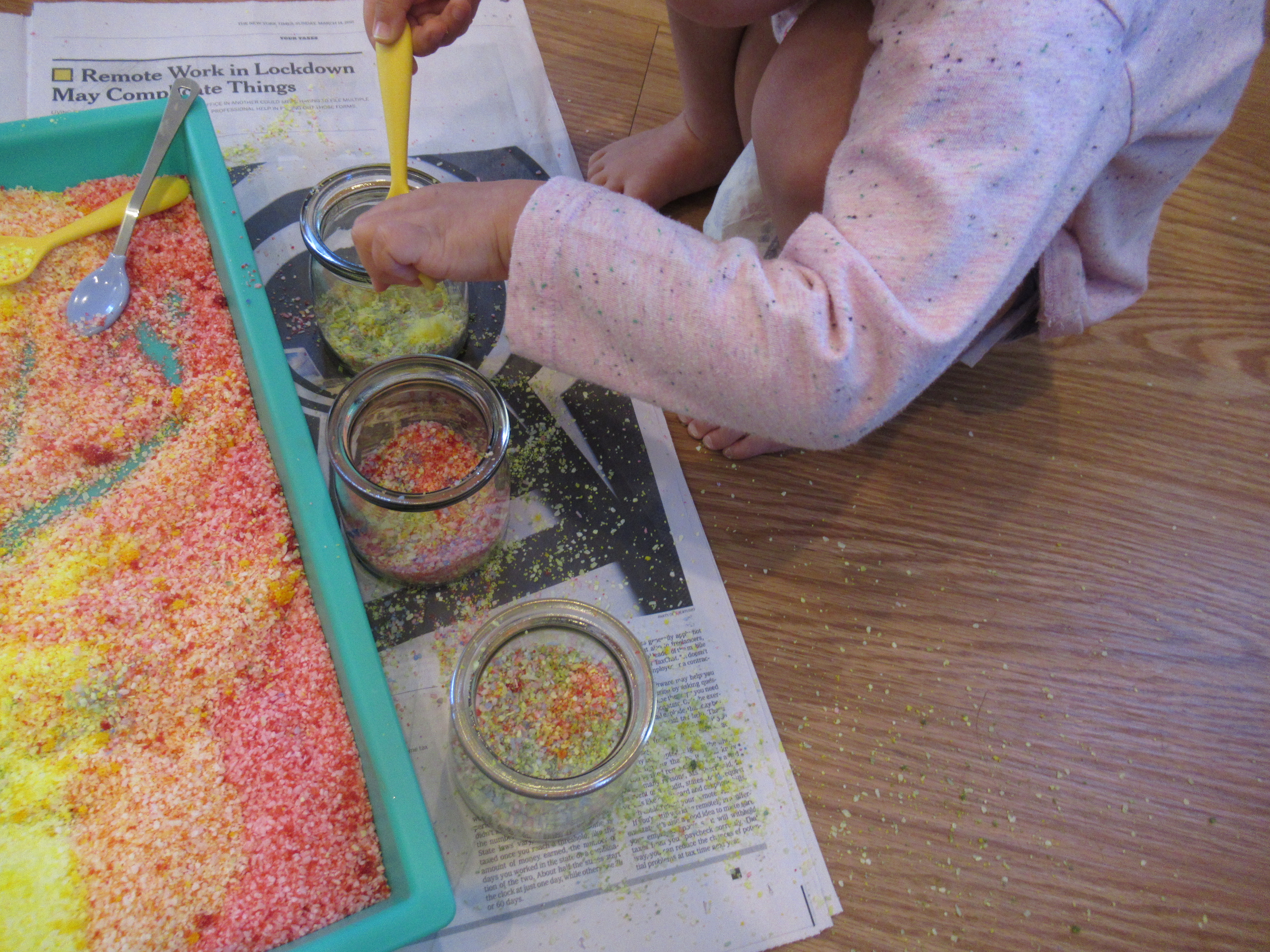
…as well as observing the mix of colors that resulted in the jars.

DIY Rainbow Salt (8)

Then she started pouring from one jar to another instead of using spoons, great for her fine motor skills and her concentration!

DIY Rainbow Salt (9)

I think she was busy making potions.

DIY Rainbow Salt (7)

She did sometimes spoon or stir through the salt on the tray, but the jars were the main draw today.

DIY Rainbow Salt (10)

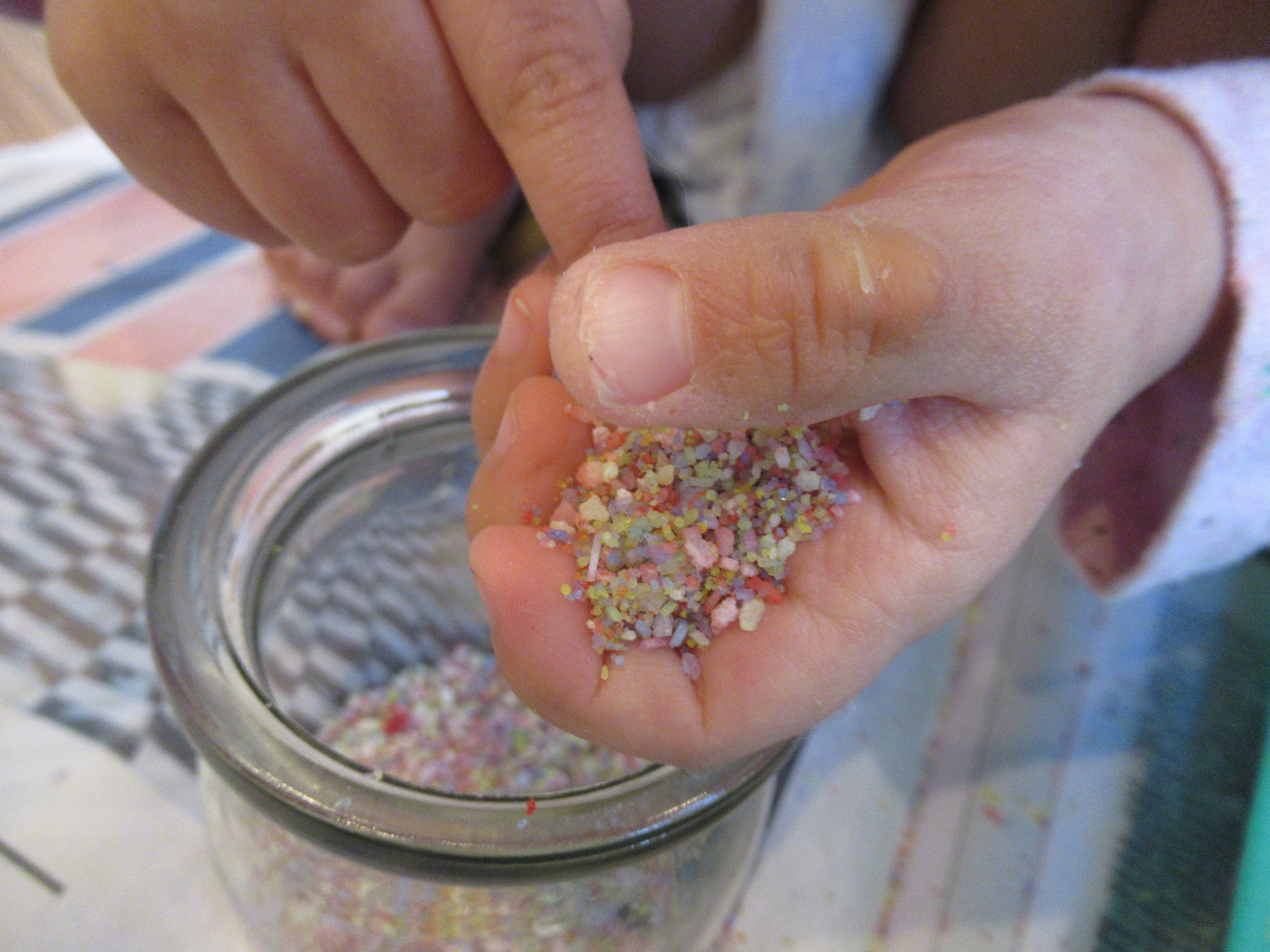
How long did Veronika play solo? Let’s just say I had time to finish the Sunday puzzle page. When she started picking up handfuls of it to scatter on the floor, we called it quits for clean-up!

DIY Rainbow Salt (11)

Swimming Letters Sensory Bag

Swimming Fish (7)

Here’s a fun way for toddlers to practice tracing as they starting out in letter recognition. Bonus points: the activity doubles as a sensory bag!

To set up, fill a large zip-top plastic bag with liquid. I made two versions of this, although neither was quite right. The first one had corn syrup and a little blue glitter, but this was a touch too thick. The second one I filled water with a little blue glitter glue, but this was too… watery. I think hair gel would be the perfect in-between solution, and I’ll aim for that next time! Regardless, once you’ve added your liquid and glitter, you’ll need to add the best part: drop in a plastic fish toy.

Swimming Fish (2)

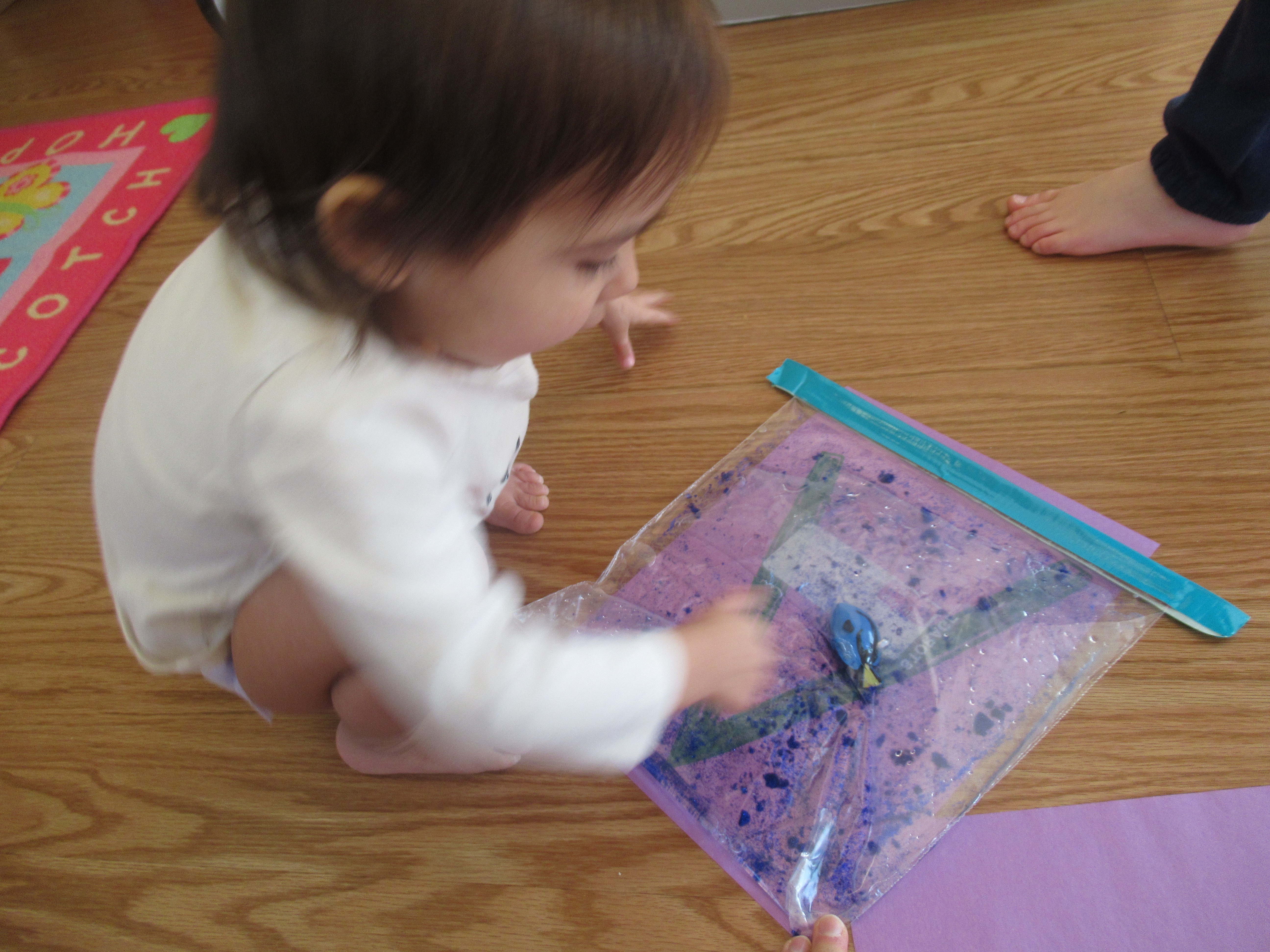
Seal the bag tightly and secure with duct tape. Next, write letters of the alphabet on pieces of construction paper, ideally with a blue background, although I only had purple. Once I had colored the letters in with green marker, they sort of looked like waving seaweed!

Swimming Fish (3)

If you want to, you could go through all 26 letters for your child. Today, I focused on two letters: V for Veronika and T for big brother Travis. Place the fish sensory bag over one letter at a time and show your toddler how to “swim” the fish along the lines to trace it.

Swimming Fish (4)

It’s hard to tell if Veronika really picked up on the learning, or whether she just loved the activity because she was enamored with the fish. She loved making it swim so wasn’t necessarily following the lines, but she could tell me whether she was looking at a V or T.

Swimming Fish (9)

Overall, I loved the idea behind this activity and may return to it when she’s a little older!

Swimming Fish (6)

Glowing Lava Lamp Sensory Bags

Glowing Colors Bag (7)

We’ve played with plenty of sensory bags in daylight, but this one is meant for after dark!

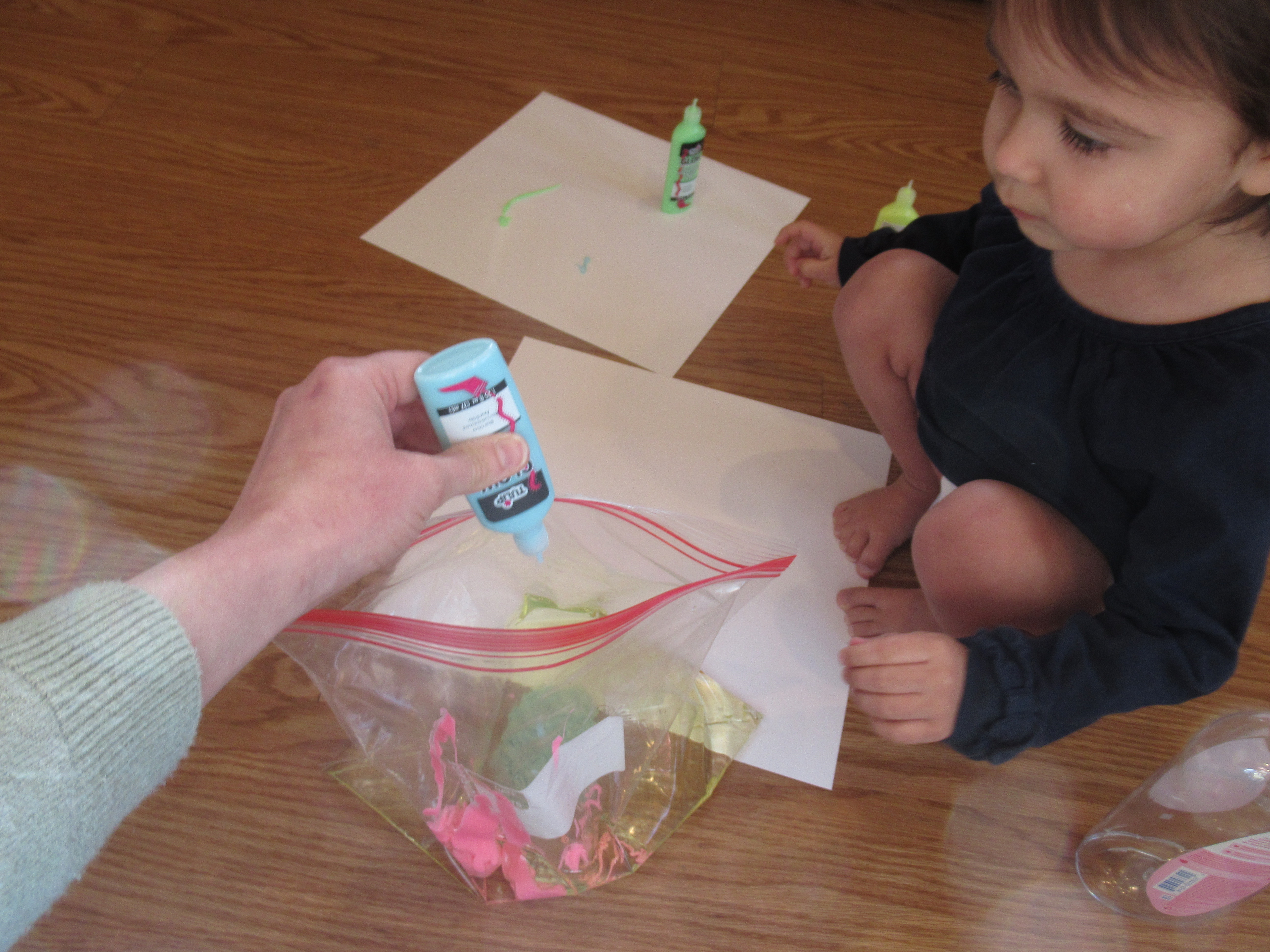
To set up, I poured a generous amount of baby oil into a large zip-top bag. Since we wanted to make two bags and I was out of baby oil, cooking oil worked in a pinch for the second bag. Squirt some glow-in-the-dark paint into each bag. Ideally I would have used watercolor paints, but even glow-in-the-dark fabric paint worked for this. Veronika absolutely loved the bright neon colors, even as we set this up during the day.

Glowing Colors Bag (1)

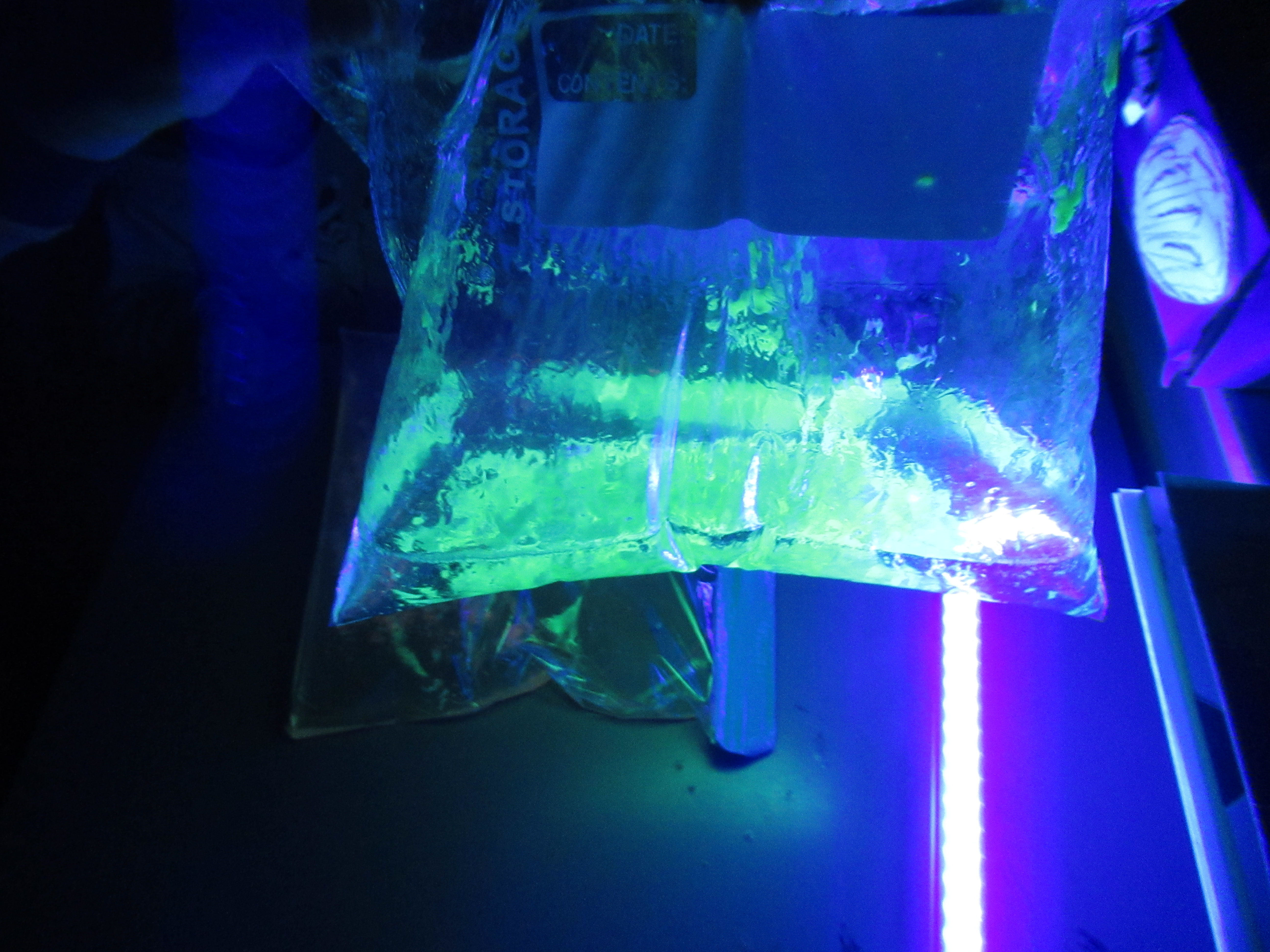
But the real fun came once the sun went down. You can simply look at the bags in the dark, but for added effect, I recommend switching on a black light. The kids were immediately squealing with delight at how the colors looked, so bright and glowing.

Glowing Colors Bag (4)

Encourage your kids to squish, squash, and watch how the bubbles of color move through the oil (a little bit like a lava lamp). If you have more than one color in each bag, as we did with a pink-and-blue version, see if the colors can mix together.

Glowing Colors Bag (6)

For sensory bag gets high marks for novelty.

Sticky Sheep

Sticky Sheep (5)

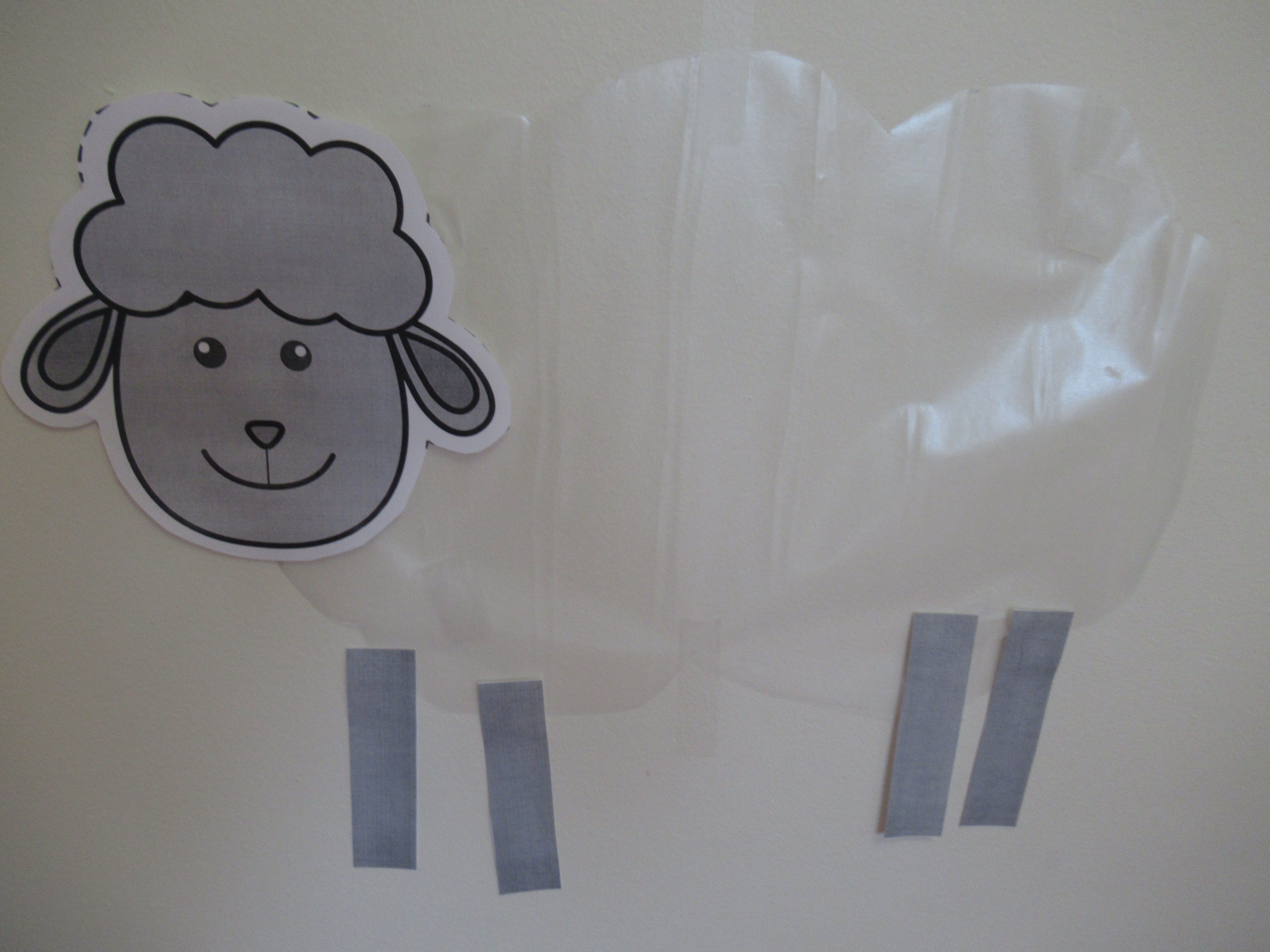
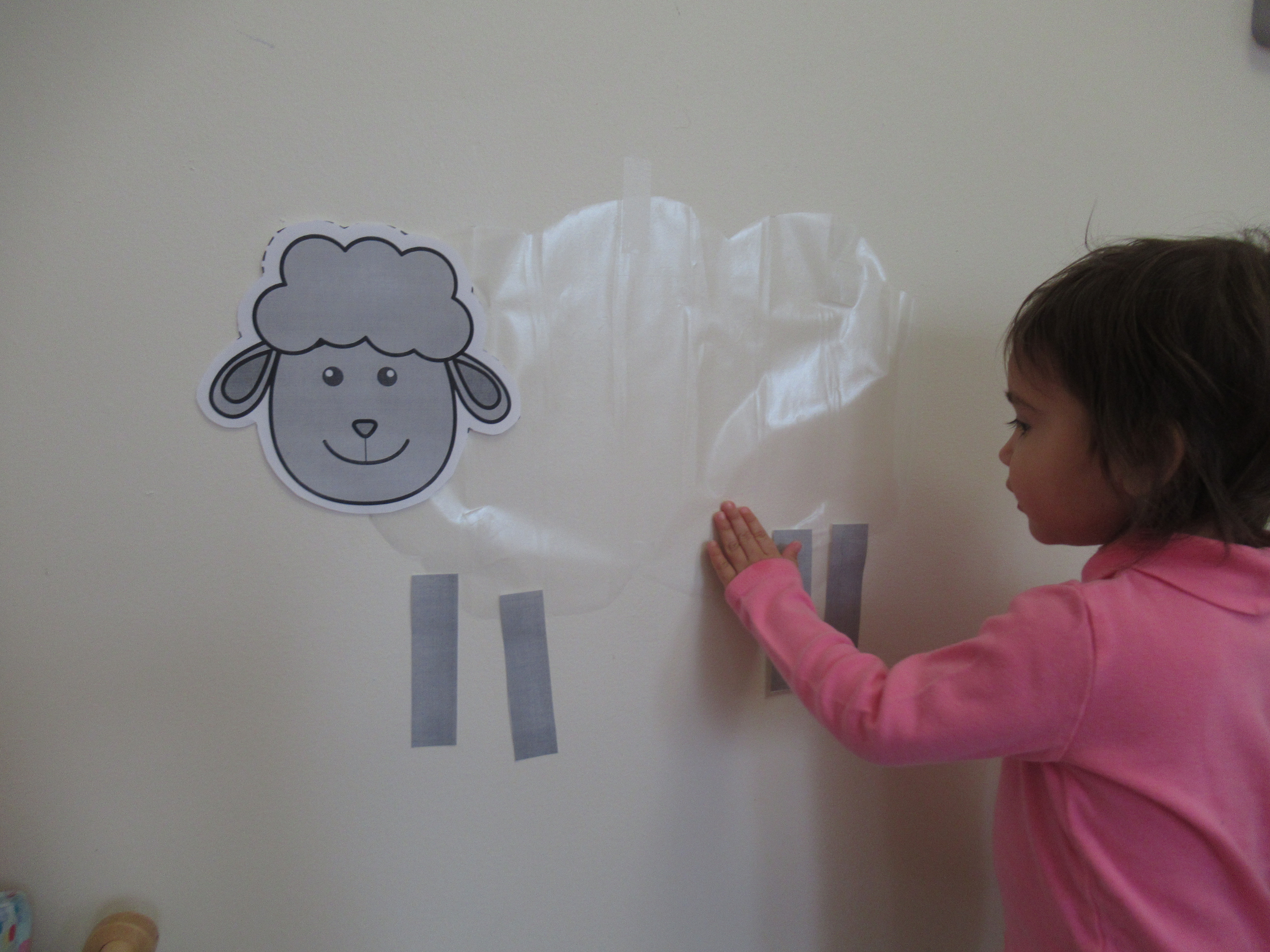
In like a lion, out like a lamb, or so the saying goes, and this adage of March has certainly been true this year. Needless to say we’re looking forward to the docile lamb weather to come. While we wait, Veronika and I decided to make our own woolly lamb inside! This activity combines farm animal play with tactile play in a very cute way. First, I printed out the face and leg templates for a sheep found at No Time for Flash Cards.

Next, I cut out almost a cloud shape from a large piece of contact paper, then attached this to the wall with clear tape and peeled off the backing. If you have white paper that is large enough, you could place the contact paper on the white paper such that you’re left with a white rim.

Sticky Sheep (1)

Attach the head and legs, and your sheep is ready. I brought Veronika over and immediately she said “baa baa” to the sheep. I invited her to touch the contact paper, so she would realize it was sticky.

Sticky Sheep (2)

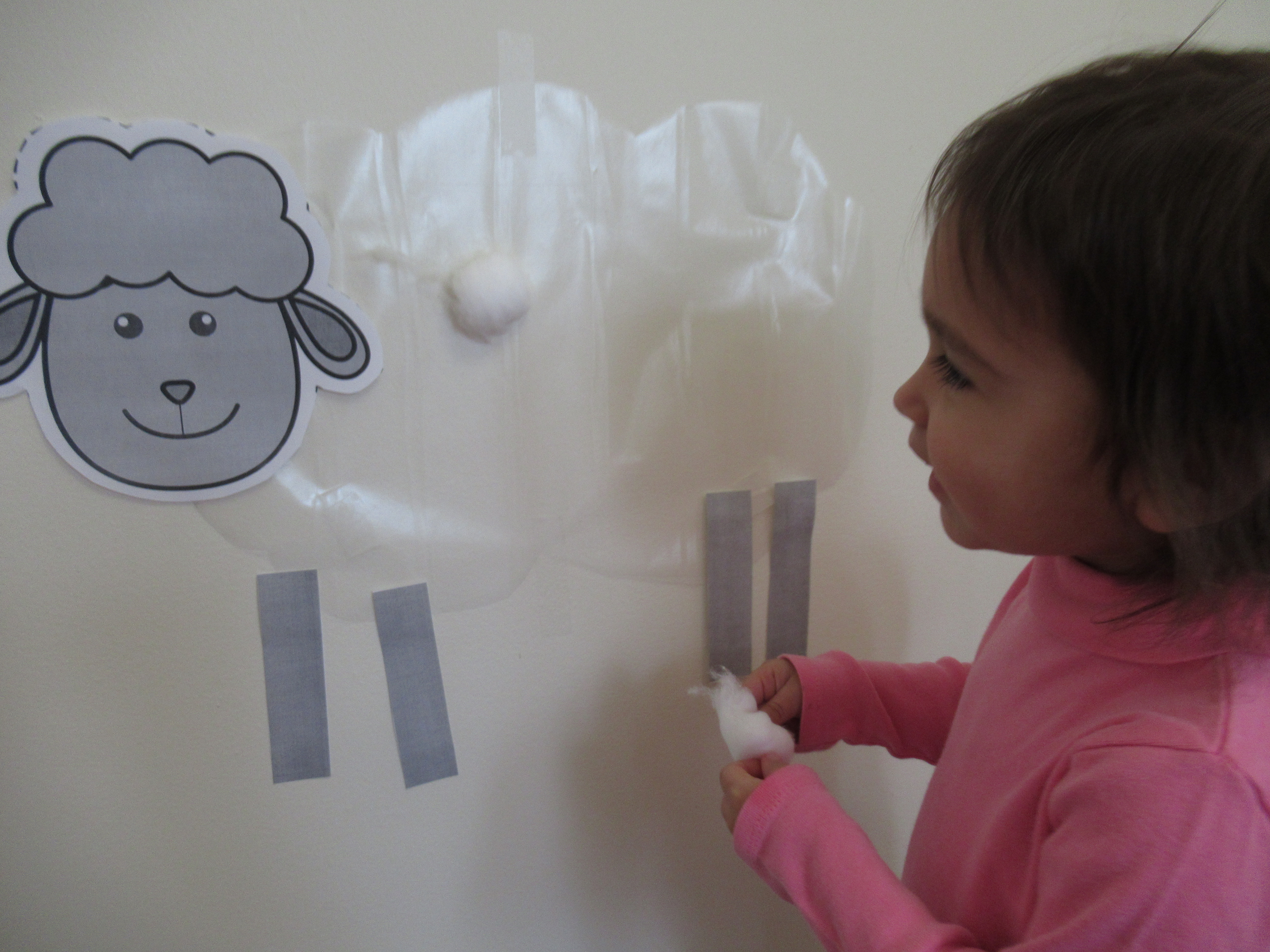
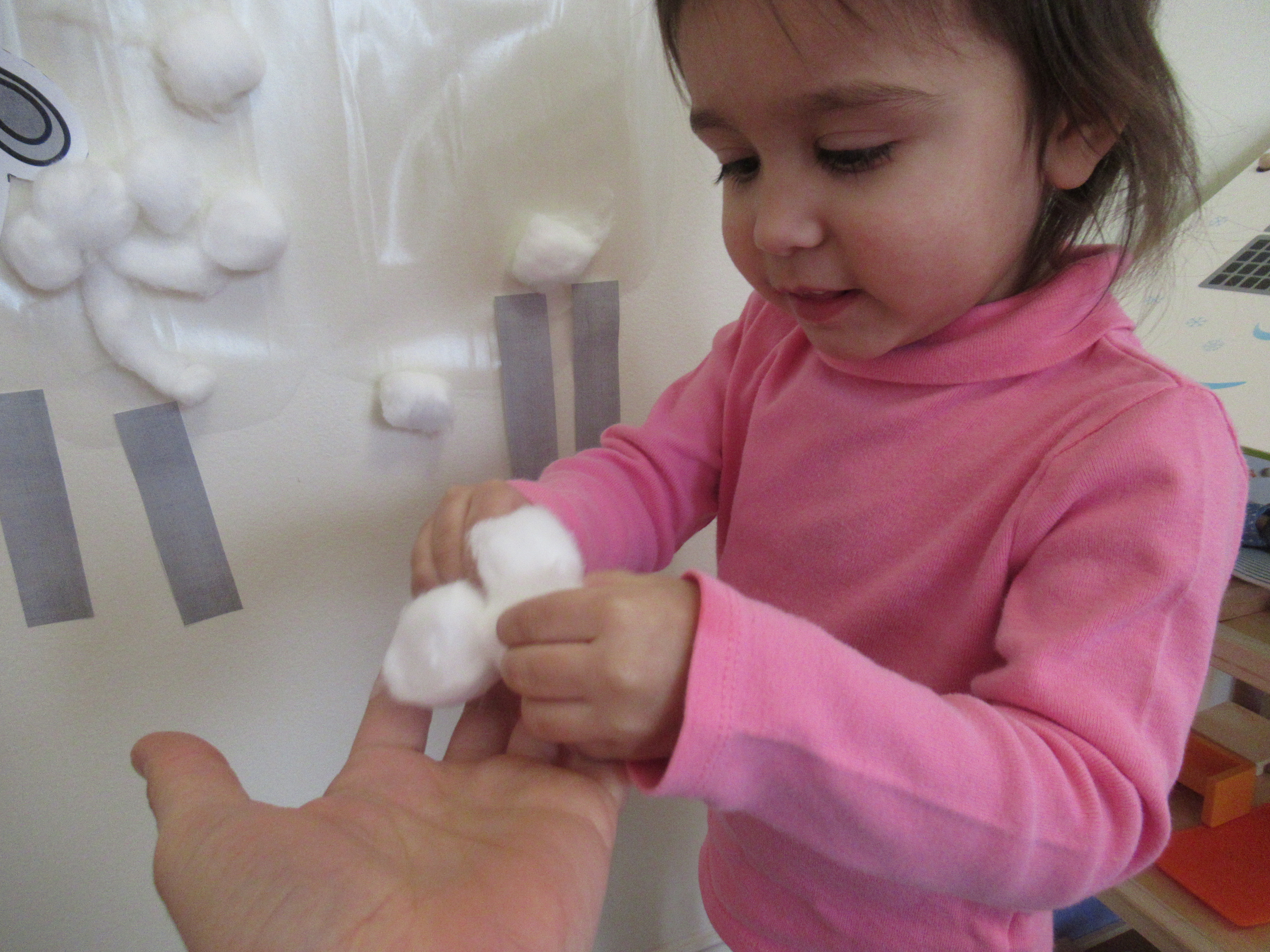
Now, I told her that the sheep was cold and we needed to help him find his wool! I set out a tray of cotton balls, and she immediately got to work. She was so proud that she could help the sheep: “We’re making him so woolly!” she exclaimed.

Sticky Sheep (3)

Once or twice she tried to stick a cotton ball on the wall where there was no contact paper and was so surprised when the cotton fell to the floor. This was a very teachable moment, and she realized she needed to stay within the lines of the contact paper.

Sticky Sheep (4)

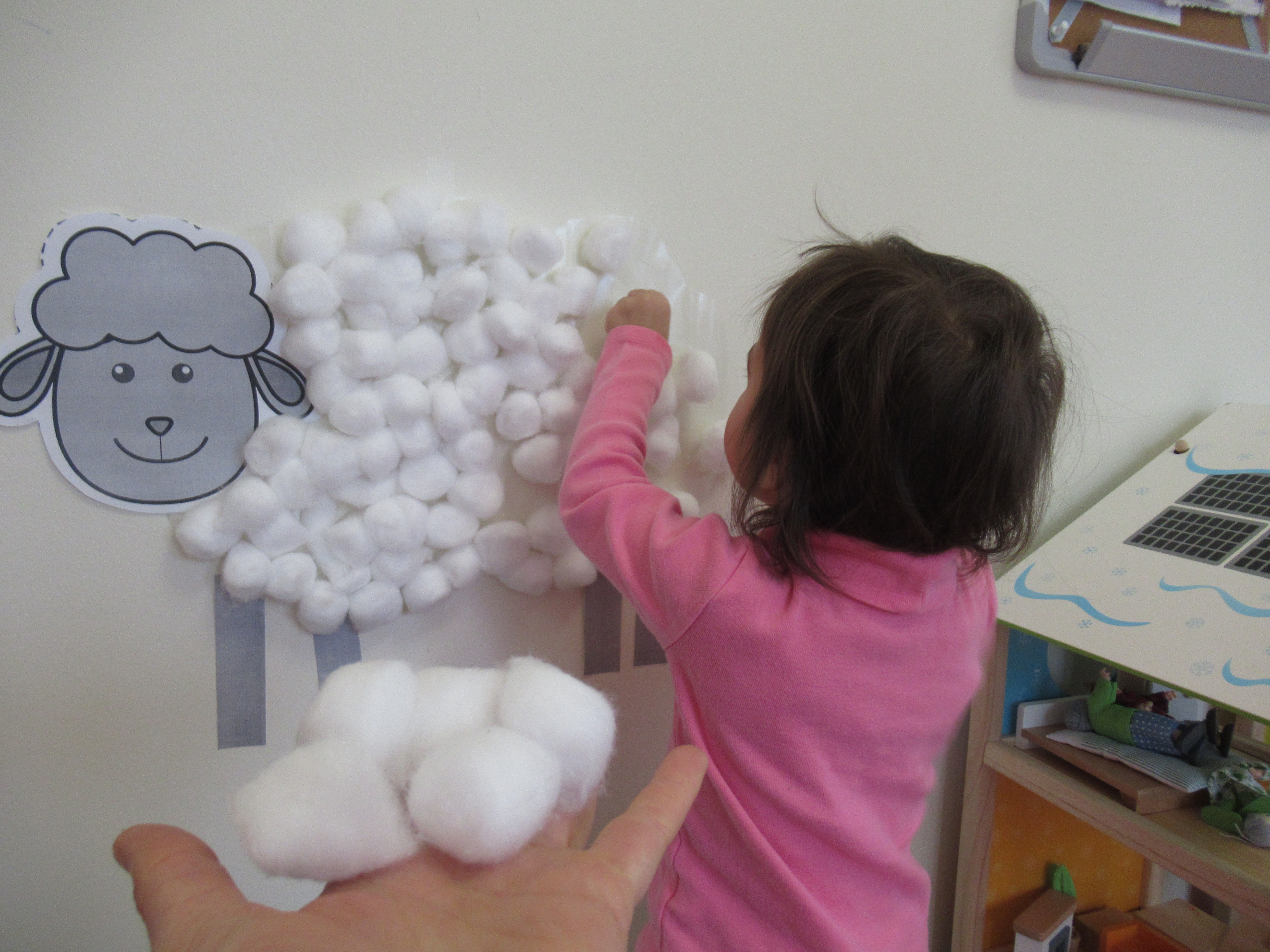
She proved remarkably adept at finding even tiny holes that needed to be filled with cotton until we had one very woolly sheep. “It’s like stickers!” she said with delight at the way that the cotton balls stayed on.

Sticky Sheep (6)

When your toddler is done, you’ll have an adorable (and tactile!) piece of artwork on the wall. We plan to keep this up until March goes out like a lamb.

Sticky Sheep (9)

Squishy Button Sorting Bag

Color Sort Buttons (3)

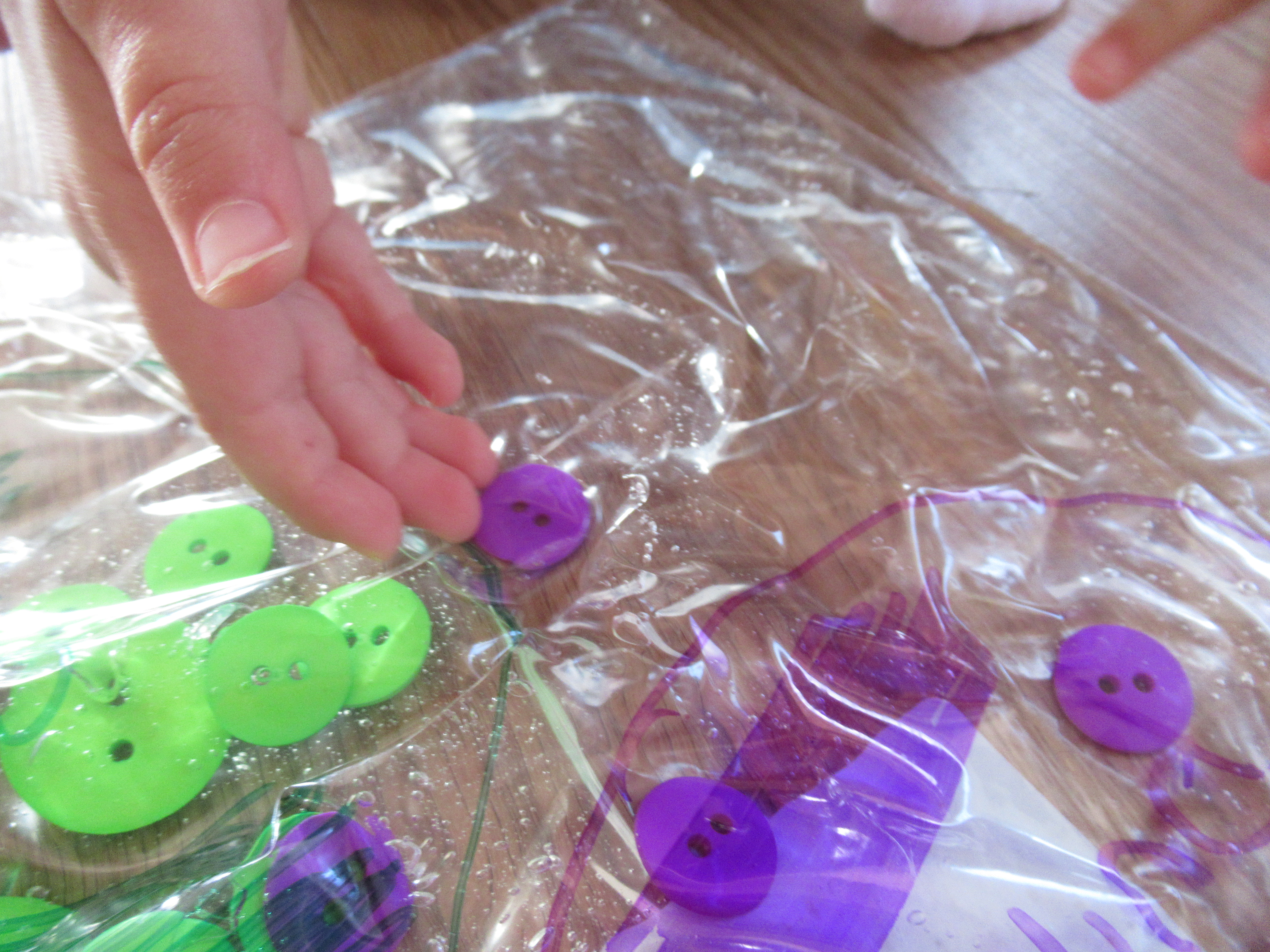
This cute twist on a regular squishy sensory bag adds the concept of sorting into the mix! Squishing buttons through the hair gel inside will be an absolute delight for toddlers and preschoolers alike.

To set up, I drew two circles on a large zip-top plastic bag with sharpies, using colors that corresponded to buttons in our craft bin. Next, squirt in a generous amount of hair gel, then add buttons in at least two colors. (Note: You can make this harder for preschoolers with additional colors). Seal tightly, adding duct tape to the seal if you worry your child might want to open the bag.

Color Sort Buttons (2)

First I just let Veronika experiment with how the bag felt. She loved squishing the buttons through the gooey insides of the bag…

Color Sort Buttons (4)

…or pressing her hands down firmly on top of it.

Color Sort Buttons (6)

Once she’d had time to explore, I showed her that she could nudge the buttons deliberately, each one toward the correctly colored circle. She picked up on the idea right away, although occasionally I had to help her with the fine motor skills needed to scoot a button in the right direction.

Color Sort Buttons (5)

To mix up the activity, I then showed her how the bag looked with the buttons completely sorted. Then it was up to her to scatter them! In sum, this was a nice variation on an idea that never gets old.

Color Sort Buttons (7)