Upside-Down Water

Yes you can turn a cup of water upside down without spilling it! This nifty “magic” trick is sure to wow family and friends, and can be done with no fancy materials or supplies.

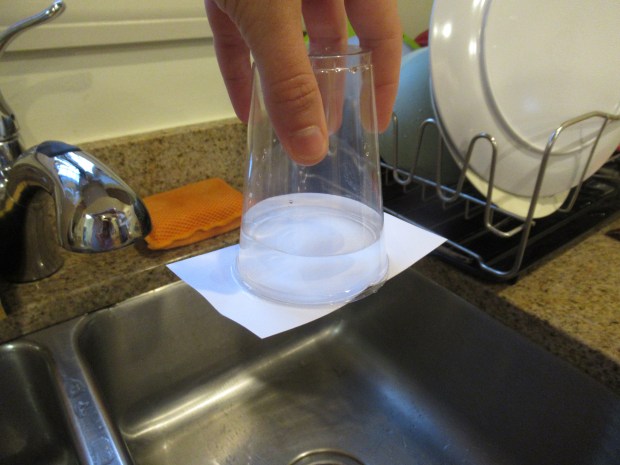
To start, fill a small plastic cup about half way with water. Place an index card on top.

Flip the cup over with your hand firmly holding the index card in place (it’s okay if a little water spills out), and make sure the index card is saturated.

Slowly remove your hand and… the index card sticks, without the water pouring out. There’s definite wow factor here, but it’s all thanks to the simple fact that water molecules like to stick together. Air can’t get in the cup as a result, equalizing the pressure, so the heavy water doesn’t pour down.

Travis also got a kick out of the way the index card pops off if you squeeze the cup even slightly, breaking the bonds of those sticky water molecules.

Want more cool water tricks this summer? Check out our old fun poking holes in plastic bottles, or playing with sticky string!

Flying Sheet of Paper

The next time you plan to make paper airplanes with the kids, throw in this little STEM exercise, first!

The idea is to hold a piece of paper (loosely from the top two corners) at about level with your chin, curling the paper slightly toward you at the top. Then blow down as hard as you can. Before we actually did the exercise, I challenged Travis to write down his hypothesis (fancy word!): Would his breath blow the paper down toward his chest, or up toward his nose?

His guess, surprising me because it is counter to logic, was… Up!

Well, it turns out he was right ,and the answer is thanks to some neat science. When the molecules above the paper move faster from your breath, the air pressure is becomes lower. That means the higher pressure air under the paper pushes it upward. So the paper billows up instead of down!

The same principal can be applied to the wing of an airplane, hence all this science before we got around to making our paper planes. Of course the next thing we did was to fold up lots of paper planes to soar all around the house!

Find Out What Absorbs Water

I love games that combine nature play and fresh air with a little sneaky STEM thrown in, and this idea from Hands on as We Grow fits the bill!

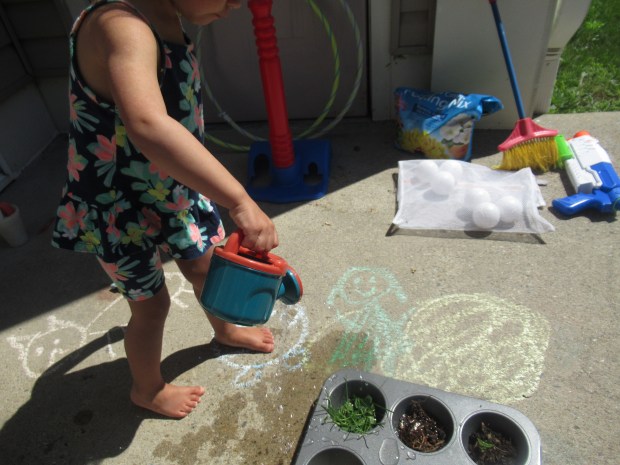
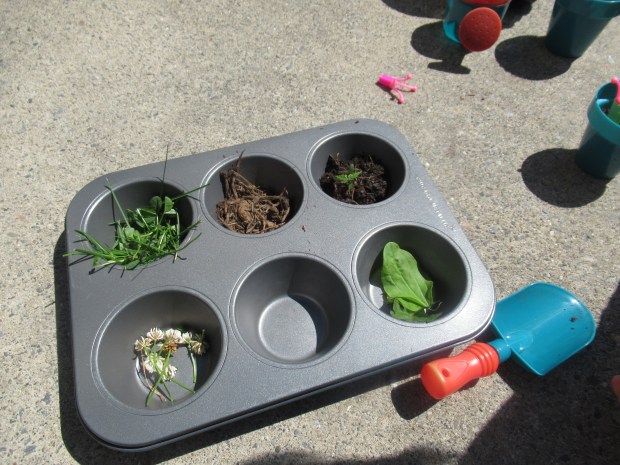
To start, I sent Veronika hunting around the yard to find treasures. With some mommy help, we then sorted these into the compartments of a large muffin tin, including flowers, grass, leaves, wood chips, and dirt. We also left one compartment empty.

I then handed over Veronika’s watering can and encouraged her to water her items!

It immediately becomes clear that the effect of the water is not the same on all the nature items. Some, like the grass and flowers, are soon just sitting in puddles of water.

But for others (spoiler alert: wood chips and dirt), the water wasn’t there for her to see any more. It was time to introduce new vocabulary: the dirt had absorbed the water! The flowers and grass had not.

Of course the STEM lesson is advanced for my two year old, but half the fun here was just in pouring the water from the can, stirring items around, and enjoying a warm morning on the patio!

Shampoo Science Lab

Shampoo Science Lab (7)

When your bottle of baby shampoo is near the end, never fear: you have the perfect amount left to make a mad scientist lab!

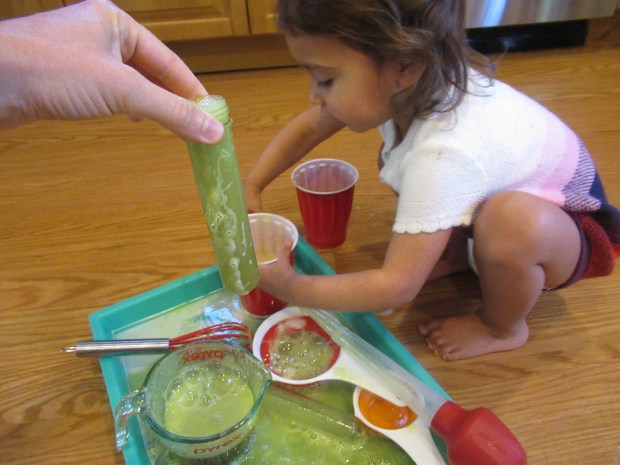
To set up a mini “laboratory” for Veronika today, I first poured the remaining shampoo into a glass measuring cup, then added other tools and ingredients. Think: beakers, measuring cups, whisks, and basters, along with other ingredients like baking soda, white vinegar, and water.

Shampoo Science Lab (1)

Now it was simply time to mix and match! I demonstrated for Veronika to start ,adding some baking soda and some vinegar to the cup with the shampoo for a fizzy reaction worthy of a witch’s cauldron. But then it was up to her!

Shampoo Science Lab (3)

She loved pouring water into all the various cups and containers, especially once we tinted it green and yellow with food coloring.

Shampoo Science Lab (4)

The baster was a big hit for sucking up one potion and transferring it from container to container. Incidentally this is great for fine motor skills, too.

Shampoo Science Lab (6)

Even once we neared the end of play, and I began rinsing out the cups and spoons, she loved getting her hands soapy and tracing the leftover baking soda in the bottom of the tray.

Shampoo Science Lab (8)

What’s your little scientists favorite concoction? Please share in the comments!

Shampoo Science Lab (5)

My Tree Journal

Today, Travis embarked on a project that will actually be a year-long process: To find a tree to follow and document the changes and differences across the seasons. This beautiful project truly teaches children to feel the wonder of nature, connect with a living natural thing, and become observant little scientists!

It all started with a picnic lunch at our local arboretum. I let Travis lead the way to the tree he deemed worthy of our picnic in the shade, and that sealed the deal of which tree he’d be observing.

The next step was to check out the label under the tree; he’d chosen a sweet cherry! This was exciting, since not as familiar to him as a maple or oak. If you’re not at an arboretum with labeled signs, consider taking along a nature guide or check out websites to identify your child’s tree.

He immediately decided the tree’s name was Chersie and drew Chersie’s picture on the front of his journal. We also made sure to snap the first of what would be our seasonal pics, in this case Chersie verdantly green in summer.

Travis went over to the tree with wonder. “It spoke to me!” he said. I asked him what the tree had told him. “It said, ‘I love you’,” he reported seriously. My tree whisperer! We marveled at how the bark was rough in patches, but smooth in others, and at all the bugs that were making Chersie their home. Travis said he missed the tree already on the drive home.

Once home, we printed the Summer photo using our Zink printer, which he then glued into the tree journal.

I will update this post with pictures from the fall, winter, and spring, so stay tuned!

Tin Foil Constellations

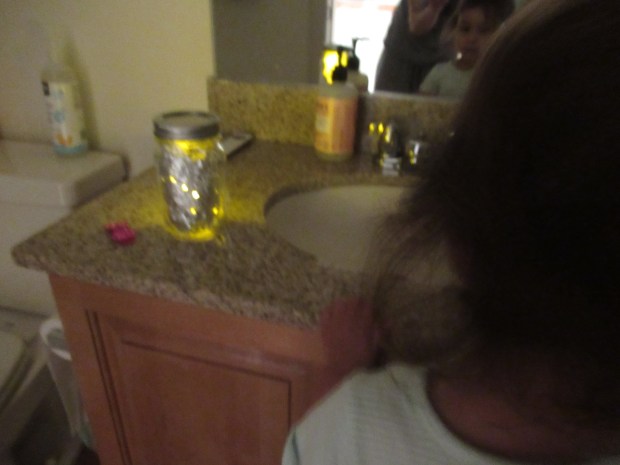
Children love the glow of the stars, and here’s a beautiful way to bring that glow inside! This activity doubles as a quick lesson on constellations and a D.I.Y. nightlight.

To start, I set out a sheet of tin foil and showed Veronika how to prick it with a toothpick to make dots. We did this step over a yoga mat, so the toothpicks wouldn’t scratch a tabletop or other surface; you could also place a sheet of felt underneath.

While she made holes at random, I made more deliberate constellation shapes, such as the Big Dipper. Older kids can follow along with pictures of real constellations, too. For a toddler, this was a great first chance to talk with Veronika about how some of the stars make shapes in the sky.

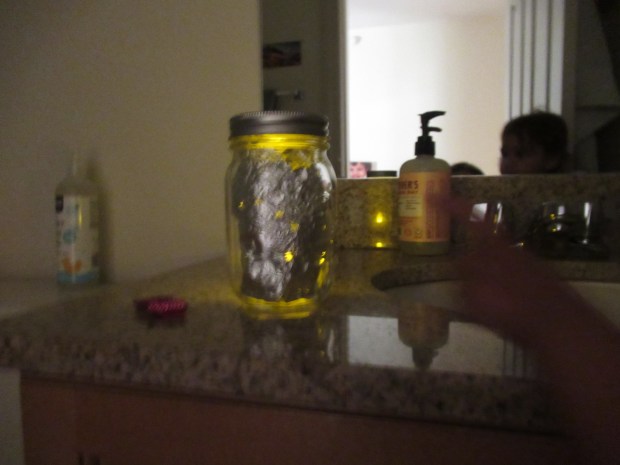
Next, we fit the dotted sheet of foil inside a mason jar. This was trickier than I thought, with the foil crumpling on the first round, so we quickly made a second sheet and inserted it more smoothly. It helps to make the holes a bit wider than the point of the toothpick, too, so they show up better.

Finally, we needed to light up the night sky! Veronika helped turn on a tea light, which we then inserted into the jar.

She marveled at the twinkle as soon as we were in a darkened room! Even better, the stars will twinkle in her bedroom all night long.

Moon Journal

The last time Travis made a moon journal, he was still in preschool, meaning I was in charge of the drawings, and he was mostly along for the ride! As a first grader, this time he was in charge of the project from start to finish, not only enjoying the art aspect, but understanding on a deeper level, too.

We started when the moon was a waxing quarter, Travis eagerly peered out the window at the night sky and chose his colors carefully before proudly presented his first drawing. Don’t forget to add the date!

Each successive night for a week, we checked on the moon just before bed. Travis took careful stock of how the moon had changed since the night before: the first night a thumbnail, the second night bigger but not quite half, and so on. He also marveled at how the position in the sky changed (by the end of the journal, he had to switch windows!)

Aside from frustration one night about cloudy skies, he loved the process.

We ended when the moon was just shy of full, and he proudly made a giant yellow circle.

This is a great way for kids to observe so much about how the moon changes, not just its size and shape, but also where it is in the sky, what time it appears, and more.

Sprout Some Beans

Sprout Some Seeds (5)

Spring is the classic time of year when elementary school kids learn about gardening, parts of the plant, and the process behind sprouting seeds. Although we’ve planted seeds in the past, Travis and I tested out a step-by-step method this year for a scientific spin on the activity.

To start, soak kidney beans in a cup of warm water for about 3 hours. Drain.

Travis selected a few of the beans to place on a wet paper towel. Fold the towel up over the beans, then place inside a zip-top plastic bag and seal. We set this inside a cabinet for 2 days. (Note: Any similar warm dark place will work fine).

Sprout Some Seeds (1)

Two days later, we checked to see if the roots had started to grow.

Sprout Some Seeds (3)

They sure had! Travis was amazed at the curly root we could see coming from each bean.

Sprout Some Seeds (4)

Now, plant the seeds in a bit of dirt with the root pointing down. Set some place sunny and add a little water each day. Then just watch the plants grow!

Sprout Some Seeds (6)

In addition to the hands-on portion of the activity, I had Travis write down a few things about the experiment, to work on conceptual knowledge. First, he listed all the supplies that were needed. His list included:

Dirt

Cups

Paper Towel

Plastic Bag

He also answered conceptual questions, like what happened after each consecutive step, or his observations at the end. A perfect project for a budding (ha) scientist.

What Sinks or Floats from the Craft Bin?

Simple Sink or Float (4)

Today, I gave Veronika full permission to raid the craft bin…in order to see what would sink or float from it, that is!

This was a cute variation on the simplest kind of “what sinks and what floats” activities for toddlers. Alternatively you could have your child gather toys from around the house, but using items from the craft bin gave us a wide variety of materials.

Simple Sink or Float (1)

First, I simply asked her to predict what would happen as she dropped each item in. She was holding a metal clip to start and guessed, “Float!” Of course, it sank right to the bottom. Pom poms floated though!

Simple Sink or Float (2)

We continued in this way, sometimes with unexpected results. Pony beads sank if they fell on their side. But if water evenly filled the hole in the center, they floated like inner tubes…until her little fingers poked them down. Pipe cleaners floated at first, but sank once fully saturated.

Simple Sink or Float (3)

I thought tissue paper would be fun, and indeed Veronika loved that she could wad it up into little balls and then fish it out, but the dye started leaking off onto our hands. Whoops!

Simple Sink or Float (5)

Wooden items (such as craft sticks) floated, while a big rubber eraser sank. And some things, like saturated strands of yarn, were purely fun to play with while wet! I loved watching her take note of each item as she plopped it in, and seeing her little brain register why some things stayed on the surface, while others fell to the bottom.

Simple Sink or Float (6)

In sum, this is a neat way to sneak in a STEM lesson while a toddler thinks they’re just playing with items in water!

Rain Catcher

With two days of rain in the forecast, we took advantage and decided to make a rain catcher. This version is especially fun for toddlers since it involves a little “person” standing guard in the rain.

To set up, cut an empty plastic water bottle apart about two-thirds of the way up with a craft knife. Turn the top portion upside down so it forms a funnel down into the bottom portion, and then add masking tape along the rim to cover any sharp edges.

To make the person, mark off 1/2-inch increments on a wooden spoon with permanent marker. Add character with wiggle eyes and additional features in permanent marker. Travis decided our fellow should be called Dave.

We set the handle of “Dave” into the bottle, then placed him out in the rain. And just in time! Within a few hours, there was already half an inch of water in the bottom. Then, this happened:

Yup, snow in mid April! It was a wonderful and unexpected chance to show Veronika how several inches of snow melted down into only about 1/2 an inch of water, once the temperature warmed back up.

By the end of the evening, the water was nearing Dave’s two inch mark. But oh no, then the wind picked up… and knocked Dave and all our hard work over!

How much rain can you collect in your rain catcher? Please share in the comments!