How to Make Pennies Turn Green

Pennies Green (7)

We’re on winter break and the science fun continues! With this easy experiment, you’ll create a simple chemical reaction – and help explain to your kids why the once copper-colored Statue of Liberty is now green!

The project was fun from start to finish because first we had to break into Travis’s piggy bank. This meant using a screwdriver (under careful adult supervision of course). We separated out the pennies from the rest of the coins, making it a quick lesson in currency denominations too.

Pennies Green (1)

Place your pennies in a bowl covered with a paper towel.

Pennies Green (2)

Pour white vinegar into the bowl, making sure the paper towel is completely saturated.

Pennies Green (4)

Now observe! We were surprised when the first penny had green spots after only a few hours.

Pennies Green (6)

The next morning, several of them were quite green!

Pennies Green (8)

I honestly have no idea why some of the pennies turned green and others did not, but here’s what’s happening: The metal copper and the acid in the vinegar react with oxygen, and form a new blue material, called malachite.

Make sure to observe under a magnifying glass, too!

Pennies Green (9).JPG


Dancing Raisins

Dancing Raisins (4)

Well, school’s out for winter break and we’re stuck indoors on a rainy day. What did we do? Science experiments of course!

Don’t be daunted when it comes to science and preschoolers. The goal is not to hammer home the scientific concepts, but rather to introduce tots to the strange, silly, and downright amazing things that happen when substances mix. I love this experiment because it epitomizes the fact. It couldn’t be simpler – all you need is club soda and raisins – but has easy-to-see, immediate, and delightful results.

First, fill a glass (or two) about 2/3 of the way with club soda.

Dancing Raisins (1)

Add about 4 raisins to each glass. Now watch what happens!

Dancing Raisins (2)

We immediately observed that the raisins sank to the bottom of the glass, but were very quickly covered in bubbles.

Dancing Raisins (3)

We only needed to wait a moment before we were rewarded…. with dancing raisins!

Dancing Raisins (5)

They swim up to the top, do a pirouette or two, and then sink back down. The best raisins did this over and over again. (Honestly, I’m not sure why some raisins were more “active” than others, but we definitely had some movers-and-shakers, and a few that just stayed inert).

I asked Travis why he thought the raisins were dancing, and he answered, “The bubbles!” He’s pretty much got it: the carbon-dioxide filled bubbles coat the raisins and rise to the top of the glass like all the bubbles in the water. Once they reach the top and pop, the raisin is released and sinks back down. For kids who can’t see molecules and atoms yet, it’s a neat visual of forces at work.

Of course Travis then needed to see what would happen if we dumped his entire snack pack of raisins into a glass. As you’d expect, the raisins mostly weighed one another down, but those on the top layer still danced for us!

Dancing Raisins (6)

Honestly, you’ll be entertained watching this experiment for quite some time; raisins are adorable dancers.

Dancing Raisins (7)

Note: We tried something similar with Halloween candy in October. What other foods can you make dance in a glass? Rice? Dried pasta? If you experiment further, please share in the comments!


Make a Leak-Proof Bag

Leak Proof (3)

This simple science experiment is sure to produce wide eyes and gasps in everyone from little kids to big grown-ups. Can you really pierce a hole in a bag filled with water, but not produce any leaks? Read on and find out!

First, gather a few sharp pencils, the sharper the better. We gave an extra honing to a few pencils, and set them aside.

Leak Proof (1)

Next, fill a large zip-top plastic bag half way with water, and seal tightly. We did the experiment over the sink just in case.

Leak Proof (2)

I stood Travis up on a stool and told him I could pierce the bag without causing a leak, only half believing it myself.

The pencils slid in surprisingly easily! Bam, three in, and not a drip in sight.

Leak Proof (5)

Travis loved it… and had even more fun pulling the pencils out and watching the fountain that erupts. We had to do the experiment three times it was so much fun.

Leak Proof (4)

Why does it work? It’s all thanks to the power of polymers, long chains of molecules that make up the plastic bag (in this case polyethylene). These molecules seal around the pencils once they are pushed through, preventing any leaks. Remember playing with silly putty as a kid? That’s another example of a polymer. So give your kids a tiny science lesson, and then simply have fun dazzling them. Bonus points if you do this over the floor instead of the sink!


Sand Pendulum

Pendulum (5)

We snagged this idea from an old Parents magazine article, highlighting STEM projects for kids. The game provides a neat visual introduction to gravity, using the simple concept of a pendulum. Pendulums – any suspended weight that swings freely from a pivot – will always come to rest at an equilibrium position, because of gravity of course. Using colored sand makes it purely fun for kids!

Make sure to cover your work surface with a roll of craft paper or other paper, both to catch your sand designs, and to save you from a big mess at clean-up time.

To set up the pendulum, tie three strings at even intervals around a thick rubber band. Travis had fun exploring the materials while I put this step together. Older kids can help with the tying!

Pendulum (1)

Fit the rubber band tightly under the lip of a kitchen funnel. Gather the three strings together and tie in the middle so the funnel hangs evenly.

Pendulum (2)

Slip the strings over a dowel – whoops, not quite balanced yet!

Pendulum (3)

The next step was a bit tricky, since it requires two sets of hands, and my three year old had his own agenda. But ideally, have your child plug the hole at the bottom of the funnel with a fingertip while you fill it with colored craft sand.

Give the pendulum a slight push, and watch the sand go back and forth. It will swing in increasingly smaller motions until it comes to rest.

Pendulum (4)

As mentioned, ours didn’t exactly work as planned…but leftover sand sure is fun to play with!

Pendulum (6)

If you capture really pretty sand designs, please share in the comments.

Engineering a Dinosaur

Engineer Dino (2)

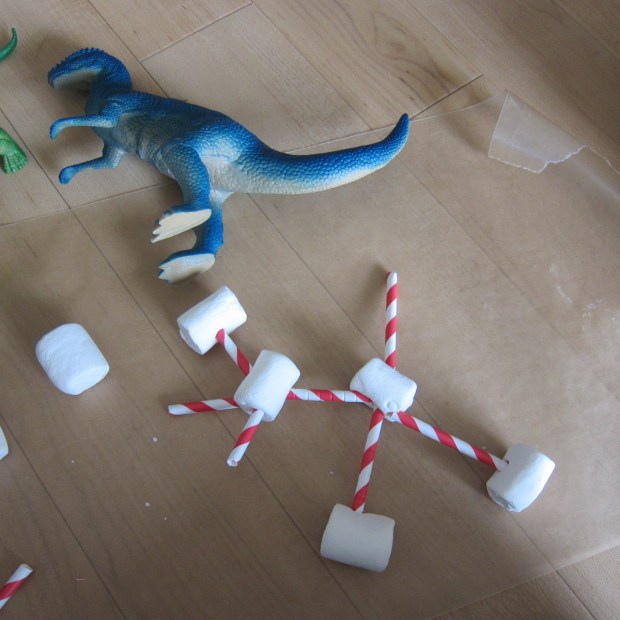
This adorable suggestion from Little Passports allows kids to plan and construct – the basics of engineering! For my three-year-old, the activity was equally about the fun of squishing straws into marshmallows (and eating a couple along the way), as it was about building a dinosaur… But nothing wrong with that! It was a neat exercise in getting him to think more deliberately about how to build a structure.

We started by setting up two of our dinosaur toys as models (if you don’t have dino toys at home, consider looking at a picture online), and gathered our materials – Dandies marshmallows and straws.

Engineer Dino (1)

I asked Travis if he thought T-rex’s head should be a marshmallow or straw, to which he replied the former, and we went from there. As we added each piece, Travis loved helping decide what should come next, and was also fascinated by how we could shape the dinosaur by trimming the straws into smaller pieces (a grown-up or big kid job).

Engineer Dino (3)

He especially loved figuring out how tails, arms, and legs attached.

Engineer Dino (5)

The fun didn’t end when our dinosaurs were complete – we had lots of leftover marshmallows which he wanted to play with. This one became a “snowman” with a firefighter’s hose.

Engineer Dino (7)

It also turned into a neat lesson on fractions, since as I cut the straws into halves, thirds, or quarters, he helped me count the pieces. Overall, great STEM-based fun!

Engineer Dino (4)

How Strong Is Paper?

Strong Paper (5)

This quick lesson on engineering was an absolute delight, for kids and grown ups both. A lot of Travis’s toys are packed up due to an upcoming move to a new home, but we still have items to play with. To wit, all we needed for this experiment was computer paper and books. The question was: just how strong was our paper?

First, I asked Travis simply to fold a couple of sheets of paper into a tent shape – could that hold up a book?

Strong Paper (2)

No way! Immediate collapse.

Strong Paper (3)

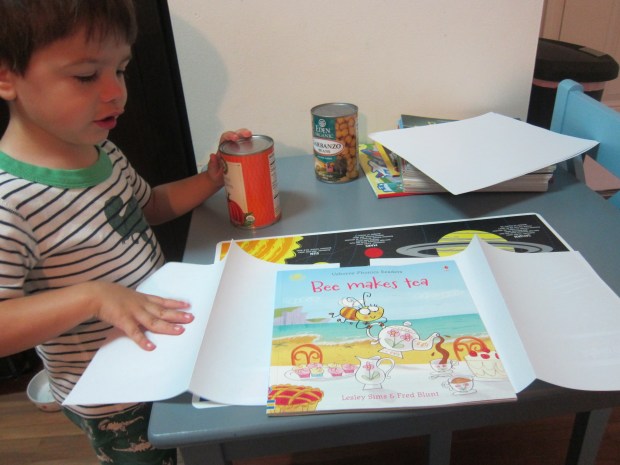
Now we needed to try something more structurally sound. Wrap three sheets of paper around cans, and tape to seal. Slide out the cans.

Strong Paper (4)

Set up the three sheets of paper like columns (those ancient Greeks were onto something…). I asked Travis to start piling on the books, and to his absolute delight, the paper remained standing. We couldn’t believe how big our pile grew – 3 books, 4 books, 5 books…

Strong Paper (6)

We had laid on about 15 of slender volumes when we decided to really test things.

Strong Paper (7)

It wasn’t until we added a fat hardcover book that the paper buckled and the whole pile collapsed – to Travis’s delight!

Strong Paper (8)

Needless to say, even I was impressed with how much weight the paper held. This activity is guaranteed fun, whether or not your little engineer grasps all of the concepts involved.

Marshmallow Sculptures

Marshmallow Sculpt (3)

Travis and I had some gooey fun attempting to make sculptures from marshmallows last November, but I confess our attempts were foiled by using large marshmallows and unsteady straws as construction materials.

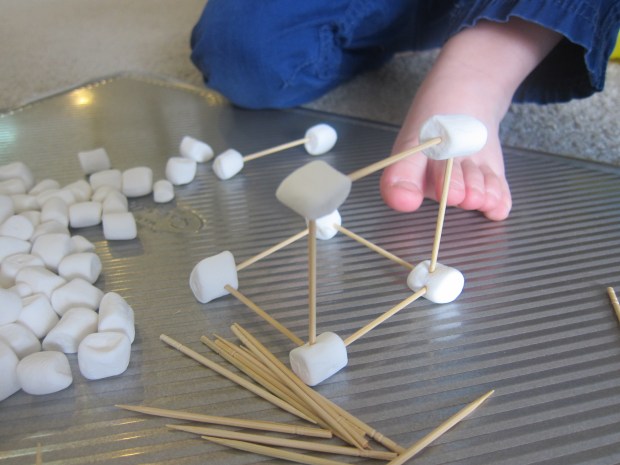
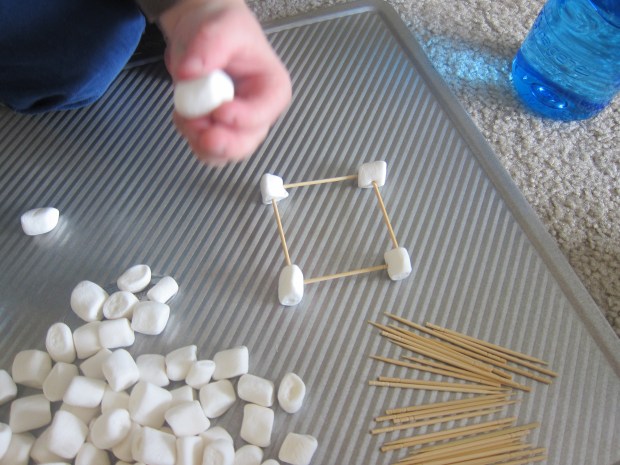
This time we used toothpicks and the small marshmallows from Dandies, and were able to create much sturdier constructions! Note: I recommend playing this game soon after your child has had a meal or a snack – that way the marshmallows will be viewed more as building material, and less as a treat to eat… Although we did sneak a few bites along the way!

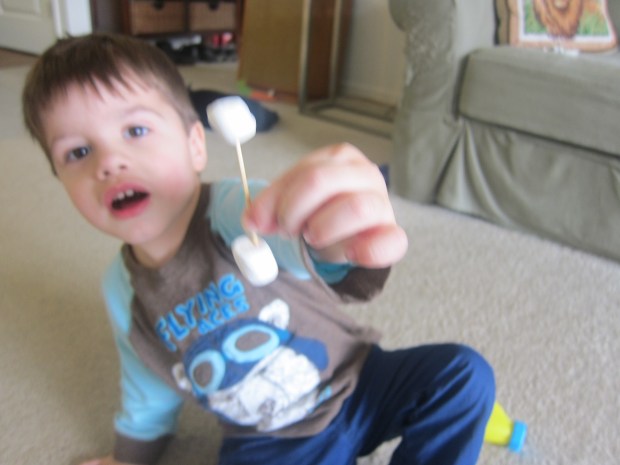
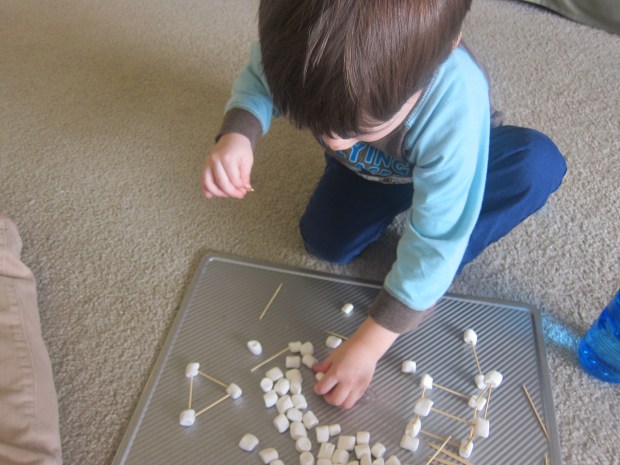
Already compared to November, Travis was much better at construction. He loved adding a marshmallow to either end of a toothpick, and loved that they looked like Q-tips!

Marshmallow Sculpt (2)

I then helped arrange these into more complex structures, whether two-dimensional shapes…

Marshmallow Sculpt (1)

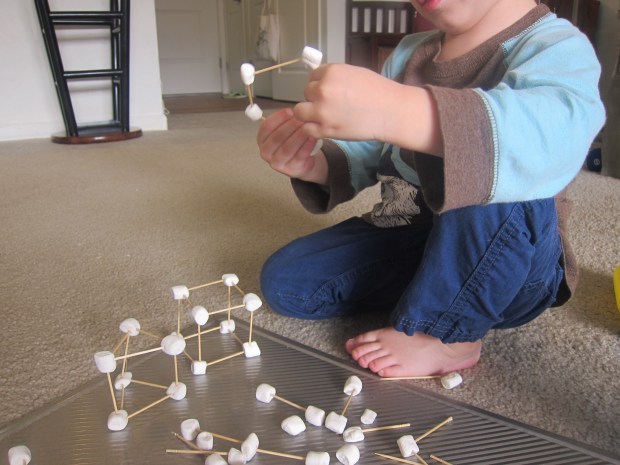
Or three-dimensional creations.

Marshmallow Sculpt (6)

The project was a great way to discuss shapes and dimensions! We even tried a double-decker hexagon.

Marshmallow Sculpt (7)

In sum, sticky fun for everyone.

Marshmallow Sculpt (4)

Volcano for Toddlers

volcano-5

Big kids can purchase D.I.Y. volcano models and witness a bubbling eruption at home, but why should big kids have all the fun? All you need to make a version that will delight your toddler is a little but of playdough (as long as you don’t mind sacrificing that particular portion of playdough), baking soda, and vinegar.

Shape your playdough into a roughly conic shape resembling a volcano, and place in a tray. Hollow out a small portion in the center of your volcano for the crater.

volcano-1

Travis was intrigued as I worked, and couldn’t wait to help spoon baking soda into the center of the crater, already excited about what reaction might occur.

We then spooned in a small amount of red food coloring to make our volcano look like real bubbling lava, although this step isn’t necessary.

volcano-2

Finally, I poured on vinegar – any kind will work, and I used rice vinegar since that was all I had at home. Now enjoy the bubbling!


volcano-6

Travis wanted to do this again and again, which we proceeded to do until my baking soda and vinegar ran out. He even took over dumping on the vinegar himself.

volcano-7

Once our ingredients were gone, he played with the leftover lava “goop” in the pan for quite some time, shoveling rivulets down the sides of our volcano, and breaking the playdough volcano into small pieces. So half the fun was in the mess we created!

volcano-8

All About the Solar System

u-week-8

Travis has been very into the solar system ever since receiving a book on the planets for his birthday. Following a visit to the science museum this past weekend, we had fun continuing the planet-themed games at home!

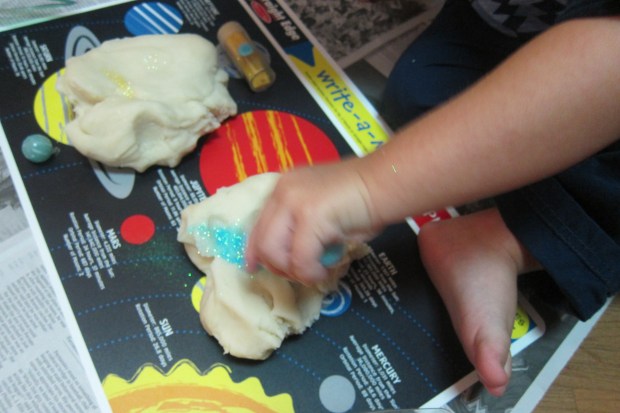
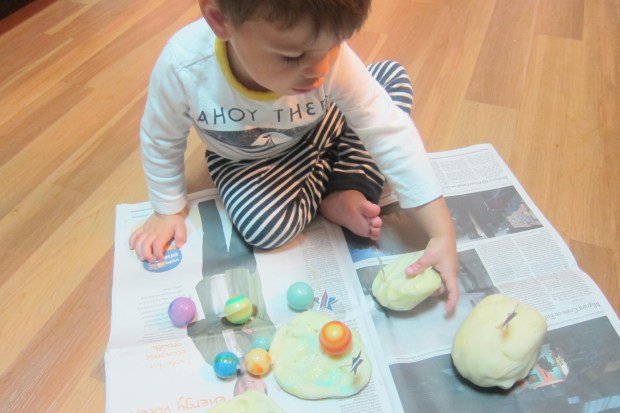
One neat idea is to make “galaxy playdough.” Alas, I did not have black food coloring, but we managed to have fun with the playdough I made following the recipe in the above link, minus the coloring. Then it was time to add “stardust”! Travis loved sprinkling in tons of blue and gold glitter to make our galactic creation.

u-week-12

We used props like model planets and star toothpicks to “explore” our galaxy, making for great fun.

solar-system-5

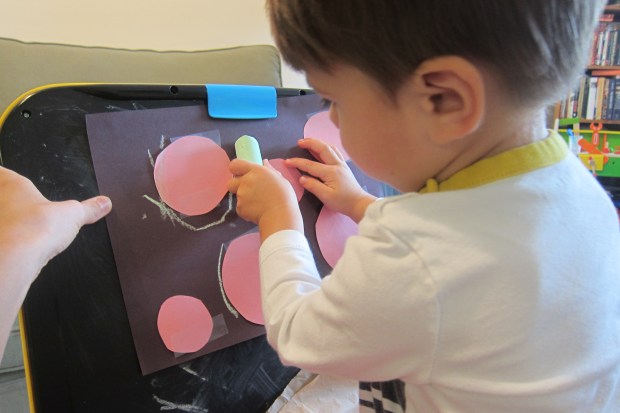
To talk about the relative size of the planets, I set up a simple tracing game. Travis is still getting the hang of tracing, so the result wasn’t as neat as yours will be if your child is preschool aged or up, but we had fun all the same! Cut colored circles from construction paper in various sizes, and tape to a second piece of construction paper, in a different color. Let your child trace around the circles with chalk.

solar-system-1

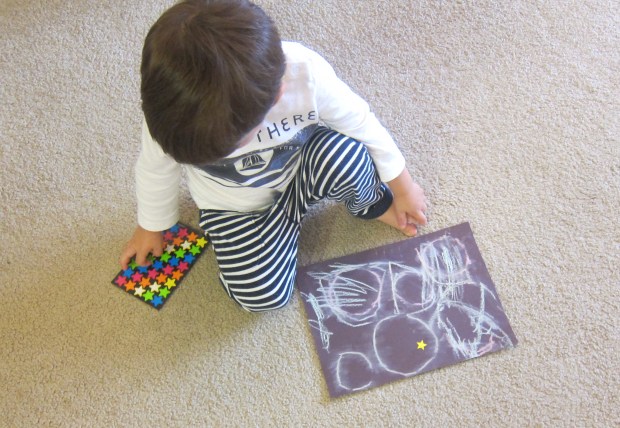
Remove the circles, leaving only the outline of the planets behind. You can smudge the edges of the chalk with your finger for a pulsing planet effect. We finished our “universe” with star stickers.

solar-system-3

What other fun galaxy games have your played with your child? Please share in the comments!

solar-system-4