Straws and Yarn

Straws and Yarn (8).JPG

This project is fantastic for keeping motor skills sharp in the summer break between preschool and kindergarten… and the final product easily becomes a gift for someone special, whether a graduation or a birthday!

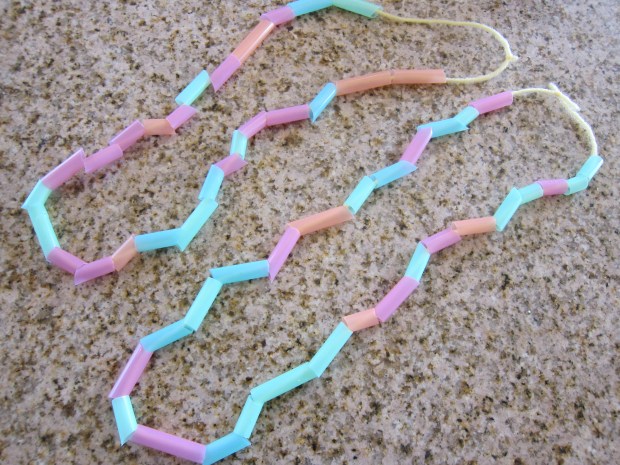
Tie a piece of yarn to a drinking straw with a tight knot; set aside. Help your child snip straws into pieces of varying size. We used wide pastel-colored milkshake straws, and discovered that the smaller we snipped them, the more they were ilke “beads” for our necklace.

Straws and Yarn (1)

The straws could be a bit tough to snip, and Travis loved when pieces went flying!

Straws and Yarn (2)

Have your child begin threading them on to the yarn.

Straws and Yarn (5)

Travis tried a few tactics, including pushing a straw “bead” onto the yarn, or pulling the yarn up through.

Straws and Yarn (3)

I loved his patience and concentration as he worked!

Straws and Yarn (4)

Once long enough for a necklace, tie the two ends of the yarn into a secure knot.

Straws and Yarn (6)

Travis enjoyed the project so much that he insisted we make two; he didn’t want either grandmother to feel left out, so we’ll be gifting two of these!

Straws and Yarn (7)

Learning to Point

Learn to Point (7).JPG

Pointing is an obvious thing that we do as adults, but such an important skill for a baby to learn. Especially before words come easily, many toddlers will point for what they want, which can ease frustration for a parent trying to understand! Get a head start and encourage pointing with this simple game.

I lined up a few toys in front of Veronika, slightly out of reach so she wouldn’t automatically grab them.

Learn to Point (1)

One by one, I pointed to each object and named it. I made sure to make my index finger very obvious, pointing and tapping it against the toy.

Learn to Point (3)

This inadvertently became a cute game of “you choose”, since she ignored some of the objects I pointed out, but others got scooped up in her hands almost immediately!

Learn to Point (4)

If that was the case, I pointed to it again as she held it.

Learn to Point (5)

Your baby won’t be pointing yet but may wave hands towards a particular toy or pat at it, both of which are good practice towards eventually using just the index finger.

Learn to Point (6)

Whatever the case, keep pointing, and your little one will soon follow suit!

Learn to Point (2)

New Switch-It Game

New Switch It (7).JPG

In the past when I played “switch-it” games with Veronika, the idea was for her to practice letting go of a toy, dropping one in exchange for another. At just shy of 7 months, the goal this time was more sophisticated: to switch a toy from hand to hand, in order to make room for another. She aced the test!

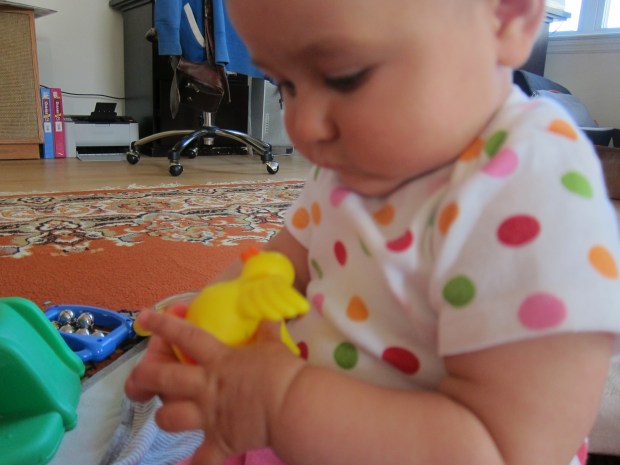
Plastic farm animals were the perfect toy for this purpose. First I handed her a duck, which she passed hand-to-hand as she played.

New Switch It (1)

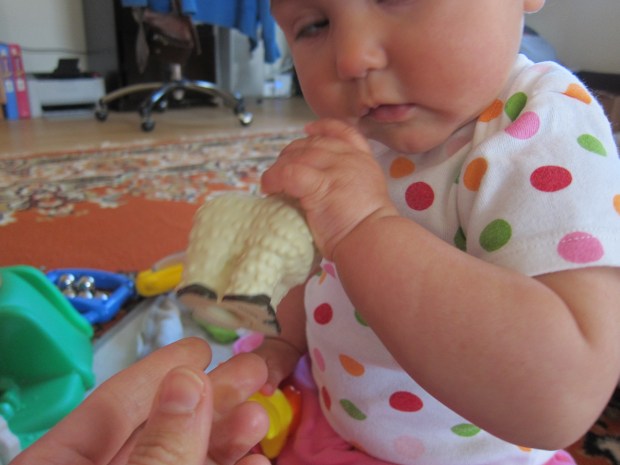
While it was in her left hand, I offered up llama, holding it up to the same hand.

New Switch It (2)

In a flash, duckie was in her right and llama was in her left!

New Switch It (3)

I praised the change she’d made, even though she didn’t entirely understand why.

New Switch It (4)

But she quickly soaked up the happy vibe and beamed proudly!

New Switch It (5)

Soon she was drumming the two animals together.

New Switch It (6)

Don’t worry if your baby doesn’t get this right away; keep practicing and soon he or she will be a hand-to-hand passing champ.

Coral Reef Diorama

Coral Reef (12).JPG

Today, Travis and I did an activity in conjunction with our Taste of Thai recipes to help him learn about the coral reefs of Thailand.

There was a lot in this lesson that was new for Travis, including guided imagery, but first I had to set the stage! I asked him if he knew what a scuba diver was and he correctly answered someone who dives underwater (thanks Fireman Sam!).

Coral Reef (1)

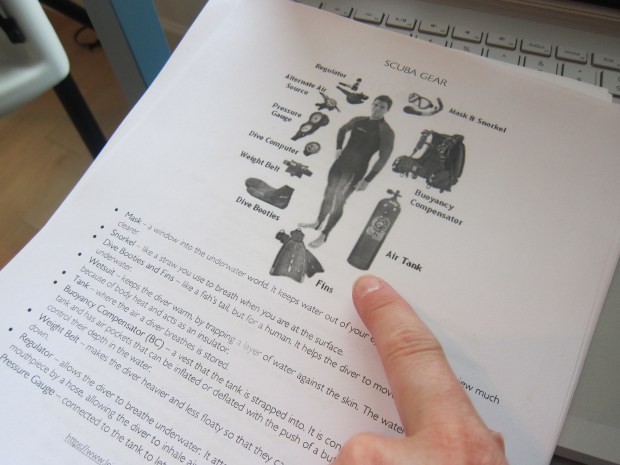
I showed him an included picture with scuba gear and then we mimed climbing in to all this equipment. Shimmy shimmy into your wet suit! This part was silly and fun.

Coral Reef (2)

Next up was our imaginary trip: a guided imagery about scuba diving in a coral reef. I knew this would be a bit of a challenge for my four-year-old, so instead of asking him to sit quietly with eyes closed, I had him paint a box blue for our upcoming diorama while I read the scenario. This allowed his hands to keep busy as he listened, and he liked the process!

Coral Reef (3)

For a simple, little-kid diorama, we made a version using play dough blobs as the base onto which we could add shells, fish stickers, and fake coral.

Coral Reef (5)

To make the coral, thread beads onto pipe cleaners – great for fine motor skills!

Coral Reef (6)

While we worked, I played Raddish’s suggested video in the background so he could see real examples.

Travis’s favorite part was using play dough to make the body for snails and hermit crabs who could live in our shells from the craft store!

Coral Reef (8)

He was so proud when he thought one of his shell creations looked like a narwhal.

Coral Reef (10)

Meanwhile, I made a few more tropical examples for him to see.

Coral Reef (7)

Bigger kids can delve a lot further into this homeschool lesson. Raddish also provided a list of discussion questions about the coral reef and links to further reading about what they are and how to protect them.

Coral Reef (9)

But for my preschooler, this simplified lesson was good fun!

Coral Reef (11)

Sitting Up Ball Games

Back and Forth (2)

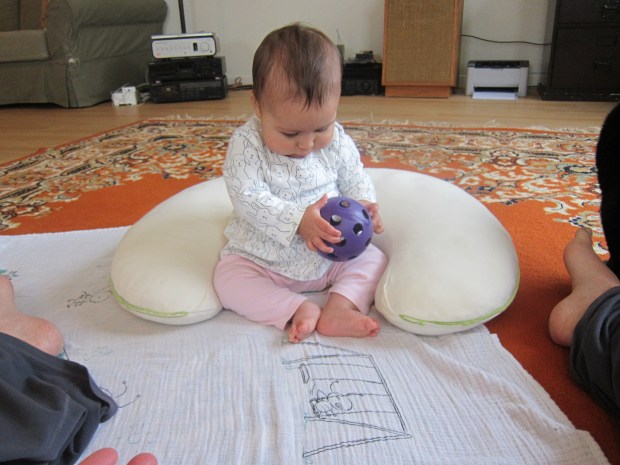
By six-and-a-half months old, your baby is probably a sitter – which means it’s time for some ball games together! Veronika can hold a ball easily, but today we got more sophisticated with her ball play; consider this her first little sports lesson!

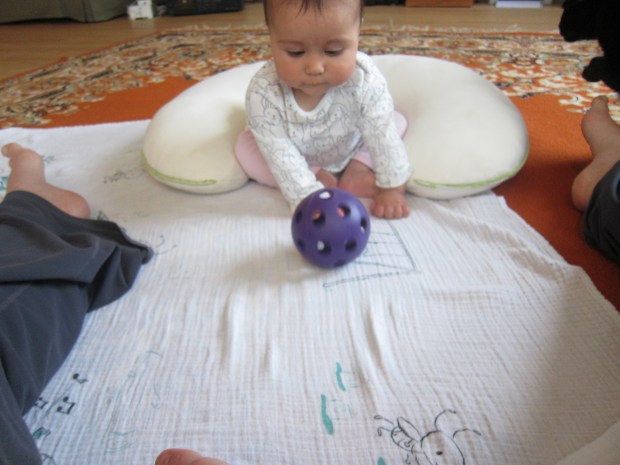
First, we played a basic rolling game. I rolled an easy-to-hold baby ball to Veronika.

Back and Forth (8)

Her natural inclination was to pick it up and keep it to herself for play, of course.

Back and Forth (7)

But I encouraged her to roll it back, using the word and gesturing. When she dropped it, it rolled toward me accidentally, but I praised this like she’d done it on purpose.

Back and Forth (6)

In this way, we kept up a little back and forth that she soon loved.

Back and Forth (4)

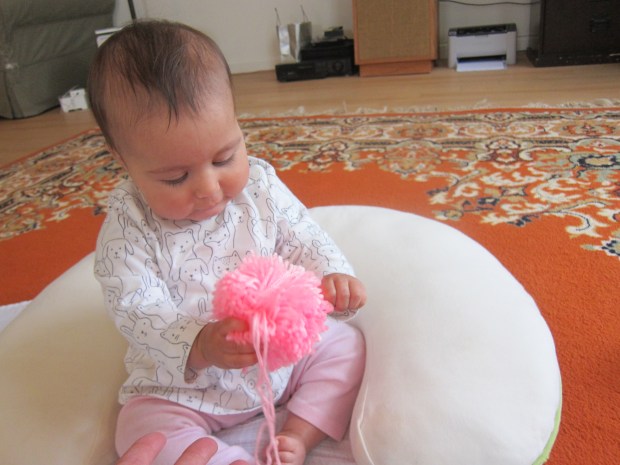
The next goal was to teach her to pass a ball between her hands. For this game, I used large fluffy pom-poms; these have the benefit of feeling yucky if your baby puts them up to the mouth, and I wanted Veronika to focus on her hands.

Pass the Ball (1)

I handed her the ball first. She loved the novel texture!

Pass the Ball (3)

Next I showed her how to pass it from hand to hand, then gave it back to her and encouraged her to do the same. As with the rolling, this really happened by accident, but each time, I praised her success! From right…

Pass the Ball (5)

…to left!

Pass the Ball (6)

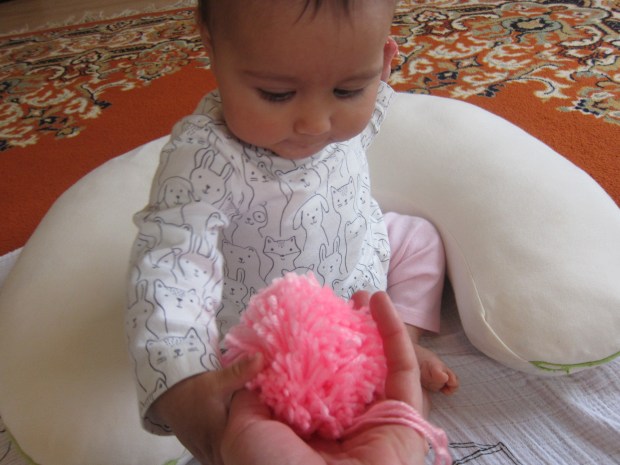
Next, I held out my hand and asked her to hand me the ball. I had to sort of take it, but then could “pass” it back to her, talking to her about what it meant to “pass”, too.

Pass the Ball (7)

These games are both great ways to build up linguistic concepts and motor skills all in one!

Back and Forth (1)

How do you and your baby play with balls? Please share in the comments!

Dropping Game

Dropping Game (4)

Here’s a game that’s sure to make your baby giggle, but little will he or she realize there are valuable skills being taught, too! The game covers everything from the concepts of in and out to the fine motor skills needed for retrieving an object.

I placed a plastic beach bucket in front of Veronika, and gathered up a few soft toys.

For each one, I dangled it over the bucket, making sure she saw it first.

Dropping Game (3)

Then I dropped it into the bucket with a big grin and an “oopsy!” This got giggles of course!

Dropping Game (2)

Once the bucket was filled, I encouraged her to pull the items out again.

Dropping Game (6)

This proved to be tricky because she was way more interested in the bucket (a novelty!) than the toys she already knows.

Dropping Game (1)

But we did have a few successful pickups. The apple goes in…

Dropping Game (7)

…and comes out!

Dropping Game (5)

This is definitely a game I’d play again; I love simple activities like this that make me pay careful attention to her skills and really zero in on her development, even for a short period, during an otherwise hectic day.


One Too Many

One Too Many (8)

In the past, I worked with Veronika on handing her one toy when she already held another in her grasp; it’s a great way to help little finger muscles practice gripping and letting go. Today, the challenge was harder: what would she do if she was holding two toys and presented with a third?

Use toys that are very similar for the best results (otherwise this becomes more like a game of toy choice). We have small shapes that she can grab on to easily, and which are quite alike, so they worked great for this game.

One Too Many (1)

She took hold of the circle when I handed it to her first, and it was easy to take the rectangle in her other hand.

One Too Many (2)

But oh no! What would she do now that triangle came along?

One Too Many (3)

It took a moment, but then rectangle was dropped.

One Too Many (4)

Uh oh, here comes rectangle back again! Who would be sacrificed?

One Too Many (5)

Down goes circle!

One Too Many (6)

She delighted in the game, and I could almost see her brain processing what to do each time. And of course there was the good fun of simply handling and gnawing on the shapes, as well.

One Too Many (7)

Feed the Frog

Feed Frog (7)

Ha, this activity is probably more suited to a creepy-crawly time of year like Halloween, but how do you keep a 4-year-old busy on the day before Christmas? With some good, spider fun, it turns out!

Travis spotted an old trove of spider rings in our craft bin, so we set up this game.

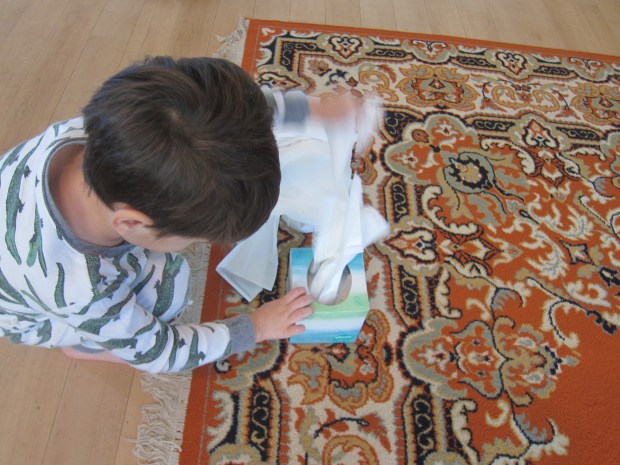
We needed a tissue box, and I let Travis go to town emptying the box and playing with the leftover tissues – something I wouldn’t normally encourage, but every once in a while, you need a sacrificial tissue box.

Feed Frog (2)

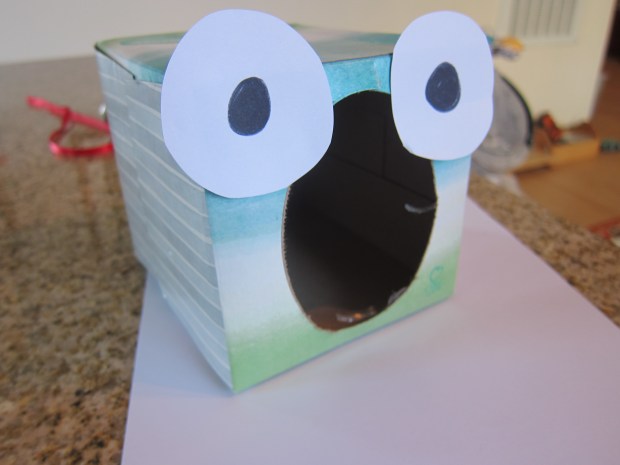
Ideally, use a green box. Ours had streaks of green as well as other colors, so I guess looked more like one of those tropical bright frogs – why not!

Feed Frog (3)

I made two big eyes for the frog, simply drawing black circles onto white paper and taping to the frog. Cut out the plastic around the hole of the tissue box, and your frog is ready to eat.

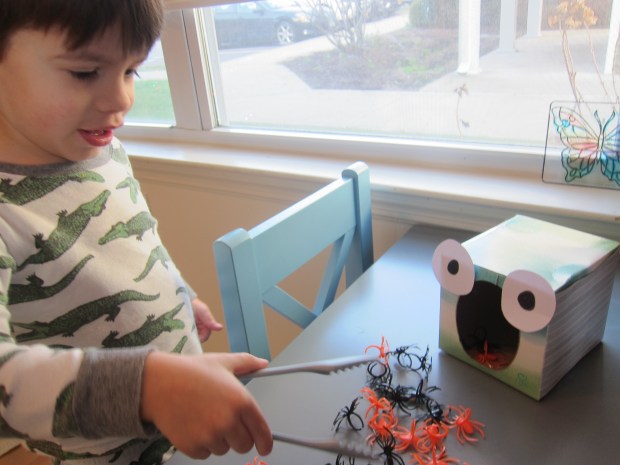
Present your child with the “frog”, a pair of tongs, and a set of spiders, and challenge him or her to feed the frog. Tongs are great for fine motor skills!

Feed Frog (4)

Travis would happily have done this all day. To throw in a little education, I asked if he could think of a pattern to feed the frog. “Black, orange, black, orange,” he suggested. Yes!

Feed Frog (5)

Next we tried rolling a dice, taking turns and feeding the frog the appropriate number of spiders.

Feed Frog (6)

When our frog got full, we simply dumped him out and started over.

Travis wanted other things for froggie to eat, so we found red pom poms, which he decided were poisonous bugs.

Feed Frog (8)

He even suggested we make a little mouth for froggie that could open and close, to keep all the food inside.

In sum, a great way to keep your kids entertained!

Paper Plate Kite

Plate Kite (7)

Let’s be honest. Kites are great but they can also be a royal pain – all that tangled string, getting enough wind to launch the kite high, etc.

This quick project gives kids the fun of a kite without the hassle. (Bonus points: there’s fine motor skill practice involved!).

Cut the center from a paper plate (or several plates, if you want multiple kites).

Plate Kite (3)

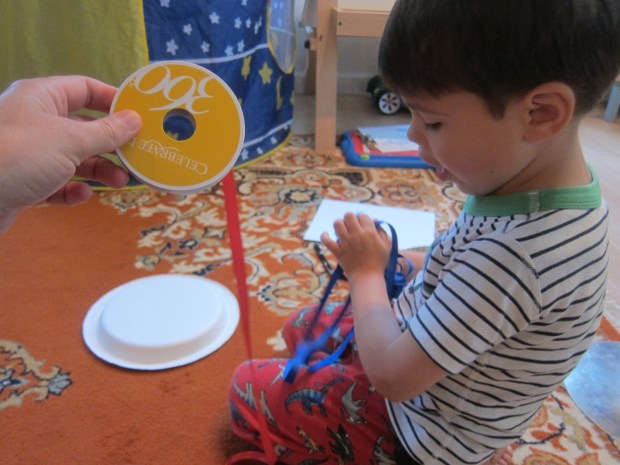
We went through our craft bin and selected pretty ribbon to tie on as the kite tails.

Plate Kite (1)

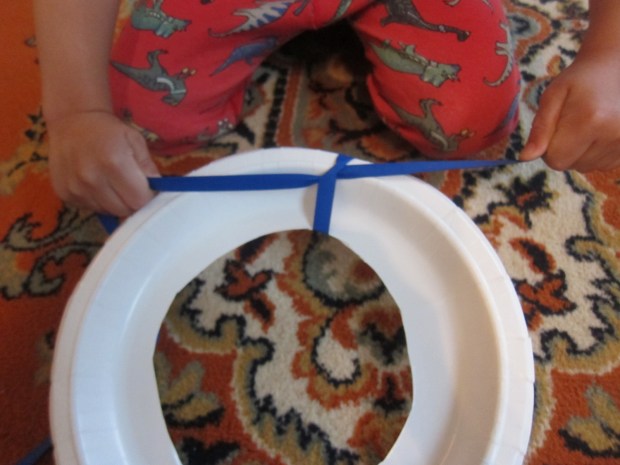
Now for that fine finger work! Help your child tie each ribbon around the bottom rim of the plate.

Plate Kite (2)

Travis was really proud when I told him this was almost like tying shoelaces.

Plate Kite (5)

No need to wait for a windy day – just run and the kite flutters with you!

Plate Kite (6)

Looking for a slightly more complicated project? Try out our plastic bag kite or tissue paper kite.

Strawberry Picking and Basket Weaving

Summer 2 (c)

Summertime! This season is synonymous with so many things, and one of those is berry picking. Last year we headed out late in the season for blueberries. This year we made sure not to miss the strawberry window. Kids will love gathering the sweet red berries, and discovering the baby green strawberries still on the plant.

Summer 2 (b)

The fun doesn’t end at home: Fruit baskets are great for fine motor skills! We picked a few pretty colors of ribbon and wove through the holes in the basket.

Strawberry Basket (1)

If you already have strawberry crates at home, do this project ahead of time, and bring your one-of-a-kind basket when you do your picking.

Strawberry Basket (2)

Then of course comes the bonus: strawberry vanilla pancakes for breakfast.

1 cup flour

2 tablespoons brown sugar

2 teaspoons baking powder

1 teaspoon salt

1 Ener-G egg

1 cup vanilla almond milk

2 tablespoons canola oil

1 tablespoon vanilla extract

1 cup chopped strawberries

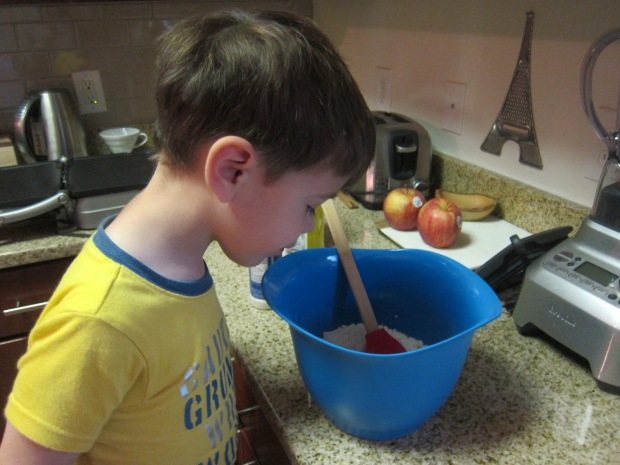
Combine all of the ingredients in a bowl.

Strawberry Basket (3)

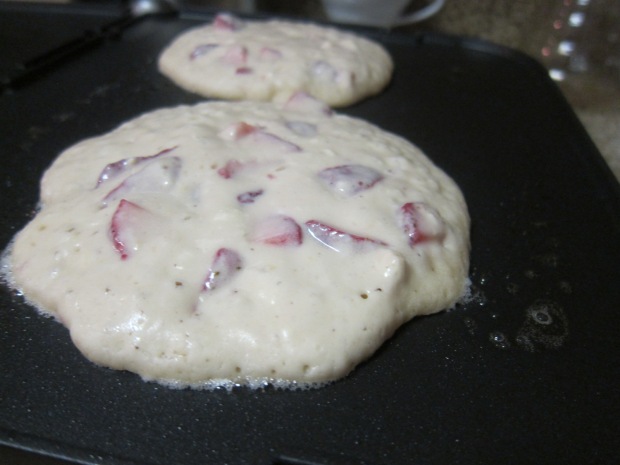
Cook on a griddle or skillet for 3 minutes until bubbles form on the top. Flip over and cook 2 to 3 minutes on the other side.

Strawberry Basket (4)

Pancakes have never tasted so much like summer!

Strawberry Basket (5)