Cardboard Learning Tree

Learning Tree (11)

This is a great activity that combines seasonal holiday crafting with a little learning. If you play your cards right, the kids won’t even know you’ve slipped in some education with their fun!

For the shape of your tree, you can either paint a large piece of cardboard (holiday gift delivery boxes, perhaps?) or poster board. We chose poster board because I knew it would be easier to cut out the tree. Either way, Travis was thrilled when I said I needed the entire thing painted green.

Learning Tree (2)

We left the paint to dry overnight, and the next day I cut out the tree shape.

Learning Tree (3)

Next we gathered supplies for the “ornaments.” Use holiday-themed cookie cutters or other shapes, and trace the outlines on colored construction paper.

Learning Tree (4)

Don’t worry if your kids don’t trace perfectly, you can always neaten up the lines when cutting the shapes out later.

Learning Tree (5)

The next step was even more fun: laminating the cards. Although this step is optional, it will definitely make your paper pieces last longer. Travis adores whenever he’s allowed to help laminate, so this was a big hit.

Learning Tree (7)

I cut out the shapes, and set them aside.

We hung our tree on the wall and added a brown piece of construction paper as the trunk.

The final step was to add Velcro strips to our tree and ornaments. Place the soft side of the Velcro on the tree at random intervals, then attach one rough Velcro piece to each ornament. Travis loved this even before we added the learning element, hanging his ornaments and then changing their positions.

Learning Tree (10)

There are so many games you can play from this point on! First, I numbered the ornaments one through twenty with a wipe-clean marker, for a number search game.

Learning Tree (12)

A simple wipe with a paper towel and we could play alphabet games. One suggestion is to hide the letters in your child’s name, and have them pinpoint those on the tree.

Learning Tree (13)

As an alternative, write the upper and lower case of a batch of letters, and have your child find the pairs.

In full honesty, Travis was way more into the mechanics of this game (taking on and off the ornaments, wiping them clean with paper towels), than he was with the learning games, but we’ll play again over the course of the next few weeks!

Make Your Own Gummies

Gummies (12).JPG

Many thanks to Glee Gum for helping make this post happen!

Travis and I received a test sample of the company’s Make Your Own Gummies kit, and he adored the project from start to finish. I’m so pleased that I can offer readers of this blog the following exclusive promotion for holiday shopping!

Save 15% on EVERYTHING at GleeGum.com!
Coupon code: JOYFUL
(Offer only valid on web-store orders placed at GleeGum.com. Enter coupon code in the lower left of your shopping cart & hit “apply coupon.” One time only; one coupon code per order. Offer ends 1/31/18 at 11:59 pm ET.) 

Without any further ado, here’s what we thought of the Gummies kit. Although marketed to ages 8 and up, my 3 year old was able to help with each step and to understand the science behind how we made the candy. Here we are opening the box – he couldn’t wait to find out what was in each little packet!

Gummies (1)

The directions were a touch vague at times, but that is my only gripe. Even though I improvised once or twice, the recipe is very forgiving because our gummies still turned out just fine.

In addition to the sweet treat at the end, the kit also includes great factual and scientific information on why you’ve received dried seaweed and seaweed powder as the starters for your gummies. Using carrageenan from seaweed means the company does not have to use gelatin from animal bones. This is a win-win situation, for seaweed farmers in places like the Philippines and of course for the animals! I loved that this vegan project was one Travis and I could share together.

Gummies (13)

So on that note, how does it work? First, we covered our dried seaweed with water and let stand. The instructions were vague here, but I used warm water and let it stand for about 5 minutes, which turned out to be enough.

Meanwhile, select molds for your candy. We decided to use holiday-shaped cookie cutters, but I would use smaller molds next time. (The kit even suggests straws to make gummy worms!).

Gummies (2)

Next, we smoothed the molding starch down onto a plate; a fun step for a three year old wielding a spoon. The kit said to place your molds in the starch and lift out. This seemed odd to me, so we left our molds in – more on that later.

Gummies (3)

Meanwhile, back to the gummies: we mixed together powdered seaweed and water, and added the dried seaweed, which was now somewhat soft and smelled strongly of the ocean – Travis loved the sensory experience! Microwave for about 2 minutes until it foams up. Discard the dried seaweed. We added pink sugar and microwaved for an additional minute.

Gummies (5)

Now pour the gummy mixture over your molds and transfer to the fridge. A wonderful bonus of this activity is that kids barely need to wait – ten minutes is all it takes for the gummies to set!

Gummies (7)

We were rewarded ten minutes later with perfect gummy figures. As the finishing touch, we placed in a zip-top bag and shook with the provided sour mix. It was only 9 o’clock in the morning, but of course my little sous-chef got to taste right away.

Gummies (9)

In sum, this is a fantastic project to share with kids. You’ll get to hone kitchen skills, learn a little science about seaweed, and eat a fantastic snack at the end. If you purchase the kit, please do share your experience in the comments!

Gummies (10)

For more details on the product described in this post, including nutrition facts & ingredients, be sure to visit GleeGum.com You can also check out GleeGum’s Facebook (Glee Gum), Twitter (@gleeguy), Pinterest (Glee Gum),and Instagram (glee.gum) accounts.

Apple Experiment

Apple Experiment (7)

Wondering what to do with any leftover haul of apples from fall apple picking? This experiment introduces kids to several concepts, namely: oxidation (the apple turning brown); PH levels (a quick overview of acids and bases); and of course the fun of making a hypothesis and testing to see if it was correct!

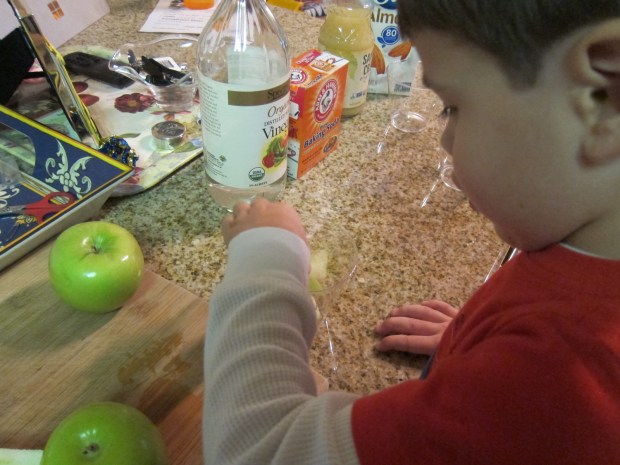
To start, we needed to cut two apples into wedges. Travis insisted on being my helper for this step. Use a butter knife or other child-safe knife.

We then divided the apple slices among 5 cups.

Apple Experiment (1)

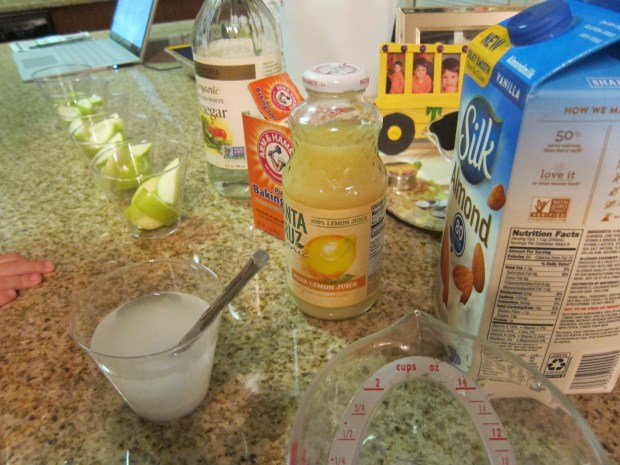
Now it was time to add our 5 solutions. Fill one cup each with the following:

Vinegar

Lemon juice

Non-dairy milk

Water

Baking soda solution

Note: for the baking soda, stir about three spoonfuls of baking soda into water and dissolve first, then pour over the apples.

Apple Experiment (3)

Travis instantly guessed that the vinegar would stop the apple from browning, and ran to share the news with his dad that we had to wait until morning! I loved that he understood a) that we were doing a scientific experiment and b) came up with his own hypothesis with no prompting.

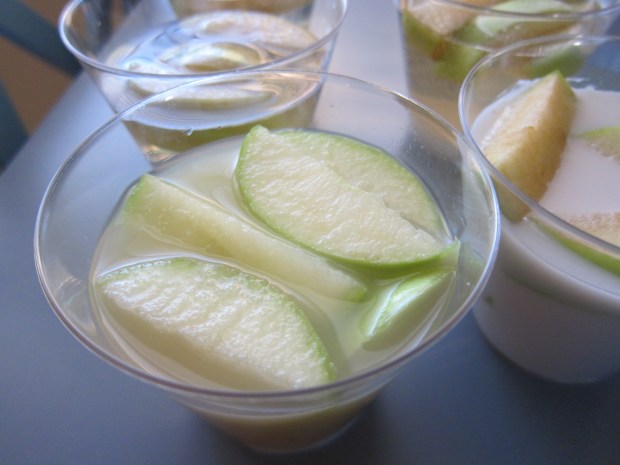
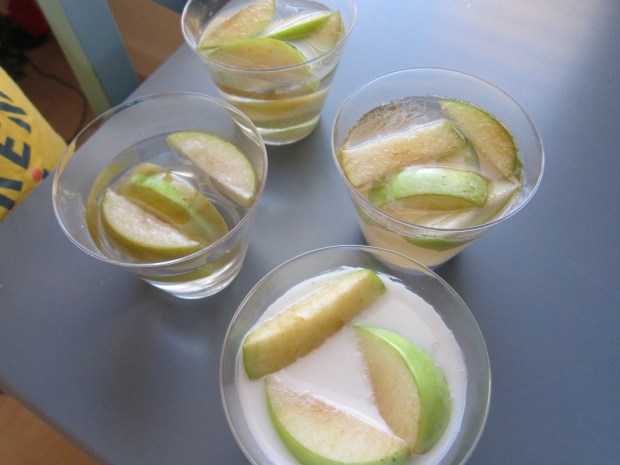
In the morning, it was time to check on our solutions. We discovered that 4 of them had turned quite brown.

Apple Experiment (6)

As grown-ups will have guessed, it was the lemon juice that did the trick. Give your child a quick lesson on how the lemon is acidic, and prevents the enzymes in the apple from reacting with the oxygen in the air.

Apple Experiment (8)

Overall, I found this to be an easy and seasonable way to introduce a few scientific concepts.

Apple Experiment (9)


Pipe Cleaner Caterpillar

Pipe Caterpillar (5).JPG

I was delighted to see Travis pretending this morning that he was on a “nature walk” around our apartment, taking along a bucket and finding “treasures.” One of the items we never found on a true nature walk this fall was a wooly bear caterpillar – so we decided to make a few to find around the house!

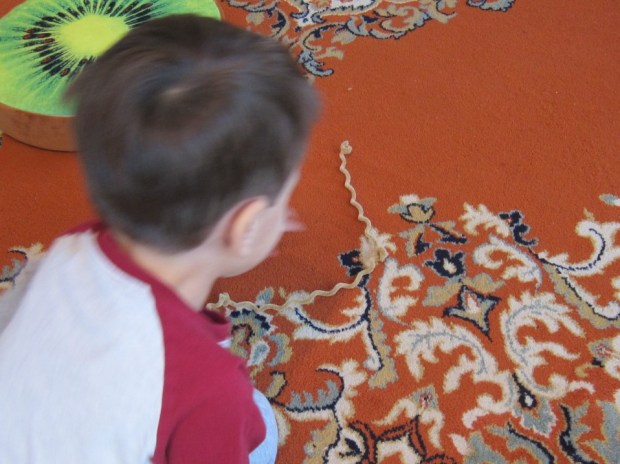
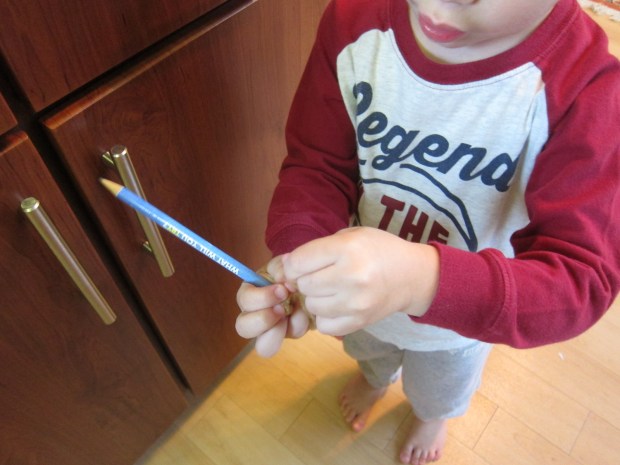
Wrap pipe cleaners around a pencil tightly, then simply slide off. I only had brown pipe cleaners at home, which served our purpose perfectly, but feel free to be inventive with colors: shiny caterpillars, multi-colored caterpillars, whatever suits your child’s fancy!

Pipe Caterpillar (1)

Travis immediately was wiggling them around the “forest floor.”

Pipe Caterpillar (3)

He then stretched out some of the coils so they could be worms instead – I love when his imagination takes a game in a direction I hadn’t anticipated.

Pipe Caterpillar (6)

He then wanted a turn coiling a pipe cleaner around the pencil, which was tricky for him, but he loved trying it out.

Pipe Caterpillar (7)

We ended up gluing googly eyes on just a couple of the caterpillars, for an extra adorable touch.

Pipe Caterpillar (4)

More Fall Leaf Fun

Fall Fun (5)

I posted about our Fall Find It walk a few weeks back, but now the fall colors are even more vibrant so we set off in the woods again. Forty degrees felt warm after an early arctic blast, making us doubly sure to get out into the sunshine. We added in a few suggestions from Parents magazine to add novelty to this particular walk!

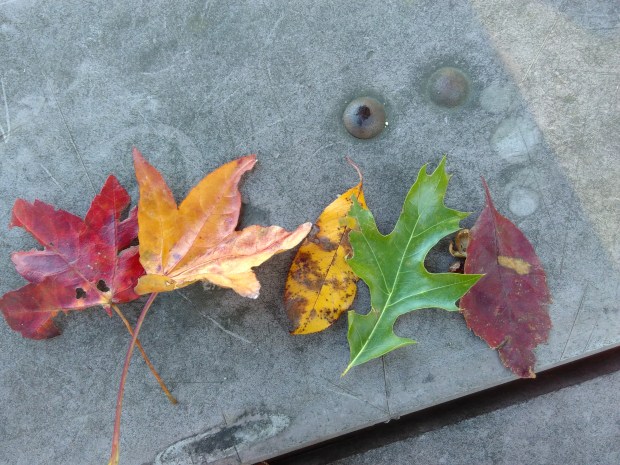
First, we decided to see if we could find the whole rainbow, ROYGBIV, that is. Blue proved to be elusive, but we did wind up with this neat line-up. Finding a purple shade was a particular triumph.

Fall Fun (1)

Then we searched for the biggest leaf, and kept dropping contenders whenever we spotted one that was even bigger. We were impressed to bring home this one at 9.5 inches… until reading about a record-setting maple leaf that was 20 inches!

Fall Fun (4)

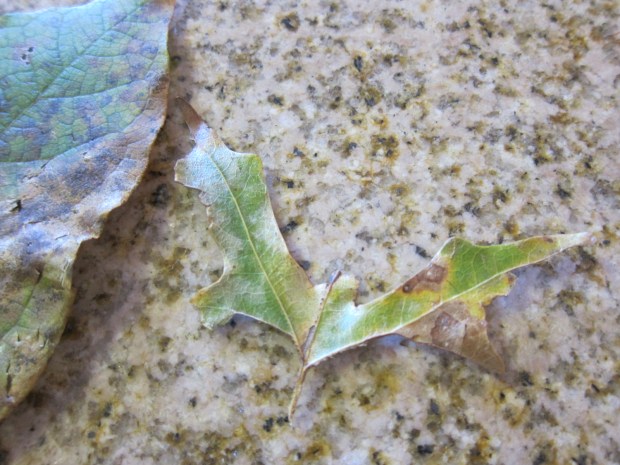
Perhaps the most fun suggestion was to find shapes in the leaves, similar to the game you’ve most likely played identifying shapes in the clouds, but with an eye to the ground this time. We spotted this little fellow that looked like a bat.

Fall Fun (3)

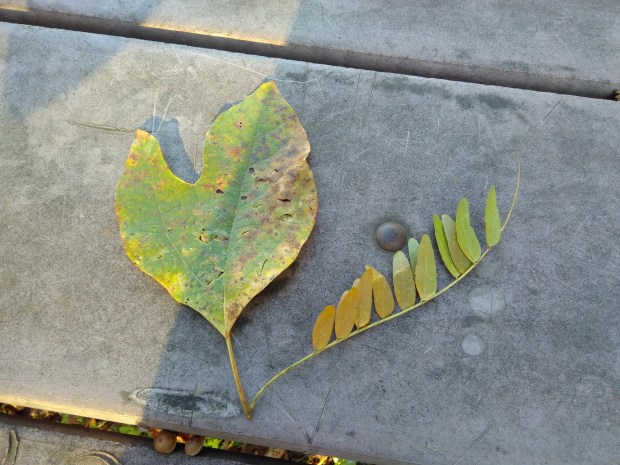
I found one that I thought looked like a rooster, and Travis decided the frilly one looked like a caterpillar! All in all, some simple and good fun that I recommend for your next nature expedition. What other leaf games do you and your family play? Please share in the comments!

Fall Fun (2)

Bird-Beak Buffet

Bird Buffet (7)

Some recent fun with a homemade bird feeder has us talking about birds, the various things they eat, and why some birds’ beaks look very different from others. It was the perfect opportunity to pull out this cute game from our Barefoot Books’ Kids Garden kit!

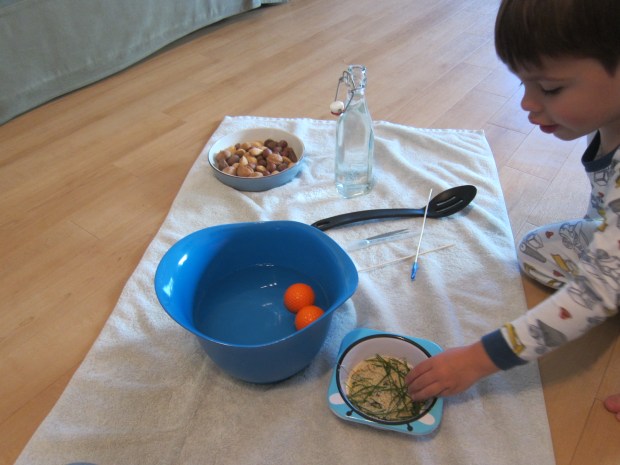
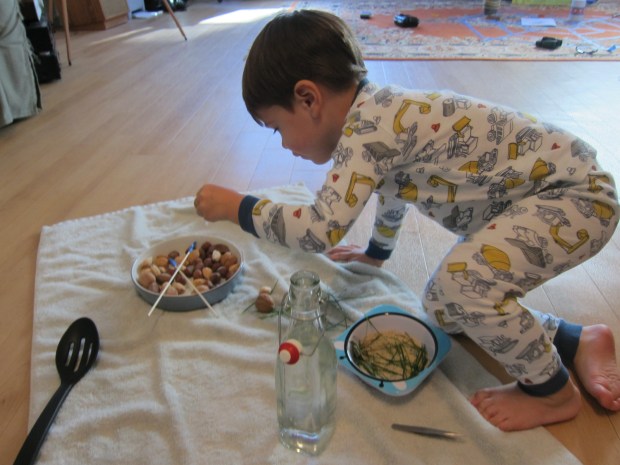
I recommend gathering all your materials ahead of time so you can lay all of the following items in front of your child at once. Otherwise, there is bound to be some curious exploration and possible trouble! First, you’ll need 4 beaks:

  • 1 pair of chopsticks (“Heron Beak”)
  • 1 eyedropper (“Hummingbird Beak”)
  • 1 slotted spoon (“Pelican Beak”)
  • 1 pair of tweezers (“Sparrow Beak”)

BIrd Buffet (1)

Then set out 4 bowls of bird “food:

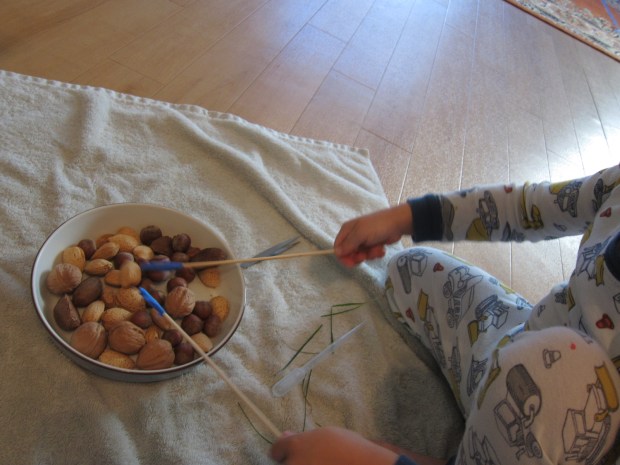
  • 1 plate of unshelled nuts as pretend field mice for the Heron
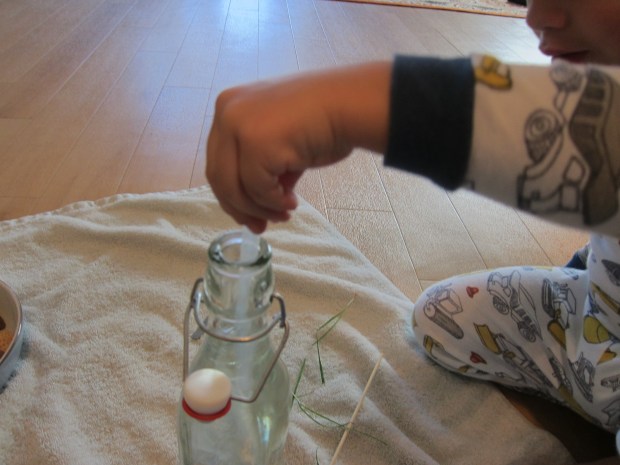
  • 1 tall bottle with a narrow top filled with water as flower nectar for the Hummingbird
  • 1 bowl of ping pong balls floating in water as fish in water for the Pelican
  • 1 bowl of sesame seeds and grass clippings as seeds in the grass for the Sparrow

Bird Buffet (2)

I recommend having a towel under your play area, since two of these bird meals involve water! Now let your child experiment with which “beak” is best suited for each food. The ladle and ping pong balls were an easy first guess, and Travis had fun pretending to be the pelican.

Bird Buffet (3)

The most enjoyable challenge was using the tweezers to grip the grass clippings and sesame. He was very focused on it, and so proud each time he could move some grass or a sesame seed.

Bird Buffet (4)

The eyedropper was a delight of course, and we talked about the hummingbird’s long narrow beak being well suited to dip inside a flower.

Bird Buffet (5)

The one that gave us consternation was picking up nuts with the chopsticks. We decided we wouldn’t want to be herons!

Bird Buffet (6)

From there, Travis had fun mixing and matching his birds. He used the eyedropper in the “pelican’s” big bowl of water, and loved using the slotted spoon to move unshelled nuts from the dry bowl into the bowl of water, then fishing them out with a utensil or his hands.

BIrd Buffet (10)

He also mixed water into his sesame seeds, and found other ways to have fun with the eyedropper (as a spoon etc.), resulting in lots of enjoyment even after the stated purpose of the game was done.

Bird Buffet (8)

We hope to follow up with some bird watching outside once the weather warms up, paying close attention to the birds’ beaks!

Jeweled Turtle

Jeweled Turtle (9).JPG

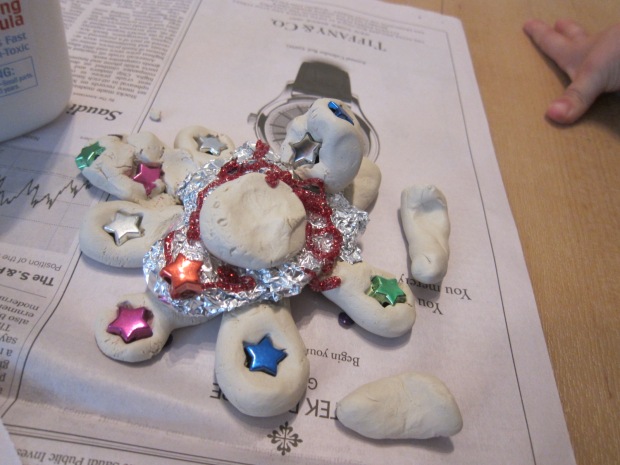
We seem to be on a bit of a reptile kick lately, and this jeweled turtle helped fill a lazy morning at home. Travis loves to play with clay and aluminum foil, so what a bonus to find a craft that combined the two!

To make your turtle shells, crumple aluminum foil into a ball, and then flatten slightly until you achieve the desired shape.

Jeweled Turtle (1)

Next we rolled little bits of air-dry clay to be the head, arms, legs, and tail of the turtle. Press slightly into the underside of the foil to adhere.

Jeweled Turtle (2)

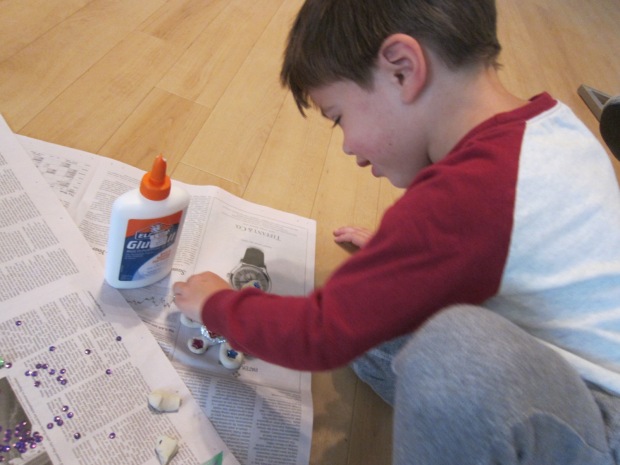
We pulled out a few sparkly odds and ends from our craft bin to decorate the shell of our turtle, including sequins and glitter glue.

Jeweled Turtle (3)

Once our first turtle was finished (admittedly with lots of adult help), Travis immediately began making a second, and this time I sat back and just watched his imagination go wild!

Jeweled Turtle (7)

The turtle had several heads, bits of clay stuck on top of the shell, eyes in several places that didn’t necessarily make “sense”, and star beads pressed into arms and feet.

Jeweled Turtle (5)

I didn’t lift a finger for this second version, and absolutely loved seeing Travis make his own creation.

Jeweled Turtle (6)

What will your child’s turtle end up looking like? Please describe or post a picture in the comments; we can’t wait to see!

Jeweled Turtle (8)

Paper Tube Snake

Paper Tube Snake (8)

We had good fun with a snake straw puppet a few days ago, and soon decided we needed another slithery friend around the house. Travis enjoyed this method of making a snake even more!

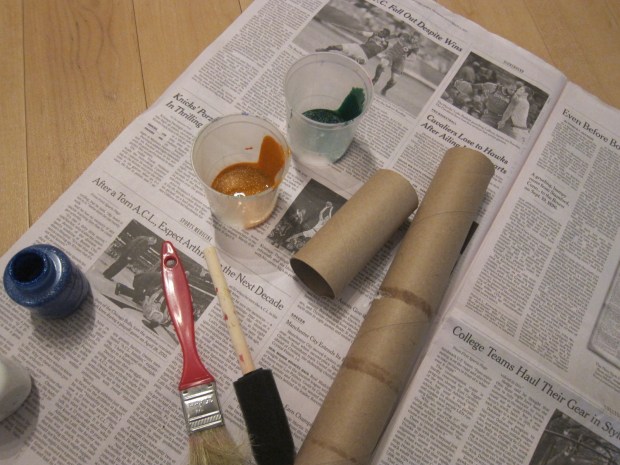
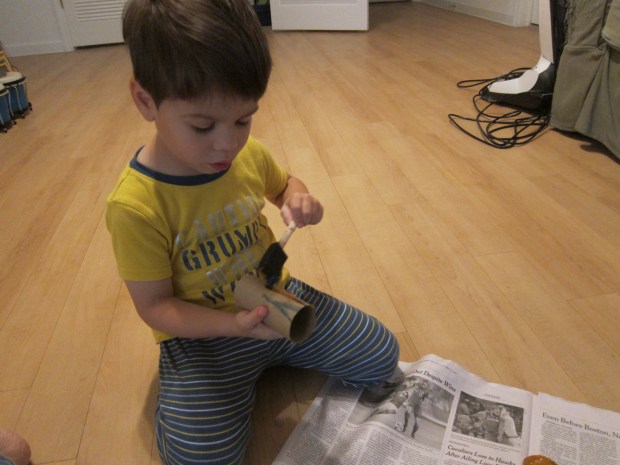
To start, paint cardboard tubes to be the snake’s body. I had one empty paper towel tube and one empty toilet paper tube, which dictated how long our final snake would be. Save lots of tubes and you can make your snake even longer!

Paper Tube Snake (1)

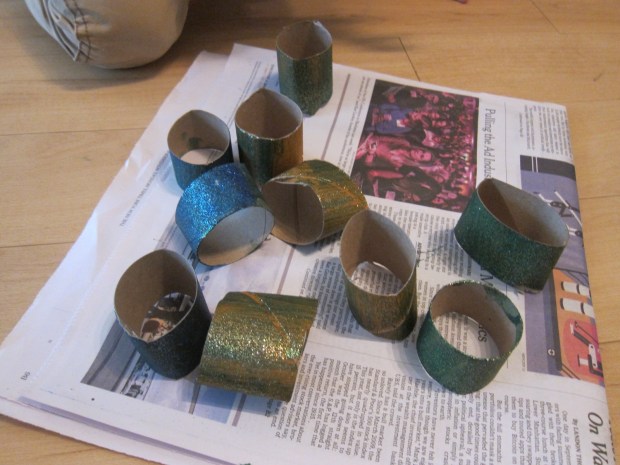
We painted the snake with glitter paint, giving it a very reptilian shimmer, then set it aside to dry.

Paper Tube Snake (2)

Once the paint dries, cut the tubes into pieces (about 3 pieces for a toilet paper roll, and 6 or 7 from a paper towel roll).

Paper Tube Snake (3)

Your child can decorate the snake further by making dots, squiggles, or other designs with more paint or with markers. But Travis decided he liked the glitter plain, and was super excited for the next step because it involved…

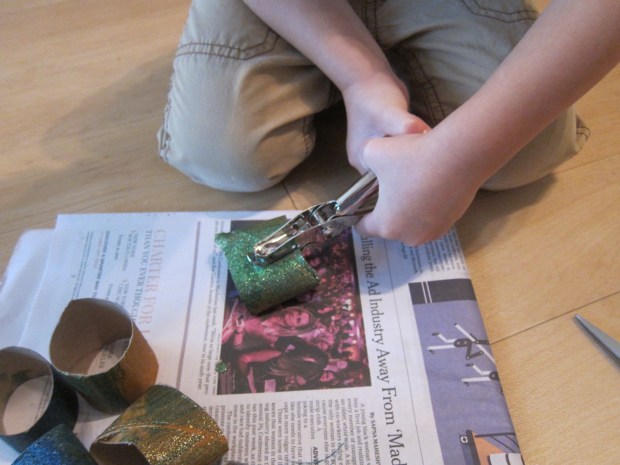
The hole punch! He loves practicing with the hole punch on paper, and was very curious to see if he could punch all the way through cardboard. The verdict is that he needed a little extra oomph from mommy’s hands, but he loved the process of punching two holes into each segment of cardboard.

Paper Tube Snake (4)

Next up was lacing. We used a long red string with an eyelet at the end, making it easier to poke through the holes without fraying, but regular yarn would work too. Travis was so proud of his ability to thread up and down through the holes as we attached our snake segments together, declaring at one point, “I love lacing!”

Paper Tube Snake (5)

Once all of your pieces are threaded on the string, tape the back and front end of the string to the cardboard. We left a little extra string at the front so Travis could tug the snake around the room.

Paper Tube Snake (6)

A little glue helped us add googly eyes and a red felt tongue as the finishing touches.

Paper Tube Snake (10)

Pardon the blurry picture, but the snake was wiggling too fast once in Travis’s hands for me to capture a clear image – a sure sign of an enjoyable snake!

Pine Cone Bird Feeder

Pinecone Feeder (6)

With daylight savings officially upon us and darker, colder days here to stay, we’re thinking about the winter to come… and in particular, helping out our feathered friends.

On our latest nature walk, we selected three large pinecones for the project. Travis was very curious to see how we would turn them into bird feeders!

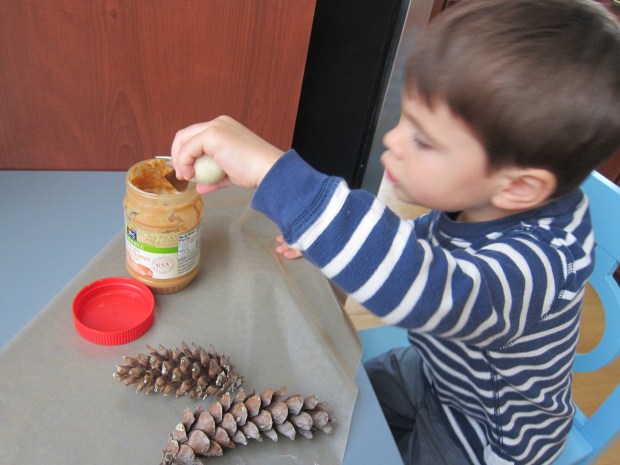
First we needed to smear them with peanut butter, a gooey and fun step.

Pinecone Feeder (1)

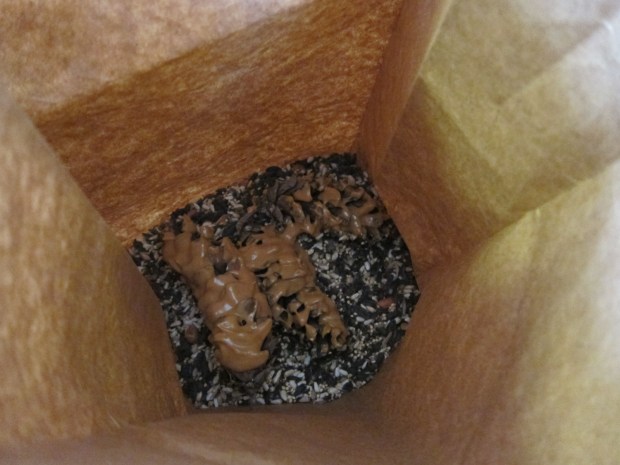
To cover the pine cones with bird seed, we filled the bottom of a paper bag with the seeds, added our pine cones, and then shook the bag.

Pinecone Feeder (2)

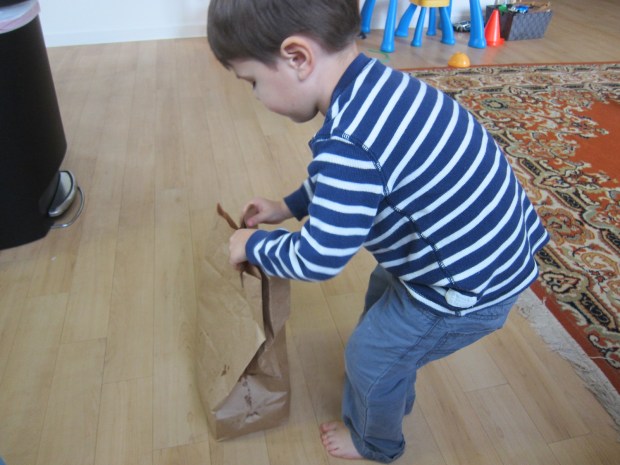
The shaking was arguably the best part of the project!

Pinecone Feeder (5)

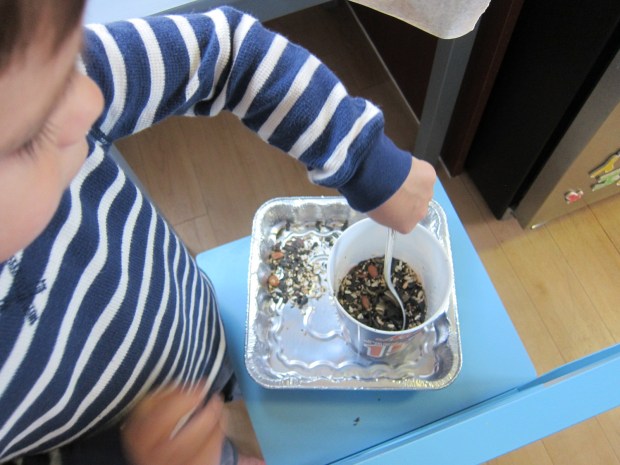
And of course, leftover seeds are fun to play with.

Pinecone Feeder (4)

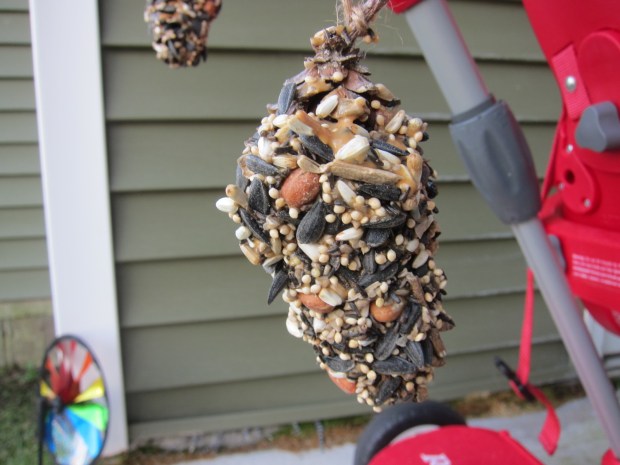
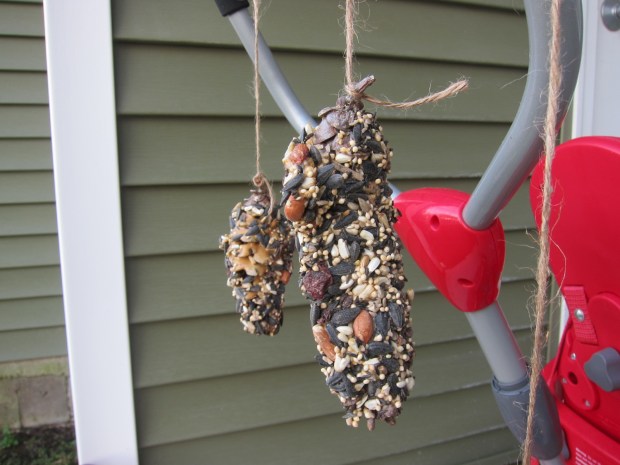
Ideally, we’d have a tree or bush to hang the feeders from, but the best I could do was to hang them from the bicycle handles on our patio. We can’t wait to see if any feathered friends visit for a nibble!

Pinecone Feeder (7)


Leafy Linens

Leafy Linens (10)

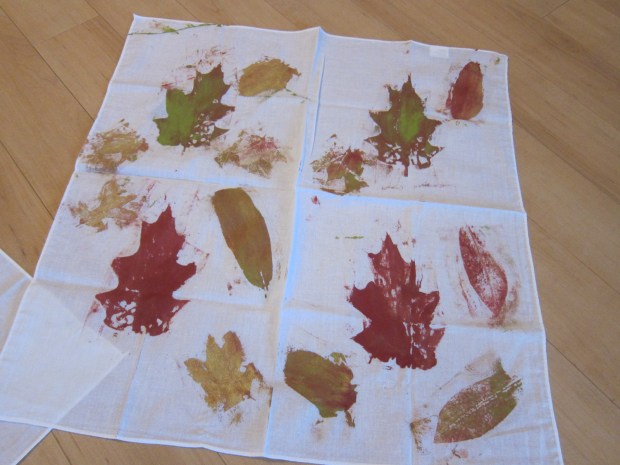
This lovely fall project would make a beautiful decoration for a Thanksgiving table, or a perfect gift for school teachers around the holidays.

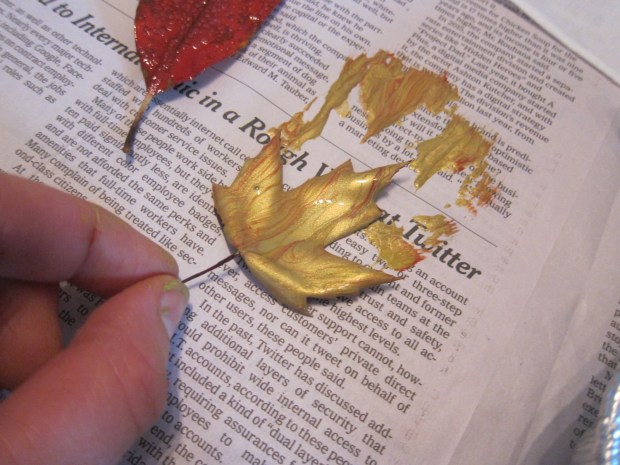
The first step (as with so many of our autumnal projects it seems!) was to bring home a few treasures from a walk in the park. Look for a variety of leaf shapes, ideally flat and still quite fresh and sturdy.

Leafy Linens (2)

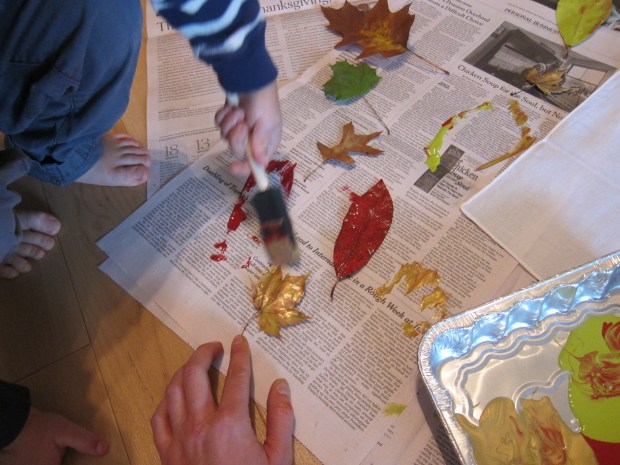
Set out the leaves, along with a foam paint brush and fabric paint – don’t use tempera paint here, since the linens will go through the wash. I gave Travis a selection of seasonable colors, such as red, green, and gold. Use neutral-colored napkins if you plan these for a holiday table. We chose to make ours onto white handkerchiefs, which will make great table centerpieces or gifts.

Paint a leaf with a foam paintbrush, ensuring you have a nice, even layer.

Leafy Linens (4)

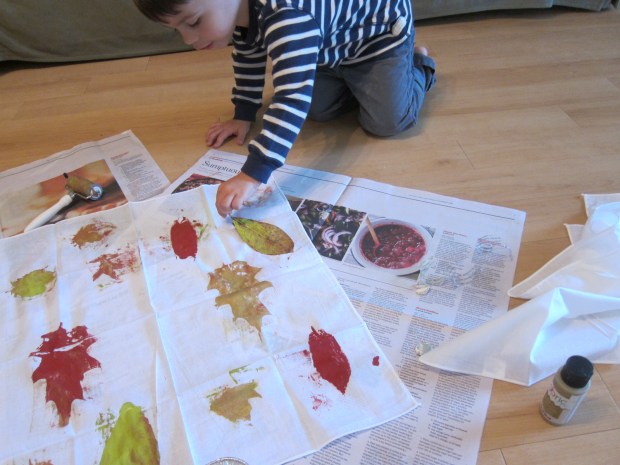
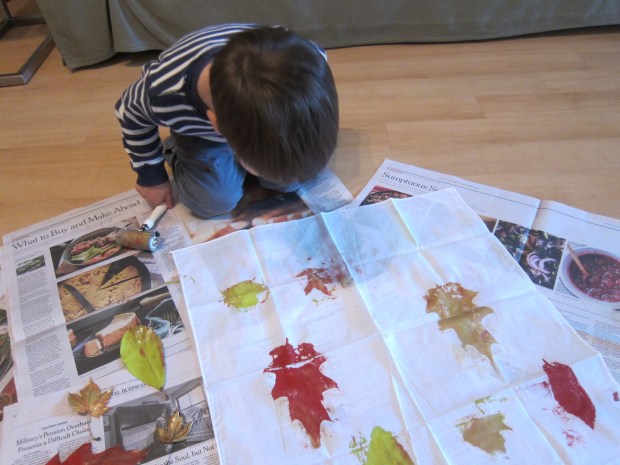
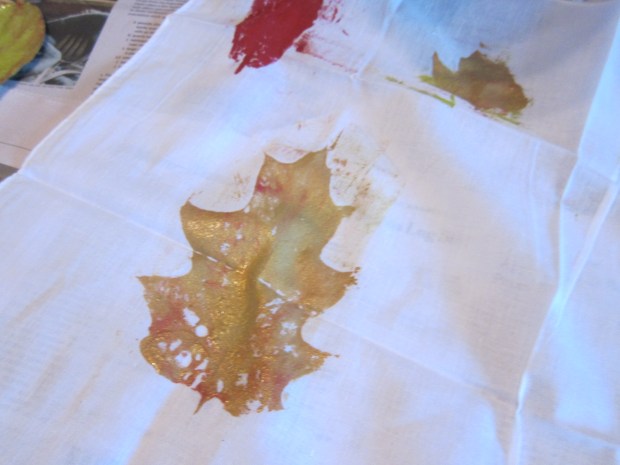
Place the leaf, paint side down, on the fabric, and roll over it with a brayer or old rolling pin. This new tool was Travis’s favorite part of the project, and he eagerly rolled over each leaf.

Leafy Linens (3)

Carefully lift up the leaf for the big reveal – neato!

Leafy Linens (8)

Repeat with different leaf shapes and colors until your fabric is filled.

Leafy Linens (7)

Towards the end, our prints got a bit messy as the brayer itself was coated in paint, so you may want to give yours a wash or two as your work. Travis didn’t mind though, and loved mixing our paint shades.

Leafy Linens (5)

We plan to give these to his preschool teachers as the holidays approach!

Leafy Linens (6)