Circle of Objects

Circle of Objects (2)

If you’re looking for a simple way to encourage your one-year-old to start using nouns and names of favorite toys, a circle of objects is a fantastic idea.

I cleared other distractions from the room and set out a few items for Veronika in a big circle, keeping the number manageable (aim for 6 to 8 things). I included: a box, stacking rings, a ball, a scarf, a toy car, a small book, and plastic cow. The idea was to have a variety, but also things that could be named with one word.

I placed her in the middle, and the choice was hers! When she trotted over to the box first, I named it. “Yes, that is a box.”

Circle of Objects (1)

She wanted to put the stacking rings inside it. More great opportunity for talk! “You found the ring. You found the green ring. Can the green ring go inside?

Circle of Objects (3)

Next the scarf caught her eye. “You found your scarf. The scarf is soft.”

Circle of Objects (4)

I draped this over a few of the items in the circle that she hadn’t made it to yet, to draw her attention. Soon she was happily uncovering and then playing with the car and small book.

Circle of Objects (5)

“The car goes fast!” I chimed in, as she spun the wheels and drove it around. This could go inside the box, too!

Circle of Objects (7)

You get the idea. Whatever it is your baby picks up from the circle, say the noun and some simple sentences to go along with it. And wait for that thrilling moment when your baby says the word back!

Circle of Objects (6)

Shape Sounds and Have a Chat

Have a Chat (3).JPG

No doubt you’ve been talking to your baby from the start. Having full conversations and exposing babies to the words and rhythm of conversation helps immensely with language development. But now there’s an exciting new development; Veronika isn’t just babbling nonsense, she’s saying real words back.

My soon-to-be one year old has 3 words officially under her belt. Her first word is “cat”.

Have a Chat (5)

She pronounces it more like “dat” but there’s no mistaking what she means; she says it whenever our cat walks by, or when she presses the cat button that meows on her musical piano, or when holding a toy cat.

Have a Chat (4)

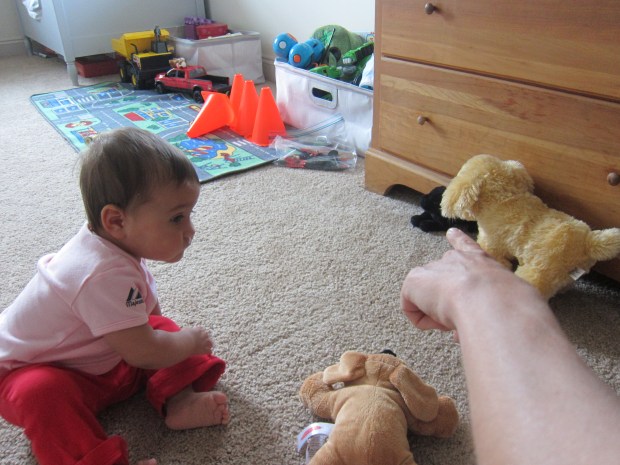
She’s also just started making a “ffff” sound when I say “woof” or she hears it on her toys. Listen for these moments, being aware of the word your baby is trying to shape or say.

Have a Chat (6)

Her second word was diaper. She started signing this word to me during diaper changes. I realized she also thinks it means having your pants off in general on the day I tried on a new pair of jeans. Seeing my pants come off, she dropped her toy and signed diaper and said “dai!” in glee. I guess mommy needed a change, to! Again, be in tune with what your baby is saying, as the words won’t quite be like yours yet. I get down at eye level and sign and say “diaper” back to her so she can practice further.

Finally, she signs “bus” and says “ba” whenever the bus brings big brother home from school. Knowing the sign for bus helps me understand that’s what she means, to differentiate from the thousands of other words that start with “ba”. But there’s no mistaking her little pull-down of the arm (like you’re pulling a bus chain for the next stop).

Have a Chat (7)

She also signed this when she saw the UPS truck in town, so we had our next chat about a new word: Truck!
Be on the alert for these signs of early language. “All done” is more of a “ahda”, but in context I can understand it.

Have a Chat (1)

I chatted with her about what she might want instead, and we settled on banana.

Have a Chat (2)

I can’t wait to see what word she learns next!

I Spot

I Spot (3)

Recently I played a fun game with Veronika just before bed flashing colors through scarves. Tonight, we put the flashlight to a different use!

Simply walk around and shine the light on various objects in your child’s room (or elsewhere in the house). For each item, say in a soft voice, “I spot a…”

I spot the light switch.

I Spot (5)

I spot a treasure box.

I Spot (1)

And so on. Sometimes, Veronika wanted to hold the flashlight and help. I spot a clock.

I Spot (2)

Sometimes she wanted to reach out and touch, and sometimes just look. I spot an apple.

I Spot (4)

This can easily become a cherished routine; if you repeat items nightly, it will reinforce the names of familiar and treasured items, and can also help lull your baby. Veronika loves it!

I Spot (6)

Roly-Poly Pictures

Roly Poly Pictures (7).JPG

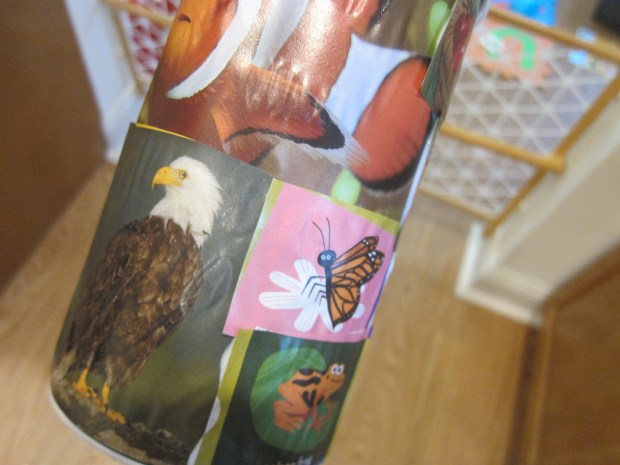
This rolling “book” is a fantastic craft to put together for your baby. It’s a toy and a book at the same time, with so many possibilities for play!

Cut out pictures from magazines that feature items your child will recognize.

Roly Poly Pictures (1)

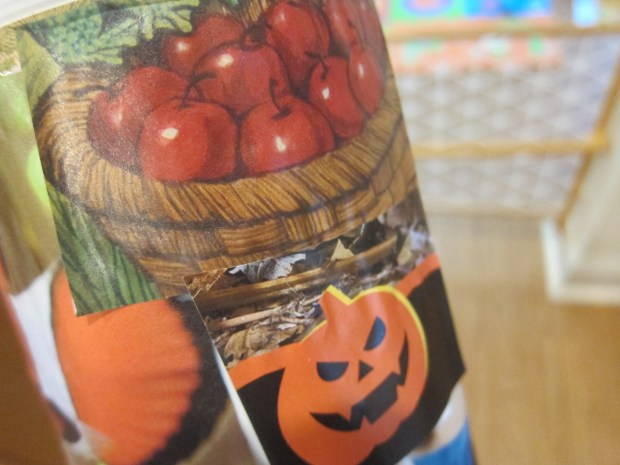
Good candidates include animals (big brother’s Ranger Rick is full of good pictuers!), foods (apples, veggies), everyday items (watches, shoes), or holiday and seasonally themed images (like pumpkins and leaves).

Veronika loved “going through” the magazines with me!

Roly Poly Pictures (2)

I glued all of the pictures around an empty oatmeal canister. Any food box that is cylindrical would work just as well. Cover with a layer of clear contact paper to ensure your little one doesn’t rip the pictures right off.

Roly Poly Pictures (3)

At first I just showed the cylinder to Veronika to see how she would interact with it.

Roly Poly Pictures (4)

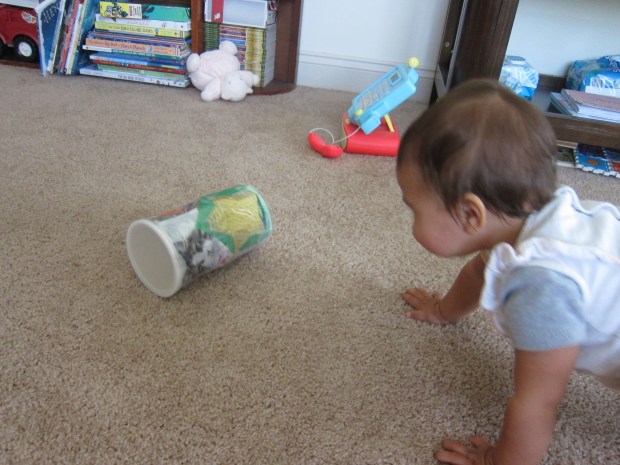
Next we played roly poly along the floor!

Roly Poly Pictures (8)

But here’s where this toy gets educational. As it came to a stop, we talked about which picture it landed on.

Roly Poly Pictures (6)

This becomes a great leaping off point to discuss colors, nouns, or little stories about the pictures. “Once upon a time there was a little cat…” The possibilities are almost endless!

Roly Poly Pictures (5)


Out and About

Out and About (2)

Instead of the usual verses of Wheels on the Bus, here’s a fun song I’ve taken to singing as I’m out and about with Veronika, to teach her about sounds that things in the world make.

First name the thing. It’s helpful to use the real word (think: dog instead of doggie), and then say the appropriate sound. You might sing:

The dog in the town goes woof woof woof

Woof woof woof

Woof woof woof.

The dog in the town goes woof woof woof

All through the town.

Repeat for every appropriate item in your day, varying the verses as needed! Here are some fun ones we found just today.

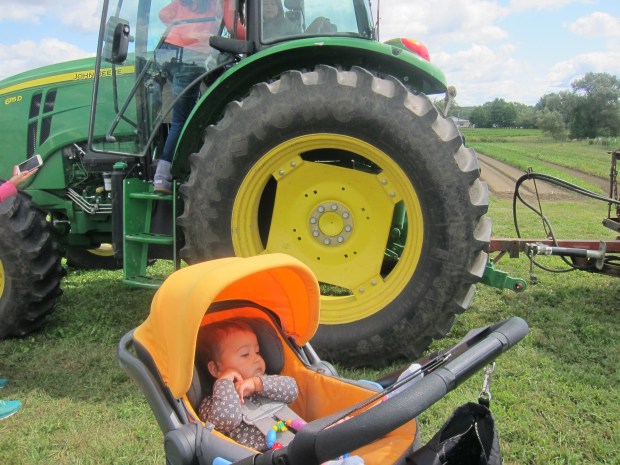
The tractors on the farm go brrrm brrrm brrrm.

Out and About (1)

The guitars at the fair go strum strum strum.

Out and About (3)

And the cars on the road go vroom vroom vroom.

Out and About (4)

There are so many verses of this you’ll probably never run out! We finished with a read-through of a fun sound book at home! Try Vroom Vroom Garbage Truck.

Out and About (6)

Fee Fi Fo Fum

Uh Oh GIant (4).JPG

Grown-ups are likely all familiar with the common syllables “fee fi fo fum” from the giant in Jack in the Beanstalk. But there’s no need to include the scary giant as you introduce this word play to your baby! The syllables echo a baby’s babble at about 10 months old, so today, I recited this classic for Veronika… with a twist.

Uh Oh GIant (1)

Sitting in front of her, I said:

Fee fi fo fum,

Here’s my fingers, here’s my thumb (open your fingers and then your thumb).

Fee fi fo fum,

Fingers gone, so is thumb (tuck fingers and then thumb away).

Uh Oh GIant (2)

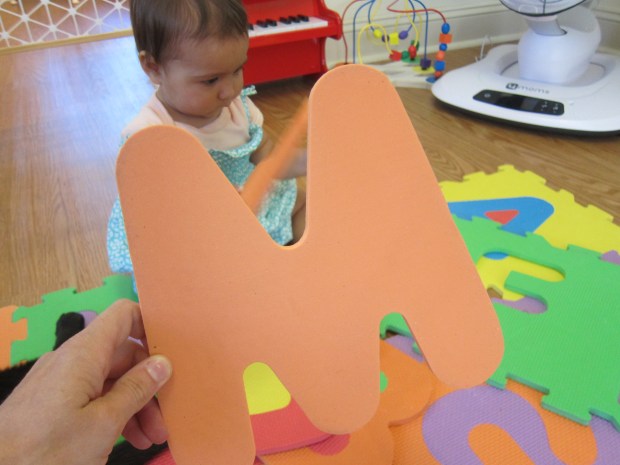
To add a little learning in, I then repeated the rhyme with a different first consonant. For each letter, I handed her the accompanying foam letter to play with – a little extra learning to absorb! So she played with a big foam B for “bee bi bo bum” and giggled over T for “tee ti to tum”,

Uh Oh GIant (4)

We also did the rhyme on “dee di do dum” and then finally on “mee mi mo mum.”

Uh Oh GIant (5)

A big hit, for little effort!

Uh Oh GIant (6)


I Spy Adjectives

Descriptive Words (5).JPG

No doubt you’re teaching your baby a lot of nouns: mommy, daddy, cats and dogs! But don’t forget about adjectives. Here’s a cute way to incorporate them into your baby’s vocabulary.

As Veronika and I went for a walk today, I made sure to mention at least one adjective for each item I named. Although you don’t need to, I find it fun to say, “I spy with my little eye…” before each one.

There were tall trees.

Descriptive Words (3)

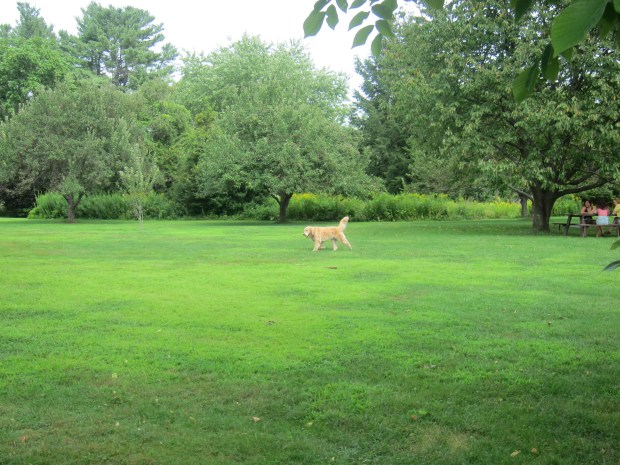
Big dogs (and some small ones we passed, too!).

Descriptive Words (4)

Cold bottles.

Descriptive Words (6)

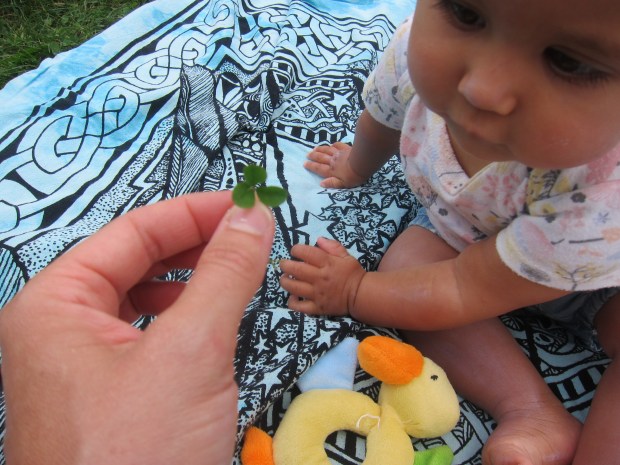
Tiny things like clovers and bugs.

Descriptive Words (7)

And so much more! You can continue the game as you drive or walk around town; fast cars are a great one, or name the colors of cars or buildings.

And certainly keep it up at home. We had mommy’s long skirt.

Descriptive Words (2)

And a big bite of food for my big girl!

Descriptive Words (1)

Consider reading a book together that same evening that focuses on adjectives, like Mouse is Small by Mary Murphy or Big Little by Leslie Patricelli.

Descriptive Words alt.jpg

What does your baby spy with his or her little eye? Please share in the comments!

Story Time with a Twist

Story with Twist (5).JPG

Story time is so important even with the littlest babies, but you may find at around eight months old that your baby is far more interested in chewing on the pages or playing with toys than paying attention to the words. This has definitely proven to be the case with Veronika, so today I made story time a bit more interactive, thanks to the help of a few stuffed animal friends!

How is it that babies amass such huge collections of stuffed animals? I’m not sure I’ve ever bought one, but through gifts, prizes, and more, we have quite a little community.

I pulled out a few and narrated a story. Veronika and her friend frog woke up and decided to go on an adventure through the forest.

Story with Twist (1)

They set off for the forest, but a big noise made them stop. They looked around and heard a growl. But it was only their friend bear, who wanted to say hello. Hello bear!

Story with Twist (2)

They kept walking and saw a stick move. It was their friend snake! Hisss, snake said.

Story with Twist (3)

I had a few more creatures meet her and frog on the journey before the story ended and everyone went home for lunch.

Story with Twist (4)

Veronika was delighted at all the colors and soft stuffies to hug, whether or not she was listening to the “story”.

Story with Twist (7)

Next, I grouped some of her stuffed animals by category. Since we have a lot of dogs, I made up few stories around this puppy “family.” First, one puppy was lost, oh no!

Story with Twist (8)

Could Veronika help mommy dog find her puppy? Hurrah, a family reunion. Next, the puppies went for rides in cars…

Story with Twist (9)

…and then we had a story about a stuffed animal parade.

Story with Twist (10)

Later in the day, we continued the fun with a “birthday party” for a few stuffed animals. I set them up with pretend food and sang the happy birthday song.

Story with Twist (11)

Veronika loved this “story”!

Story with Twist (12)

In sum, you can involve stuffed animals as actors in your baby’s story time in so many ways. What will your animals do next? Climb a hill? Go on a journey? It’s a little different than reading a book and will engage your little one’s imagination and senses.

Fun with Idioms

Idioms alt.JPG

Many Raddish lesson plans that accompany their recipes are quite involved, but this one was fairly straightforward. But it got lots of giggles and introduced my kindergartner to a new term and concept.

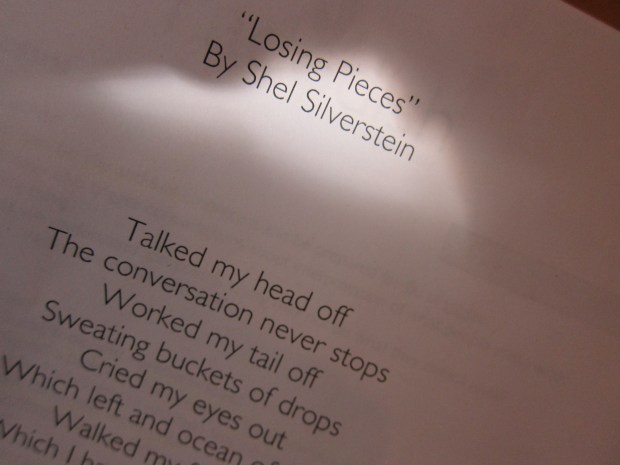
I sat Travis down and read through the silly poem “Losing Pieces” by Shel Silverstein, in which he talks about talking off his head, crying his eyes out, and singing his heart out. It concludes:

There’s really not much

left of me.

Travis giggled at the last line but I asked him what was going on here. Had the author really lost his head? Walked his feet off?

Idioms (1)

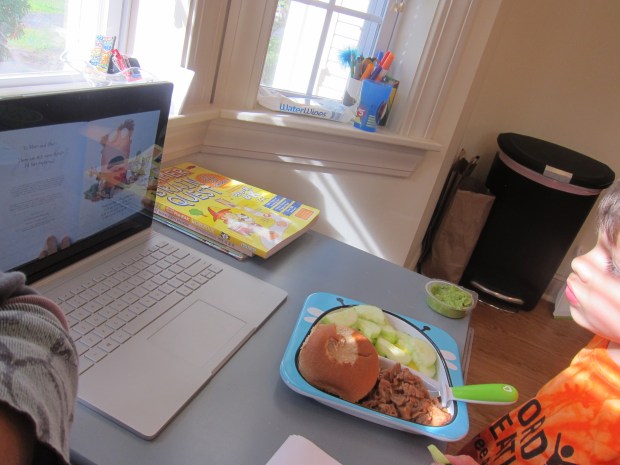
Hmm… We needed more exploration. Travis is familiar with the book Parts by Tedd Arnold, but we hadn’t known there was a More Parts sequel. I showed Travis an online read-through, again producing giggles.

Idioms (2)

Once the read-through was complete, I told Travis he’d been listening to idioms. In other words: a group of words that mean something different from what the words actually say.

Raddish also suggested a great clip with illustrations by children showing the literal meaning of an idiom (like ‘holy cow or ‘cat got your tongue’) and then a child steps in to explain what it really means.

Idioms (3)

So now it was Travis’s turn! Check out the list of idioms here if your child needs help thinking of one to illustrate. Travis laughed when we got to “chip on one’s shoulder” so we stopped there.

Idioms (4)

He drew a person and positioned a little yellow chip right on the shoulder. For fun, show your drawing to friends or family members and see if they can guess which idiom is pictured!

Idioms (5)

Increase Baby’s Vocabulary: Onomatopoeia

Increase Vocab (2)

Today I focused on a few specific words with Veronika while dressing her and folding laundry… all words having to do with the sounds that clothes can make. In other words, many of these are examples of onomatopoeia, and they’re a fun way to expand your baby’s vocab!

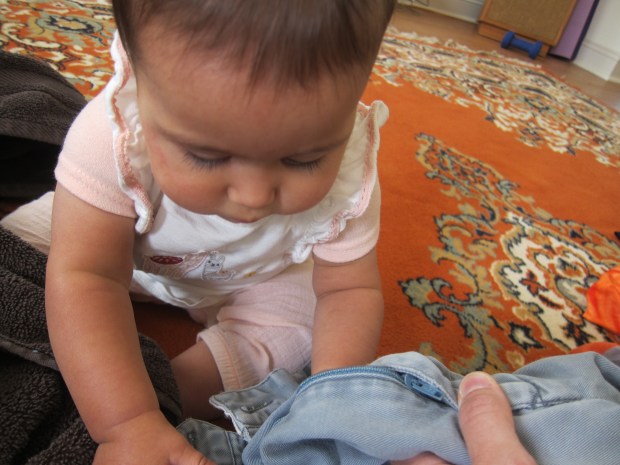
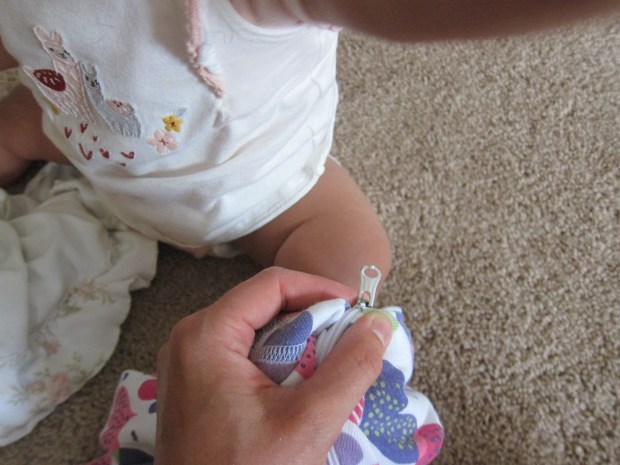
First, of course, there are zippers. I ran a few up and down for her, and said “zzzzzip!”

Increase Vocab (5)

She wanted to reach out and touch the zipper and I encouraged her to babble the zzzz sound back to me.

Increase Vocab (1)

There are lots of other fun ones to try. Each time I snapped her clothes up, I said “snap snap snap”, and then let her hear the sound close to her ear.

Increase Vocab (4)

You can do the same for anything that clicks or buttons, even though these are subtler sounds.

Increase Vocab (3)

In sum, have fun when you dress your child. It will make the mundane tasks of daily dressing or folding laundry that much more enjoyable, and turn into a little lesson to boot!