Halloween Countdown Day 8: No-Bake Pumpkin Pie

Halloween 8 No Bake Pumpkin Pie (7)

What better way to wait out the anticipation before you can carve your pumpkins… than to eat them! This pie should successfully tide everybody over until jack o’ lantern time. Bonus points: the recipe is easy enough that even my two-year-old can help!

First, combine 1/2 cup non-dairy milk and 1 packet instant vanilla pudding mix in a container with a lid. Seal and shake. Fun!

Halloween 8 No Bake Pumpkin Pie (1)

Pour the pudding mixture into a large bowl. Stir in 1 cup canned pumpkin pie filling. Fold in half a container of non-dairy whipped topping (such as So Delicious Coco Whip).

Halloween 8 No Bake Pumpkin Pie (3)

Spoon the mixture into a prepared graham cracker crust (such as Mi-Del), then spread the remaining whipped topping on top. Veronika was eager to hold the spatula and help smooth out the top!

Halloween 8 No Bake Pumpkin Pie (4)

But mostly, she wanted to taste-test every step of the way. She earns an A plus for making sure every step of the recipe was delicious.

Halloween 8 No Bake Pumpkin Pie (2)

Pop the pie in the freezer for at least 2 hours and voila, a pie that never needs to bake.

Halloween 8 No Bake Pumpkin Pie (6)

Your kids might think it’s Halloween magic!

Halloween 8 No Bake Pumpkin Pie (9)

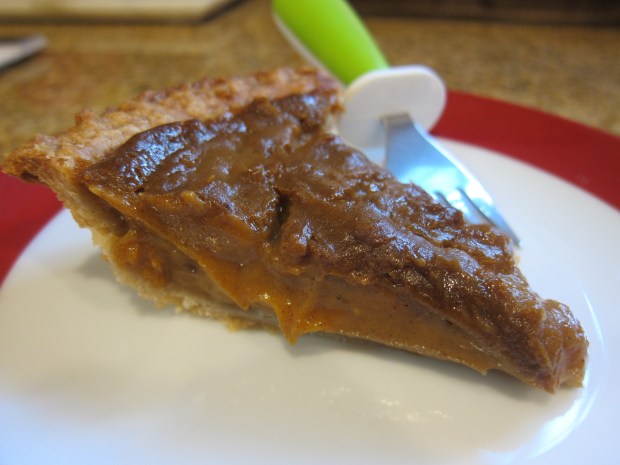
Sweet Potato Pie

Sweet Potato Pie (3)Having sneaked carrots into cookies, I wanted to show Travis a few more recipes featuring veggies-for-dessert. First up was this sweet potato pie that was – literally! – as easy as pie since it relied on a store-bought crust.

Ingredients:

  • 1 (15-ounce) can sweet potato puree
  • 1 cup plain almond milk
  • 3/4 cup date sugar
  • 2 tablespoons cornstarch
  • 1 teaspoon vanilla extract
  • 1 teaspoon cinnamon
  • 1/4 teaspoon nutmeg
  • 1/4 teaspoon ginger
  • 1 (9-inch) pie crust
  1. Whisk the first eight ingredients together in a large bowl. Pour into the pie shell of your choice, whether homemade or store-bought.
  2. Bake at 375 degrees F for 65 minutes. Cover the top with foil near the end, if needed, if the filling gets too dark.
  3. Cool completely before serving.

Sweet Potato Pie (1)

Pie Crust Science

Pie Crust Science (2)

The lesson plan that went with Travis’s recent Apple Crumb Pie recipe delved deeper into what makes a pie crust so yummy. This was a hard one to tailor for Travis’s age, so here’s just an abbreviated version.

Start off with a read of Enemy Pie by Derek Munson, which you can find at your library or watch a full read-through online. This interesting story will whet the appetite, if you will, for pie!

Pie Crust Science (1)

Travis enjoyed watching, and afterwards we talked about what role pie had played in the story. We talked about pies we’ve made, and specifically about the components that had gone into our recent crust. I helped him remember that we had used:

  • flour
  • sugar
  • salt
  • Earth Balance butter
  • water

You can go through the reasons for each ingredient, as well as definitions for tenderness and flakiness, the two things that people look for in a “successful” crust. Another quick video clip helped Travis understand the idea better.

Raddishthen suggests letting kids become food scientists, making two different pie crusts but only changing one variable. I knew though that Travis would lose interest in taking time to bake two crusts, plus I worried two full pies would go to waste! The idea of independent and dependent variables was also a bit advanced for a kindergartner.

So instead, we baked a store-bought pie shell from our freezer that differed from our homemade crust in one significant way: palm oil as the fat instead of our Earth Balance butter. I had him do a side-by-side taste test of the crusts, both of which he declared delicious.

Pie Crust Science (5).JPG

Older kids can be much more scientific about this. Consider varying the type of flour used, the tool used for mixing, and more. Chart independent and dependent variables along a graph if your kids are old enough for that kind of math. Invite friends over for a complete taste test, if you have the time!

Pie Crust Science (4)

So this was a brief lesson for my little one, but there is lots more to explain here if desired.

Proportional Pie

Proportion Pie (6)

Much like the magnetic hearts that Travis and I crafted today, this project is a fun way to teach kids about symmetry… With the added bonus that it’s edible!

Unlike linear symmetry, this project shows circular symmetry. You can point out to your child things in nature that show symmetry in a circle like this, including starfish and spider webs.

For the ready-to-eat equivalent, bake a pre-made pie shell according to package directions and let cool. (Note: A convenient vegan go-to is Wholly Wholesome).

Spoon a thick layer of non-dairy yogurt into the pie.

Proportion Pie (1)

Set out plates of berries or other fruits for your child to use as decoration and score the top of the yogurt so the pie is divided into 4 equal portions.

Proportion Pie (2)

(Note: Bigger kids might want to do this with six portions, but four seemed easier for my kindergartner to handle).

I placed a strawberry in one quarter of the pie. How many strawberries should each of the other three sections receive? Travis quickly added 1 strawberry to each.

Proportion Pie (3)

Next I placed two blueberries in one section. At first he placed his blueberries any which way, but I showed him how to place them not just in the right quadrant, but also the same place.

Proportion Pie (7)

“Is it ready to eat?” he wanted to know. Almost!


Proportion Pie (4)

We added just a few more blueberry and strawberry decorations to help him see the symmetry, and then it was time to scoop into the pie. What delicious fun!