Froot Loop St. Patrick’s Day Fun

Froot Loop St Pats (11)

If ever there’s a day for rainbow cereal fun, St. Patrick’s Day is it. Here are a few ways we incorporated Froot Loops into the day to mark the holiday.

To start, surprise your kids in the morning by pretending a “leprechaun” visitor left behind a rainbow. I threaded Froot Loops in rainbow order onto a pipe cleaner, then inserted the ends into two “pots of gold” (vegan mini muffins), following a tip from Painted Confetti.

Froot Loop St Pats (1)

Since Froot Loops aren’t vegan, I told the kids this was magical leprechaun food for decoration, not eating. Travis was too busy to care, since he was so busy peeking inside a homemade leprechaun trap to see if it was caught inside. Looks like the little fellow got away!

Froot Loop St Pats (2)

Later in the day, Veronika and I used extra Froot Loops for a pretty rainbow craft. I drew the arcs of a rainbow with marker, and then dumped some of the cereal onto a tray. (Since it would be unfair to allow no snacking during a craft like this, I gave her a bowl of vegan cereal on the side for munching!).

Froot Loop St Pats (5)

Working with one color at a time, we made a line of glue dots along that rainbow arc and found the right color cereal in the tray.

Froot Loop St Pats (7)

Veronika stuck with it for a few pieces in each color, and I filled in the gaps. Preschoolers can try to tackle the full rainbow by themselves.

Froot Loop St Pats (8)

Cotton ball clouds were the final touch!

Froot Loop St Pats (10)

I loved the touch of magic that these projects gave to our holiday, leaving the impression that the leprechaun had really been there. If you truly want to wow your kids this St. Patrick’s Day, here’s one final shenanigan: Sneak downstairs before everyone else is awake and add a little green food coloring to the toilet bowl. Travis couldn’t believe this final bit of leprechaun evidence!

Froot Loop St Pats (3)

DIY Rainbow Salt Tray

DIY Rainbow Salt (3)

This colored salt activity looks beautiful, is great for sensory play, and is guaranteed to keep your toddler busy.

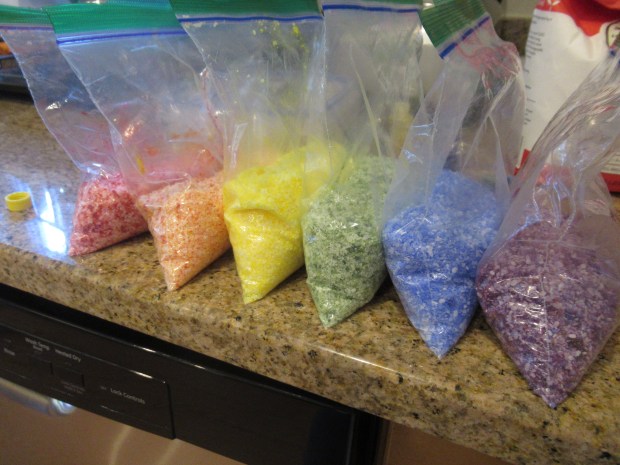
Preparation is remarkably easy. For the best result, you want to use large salt crystals, rather than regular table salt. I used kosher salt, but rock salt would have been even better! I poured a little salt into each of 6 zip-top plastic bags, then added food coloring to each, mixing two colors where needed to result in a full rainbow. Seal the bags and shake to combine. Your toddler might want to help with this part!

DIY Rainbow Salt (1)

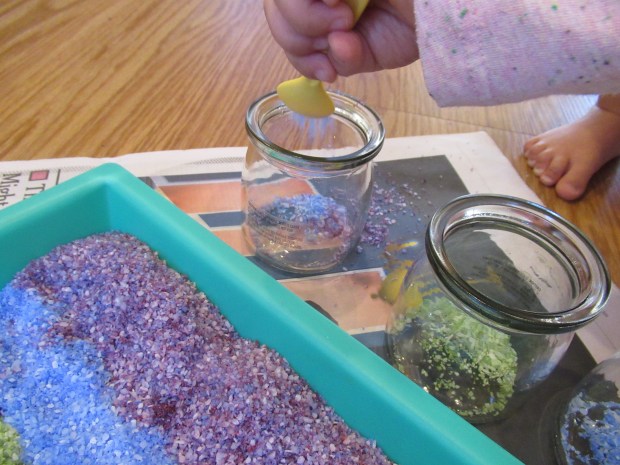
I then arranged the salts in rainbow rows on a craft tray. In remarkably short time (only about 30 minutes), the color on the salt had dried and was ready for play.

DIY Rainbow Salt (2)

I had no agenda for Veronika other than to enjoy! I set out small glass jars and she immediately was spooning salt into them. She loved seeing or choosing what color was on her spoon…

DIY Rainbow Salt (5)

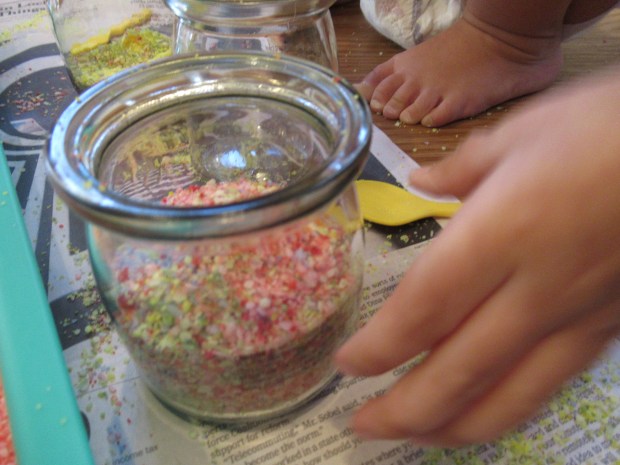
…as well as observing the mix of colors that resulted in the jars.

DIY Rainbow Salt (8)

Then she started pouring from one jar to another instead of using spoons, great for her fine motor skills and her concentration!

DIY Rainbow Salt (9)

I think she was busy making potions.

DIY Rainbow Salt (7)

She did sometimes spoon or stir through the salt on the tray, but the jars were the main draw today.

DIY Rainbow Salt (10)

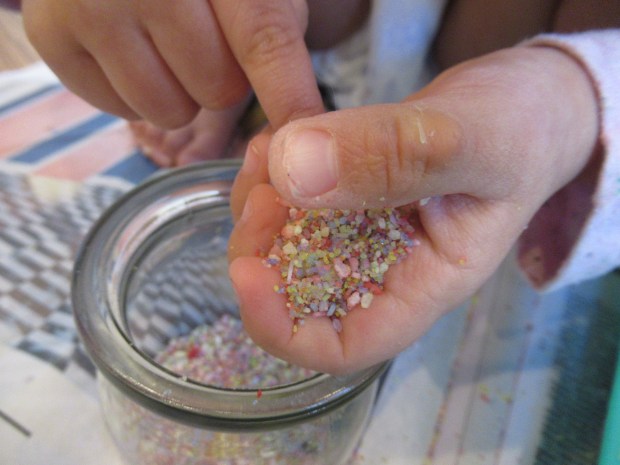
How long did Veronika play solo? Let’s just say I had time to finish the Sunday puzzle page. When she started picking up handfuls of it to scatter on the floor, we called it quits for clean-up!

DIY Rainbow Salt (11)

Primary Color Rainbow Suncatcher

Rainbow Suncatcher Primary Color (8)

St. Patrick’s Day gets us thinking about all things rainbows and pots of gold. Here’s a neat way to show a toddler how to make a full rainbow… just from the three primary colors!

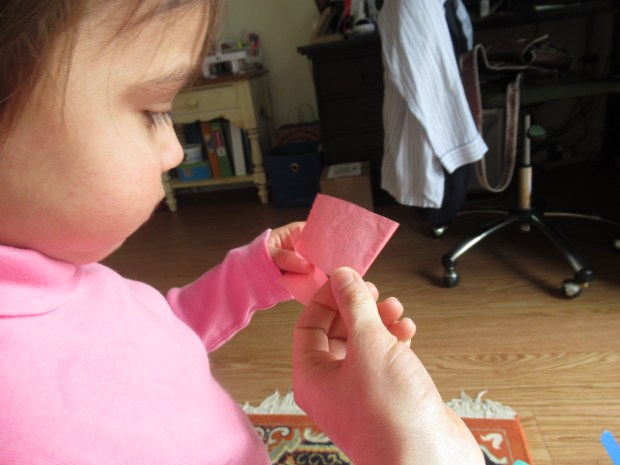
To start, I cut an arc from contact paper and taped it down to the floor. I then cut lots of tissue paper squares in red, yellow, and blue. I had these mixed in our craft tray which I soon worried was a mistake, instead of sorting them. But the big messy mix turned out to be half the fun!

Rainbow Suncatcher Primary Color (1)

To make the rainbow, you’ll need to work deliberately row by row. An outer row of red is followed by an overlapping yellow (to make orange), then plain yellow. Next overlap blue (to make green), then add a row of plain blue. Finally, overlap a little more red and you’ll get a bottom row of purple.

Rainbow Suncatcher Primary Color (3)

Veronika wasn’t old enough to understand that the colors needed to stay in their proper rows, but I soon realized the benefit of having mixed all the colors in the tray; she was the perfect helper to find me each right color. “Now let’s find only red squares!” I told her, and she happily dug through the tray.

Rainbow Suncatcher Primary Color (2)

Then she discovered how fun it was to make the tissue paper rain down as I finished up the rainbow.

Rainbow Suncatcher Primary Color (5)

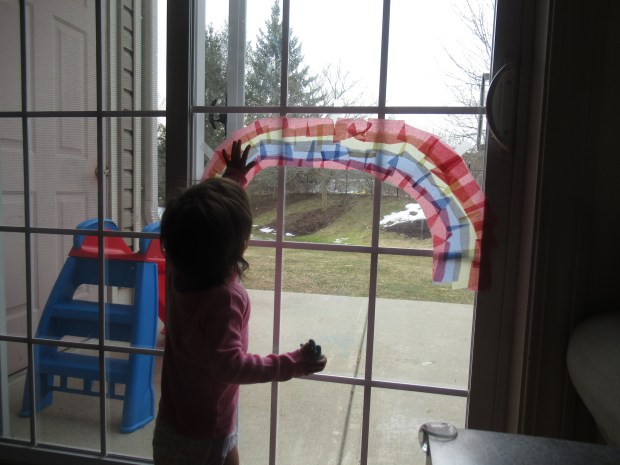
The real engagement with the craft began for her once the suncatcher was taped to the window. Of course there’s the obvious element that now it sparkled and shone…

Rainbow Suncatcher Primary Color alt

…but now the full rainbow magically appeared as well. Where red and yellow overlapped, there was orange; yellow and blue made green, and blue and red made purple. We sang rainbow songs and Veronika loved following the arc of it with her fingers.

Rainbow Suncatcher Primary Color (7)

Next she pretended her favorite toy was sliding up and down it! We’re going to keep this beautiful rainbow suncatcher in the window to cheerfully greet the spring.

Rainbow Suncatcher Primary Color (9)

Make a Rainbow

Make a Rainbow (2)

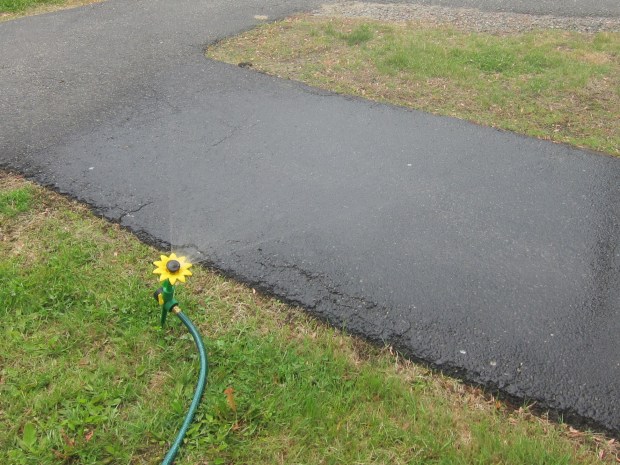
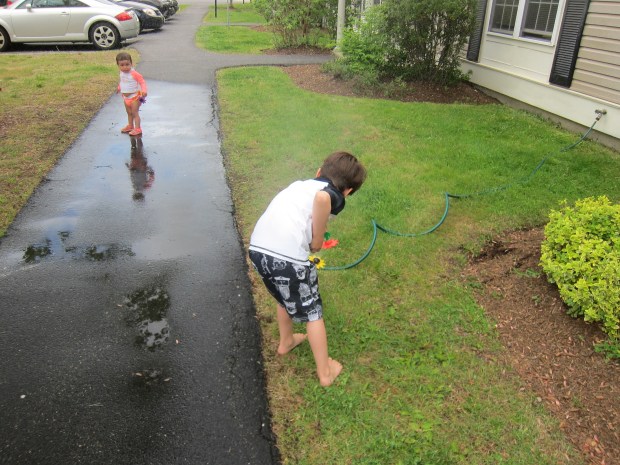
All you need for this little science trick is a hose and a sunny day. We’ve had early hot weather that made us pull out the sprinkler, but it’s also been overcast. Luckily this afternoon the sun poked through!

I set up a sprinkler with flower attachments that spray a fine mist. The mist will make it more likely to spot a rainbow, so if you don’t have any sort of hose attachment, you’ll need to use your thumb to change the flow of water.

Make a Rainbow (1)

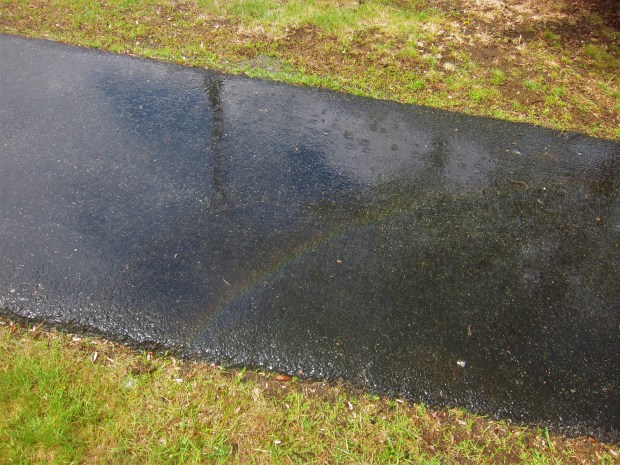
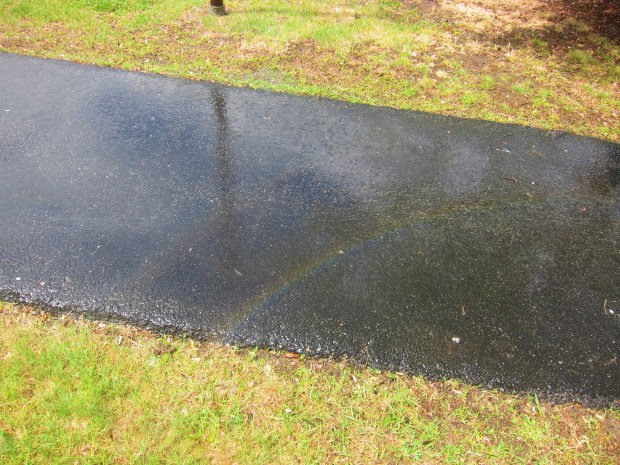
Now aim in the direction of your shadow. A rainbow will appear! This was magical for my toddler, and of course scientific for a my kindergartner. Travis understood that the water was bending the light from the sun and breaking it apart into the full spectrum of colors in a rainbow.

Make a Rainbow (3)

Then just have fun in the sprinkler of course!

sprinkler ($)


Spectroscope

Spectroscope (5).JPG

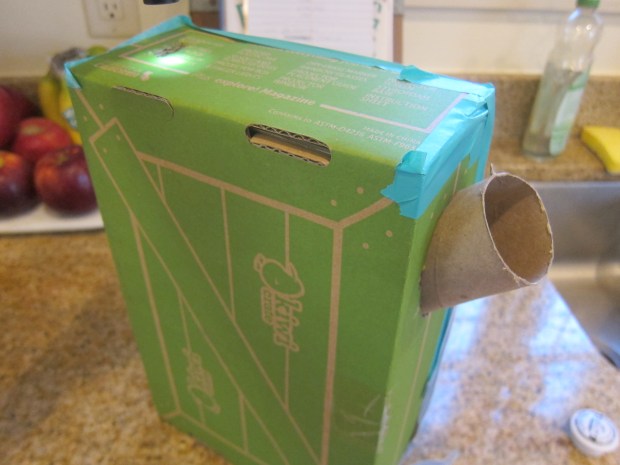
This quick project was a neat follow up to Travis’s exploration with his Rainbow Optics Crate. And to make it, we even got to upcycle the box from Kiwi Co.!

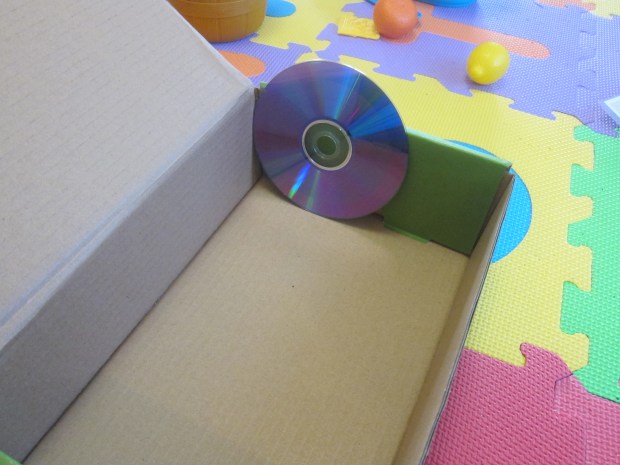
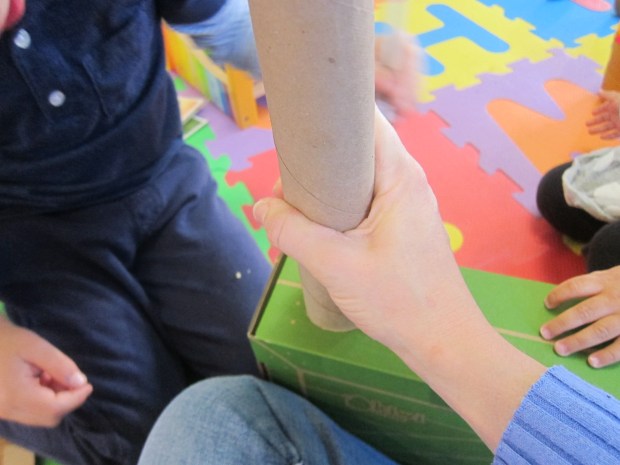
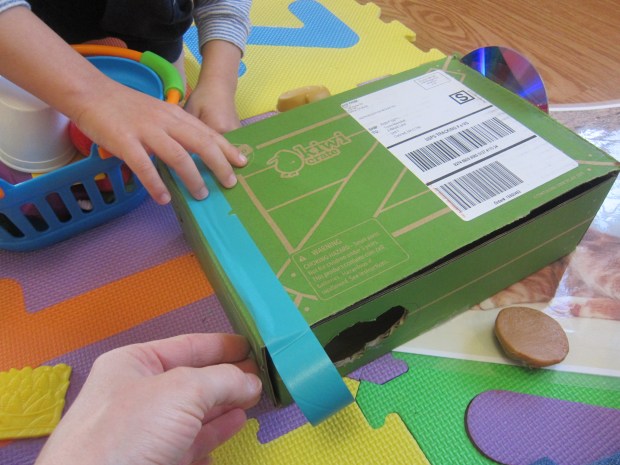
Cut any extra flaps from the box, including those that fold in to the sides and front. Tape a blank CD to the inside of one short end, flush against the back wall. Make sure your box can close!

Spectroscope (1)

Trace around the end of a paper towel tube twice, in overlapping circles, so you have an opening that’s about 1 and 1/2 times as wide as the tube. Insert the tube at an angle, looking towards the CD.

Spectroscope (2)

Also cut a slit on the short edge directly opposite the CD, to let in light. Tape up any other edges where light might slip in.

Spectroscope (3)

Now take a peak inside! We found this worked best when we shined a flashlight directly into our slit. One person can shine the light while the other person makes sure the tube is aimed properly at the CD; you’ll see the spectrum of the rainbow appear.

Spectroscope (4)

You can also try this with other light sources, including sunlight, and see which one works best!

Rainbow Optics Kiwi Crate

Kiwi Rainbow (4).JPG

On the heels of playing with mirrors and illusions, Travis got to delve further into the science of light with Kiwi’s Rainbow Optics crate. Most of the projects involved mixing or pulling apart colors, to explain the way white light bends to form a rainbow.

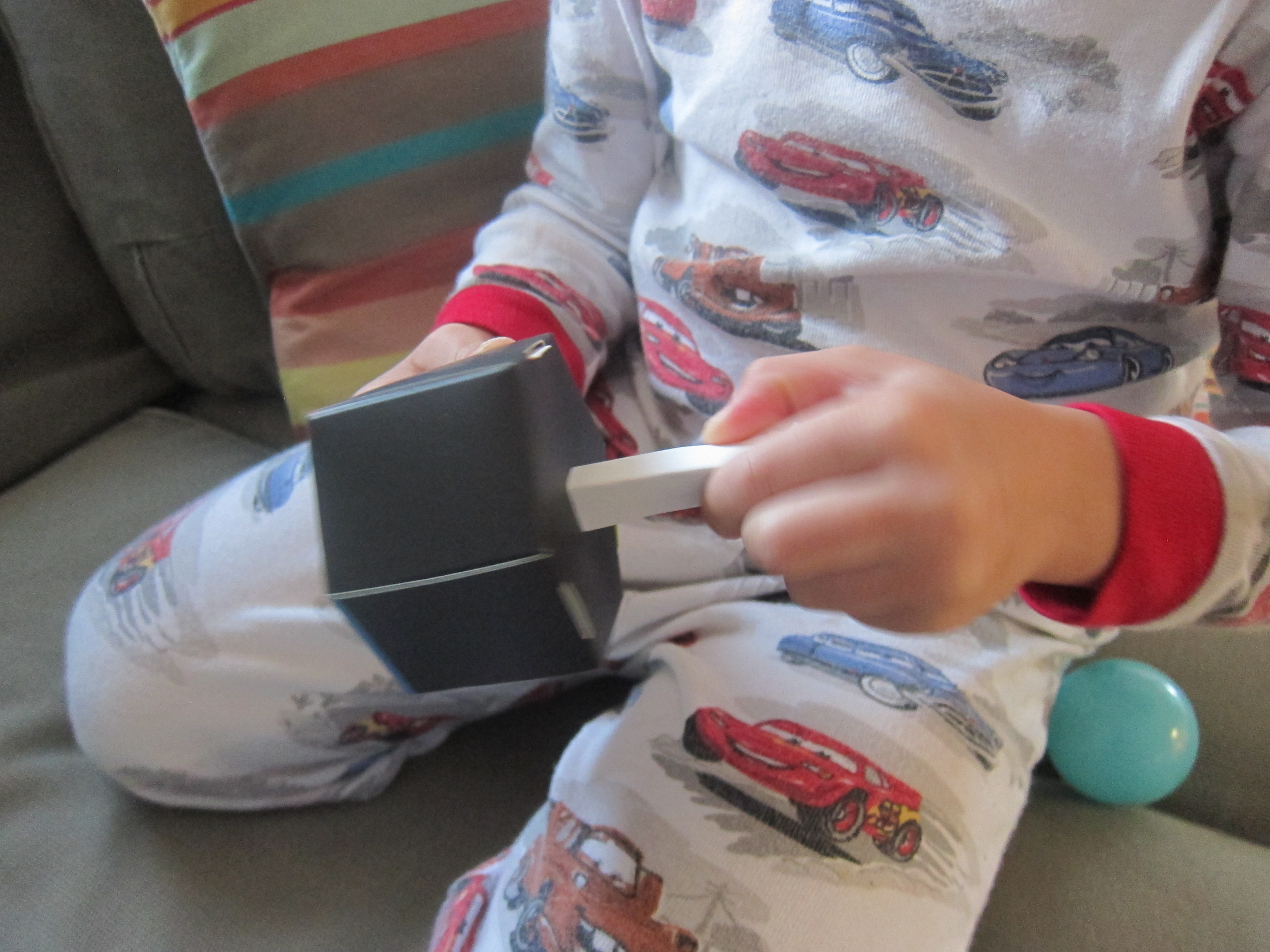
The first project was Mixing Colored Light. Travis helped adhere a wooden hexagon onto the provided box lid, fold up cardboard into a triangle as a support piece, and insert a provided color guide into the base of the hexagon box.
Kiwi Rainbow (1)

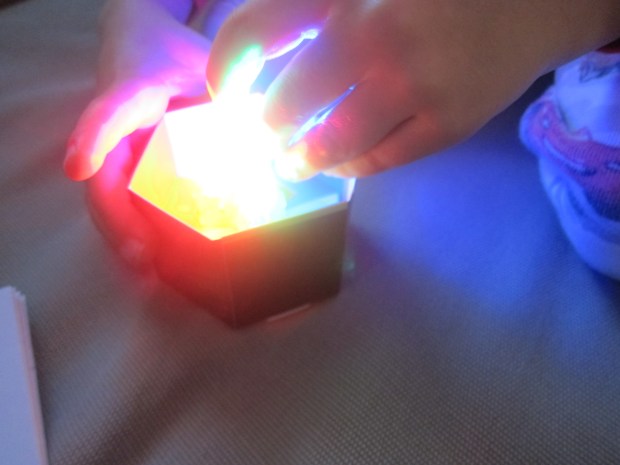
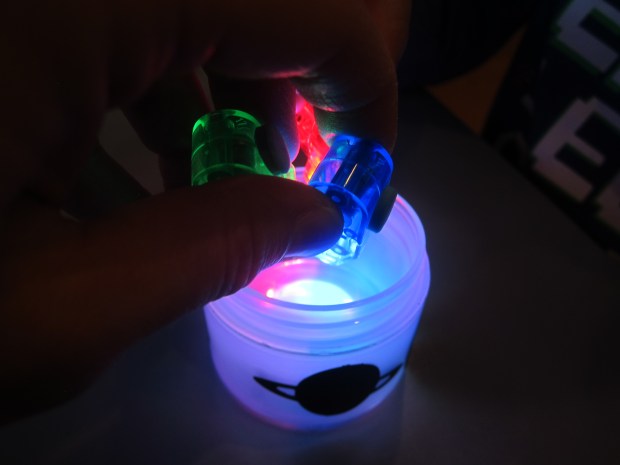
Three neat finger lights (one each in red, green, and blue) then slip into this insert. Travis loved turning these on!
Kiwi Rainbow (2)

Decorate the provided frosted plastic jar with stickers; options include everything from moons and planets to sea creatures. Place an additional black sticker on the bottom of the jar. This has a hole in just one area… And Travis was about to see why!

Place the frosted jar on top of the hexagon box and spin it slowly. Because the bottom sticker only allows one or two lights through at a time, the colors change with each spin, from red, to magenta, to blue, to cyan, to green, to yellow.

Kiwi Rainbow (3)

Travis loved spinning this, and pretending it was a forge in later make-believe games.

Next up was Projecting Colorful Shadows. Again there were lots of little steps, including adhering the Styrofoam base to a paper guide with sticky Velcro dots.

Kiwi Rainbow (5)

Kids can write on the provided projector window screen, which is then Velcroed onto a projector box.

Kiwi Rainbow (6)

Stretch a projector screen onto the other side of the box and secure with blue stickers.

Kiwi Rainbow (7)

Now it was time to set up the projector box on the paper base, and add another set of those fun finger lights to the Styrofoam block. As you shine these, each light hits the drawing at a slightly different angle, casting shadows in multiple colors.

Kiwi Rainbow (8)

We took the booklet’s suggestion to hold other objects between the lights and our projector screen. Our fingers had definite wow factor!

Kiwi Rainbow (10)

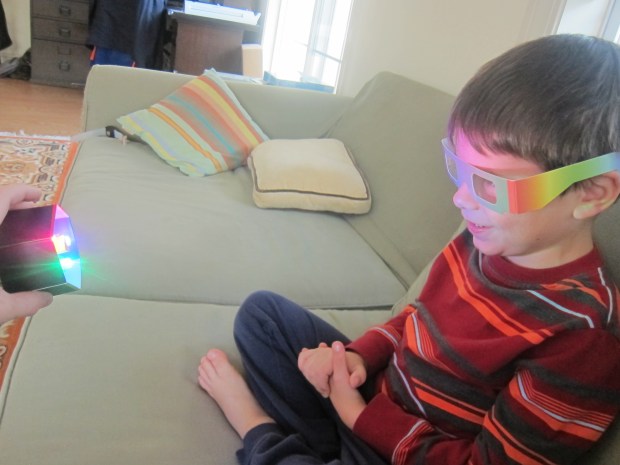
Finally, the kit included Rainbow Glasses, the kind you might remember from childhood! This involved no assembly, just looking around at different light sources.
Kiwi Rainbow (11)

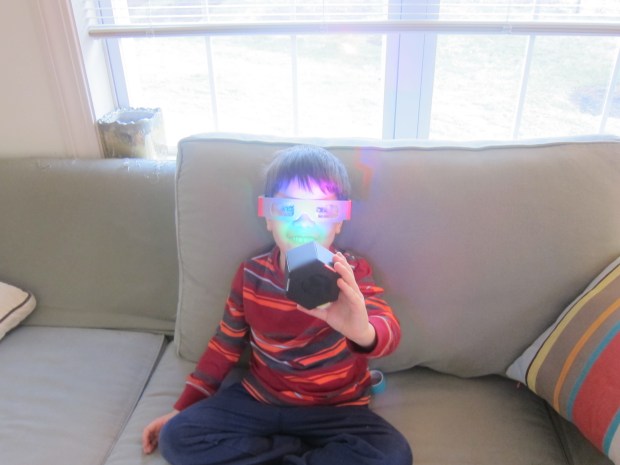
The finger lights, in particular, were fun to look at. Travis wandered all over the house to find his favorite lights, and the booklet helpfully explained how the glasses work through diffraction plastic.
Kiwi Rainbow (12)

Well now we needed to experiment further! We could test out making a rainbow on white paper with a few simple materials: Attach a mirror to a glass pan half filled with water, using modeling clay to attach. Shine a flashlight on the paper mirror where it is under the water. Hold up a piece of white paper, and watch your rainbow appear!

Kiwi Rainbow (22)

It was tricky to get the angle just right, but I was able to hold things steady while Travis manned the camera!

Kiwi Rainbow (23)

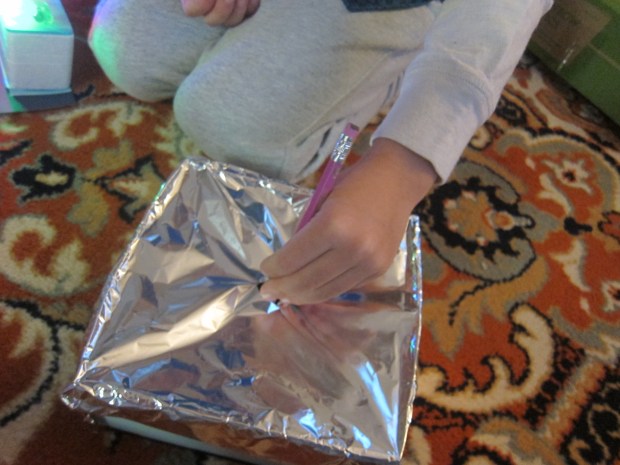
We also tried to overlap colors with a twist on the projector box project. Remove the projector paper, and instead add a sheet of aluminum foil. Poke a quarter-sized hole in the center with a pencil.
Kiwi Rainbow (16)

Shine the finger lights through, and watch for overlapping shades (i.e. red and blue should make magenta). The results of this weren’t obvious to Travis, but it was a neat variation.

Kiwi Rainbow (17)

Interestingly, you can also show how red + blue paint = purple paint, but red + blue light = magenta light.

Kiwi Rainbow (20)

Why? Because the paint colors combine towards black, but the light colors combine to towards white. Neat!
Kiwi Rainbow (21).JPG

We finished with a read of two suggested books: All the Colors of the Rainbow by Allan Fowler and The Rainbow Goblins, by Ul De Rico.

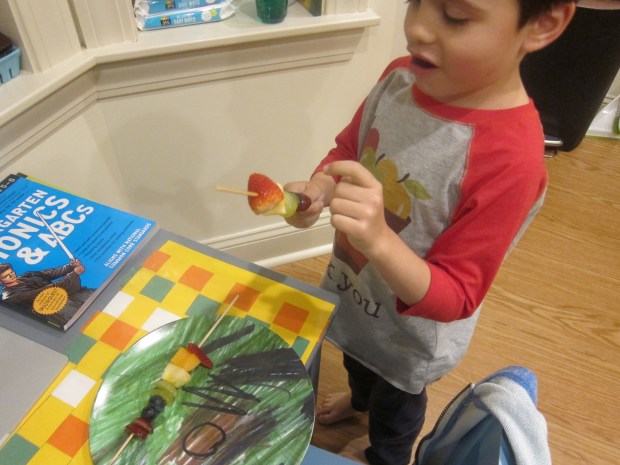
All this rainbow talk had us hungry! So finish your fun with rainbow kabobs made of the following:

  • red strawberries
  • orange cantaloupe
  • yellow pineapple
  • green grapes
  • blue blueberries
  • purple grapes

Rainbow Kebabs (1).JPG

Travis reminded me we really needed indigo grapes. Yes indeed, but tasty nonetheless!
Rainbow Kebabs (2)


Rainbow Science

Make a Rainbow (8).JPG

With all the talk about rainbows this month, whether cooking or crafting, it was time to get scientific. What exactly makes a rainbow appear? Today Travis and I answered the question in two ways, one more scientific, and one more artsy!
First, following the lesson plan provided by Raddish Kids, we did a visualization exercise. This was a first for Travis, but with a few prompts he got the idea. I told him to close his eyes and imagine and rainbow. He said he could see his rainbow through the trees in the morning, and it was star-shaped! Guide your child through this: what does the air feel like? Where is the rainbow? What time of day is it?

Next we did the quick run-down on the science. Raddish Kids provided two great video links to add some visual fun to hte science.

Make a Rainbow (1).JPG

We watched a few suggested video clips, to understand the science behind refraction. Raddish provides a very detailed write-up that older children can study, too.

Make a Rainbow (2)

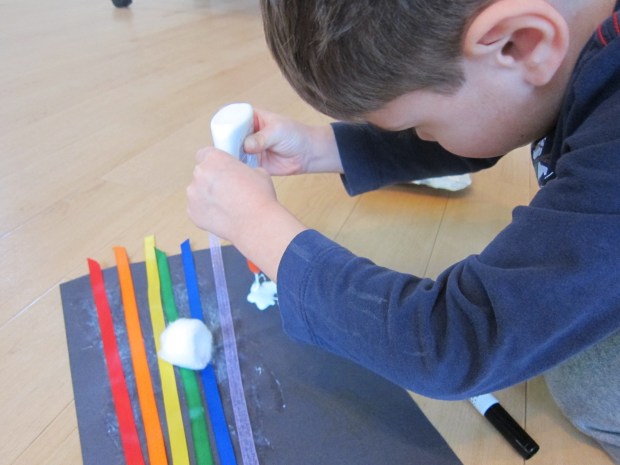
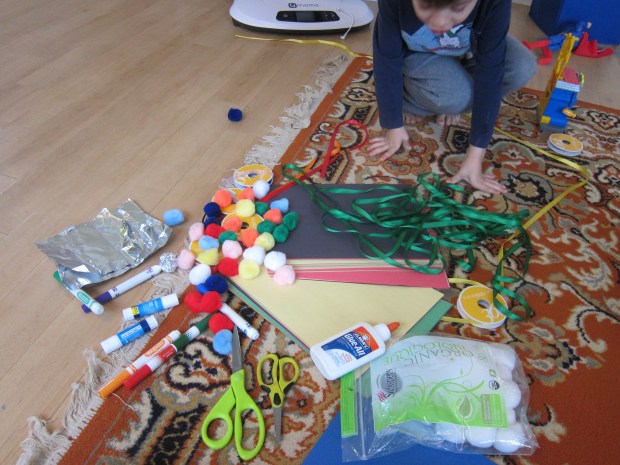
Next up was a challenge: Could Travis make a visual of a rainbow that not only showed all the colors, but also showed how the rainbow is formed? It turns out this is called process art, and I laid down lots of material for Travis to choose from but provided little direction beyond that.

Make a Rainbow (3)

He decided he wanted a ribbon rainbow, so used lots of glue to adhere the lengths.

Make a Rainbow (4)

I was so proud when he realized he was gluing in the wrong order, and fixed things with his red placed first!

Make a Rainbow (5)

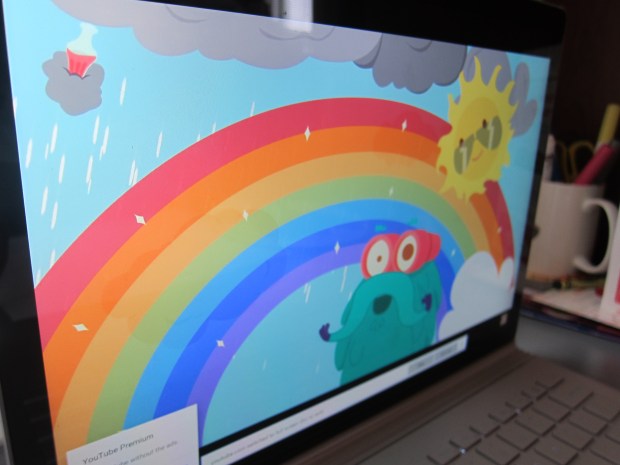
Next he needed to add the science part. He chose to use marker for sun and rain drops, and cotton balls for clouds. Now he had all the ingredients necessary for a rainbow to form!

Make a Rainbow (7)

I made a second version alongside him to show him how open-ended this project is: cotton ball clouds, tin foil raindrops, and pom poms for my sun and rainbow.

Make a Rainbow (6)

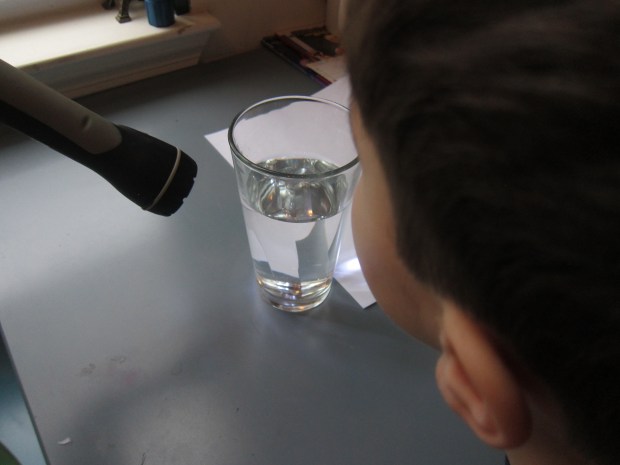
Finally, we formed a rainbow with science! Place a prism in a glass of water. Shine a flashlight or other light source on it.

Make a Rainbow (9)

Hold up a piece of white paper behind the glass, and you should see a rainbow reflected on the paper. It’s a bit tough to see in the photograph, but it was there!

Make a Rainbow (10)


Ribbon Dancer

Rainbow Dancer (4)

April showers bring May flowers, or so they say! Which means we’re having a rainy month and we’re on the lookout for rainbows these days. This easy craft is a cute way to bring a little color and rainbows inside, even when the days are cloudy and gray.

Rainbow Dancer (1)

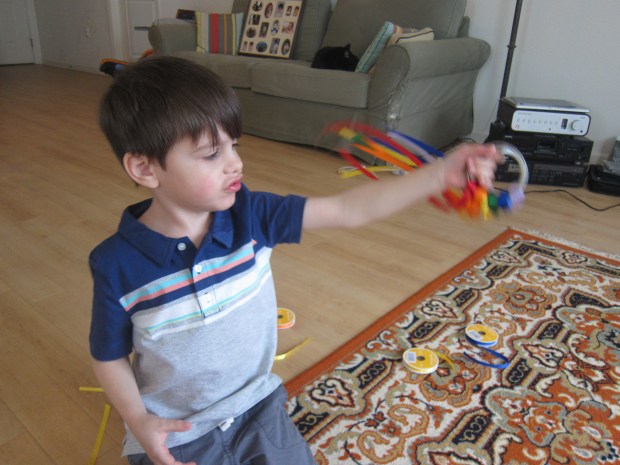
First, we measured out a length of red ribbon that was as tall as Travis – he thought it was neat to see a piece so long!

Rainbow Dancer (2)

Once we had our red, we could measure out the other colors of the rainbow against it. This is a good chance to review ROYGBIV order for preschoolers. Travis used scissors to cut each to the right length.

Now fold one ribbon in half, and loop through the ring of a canning jar. Pull the ends of the ribbon through the loop.

Rainbow Dancer (3)

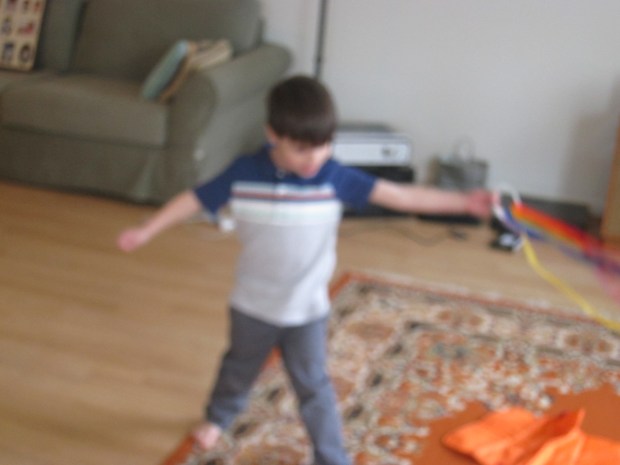
Pretty soon we had our rainbow strings for dancing!

Rainbow Dancer (5)

Put on some good music and just jive.

Rainbow Dancer (6)Or perhaps do a raindance.

Rainbow Dancer (7)

If you’re lucky and it’s beautiful outside, this little rainbow looks even prettier out in the sunshine!

Rainbow Sugar Cookies

Rainbow Cookies (8).JPG

Kids are all too often over-scheduled these days, and I’m as guilty of it as the next parent. That’s why I love the afternoons that I deliberately keep wide open for my son and me. It’s the perfect excuse just to play or, one of our favorites, to bake! This cooking project is messy, that’s for sure, but so worth the smiles.

To start, we made a basic sugar cookie batter. In a bowl, cream together 2 sticks (1/2 pound) Earth Balance butter and 1 cup sugar using a wooden spoon or fork. Travis loved this step! Usually we use our stand mixer, and it was so fun to get in there with muscle power.

Rainbow Cookies (2)

Add 2 Ener-G eggs and 2 teaspoons vanilla extract, stirring until combined.

Carefully stir in 2 and 1/2 cups flour just until blended. Travis pretended he was a stand mixer on “slow” setting for this step. Loved it!

Rainbow Cookies (3)

Now for the messy part. Divide your dough into about 4 or 5 portions on a floured surface. Working with one portion at a time, knead in colors of the rainbow. We didn’t make a full rainbow, but soon had red, yellow, green, and blue portions, using the all-natural food coloring from Watkins.

Rainbow Cookies (4)

You’ll notice Travis took a moment to steal some leftover batter!

Rainbow Cookies (5)

Wrap each portion of dough individually in plastic wrap and place in the fridge for at least 1 hour (longer is fine).

Rainbow Cookies (6)

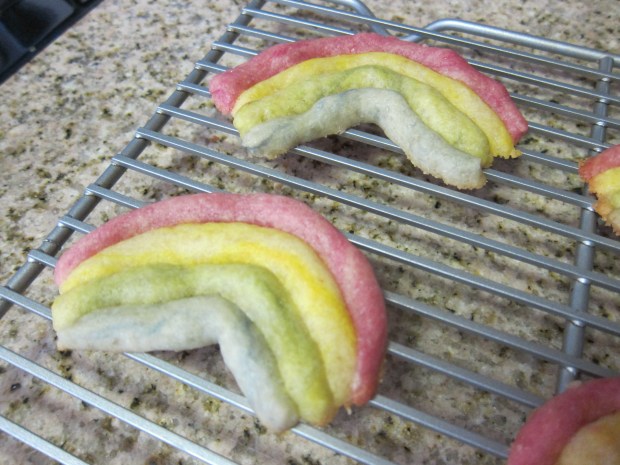
When it’s time to bake, coat a baking sheet with cooking spray. Pinch off a section of each color and roll into a long worm, then make rainbows on the baking sheet.

Rainbow Cookies (7)

Bake at 375 degrees F for 7 minutes. Transfer the cookies to a wire rack and repeat with the remaining dough until gone. (Note: we made two batches today, and the dough easily freezes for future rainbow-making).

Rainbow Cookies (9)

Rainbow Kebabs

Rainbow Kebabs (3)

As fun as it is to draw the rainbow or craft with the rainbow, it’s even more fun to eat it! Make these simple kebabs for a healthy and educational snack.

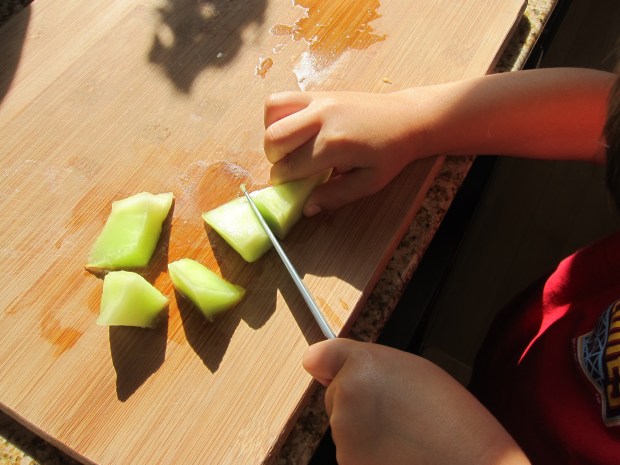
Start off with some fine-motor skills practice by letting your child use a kid-friendly knife on some of the larger fruit pieces, like pineapple and melon. Smaller items (blueberries, grapes), don’t need to be cut.

Rainbow Kebabs (1)

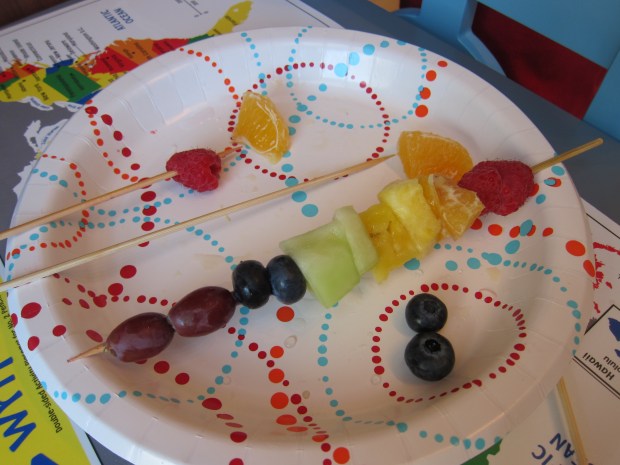
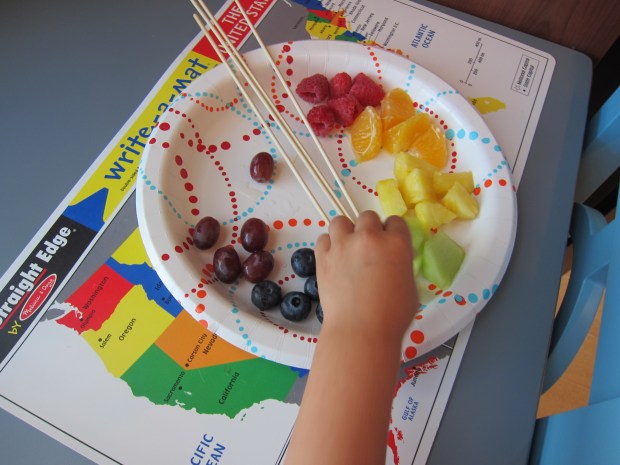
Now assemble all of your fruits on a plate, making sure you have something in every color of the rainbow. Suggestions are as follows:

Red: strawberries, raspberries

Orange: oranges

Yellow: pineapple

Green: kiwi, honeydew

Blue: blueberries

Purple: grapes

Encourage your child to thread the fruits onto their skewer in rainbow order. Travis was so busy stealing nibbles of fruit that he let me assemble most of them, though! He was most excited by the pineapple, which I don’t buy very often: “I want a yellow one!”

Rainbow Kebabs (2)

If you want to add whimsy to your skewers, consider a marshmallow “cloud” or two!

Overall, this snack ranks high for being both healthy and fun.

Rainbow Kebabs (4)