Light-Up Heart Flower

Light Up Flower (7)

After lots of experiments with circuits, not only does Travis have a good understanding of how they work, but mommy does, too! In all honesty, this was a project I put together for Travis to make home school pencils feel special, rather than one he learned from. Many of the steps were simply too advanced for a kindergartner’s dexterity. But consider it as a STEM project if you have kids aged 9 and up!

First, wrap a pencil in green tape for a flower stem. I did this against a light green pencil, giving it a nice two-tone look.

Light Up Flower (5)

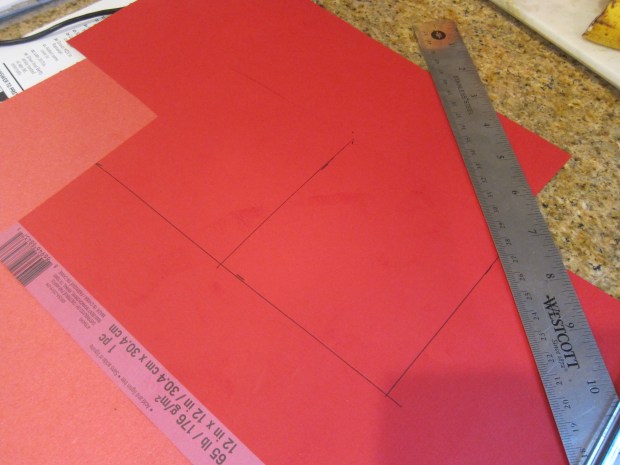
To make petals, cut two squares of red cardstock that are 4×4 inches, and one square that is 3×3 inches.
Light Up Flower (1)

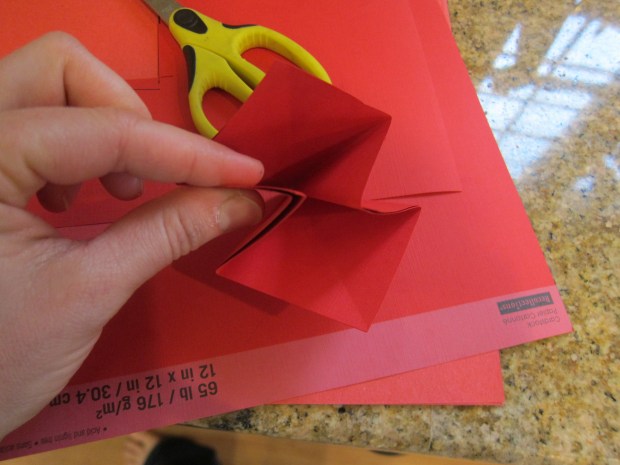
Fold the squares in half first vertically and then horizontally. Then fold diagonally in both directions. You can now tent up the piece of paper so it forms a smaller square.
Light Up Flower (2)

Draw a heart such that the bottom of it comes to the center fold.

Light Up Flower (4)

Cut out along the heart shape, and when you open the paper up, you’ll have 4 hearts! Repeat with the other pieces of cardstock.
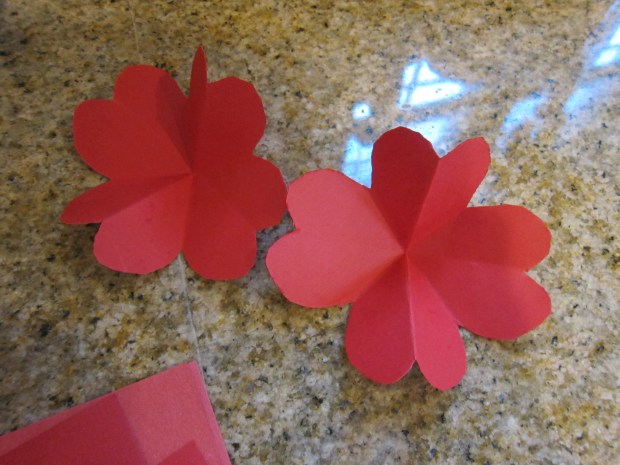
Light Up Flower (3)

Punch a hole in the center of each of these “petals” using the sharp tip of a pencil or pen, and set aside. To put the flower together, glue an LED light to the pencil’s eraser end.
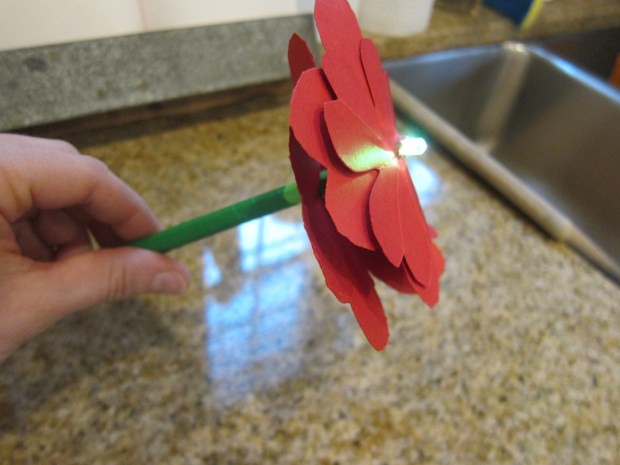
Light Up Flower (6)

Slip one large petal over the light, followed by the smaller petal, and use hot glue to secure in place. Tape a 3V battery underneath the large petal. Make sure that the negative side of the battery lines up with the negative end of the LED light, and the positive with the positive. (Hint: the positive leg is the longer one). Secure one of these connections with tape, but leave the other loose.
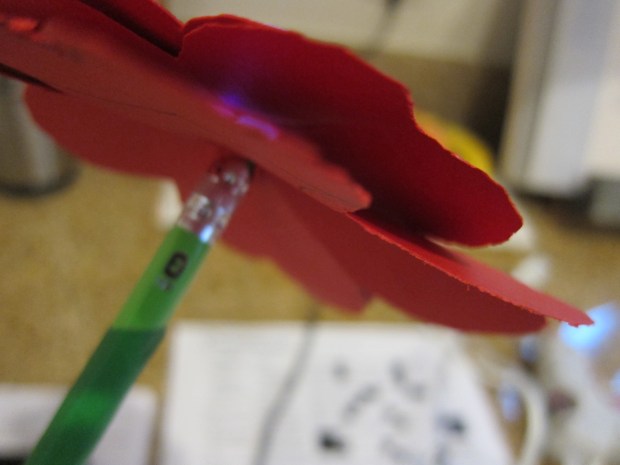
Light Up Flower (8)

Now push the final cardstock petal up from the lead end of the pencil. When it presses the other leg of the LED light against the battery, the circuit is complete!

You can secure this bottom piece of cardstock in place with a rubber band, if desired. Hopefully this makes all of Travis’s writing projects more exciting in the home school weeks ahead!
Lemon Battery

Lemon Battery (4)

Travis has enjoyed learning about circuits lately, and today we tried to make our own battery! This is a bit of a spin on the old potato battery experiment you might remember from elementary school.

For the set up, first we washed a penny in warm soapy water to make sure it was clean.

Lemon Battery (1)

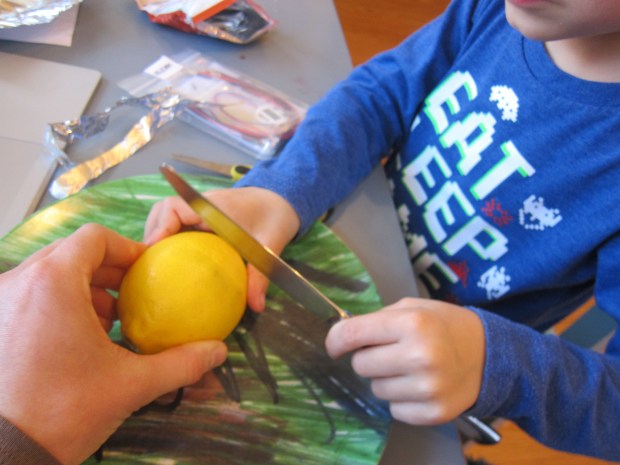
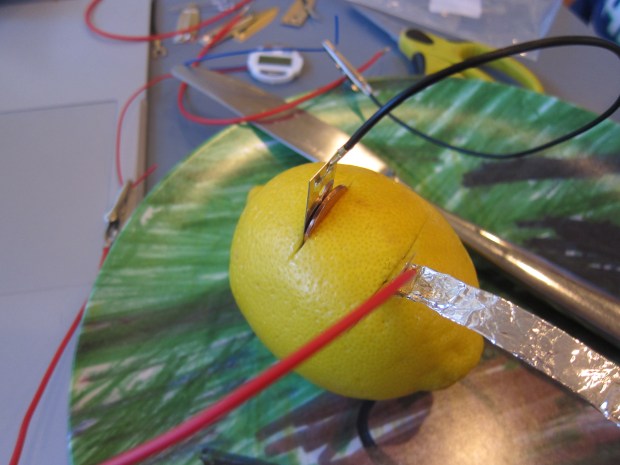
Cut two small slits in a lemon, about 3/4-inch wide and deep enough to reach the lemon juice under the pith. The juice is key!

Lemon Battery (2)

Fold a square of aluminum foil in half and then half again, so that it makes a sturdy strip. Insert the penny into one slit of the lemon and the foil into the other, making sure both touch the lemon juice.

Lemon Battery (3)

Now you can test your battery! The easiest way is to do a reading against the two nodes of a multimeter. Alternatively, try attaching alligator clips and wires to an LED light, and see if you’re able to power it up.

Lemon Battery (5)

We didn’t have fantastic success with our “battery”, which might have been because our aluminum strip was too long, or perhaps was due to a slightly faulty multimeter. If you do the project, please share your results in the comments!

Lemon Battery (6)

Circuit Science Kiwi Crate

Kiwi Circuits (9)

Travis’s Kiwi Crate has never been so welcome as during this period of home school and social distancing, particularly on a rainy day when we couldn’t get outside for a spring nature walk. The package literally saved the day! Sometimes Travis wants to spread out the projects, but this time he insisted we dive into the crate right away and do all three projects start to finish.

The big concept this month was electric circuits, which Travis has grown to understand recently from a few at-home projects, so I was glad the concept wasn’t foreign to him.

First up was the Lamp: A simple set-up involved attaching a lamp base and LED light holder onto a cardboard base, then inserting batteries into the provided battery pack. Travis connected red wire to red wire and black to black, and his lamp turned on!

Kiwi Circuits (1)

The second project, the Lampshade, was really the only “A” component of STEAM for this crate.

Kiwi Circuits (3)

Travis loved punching the holes along the lines of a Steve the Kiwi template, with a sheet of black paper underneath, since it was similar to punch art he does at school.

Kiwi Circuits (2)

The black paper then slips easily inside the lamp, and Steve glows!

Kiwi Circuits (4)

We put it all together with the Electric Bowler Game. This was definitely complicated, but Travis was determined to put together a circuit board that involved four brads against a wooden plate and wires that slip over the outer brads.

Kiwi Circuits (5)

He slotted the wooden frame together and held it all together with provided rubber bands.

Kiwi Circuits (7)

A wooden dowel in the middle is the switch to deactivate the circuit when needed. 3 silver balls then trigger the circuit; these need to be scuffed with scratchy pads first, although to our disappointment, the booklet did not explain why.

Kiwi Circuits (10)

To complete the game, a wooden board sits on top with a foam bumper. Take turns rolling the three metal balls towards the holes at the end. Once all three metal balls fall into place between the brads on the circuit board below, the circuit is complete, and the lantern turns on!

Kiwi Circuits (11)

Definitely play in a dim room, for the best effect.

Kiwi Circuits (13)

Travis enjoyed the Explore magazine that delved deeper, including an experiment called Let It Flow. What else could complete the circuit in our set-up, other than the three metal balls?

Kiwi Circuits (14)

Three plastic beads failed, as did three marbles. But three strips of aluminum foil did the trick!

Kiwi Circuits (15)

There was no suggested further reading this month, but I recommend Oscar and the Bird: A Book About Electricity.

Kiwi Circuits alt

We also plan to check out I Am Benjamin Franklin when the title is released in October, as there’s sure to be some fun bits about electricity in there!

Holiday Card Circuits

Holiday Card (4)

Need to celebrate a birthday with someone from afar during COVID-19? Or planning on sending cards for Passover or Easter (or whatever the closest holiday might be?). In this age of social distancing, here’s a card that will literally shine through, even over Zoom!

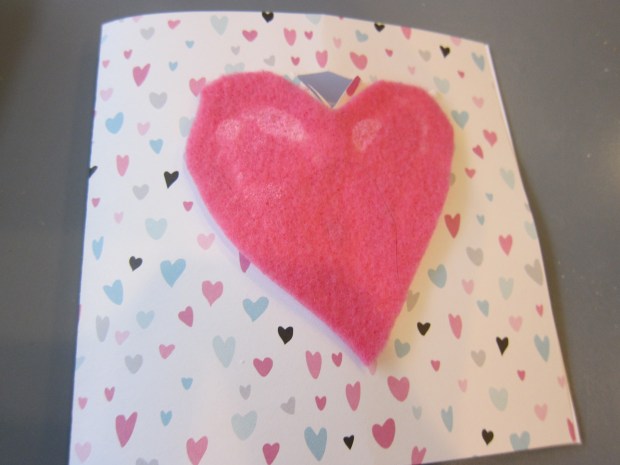
This card works on the exact same circuit principle as the graphite circuit Travis made recently. But first we needed to make a pretty card! Since ours was a birthday card, we chose heart-print scrapbook paper and glued a felt heart to the front. Make sure you cut a hole where your LED light will shine through.

Holiday Card (1)

Of course you could go in so many directions with this card, whether one for Easter (a light-up chick or egg?) or just a fun theme to say hello like a UFO beam or fire truck siren. You can use stickers or cardstock cut-outs for the decorations.

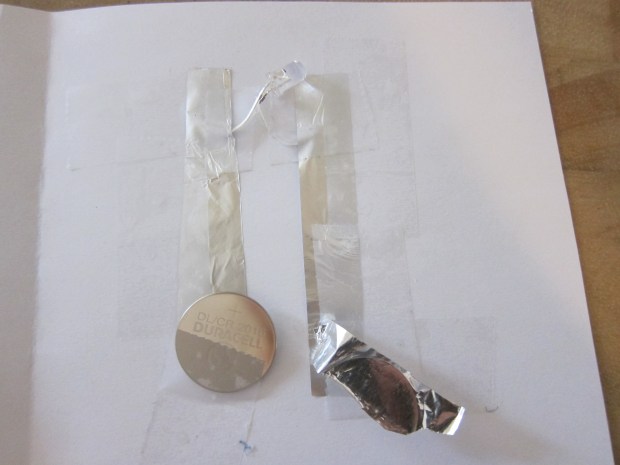
Inside, make a rectangle from three strips of aluminum foil and tape down, leaving one corner that still flaps open. Also leave a gap at the top where the LED light will go. Tape down the legs of the LED, one to each side, making note of where the positive and negative sides are (Hint: the positive leg is longer).

Holiday Card (2)

Now tape down a 3V battery in the corner where you’ve left the foil loose. When the flap of aluminum foil folds down, the circuit is complete and the card lights up!

Holiday Card (3)

Here’s mom’s amazement, even if it was a little old-hat for Travis.

Mini Bots

Mini Bot (6)

Travis built a robot today! Armed with a few specially ordered items, even younger elementary kids can do this project. My kindergartner needed adult hands for a lot of the steps, but could understand the process behind creating a simple circuit.

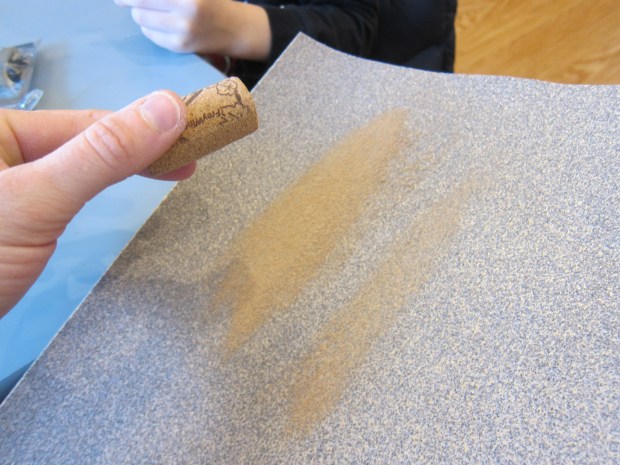
To start, we used sandpaper to smooth one side of a cork so it would sit flat once the robot was complete.

Mini Bot (1)

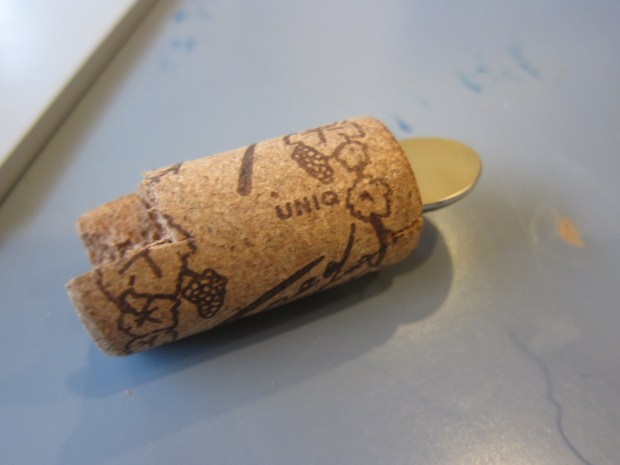
Using an Xacto knife, I made a slit in one end of the cork; this was for a 3V battery to slot into. Initially I made the slit such that the battery would sit horizontally, but we later changed it to vertical for ease of attaching the wires.

Mini Bot (3)

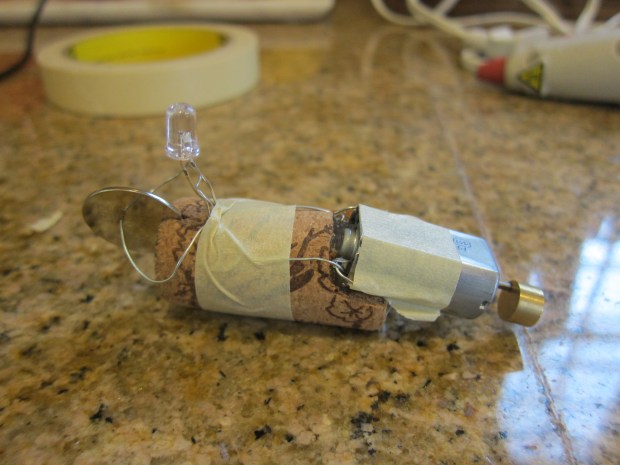
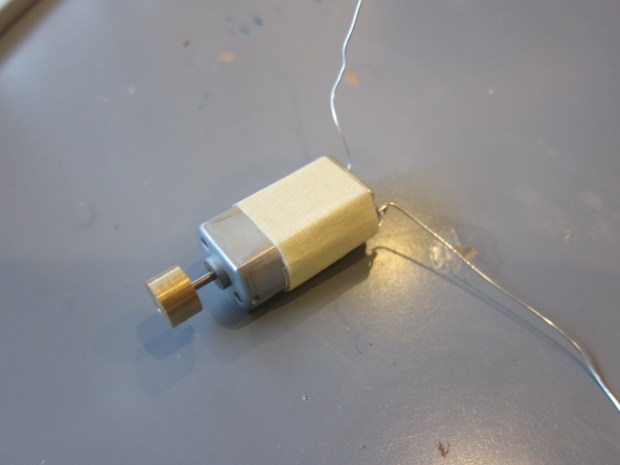
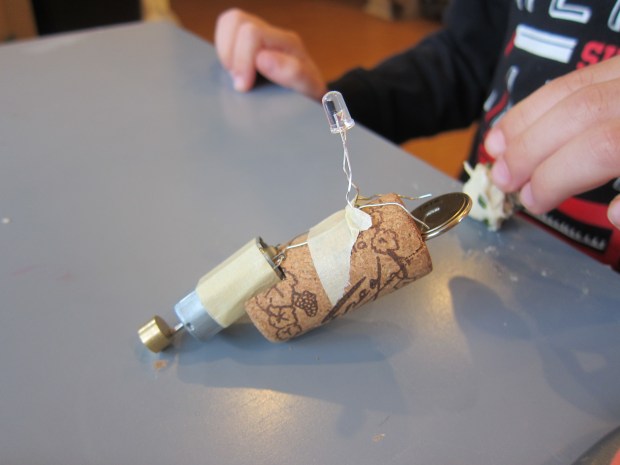
On the opposite side of the cork from the battery slit, I cut a square large enough to fit a pager motor. Hot glue the motor in place for security.

Mini Bot (2)

Attach two wires (about 3 inches long), one on either side of the pager motor. Secure with masking tape. I used a thin floral wire for this step.

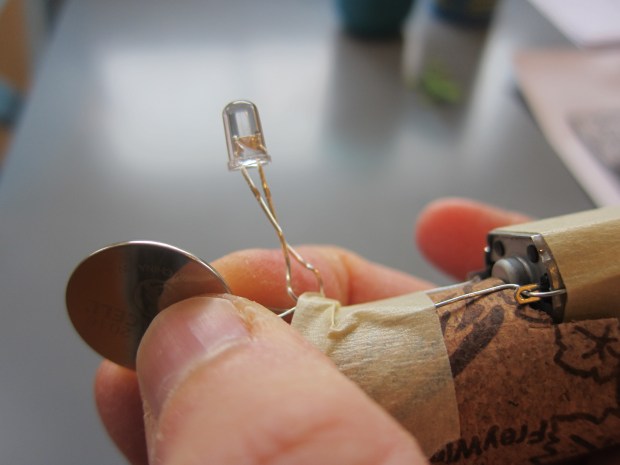
Now poke both ends of an LED light into the cork, taking note of the longer (anode) side and shorter (cathode) side. Wrap the wires that extend from the pager motor around each leg of the LED, and continue along until they reach the 3V battery. Tape it all securely in place with masking tape.

Mini Bot (5)

Every time you touch both wires firmly to the battery, it will kick into action. The light lights up and the motor starts whirring! If you have trouble, go back and check that all your + sides are aligned, as well as all your – ones.

Mini Bot (4)

Your child may want to decorate their mini bot with wiggle eyes or pipe cleaners for personality, but Travis loved it just like this! Here it is in action:

Let’s Build a Flashlight

Build a Flashlight (4)

Kids will feel like real electricians with this easy project! All you need is a cheap flashlight, the kind you’ve probably picked up at a drugstore or dollar store check-out in the past and have lying around.

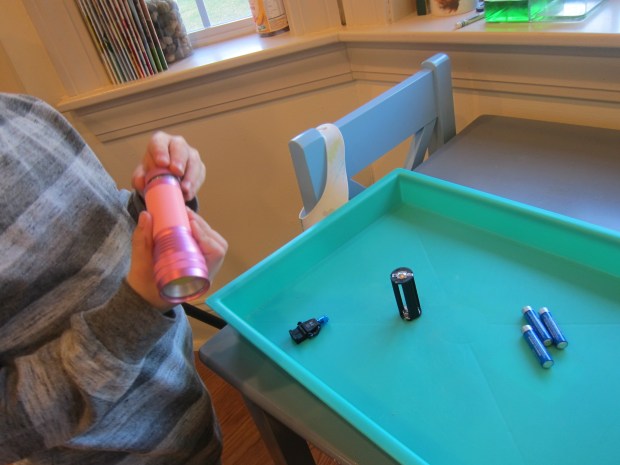
I disassembled the flashlight into all of its components and arranged them on a tray so it felt very official, then called Travis over.

Build a Flashlight (1)

He was so excited when I challenged him to put it together again! At first he was twisting together just the body and the screw cap, without a thought for coils or batteries or other pieces that might need to go inside.

Build a Flashlight (2)

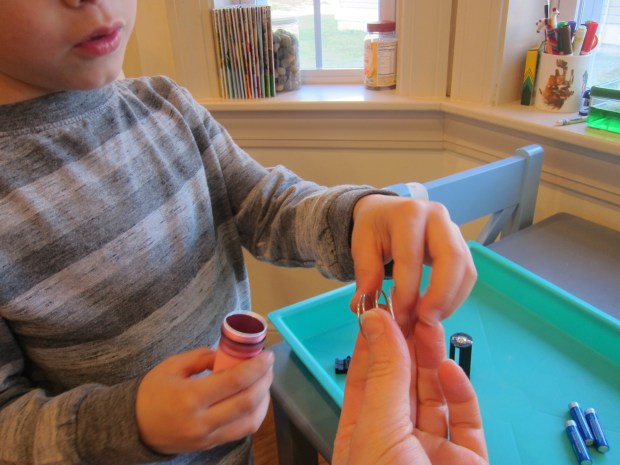
Hmm… it wouldn’t turn on. What was missing? Now he worked hard to figure out where the coils should go.

Build a Flashlight (3)

Being allowed to handle the batteries all by himself was super thrilling!

Build a Flashlight (5)

It took a few tries before he had everything arranged in the right direction.

Build a Flashlight (6)

He was so proud once a push of the button turned it on!

Build a Flashlight (8)

This is a great introduction to battery power that even young children can grasp.

Build a Flashlight (7)

Baking Soda and Vinegar with Color Fun

Baking Soda Colors (8)

This activity was intended for my toddler, but it turned out to be my kindergartner’s favorite part of the day. Since there’s some STEM involved, keep it in mind if you find yourself home schooling!

For set up, I wanted Veronika to have the option of color mixing, so I filled three cups with vinegar. I left one clear, added yellow food coloring to the second, and blue food coloring to the third.

Baking Soda Colors (1)

I then sprinkled a box of baking soda into a shallow tray. Veronika instantly liked making lines through it with the pipettes I had left out. It was sort of like an indoor sandbox for a moment.

Baking Soda Colors (2)

Then it was time to start squeezing in vinegar! I used the clear cup first, knowing the bubbly reaction was enough to get a “wow” even before we added color.

Baking Soda Colors (4)

Then we started piping in the colored vinegar. I had hoped Veronika might get in some fine motor practice with the pipettes, but that was too much for 16-month-old fingers. Big brother Travis loved using a pipette and baster, though! Then the kids poured the cups of vinegar instead, for even bigger reactions.

Baking Soda Colors (5)

The blue and yellow turned into a nice green, of course, which I’d also hoped to demonstrate.

Baking Soda Colors (9)

After that we just had a big pile of green bubbly “lava” that the kids loved scooping through with pipettes and cups for ages.

Baking Soda Colors (7)

Eventually they wanted to drip in other colors from the food coloring set, which was fine, although it didn’t look so pretty.

Baking Soda Colors (10)

A great afternoon activity!

Baking Soda Colors (6)

Outer Space Parachute

Space Parachute (5)

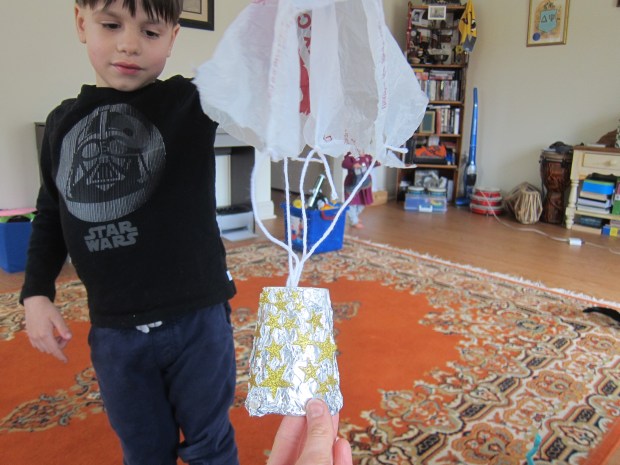
Last summer and fall, Travis and I experimented with a few different ways to make a parachute. For home school “science” today we tried once more, but this time made it outer space-y with a coating of aluminum foil. Travis thought it looked just like the gear used to ease the landing of Mars rovers!

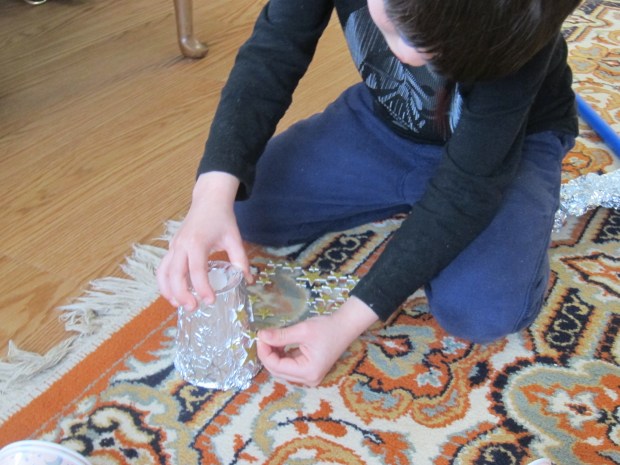
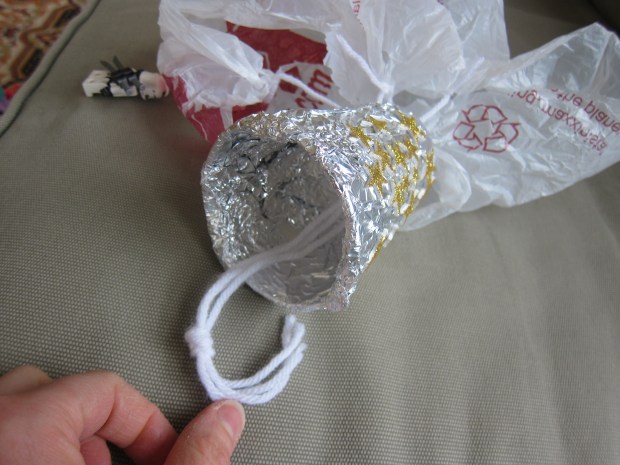
To start, wrap a paper cup in aluminum foil. Travis enjoyed decorating all over with star stickers (in keeping with the theme of course).

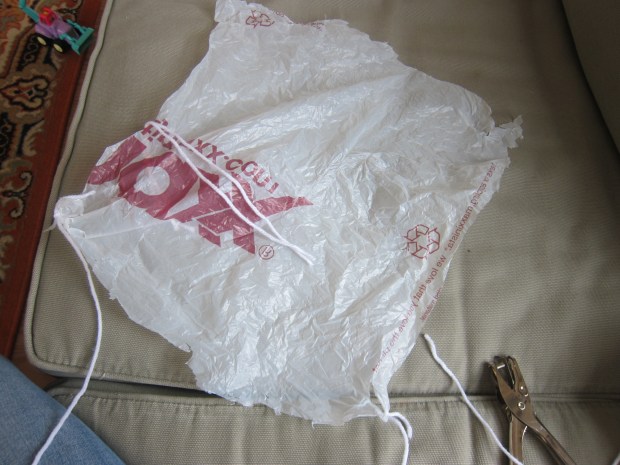
Space Parachute (2)Cut a square from a plastic shopping bag, and then use a hole punch to make a hole in each of the four corners (you may need to rip the bag a little bit, too, to help the hole punch through).
Space Parachute (3)

Cut four equal lengths of yarn and tie one to each corner with a knot. Gather these four strands together and push down through a hole in the top of the cup. Make a fat knot so they won’t slip back out.

Space Parachute (4)

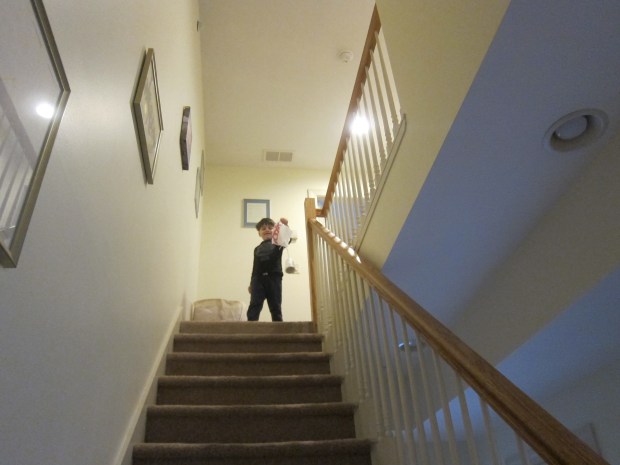
Time to launch! My intrepid explorer bravely climbed the stairs.

Space Parachute (6)

Then it was 3, 2, 1: Blast off!

Balloon Hovercraft

Balloon Hovercraft (3)

This balloon activity is a simple but neat way to demonstrate friction. Similar to an old balloon propeller experiment Travis tried, it illustrates Newton’s third law (that for every reaction, there is an equal and opposite reaction). So when the air from the balloon is allowed to escape, the it propels the CD forward. Consider it for a quick science class if you’re homeschooling this week!

I raided my old CD binder for the project, which had the kids immediately intrigued. This is not technology they see often anymore.

Balloon Hovercraft (1)

Hot glue a pop-top water bottle cap to the middle of the CD, making sure the seal is air-tight.

Balloon Hovercraft (2)

Fit a balloon over the bottle cap, then blow through the hole in the bottom of the CD to inflate the balloon. This definitely takes some lung power!

Balloon Hovercraft (4)

Immediately seal the pop-top. Place the balloon on a flat surface, and lift the pop-top. As the air rushes out, your balloon will go forward, which had big wow factor every time.

Balloon Hovercraft (5)

We never managed to create enough energy to have the CD actually lift and hover, but please share in the comments if you do! We did get it to zoom, though, which you can see in this quick clip:

Peppermint Sugar Crystal Sticks

Peppermint Crystals (4)

If your kids love rock candy, they’ll be intrigued by this method to make it at home. Unfortunately, our spate of bad luck with crystallization projects continues, but here’s a step-by-step guide. I’d love to hear if your kids are successful with this one!

First, bring 1 cup water to a boil in a saucepan. Stir in 2 cups sugar and continue to cook at a boil until the sugar dissolves.

Peppermint Crystals (1)

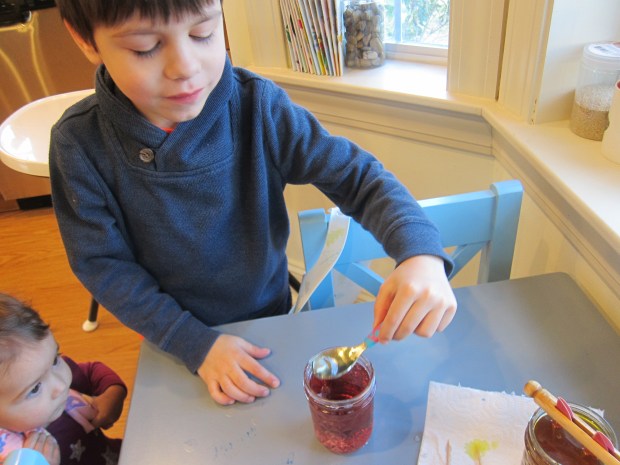
Carefully pour the mixture into two small mason jars. Add a few drops of peppermint extract to each. Travis loved the way this smelled! Next he added a couple drops of red food coloring to one and green to the other.

Peppermint Crystals (2)

Ideally, use lollipop sticks to grow your crystal candy. We had to improvise and used toothpicks instead, which may explain our poor results. Dip these in the peppermint sugar solution, then roll in regular sugar. Use a clothespin to suspend them in the red and green liquid, making sure they don’t touch the sides or bottoms of the jars.

Peppermint Crystals (3)

Now wait!

Peppermint Crystals (6)

We did see a little bit of crystallized liquid form near the surface of the jars after about three days, which we could skim up with a spoon, but nothing crystallized on the toothpicks.

Peppermint Crystals (5)

Well, that didn’t deter Travis from spooning up some sugary liquid for a quick snack!