Go Get It

Go Get It (5)

There are so many games I’ve been waiting to play with Veronika with the caveat that she needed to be a crawler first. Well, now she’s a crawler and we’re playing!

Today, it was a simple game of pointing her towards her toys and saying, “Go get it!”

Go Get It (1)

First, I rolled two balls away from her. She barely needed me to say the words before she was off.

Go Get It (2)

I asked her next if she could get the purple one.

Go Get It (3)

Of course the fact that she went for it was probably pure coincidence at this age, but it’s never too early to build the vocabulary for colors.

Go Get It (4)

You can also turn it into a game for following instructions. Any toys on the “pillow fence” are irresistible to her, so she was off and crawling for them in a heartbeat.

Go Get It (6)

“Can you put them in the bucket?” I asked, aping the movement for her.

Go Get It (7)

She crawled happily over to the bucket and… ker-plunk!

Go Get It (8)

You can even make the game into a “race” with mommy or daddy, which will have your little one giggling. Who would get to the toys first?

Go Get It (9)

In sum, there are lots of variations you can play with this baby version of fetch, and your little one will love building those crawling muscles during all of them.

Kindergarten Summer Math Games

There are so many subtle ways to sneak math into your child’s summer to avoid the “summer slide.” Here are just a few Travis has enjoyed this summer, in the bridge between pre-K and Kindergarten, without even realizing I was helping him with his math skills!

Counting: How Many People?

Every once over the course of a day or a week, stop and ask your child to quickly tell you how many people are in the room. You can do this when the number is small (say, at home in our living room), or large, as when we found ourselves in a playspace. The playspace was fantastic because the number kept changing over the hour or so that we played there, making Travis count as high as 12 at one point.

Summer Math (7)

Counting: Toy Pick-Up Challenge

Travis has fought me on requests to clean-up lately, but not so on the day I announced a challenge. Could he pick up ten toys exactly? Immediately, he was racing around and counting out loud. One, two, three went into a toy bin.

Summer Math (16).JPG

A huge battle between action figures and bugs was going on over by the piano. This gave him numbers four, five, six, seven, eight, and nine. He could barely hold them all in his excitement.

Summer Math (17)

“I need one more!” he exclaimed, realizing all his toys were now put away. I told him he could be a super-helper and clean up one of baby sister’s toys. Ten!

Sorting and Estimating: Laundry Sort

I told Travis I needed his help on a recent big laundry day. As each load came out of the dryer, we made piles. Baby sister things, Travis things, mommy things, and daddy things.

Summer Math (3)

It soon became a silly joke, since we seemed to have a load that was almost entirely daddy clothes and very few Travis ones.

Summer Math (2)

“Did you forget to get dressed this week?” I teased him. Well he thought this was just hilarious, and soon was happily tossing clothes into the right piles.

Summer Math (4)

When we had finished, I asked him who had the least clothes. For this load, it turned out to be baby sister. Who had the most? Daddy!

Summer Math (6)

He loved the game so much he couldn’t wait for a repeat as loads two and three came out of the dryer. I plan to enlist him as my helper for as long as I can con him into this!

Summer Math (1)

Money and Coins: Pretend Store

For the occasion, I bought Travis a new toy register (an early birthday gift), which added to his excitement. We grabbed a few real food items from the pantry and added price tags.

Summer Math (10).JPG

Based on the denominations in this particular register set, clearly our grocery store suffered from inflation, ha.

Summer Math (9)

As we played, we talked about prices, and learned which bills or coins added up to which totals.

Summer Math (11)

Realizing that things were a bit strange with the fake coins in the register, we next played using real quarters.

Summer Math (12)

You can talk about how there are 100 cents in a dollar, and the value of one, two, three, or four quarters. It was a lot of information to send his way, and I knew all this was a bit over his head, but it never hurts to have an intro!

Summer Math (13)

Shapes: Dinner Quiz

At dinner, do a quick pop quiz. What shape is the plate? A circle!  What shape are the napkins? Rectangles! How about the leftover quesadilla? A crescent!

Summer Math (14)

You can also take this opportunity for some quick counting, i.e. how many green beans are left on your plate or how many utensils.

Summer Math (15)

Shapes: Toy Pick Up

As your child cleans up the room, announce that they have to shout out the shape (and color, too!) of each toy they clean up.

Summer Math (19).JPG

This works particularly well with toys like blocks.

Summer Math (20)

I turned it into a hunt for Travis, and I’ve never seen this set of blocks get so willingly cleaned.

Summer Math (22)

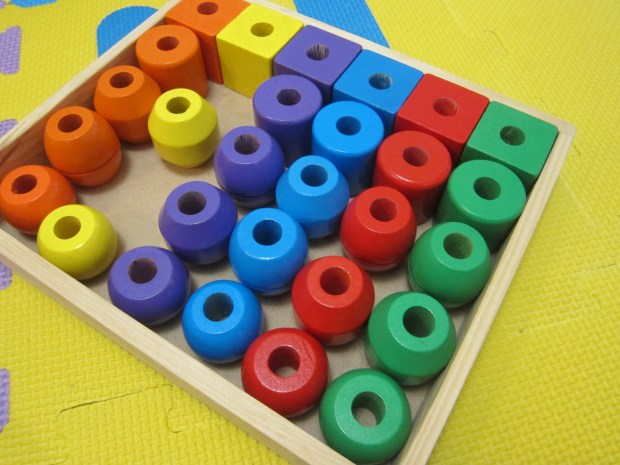
It worked well with baby sister’s beads, too… and even alerted us to the fact that a couple were missing!
Summer Math (23)

Fractions, Measuring and Estimating: Get Cooking!

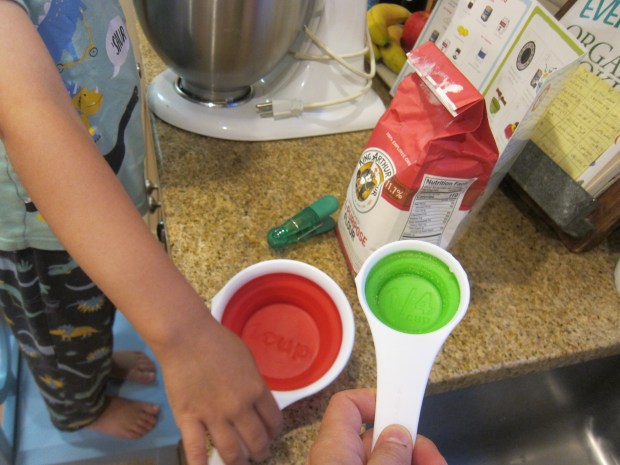
Get kids measuring, scooping, pouring, and leveling in the kitchen, and they’ll be getting a math lesson without even knowing it. Although fractions are a bit advanced for kids entering kindergarten, just hearing the terms “a third of a cup” or “half a cup” will expose them to the idea of dividing one whole into smaller portions.
Summer Math u.JPG

Cooking is also great for learning equivalents (3 teaspoons = 1 tablespoon), relative sizes (a tablespoon is bigger than a teaspoon), and reading larger numbers (350 degree ovens). Here, I asked Travis how long our recipe needed to bake. “20 minutes!” he reported.

summer math u2

Matching: Sock Match-Up

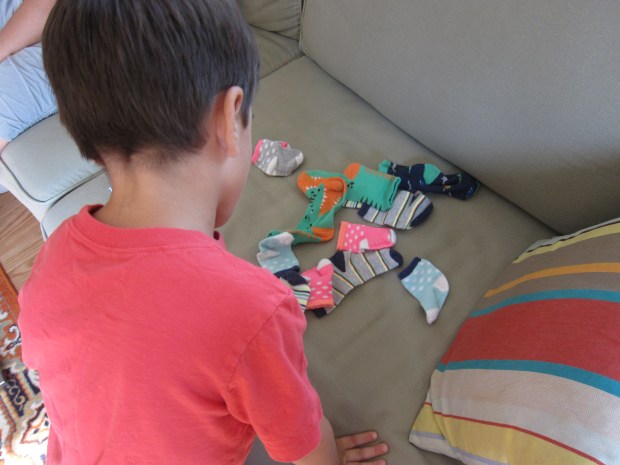
Another great laundry game: Fold your laundry, but leave the socks in a big pile. When Travis came home one afternoon, I said to him, “Oh no, the socks ran away from me!”
Summer Math (28)

He thought the idea of the socks having escaped the laundry pile was very silly. In no time at all, he was matching them up.

Summer Math (29)

A few (similar striped patterns, for example) fooled him but a moment, but then he had things all matched up.

Summer Math (30)

Temperature: Morning Temp

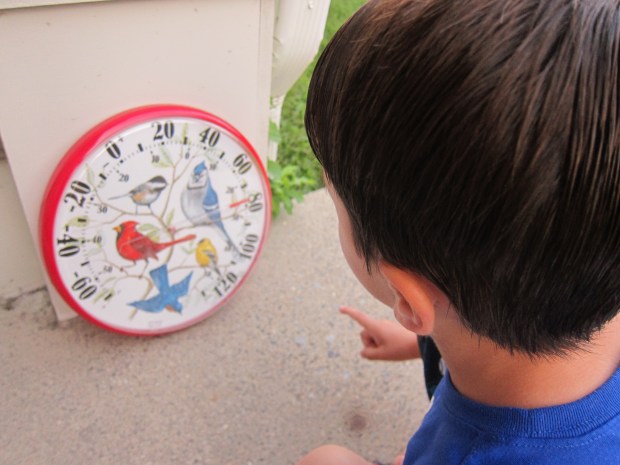
Invest in a thermometer for outside your home or on your patio, and have your child read it every morning.
Summer math (28).JPG

This has become a fun ritual in our house! Because many patio thermometers don’t have all the digits listed, it has become an unintended lesson on skip-counting by twos, with each notch in our dial representing two degrees.

Engineering: Lego Building

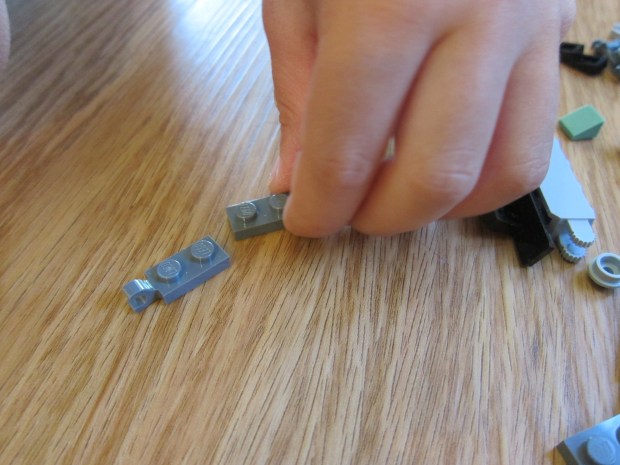
Legos help with fine motor skills, problem solving and planning skills, shape recognition, and so much more. There’s a reason so many towns have Lego building clubs these days!

Summer Math (26)

You don’t need to join a club; just get building at home. Need I say more?
Summer Math (27)

Telling Time: Model Clock Book

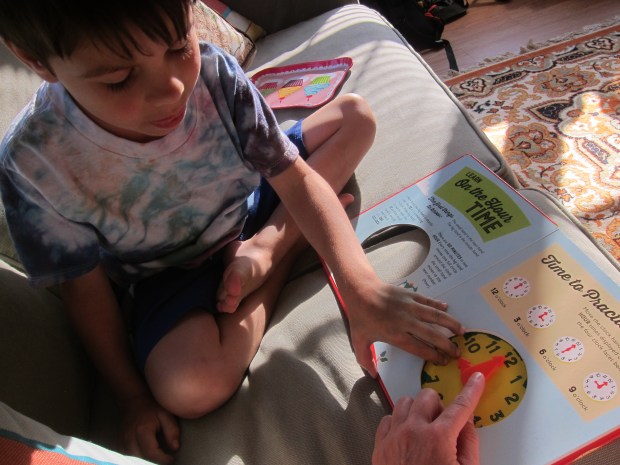
Telling the time is a great skill to work on over the summer. Invest in a good analog clock or a great book about one featuring a clock with hands that your child can manipulate. We love How To… Tell the Time from Cottage Door Press because not only does it give a nice run-down of telling the hour and half hour, but there is a fun section for kids to move the hands based on their activities each day (brush teeth, go to bed etc.).
Summer Math (28).JPG

This gave a real-life scenario way for Travis to think about the time and understand it better. There’s even a model clock to punch out.

Summer Math (29).JPG

(Note: I have yet to find a good book featuring the minutes; many focus on hours and half hours, so I added the minutes in tape to our model clock).

Summer Math (30)

Volume: Measuring Cup Play

Measuring cups are the perfect tool for teaching about volume (and fractions, too!), and if you add colored water, your child will simply think they’re playing and having fun!

Summer Math Volume a

We took clear plastic cups, measuring cups, and food coloring outside one morning. I taught Travis to read the number after the slash on each measuring cup to know how many times he’d need to fill it for one full cup. So two 1/2 cups, three 1/3 cups, and four 1/4 cups. For extra fun, we used food coloring to differentiate between each version.

Summer Math Volume b

Soon he was just happily pouring and mixing and having a blast in the sunshine – vitamin d as an added bonus to math time!

Weight: Fruit and Veggie Weigh

At the grocery store, Travis loves to help weigh our fruits and veggies on the scale. Give a quick lesson on how there are 16 ounces to 1 pound, and let your child read off the weight of each item you place on the scale. It’s a great intro to gently introduce the topic.

Summer Math weigh.jpg

Baby-Friendly Ice Sensory Activity

Baby Ice (2)

Here’s a way your baby can cool off while fitting in sensory play on a hot day!

I took Veronika outside before the sun was too high in the sky, along with a bowl of ice cubes and a few tools.
Baby Ice (1)

First, I simply wanted to see how she would react to the ice. Some babies may want to grab it and really get in there! Veronika seemed a touch nervous about how cold it was but liked the sensation on her toes.

Baby Ice (3)

For added fun, I buried two shape toys in the ice. She loved reaching in and grabbing them out.

Baby Ice (4)

A wooden spoon added to the fun, too. She could “stir” the ice, or tap against the bowl. I put a few pieces on the hot patio and we watched together how quickly they turned to water.

Baby Ice (7)

You can also use measuring cups as scoops. These were fun for her to reach into the bowl with. Or just nibble on!

Baby Ice (5)

Don’t forget about sound! Put a few pieces of ice in one of the measuring cups and shake it for an auditory sensory experience.

Baby Ice (6)

And when you’re done, clean-up simply means dumping out the ice to melt in the grass!

Baby Ice (8)

Solar Oven S’mores

Solar Smores (9).JPG

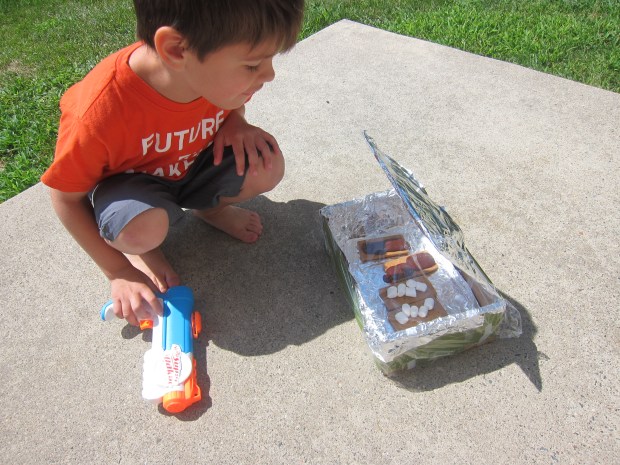
Happy National S’mores Day! Travis and I celebrated with a STEM take on this classic summer treat: s’mores cooked in a solar-powered oven made from one of his recycled Kiwi Crates!

To start, cut the flaps off the top of the Kiwi box (or an old shoebox). Line the entire inside with aluminum foil, and secure with clear tape.

Solar Smores (1)

Place 4 graham crackers on the bottom; we love the vegan and gluten-free grahams from Kinnikinnick.

Solar Smores (2)

Top two of the graham cracker pieces with dark chocolate squares and the other two pieces with Dandies marshmallows.

Solar Smores (3)

Cover the top of the “oven” with plastic wrap and tape down; you don’t want any bugs in there! We placed our oven on the patio in hot sunshine.

Solar Smores (4)

82 degrees ought to do it!

Solar Smores (5)

After 20 minutes, we took a peek. Our chocolate was so hot and melty and perfect.

Solar Smores (8)

The Dandies had softened up, although they didn’t melt all the way down. But these made fantastic s’mores!

Solar Smores (7)

Alphabet Dictionary

Alphabet Dictionary (1).JPG

As with playing Letter Detective, here’s an activity you can do with your child over the course 26 days. We ended up taking a short-cut (read on for why!) but Travis really enjoyed the process.

To start, I made a “book” with a printed letter of the alphabet glued onto colorful construction paper for each page. Hole punch these and tie together with yarn.

Alphabet Dictionary (8).JPG

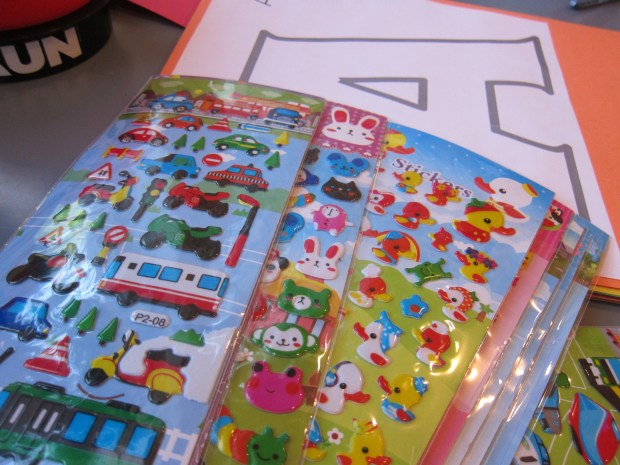
Each day, Travis drew something beginning with the assigned letter on its page. Then we went through stacks of fun stickers and added anything that started with that letter.

“A” received an apple drawing, as well as apple and alligator stickers on the first day.

Alphabet Dictionary (2)

He was so excited to get a second chance to comb through the sticker packs on day #2, and found bananas, bunnies, and buses for “B”.

Alphabet Dictionary (3)

Plus drew a “bagel”!

Alphabet Dictionary (4).JPG

After a few days of focusing only on one letter per day, I realized Travis was frustrated finding stickers he couldn’t use yet. So instead, I laid out all the printable pages for him, and a whole pack of stickers, and made it a free-for-all.

Alphabet Dictionary (6)

Well wouldn’t you know he loved it! “Thanks for buying all these stickers!” he declared, happily stickering all over, occasionally asking me where one belonged.

Alphabet Dictionary (5)

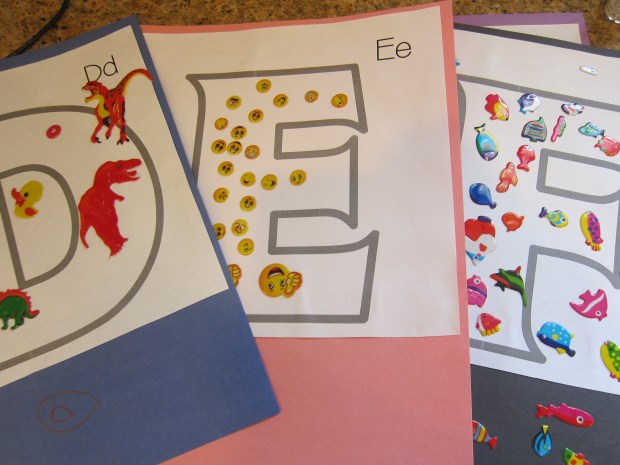
Based on the sticker themes in our set, we had some letters that received lots (S for stars, T for trains) and some with relatively few.

Alphabet Dictionary (10)

We got a little creative; our E page was covered in “emotions” from emoticon stickers.

Alphabet Dictionary (11)

Another idea is to supplement with pictures cut out of magazines. One way or another, Travis was very proud of his “dictionary.”

Alphabet Dictionary (9)

It was a great phonetic addition to the tracing and modeling we’ve done throughout the summer.

Alphabet Dictionary (7)

I would say this boy is kindergarten ready!

Shape-Sorting Puzzles

Shape Sorters (2)

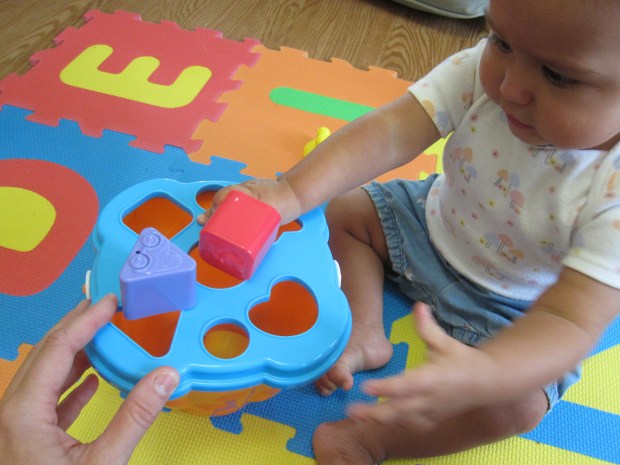
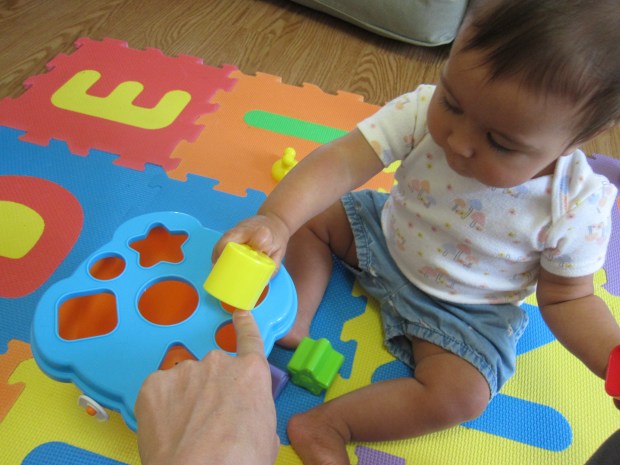
I’ve already introduced Veronika to the notion of “in” and “out” with games when she was younger. Now, at nine months old, it’s the perfect chance to introduce a toy that takes this concept to the next level: shape sorters!

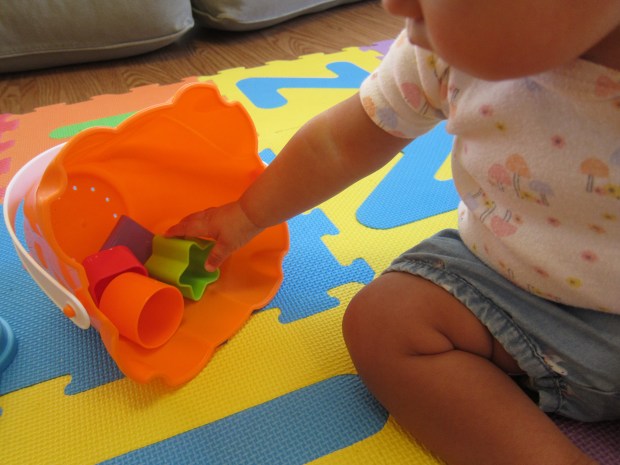
Not only are shape sorters fantastic for (obviously) learning shapes, but they also hone fine motor skills and they are the perfect vessel to continue games of “in and out.” Rather obviously, first all the shapes go in…

Shape Sorters (1)

…then all the shapes come out!

Shape Sorters (6)

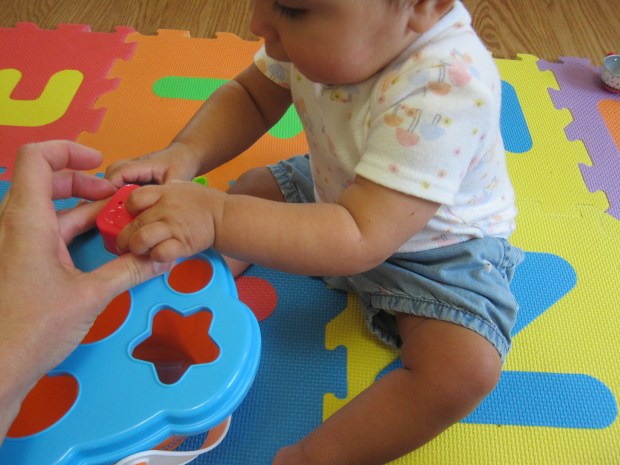
Veronika has two shape-sorting puzzles that she loves. The first is a classic bucket with a lid that detaches. Mostly she bangs the shapes against the lid, but she does aim for the holes and gets closer every time. Sometimes I’ll place a square (or circle or triangle) right near its hole so all she has to do is it tap it in.

Shape Sorters (3)

“In!” we say, whenever one lands.

Shape Sorters (5)

The second shape sorter is a little bus that has three shape slots on top to put them in

Shape Sorters (4)

…and a fun compartment in back that opens up to dump them out.

There are plenty of other ways to focus on “in” and “out” if you don’t have shape sorters. Consider mailing a letter together! Today Veronika helped me put one in to the envelope…

In and Out (1)

…and then in to the mailbox!

In and Out (2).jpg


Letter Detective

Letter Detective (1).JPG

For 26 days, Travis has been playing detective. Letter detective that is!

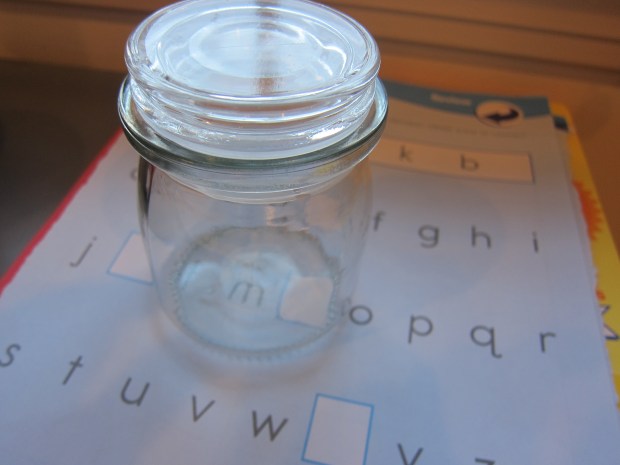
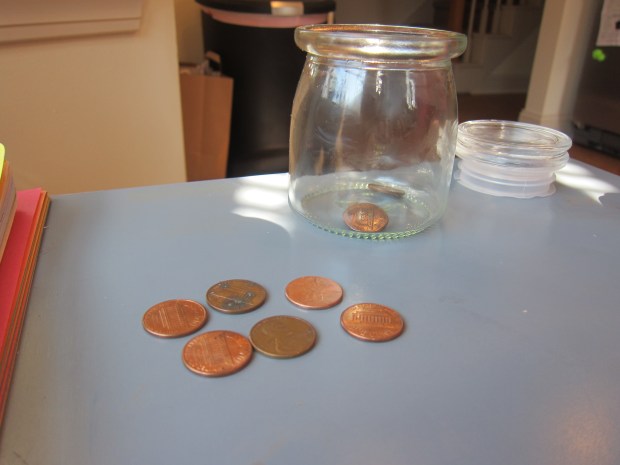
For the assignment (a neat suggestion from his summer pre-k to kindergarten workbook), I purchased a small glass jar with a lid and set aside a collection of pennies.

Each day, he was tasked with finding one letter of the alphabet. Every time he notices it, a penny goes in the jar. Fair game includes magazines we read, food labels, street signs around town, and more.

When we started with A, he needed lots of prompting, but over the course of the day he spotted 8 As.

Letter Detective (2).JPG

8 pennies in the jar!

Letter Detective (3).JPG

Truth be told, it was hard for Travis to find the letter of the day as we drove; his recognition isn’t fast enough to keep up with the speed of a car. But at-home materials proved more fruitful, and the goal is to count up the pennies at the end and perhaps earn a small reward!


Community Matters

Community Matters (3).jpg

I’ve moved three times since having children, and each time, there are two places in a new town that I head to first: the town library and the town recreation center. Both are a goldmine of information and opportunities – usually free or low cost – for children of all ages. They are also focal points of the community, which can be a great way to connect with other parents, find a way to get involved in the community, or just have a place to go on a rainy day for play.

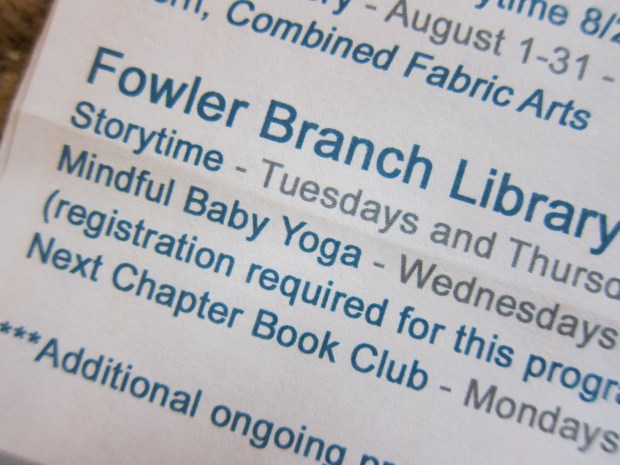
To wit, Veronika and I have already found a baby yoga class at our new town library, a fantastic chance to connect with babies about her age. Make sure to pick up a local flyer or calendar so you know what’s coming up next: story hour and toddler singalong are both on our list!

Community Matters (1)

Rec centers usually have many options, too, and we’ll be checking out the open gym play for her gross motor skills in the fall and winter.

Community Matters (2)

What’s your favorite baby program in your town? Please share in the comments!

Share the Chores

Swap Chores (1)

If daily tasks around the house feel like drudgery with your baby around, then it’s time to invest in tot-sized versions of some daily household chores. This not only keeps your little one entertained while you work, but will be so darn cute you don’t mind all that drudgery (truly!).

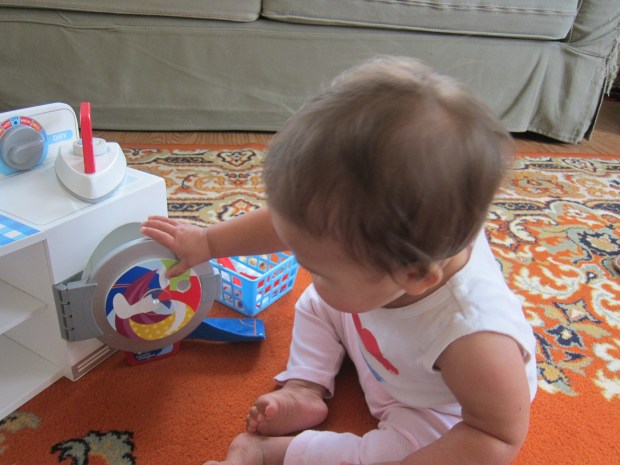
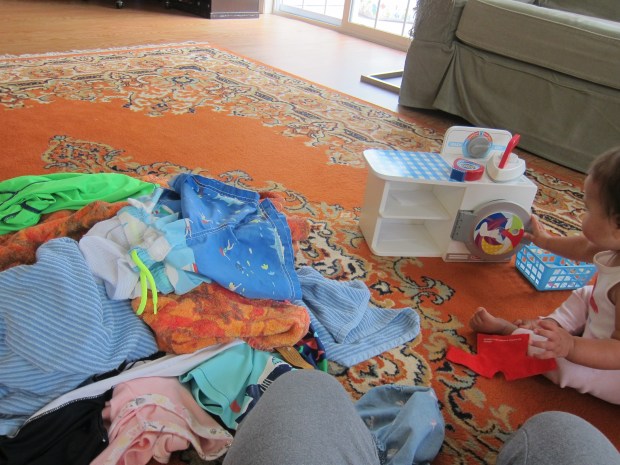
Today, Veronika joined me with her own little “laundry” machine. She loved everything about this; the felt paints and shirt she could put it in and take out of the washer over and over; the door to open and close; the spinning feature on the door that went round and round; the iron to zoom back and forth.

Swap Chores (2)

Plus she had a laundry detergent bottle that could safely go to her lips!

Swap Chores (4)

Meanwhile, I got all the folding done next to my little helper.

Swap Chores (3)

Babies and toddlers love to imitate you and that’s what makes toys like this worth the investment; big brother Travis loved playing mini-me with toy vacuums, toy mops and brooms, toy dish washing sets and more, and Veronika can help with all of these, too, as she gets older. Toy oven sets are also perfect for this in the kitchen.

Swap Chores (5)

Another idea, if you’re feeling bored of your chores, is to swap with your partner for a day or a week. If one of you tends to do one thing and one tends to do the other, consider a temporary switch. Truth be told, I prefer to do the lion’s share around the house, but I challenged myself to tackle a chore I’d normally hand off to my husband: hanging pictures that were idling on the ground still after a recent move. It was unexpectedly fun be the one wielding hammer and nails.

Swap Chores

So mix it up, and perhaps you’ll find a new task to make your own. How do chores get divided up in your house? Please share in the comments!

Coach Whistle

Coach Whistle (8).JPG

The sports coaches at Travis’s camp have whistles… which means Travis needs one too! Well, it turns out that we couldn’t exactly make a whistle sound from this Highlights craft, but it was fun to make and Travis was so proud to wear it around his neck.

First, cut a strip of paper that is 1 inch wide and 9 inches long. I love letting Travis help with a ruler for sneaky “math” practice.

Coach Whistle (1)

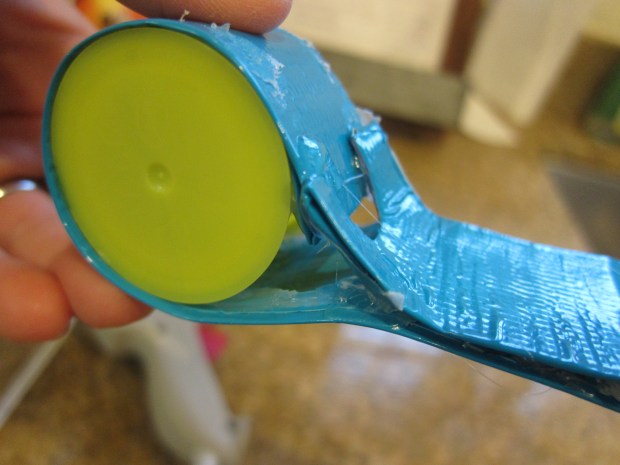
Cut out the strip and cover in duct tape; we used a colorful blue. Cut a u-shaped notch in one end.

Coach Whistle (2)

Grown-up step: Hot glue two juice lids to the opposite end from the U.

Coach Whistle (3)

Roll up, continuing to glue, until there’s only a 1/4-inch gap open between the lids and tape. Fold back the U so it overlaps this gap. I knew we needed to get this exactly right for a true whistling sound, but because we were working in those quick minutes before camp, I had to sort of fudge it.

Coach Whistle (4)

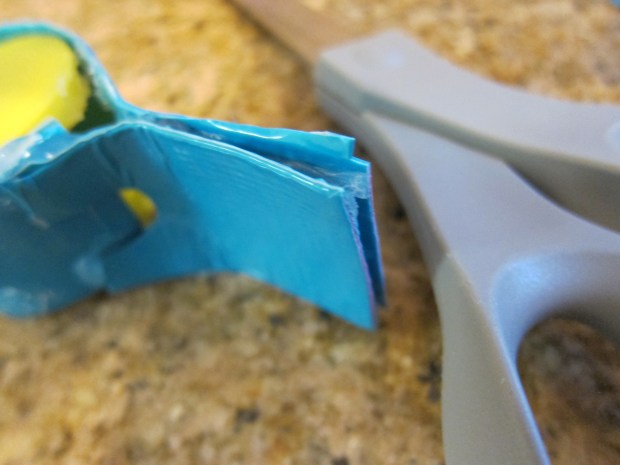
Snip the end of the tape so there is an opening to blow into.

Coach Whistle (5)

Attach a pony bead to the back of the whistle with hot glue, and thread through yarn to go around your “coach’s” neck.

Coach Whistle (6)

As I mentioned, Travis did more of a hoot hoot into the whistle, and didn’t get a true whistle sound, but he loved it and proudly showed it off to camp counselors.

Coach Whistle (9)