Building Sticks

Building Sticks (3)

This project is so simple and yet so great for engaging minds and hands. If you like, you could even throw together a travel set to take these on long car rides!

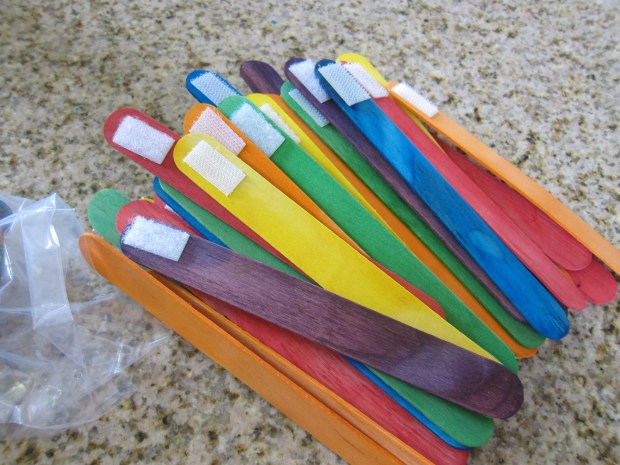
All you need are Velcro dots and craft sticks – plain wood will do, but for added fun, I like the pre-colored craft sticks for this purpose.

When we first set up the game, I only had enough Velcro for one side of each stick. I intended to buy more Velcro in the morning, but this didn’t stop Travis from wanting to build right away.

Building Sticks (2)

Soon he was making “wands” and “books.” He came up with the idea of using tape himself, to put together some more complicated structures (a teepee!)

Building Sticks (5)

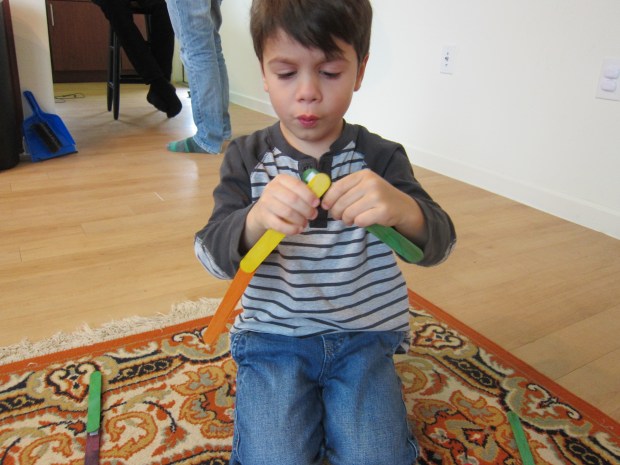
Once we actually had enough Velcro the next day, we made sure each stick had a dot on each end. This enabled much more complicated structures.

Building Sticks (7)

It was still hard to build up (for that you’d need Velcro on both back and front of each stick), but we soon had long complicated structures moving across the carpet.

BUilding Sticks (8)

Travis declared these were machines, and enjoyed the challenge of making sure he was attaching the “fluffy” side of the Velcro to the “scratchy” side.

Building Sticks (9)

A simple activity to keep hands busy!

Pretzel Log Cabin

Pretzel Cabin (6)

We’ve been enjoying a great book recently about Abraham Lincoln (from the Ordinary People Change the World series written by Brad Meltzer), which prompted talk about a log cabin. You can introduce your child to this style of architecture through classic toys like Lincoln Logs of course, but even more fun was putting together this edible version!

To construct the cabin, you need thick pretzel rods and your frosting of choice – we like the vegan vanilla from Wholesome Sweeteners.

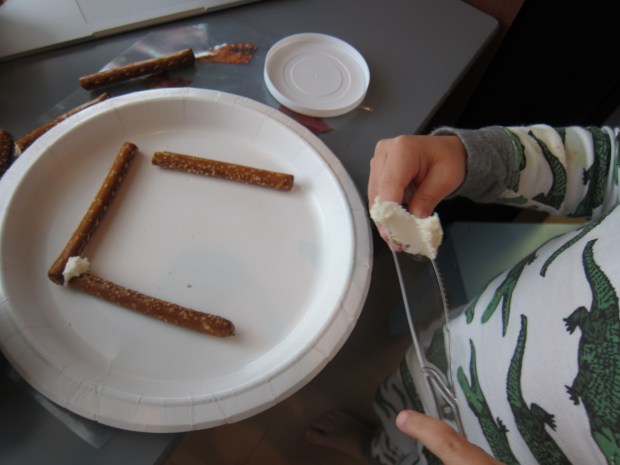
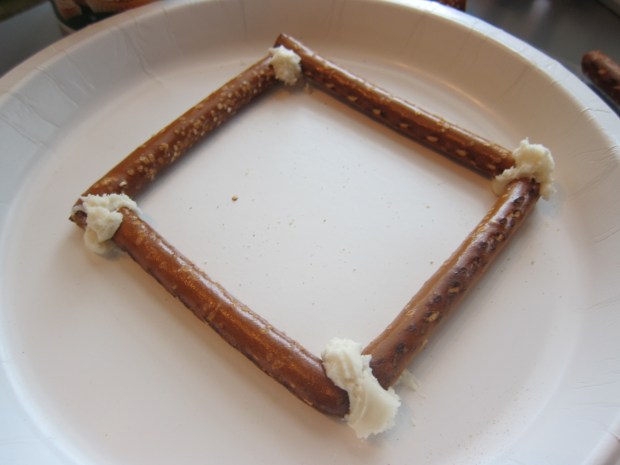
Start out with a base, using the frosting as “glue” to attach the four corners.

Pretzel Cabin (1)

Travis loved smearing on the frosting with a plastic knife, but your child may find that a makeshift pastry bag (i.e. a zip-top bag with a hole snipped in it) is easier.

Pretzel Cabin (2)

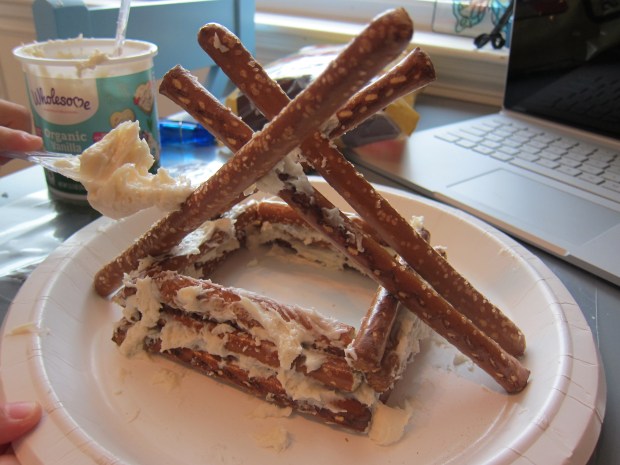
From there, we spread our pretzels with more frosting (“cement”), and built up several layers.

Pretzel Cabin (3)

A little carpenter at work!

Pretzel Cabin (5)

It was tough to make the roof stay in the way we originally planned; if you have chocolate at home, it may be useful to melt some and use that to adhere two pretzel rods diagonally together. We managed to balance ours with generous globs of frosting, though it wasn’t particularly sturdy.

Pretzel Cabin (7)

Luckily, the cabin was meant to be eaten, not saved – what a fun snack!

If you make this craft in the wintertime, your child may want to sprinkle the structure with coconut “snow” before snacking, too.

Chalkboard Painted Block Puzzle

Chalkboard Puzzle (6).JPG

Travis has been home sick from school this week, so we’ve been looking for quiet, indoor games. Puzzles are a fantastic way to keep a child entertained when under the weather, engaging their mind while letting their bodies rest. A little leftover chalkboard paint helped us make up a craft-y version, as well!

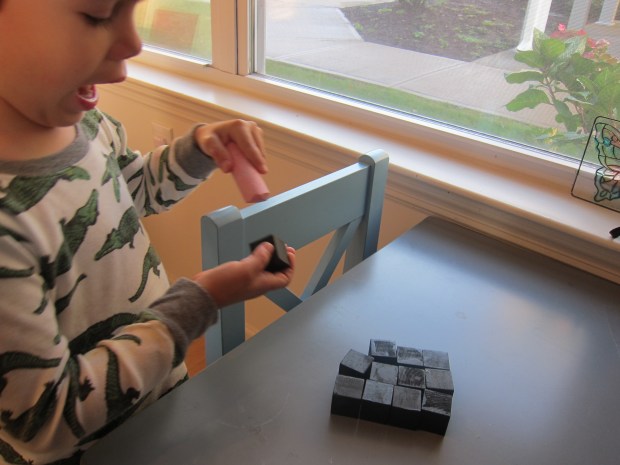
While Travis rested, I painted wooden cubes (available at craft stores) with chalkboard paint on all sides. For the least mess while drying, paint 3 sides and let dry, then flip over and paint the remaining 3 sides.

Chalkboard Puzzle (2)

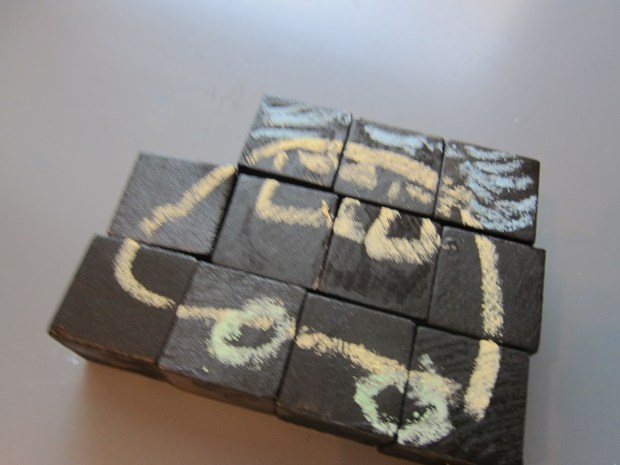
Ideally I would have used larger cubes, but the small ones I had on hand worked just fine. Once the paint dries, take turns with your child making drawings in chalk, and having the other person assemble.

Chalkboard Puzzle (4)

To wit, I designed a car and flower for Travis.

Chalkboard Puzzle (7)

He was briefly into the puzzles, but more intrigued with the idea of chalking all over the squares.

Chalkboard Puzzle (3)

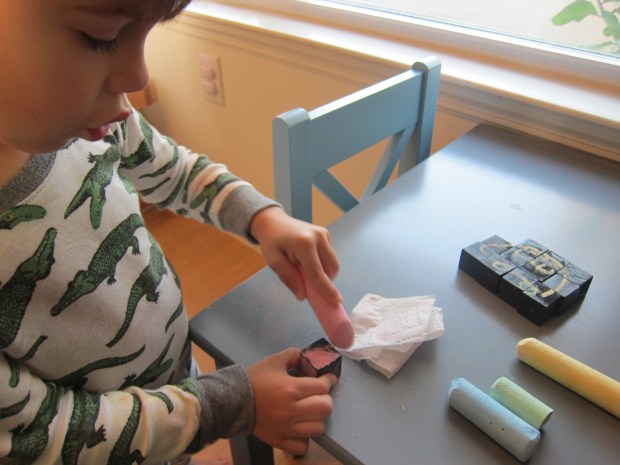
Even more fun was how easily they can erase with just a swipe of a wet paper towel, when you’re ready to change the design.

Chalkboard Puzzle (5)

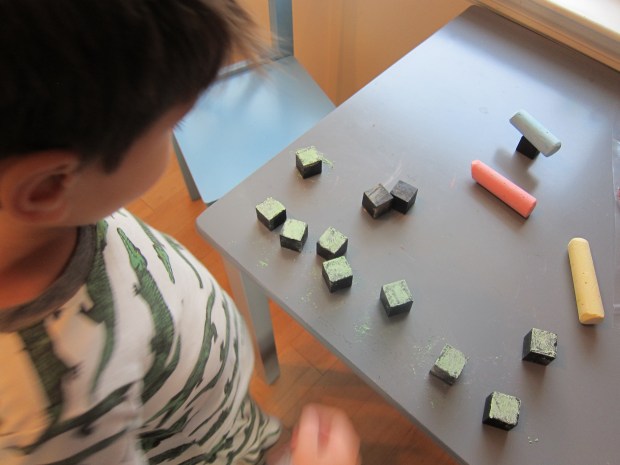
Here he is making a puzzle for mommy – hope I can figure out the right way to put all those green squares together!

Chalkboard Puzzle (9)

The perfect activity for any time you need to lie low.

Tape City

Tape CIty (8).JPG

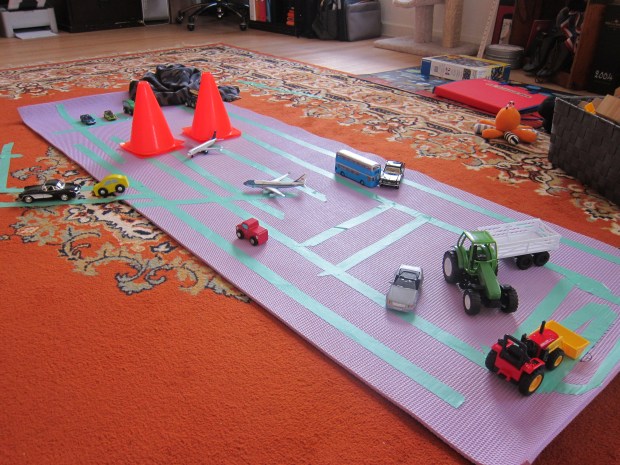
Tape + cars is one of those classic games that never goes out of style. Simply grab a roll of painter’s tape, and turn your floor or carpet into roads and cities. I used to make these roads for Travis when he was a toddler, but this was the first time I put him in charge, and the results were fantastic!

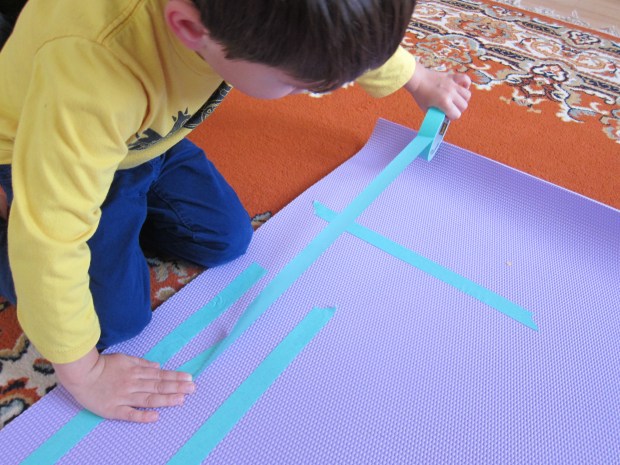
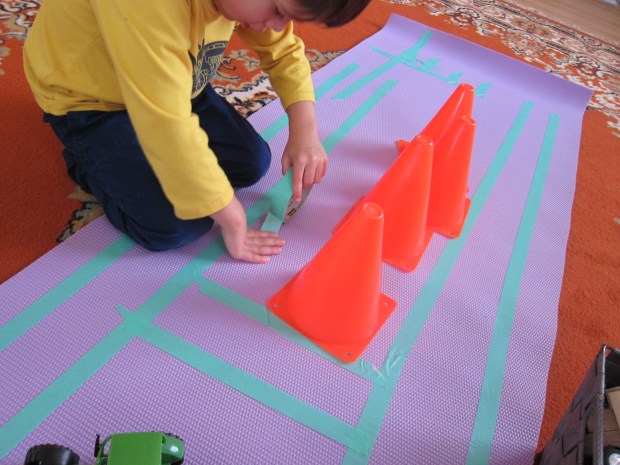
For starters, we decided to lay our city out on mommy’s yoga mat, which added a new feel to the game. Travis began with long roads, and loved unrolling the tape.

Tape City (1)

Then he decided the road ended at a restaurant, so we needed a parking lot.

Tape City (6)

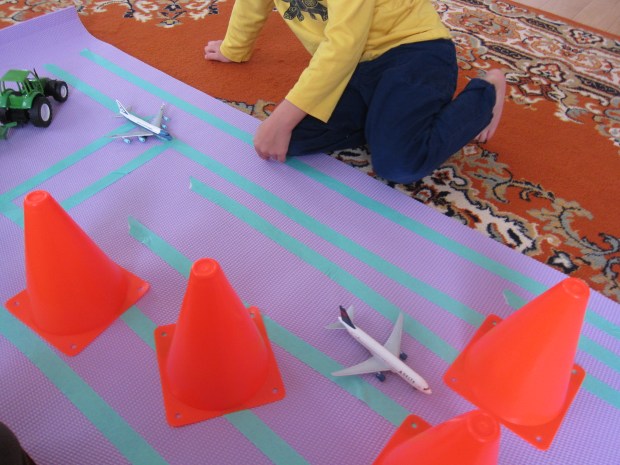
From there, his imagination was off and running! Soon we had an airport runway marked by cones…

Tape City (3)

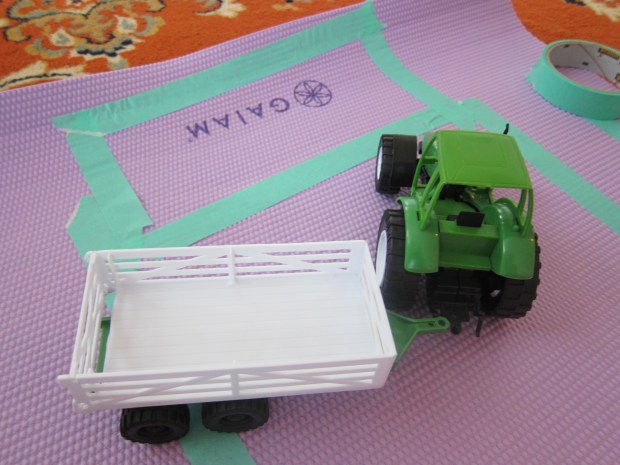
A farm…

Tape City (4)

And he even decided we needed a swamp! Uh oh, hope the cars don’t drive in.

Tape City (5)

He had fun making side streets (venturing boldly off the yoga mat!), which then turned into roads that were blocked off for construction.

Tape City (7)

The tape might not have been as neat or precise as a grown-up’s lay out would be, but I loved seeing his engineering and creativity at work.

Tape City (2)

What will your child add to their tape city? Please share in the comments!

Oatmeal Chocolate Coconut Chewy Cookies

Oatmeal Coconut Cookies (2)

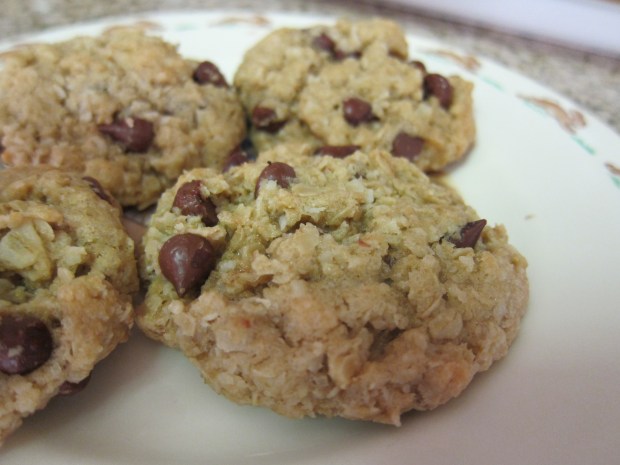
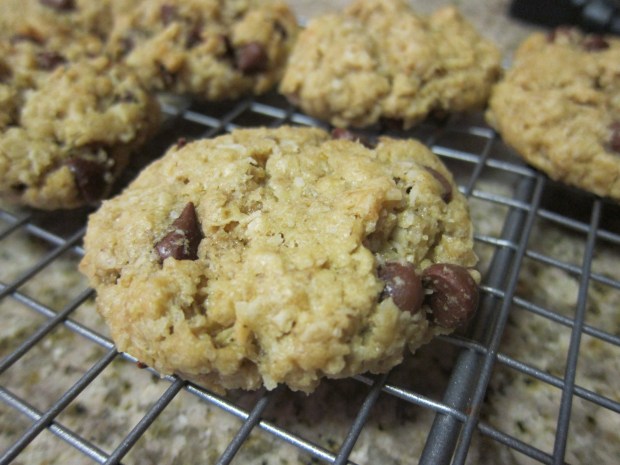
These cookies are absolutely loaded with yummy ingredients, a few of which you can feel good about (rolled oats, shredded coconut), making it a treat you won’t mind giving your kids. You could also add 1 cup walnuts or raisins to the mix, if desired.

Ingredients:

  • 1 cup Earth Balance butter
  • 1 and 1/4 cups brown sugar
  • 1/2 cup sugar
  • 2 Ener-G eggs
  • 2 tablespoons plain non-dairy milk
  • 2 teaspoons vanilla extract
  • 1 and 3/4 cups flour
  • 1 teaspoon baking soda
  • 1/2 teaspoon salt
  • 3 cups rolled oats
  • 2 cups non-dairy chocolate chips
  • 1 cup shredded coconut
  1. In the bowl of a stand mixer, cream together the butter, brown sugar, and sugar. Add the Ener-G eggs, milk, and vanilla; beat until combined.
  2. In a large bowl, combine the flour, baking soda, and salt. Add the flour mixture to the sugar mixture and beat until combined.
  3. Stir in the oats, chocolate chips, and coconut.
  4. Roll the dough into balls of about 1 tablespoon, and bake in batches at 350 degrees F for 12 to 14 minutes, depending on desired crispness. Let cool on the pans for 1 minute before transferring to a wire rack to cool completely.

Oatmeal Coconut Cookies (1)


Paper Bag City

Paper Bag City (7).JPG

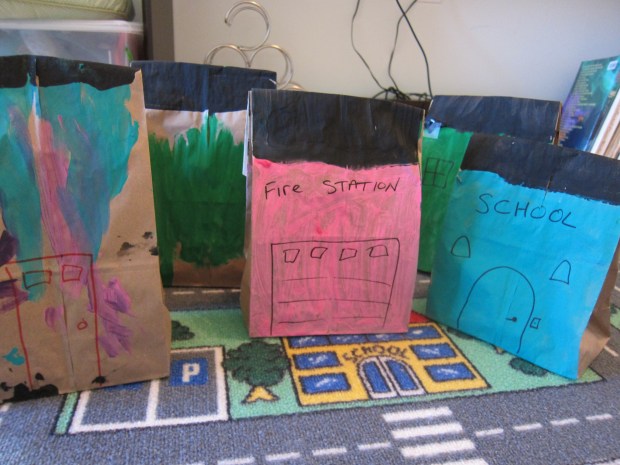
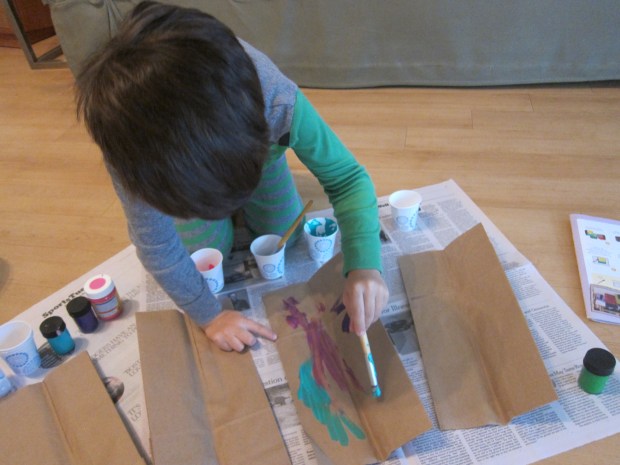
Following our fun with Koala’s city-themed crate, we constructed our own city at home, using nothing but extra paper lunch bags!

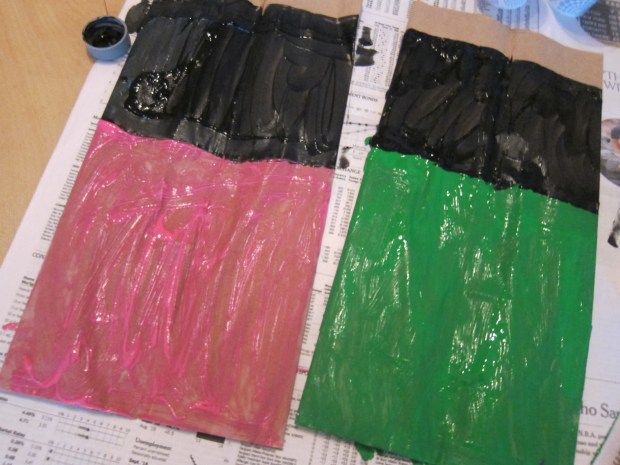
First, paint the bags to resemble buildings, with one color on the bottom, and black (or another second color) on top for the roof. This turned out to be more of a puzzle for Travis than I imagined, since he just wanted to paint the bags any which way. Providing a guiding line for him helped…

Paper Bag City (4)

…But the point is never perfection!

Paper Bag City (1)

I let him decorate a few houses to his own taste, and made a few others to add to our city. Let the paint dry completely.

Paper Bag City (2)

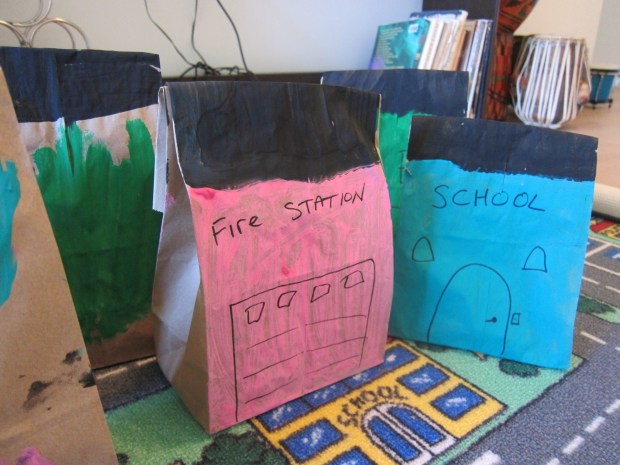
If your child wants to paint on features (doors, windows), they can do so. Instead, I added those later with permanent marker.

Paper Bag CIty (8)

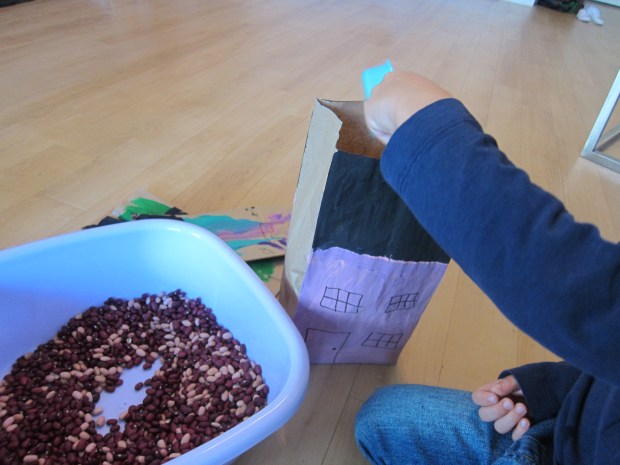
To finish your town, fill each bag with about 1 cup dried beans to weight it down. Fold the top edge over and tape into place.

Paper Bag City (5)

You can set the buildings up on a car playmat, or just on the floor. Bonus points for toy vehicles in your city!

Paper Bag City (10)

Since this particular city belonged to a four-year old boy, soon we had villains knocking down the houses… He sure does come up with games I never would imagine!

Paper Bag City (11)

What buildings will be in your town? Please share in the comments!

Cityscapes Crate

Koala City (16)

Our latest from Koala Crate was a kit all about “cityscapes,” which introduced great city landmarks (i.e. the Eiffel Tower), as well as the various buildings, modes of transportation, or shapes you might find in a city. The crate used buildings as a leaping off point to talk about colors, patterns, and geometric shapes, making this one of the more STEM-related kits we’ve received to date.

To wit, first up were City Building Blocks. This project is clever, of course – for what is a city if not built up of blocks? Cement, stone, brick, you name it. There are 9 blank wooden blocks in the crate and 9 sheets of stickers with which to cover them.

Koala City (2)

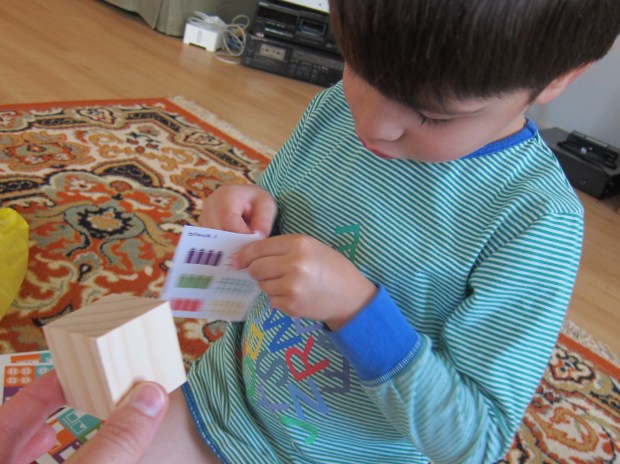
I was proud of Travis for latching onto the idea that each cube had six faces, and making sure to turn to an empty face before he added each new sticker.
Koala CIty (1)

Soon we had trees, walls, doors, windows, rooftops, and more. Your child can simply use the blocks to free-build a city…

Koala City (3)

…or use them in a more educational way. Can you construct an all red building? All purple? An alternating pattern? (We tested out: door, window, door, window etc.). You can also talk about the shapes within the blocks, although we didn’t do much of that.

Koala City (17).JPG

One note of caution: the stickers are a bit tricky to peel off, which may lead to a moment of four-year-old frustration… Hopefully easily diverted!

When Travis spotted the glitter paint in the crate, he couldn’t wait for the next two projects. Because glitter makes everything better of course.

Koala City (7)

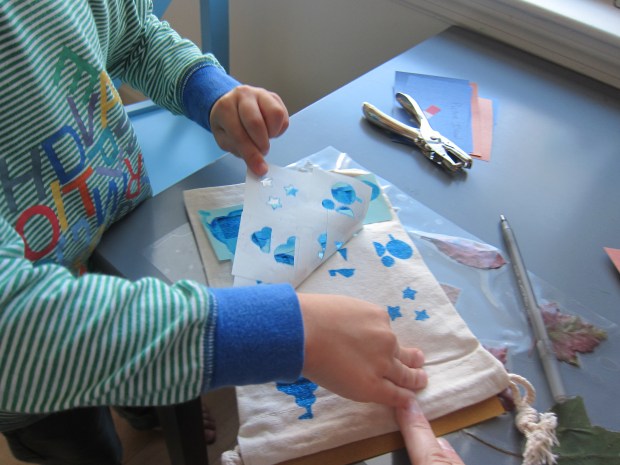
First, we decorated the Stencil Drawstring Pouch, which is fun as a project and then handy later to store the blocks in. Slip the provided wax paper into the provided drawstring bag to prevent the paint from bleeding through.
Koala City (4)

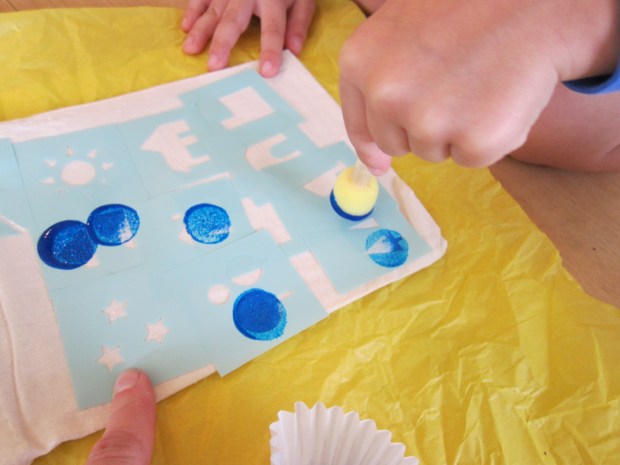
This project relies on stencil stickers. I paused to explain to Travis that the paint would go inside the blue lines, once I realized he was overlapping his shapes a little. He seemed fascinated by this, and most of our buildings turned out just fine. We talked about what went where in the layers of a city – buildings and trees on the bottom, rooftops in the middle, stars and clouds up top.

Koala City (5)

To paint, dip the provided sponge brush into the provided paint cup, and dab inside the blue lines.
Koala City (6)

Let dry for about one hour before peeling off the stencils and revealing your city.
Koala CIty (10)

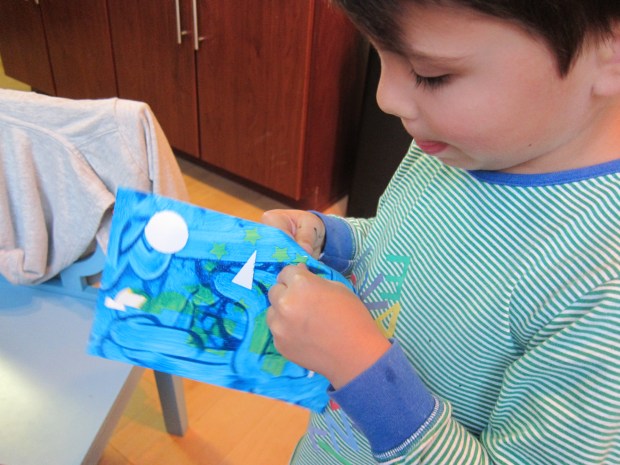
The final project, Skyline Paintings, employed the opposite method from stenciling (i.e. resist painting). I loved watching my engineer at work, talking about all the geometric shapes and what we could make from them: a house from a square and triangle, for example, or a bridge from a semi-circle and rectangles.

Koala City (8)

Then he grew creative and started inventing his own. And of course then there was the fun of paint dabbing.

Koala City (9)

Let the paint dry, then peel off the stickers. “How did it make the shapes?” Travis wondered, marveling at how his houses and towers looked once the stickers had lifted away.
Koala City (11)

We’d used up all the stickers, but took some extra time to make our own neighborhood, talking about what shapes we see near our home. Soon we had a cute collage – rectangle buildings, semi-circle driveways, oval ponds, square windows etc.

Koala City (15)

As you can see, this kit was heavy on the geometry, and on seeing and finding patterns. Happy kid, happy mama. Thanks Koala!

Koala City (13)

Slow-Cooker Curried Chickpeas and Quinoa

Curried Chickpea.JPG

Set the slow-cooker going in the early afternoon for this recipe, and it’s ready by dinner time. We love walking in the door to the smell of curry!

Ingredients:

  • 1 tablespoon olive oil
  • 1 cup chopped onion
  • 3 minced garlic cloves
  • 2 cups cauliflower florets
  • 1 (15-ounce) can fire-roasted tomatoes
  • 1 (15-ounce) can chickpeas, rinsed and drained
  • 1/2 tablespoon curry powder
  • 1 teaspoon ground ginger
  • 3/4 teaspoon salt
  • 1 (13.5-ounce) can coconut milk
  • 1 and 1/2 cups vegetable broth
  • 1 cup quinoa
  • 3 cups chopped kale
  1. Heat a slow-cooker to high and add the onion and garlic; cook for about 5 minutes.
  2. Add the cauliflower, tomatoes, chickpeas, curry powder, ground ginger, salt, coconut milk, and broth. Cover and cook on high for 3 to 4 hours.
  3. Stir in the quinoa, and cook for 15 minutes. Add the kale and cook for a final 15 minutes – the liquid should be mostly absorbed.

Pineapple Pumpkin (and More Pumpkin Fun)

Pineapple Pumpkin (8)

We had so much fun at the pumpkin patch this year; Travis needed to come home and carve one right away. We even sorted and saved the seeds for roasting (full recipe below). With our final three pumpkins, we got a little craftsier, putting together these three painting projects.

First up was Mr. Pineapple Pumpkin. Paint your pumpkin with a layer of yellow acrylic paint and let dry overnight.

Pineapple Pumpkin (1)

Once dry, I added upside-down V marks with a sharpie to mimic the exterior of a pineapple.

Pineapple Pumpkin (4)

Travis helped glue on two eyes, and we used dot stickers (cut in half and slightly overlapped on the top) for the mouth.

For the pineapple stem, attach two pieces of green sticky-back craft foam together, leaving a sticky overhang on either side. Cut leaf-like shapes into the foam. Attach one sticky portion to the stem, then wrap tightly and use the remaining sticky edge to hold the “stem” in place.

Deck out your pineapple fellow with a blingy pair of shades for the final touch!

Pineapple Pumpkin (5)

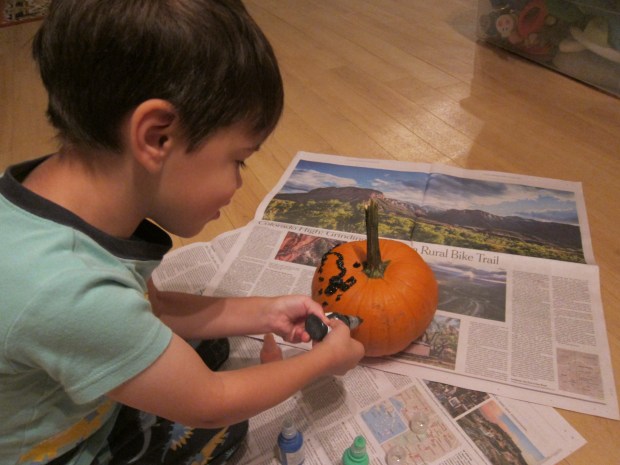
Needless to say, this particular pumpkin craft required significant adult help for a four-year old. For something he could do entirely on his own, I set Travis up with puffy paints and a whole pumpkin.

Pineapple Pumpkin (2)

He loved squeezing out all the colors, which almost looked like goopy spider webs.

Pineapple Pumpkin (7)

Kids who are too young to carve might also love attaching feathers to a pumpkin, or sticking on pre-cut foam shapes for a funny face. Many sets of facial features come available in craft kits, and Travis enjoyed selecting this goofy look.

Pineapple Pumpkin (6)

What pumpkins are adorning your stoop this year? Please share in the comments!

I’ll leave you with this easy pumpkin seed recipe:

Scoop seeds from 1 pumpkin (about 1 cup). Rinse well and pat dry. 

On a baking sheet, drizzle with 1 and 1/2 tablespoons melted butter and sprinkle with 1 teaspoon salt.

Roast at 200 degrees F for 40 minutes. Increase the heat to 325 degrees F and roast a final 5 minutes.


Leaves + Contact Paper = Fall Placemat

Fall Placemat (5).JPG

It’s been a rather disappointing autumn for leaf color in our neck of the woods, with oddly warm temperatures keeping the leaves stubbornly green. Happily, we returned home from a recent nature walk with enough leaves that had managed to turn shades of red, orange, and yellow, and knew we needed a quick project for them. Here we are on the hunt – it’s finally cold!

Nature alph (4)

If you want to make this a science project as well as an art one, talk about how the leaves stop producing chlorophyll this time of year, which reveals the hidden autumn shades under the green. I touched on the matter briefly, but really we were just happy to come home with pretty finds.

Fall Placemat (2)

To easily preserve your leaves, make this placemat:

Place a piece of contact paper, sticky side up, on a work surface. Travis got impish at first, and wanted to stick his hands to the paper a few times!

Fall Placemat (1)

Encourage your child to arrange the leaves in whatever manner they see fit, varying the shapes, size, and colors until they are happy with their arrangement.

Fall Placemat (3)

Seal the leaves by placing a second sheet of contact paper, sticky side down, on top. Trim to size and voila – you have the perfect fall placemat.

Fall Placemat (4)

If you have the inclination and enough leaves, go ahead and make several; these would make wonderful holiday placemats. For Thanksgiving decor, perhaps?

Fall Placemat (6)