Floating Toothpick Trick

Floating Toothpick (4)

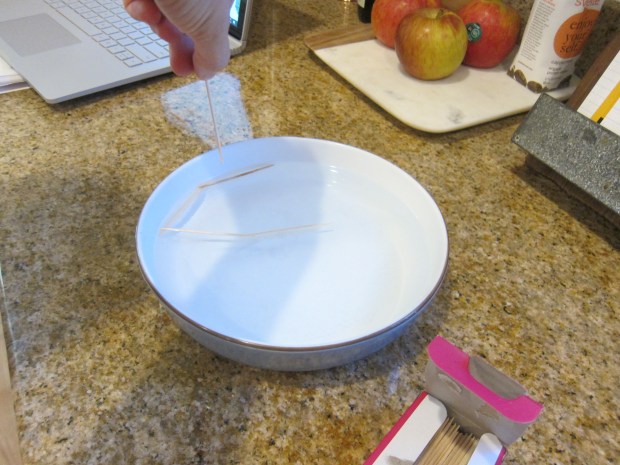
After learning about how water molecules help each other up the roots of a tree (just imagine cute water droplets holding hands!) Travis and I tried this fun way to break those same water molecules apart. All you need is a bowl and toothpicks! My kindergartner found it slightly naughty to break the bonds, meaning he thought this experiment was hilarious!

Floating Toothpick (1)

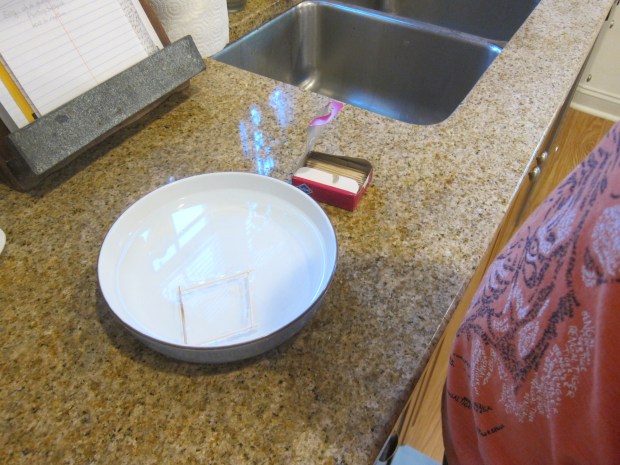
First, fill a shallow bowl with water. Wait for the water to be still, then very carefully arrange four toothpicks in a square. It helps to overlap them slightly, but not so much that they will stick together.

Floating Toothpick (2)

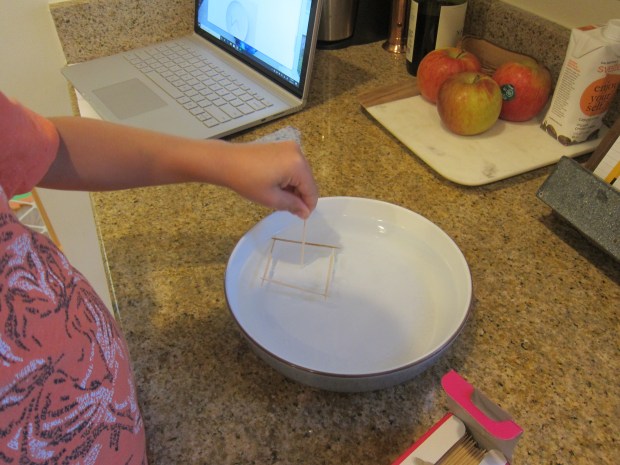
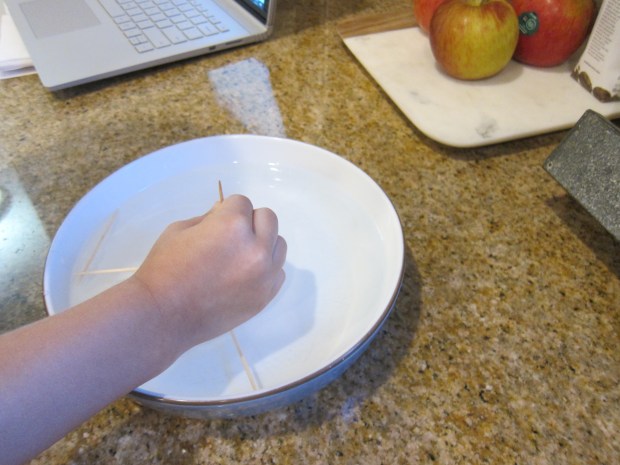
Dip a toothpick into the center of the square. Nothing happens! There is nothing to break up the water bonds.

Floating Toothpick (3)

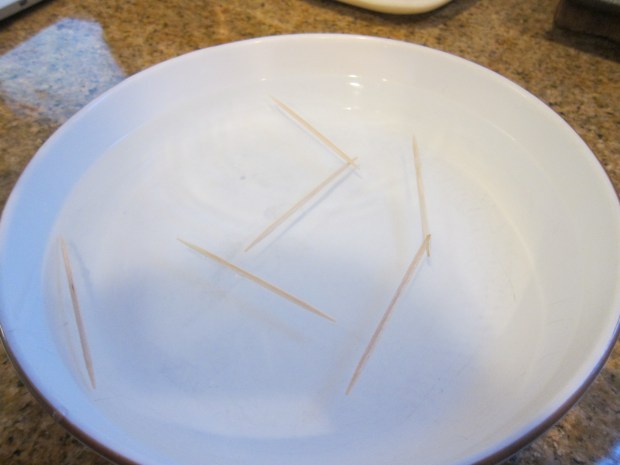
Now dip a second toothpick into dish soap. Dip into the center of the square and… the toothpicks run away from each other!

Floating Toothpick (7)

As stated above, Travis thought this was pretty hilarious, and he wanted to repeat with our toothpicks in different configurations. We tried a zig zag, although the results weren’t as pronounced.

Floating Toothpick (5)

So then we needed to repeat the square a few times (if you repeat, start with fresh water; once the water is soapy, the effect isn’t as pronounced).

Floating Toothpick (6)In sum, a very kid-friendly way to illustrate some big (or should I say, microscopic) scientific concepts!

Solar System Models

Planets alt

When you’re the only mom who gets her kid up and dressed and backpack packed and lunch made and head to the bus stop and then learn that the Friday before Labor Day is apparently also a day off from school… Well then whoops, you suddenly have a day to fill!

Luckily I had this little project from Raddish Kids up my sleeve, a chance to make two models of the universe: one tiny and one huge!

First I asked Travis what planet we live on. He correctly knew Earth, and was able to name a few facts about it, like how its watery.

Raddish provided a chart to name the other planets, all of which my budding astrologer could fill in. He proudly gave me a fact about each, which I wrote down (in glittery galactic pens, of course). Filling in the column with further questions about each planet was a bit harder for him to grasp, but big kids can write in any pending querries here, as well.
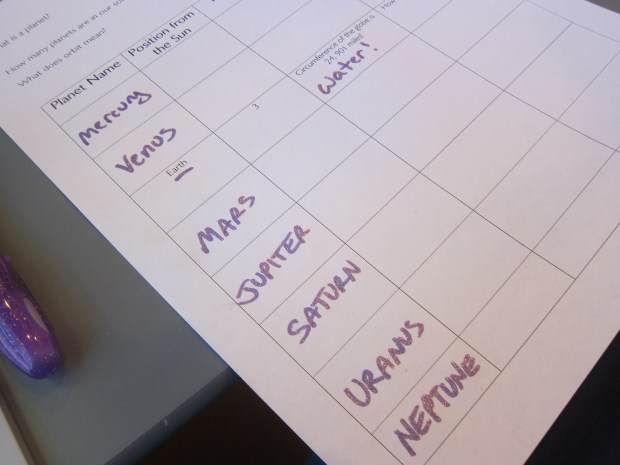
Planets (1)

After watching a suggested video that helped him fill in a few new facts about each planet, it was time to model!

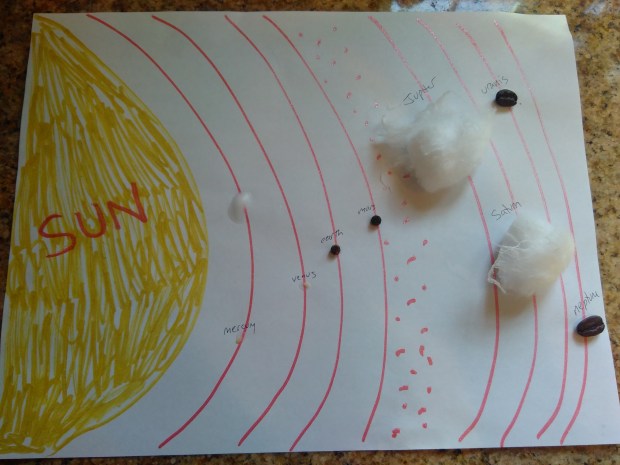
First up was the Tiny Solar System. I drew a half circle on the edge of a piece of white paper and labeled it as the sun. I drew 8 orbits, with an asteroid belt making a wide patch between the fourth and fifth lines.
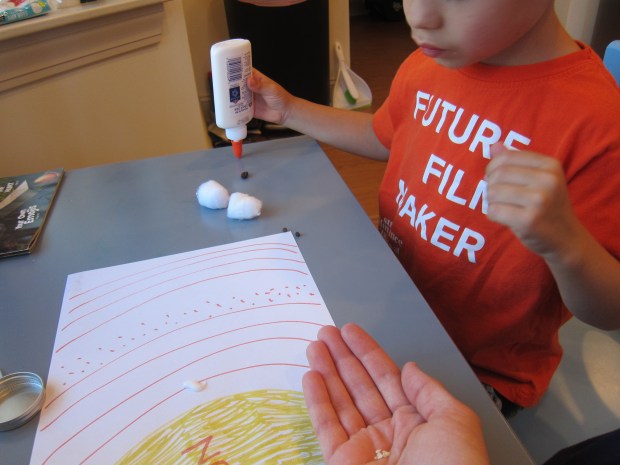
Planets (2)

For scale models of the planets, we glued on the following:

2 sesame seeds (Mercury and Venus)

2 peppercorns (Earth and Mars)

2 cotton balls (Jupiter and Saturn)

2 coffee beans (Uranus and Neptune)

Planets (3)

Note: the scale obviously isn’t exact, but the idea here is that the relative sizes of the planets (the enormity of Jupiter, the tininess of Mercury) become apparent. This model also didn’t show the distance between orbits to scale.
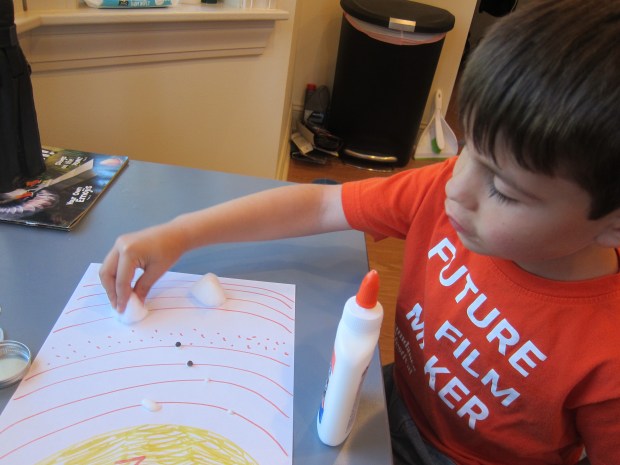
Planets (4)

Travis marveled at the tiny sesame seeds. In fact they were so small we could barely see them until the glue dried!

Now for the Large Solar System! We headed out to the playground with a bag full of balls in various sizes. Travis was very curious as I collected these from around the house, but was soon to see why.

I inflated a silly starfish to be the sun and put this right in the center of a baseball diamond. (Note: A beach ball would work, too, but I liked that the starfish was a sun/star shape).
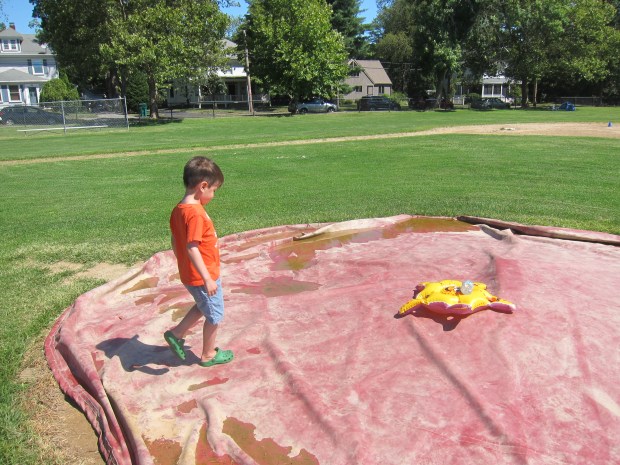
Planets (5)

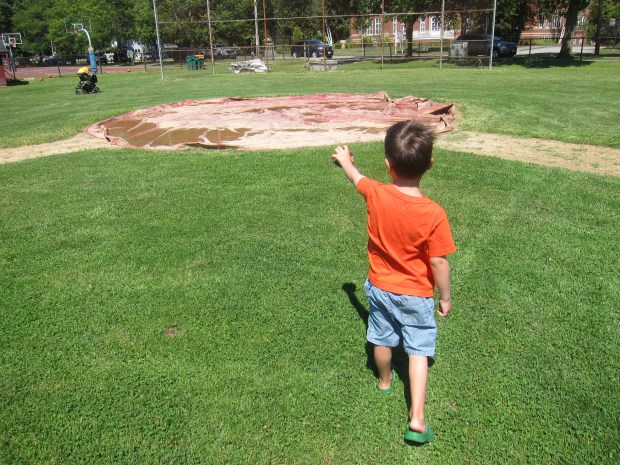
Next we walked out a full 78 steps from the sun holding a wiffle ball as “Neptune.” This took us right to the edge of the baseball field.
Planets (6)

Repeat with the following:

50 steps: wiffle ball (or tennis ball): Uranus

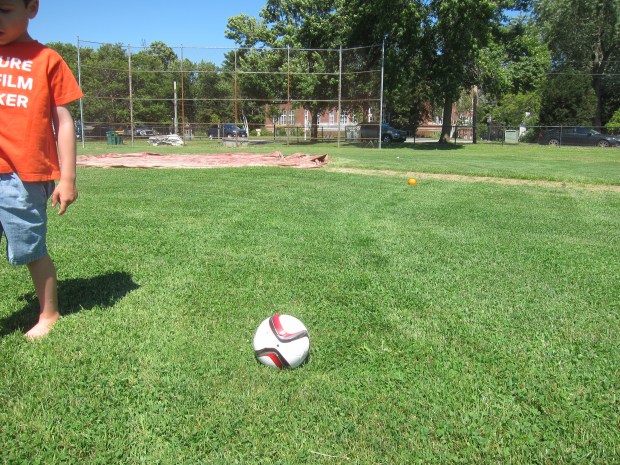
25 steps: soccer ball: Saturn

13 steps: basketball: Jupiter

4 steps: ping pong ball (or golf ball): Mars

3 steps: ping pong ball: Earth

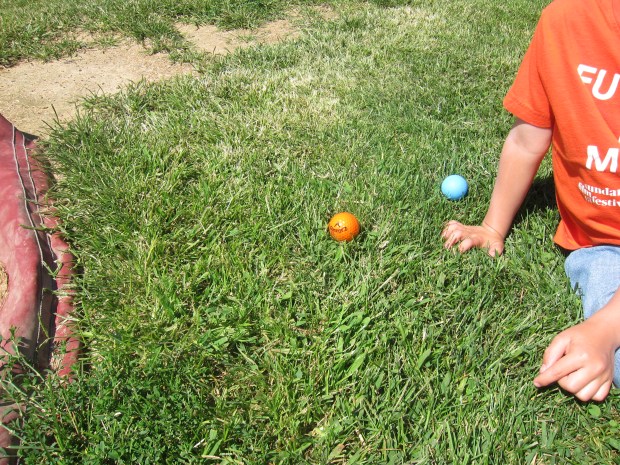
2 steps: marble: Venus

1 step: marble: Mercury
Planets (8)

This exercise is eye-opening even for a grown-up, revealing how truly close our rocky neighbor planets are, and how truly vast the distances are between the outer planets.
Planets (9)

I shared these fun facts with Travis to highlight the great distance across the baseball field. Each step we’d taken was equal to 36 million miles. A rover took 6 months to reach Mars, that “one step” away, but 12 years to reach Neptune! He seemed impressed, but then wanted to play soccer… There goes Saturn!

On the way home, we made up some corny space jokes.

How did Mars know what Venus was thinking? It red its mind.

Why was Jupiter so stinky? Because it passed gas.

Ha, what space joke will your kid create? Please share in the comments!

Planets (7)

Moon Crater Experiment

Moon Craters (9).JPG

Travis loves learning about the moon, and specifically how its craters were made. Okay, so this “experiment” isn’t exactly accurate, but your kids will have a blast launching “asteroids” at the moon surface to make holes!

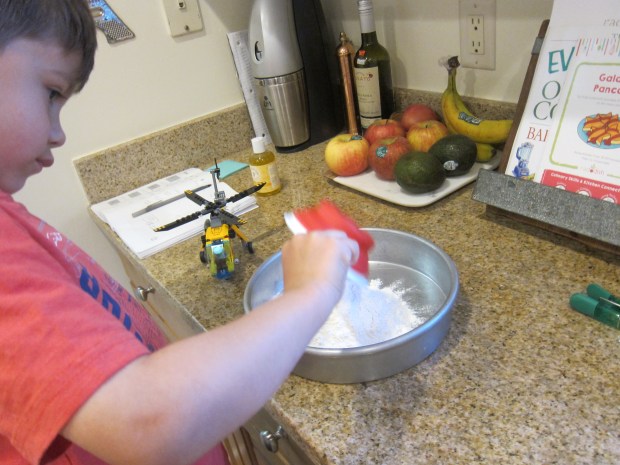
To make our moon, Travis first poured 4 cups flour into a cake pan.

Moon Craters (1)

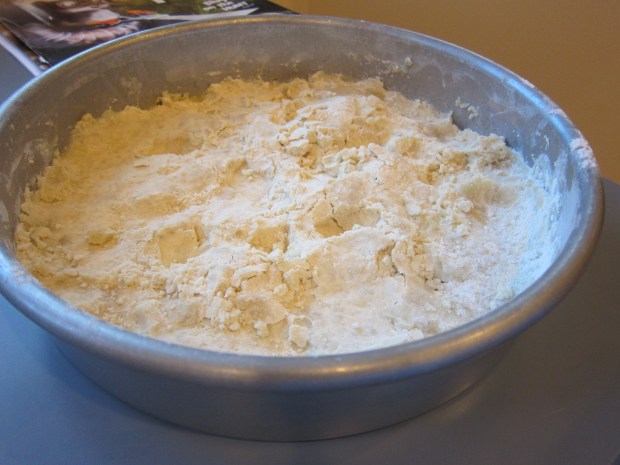
Add 1/2 cup baby oil and mix until the mixture holds together; we found that hands worked better than a spoon for this purpose. Now we had moon dust!

Moon Craters (2)

Next we headed outside to the “asteroid belt!” My proud astronaut discovered a trove of pebbles and very carefully selected some to bring inside.

Moon Craters (4)

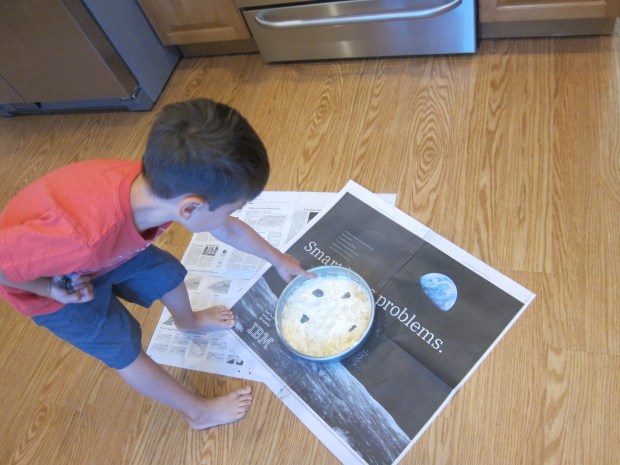
Place your moon cake pan on a layer of newspaper to avoid any mess. Wouldn’t you know, there was an ad featuring a view of Earth from the moon!

Moon Craters (7)

Travis began launching our “asteroids” one at a time.

Moon Craters (5)

He discovered that pressing the pebbles in a bit made a better crater than simply dropping them, and experimented with the difference between dropping them from up close versus up high.

Moon Craters (6)

That’s one small drop for a boy, one giant leap for imagination.

Moon Craters (8)

Bugs vs. Birds

Bugs v Birds (3).JPG

To slip some subtle math and science into your child’s next summer nature walk, turn it into a tally hunt for bugs and birds. I told Travis we’d be counting both, and asked him whether he thought he would find more birds or bugs. He quickly replied birds, but then thought about it for a moment; we passed a bunch of flowers, already teeming with five bees. “Bugs!” he guessed.

Bugs v Birds (8)

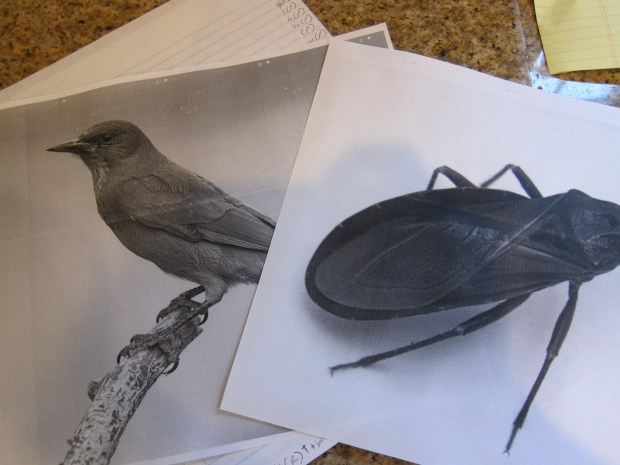
To prepare a little scientific notebook, print out a picture of a bug and a bird, and tape or glue down to notebook paper. Now you can tally as you walk.

Bugs v Birds (1)

This will also be a great lesson on tallying and making marks in groupings of 5 (good for skip-counting!).

Bugs v Birds (5)

As we walked, Travis sometimes forgot to count, since there was so much else to see. Eventually we decided he would look out for bugs, and I was in charge of birds.

Bugs v Birds (6)

It quickly became apparent that bugs were far more abundant…so much so we eventually stopped our tally at around 35. Although hard to see, the picture above shows two beautiful dragonflies perched on a limb.

In short, this game is a great way to get your little one noticing nature on a closer scale, as well as to think about the differing populations of species within an area.

Osmosis vs. Diffusion

Osmosis (11).JPG

The final lesson plan to go with Travis’s Backyard BBQ Raddish Kids kit was quite scientific and a little over a five-year-old’s head. But thanks to two yummy experiments, even my kindergartner could keep up with the concepts involved.

First, I came to the table with a cup of clear hot water and a tea bag. I put the tea in the cup and asked Travis what he observed happening. “It’s turning golden,” he noticed.

Osmosis (1)

I agreed, and more specifically told him he was seeing diffusion: molecules moving from an area of high concentration (close together) to low concentration (further apart). This actually wasn’t too foreign an idea for him, since he loves a book about Albert Einstein pondering molecules.

Explain to your child that osmosis is a specific case of diffusion, having to do with the movement of water molecules. Two suggested clips on diffusion and osmosis helped Travis understand a bit better, though to be honest, this part was over his head. To make it more accessible, you can give examples of each. Diffusion might mean:

the aroma you smell from a cake baking

food coloring dispersing in water

Osmosis might be:

wrinkled fingers in a bathtub

rehydrated dried fruit

Now it was time to experiment! For diffusion, I asked him what he thought would happen to a scent if we trapped it inside a balloon. Would we be able to smell it? His hypothesis was yes! We carefully added a few drops of vanilla extract to a balloon.

Osmosis (2)

Inflate the balloon and tie the end into a knot. Place it in a closed box and let rest for 10 minutes or so.

Osmosis (3)

When we lifted it out, the box smelled a bit like vanilla; in other words, the scent had diffused. The result was subtle, which I think underwhelmed Travis.

Osmosis (9)

You may want to leave your balloon inside longer, or put more vanilla in it, to wow your kids with the results.

Next up: osmosis! For this one, we tested out the affect on gummy bears of being in plain water, salt water, and no water.

Osmosis (5)

We filled out the provided chart with his guess for the results. After some prompting about those plump rehydrated raisins, he was able to surmise what might happen.

Osmosis (6)

Big kids can really get scientific with this, filling in measurements before and after for color, length, width, thickness, and mass.

Osmosis (8)

For the set up, you’ll need three clear jars. The first simply received a gummy bear. The second had the bear plus 1/2 cup plain water. The third had the gummy in a saturated salt solution; add 1 teaspoon salt at a time to 1/2 cup water until no more will dissolve.

Osmosis (7)

We left them overnight, then checked in on the bears the next morning! Again, the results were a bit underwhelming, which may have been the vegan gummy bears we were using. But our plain water one looked a bit more plump, and our salt one looked a bit scrunched.

Osmosis (10)

Well, if all else fails, you can watch this osmosis rap video!

Magnetic Hearts

Magnetic Heart (10).JPG

This quick craft not only teaches about the topic of symmetry, but is also a fantastic way to explore the properties of magnets!
To cut out symmetrical hearts, fold cardstock in half and draw half a heart; cut out.

Magnetic Heart (1)

I thought to only have Travis help cut out the accompanying two long rectangles we would need from each color of cardstock, but he insisted on cutting out the heart himself – great practice along curves!
Magnetic Heart (2)

Open up the paper to reveal a symmetrical heart, then cut it in half.

Magnetic Heart (4)

Fold the rectangular strips you’ve cut out accordion style to form 5 pleats.

Magnetic Heart (5)

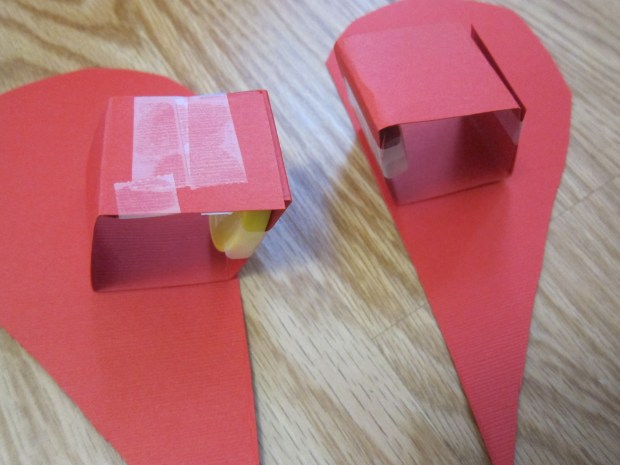
Fold this strip around itself to form a square and use tape or glue to adhere shut.

Magnetic Heart (6)

Tape a magnet to one side of the square, facing towards the center of your heart.

Magnetic Heart (7)

Tape down onto the heart and repeat on the other side.

Magnetic Heart (8)

Now, your two heart halves will snap together!

Magnetic Heart (9)

The other fun way to do this is to deliberately set up the magnets to repel each other. Travis loved chasing halves of hearts around the play room this way!

Magnetic Heart (13)

As you play, have a quick talk about attraction and repulsion in magnets, and you’ll have thrown a little learning into the fun.

Magnetic Heart (12)


Water Work

Water Work (6)

This easy experiment will teach your preschooler or kindergartner about evaporation in an easy to see, hands-on way. Plus get you out into the sunshine each morning!

Travis filled two equal containers with 1 cup water each. We made sure to measure carefully before pouring, so our results would be accurate.

Water Work (1)

We screwed the lid tightly on one container but left the other container open. Place them somewhere that gets direct sunlight.

Water Work (2)

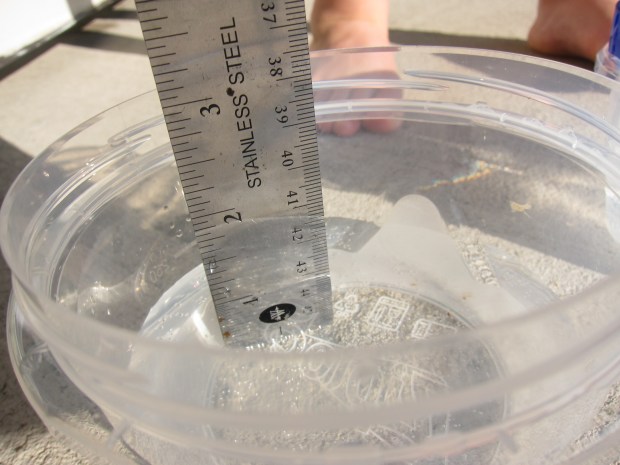
Each morning for a week, we headed out and measured the water. On the first day, the difference wasn’t that great, 1.5 inches of water in the lidded container, versus 1 inch in the open one.

Water Work (3)

By the next day, the results were 1.25 inches in the closed container (some had condensed on the lid!) versus only .75 inches in the open.

Water Work (5)

I asked Travis where the water was going and he correctly understood that some was evaporating into the air each day.

We continued to check on subsequent days, until a final reading of .25 inches in our open container. As a final component, Travis drew what had happened, showing a very full closed container and only a small layer of water in the open one. Those are three hot orange suns boiling off the water at the top!

Water Work (7)

A fantastic STEM/STEAM project for your summer!


Pollinators for Every Flower

Pollinators (11).JPG

The final lesson plan for the Garden Party kit from Raddish Kids was a huge hit, since Travis loves bugs and everything about them. He was a whiz already at much of this topic, but enjoyed the hands-on and artistic aspects of it!

When he came to the table for our lesson, he was surprised to find a flower waiting.

Pollinators (1)

We explored the flower in detail, including: rolling the leaves between his fingers to see how that changed the texture; smelling it; feeling the fluffy petals; and looking closely with his eyes.

Pollinators (3)

As he explored the flower, I read to him from a provided chart about plant anatomy. Much of it was a bit over a preschooler’s head, so focus on the bits your child will grasp. He liked the rather astounding fact that while people and animals are either a man (male) or woman (female), a plant is both!

Pollinators (10)

Some pollen ended up on the table… the perfect segue-way!

Pollinators (2)

I asked him to name pollinators he knew and he quickly rattled off butterflies and bees. After some prompting, he also guessed birds. I told him he was correct, especially hummingbirds, and then named a few surprises: bats, beetles, and the wind!

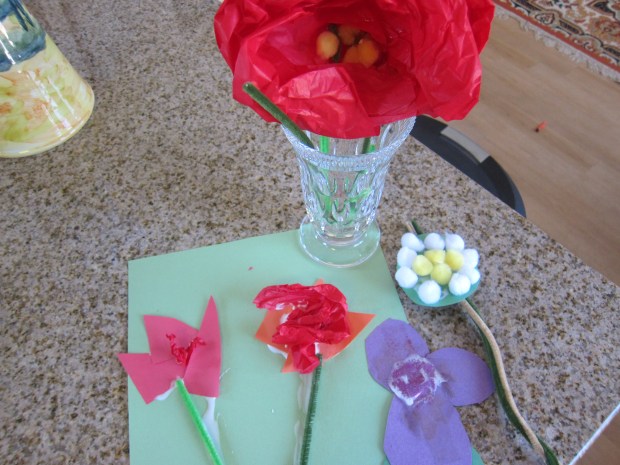
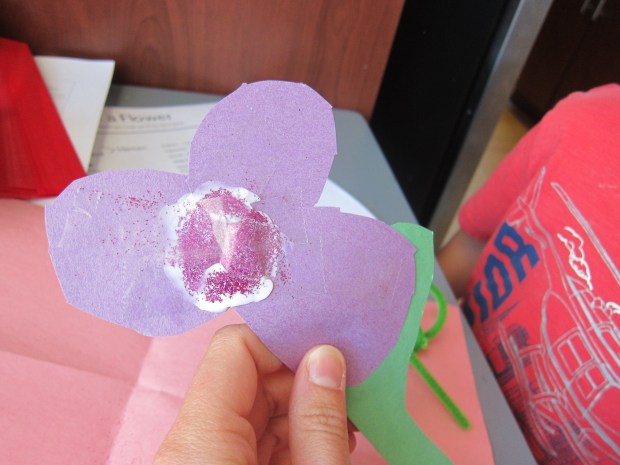
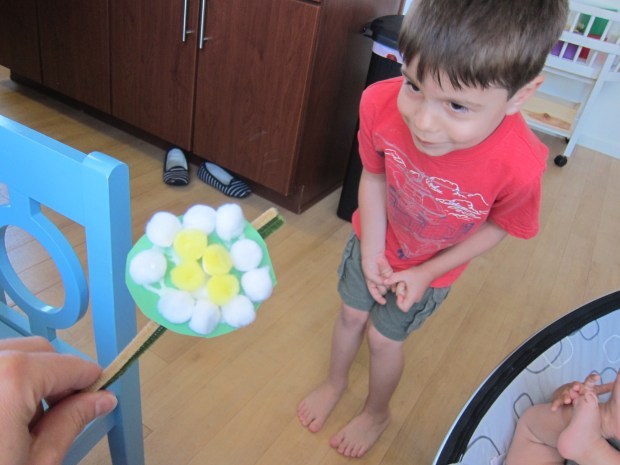
The next challenge was to pick a pollinator and make a flower with art supplies that was specific to that pollinator. First up was a bee! Thanks to the provided pollinator profile cards from Raddish, we learned that bees like flowers that smell sweet and in bright colors like yellow and purple.

Travis chose construction paper for this flower, and added glittery “pollen” in the center. To make it smell sweet, we dabbed a vanilla extract-scented pom pom around the petals. Travis loved this!

Pollinators (6)

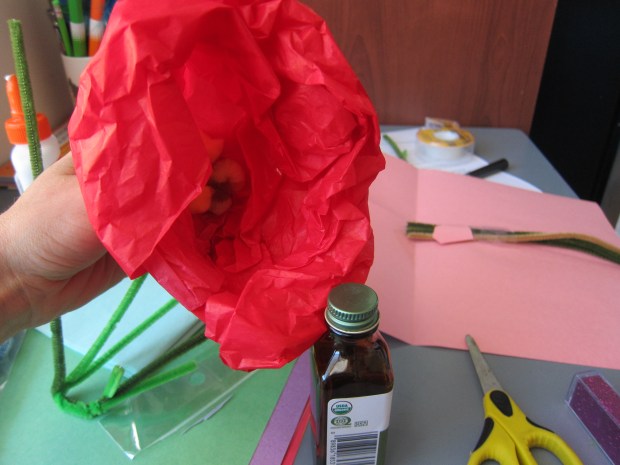
Next he wanted to make one for a hummingbird. Our card said the birds don’t land on the petals but instead dip in their beaks, so I helped him fashion a tube-shaped flower from tissue paper (we used red, since the birds like the bright colors). It was fun to add vanilla to the “pollen” pom poms in this one, too, even though the profile card said the birds had good vision but a poor sense of smell.

Pollinators (5)

Travis next wanted beetles, delighting in the notes on the card that they like “unpleasant” smelling flowers or ones with no scent. We used white pom poms, since beetles prefer pale or dull colors, and added lots of yellow pollen in the center, which the beetle eats.

Pollinators (7)

He was so proud! I loved watching him think carefully about each pollinator, as well as use different materials each time.

Finally, he wanted a flower for butterflies! This one needed petals for the butterfly to rest on, bright reds and oranges, and no vanilla extract since the butterfly has good eyesight but a poor sense of smell.

Pollinators (9)

Overall, a fantastic lesson, with a little bit of art, a little bit of science, and important information about the role pollinators play in food crops thrown in there.

Flying Paper, Two Ways

Flipping Fish (6)

Here are two fun ways to harness the power of paper and watch things take flight.

Both of these projects are far less involved than the rockets and planes Travis and I have made recently, but sometimes you just need something simple to fill a lazy morning.

First we made a school of  “flipping fishies”.

Flipping Fish (2)

Draw rectangles on white paper and color in. The more colors the better!

Flipping Fish (3)

Cut out the rectangles, and cut a notch on each end, facing in opposite directions.

Flipping Fish (4)

Slot these notches together and you have fish. Soon we had mommies, daddies, and baby fish.

Flipping Fish (7)

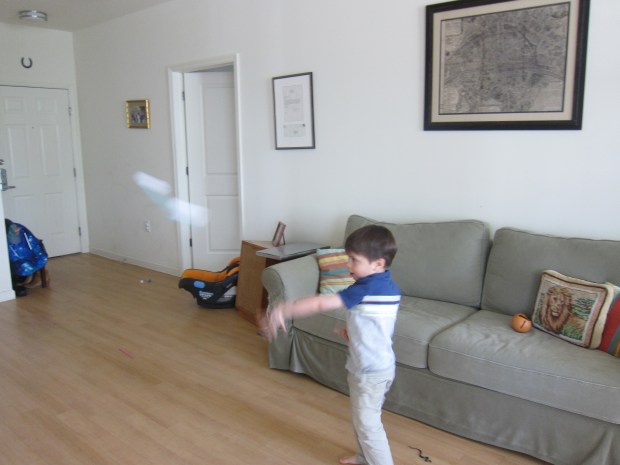
Toss them in the air and watch them whirl!

Flipping Fish (5)

Interestingly, we discovered that our baby fish swirled much better than the bigger ones we made.

Flipping Fish (8)

Next up, we did a repeat of a flying straw we’d made recently with a Kiwi Crate; as with our repeat of the Balloon Rocket, this time we used wide (“milkshake”) straws for better effect.

Cutting out rectangles was great practice for Travis to cut in straight lines!

Flying Straw (1)

For each straw, make one long rectangle, and one short; tape these into circles, and tape onto the straws.

Flying Straw (2)

Hold your straw so the small circle is at the front – and let it soar!

Flying Straw (4)

Those paper circles really catch the wind, and will carry your straw across a room. It’s fun to compare these to a plain old straw, which nose-dives right down.

Flying Straw (5)

Happy flying!

Paper Parachutes

Paper Parachutes (3).JPG

Travis and I recently made fabric parachutes that were a bit complicated and tangled easily while soaring down. Today we wanted something simpler, because the goal wasn’t so much about the parachute itself as it was to test how to make a parachute fall faster.

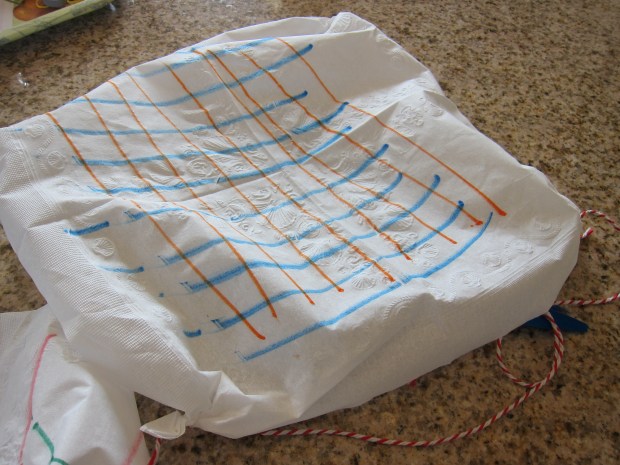
For our experiment, we quickly put together paper napkin parachutes.

Decorate your napkins with markers first.

Paper Parachutes (1)

Travis quickly learned that you need to be gentle drawing on napkins, and was proud when he got the hang of it!

Paper Parachutes (4)

Cut 4 equal lengths of string for each parachute, and tie around the napkin corners.

Paper Parachutes (2)

Gather the four lengths of string together in the center, and tie around any small object. Our “contestants” were a feather and a rock. But if you want, multiple toys can get in on the action; this game would be great with Lego people!

Paper Parachutes (5)

Travis made his hypothesis: that the rock parachute would fall faster than the feather one.  So we headed outside to test it out! A fenced-in overlook made the perfect launch site.

Paper Parachutes (6)

Even in a still photo you can see the feather parachute lazily drifting down as the rock plummets to the ground.

Paper Parachutes (7)

The difference here was extremely stark, of course. As mentioned, your kids might want to do multiple launches with items closer in weight. Enjoy the discoveries!