Ooey-Gluey Colors

Ooey Gooey Colors (5).JPG

It’s not often that I find an art project for my 5-year-old that feels refreshingly new. This artsy idea from Highlights magazine had definite goo factor that appealed to him!

First, drip school glue all over the clear acrylic cover from an empty photo frame. We used an 8×10 frame for maximum work space.

Ooey Gooey Colors (1)

Drip food coloring over the glue, ideally with some restraint, although Travis loved making big puddles of color.

Ooey Gooey Colors (2)

Finally, use a paintbrush to smear it all together.

Ooey Gooey Colors (3)

The colors will swirl and mix in neat ways and make little bubbles on the acrylic. This is a fun chance to experiment with different brushstrokes.

Ooey Gooey Colors (4)

Let dry completely, then insert back into the photo frame (gooey side in) for instant art. These look particular pretty when the sun hits them through a window, acting almost like a suncatcher.

Sensory Play with Frozen Veggies

Edible Frozen Veggies (3)

Not only is this game great for toddler sensory fun, it doubles as a comforting way to soothe all those teeth coming in. Veronika is currently getting 8 new chompers, in addition to the 8 front ones she’s already got, which made the timing just right.

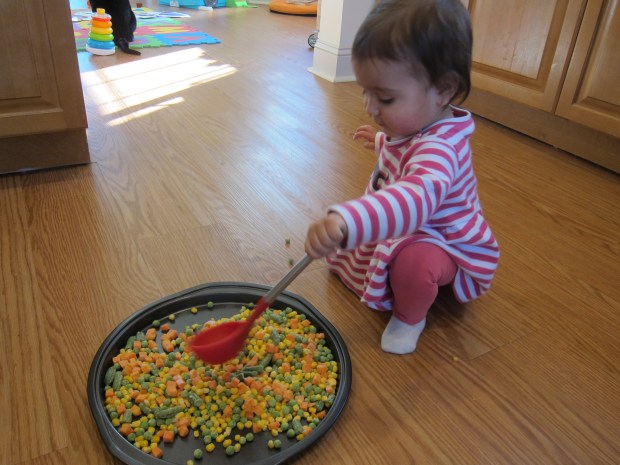
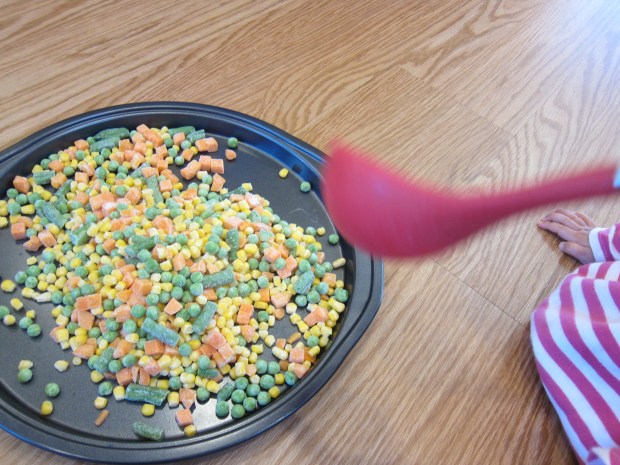
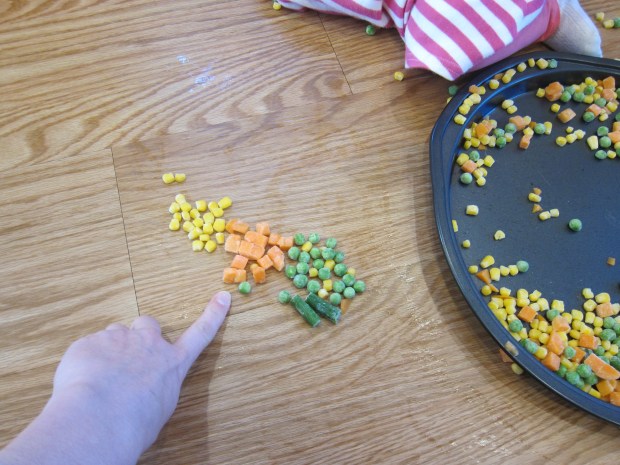
To play, I simply opened up a bag of frozen mixed vegetables and emptied them onto an pizza tray.

Edible Frozen Veggies (2)

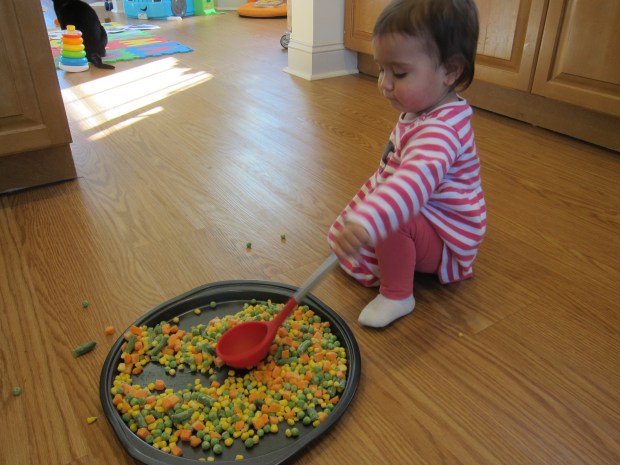
I added a big ladle for her to scoop with, but the lip of it was too tough to get under the veggies, so soon we switched to a regular dinner spoon.

Edible Frozen Veggies (4)

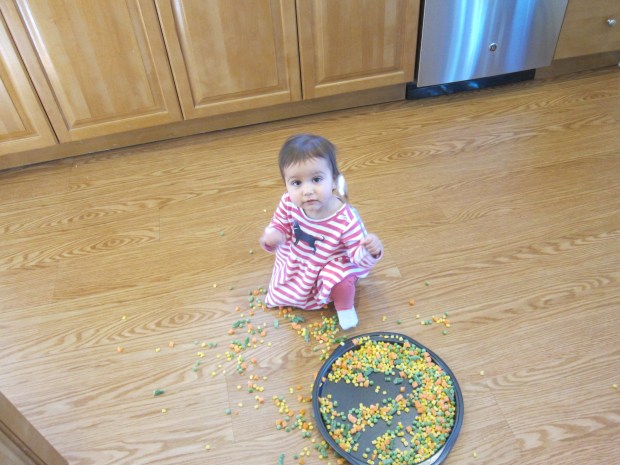
She took it from there! She loved the sound that the spoon made in the pan, shoveling through the veggie pile, and of course pushing them to the floor.

Edible Frozen Veggies (5)

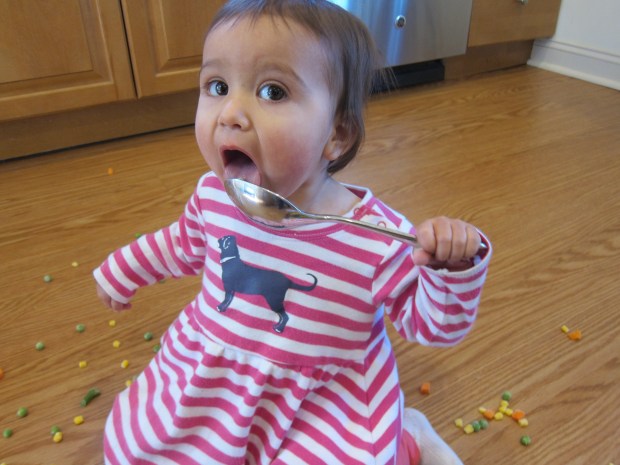
The small carrots, peas, and corn will thaw pretty quickly, but remain cold enough to soothe, which means she was thrilled when she lifted the spoon to her mouth and got a taste.

Edible Frozen Veggies (7)

This became an impish game, testing if mommy was going to chide her for eating her “toys”. Not this time!

If you want to throw in some quick learning, talk about the colors of the different veggies!

Edible Frozen Veggies (6)

Mostly, though, I let her play solo; the veggies kept her happy on the kitchen floor for almost a half hour, a big win in my book!


Flashcards in Envelopes

Flashcard Envelopes (7).JPG

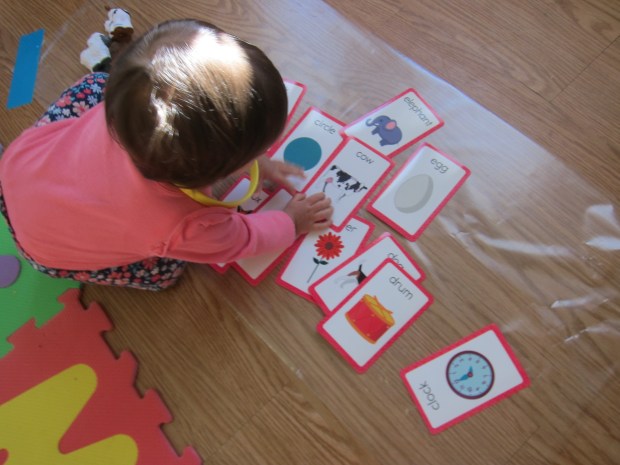
I spotted this game online and found it a delight in so many ways. It works fine motor skills for toddlers (taking flashcards in and out of envelopes), requires no fancy materials, keeps your tot busy for ages, and doubles as a lesson on word recognition. If you don’t have a set of flashcards, consider investing in some. You can play this game now, and use them with a beginning reader far down the road.

Flashcard Envelopes (2)

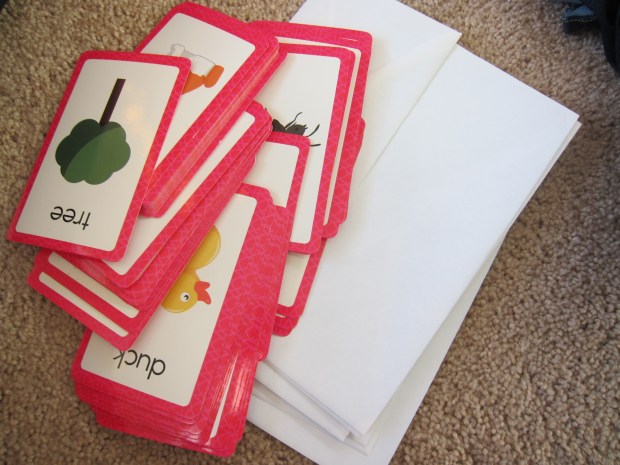
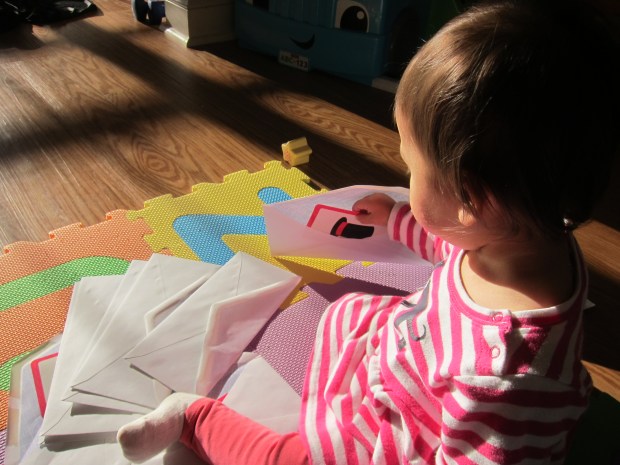
To play, I simply put about 10 flashcards into empty business envelopes. If your toddler is closer to 2 years old, consider sealing them shut. For Veronika, I left them easy to open.

Flashcard Envelopes (1)

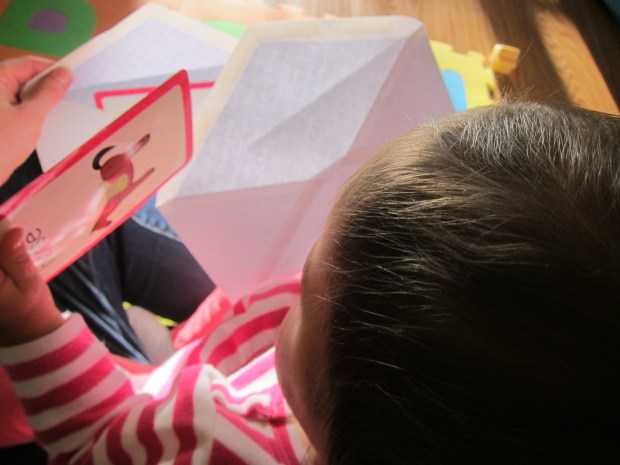
She started out sitting on my lap, as I showed her how to lift the envelope flap and remove the card inside.

Flashcard Envelopes (3)

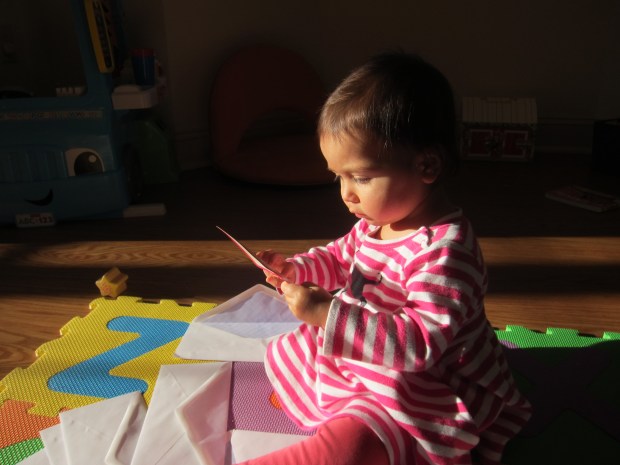
Soon she was concentrating hard on fitting the cards back in again.

Flashcard Envelopes (4)

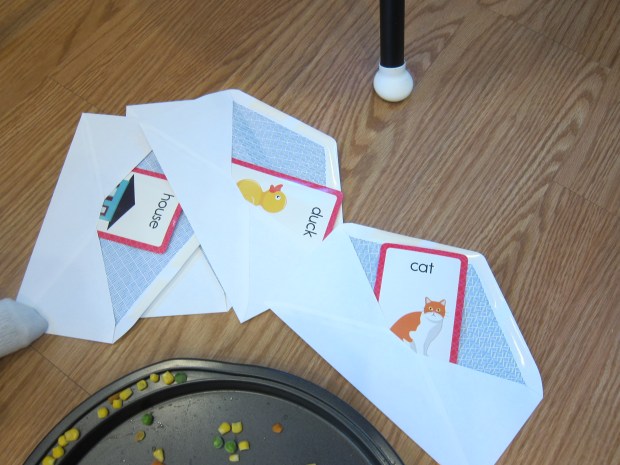
Once she had mastered the mechanics of this, she started to pay more attention to the pictures on the cards. I had deliberately used some that are her early words, and she happily said or signed them to me.

Flashcard Envelopes (5)

Hat! Duck! Cat!

Flashcard Envelopes (6)

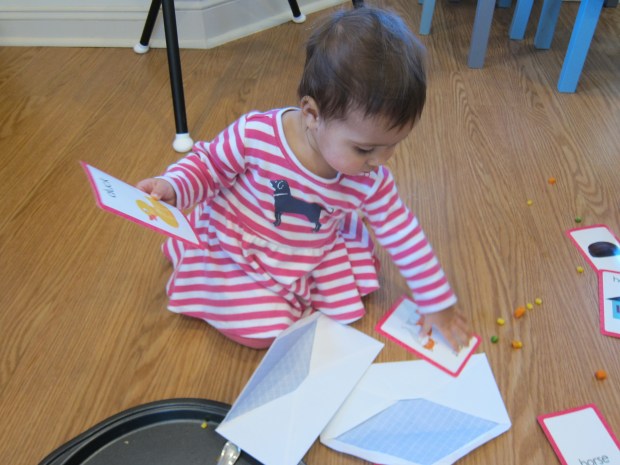
Once she got tired of that, there was simply a big heap of fun envelopes and cards to play with for a while, making this activity great for self-entertainment.

Flashcard Envelopes (8)

My Beautiful Balloon

My Balloon (6)

Veronika had so much fun with a balloon recently that today I treated her to another, this time the small Mylar kind, but we turned it more into a game of cause-and-effect. These little balloons are perfect for multiple games, all of which encourage hand-eye coordination, too.

She immediately discovered that, when released from her hands, the balloon skittered away from her. This led to an excellent time giggling and chasing it around the house.

My Balloon (1)

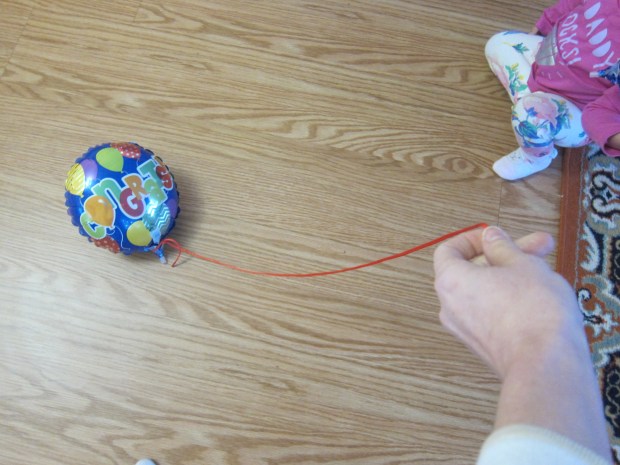
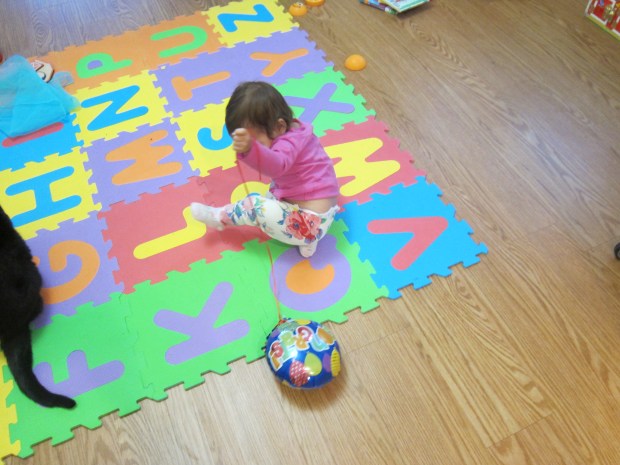
To avoid frustration, next we tied on a string. I towed it along behind me and she gave chase on hands in knees.

My Balloon (2)

Then it was her turn to tug it along, soon her endless companion in loops around the house.

My Balloon (3)

The best fun was dropping it from a height and bopping it back in the air. She roared with laughter.

My Balloon (4)

Lie your toddler on his her or her back for the best view!

My Balloon (5)

Bubble Fun

Bubble Fun (3)

My new favorite thing in the world is Veronika’s first full sentence: “Bubbles, please please.” As a result, I’m constantly trying to meet this adorable demand, with bubbles in the bath or during playtime. We quickly ran through a bottle of store-bought bubbles so I tried these two recipes at home. Both are so easy, and toddler-friendly to boot.

Bubble Fun (1)

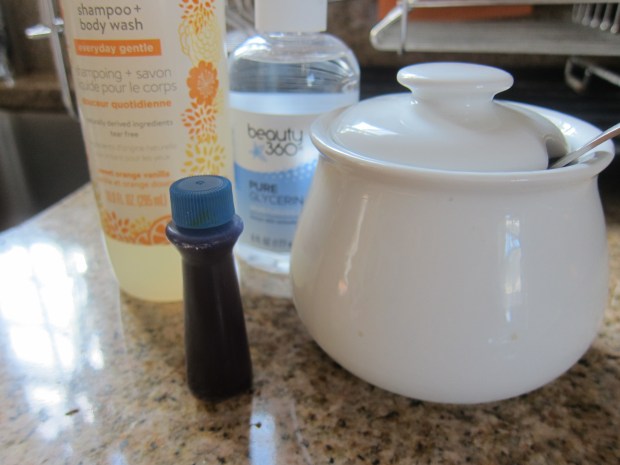
Bubbles 1:

  • 1/3 cup baby shampoo
  • 1 and 1/4 cups water
  • 2 teaspoons sugar
  • 2 drops blue food coloring

This nice mild formula blows great bubbles that you can also catch on the wand without popping them. The added bonus is that it will be tear-free if any solution gets in the eyes.

Bubble Fun (4)

Bubbles 2:

  • 1/4 cup dish soap
  • 1/4 cup glycerin
  • 3/4 cup water
  • 1 tablespoon sugar

This version makes stronger bubbles, which float high up in the air, and they will leave behind little strands of popped sugar when popped just right (you may have noticed that the sugar-based bubbles at a Gymboree class act the same).

Bubble Fun (7)

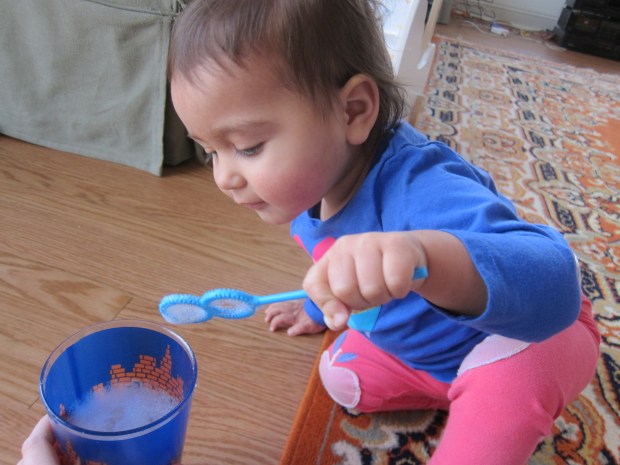
Veronika was not content to watch me blow the bubbles; she wanted to take charge, dipping the wand in and out.

Bubble Fun (5)

Older toddlers will no doubt want to practice their blowing skills, too.

Bubble Fun (6)

Needless to say, you can’t go wrong with bubbles.

Toddler Bath: Mess and Clean

Bath Crayons (1)

Here are Veronika’s two current favorite games in the tub, at fourteen months old. One involves making a mess.. .and the other involves clean-up!

First up is bath crayons. Whether you’re using crayons or tub-safe finger paints, and whether they are store-bought or homemade, making art in the tub fascinates kids this age. The marks appear as if by magic on the white tub walls, and then wash off with one swish of the water.

Bath Crayons (2)

You can just set your artist free to make swirls or have fun helping your little one by drawing objects (boats, the sun) or drawing letters and shapes.

Bath Crayons (3)

For some clean up fun, we love to take toy cars into the tub! I showed Veronika how to use a washcloth to scrubby scrub scrub on the cars.

Wash Cars in Tub (1)

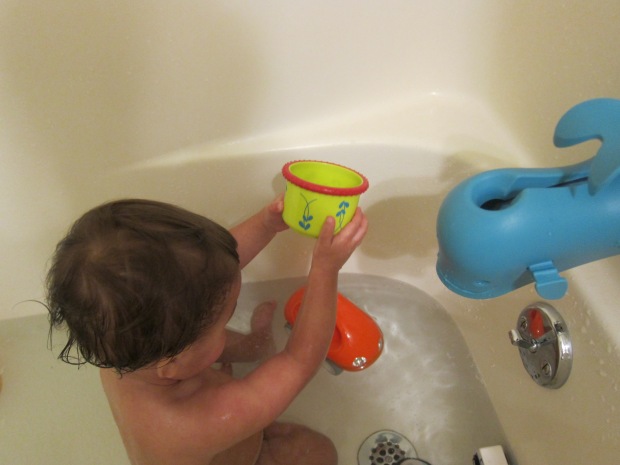
She loves to take a cup of water and pour it over them (cause and effect!) to help rinse the cars off.

Wash Cars in Tub (2)

Both of these are simple but turn a regular bath time into true play time for your tot.

Books for the Car

Cloth Book (4).JPG

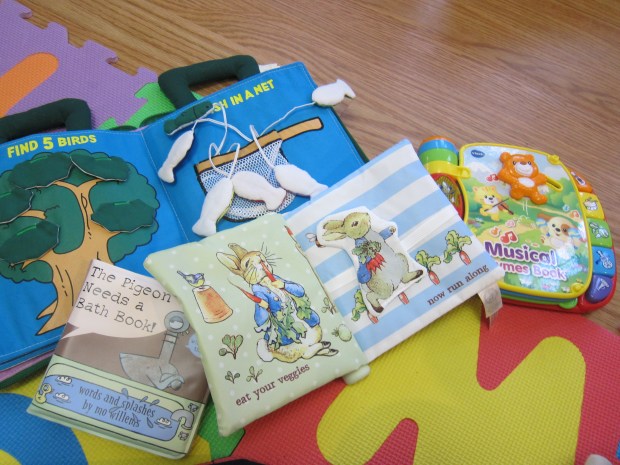
I thought it was worthwhile to do a post about books that keep Veronika entertained in the car, as she hits fourteen months old. I’ve found that while she won’t spend much time with books at home, she’ll flip through these solo in her car seat, often for quite some time! Here are a few varieties that really do the trick.

First up: cloth books. She has one I love that features a different number on each page, and items to manipulate in different ways (four slices of pizza, six fish, etc.). Another favorite tells the (much abbreviated) tale of Peter Rabbit, with bunnies to slide and flaps to lift, all in soft cloth. These are great for the car because they double as sensory material in addition to the visuals.

Next up: bathtub books are surprisingly great in the car since the texture is novel and the pages beg to be turned.

Cloth Book (2)

We love to giggle over The Pigeon Needs a Bath, even if she doesn’t “get” the story yet.

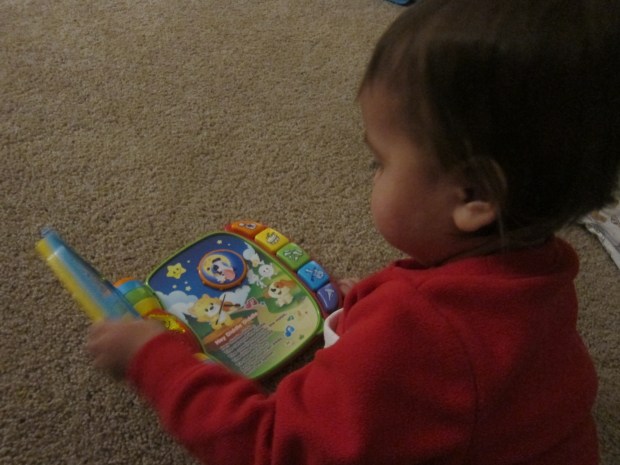
Finally, musical books. Although I’m not a fan of them in the house, books that make a lot of noise can be just the ticket for car entertainment. We love V-Tech’s Musical Rhymes Book that sings the words on each page, plus features buttons with instruments or colors.

vtech (3)

What does your toddler love in the car? Please share in the comments! Note: All photos were taken outside of the car for safety’s sake, of course.

vtech (1)

Silly Photo

Silly Photo (1)

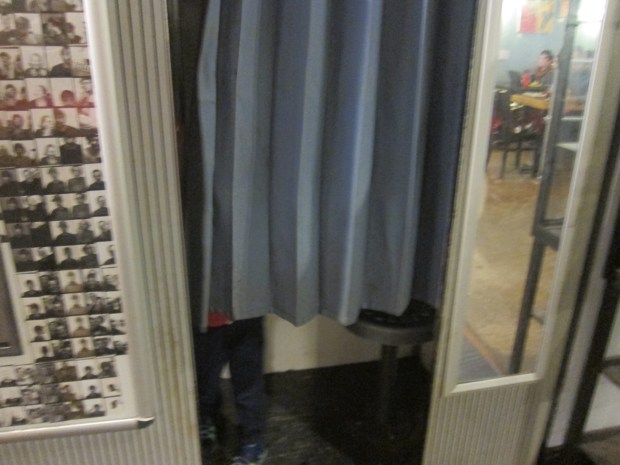
This is an activity I’ve wanted to do with Veronika for ages, so much so that a while back I loaded up both kids in the car and drove 45 minutes to a lunch spot that was supposed to have a working photo booth.

Silly Photo (6)

It turned out to have been broken for 2 years (although popping in and out from behind the curtain was still fun!)>

Silly Photo (7)

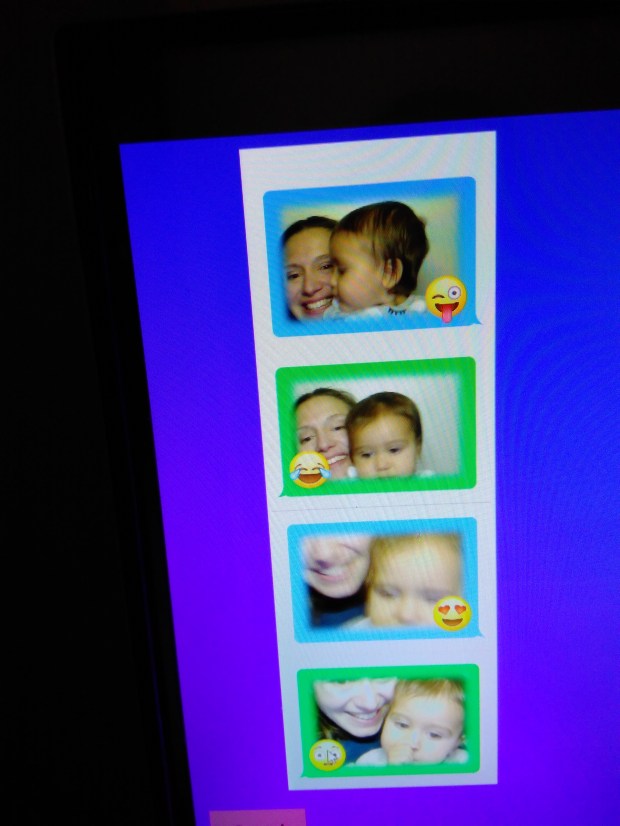
Serendipity was with us at an arcade though, where I spotted a photo booth among the game machines. I immediately popped inside and sat Veronika on my lap. She was confused but intrigued by the screen, the curtain, the buttons, all of it.

Silly Photo (3)

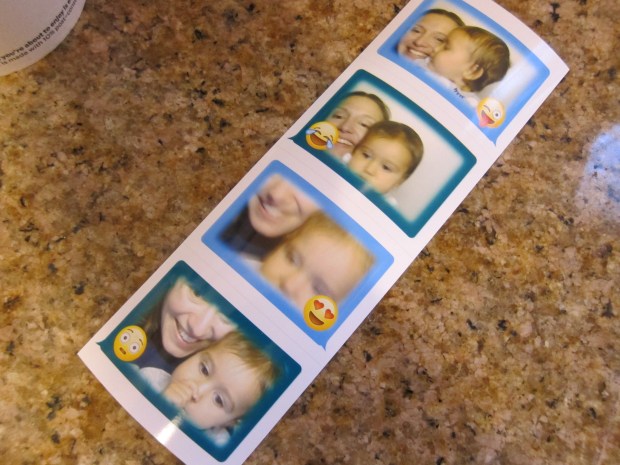
Getting a toddler to pose for pictures is tough of course, but we got some cute shots!

Silly Photo (4)

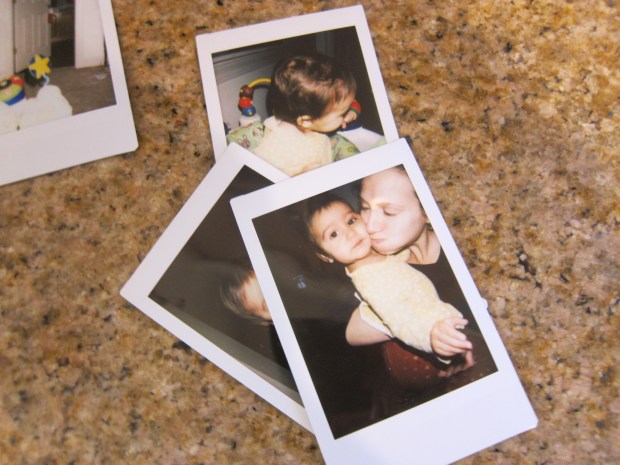
Now these an hang on our fridge; I love that I can point the photos out to her and remind her of the memory. We also took time with our instant camera at home to make a few more deliberate shots.

Silly Photo alt

Pick an action like nuzzling cheeks, kissing noses, or other silly poses you can look back on and smile. Say cheese!

Arcade Kiwi Crate

Kiwi Arcade (8)

Whenever we walk into an arcade, Travis’s favorite game is the claw machine, even though we almost never win. So the instant his Arcade kit arrived from Kiwi Co., I knew it was going to be a huge hit. He got to make his own claw and prizes…and was sure to be a winner this time.

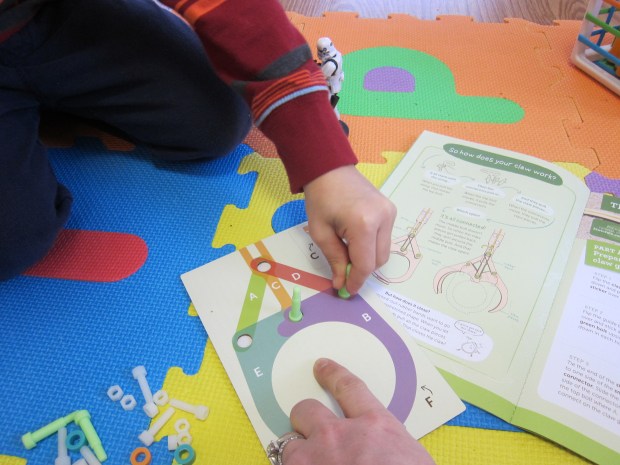
There’s tons of STEM to love about this crate, especially in the first project: The Claw. Start by reading the explanation of how this simple machine works: a string that moves a bolt that pulls a connector that pulls a claw, resulting in the claw opening. The booklet even explains how it closes up again, when stretched-out rubber bands want to revert to their unstretched shape, pulling everything closed again.

To prepare the Claw, Travis followed along layering bolts, wooden pieces, and nuts in the proper order, using the handy color-coded piece of cardboard that is the guide.
Kiwi Arcade (1)

Once assembled, the claw then lifts right up off the guide. A long wooden handle is attached in the same way with a second guide.

Kiwi Arcade (2)

Travis had to test it out on baby sister’s toys right away, of course!

Kiwi Arcade (3)

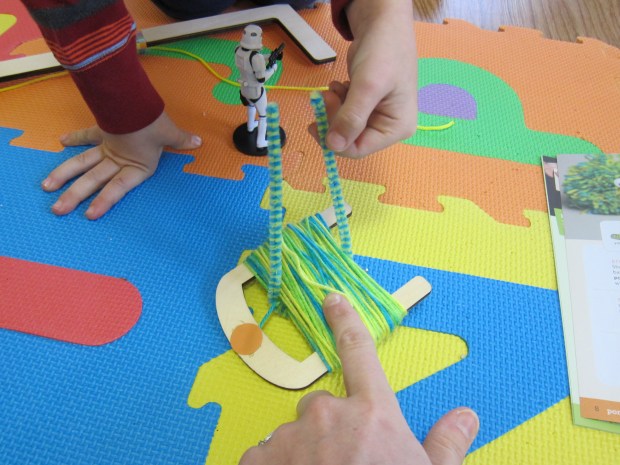
We immediately had to follow up with the next project: Pom-Pom Prizes. This was the artsy part of our STEAM lesson. Attach the end of one provided yarn bundle to a wooden pom-pom winder with a sticker, and loosely wind the yarn around.

Kiwi Arcade (4)

Having made homemade pom-poms, I appreciated how Kiwi took all the guesswork out of this, with yarn that looped along in no tangles. Now secure around the middle with the provided pipe cleaner.
Kiwi Arcade (5)

Slide the yarn off the winder and use scissors to snip open the loops of yarn. Fluff it out and you have a pom-pom! The pipe cleaners now bend down as little antennae and there are sticky-back wiggle eyes to adhere as the final touch. The crate contains enough material to make two. Travis loved these creatures, even before turning them into arcade prizes!

Kiwi Arcade (7)

It was time to put it all together and play the Claw Game. We cut a rectangular hole in the lid of the Kiwi Crate, leaving about a one-inch border, and a second hole on the side, leaving about a 1/2-inch border. Cut a piece of plastic from a gallon plastic bag to fit over the hole in the lid, and tape it on securely.

Kiwi Arcade (9)

We taped on the provided Claw Game decorations, then filled the box with little knickknacks from Travis’s treasure box. And added in the pom-pom prize of course.

Kiwi Arcade (10)
Travis was so proud once he got the hang of it.

Kiwi Arcade (13)

Mommy got the grand prize pom-pom!

Kiwi Arcade (11)

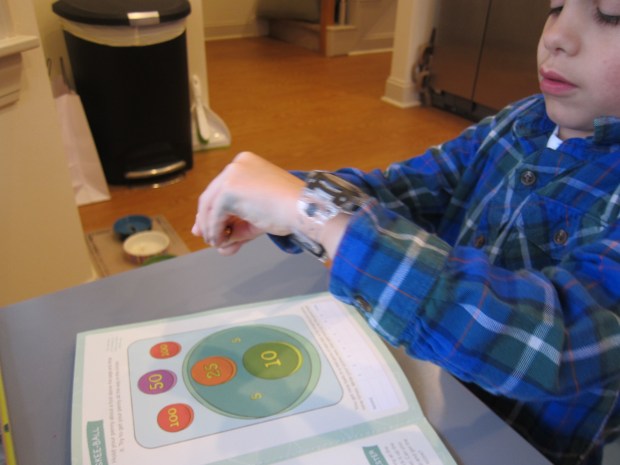
As always, we turned to Explore magazine for extended fun. There is a page filled with “penny arcade” games, a fun riff on the old-fashioned term, where kids can play games on the page with a literal penny.
Kiwi Arcade (14)

Next we made a Laser Maze with crepe paper.

Kiwi Arcade (18)

A big fun house challenge!

Kiwi Arcade (17)

Finally, we made the Tilt-to-Win: Cut empty paper towel tubes to various lengths and cover each in a different color construction paper. Glue construction paper to a large flat box as the background, and glue on the tubes.

Kiwi Arcade (20)

Once dry, add a point value to each tube with marker. Put in a small ball, and take turns seeing how many points you can get in one minute.

Kiwi Arcade alt

This is almost like a handheld pinball machine!

Kiwi Arcade var

The two recommended books are worth investing in, as each contains more ideas than we’ll ever get to for gaming fun. Do check out The Kids’ Book of Simple Machines: Cool Projects & Activities That Make Science Fun and Play These Games: 101 Delightful Diversions Using Everyday Items.

Kiwi Arcade (12)

Sticky Step

Sticky Step (3)

Veronika is so close to walking, but still walks very stiff-legged when she holds our hands, her knees barely bending. This activity will not only delight your toddler, but is also great for strengthening those little leg muscles and encourage high stepping!

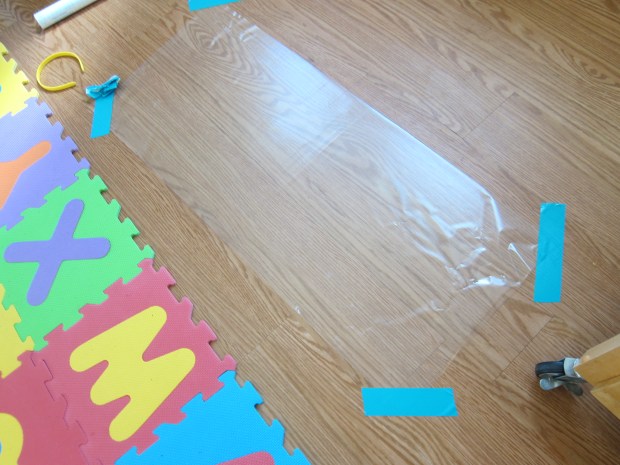
Tape a piece of contact paper to the floor, sticky side up. The set-up itself was of course fascinating for Veronika, who loved “helping” with the tape.

Sticky Step (1)

I held her hands and helped her walk along the sticky surface. At first she looked so surprised, but once she saw my encouraging smile, she bravely marched across the contact paper, knees lifting high to pull up with each step. She kept looking back over her shoulder at me in delight, as if to say, “Mom do you feel this too?”

Sticky Step (2)

Have fun with the contact paper while it is out! It’s great for sticking on lightweight toys.
Sticky Step (6)

And she kept dabbling in placing her toes on it, as if just to make sure it was still sticky.

Sticky Step (5)