Glowing Hula Hoop

Glowing Hula Hoop (6)

Daylight savings means we have a few extra hours of dark before bed, and that means Travis and I can do projects that require a little extra darkness! Kids will go wild for this glowing hula hoop. You just need a few special items to put it together.

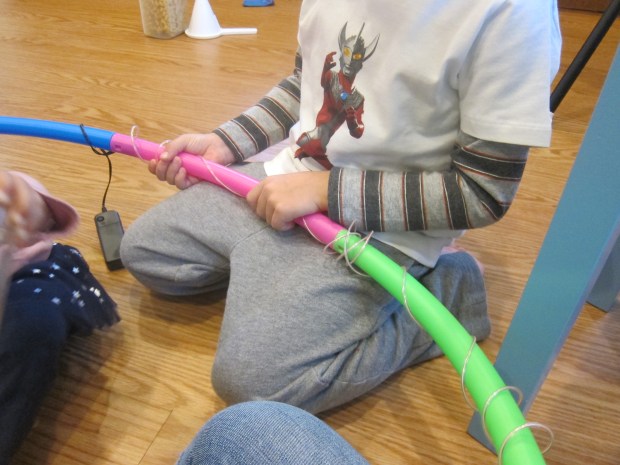
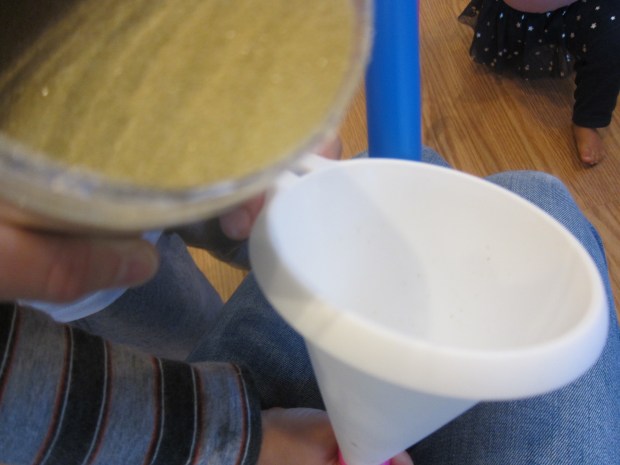
We have a hula hoop that snaps together, which was perfect because to start, you’ll need to open up the hula hoop and dump in a little sand. A funnel helped keep this step neat and tidy. Snap the hula hoop back together.

Glowing Hula Hoop (1)

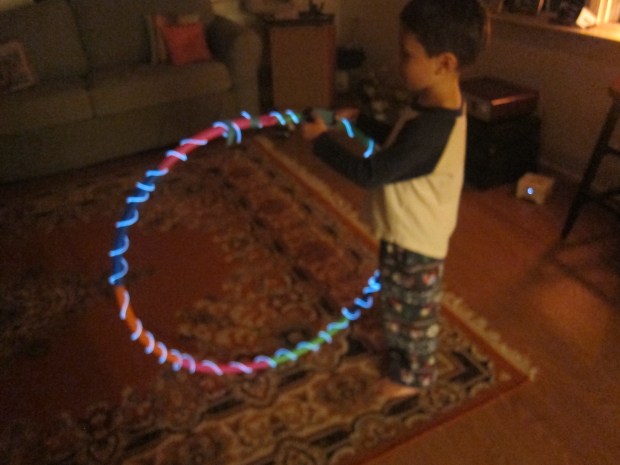
Wind EL wire (available at Amazon) around the outside of the hula hoop. Secure with zip-ties, trimming them down if a long end remains.

Glowing Hula Hoop (2)

In a pinch, use electrical tape to secure the wire to the hula hoop in a few places. Add batteries to the wire’s battery pack, and use the clip on the back of it to hook onto the hula hoop through one of the zip ties. You’re ready for glow time!

Glowing Hula Hoop (3)

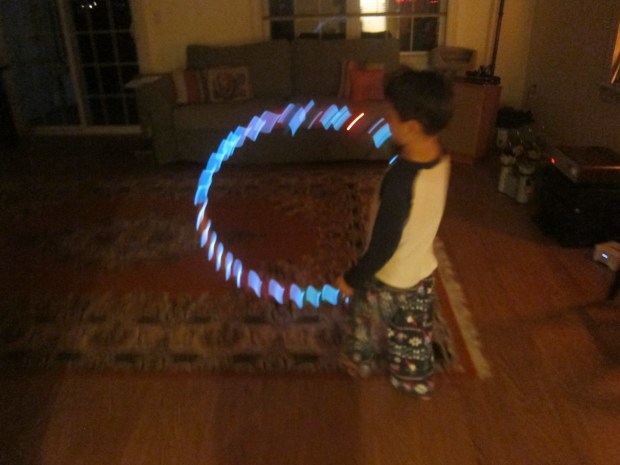
After dark, we turned out the lights and did the hula!

Glowing Hula Hoop (4)

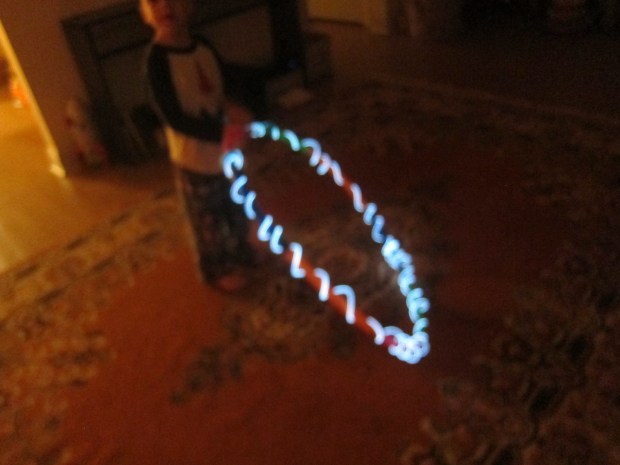
Travis actually preferred not even having it around his waist; he just loved rolling it, spinning it, and testing out the feature on our EL wire that made the lights steady or blinking.

Glowing Hula Hoop (5)

What fun after dark!

Glowing Hula Hoop (7)

Sensory Activity: Dry Pasta Noodles

Sensory Dry Pasta (1)

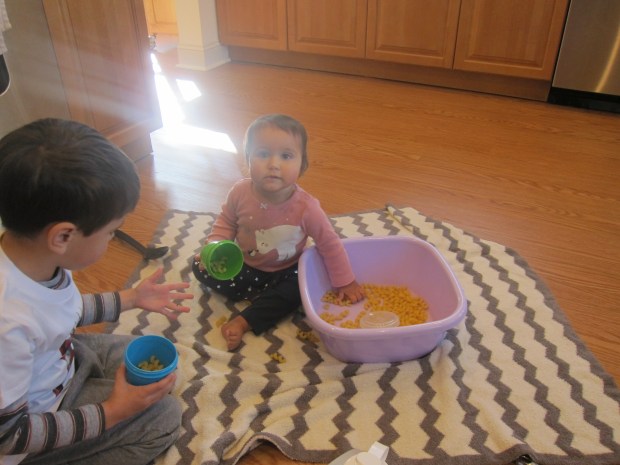
The last time I gave Veronika pasta as a sensory item, it was cooked and she was tiny (she looks so little even though this was only 5 months ago!) Now for my bigger girl, the item of the day was dry pasta! I’ve seen sensory bins like this done with dried macaroni, but I chose larger cavatappi noodles just in case she tried to eat one. Little did I know how much fun would be had with this simple activity!

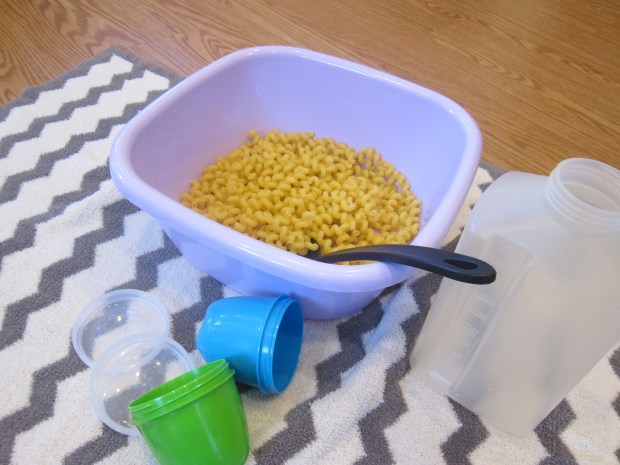
I set out a bin with the pasta, along with a few containers that it could be scooped into, a big plastic spoon, and a larger jug.

Sensory Dry Pasta (1)

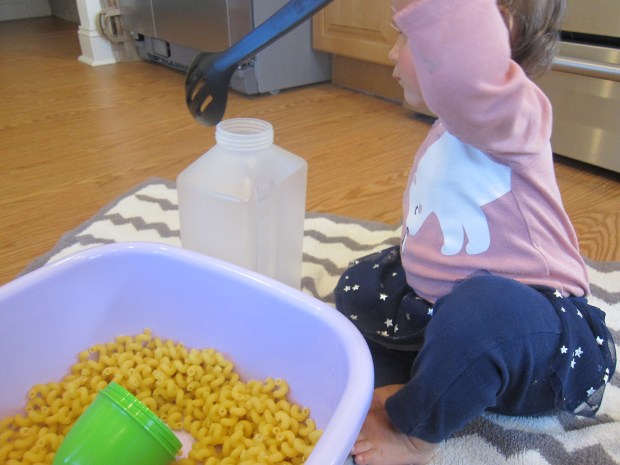
Veronika instantly knew she wanted to transfer the pasta to the jug but couldn’t quite figure out the mechanics.

Sensory Dry Pasta (2)

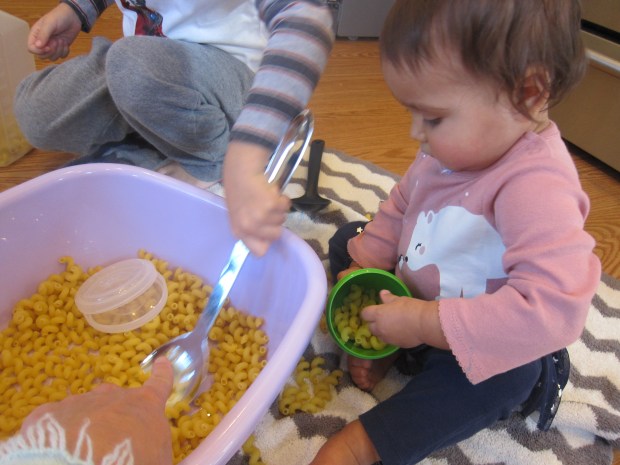
I helped her along with the ladle. What fun when it landed in the jug with a plink!

Sensory Dry Pasta (3)

The smaller containers I had set out were great for scooping up pasta. With the lids on, these were just like maracas.

Sensory Dry Pasta (5)

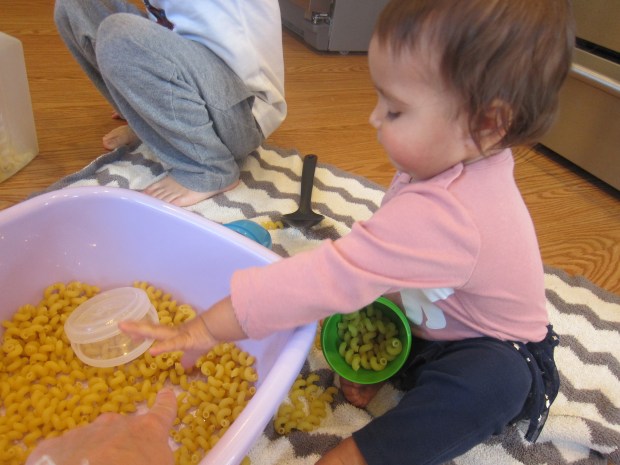
Veronika also loved transferring pasta piece by piece from the small container back to the big bin. Over and over!

Sensory Dry Pasta (6)

What I hadn’t anticipated was how much even my 5 year old would love this sensory tray!

Sensory Dry Pasta (7)

He loved filling the jug, shaking it, and playing some imaginary game involving the pasta pieces. Soon they were happily sharing, and I loved seeing them play together.

Sensory Dry Pasta (8)

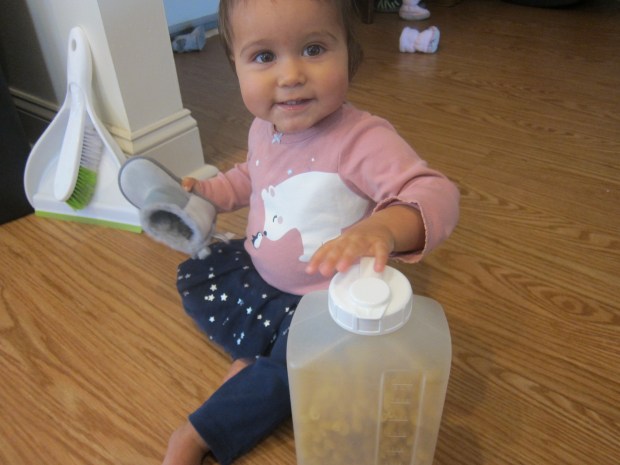
Once the jug was all filled up, Veronika looked so pleased!

Sensory Dry Pasta (9)

Go to a Police Station

Police Office (6).jpg

Whether your kids are in grade school or still just babies, a visit to a local police station is a fantastic outing for the whole family. Older kids can learn about the profession and have a positive experience with our brave workers in blue, while younger kids will just have so many sensory elements to take in. We were lucky enough to win a behind-the-scenes tour of our local station at a raffle. Here we are about to go in; Veronika looks so psyched for the tour, and Travis looks a bit nervous!

Police Office (3)

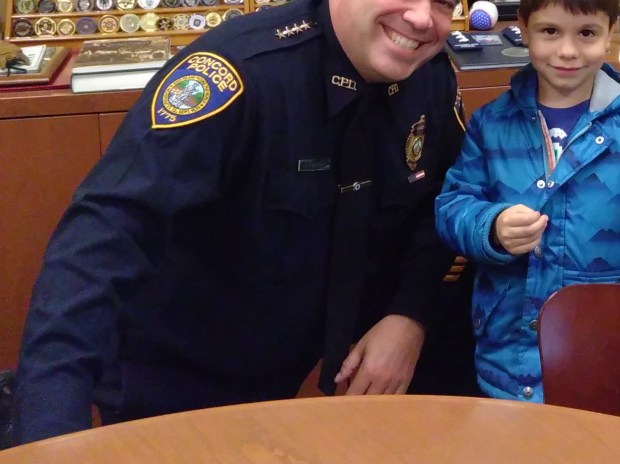
The first obvious draw is the chance to meet real police officers! This meant posing with the chief of police and all his medals.

police office (8).jpg

Plus checking out all the computers and controls in the 9-1-1 call center.

Police Office (7)

For little kids who don’t understand what they’re seeing on the tour, there was so much to look at: computer screens, shiny medals, bold blue uniforms, and all those badges!

Bigger kids of course will understand what they’re looking at, and get to check out stuff with serious “wow” factor, like a a real policeman’s handcuffs…

police office (2)

…and real jail cells.

Police Office (5)

Has your family visited a local station? Please share in the comments!


High Chair Painting

High Chair Painting (5).JPG

I’ve loved my first forays into making art with Veronika, and today I dared to give her real paint for the first time, meaning it wasn’t sealed up or homemade. The verdict? She did not eat any! In fact, there wasn’t much of a mess at all.

For this age, though, I do recommend strapping baby into a highchair before pulling out the paints, resulting in the safest, least messy location. You can cover the floor below with newspaper if desired, and tape down the paper to the high chair.

High Chair Painting (1)

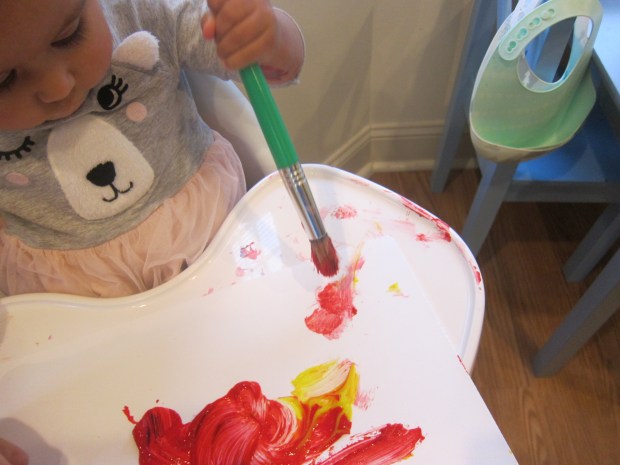
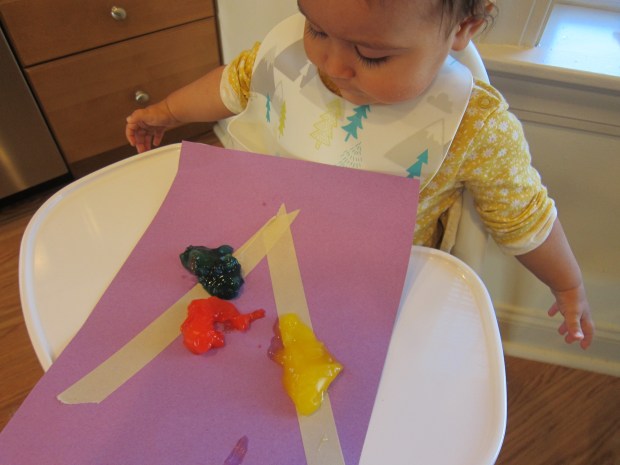
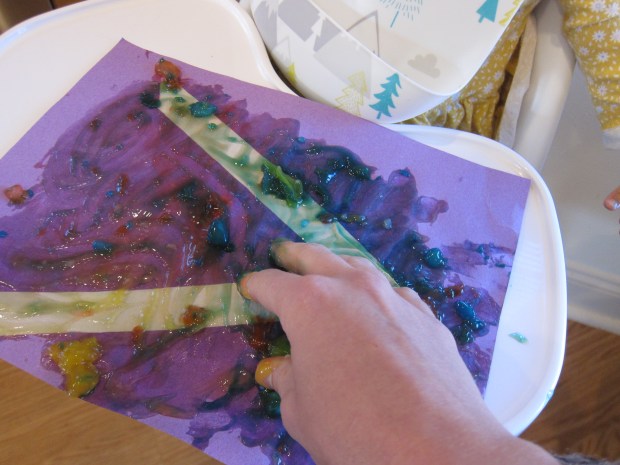
I started this way, using a few blobs of store-bought finger paint. But this time I gave her paintbrushes, and showed her how to dab into the blobs and swish it around. She looked so proud to hold the brush!

High Chair Painting (2)

After a few strokes, though, she preferred to pick at the masking tape. Hmm…

Thinking quickly, I gave her a fresh sheet of paper with no tape, and just held onto it firmly.

High Chair Painting (3)

Now, Veronika loved it. The serious look on her face was her way of really processing how it worked to smoosh down the bristles and see new paint appear.

High Chair Painting (8)

She kept at it for quite some time.

High Chair Painting (4)

You’re an artist, Veronika!

High Chair Painting (7)

A proud first paintbrush painting!

High Chair Painting (9)

Aluminum Foil Art

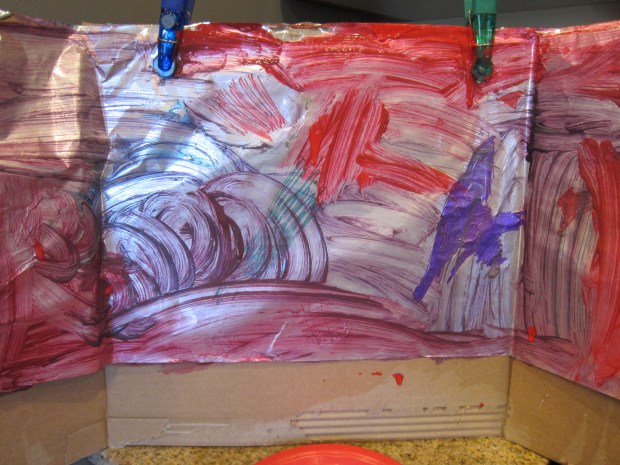
Aluminum Foil Painting (7)Something as simple as switching up the canvas can make an everyday activity like painting feel new again! Recent shiny mirror play prompted me to have Travis paint not on paper but on… foil!

I put the foil against a sturdy cardboard backing, and used snack bag clips to hold it securely.

Aluminum Foil Painting (1)

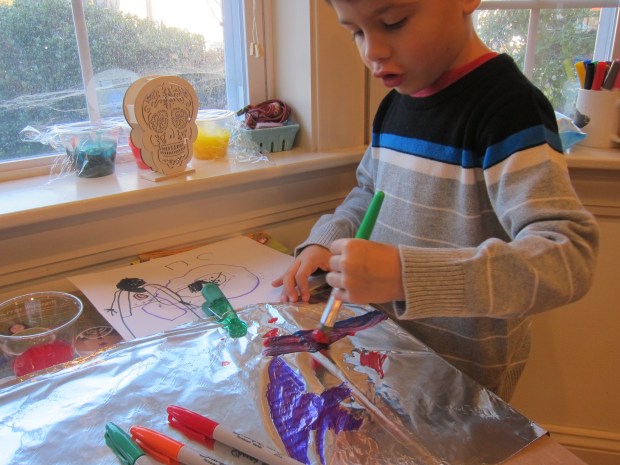
At first I thought he might want to use permanent markers on the foil. These made not only vibrant colors, but also fun texture where it indents the foil slightly.

Aluminum Foil Painting (2)

He was instantly designing a Star Wars ship (of course), but quickly decided to move on to paints.

I mixed tempera paint colors with a couple drops of dish soap in each (which supposedly helps it adhere to the foil better).

Aluminum Foil Painting (3)

Now he was off and running!

Aluminum Foil Painting (4)

He mixed colors, made fun designs, and wasn’t content until the whole surface of the foil was finished.

Aluminum Foil Painting (5)

What novel canvas has your child used for art? Please share in the comments!

Aluminum Foil Painting (6)

Rice Cereal Sensory Tray

Rice Cereal Sensory (2)

One-year-olds are a tough age when it comes to devising activities. They’re old enough to want variety and to do things with those little hands and bodies, but not skilled enough yet for the games and projects they can enjoy once true toddlers (closer to 15 or 18 months).

Here’s a fantastically easy sensory bin that’s sure to engage a baby at just this age. If you have a box of rice cereal, just dump it in a bin! I added a few of her favorite little toys (Duplo figures, plastic farm animals) and buried them somewhat in the cereal. Now everyone was hiding in the rice paddy!

Rice Cereal Sensory (1)

I also added a rake for her to explore with, thinking this would make less of a mess than shovel. This wasn’t necessarily the case, but the rake became a fast favorite, and she trotted over to her playroom with it once the sensory play was done!

I also added a spritz bottle. Toddlers can practice squeezing the handle themselves. For Veronika at age one, I spritzed the water so she could watch the droplets in the sun-lit room.

Rice Cereal Sensory (7)

The instant the water hits the rice cereal, you’ll also get a scent sensory bin, with the homey smell of cereal for breakfast wafting up.

The water also means the rice cereal will clump together. She delighted in handfuls, picking them up, marveling when they stuck to her little palm, and shaking them loose with glee.

Rice Cereal Sensory (9)

And of course, trying a taste!

Rice Cereal Sensory (10)

She had fun raking through and finding the toys.

Rice Cereal Sensory (8)

Then it was lots of scattering the rice cereal around for ages.

Rice Cereal Sensory (6)

But don’t worry about clean-up. The rice cereal (even when wet) sweeps up like a charm with a simple dustpan.

Rice Cereal Sensory (11)

This was definitely a winner!

Rice Cereal Sensory (4)

Circle of Objects

Circle of Objects (2)

If you’re looking for a simple way to encourage your one-year-old to start using nouns and names of favorite toys, a circle of objects is a fantastic idea.

I cleared other distractions from the room and set out a few items for Veronika in a big circle, keeping the number manageable (aim for 6 to 8 things). I included: a box, stacking rings, a ball, a scarf, a toy car, a small book, and plastic cow. The idea was to have a variety, but also things that could be named with one word.

I placed her in the middle, and the choice was hers! When she trotted over to the box first, I named it. “Yes, that is a box.”

Circle of Objects (1)

She wanted to put the stacking rings inside it. More great opportunity for talk! “You found the ring. You found the green ring. Can the green ring go inside?

Circle of Objects (3)

Next the scarf caught her eye. “You found your scarf. The scarf is soft.”

Circle of Objects (4)

I draped this over a few of the items in the circle that she hadn’t made it to yet, to draw her attention. Soon she was happily uncovering and then playing with the car and small book.

Circle of Objects (5)

“The car goes fast!” I chimed in, as she spun the wheels and drove it around. This could go inside the box, too!

Circle of Objects (7)

You get the idea. Whatever it is your baby picks up from the circle, say the noun and some simple sentences to go along with it. And wait for that thrilling moment when your baby says the word back!

Circle of Objects (6)

Tape Resist Letters with Homemade Edible Finger Paint

Finger Paint Tape Resist (6)

It was Daylight Savings today, and parents know what that means: an extra-long day where the kids wake up extra-early. Here’s just the right kind of messy project to help fill those extra hours… Daylight savings or any day the kids are up early!

I knew I wanted a messy art project for Veronika, but she’s still too little for paint since those little fingers go right to little mouth. This homemade finger paint recipe was perfect. After breakfast, I made the following:

Finger Paint Tape Resist (1)

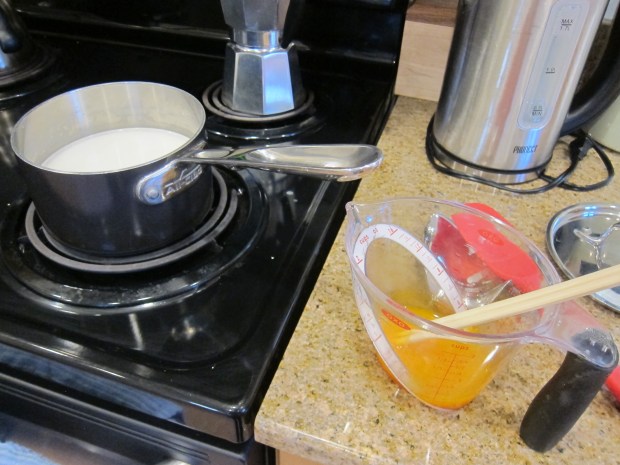
Combine 2 and 3/4 cups water in a saucepan with 1/2 cup cornstarch. Bring to a boil.

Meanwhile, dissolve 1 packet of vegan jel dessert (such as Simply Delish) in 1/4 cup cold water. I used the orange flavor, meaning our paint would be nice and sweet, but unflavored is fine!

Once boiling, remove the saucepan from heat and stir in the jel mixture. Let cool completely.

Transfer to plastic cups and add food coloring if desired for other colors. Since the finger paint was naturally yellow, I added a few drops of red for some orange cups and a few drops of blue for some green ones.

Finger Paint Tape Resist (5)

Next, I added masking tape to a few pieces of construction paper for the tape resist portion of the project. A big V for Veronika seemed just right, and we made a T for Travis, too. Give the paper to your little one and add a few big blobs of paint.

Finger Paint Tape Resist (2)

Veronika was more hesitant than I would have thought to get her fingers in there at first! I showed her how to smear the paint all over the paper, mixing and mushing the colors.

Finger Paint Tape Resist (3)

I moved her down to the floor at one point, thinking she might want to get messier with lots of paint and paper spread out, but even then, she was a touch hesitant.

Tape Resist alt.JPG

No matter what, your paper will be very wet once completed, and will probably take all day to dry; I know ours did!

Finger Paint Tape Resist (4)

Once the “paint” dried, I peeled off the masking tape for the big reveal.

You could also do this activity with more complicated patterns or pictures, simply applying the masking tape in whatever design you like. Big kids might just want to get their hands in there too!

Mirror Illusions Kiwi Crate

Kiwi Mirrors (17).JPG

Travis’s Kiwi Crate this month focused on mirrors and the tricks of light that allow for illusions. There was a bit of overlap with the Secret Agent crate, so I was surprised it was next in our queue from the company, but he still enjoyed the projects!

First up was making a Trick Box. This very simply involved folding open the provided green cardboard box and slipping in an illustrated insert. (Kids also have the option to illustrate their own insert).

Kiwi Mirrors (7)

Place the insert in the box, then slip in the provided mirror, making sure it is at the correct angle (arrows marked inside help kids to ensure a proper alignment).

Kiwi Mirrors (8)

Peeking through the box now reveals the image in reverse. This was a bit lost on Travis, as he couldn’t read the “hello there” message he’d chosen either forwards or backwards.

More of an impact came from the penny trick you can perform: Drop a penny through the slot in the top and it seems to disappear, when really it is just falling behind the angled mirror. This is a fun one for kids to play a “magic trick” on friends and family.

Kiwi Mirrors (16)

Next up was making a Painted Puzzle. Place the provided wooden squares in a frame, and cover with one of the provided clear stickers. Travis did this a bit differently, attaching all four clear stickers, so our results weren’t perhaps perfect.

Kiwi Mirrors (9)

But the painting method was neat! Travis liked using the paint stampers, which are dipped into provided tiny paint pots. Cover the surface of the wooden tiles, let dry, then peel off the stickers.

Kiwi Mirrors (10)

The painted puzzle can now be taken apart and put back together again. But even cooler is viewing it through…

…Mirror Goggles, the final project. To make these (which look almost like Google’s VR viewer), open up the provided cardboard goggle box.

Kiwi Mirrors (1)

Travis got to exercise his fine motor skills to attach the sides with a brad; add padding foam around nose and forehead for comfort; and place a sticky donut and bead on top. This bead is going to help you keep your head up later, read on!

Kiwi Mirrors (2)

Thread an elastic through the holes on either side and secure with cord stoppers, then attach a mirror to the underside of the goggles with sticky foam. Your goggles are ready for viewing!

Kiwi Mirrors (4)

Wearing them took a bit of practice, with the goal of piecing together your Painted Puzzle or a provided wooden puzzle. I had Travis watch me first, as you really need to keep your head up to have the mirror show you what’s on the work surface below. Don’t tilt your head down for peeking or the bead will fall from the donut!

Kiwi Mirrors (5)

Once he got it the hang of it, Travis thought it was so cool. I loved watching his hands move, forward when they needed to go backwards and vice versa, until he started to understand he was seeing in reverse; it was like observing the gray matter of his brain at work.

Kiwi Mirrors (14)

If it won’t frustrate your kids, have them try writing their name or drawing a picture while wearing the goggles. Full disclosure, this is hard. Here’s my attempt to write his name!

Kiwi Mirrors (15)

There was lots more fun to be had in Explore magazine. First, we made a map (a bit of an overlap from Secret Agent). When read normally, it led him nowhere. Then he looked at it through the selfie feature on my phone.

Kiwi Mirrors (11)

Aha, he spots the treasure…

Kiwi Mirrors (12)

Success!

Kiwi Mirrors (13)

Then I showed him an example of backwards writing (again an overlap from Secret Agent).

Kiwi Mirrors (20)

There’s also a mirror word search for older kids, and a few cool mirror illusions you can try to recreate at home like multiplying apples…

Kiwi Mirrors (19)

…or a disappearing middle!

Kiwi Mirrors (18)

We finished with a bedtime read of two suggested books: Light: Shadows, Mirrors, and Rainbows by Natalie Rosinsky and Mirror, Mirror: A Book of Reverso Poems by Marilyn Singer. The latter features fantastic poems that can be read both backwards and forwards.

Baby Flying

Baby Flying (5)

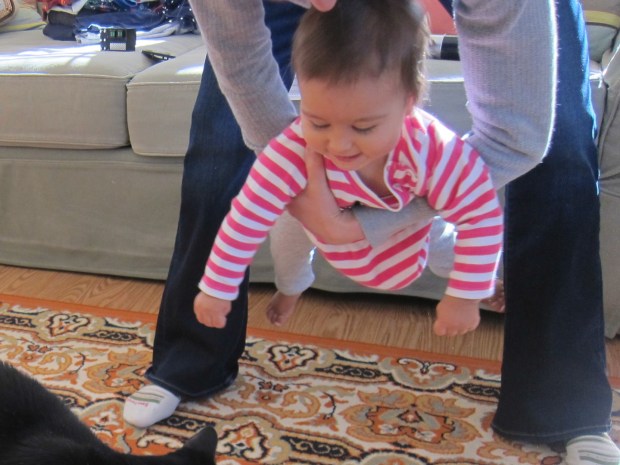
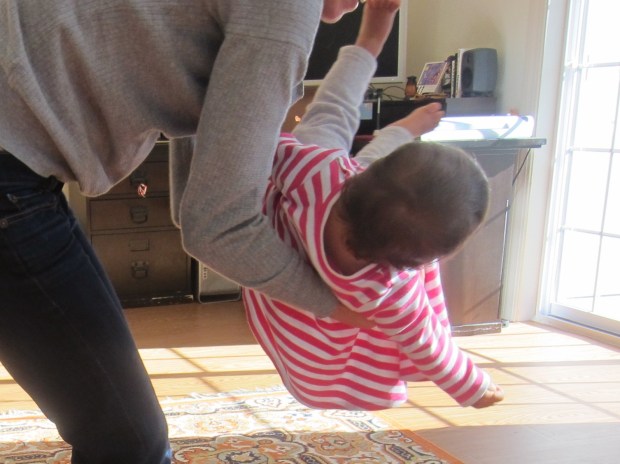
Veronika went flying today! Ok, she didn’t really board an airplane, but here are three fun ways to turn your little one into a plane. Play them now before he or she is too heavy! Photo credit for all three versions goes to big brother Travis, who mostly managed to capture the antics in frame.

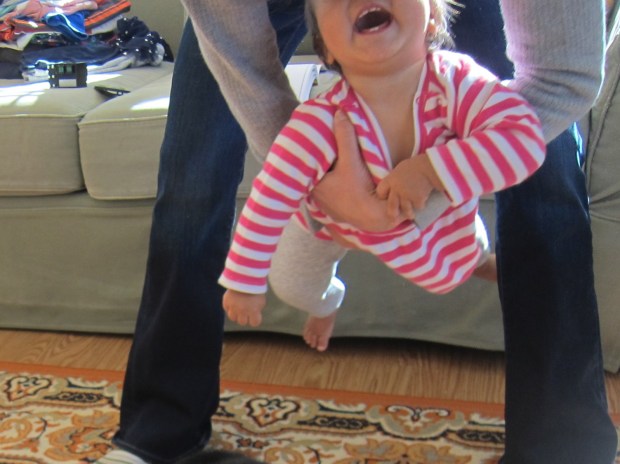
For the first method, stand with your baby between your legs, lying down on his or her tummy. I lifted Veronika up, supporting firmly beneath her stomach, and gently swung her back and forth.

Baby Flying (1)

For this one I love to sing the “shake them low” verse from Shake Those Simmons Down; it gets a laugh every time!

Baby Flying (2)

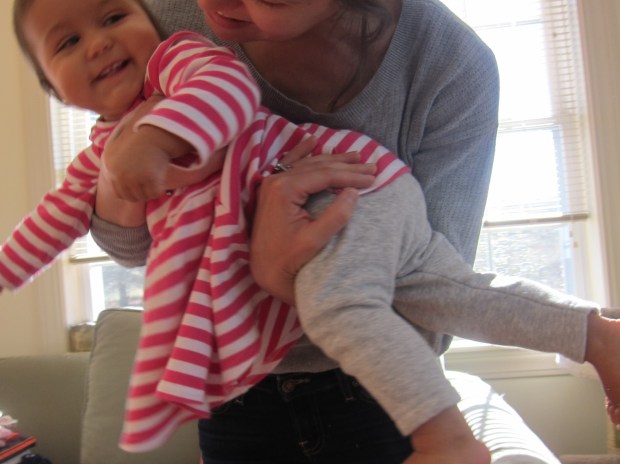
For the next version, she was in higher airspace: Do more of a football tuck with your arm under your baby’s chest, and zoom him or her back and froth. Airplane noises encouraged!

Baby Flying (3)

The final version suggested actually holding one hand and one foot and swinging baby around in circles. This sounded like a good way to pop a joint from a socket, so I held Veronika a little more firmly, but she loved the circling spins. Whee!

Baby Flying (4)