Frog Pond Game

We set out to make this game after spotting it on Kiwi Co’s website… Only after saving up enough lids to make the playing pieces, I could no longer find the post. That meant we improvised, but still created a fun game!

To start, use bottle lids (from cider or lemonade jugs), and trace onto green craft foam. For each “frog”, I hot glued two lids together, and glued a circle of craft foam to the outsides. We made enough to have two playing pieces each.

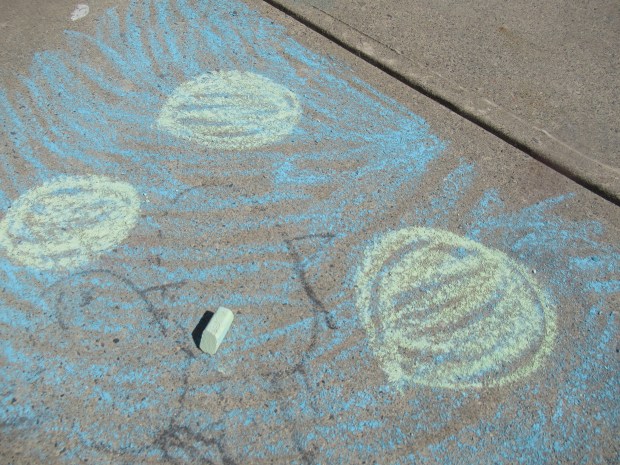
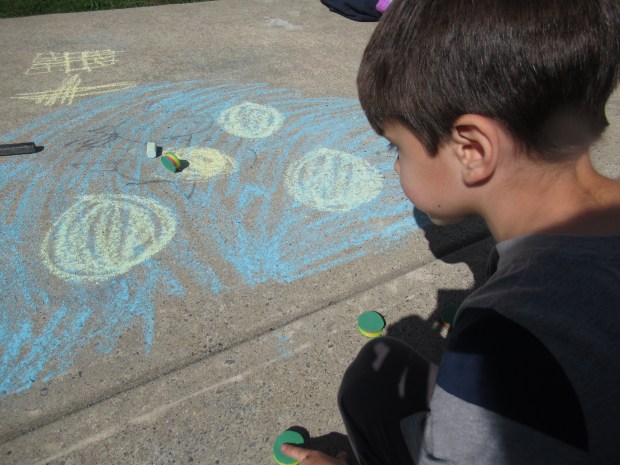
For the game board, we headed outside on a gorgeous spring day to draw the pond with chalk. I added green lily pad targets, and Travis liked adding black fish to the water, too. Oh no, potential hazards!

Finally, we labeled the pads with points; smaller, further away ones were worth 10 points and nearer, bigger ones worth only 5. Take turns rolling or flinging your frogs at the lily pads and see who accumulates the most points!

This was a cute game to play in spring sunshine, and now we have plans to take a walk to our local pond and listen for real frogs!

Pond Ecology Kiwi Crate

Here’s our unboxing review of Travis’s latest from Kiwi Co, all about the ecosystem of pond life. This was a neat divergence from past crates, in that it focused on a place rather than one scientific principal. There was lots to learn about frogs, fish, and more!

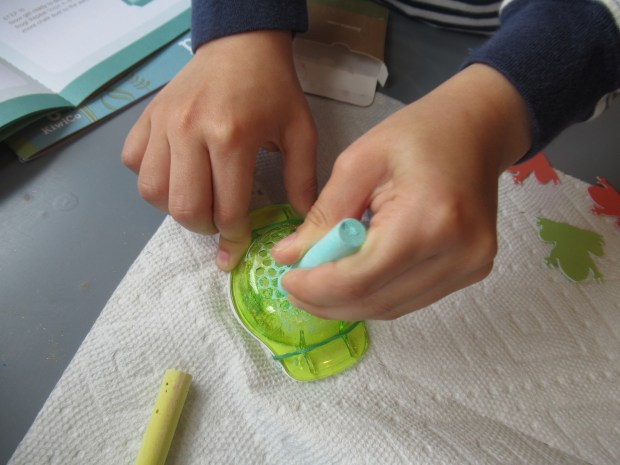
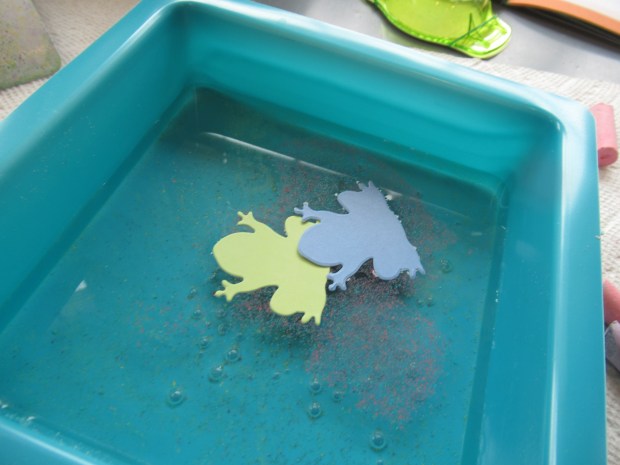
The first project was the most creative of the lot: making Chalk-Art Frogs. The process relied on surface tension (floating chalk) to color in the provided paper frog shapes. Travis helped put together the provided chalk grater and loved carefully grating a mix of chalk colors into it.

Tip over the provided tray of water and gently tap out the chalk. We did a test run on a provided square of paper first.
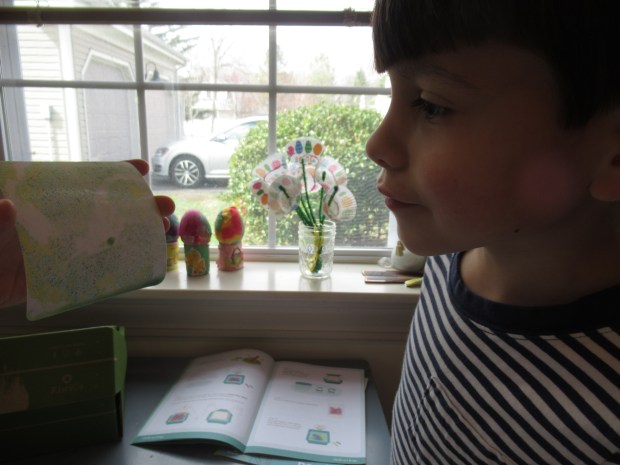
Lift up gently for the big reveal!
Next Travis carefully added the frogs, which didn’t pick up the chalk as clearly as the white paper, but were still neat. Let dry completely, then move on to…
…project two, a Leaping Lily Pad. The scientific principal in action this time was energy, as in a spring (or a frog’s legs). Travis decorated the provided cardboard lily pad with a few of his completed frogs, then it was just a matter of wrapping it with the provided rubber band to create tension.

Release, and…. Pop!

We found that this only worked if we used both provided elastics, not just one.

Now it was time to peer under the pond water and make an Aquarium in a Bottle, with the scientific concept of density at play. Travis mixed the provided salt into warm water, and filled three small plastic cups. For a fun way to color them, Kiwi instructs kids to scribble marker over thin paper squares. Place the paper in the cups, one each for red, yellow, and blue, and the water immediately changes color.
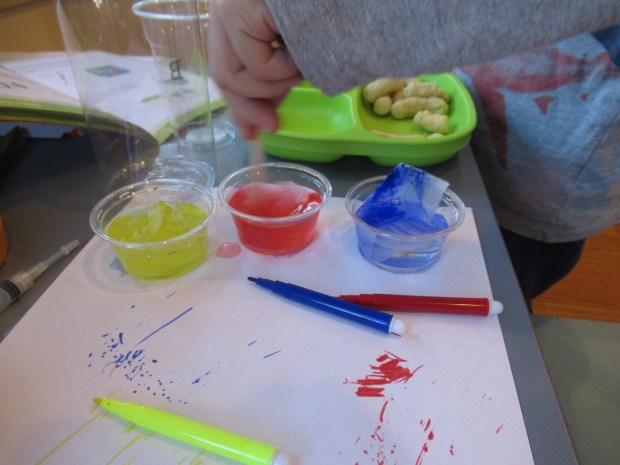
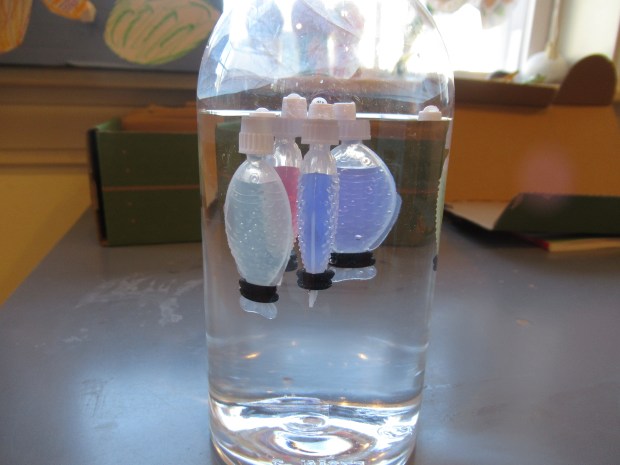
Next, he used the provided syringe to fill plastic fish with this colored salty water. The booklet contained helpful tips for testing the buoyancy of each fish. If there was too much water and not enough air, it sank; squirt out a little. If it floated on the top, there was too much air and not enough water; add a little more from the syringe!
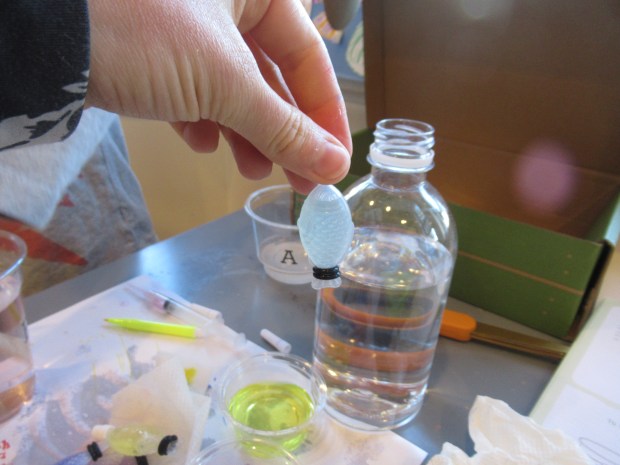
When all our fish were just right, Travis added them to the provided clear bottle for a little “aquarium” he can keep on display.

Kiwi often provides ways to upcycle the crate itself, and this month was no exception, with a suggestion to make another “leaping” project: Lively Leaper frogs.

Cut the front flap from the crate (or a similar box) that measures 7 inches long x 2 inches tall. Make notches at 1.5 inches and 3.5 inches. Fold in half at the 3.5 inch mark, then fold again at the 1.5 inch mark, down in the opposite direction.
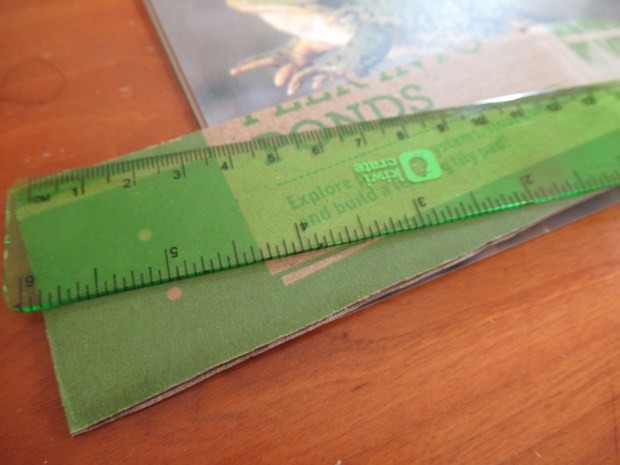
Just like the lily pad, hold your finger on it, then release and the frog “jumps”. We added a little green frog with marker for extra effect.

Overall, Travis liked that this crate explored lots of scientific concepts instead of just one topic in depth.
Frog in the Grass

Frog in the Grass (10)

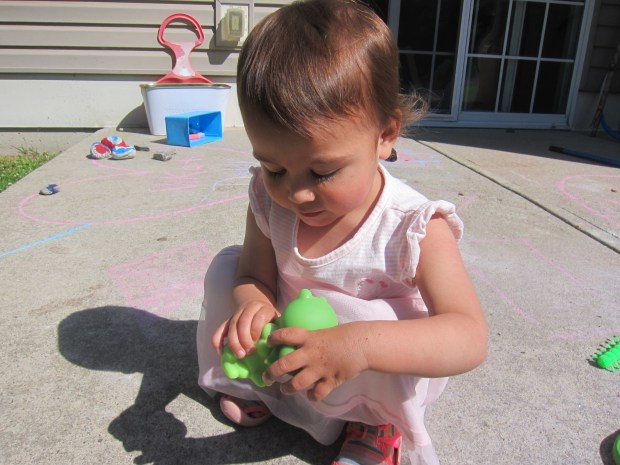
Here’s an adorable game to play outside with a toddler, one that involves both imaginative play and observational skills. We used frog toys because the green camouflages perfectly in the green grass, but any green animal toy would work equally well, or even green beanbags. To wit, we also added a snake and a centipede.

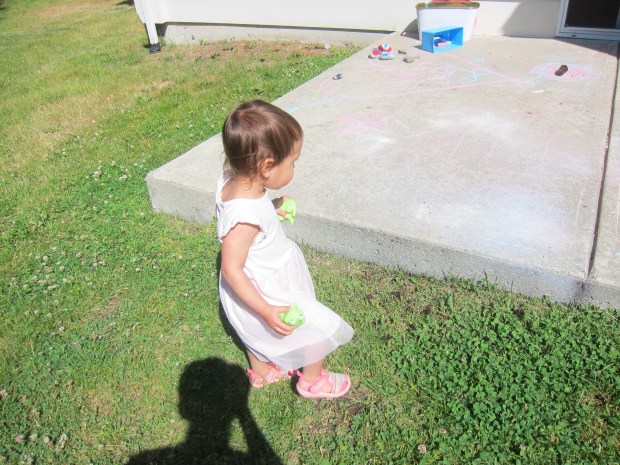
Veronika spotted the frog toys before we headed outside, excitedly declaring, “Froggie, froggie!” so I knew she would love the game. Once we were outside, I scattered the frogs in the grass while Veronika watched, curious. Older toddlers can be asked to close their eyes while you scatter the frogs, making it a true hunt.

Frog in the Grass (1)

“Frog in the grass!” I yelled, once all four had been ‘hidden’. She was confused until I led her by the hand to toddle over to the first frog. Then it seemed like the most exciting errand in the world!

Frog in the Grass (3)

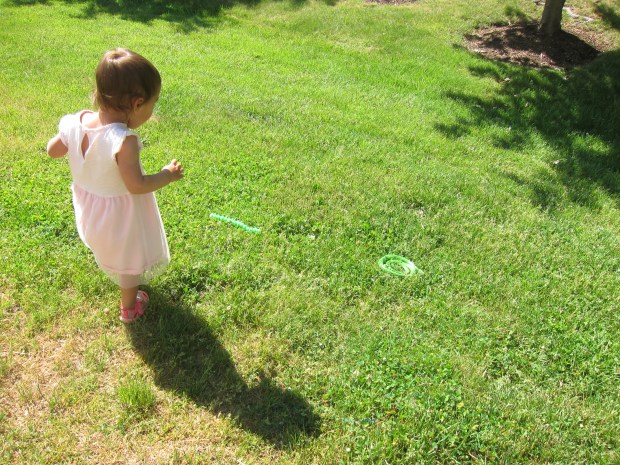
After that she was off and running, finding a frog in the green grass, bringing it back to the patio, and then returning for the next one.

Frog in the Grass (4)

Then we also hunted down the green snake and centipede.

Frog in the Grass (7)

Once everyone safely made it to the patio, I tossed them back into the grass. “Frog in the grass!” I yelled again. This time she thought it was hilarious, and went scampering over.

Frog in the Grass (9)

You can add animal learning to the game by making the corresponding noises and motions. Veronika loves to say “ribbit”, and I encouraged her to leap like a frog.

Frog in the Grass (12)

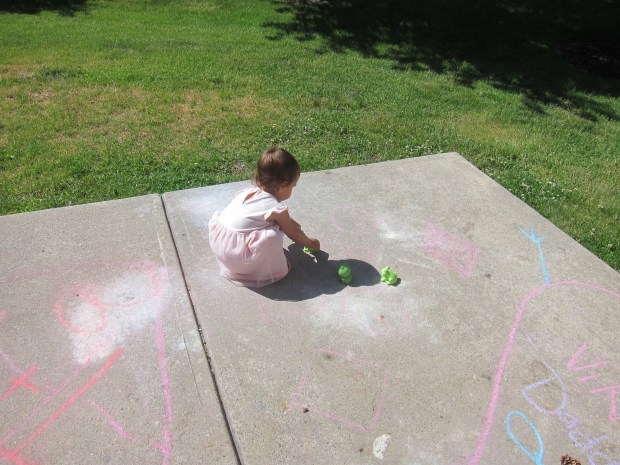
Next thing I knew, she had two of the frogs kissing on the patio, unprompted!

Frog in the Grass (8)

We’ll have to see if one of them turns into a handsome prince.

Frog in the Grass (2)

Paper Plate Frog

Paper Plate Frog (9)

Travis has just started camp, and every day the teacher gathers everyone together for craft time. It has renewed his interest in simple hands-on activities – painting, gluing – which lately he seemed to have tired of when it was just mom in charge! Now he comes home and wants to play camp, so we threw together this easy frog with items we had on hand.

For the mouth, fold a paper plate in half; paint the outside green, and the inside black. Travis didn’t even want my help making sure the paint got all the way to the edges.

Paper Plate Frog (1)

For the legs and arms, I drew simple outlines on green craft foam and cut them out.

Paper Plate Frog (3)

Travis was a big helper putting on globs of glue so we could set the legs and arms in the right place once the paint was dry. A pink construction paper tongue was added as well.

Paper Plate Frog (4)

I glued on googly eyes as the final touch. When the frog was ready, Travis decided all on his own that we needed to make flies to feed it. “Let’s paint them white!” White flies? Why not!

Paper Plate Frog (7)

A hoppin’ good time.

Paper Plate Frog (8)

Frog Rock

Frog Rock (6)

Here’s a sweet and simple project that comes together fast, with super cute results.

The best part by far was our spring nature walk – we always come home with treasures! Travis found the most perfect rock, and I decided we should turn it into a little frog. This sent us hunting for green leaves to cover our frog with amphibian skin, and Travis loved finding leafy treasures.

Frog Rock (1)

At home, we tore some of the leaves into smaller pieces, and glued them in overlapping patterns on the frog.

Frog Rock (3)

When the glue dried, I added little felt eyes and feet.

Frog Rock

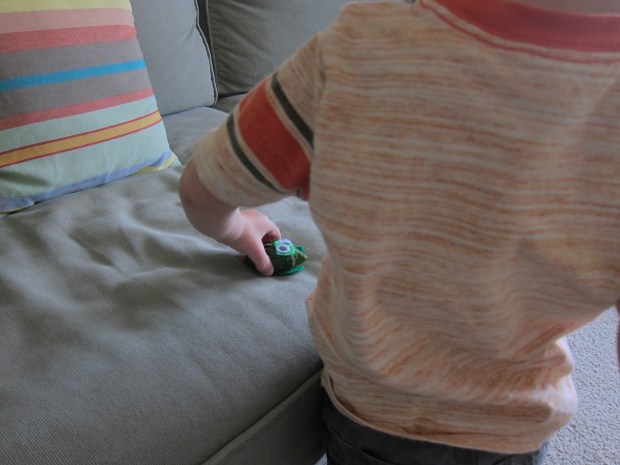
Travis had so much fun leaping his frog about!

Frog Rock (5)

DIY Frog Pond

frog-pond-5

With a few rubber frog bath toys and lily pads cut from craft foam, you can turn your child’s bathtub into a magical frog pond!

I set the game up shortly before bath time, with Travis in a bathing suit just in case things got splashy!

frog-pond-1

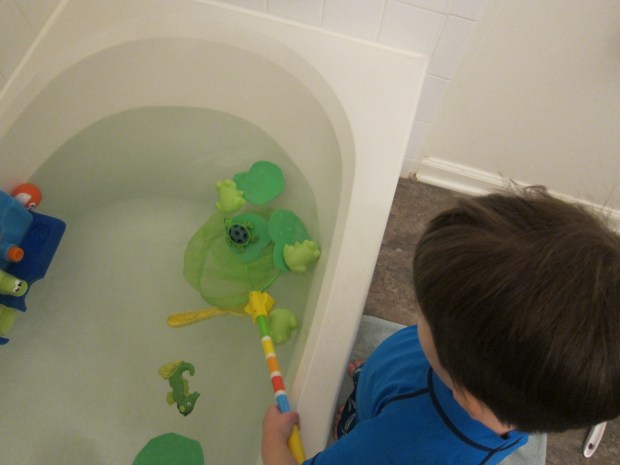
Fill your tub with water and add the “lily pads”, frogs, and a few other fun toys that fit the theme – we also added a rubber turtle, a cup for pouring, and a net. Consider adding other pond elements you have at home, like rocks or rubber snakes!

frog-pond-3

Travis immediately grabbed the net and began fishing the frogs and lily pads from the water, which he thought was pretty much the best game ever.

frog-pond-6

He also used a beach rake to skim among the lily pads. I thought he would be more into hopping the frogs from lily pad to lily pad, but he preferred simply to catch them or swish them around in the water.

frog-pond-4

He also liked filling a plastic cup with water to rain down over the frogs.

frog-pond-8

And perhaps the biggest delight of all: after we drained the water, he lined them all up on the side of the bath and then had them jump into the empty tub – a feat we had to repeat several times!

frog-pond-9

I definitely want to try this activity again with an outdoor water table in the summer. Having access to all four sides, rather than just one side of the bathtub, would no doubt make it even more enjoyable.