Decode Baby’s Cries

Decord Cry (1)

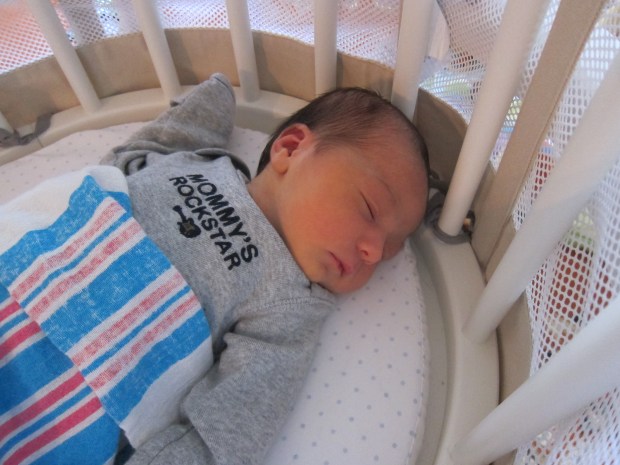
One of the best pieces of advice I found before becoming a mother was a snippet from an old Oprah episode that promised to decode a baby’s cries. I highly recommend watching the video in full, but for a quick summary, here’s the golden advice I took away from it.

  • Neh = I’m hungry
  • Heh = I’m tired
  • Eh = I’m uncomfortable (gas etc.)

It’s amazing that infants universally make these cries, and also how tuned into them you’ll be if you know what to listen for.

But because even this method isn’t fail-proof, today I took the time to listen to Veronika when she cried. You can even ask your child, “Why are you crying?” They won’t be able to tell you yet, but it sets up two-way conversation and makes baby feel heard.

Also be sure to look for non-verbal cues (i.e. baby’s body language). Turning their head toward an object or stuffing fists near their mouth (otherwise known as “rooting”) is a sure sign that baby is hungry. Turning their face away is a good indicator that the baby might feel overwhelmed or overstimulated. And of course you can guess what little smiles or wide-open eyes mean!

If you really can’t figure out what the baby needs, take a pause for you both. I lay Veronika down on a blanket on the floor, closed my eyes and took a deep breath. Calming yourself is equally as important in these moments as calming the baby.

Do you have a secret tool you use to decode baby’s cries? Please share in the comments!


Begin a Baby Journal

Start Journal.JPG

Today’s prompt from a baby game book was to start journaling about the journey… I confess it felt redundant, as I already journal every night. But in following the recommendation, I thought about other ways to journal and record Veronika’s days, alongside my nightly written entries.

When they are this young, babies are literally changing daily, and it’s these little moments that I try to jot down each night. But words can only jog the memory so much. A visual journal is equally important. Try to capture a picture of your child each day in these early weeks and months, carefully labeled (three days old, five days old, etc.), and you’ll see the changes that take place and add up over time.

5 days

I love storing pictures online, divided by folder into months, so they are easily accessible!

6 days

Video is a fantastic log, too. You’ll never remember quite the pitch of your baby’s coos, or the way their expression quirks into a little smile if you don’t have a video record.

You may also have been filling out a pregnancy journal along the way. Many contain a section at the end about the first few days back at home, so don’t neglect it! You’ll thank your past self when you look back on these precious early memories later on.

Start Journal (2)

What form will your baby journal take? Please share in the comments!

Update: Just a friendly reminder to add to your journal, since it’s been about a month since this post! There is so much to keep track of these days – that Veronika’s eyes are changing from baby blue to a deeper brown, that she loves staring at the apple prints I posted near her diaper table, that she’s beginning to make sounds more like coos than just cries, and that her smiles seem to be true ones of joy. What have you noticed that’s different? Please share in the comments!

Add to Journal.JPG


Mama’s Scent

Mama's Scent (1)

One of the biggest differences between baby one and baby two is that I can’t always be there for Veronika as I was for Travis – school drop-off, Halloween events, you name it. Even in one week, I’ve learned that I can’t be in two places at once.

Fact is, whether your newborn is your first or your fourth, you’re going to be away from them eventually. But you can leave a little bit of yourself behind – your scent that is. Newborns have a remarkably attuned sense of smell (able to distinguish their mother’s milk from another mom’s milk, for example), which is their most developed sense at birth.

If you’re like me, then you have a burp cloth draped around you pretty constantly. I especially have one on my shoulder while nursing Veronika, so it’s covered in my scent (And in leaked milk!). And this makes it the perfect item to leave behind.

Case in point, today while I went grocery shopping with Travis, the burp cloth was left behind to bring comfort.

Mama's Scent (2)

You don’t want to leave the cloth with a baby who is unattended (nothing in the crib until a year old, remember!) but under supervision, the scent may just help a crying baby settle down.

Mama Scent (3)

Sing a Lullaby

Sing Lullaby (2).JPG

Phew! After a first few hectic days at home, adjusting to life with two, I’m taking time during nursing sessions or before bed to sing Veronika lullabies.

I love lullabies, and I particularly love singing them while nursing, even if bedtime isn’t shortly to follow (newborns are in and out of sleep so often, that pretty much any time counts as nap time!). Singing keeps me present and in the moment, instead of turning to my phone or another distraction. Plus it engages her senses, and helps us bond. If she dozes off at the end of the song, so much the better!

Sing Lullaby (1)

Some traditional ones to sing include: “Baa Baa Black Sheep”; “Twinkle Twinkle Little Star”; “Rock-a-Bye Baby”; “Hush Little Baby”; and “Swing Low Sweet Chariot.” But don’t stop there! Almost anything can be a lullaby if you sing it with the right intention. To wit, some others I love for little babies include:

The Water is Wide

Little Drummer Boy

Slip Sliding Away

Those Were the Days

Taxi

Blowing in the Wind

Scarborough Fair

I adore singing for my children so much that I even recorded an a cappella lullaby CD when Travis was small! It doesn’t matter if you are a professional musician or can’t carry a tune… I hope this post inspires some singing for your little one today.

Start Talking

Start Talking (2)

If you’re the parent of a newborn, chances are you’re already guilty of speaking “baby-ese”, that particular, sing-songy voice that people seem to instinctively use with infants. And there’s a reason for it. The pitch is higher than normal adult-speak, and the vowels are longer; studies show that babies pay more attention to adults using this type of language than those speaking in a normal pitch, and that the exaggerated mouth movements help infants better grasp meaning.

So start talking! Your newborn may seem like a sleeping-eating-pooping machine, but they are already taking in so much of the world.

Today’s activity with Veronika, then, was simply to remember to keep talking, especially in a home where adults and big kids dominate.

Any time is a good time to talk, whether over breakfast with big brother…

Start Talking (1)

…or in quiet one-on-one moments. You might even elicit a little smile.

Start Talking (3)

Or a big gummy grin.


Diaper Time Reflections

Diaper Mirror (1)

Right now, your newborn can only focus about 8 to 10 inches away – ideal for focusing on your face during nursing sessions or snuggles of course! But that means you’ll want to find other ways stimulate the eyes up close.

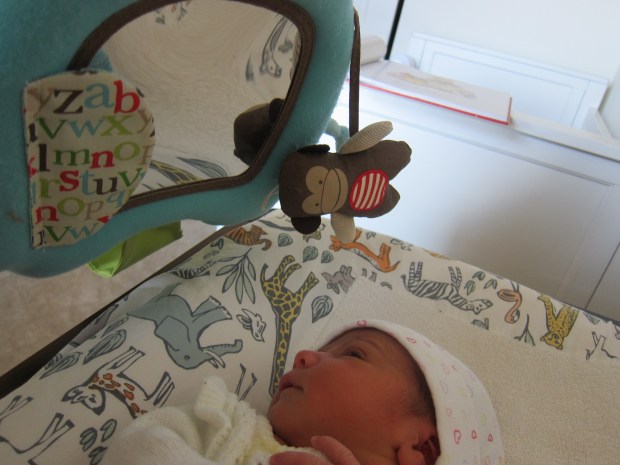
To wit, a small unbreakable toy mirror on the diaper table during changing time is a fantastic option. Not only will baby be entertained (many such mirrors contain crinkly flaps, or small stuffed animals to look at, but oh my goodness…

Diaper Mirror (2)… Veronika is wondering, who is that cute face in the mirror?

Baby won’t understand yet that they are looking at themself, but it will certainly provide a distraction from an unwanted diaper change.

Diaper Mirror (3)

No need to reserve this activity for the diaper table – Veronika loves looking at the mirror in her playgym, too!

First Sensations

FIrst Sensation (5).JPG

Your newborn is developing all five senses rapidly in his or her first few weeks out of the womb. It’s easy to focus on the obvious senses like hearing and sight, but don’t forget to include touch along the way! Here are a few simple ways to engage your baby’s sense of touch.

During diaper changes, while the baby is calm, try stroking hands, feet, or tummy with different soft objects. Great items for this purpose include feathers and silk scarves.

FIrst Sensation (3)

Veronika loved the silk against her cheek!

First Sensation (2)

You might also try swatches of other fabric like velvet if you have them.

Another fun one is to roll a small inflatable beach ball over baby’s tummy before you put the new diaper on (take care while doing this move if the umbilical stump hasn’t yet fallen off). Sure to elicit a giggle or two!

FIrst Sensation (1)

Off the diaper table, you can also engage the sense of touch while nursing. Try just stroking along baby’s fingers and toes, or use a soft cotton ball. This move also helps draw awareness to baby’s hands and feet, so he or she can see where the body begins and ends.


Feeding Time Activity Bag

Feeding Activity (1)

One of the biggest differences about bringing home baby number two is that you still have to (and want to!) entertain child number one… Who now demands your time and attention even doing the things that have to get done, like nursing, oh, twelve times a day. Cue this brilliant suggestion from Hands on As We Grow for a feeding time activity bag.

Okay, ours is actually a basket, not a bag, but the toys within are only for my preschooler to use when the baby is nursing, meaning they feel special and different.

Stock the basket with simple games that a child can do by him or herself – you don’t to have to get down there to open packages up!

To wit, we stocked ours with goodies like Button Art. Travis jumped at this activity, taking to it with alacrity, and so excited he didn’t want the nursing session to end.

Feeding Basket (2)

The next time his sister was hungry, he fell to the sticky foam. This stuff is ingenious (no mess!) and was soon making cakes and other concoctions.

Feeding Basket (1)

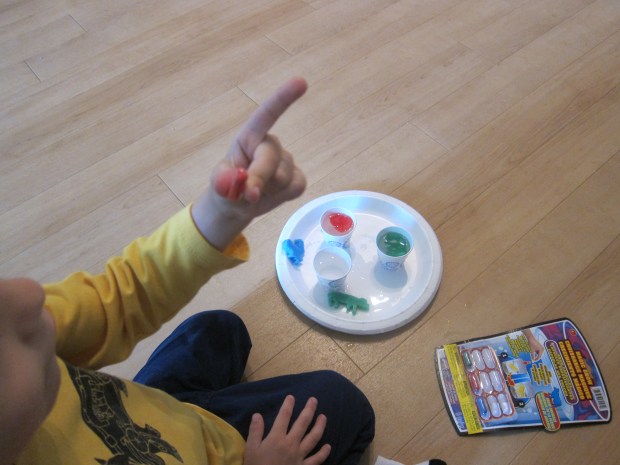
Later in the day, he couldn’t get enough of sponge animals (I did get these started for him, in cups of warm water), not only revealing the animals but using them in games all about the room.

Feeding Basket (4)

Other simple ideas for your kit? Think stickers books, paint-by-number, coloring books, or any other quiet activity your child would enjoy.

Feeding Basket (5)

Happy nursing!


Birth Recovery

Birth Recovery (4)

My activity today with Veronika was profound on so many levels: relaxing us both after the birth a few days ago; taking a quiet a moment to bond, and providing a moment of physical comfort. I highly recommend making time for this simple exercise; it will be a moment of pure bliss in your day.

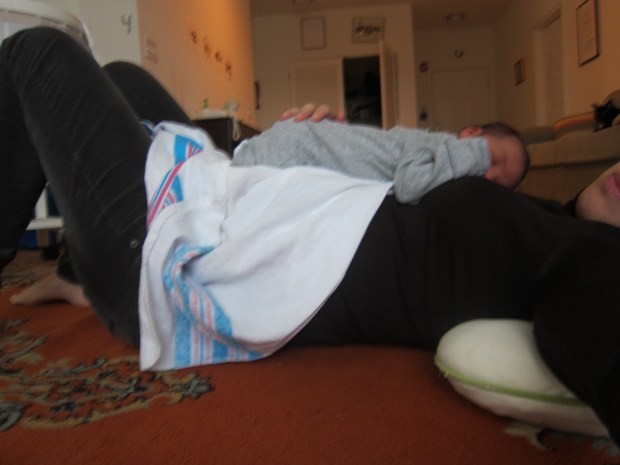
Lie on the floor (on a carpet) on your back with knees up, head on a pillow, and your baby on your chest (the baby’s face should be turned to face one side). Admittedly it was difficult to take pictures of us in this position, but I did my best!

Birth Recovery (6)

Inhale, then as you exhale, press the base of your spine and your shoulder blades into the floor, holding for a few seconds. You’ll feel a great release of tension in your back, if you’ve been holding it there since delivery.

Birth Recovery (2)

In between reps, simply lie with your baby and breathe, feeling your stomachs and diaphragms against each other as you both inhale and exhale. I would have stayed this way forever if I didn’t have a preschooler to fetch from school!

How do you relax with your newborn? Ideas like this are so simple, but so vital as a reminder to slow down in the precious first few days of life. Please do share your thoughts in the comments!

Animal Hammock (and Other Stuffed Animal Solutions)

Animal Hammock (3)

This activity for a newborn can be done even before your bundle of joy arrives in the home, or is a great one to do in the first days upon return from the hospital, that moment when you wonder… Well, what do we do next? New parents so often express this sentiment to me: The new baby is in the car seat on the floor, and now there are days and days to fill! It’s also an activity that is great for veteran parents who want to involve a big sibling.

To wit, I told my son I needed his help in the nursery, and we emptied out all of the stuffed animals from where they’d been in a basket, untouched, for years. Not only did he have fun going through old favorites, but he was also fascinated watching as I selected a baby blanket (chances are you have one too many!) and thumb-tacked it to the wall. Make sure the thumb tacks are very secure, or at the least some place where they can’t land on the baby in case one pulls free.

Animal Hammock (1)

Once you have all four corners tacked up, fill the hammock gently with the stuffed animals. Be sure not to overcrowd or make the blanket too heavy.

The result is adorable! Stuffed animals are easily visible to pick out for playtime, but also up off the floor and out of the way. This especially makes sense in the first year of life, when baby is too young to have any stuffies in the crib for naps or nighttime.

Animal Hammock (2)

A second idea is to buy a large wreath from a craft store, and attach stuffed animals with floral wire. I like this solution for larger animals that were a bit too heavy in the hammock. Poke the wire through a bit of the stuffing in their backs (don’t worry, they won’t feel it!), and attach securely around the frame.

Bear Wreath (2)

This is a great way to display stuffed animals, functioning almost like a mobile or visual stimulus near the crib.

Bear Wreath (4)

If you’re feeling truly ambitious, here’s a third solution. (Note: we skipped this one!).

Buy a 2-inch thick dowel from your local Home Depot, cut to measure the height of your baby’s room. You’ll need to set the pole in wooden brackets on the floor and ceiling of the nursery. Use screw-in hooks along the length of the pole for stuffed animals to climb the “tree.”

If you attempt this third stuffed animal idea, I’d love to see pictures or hear how it went in the comments!