Solar Eclipse Science Project

Solar Eclipse Viewer (8)

I put together a simplified version of this box back when there was a solar eclipse in our area in 2017. Today we wanted to see if the box would work for Mercury’s transit across the sun, and now Travis was old enough to help with all the steps!

To start, we upcycled a Kiwi crate (though any shoe box would work). Measure 2 inches in from one edge and poke a push pin or thumb tack through for a small hole.
Solar Eclipse Viewer (1)

On the opposite side of that same edge, measure in 1/2 an inch and cut a square that is 2 inches on each side.
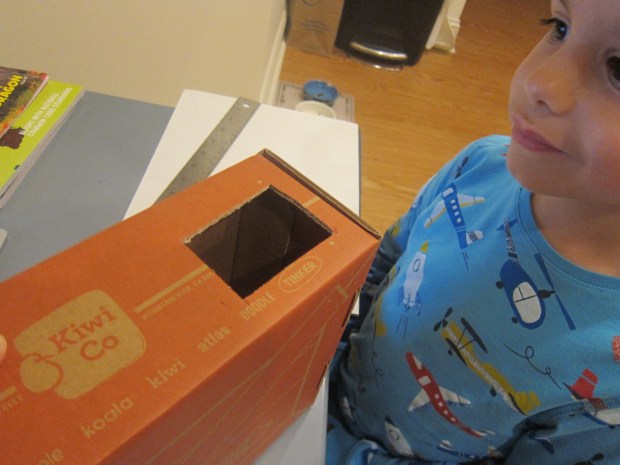
Solar Eclipse Viewer (2)

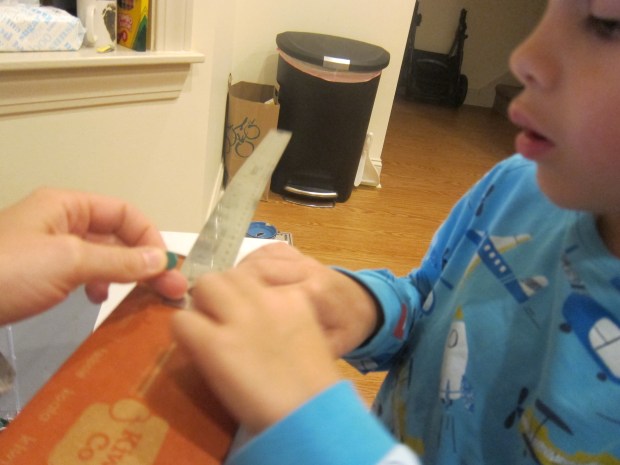
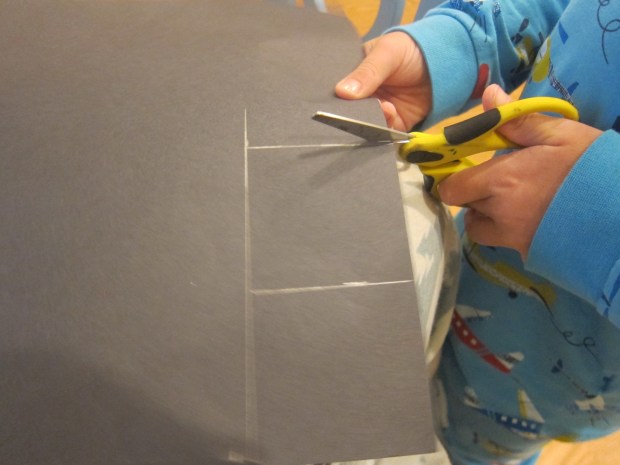
Cut a square from black paper that is 2.5 inches on each side. Travis loved cutting along the lines I measured with our ruler.
Solar Eclipse Viewer (3)

Trace the inside of a small roll of tape in the center of the black square, and cut out this circle (a mommy step).

Solar Eclipse Viewer (4)

Tape down on the inside where you’ve cut the viewing hole.

Solar Eclipse Viewer (5)

Next cut a rectangle from white paper that is 10.5 inches long x 3.25 inches tall. Use double-sided tape to attach on the inside of the box opposite the viewing hole.

Solar Eclipse Viewer (6)

Now cover any seams or cracks with tape. Travis took it very seriously to ensure that we had no points where light could filter through.

Solar Eclipse Viewer (7)

We peeked inside in the kitchen, but if course there was only darkness without any sunlight coming through our tiny pin prick.

Solar Eclipse Viewer (9)

The answer to our initial question (would the box work for Mercury), alas, was no.

Mercury entered its transit across the sun the next morning at 7.30, but it was so cloudy that the sun wasn’t visible all day! Further research suggested that Mercury would be much too tiny to spot in our viewer anyway, and what we really needed was a telescope with a proper sun filter. Instead, we checked out the transit online. And now we’re going to set aside our solar eclipse viewer for the next one… in 2024!

String of Floaters

String of Floaters (2).JPG

It’s never too early to introduce a little science at tub time! Older toddlers will love experimenting with what sinks and what floats, and perhaps understanding a little bit of why. But for my one-year-old tonight, this activity was more about delighting with the visual of flotation!

Gather items around the house that float: corks, Styrofoam, and wooden beads are all perfect. I strung these items together in one big line. Now it was ready to be a boat!

String of Floaters (3)

Veronika loved towing the items along, running her fingers over each of the different materials and dragging them through the water.

String of Floaters (4)

I also cut a sponge into a few different shapes, like rectangles, diamonds, and triangles, and added these pieces to the tub.

String of Floaters (1)

Veronika loved grabbing the sponges and discovering she could squeeze them. Then she began scrubbing at the Styrofoam with the sponge pieces; cleaning and learning, what a double win!

String of Floaters (6)

We will definitely get good mileage out of this homemade tub toy. As always, make sure water play is 100% supervised.

String of Floaters (7)

Rainbow CD

Rainbow CD (3)

If a gray day has you wishing for rainbows, make some at home with this easy craft! It’s just one of several ways Travis and I have made light after dark, lately.

We made our project a bit whimsical by turning it into a sort of “hunt” for the rainbow at the end of a pot of gold. That meant we wanted to decorate our CD with shamrocks. To make them, use a heart-shaped hole punch.

Rainbow CD (1)

For every shamrock, fit 3 hearts together into a clover-shape. Tape the hearts to the back of a blank CD.

Rainbow CD (4)

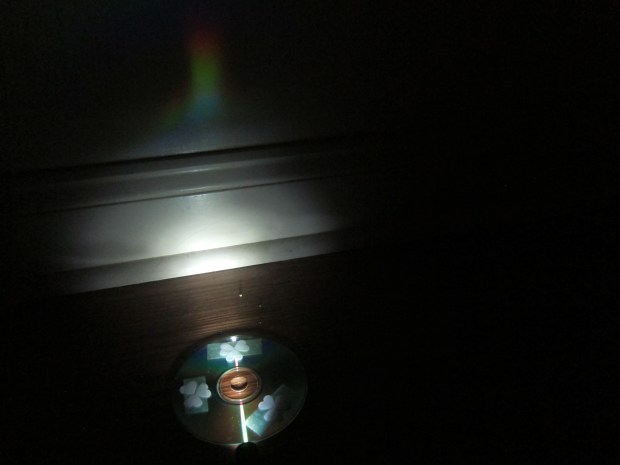
Now head some place dark, and shine a light!

Rainbow CD (5)

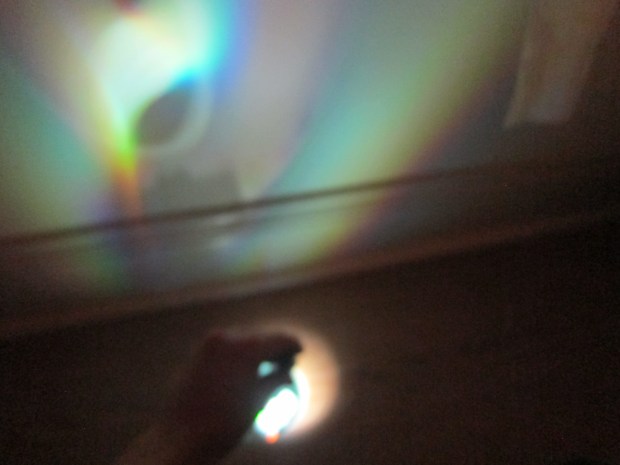
Travis loved holding the flashlight and seeing the rainbows appear on the wall. We experimented with different angles; if he held the light directly over the CD, the rainbow was like a laser line on the CD itself.

Rainbow CD (6)

If he held the light close to the floor, the rainbow appeared on the wall, growing bigger or smaller as he altered the angle.

Rainbow CD (7)

Note: there’s no need to decorate your CD to make this craft work, but it does add a nice touchy of whimsy!

Cranberry Chemistry

Cranberry Chem (6)

The cranberry harvest has hit the shelves, making it the perfect time of year to experiment with this under-appreciated berry. Okay, so this quick science trick uses cranberry juice, not whole fresh cranberries, but it’s still a fun seasonal project for kids!

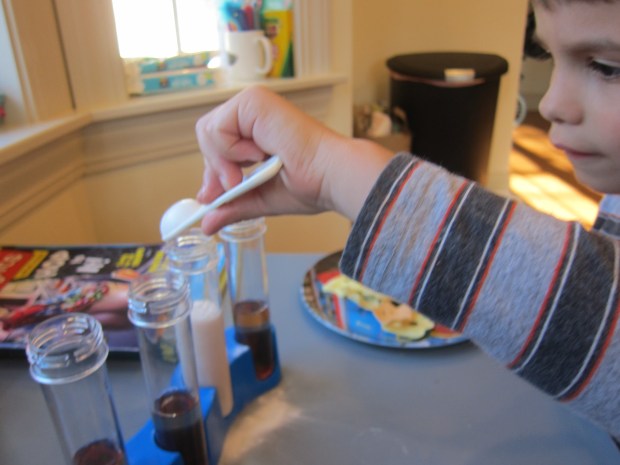
I set up a few test tubes about 1/3 of the way full with cranberry juice and laid out baking soda and lemon juice.

Cranberry Chem (1)

First, Travis added 1 teaspoon baking soda to one test tube. It fizzed instantly, always the most exciting part.

Cranberry Chem (2)

When the bubbles settled, the cranberry juice was noticeably more yellow.

Cranberry Chem (3)N

ow add 1 teaspoon lemon juice (or citric acid) to the same test tube. It will return (almost) to the original color. The color became sort of striated in ours, so the return to normal was clearest near the bottom of the tube.

Cranberry Chem (5)

The science at work here is base (baking soda) first neutralizing the anthocyanins in the juice, and then the acid returning it to normal. Travis had fun simply experimenting from there! He thought we might make it extra yellow by adding 2 teaspoons baking soda (that one was really fizzy!).

Cranberry Chem (4)

Next time, we’ll think of other solutions we can add, like soda or baking powder.

Toppling Tower

Toppling Towers (8)

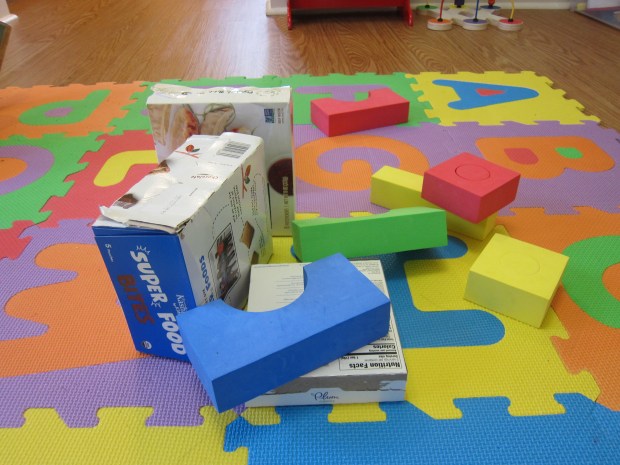
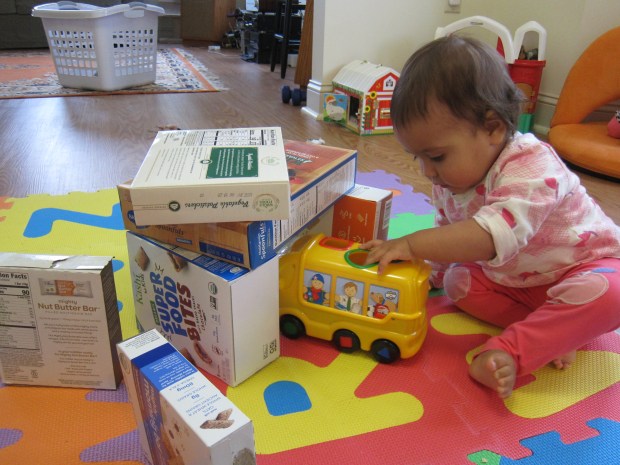
Chances are you have lots of empty snack boxes if you have kids. Instead of recycling, set them aside and build up a collection. Now you have all you need for building towers with your baby!

For about a week, I saved every empty snack box and cereal boxes. Tape the tops closed, if needed, so no edges stick out. First, I dumped out the bag in front of Veronika. Instant fun!

Toppling Towers (1)

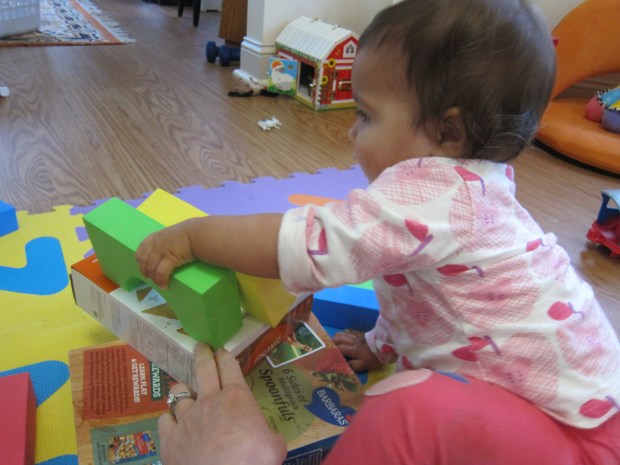
Then we got building. You can encourage your baby to place one box on top of another, but don’t be surprised if the preferred activity is knocking down! This post is called toppling tower, after all.

Toppling Towers (2)

We even got into some pretend play and made a garage for her vehicles.

Toppling Towers (4)

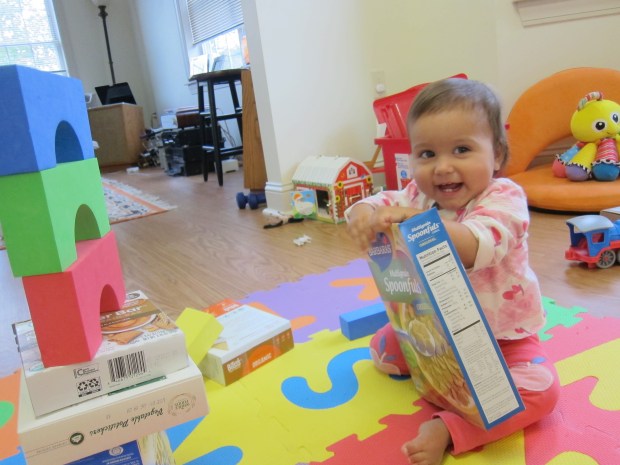
Add in real building blocks to make the structure more complicated (soft foam ones are my favorite for this age).

Toppling Towers (5)

This tower, too, needed to be toppled of course.

Toppling Towers (6)

This kind of early STEM activity will help build new connections in your baby’s brain, plus provide lots of enjoyment!

Toppling Towers (7)

Kaboom!

Toppling Towers (3)

Geometric Refrigerator Magnets

Refrigerator Magnets (7)

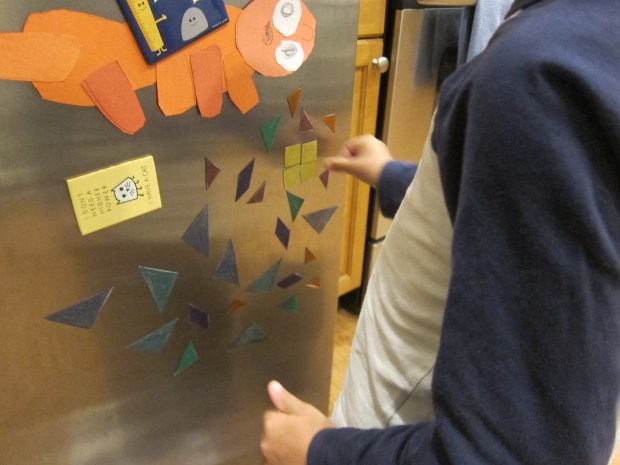
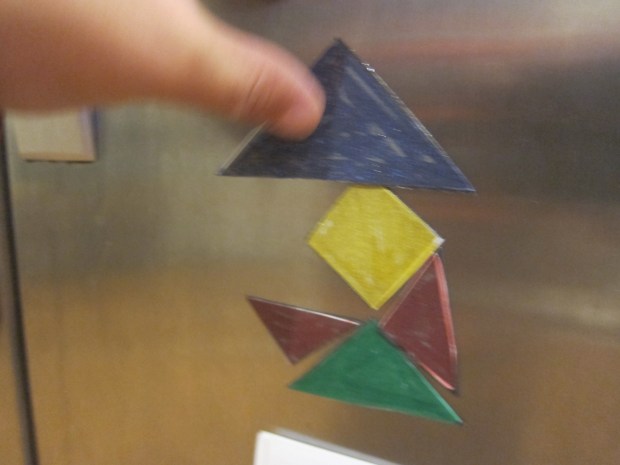
We now officially have tangrams all over the house, whether felt versions to make in the playroom or this handy set for the fridge!

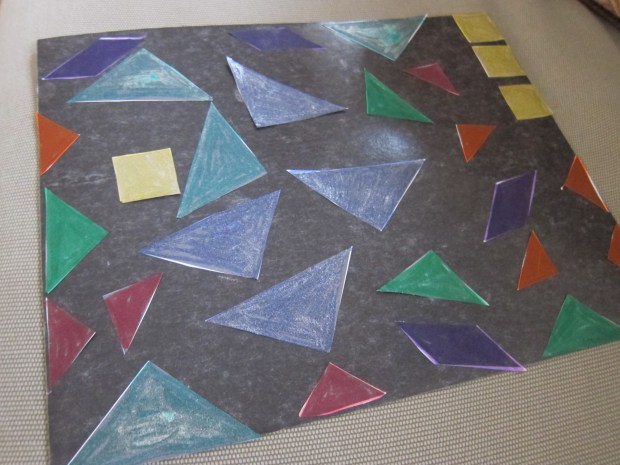
Travis loved making the magnets. You can purchase sheets of magnetic paper at the craft store with a sticky backing on the other side. We printed out and colored tangram shapes, and simply stuck these onto the sticky side.

Refrigerator Magnets (1)

Travis was fascinated with how it worked: where was the magnet? he wanted to know. How did the shapes stick?

Cut out your shapes (this was a lot of cutting for mama!) and transfer to the fridge.

Refrigerator Magnets (2)

At first Travis just played with them and made up his own designs.

Refrigerator Magnets (4)

For a challenge, print out a few tangram shapes and set your child loose. Bigger kids can work with just the outline; younger kids can rely on the answer code at the end of the pdf.

Refrigerator Magnets (3)

Now when I hear those whines of, “Is dinner ready yet?” I set him loose to solve a tangram at the fridge. Built-in kitchen entertainment!

Refrigerator Magnets (6)

Felt Tangrams

Felt Tangrams (3)

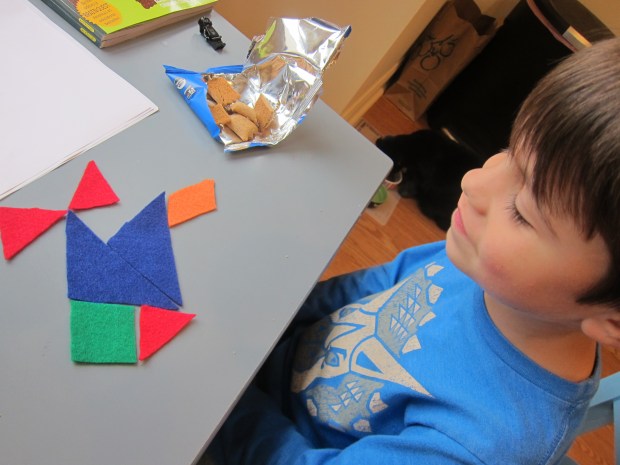
Consider me a tangrams convert; these puzzles have turned out to be a fantastic way for Travis to entertain himself in those moments when I need him occupied. If you don’t want to purchase a set from the store, make a quick version from felt!

I cut out the various shapes that make up a tangram set using a different color for each shape. I free-handed the following: large triangles, small triangles, squares, trapezoids, and hexagons.

Felt Tangrams (1)

Now simply print out pictures of tangrams and set your child to work. If the picture printed out big enough, Travis could work right on the paper.

Felt Tangrams (2)

More of a challenge were small diagrams that he then had to design on a surface next to the paper.

Felt Tangrams (5)

Look mom, a helicopter!

Felt Tangrams (6)

This easy project is sure to keep hands and minds busy!


Missing Square Puzzle

Missing Square (5)

Here was a quick puzzle to do with Travis before school. Simply print out the template, color in the shapes, and cut out. Then I presented Travis with the two challenges.

Missing Square (1)

For the first, the goal is to fit the shapes into the large triangle (we made ours pink) in such a way that no shaded squares show through. This was easy, with a tiny bit of help once he had a triangle pushed against the far corner.

Missing Square (2)

We shuffled the pieces and now tried for challenge number two: to fit in the shapes so one pink square remains uncovered. This was trickier, but accomplished with some shifting around. “I did it!” Travis declared.

Missing Square (6)

Hmm, but how is it possible? It turns out the answer lies in the fact that the colored triangle isn’t actually a triangle; it curves slightly, making it a quadrilateral (too much for Travis to comprehend). What I explained to him instead is that the extra area left over in this slight curve is exactly equal to 1 shaded square.

Missing Square (4)

It certainly looked like a little before-school magic!

Missing Square (3)


All Kinds of Balls

All Kinds of Balls (9).JPG

Travis and I are about to launch into his Game Day-themed kit from Raddish Kids, featuring a trio of recipes perfect for this time of year. Whether your family loves Sunday football, World Series baseball, or simply watching a local game of youth soccer in the park, there’s no better season for sports and eats!

It seemed fitting, then, to start off with this fun lesson plan on all kinds of balls, and namely: why some bounce and some don’t.

First, we needed to brainstorm a list of balls. I gave Travis a definition of the term: coming up with ideas in a safe space where all ideas are welcome and together we made a quick list. I guided him towards actual sports after his first few ideas were more descriptive (squishy balls, hard balls).

All Kinds of Balls (1)

We went through and talked about which was the biggest (basketball!) smallest (ping pong!) and most colorful (tennis!). Now it was time to watch how some of these were made.

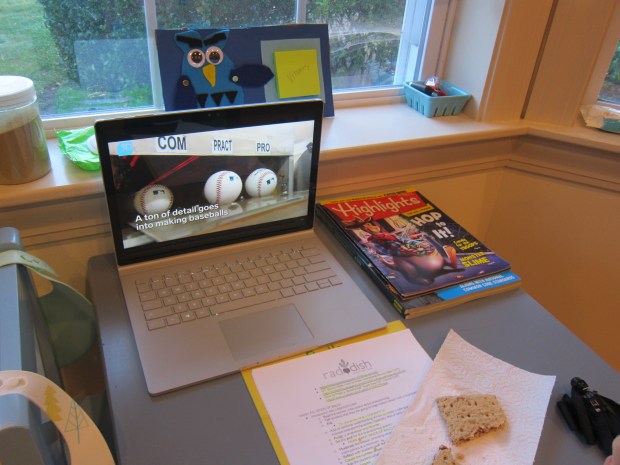
Raddish included links for everything from a soccer ball to a baseball. We added in an old favorite video: check out the bowling ball factory nine minutes in (come for the bowling ball, stay for the jaw-dropping domino demonstration). Travis adores “how-it’s-made” videos like this and was a rapt audience.

All Kinds of Balls (2)

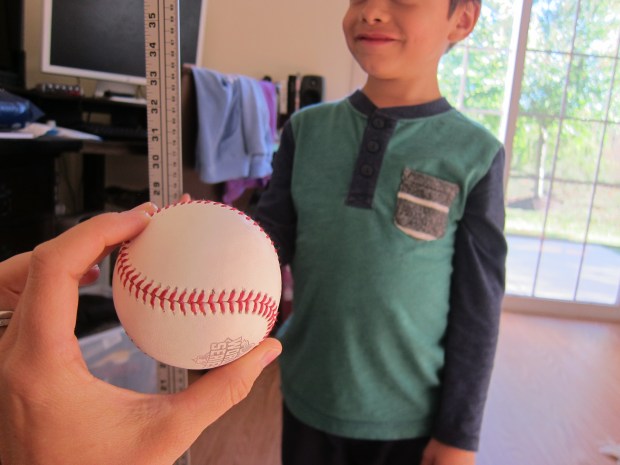
Now it was time to experiment with balls! Relying on what we had around the house, we gathered them into a pile and added a long yardstick.

All Kinds of Balls (3)

Bounce each ball and measure which goes the highest. Our clear winner was a squash ball (36 inches!) while others were duds like the soccer ball and baseball (about 9 or 10 inches).

All Kinds of Balls (4)

This prompted us to talk about why some balls were bouncy, and others not meant to be. (You can guide kids to think about how soccer balls are kicked, baseballs hit, etc., rather than meant to bounce).

For older kids, get into the specifics of kinetic energy here. The lesson was a bit over Travis’s head, but he did like watching a ball bounce in slow motion. We also tried experimenting with which balls bounced best in a certain direction but since all our balls were round (we couldn’t find our football) they all easily went into a target.

All Kinds of Balls (5)

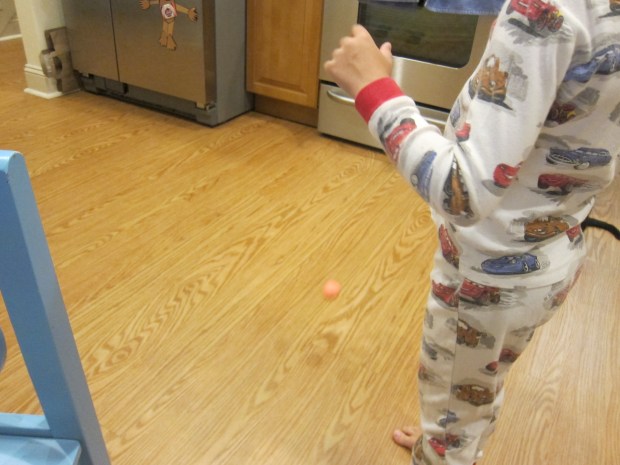
Finally, we bounced them on a wood floor versus carpet, to observe any differences.

All Kinds of Balls (6)

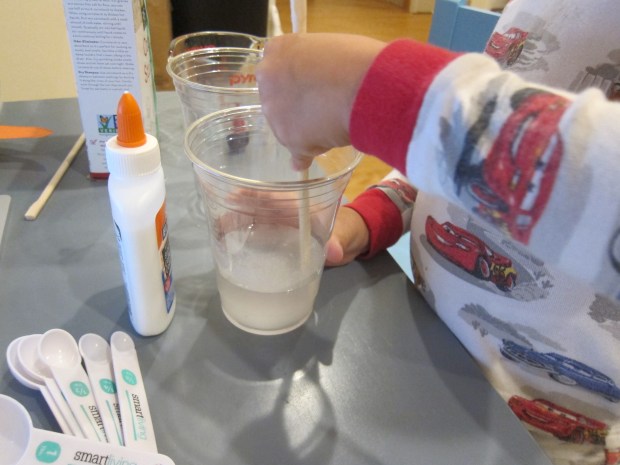
Now for the best part: we made our own ball! Pour 1/2 cup water and 1 tablespoon borax into a clear cup and stir until the borax dissolves.

All Kinds of Balls (7)

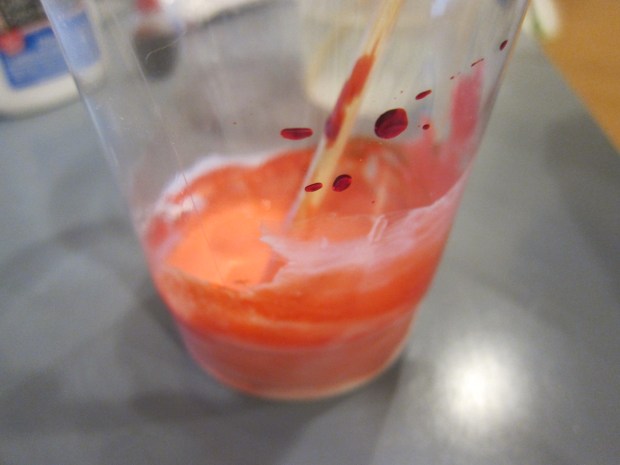
In a second cup, combine 1 tablespoon cornstarch, 2 tablespoons glue, and a few drops of food coloring. Travis chose a red ball.

All Kinds of Balls (8)

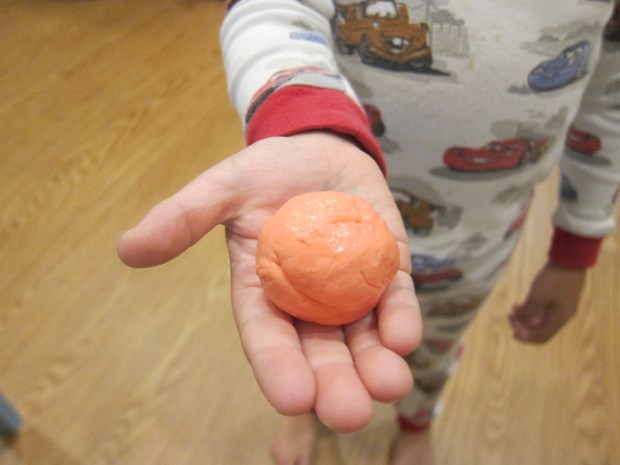
Add the glue mixture to the borax mixture. Your ball will start to firm up immediately. I worked the ball with my hands, dipping back into the borax as needed, until we had a nice round ball. Note: it is safe to touch Borax, but do remind your kids no matter their age that it is inedible.

Travis gave our ball a bounce – it worked!

All Kinds of Balls (10)

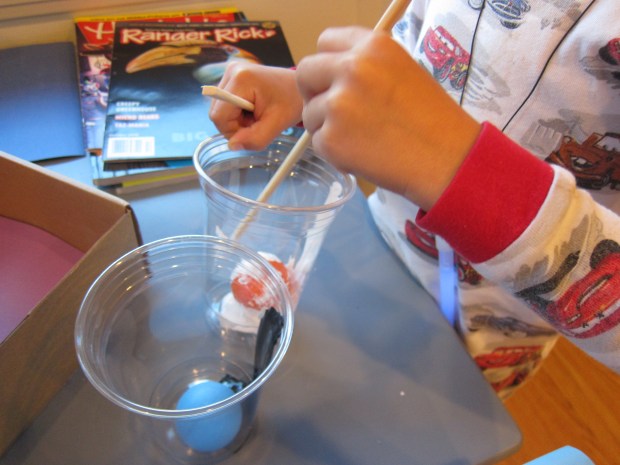
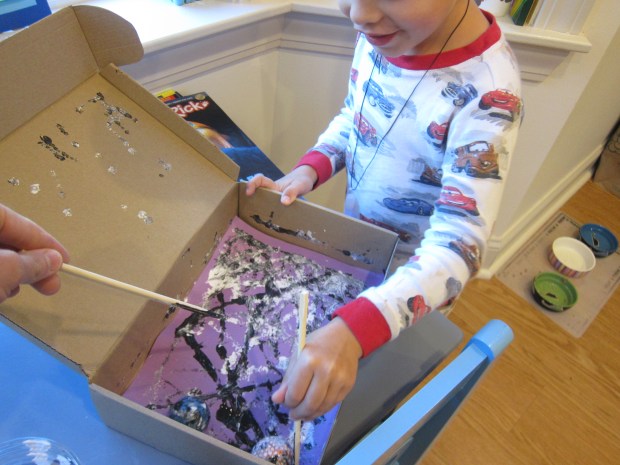
For some final fun, we painted with balls. Roll small balls like golf or ping pong ones in cups of paint.

All Kinds of Balls (11)

Place on a sheet of construction paper in a box. You can close the box and shake it, but Travis preferred to move the ball around with a chopstick.

All Kinds of Balls (16)

We finished with a few fun ball reads including: Round Like a Ball by Lisa Campbell Ernst and Goodnight Football by Michael Dahl.

All Kinds of Balls alt

Make Your Own Jigsaw Puzzle

Make Your Own Jigsaw (4).JPG

Travis had so much fun with the puzzles in his latest Kiwi Crate that we decided to make a few of our own!

Download and print out any puzzle template from online. We found ones we liked showing a teddy bear and a butterfly (and if anyone can find the Steve the Kiwi template from kiwico.com/puzzles, let us know!).

Make Your Own Jigsaw (1)

Coloring in was half the fun. I warned Travis that if he made his butterfly all orange, it was going to be very hard to put back together.

Make Your Own Jigsaw (2)

Soon he branched out to other colors, and added blue so that the butterfly was flying over the ocean. Glue your template to an old cereal box and let dry completely.

Make Your Own Jigsaw (3)

Now it was time to cut up the pieces! Word of caution: This task is quite time-consuming for a 16-piece puzzle. For that reason, and because I worried the 16 pieces would be quite a challenge for Travis, I cut his butterfly into fewer, larger pieces.

Make Your Own Jigsaw (5)

Now puzzle! As mentioned, the butterfly came together quickly.

Make Your Own Jigsaw (6)

Between uneven pieces and tricky outlines, the teddy bear nearly stumped us!

Make Your Own Jigsaw (7)

What would your child make a puzzle of? Please share in the comments!

Make Your Own Jigsaw (8)