Holey Hand

Holey Hand (4)

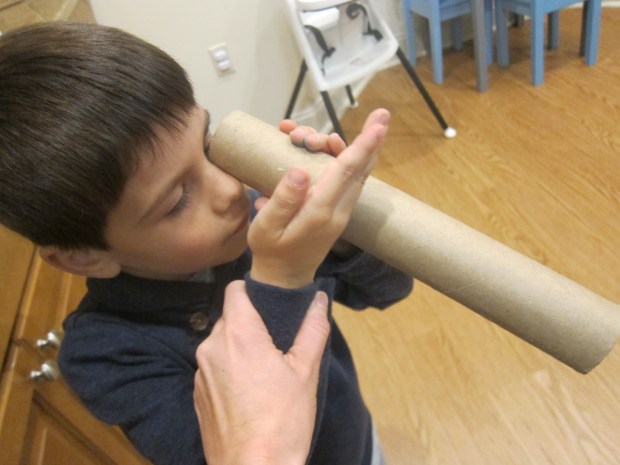
This simple trick is a tangible way to show kids how each eye sees the world in just a slightly different way. Kids will marvel at the fact that the brain blends together two views into one picture once they have a “hole” in their hand!

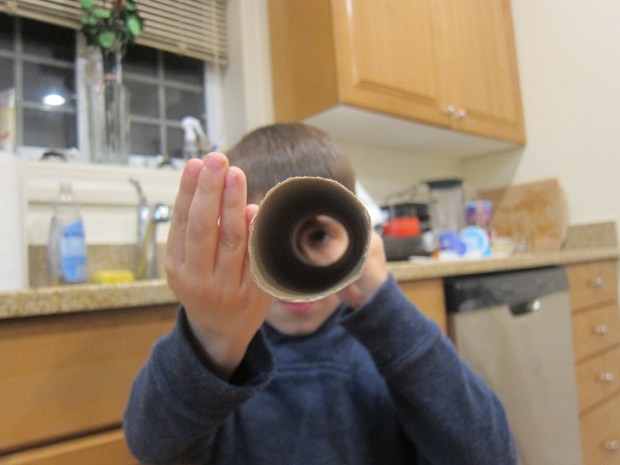
All you need to do is hold an empty paper towel tube up to the left eye, holding it in the left hand. Leave both eyes open, and place the right hand directly in front of the open right eye. Slowly begin moving that hand forward, keeping it against the side of the cardboard tube.

Ideally, you’ll start to see a hole in your hand! I had to help Travis with a few mechanics. At first he zoomed his hand forward too fast.

Holey Hand (1)

Then it wasn’t quite at the right angle.

Holey Hand (2)

But then I got a big smile and laugh once he had the trick of it down. Grown-ups, you’ll want to try this, too!

Holey Hand (3)


Jiggly Rainbow Cups

Jiggly Rainbow (8).JPG

Here’s a cute way to “taste the rainbow”, as the old slogan goes! You’ll need jel dessert in all colors of the rainbow. Jell-o of course comes available in everything from red to purple but is not vegan. Instead, I prepared a big batch of Lieber’s clear unflavored jel dessert. We divided it among 5 cups, and used food coloring to make:

  • red
  • yellow
  • green
  • blue
  • purple

This was a great refresher on color mixing, since I only had food coloring in primary colors!

Jiggly Rainbow (2)

I also had Simply Delish’s orange flavored jel dessert, so we used that for the orange layer.

Jiggly Rainbow (1)

Now you’ll need to layer your dessert. We spooned a layer of purple into a cup and placed in the freezer for about 15 minutes to speed up the setting process.

Jiggly Rainbow (3)

Continue adding layers and freezing briefly until you have a full rainbow.

Jiggly Rainbow (4)

Unfortunately our three dark layers (purple, blue, green) and three light layers (yellow, orange, red) sort of blended in with one another. Shining a flashlight helped reveal the distinction!

Jiggly Rainbow (6)

Meanwhile Travis thought this was just the best dessert ever. Of course there was the obligatory poking and squishing that must happen with jel desserts.

Jiggly Rainbow (7)

Then it was time to spoon through the layers, and he kept me updated on his progress: “Mom, I’m up to the yellow!”

Jiggly Rainbow (9)

A super fun way to play with rainbows.

Rainbow CD

Rainbow CD (3)

If a gray day has you wishing for rainbows, make some at home with this easy craft! It’s just one of several ways Travis and I have made light after dark, lately.

We made our project a bit whimsical by turning it into a sort of “hunt” for the rainbow at the end of a pot of gold. That meant we wanted to decorate our CD with shamrocks. To make them, use a heart-shaped hole punch.

Rainbow CD (1)

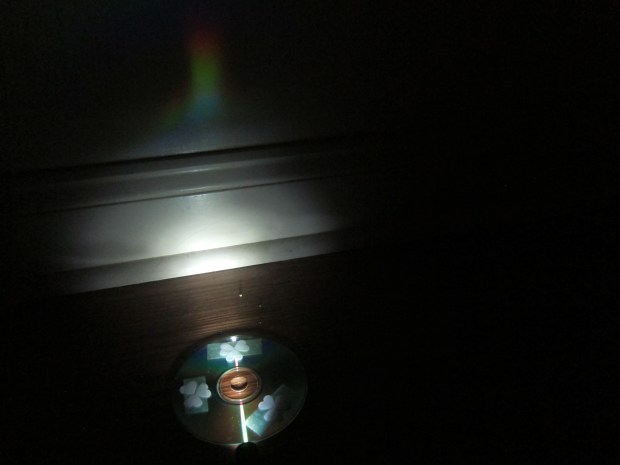
For every shamrock, fit 3 hearts together into a clover-shape. Tape the hearts to the back of a blank CD.

Rainbow CD (4)

Now head some place dark, and shine a light!

Rainbow CD (5)

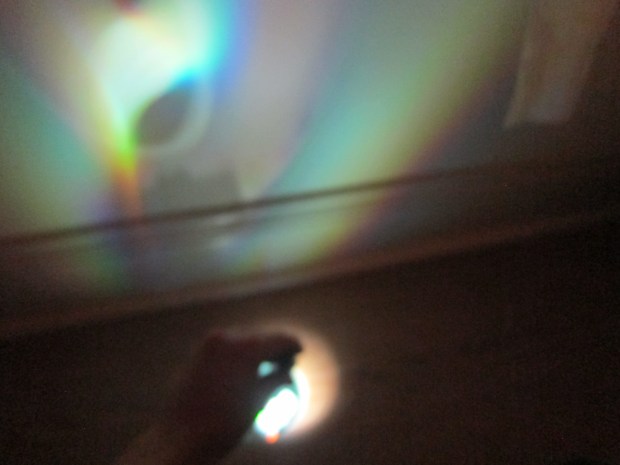
Travis loved holding the flashlight and seeing the rainbows appear on the wall. We experimented with different angles; if he held the light directly over the CD, the rainbow was like a laser line on the CD itself.

Rainbow CD (6)

If he held the light close to the floor, the rainbow appeared on the wall, growing bigger or smaller as he altered the angle.

Rainbow CD (7)

Note: there’s no need to decorate your CD to make this craft work, but it does add a nice touchy of whimsy!

Glowing Hula Hoop

Glowing Hula Hoop (6)

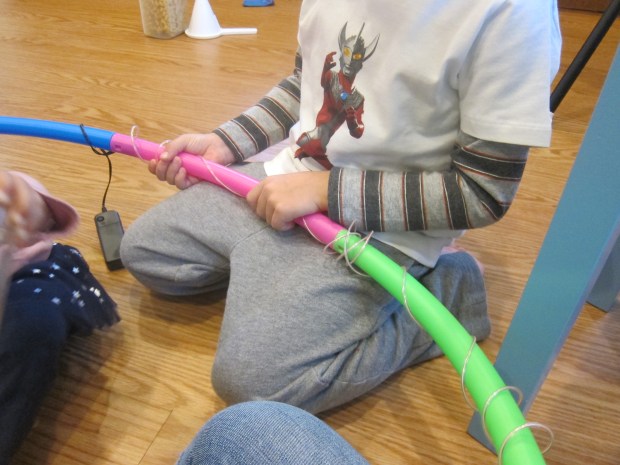
Daylight savings means we have a few extra hours of dark before bed, and that means Travis and I can do projects that require a little extra darkness! Kids will go wild for this glowing hula hoop. You just need a few special items to put it together.

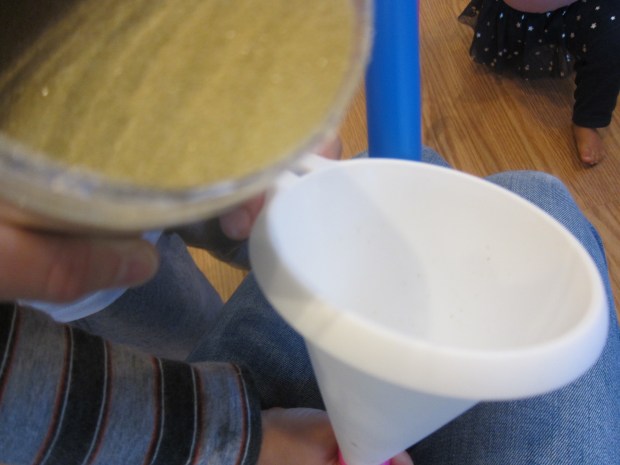
We have a hula hoop that snaps together, which was perfect because to start, you’ll need to open up the hula hoop and dump in a little sand. A funnel helped keep this step neat and tidy. Snap the hula hoop back together.

Glowing Hula Hoop (1)

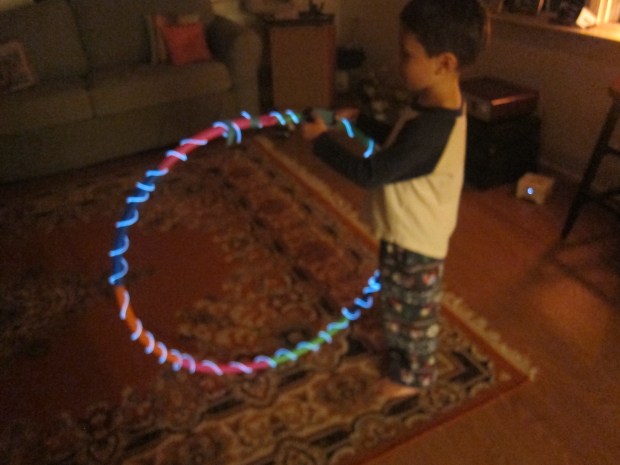
Wind EL wire (available at Amazon) around the outside of the hula hoop. Secure with zip-ties, trimming them down if a long end remains.

Glowing Hula Hoop (2)

In a pinch, use electrical tape to secure the wire to the hula hoop in a few places. Add batteries to the wire’s battery pack, and use the clip on the back of it to hook onto the hula hoop through one of the zip ties. You’re ready for glow time!

Glowing Hula Hoop (3)

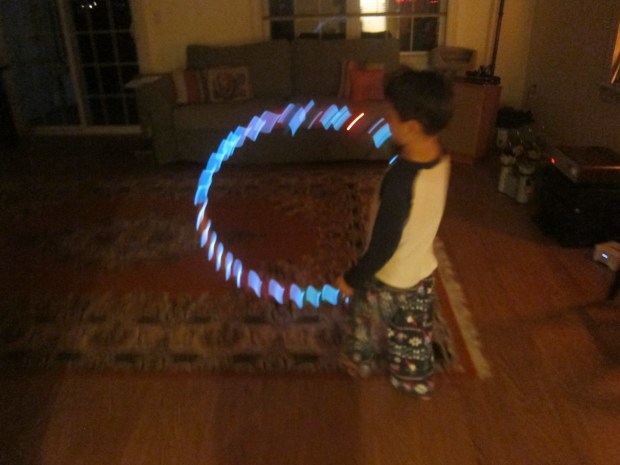
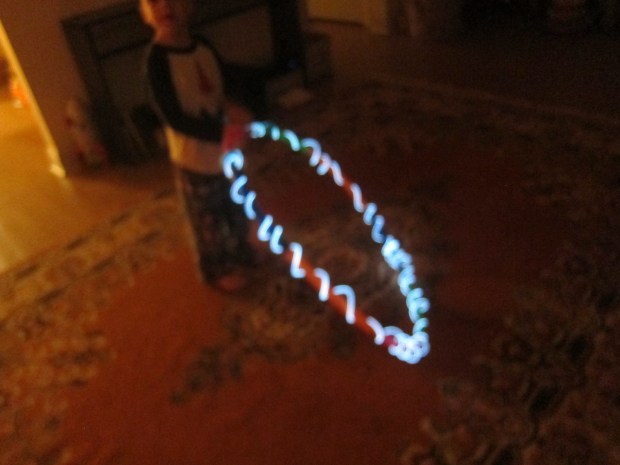
After dark, we turned out the lights and did the hula!

Glowing Hula Hoop (4)

Travis actually preferred not even having it around his waist; he just loved rolling it, spinning it, and testing out the feature on our EL wire that made the lights steady or blinking.

Glowing Hula Hoop (5)

What fun after dark!

Glowing Hula Hoop (7)

Serious Secrets of the Circle

Secrets of Circles (6).JPG

Travis was bit young for the lesson on Pi that accompanied his Jack-O’-Pot Pie recipe from Raddish Kids, but there were plenty of suggested activities for younger kids. Without the advanced math, you can still explore circles and their properties with those in Pre-k or kindergarten.

First, check out a copy of Lois Ehlert’s Color Zoo from the library. Go to the first page with a circle, and cover behind it with a piece of paper.

Secrets of Circles (1)

Ask your child what animal it might be, then remove the white paper for the reveal of a tiger face. We went through the rest of the book, each animal’s face featuring a different shape.

Secrets of Circles (2)

I reminded Travis how everything in the world is made up of shapes, but today we’d be focusing on circles… Circle detectives!

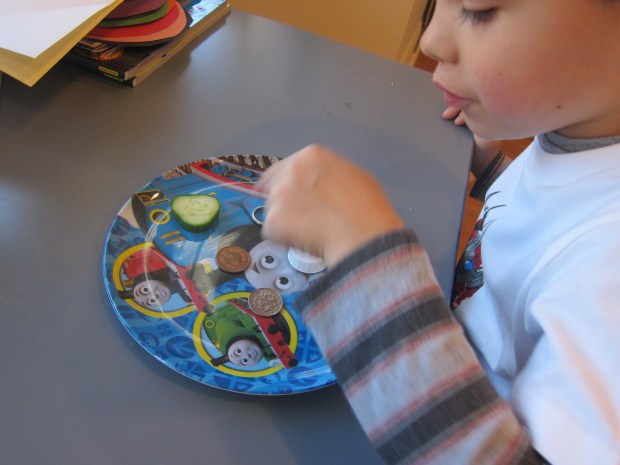
I set out a plate (itself a circle!) with other circular items on it, including a ring, coin, cucumber slice, and bottle cap. Other easy ideas would be a button, slice of orange, or wheel.

Secrets of Circles (3)

I invited Travis to investigate the items. What did he notice? He noted how they all had no corners, they were round, they were flat (don’t use spheres like balls!) and they could spin or roll. He had helped define a circle!

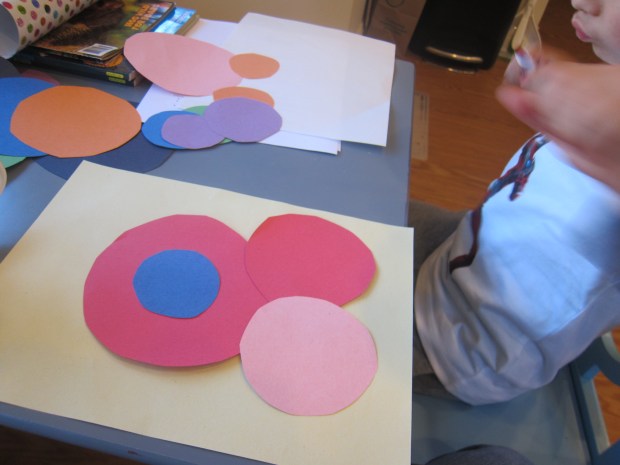
With the detective work complete, it was time for circle art. I had pre-cut lots of different sizes and color circles from construction paper. His challenge was to make a picture or shape of something, but only using circles!

At first he seemed stumped. I showed him an animal face and we quickly decided it was a mouse.

Secrets of Circles (4)

Once he had the idea, he began gluing down circles as a Star Wars space craft.

Secrets of Circles (5)

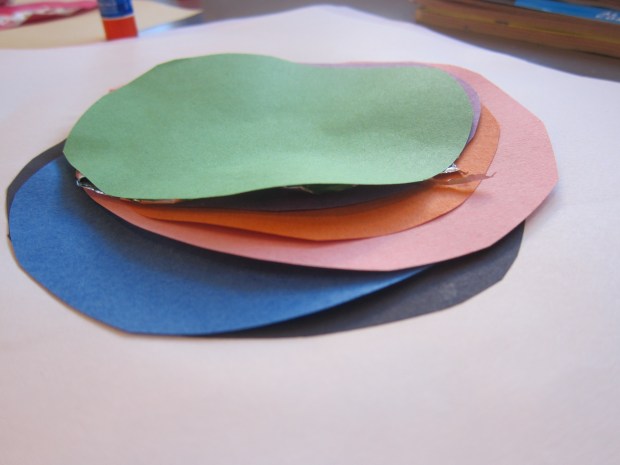
But then when he saw there were more than just black circles to work with, he became excited and began piling them up. It turned out to be a building!

Secrets of Circles (8)

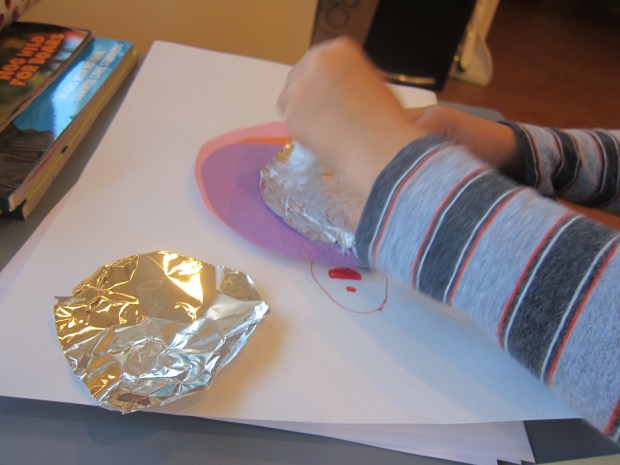
You can use other materials like tin foil circles, wrapping paper, or tissue paper for embellishment. Have fun with this part!

Secrets of Circles (7)

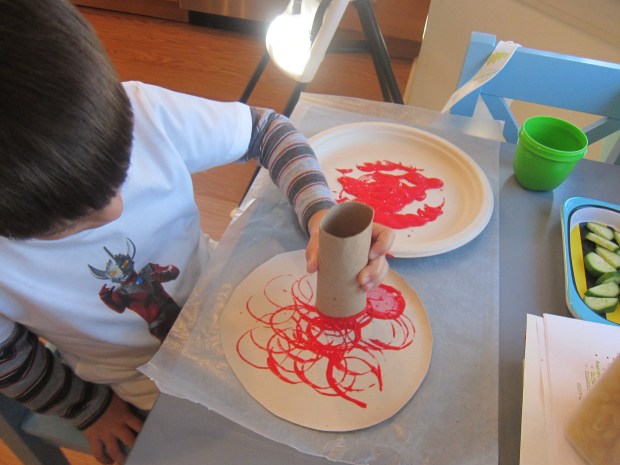
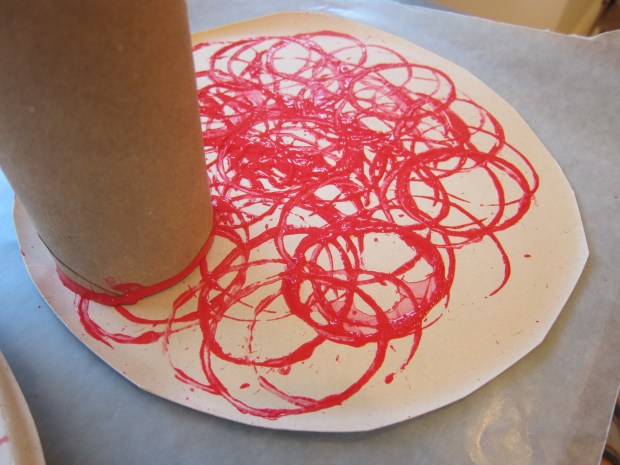
For extra circular art, I cut the bottom from a paper plate. The challenge was to cover this plate with red circles using only the end of a toilet paper tube as his paint brush, stamping only circles over it!

Secrets of Circles (10)

He decided he liked his with some plate still showing through, but your kids might enjoy seeing how long it takes to completely cover the circle with, well, circles.

Secrets of Circles (11)

Now we became detectives again. He selected two favorite books and we had a competition. Whose book had more circles in it? We marked each page with circles with a post-it note, then tallied them up. Mommy’s book won, with 21 pages of circles!

Secrets of Circles (12)

(Note: you could also tally up every circle in the images, but this would have taken us into the 100s).

For some final fun, we extended the lesson into story time, reading the following:

  • So Many Circles, So Many Squares by Tana Hoban
  • Around the Park: A Book About Circles by Christianne Jones


Mirror Pattern Gloves

Mirror Socks (10).jpg

This project is a fun intro-to-sewing for little kids, and also helped drive home some recent lessons on mirror imagery that Travis and I have talked about lately.

To make the gloves, you’ll need a long pair of socks. I had Travis put his forearms at the ends, and traced a wide L shape where his fingers and thumb would go.

Mirror Socks (1)

Cut off and discard the sock above this L.

Mirror Socks (2)

Fold the sock inside-out and do a basic running stitch (in, out, in, out) to attach the two sides, up to where the thumb is. Honestly, I am no seamstress: here is my hack job of a running stitch.

Mirror Socks (4)

But Travis loved helping thread a plastic needle and make a few practice threading motions.

Mirror Socks (3)

Put the sock right-side out again and try it on for size! Repeat with the other sock to make your second glove.

Mirror Socks (5)

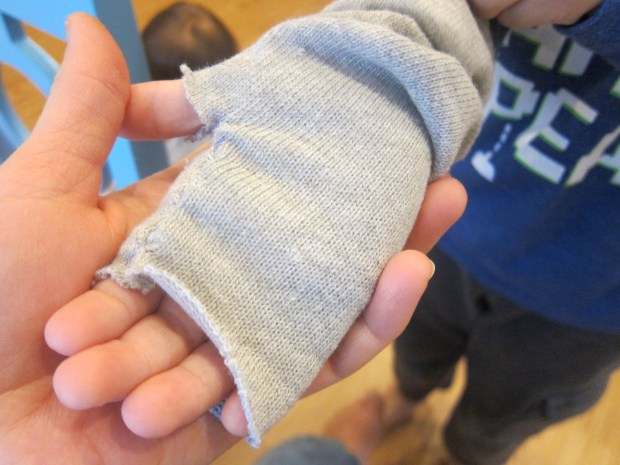
We wanted to decorate our “mirror image” gloves with felt stickers but the only ones I had were Christmas-themed! So perhaps he can pull these out to wear around the holidays.

Mirror Socks (6)

As he placed each sticker, he thought hard about what would make a mirror image. Should the blue sticker go to the left or to the right?

Mirror Socks (7)

He quickly got the hang of it. And loved wearing the fingerless gloves once the project was complete!

Mirror Socks (8)

Aluminum Foil Art

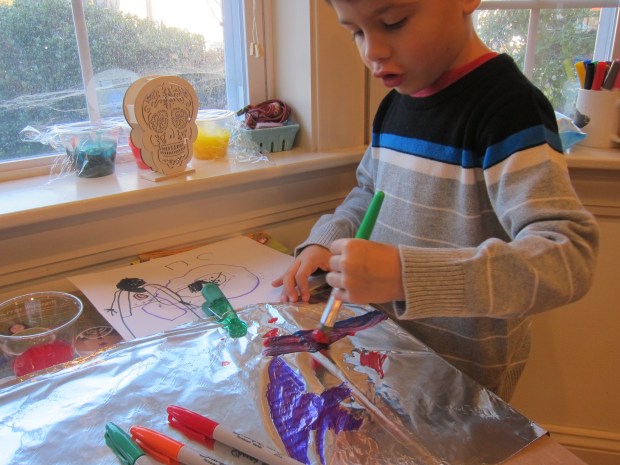
Aluminum Foil Painting (7)Something as simple as switching up the canvas can make an everyday activity like painting feel new again! Recent shiny mirror play prompted me to have Travis paint not on paper but on… foil!

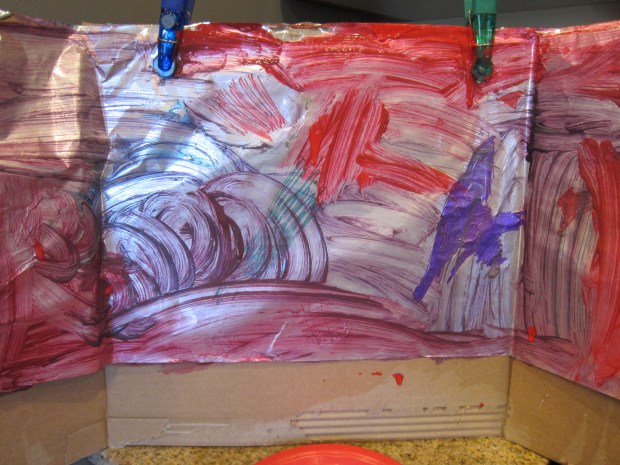
I put the foil against a sturdy cardboard backing, and used snack bag clips to hold it securely.

Aluminum Foil Painting (1)

At first I thought he might want to use permanent markers on the foil. These made not only vibrant colors, but also fun texture where it indents the foil slightly.

Aluminum Foil Painting (2)

He was instantly designing a Star Wars ship (of course), but quickly decided to move on to paints.

I mixed tempera paint colors with a couple drops of dish soap in each (which supposedly helps it adhere to the foil better).

Aluminum Foil Painting (3)

Now he was off and running!

Aluminum Foil Painting (4)

He mixed colors, made fun designs, and wasn’t content until the whole surface of the foil was finished.

Aluminum Foil Painting (5)

What novel canvas has your child used for art? Please share in the comments!

Aluminum Foil Painting (6)

Tic-Tac-Yum

Tic Tac Yum (3)

Here’s a novel way to play tic-tac-toe… and to have a healthy snack. Winner takes first bite!

To set up the game, wind yarn around a flat mirror until you’ve divided it into 9 squares like a tic-tac-toe board. Secure on the back with tape.

For the Os, cut celery hearts into slices in the shape of a C. For Xs, cut chunks of non-dairy cheese and then make a slit so each piece looks like a V.

Tic Tac Yum (2)

Once arranged on the mirror, Travis was delighted to find the C was now an O and the V was now an X!

Tic Tac Yum (1)

I challenged him to a match…

Tic Tac Yum (4)

…but it wasn’t long before the Vs began disappearing as a snack. Tic-tac-yum indeed!

Tic Tac Yum (5)


Mirror Illusions Kiwi Crate

Kiwi Mirrors (17).JPG

Travis’s Kiwi Crate this month focused on mirrors and the tricks of light that allow for illusions. There was a bit of overlap with the Secret Agent crate, so I was surprised it was next in our queue from the company, but he still enjoyed the projects!

First up was making a Trick Box. This very simply involved folding open the provided green cardboard box and slipping in an illustrated insert. (Kids also have the option to illustrate their own insert).

Kiwi Mirrors (7)

Place the insert in the box, then slip in the provided mirror, making sure it is at the correct angle (arrows marked inside help kids to ensure a proper alignment).

Kiwi Mirrors (8)

Peeking through the box now reveals the image in reverse. This was a bit lost on Travis, as he couldn’t read the “hello there” message he’d chosen either forwards or backwards.

More of an impact came from the penny trick you can perform: Drop a penny through the slot in the top and it seems to disappear, when really it is just falling behind the angled mirror. This is a fun one for kids to play a “magic trick” on friends and family.

Kiwi Mirrors (16)

Next up was making a Painted Puzzle. Place the provided wooden squares in a frame, and cover with one of the provided clear stickers. Travis did this a bit differently, attaching all four clear stickers, so our results weren’t perhaps perfect.

Kiwi Mirrors (9)

But the painting method was neat! Travis liked using the paint stampers, which are dipped into provided tiny paint pots. Cover the surface of the wooden tiles, let dry, then peel off the stickers.

Kiwi Mirrors (10)

The painted puzzle can now be taken apart and put back together again. But even cooler is viewing it through…

…Mirror Goggles, the final project. To make these (which look almost like Google’s VR viewer), open up the provided cardboard goggle box.

Kiwi Mirrors (1)

Travis got to exercise his fine motor skills to attach the sides with a brad; add padding foam around nose and forehead for comfort; and place a sticky donut and bead on top. This bead is going to help you keep your head up later, read on!

Kiwi Mirrors (2)

Thread an elastic through the holes on either side and secure with cord stoppers, then attach a mirror to the underside of the goggles with sticky foam. Your goggles are ready for viewing!

Kiwi Mirrors (4)

Wearing them took a bit of practice, with the goal of piecing together your Painted Puzzle or a provided wooden puzzle. I had Travis watch me first, as you really need to keep your head up to have the mirror show you what’s on the work surface below. Don’t tilt your head down for peeking or the bead will fall from the donut!

Kiwi Mirrors (5)

Once he got it the hang of it, Travis thought it was so cool. I loved watching his hands move, forward when they needed to go backwards and vice versa, until he started to understand he was seeing in reverse; it was like observing the gray matter of his brain at work.

Kiwi Mirrors (14)

If it won’t frustrate your kids, have them try writing their name or drawing a picture while wearing the goggles. Full disclosure, this is hard. Here’s my attempt to write his name!

Kiwi Mirrors (15)

There was lots more fun to be had in Explore magazine. First, we made a map (a bit of an overlap from Secret Agent). When read normally, it led him nowhere. Then he looked at it through the selfie feature on my phone.

Kiwi Mirrors (11)

Aha, he spots the treasure…

Kiwi Mirrors (12)

Success!

Kiwi Mirrors (13)

Then I showed him an example of backwards writing (again an overlap from Secret Agent).

Kiwi Mirrors (20)

There’s also a mirror word search for older kids, and a few cool mirror illusions you can try to recreate at home like multiplying apples…

Kiwi Mirrors (19)

…or a disappearing middle!

Kiwi Mirrors (18)

We finished with a bedtime read of two suggested books: Light: Shadows, Mirrors, and Rainbows by Natalie Rosinsky and Mirror, Mirror: A Book of Reverso Poems by Marilyn Singer. The latter features fantastic poems that can be read both backwards and forwards.
World Hello Day

World Hello Day (2)
Well, hello! It turns out that today (November 2) is World Hello Day, and Travis boldly accepted the challenge I set him: To say hi to ten people over the course of the day.

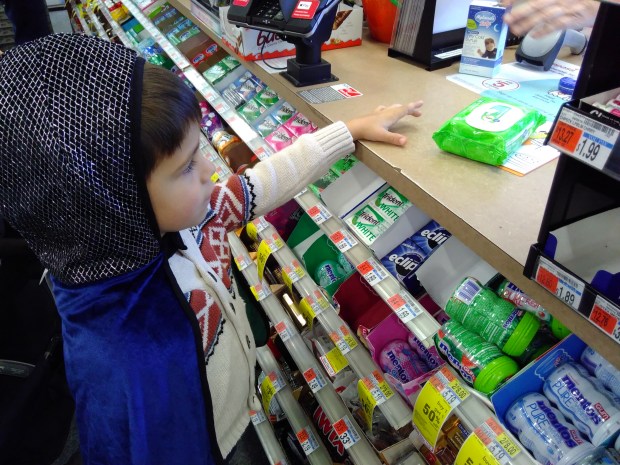
He was so proud with each chance that came while out of the house. A big hello to the woman next to us in the parking lot, a proud hello to the cashier at the drugstore, hello to the librarians when we stopped in for books, and more.

World Hello (3)

Each time, he turned to me with pride and said, “That’s three” and so on, until he reached 10.

World Hello (5)

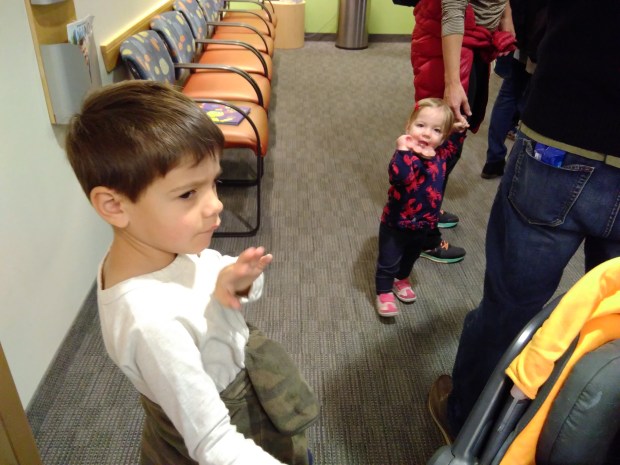
Little sister wanted to get in on the hello fun, too, as she practices how to wave!

World Hello (4)

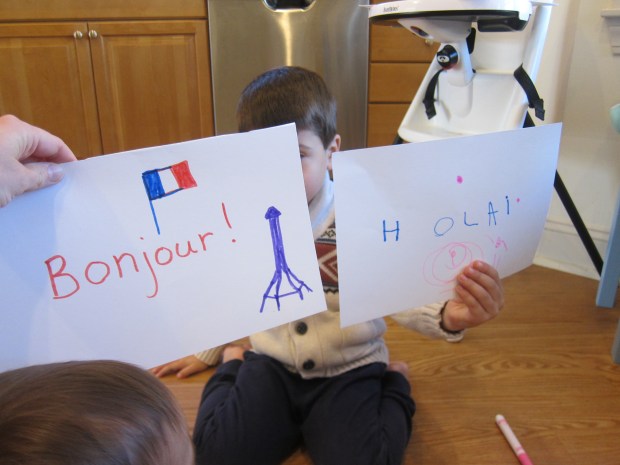
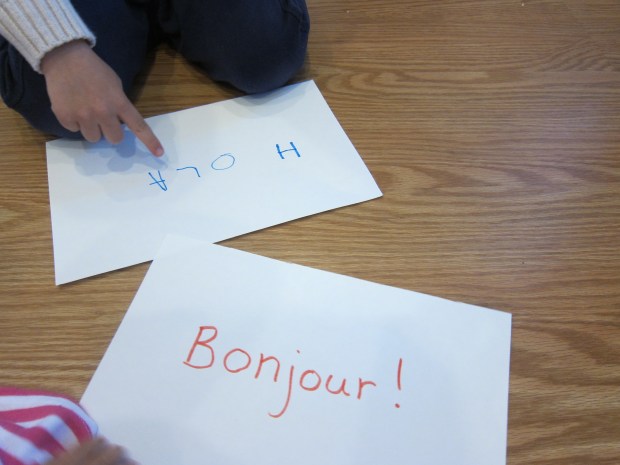
For more hello fun, we made big posters in languages we know. Travis is learning Spanish at school, so I helped him with the spelling of “hola”, and he decorated it for his Spanish teacher.

World Hello Day (1)

What new ways can you think of to say hello to neighbors and friends? Please share in the comments!