Find the Color

Find the Color (2)

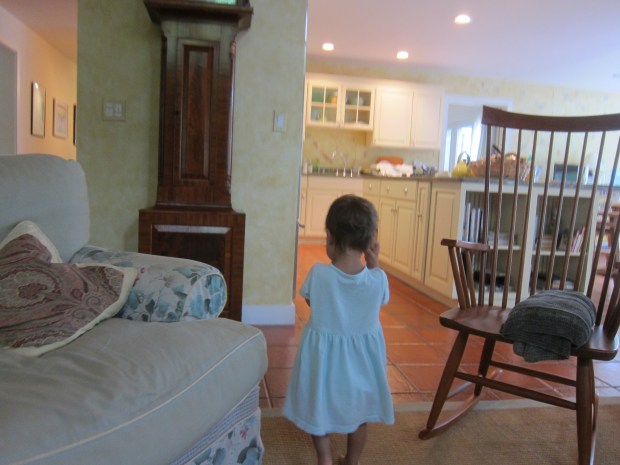
I love throwing a little learning into even vacation days with a toddler, and here is a game that you can literally play anywhere. Simply ask your child to find something of a certain color, then start counting dramatically down from 10 to 0 until they run and touch it.

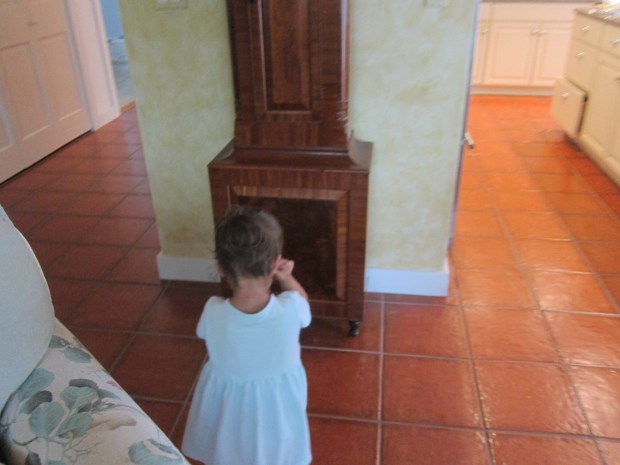
I demonstrated for Veronika the first time through, naming the brown clock and then doing a big happy run over to it. Ten, nine, eight…

Find the Color (1)

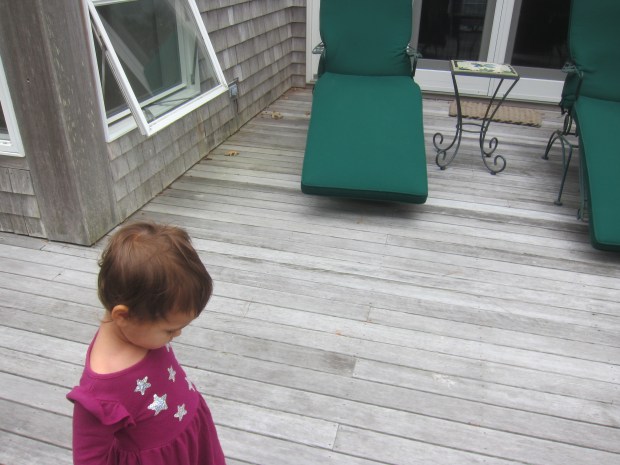
She giggled and wanted to play along. Could she touch orange?

Find the Color (5)

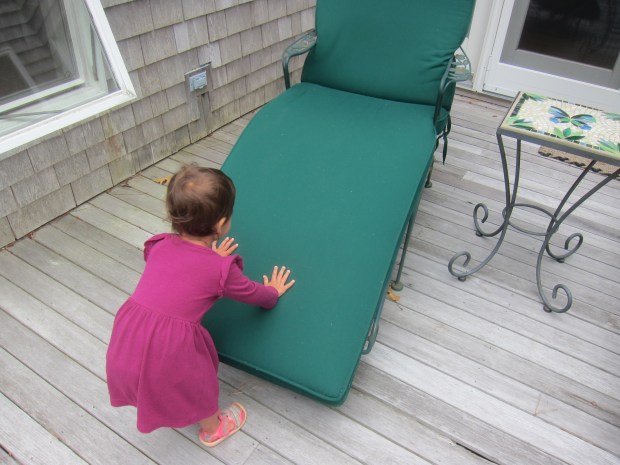
Could she touch green?

Find the Color (3)

Yes!

Find the Color (4)

You can see how easy and obvious the game is, which means it can easily occupy fussy toddlers just about anywhere.

Beanbag Toss

Beanbag Toss (6)

Beanbags are such a versatile toy for kids of all ages and I highly recommend having a pile of them on hand. Today, Veronika used them both for target practice and shape learning.

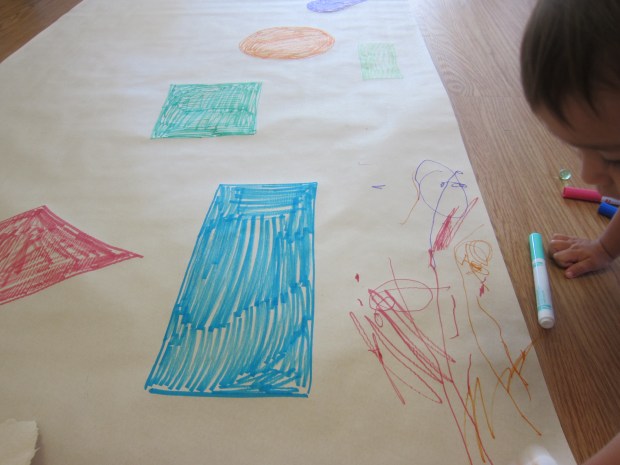
I loved that the first part of this game was a chance to make art together. I unrolled a long piece of craft paper and set out markers.

Beanbag Toss (1)

I had just started a green square when Veronika said, “Let’s draw a blue rectangle!” So a blue rectangle it was. She drew “shapes” alongside me while I made larger ones all over the paper, including purple hearts, orange circles, and more.

Beanbag Toss (2)

Now it was time for some toddler sports! I asked her if she could toss a beanbag onto the blue rectangle. Easy shot! It was harder for her to throw towards shapes further back on the paper, so this game was great for strengthening little muscles.

Beanbag Toss (4)

Sometimes she preferred to run and stand on the shape I named, instead of tossing the beanbag.

Beanbag Toss (5)

Leave out your big piece of paper and the pile of beanbags, and no doubt your toddler will find ways to play with it solo throughout the day, too.

Beanbag Toss (3)

Pompom Counting Fun

More Pom Pom Fun (3)

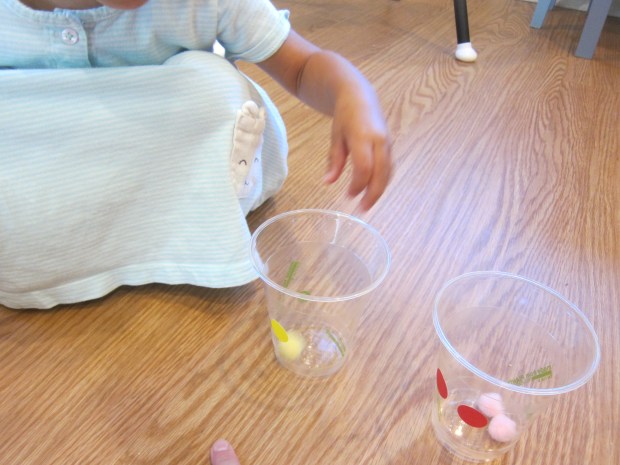
Veronika and I have been exploring early math concepts lately, and here was another fun way to do so using simple materials that she loves: stickers, plastic cups, and pompoms!

I marked three clear plastic cups with dot stickers, each cup with a different color. The first cup had 1 yellow sticker, the second had 2 red stickers, and the third had 3 blue ones.

More Pom Pom Fun (1)

I then showed Veronika the one dot on the first cup, and told her there was one sticker. “Can you add one pompom?” I asked her. I chose to color-coordinate the pompoms to the dot stickers for clarity, but you don’t have to.

She dropped in one pompom!

Now I held up the second cup and we counted the stickers. One sticker, two stickers. “Can you add two pompoms?” Plink plink into the cup!

More Pom Pom Fun (2)

We repeated for the third cup with three pompoms. Obviously I was directing the game very clearly, which helped her get each answer “right”; don’t expect a toddler to do this game solo. But the activity reinforces the notion of counting up, and that numerals are attached to a tangible amount.

More Pom Pom Fun (4)

It would be been coldhearted not to let her play with the extra materials after that! There were more stickers she could happily dot onto extra cups, and lots more pompoms to play with and keep herself busy for a while.

More Pom Pom Fun (6)

While we were at it, we could talk about a few opposite concepts, like over the cup and under the cup.

More Pom Pom Fun (7)

So this activity is definitely a winner.

More Pom Pom Fun (8)

Kitchen Math

Kitchen Math (3)

After a day of math out at the park, it was time for a day of math in at the kitchen.

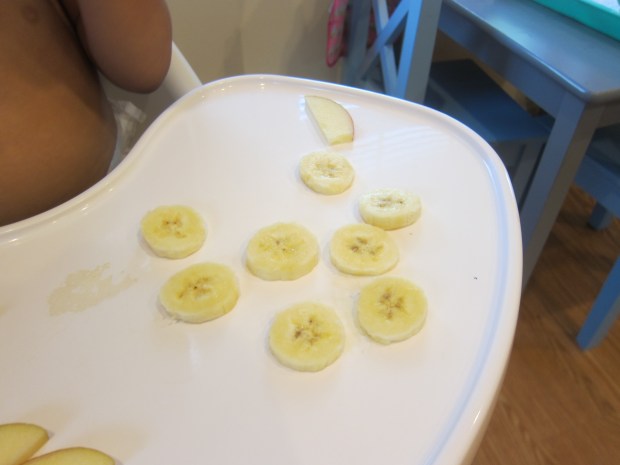
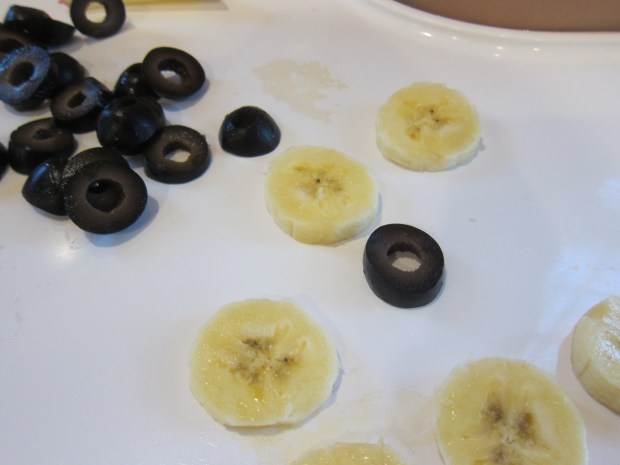
Veronika and I played around with kitchen math in a few ways. For a simple intro to math concepts, I sat her down for snack and made it all about comparisons. We used three different foods: apple wedges, bananas (cut into circles), and olives.

Kitchen Math (5)

We could discuss the circular shapes of the bananas and olives. The apple wedges were more like semi-circles! Or we could compare items; the apple was longer than the banana. The banana was bigger than the olive. And so on.

Kitchen Math (6)

Next up was far messier math; involve your toddler in cooking! While making a cookie recipe, I set Veronika up with her own station for filling cups of flour and scooping. “Can you help me fill two cups of flour?” I asked her.

Of course she couldn’t really, but I could point out that some measuring cups were bigger or smaller than others, or use vocabulary like “half” and “third” of  a cup even though she’s a long way from understanding that.

Kitchen Math (4)

We also pulled out the kitchen scale to weigh flour together. “I want to scoop!” she said, proudly reaching deep into the flour bag.

Kitchen Math (2)

This of course made a giant mess, but I find that flour play is worth it once in a while. Plus your toddler gets rewarded with a yummy treat if you’ve really baked during the messy play.

Kitchen Math (1)

Note: If you want to introduce measuring to your toddler with less mess, consider a recipe like granola or baked oatmeal.

One, Please

One Please (3)

Here’s a quick but fun way to get your toddler thinking about counting (just to one and two for now), as well as a first lesson on using fingers to count and represent a number.

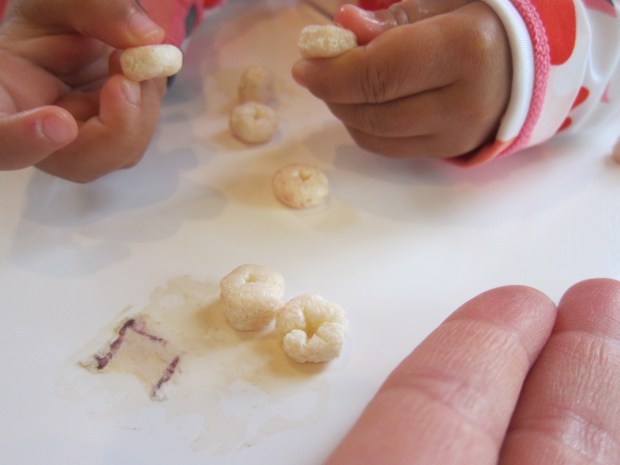
I set Veronika up in her high chair with cereal puffs for a snack, an old favorite. First I gave her one. “You have one puff,” I told her. Whoops, which quickly was back to zero!

One Please (1)

Then I put out two puffs and counted them. One puff, two puff. To make it trickier, I then put a whole handful on the tray, but asked her to give me one puff. Success.

One Please (2)

Could she hand me two puffs? Double success! I loved that she did this two-handed, one puff per hand, which was a neat insight into her brain.

One Please (4)

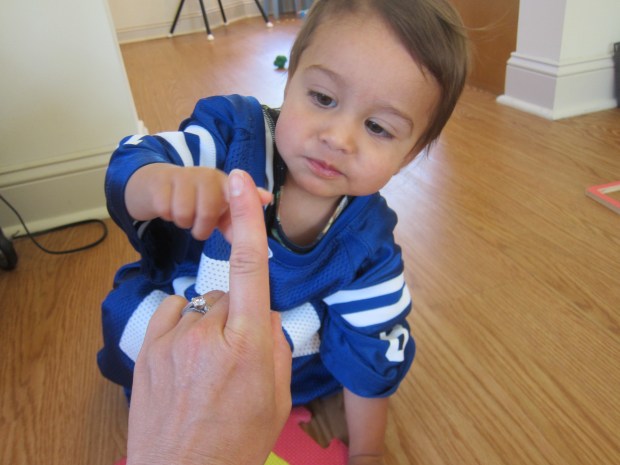
Now we turned to the concept of holding up a finger. I asked if she wanted one cracker, holding up one of my own fingers to demonstrate. Then I helped her shape her hand so only one finger was up. Repeat the word “one” and the gesture; it’s okay if your toddler doesn’t get it on the first round!

One Please (5)

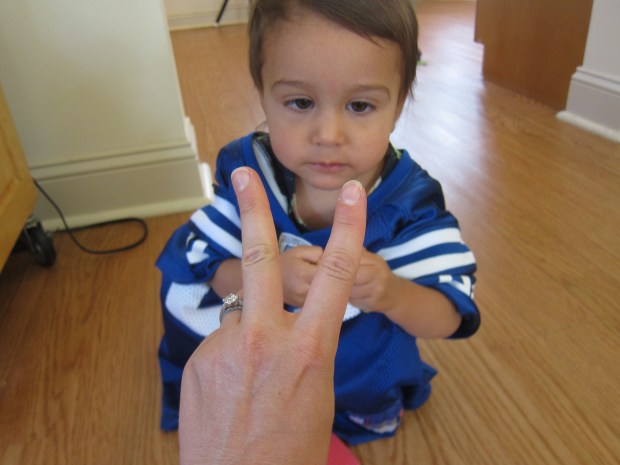
Repeat with two crackers (or a similar snack), and help your little one hold up two fingers.

One Please (6)

This was just a first foray, but a great foundation for counting down the road. Either way, my guess is your toddler will ask for more more more of whatever is on the snack menu!

Clothespin Colors

Clothespin Colors (7)

I had two goals for this simple activity: to review Veronika’s color knowledge and to hone her pinching skills. She’s just old enough now (at 21 months) to pinch a spring-type clothespin, but I realized quickly that it’s still a struggle for her. So you may want to wait until your toddler is a little older before setting up this activity.

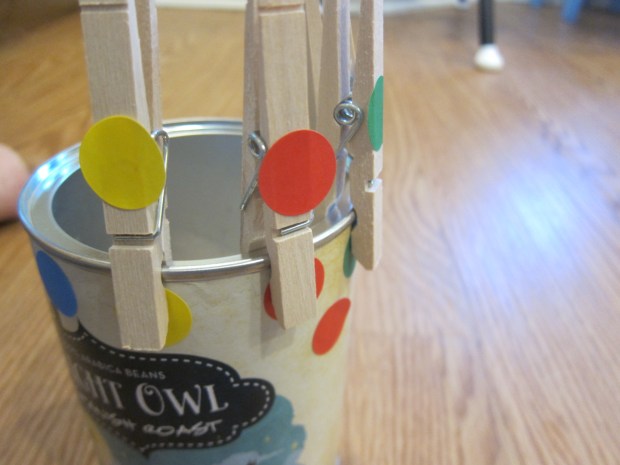
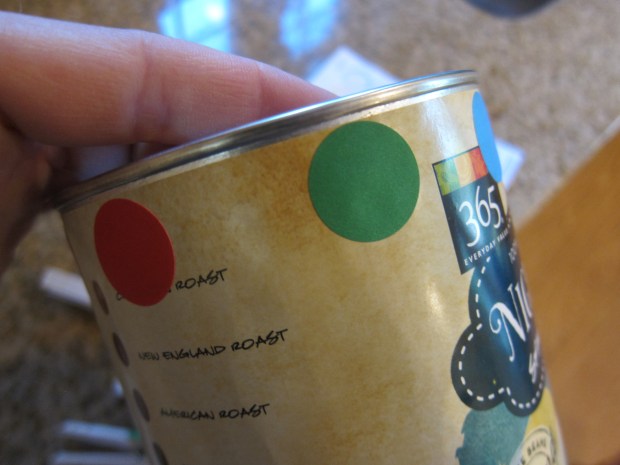
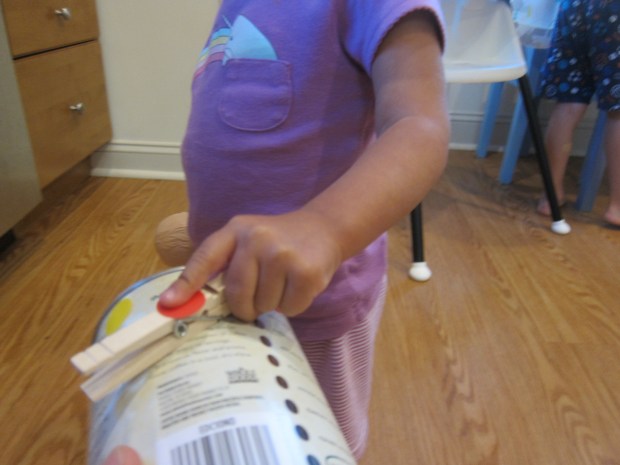
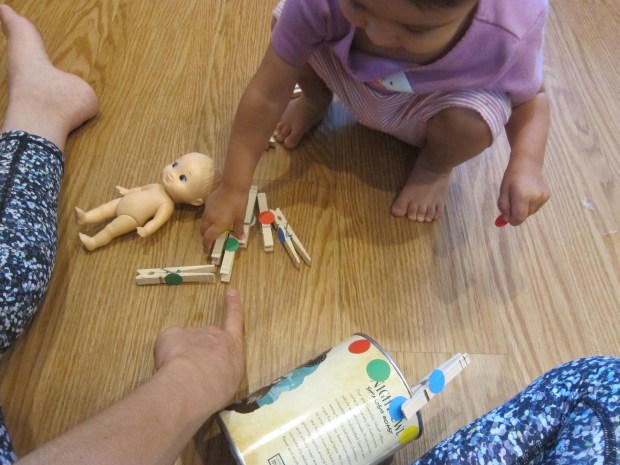
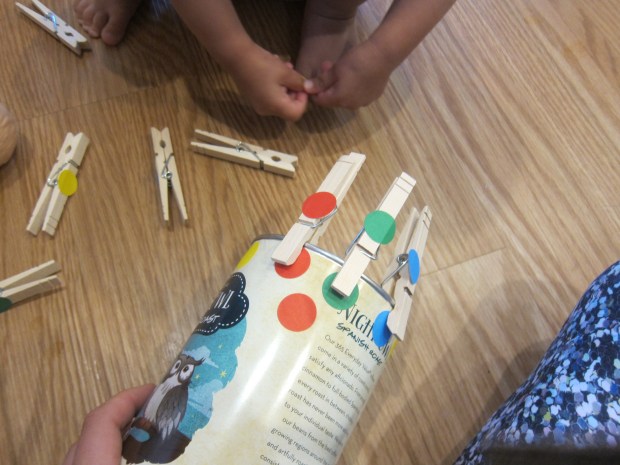
Still, we made it work! I put colored dot stickers at intervals around the rim of an empty coffee can.

Clothespin Colors (1)

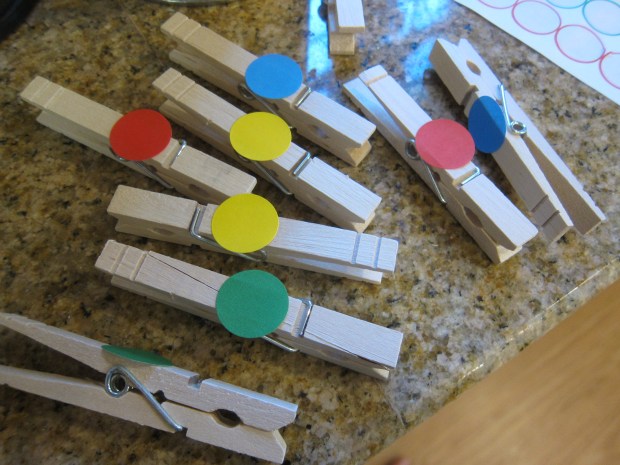
Then I put corresponding dot stickers on the clothespins.

Clothespin Colors (2)

For each one, I asked her, “What color is this dot?” Once she answered, I had her hunt through her pile for the same color on a clothespin.

Clothespin Colors (3)

Since the pinching was hard for her, I helped her secure the clothespin to the dot, then moved on to the next one. “What color is here?”

Clothespin Colors (5)

“Green!” she said proudly.

Clothespin Colors (6)

We worked our way once around the coffee can one time, though she did then lose interest and wanted to play with more dot stickers instead. Luckily there’s lots to do with leftover clothespins and empty cans if you leave them lying around.

Clothespin Colors (3)

Super Simple Color Collage

Simple Color Collage (7)

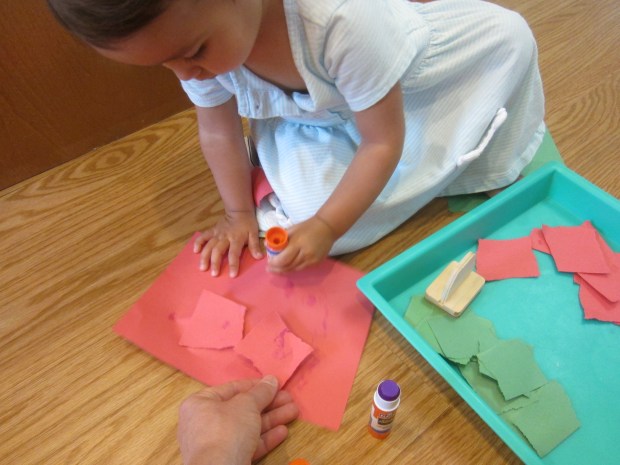
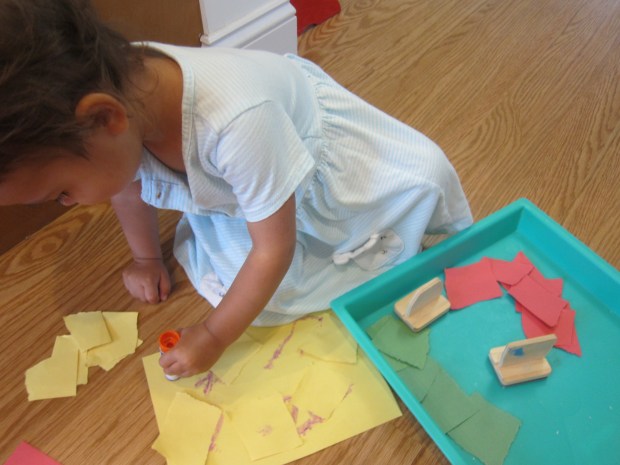
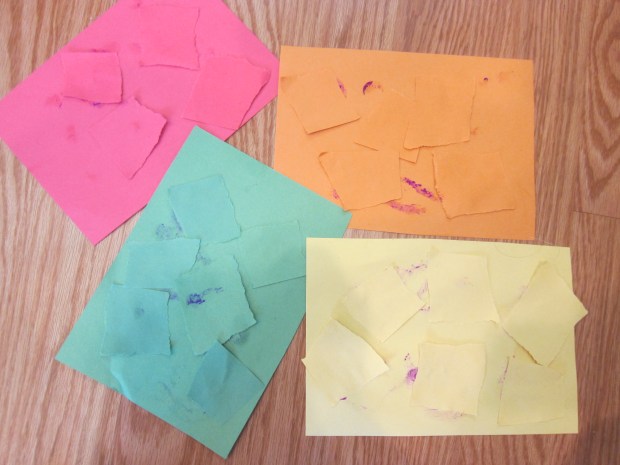
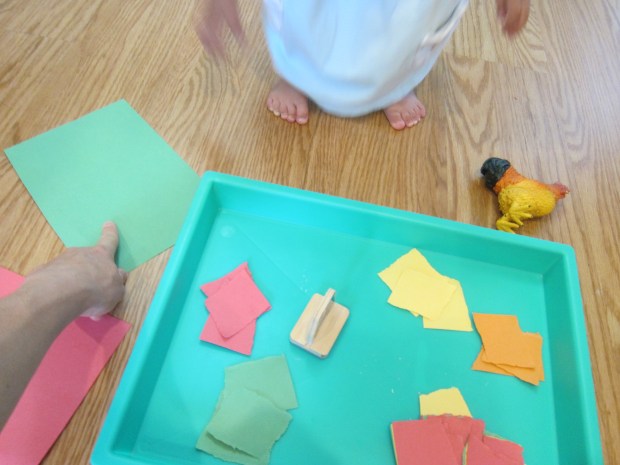
This is a great activity for a toddler who has just learned his or her colors, and it’s quite simple to set up. I laid out pieces of construction paper, and for each one I tore up scraps of paper in the same color and arranged them on a tray.

Simple Color Collage (1)

So as not to overwhelm your toddler with too many colors at once, I recommend starting with one background color at a time. “What color?” I asked her, pointing to the paper. “Red!” she said.

Simple Color Collage (2)

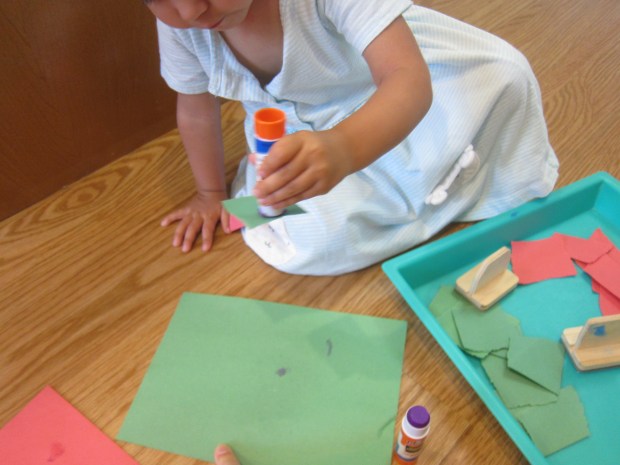
She was way more into the glue stick I gave her than in selecting which color of scraps to add from the tray, but I guided her back when I could. “Let’s add the red scraps!” I suggested simply, reinforcing her knowledge that the paper was red.

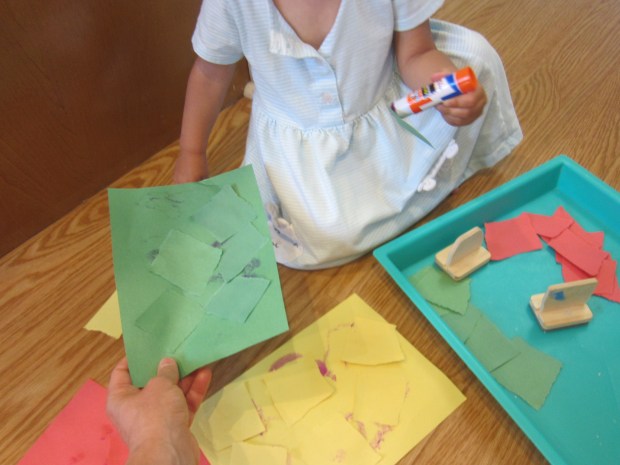
In this way, she worked through adding red scraps to red paper, yellow scraps to yellow paper, and so on.

Simple Color Collage (5)

Towards the end, I made it sightly harder and showed held up a scrap of paper. “Which color should we glue this one on?” I asked. She’d gotten the gist, now, to glue green onto green.

Simple Color Collage (3)

So as the title suggests, this activity was simple to set up, simple for a toddler to do, and simple to clean up. The trifecta!

Simple Color Collage (6)


Five, Six, Pick-Up Sticks

Five Six Pick Up Sticks (6)

Nature is the perfect playground for children to learn in, which is a no-brainer because, of course, we evolved and learned to learn in… Nature! I was reminded again today that it’s all right there: sensory concepts, numbers, shapes, and so much more.

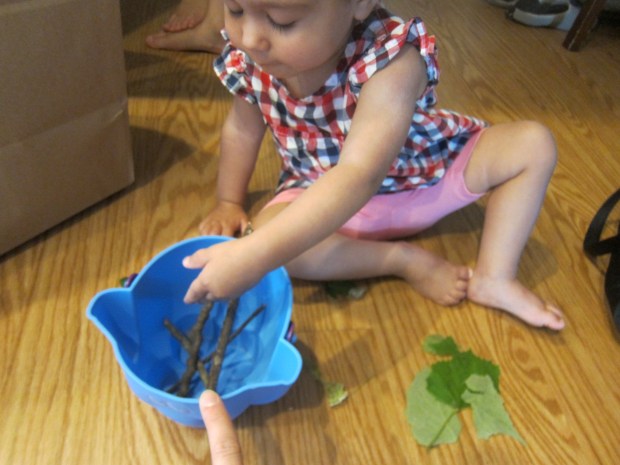
The first step of our project today, then, was simply to head out with a little bucket and collect anything that caught Veronika’s eye.

Five Six Pick Up Sticks (9)

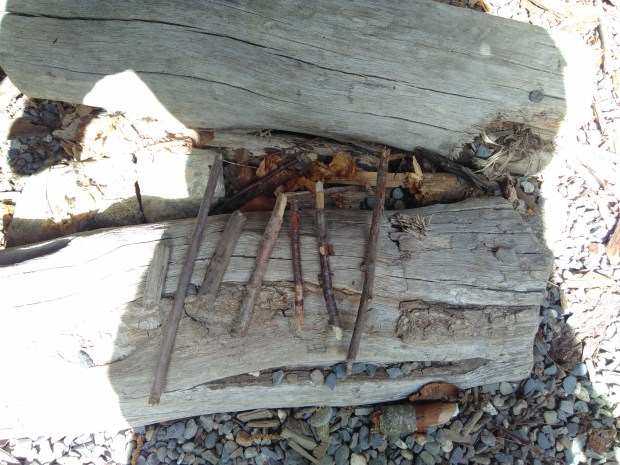
We paused at intervals to discuss her collection or to organize it in various ways. She loved lining up sticks on this log, for example!
Five Six Pick Up Sticks (11)

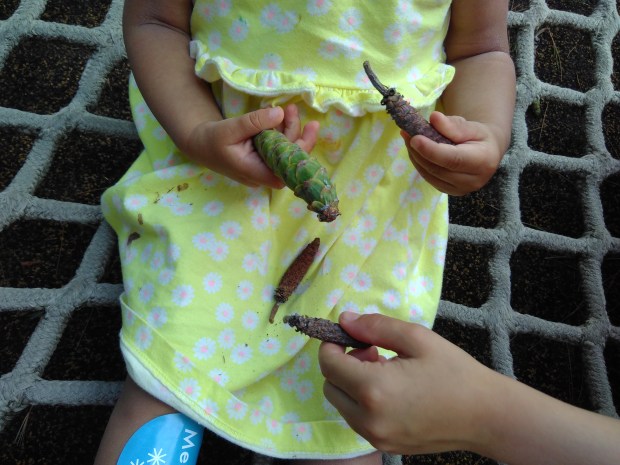
Or playing with various sizes of pine cones.
Five Six Pick Up Sticks (12)

Don’t worry about curating your child’s collection. Simply add anything that he or she wants to the bucket, whether that means little pebbles (one of Veronika’s favorites), seed pods, sticks, leaves, grass, or anything else.

Five Six Pick Up Sticks (10)

Once home, we didn’t even have our shoes off before she dumped the collection on the floor.

Five Six Pick Up Sticks (7)

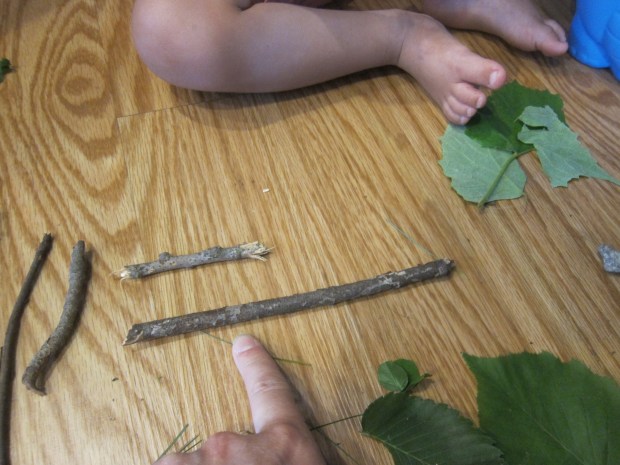
But that was just fine with me! I sat down with her to talk about everything we’d brought home. First we concentrated on size as I lined up the sticks. Could she find me the longest one? Yes!

Five Six Pick Up Sticks (2)

The shortest stick? Yes! I was really happy to see her mastery of this concept.
Five Six Pick Up Sticks (3)

We played around by subdividing her findings in different ways, whether by item, by color, by texture, and more.

Five Six Pick Up Sticks (1)

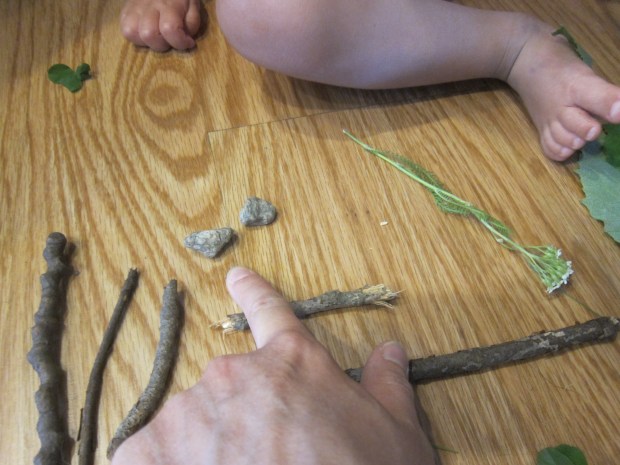
You can also use the opportunity to count. How many pebbles did we bring home? “One, two!” she told me.
Five Six Pick Up Sticks (4)

How many acorns? “Just one!” Then of course your toddler is simply going to want to play with all the treasures that have come home.

Five Six Pick Up Sticks (5)

Color Cards

Color Cards (5)

These easy DIY color flashcards are similar to a set I made for Veronika last week, that time featuring shapes. This time, I likewise covered construction paper with sticky contact paper for durability, and then cut two squares from each color. I wanted all the shapes to be uniform, because the test now was on colors!

I laid all the squares in front of Veronika and held up one green. If I had a green, could she find the match?

Color Cards (2)

It was interesting to watch her go through this game, as it made clear which colors she knows and which she still guesses. She mixes up blue and green, for example, as well as red and orange, but she has a solid grasp on yellow, pink, and white!

Color Cards (4)

Honestly the game didn’t interest her nearly as long as the shape version. But since the squares fit neatly into a zip-top bag, and I can pull these out again and again, the older she gets and the better she knows her colors!

Color Cards (1)

Shape Mail Carrier

Mail Carrier (8)

Today I made a shape matching activity for Veronika, and it turned into a game of playing a mailman who was making deliveries! She was the mail carrier and had to deliver the right shape to the corresponding “mailbox”. I loved that this game was equal parts learning and introduction to imaginative play.

To start, I covered construction paper with sticky contact paper on both sides for durability, and cut out shapes: rectangles, hearts, circles, triangles, and squares.

Shape Match (1)

So first up was a simple game of shape matchup. If I had one of the pair, could she find the other?

Shape Match (3)

She quickly proved to be an ace at this test, not just picking up the right shape…

Shape Match (4)

…but naming them, too.

Shape Match (2)

I wanted to make the game more exciting, so turned it into the mail carrier game. We have a set of toy boxes, each one a different shape with items of the same shape nested inside (i.e. a pizza wedge and watermelon wedge inside the triangle box). We scattered all the shapes on the ground, along with the construction paper set I’d just made, and I placed the empty boxes in front of her.
Mail Carrier (1)

“Special delivery!” I called. “Which mailbox should the triangle go in?”

Mail Carrier (3)

She was so proud making these deliveries!

Mail Carrier (2)

Note: If you don’t have a toy like this, simple cut out and laminate each shape from paper, then tape or glue onto an empty shoe box. These can be your mailboxes!

Mail Carrier (7)

After we’d filled the mailboxes, she decided to get a little impish. I could see the wheels in her brain turning as she deliberately placed the shapes in the wrong box, and then looked at me for a laugh.

Mail Carrier (6)

But if you think about it, this was showing her understanding of shapes on a whole new level.

Mail Carrier (5)

She thought this was hilarious and kept it up for quite some time.

Mail Carrier (9)