Get Down On All Fours

Get On Fours (4)

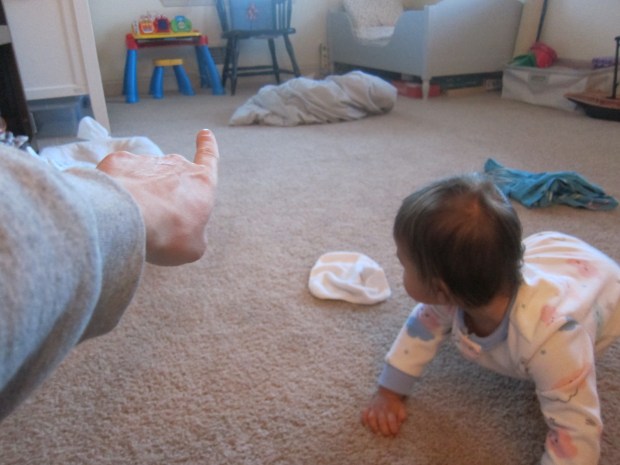
Recently in our music class, Veronika’s instructor had the grown-ups get down on all fours for a train song, and the looks of surprise and delight on the babies’ faces were priceless! So today, I did something similar with Veronika at home. When you get down to crawl on baby’s level, it not only makes him or her feel special, but it also leads to lots of fun.

First, it was big brother’s turn to crawl. I challenged them to a “race” towards a toy. You’ll notice that he crawled so fast I barely had time to get in a picture of the race!

Get On Fours (1)

But Veronika was undaunted and giddily crawled over to join him.

Get On Fours (2)

Next, I set up an obstacle course. She thought it was so silly to see mommy zig and zag through the pillows on my knees. The obstacle course led us up and over, so not only were we having fun on all fours together, but she got to practice her climbing skills.

Get On Fours (3)

Then I copied that train game from our music class, pushing a toy train around while I crawled behind it.

Get On Fours (5)

It was plain to see she loved it! Definitely consider this game if your baby is close to trading a crawl for a walk.

Get On Fours (6)

Pack a Purse

Pack a Purse (1)

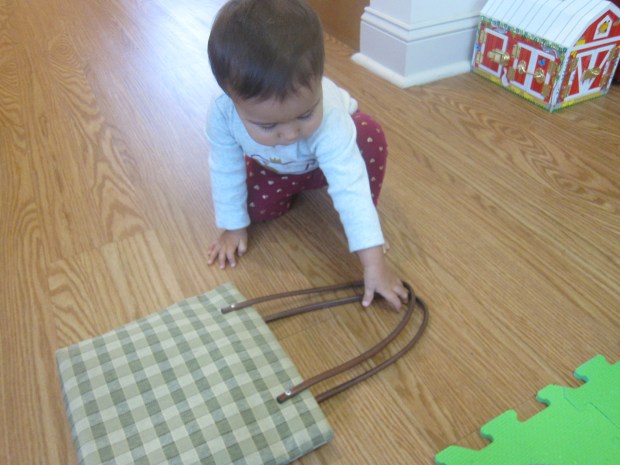
Forget toys: Babies always want to use our grown-up things, whether that’s keys, cell phones, wallets, or anything else off-limits. Control that urge by safely packing up a purse that baby can go through, in this cute game.

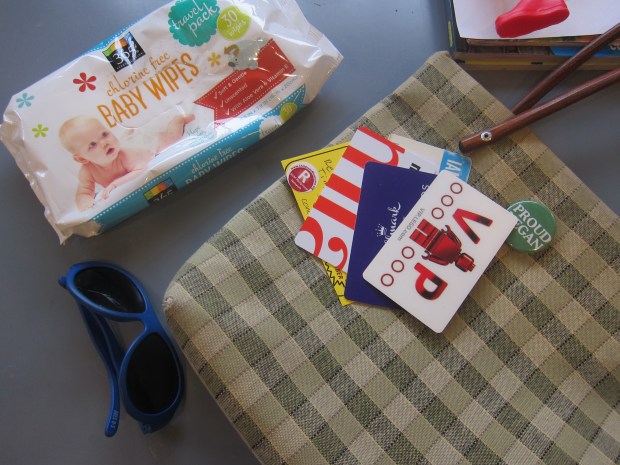
I grabbed an old purse that was small enough for Veronika to hold easily. I filled it with “mommy” things like a pack of wipes, sunglasses, old store cards, and a spare set of keys. She immediately wanted to know what was in there!

Pack a Purse (2)

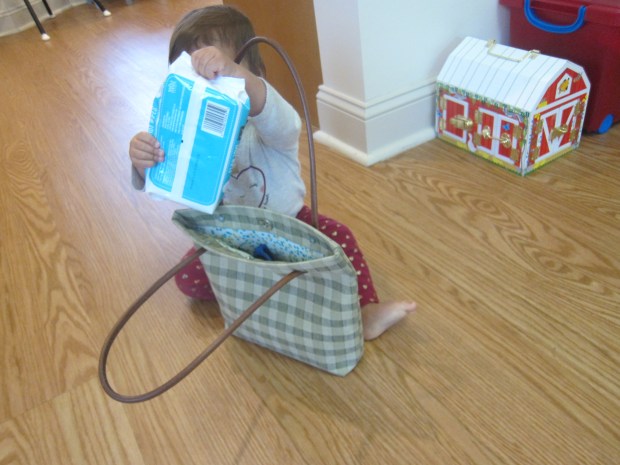
Ooh, wipes were fun!

Pack a Purse (3)

And sunglasses were a big hit.

Pack a Purse (4)

The more pockets the better. Veronika had to dig around a little to find the cards I’d hidden, and then loved playing with them.

Pack a Purse (5)

If you prefer, you can also buy little toy purses “just like mommy’s”. Veronika has a mini version with her own “cell phone” “car keys” and more!

Pack a Purse alt

Mashed Potato Sculpture

Mashed Po Sculpture (2)

This is a great sensory activity… and a way to get your kid to try mashed potatoes!

Start with instant mashed potatoes as the base. Yes, you can bake and mash your own, but the instant stuff has a sticky quality that makes it better suited to this “art” project. I whipped up a batch using almond milk, Earth Balance butter, and the potato flakes, and then let it cool completely.

Mashed Po Sculpture (1)

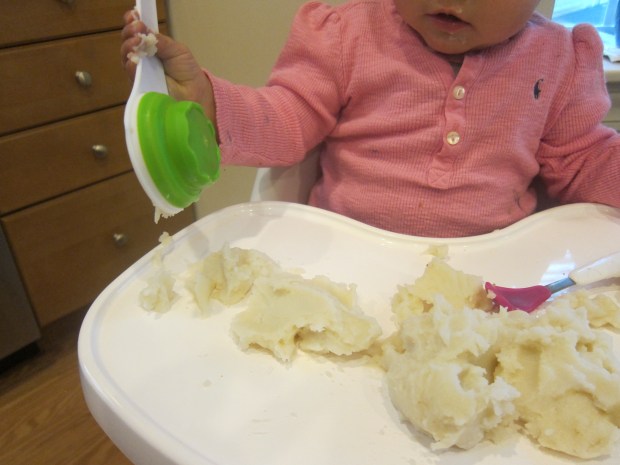
When Veronika was finished with lunch, I spooned a huge heap of this onto her tray. She looked instantly delighted!

Mashed Po Sculpture (3)

Set out a few props to encourage the artistic process. Veronika received a measuring cup and spoon, and soon was scooping, digging, and poking holes in it.

Mashed Po Sculpture (8)

I showed her how to make a few “sculptural” elements, including round balls and little snakes.

Mashed Po Sculpture (4)

I tried for a little mashed potato snowman, but Veronika didn’t let him last long!

Mashed Po Sculpture (7)

And of course she discovered that little bites of the stuff was delicious. Eager fingers kept digging in for more, both to eat and to play!

Mashed Po Sculpture (5)


Where Game

Where Game (4).JPG

At her one year physical, the pediatrician asked if Veronika is pointing yet. This is one milestone she hasn’t hit, which isn’t a concern, but I realized it’s probably because I only rarely model the behavior. So today we played The Where Game!

This is the simplest game ever. Walk around any room in the house asking where things are. “Where is Veronika’s crib?” “Where is big brother’s bed?” “Where is the window?” As I asked each question, I pointed first and then exclaimed, “Here it is!”.

Where are her books? She found them.

Where Game (2)

When we were downstairs by the computer, I asked where it was. Her little hand began reaching out in a point, almost too fast to catch on camera. But she’s starting to ge tthe idea!

Where Game (1)


Who Says MOOO?

Who Says Moo (1)

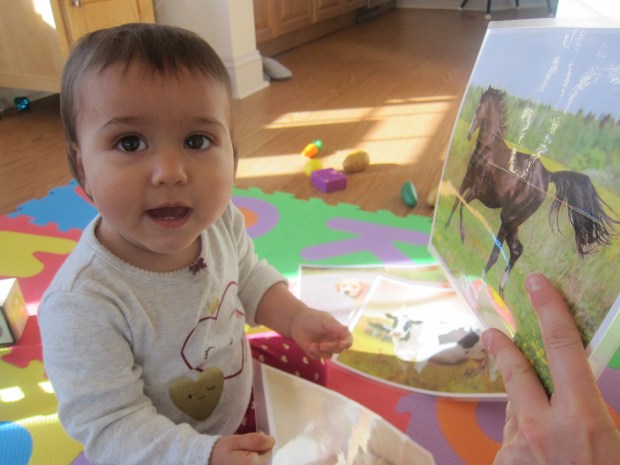
Here’s an easy variation on teaching animal sounds to your little one. Print out brightly colored pictures of a few favorite animals (or cut them from children’s magazines) and have them laminated.

Now you have the perfect “flash cards” for having fun with sounds.

Veronika knows and copies two of these already: cat:meow and dog:woof, so I showed her these cards first.

Who Says Moo (2)

She loved the cat image so much she hugged it and didn’t want to put it down.

Who Says Moo (3)

The dog got her experimental “ffff” sound, plus silly play.

Who Says Moo (4)

When I showed her the cow and asked,”Who says moooooo?” in a loud imitation, she looked up at me in delight. She’d never heard such a long moo. I think she even tried to vocalize it back.

Who Says Moo (7)

We also went through a few common animals like horse:neigh, pig:oink and sheep:baa.

Who Says Moo (8)

The cards themselves were a delight to her, so we’ll keep these around for lots of play and learning!

Who Says Moo (9)

Give Me

Give Me (6).JPG

One great concept to work on with babies around age one is give and take. For this simple game, I just wanted to see if Veronika could mirror my action of handing over a toy when asked.

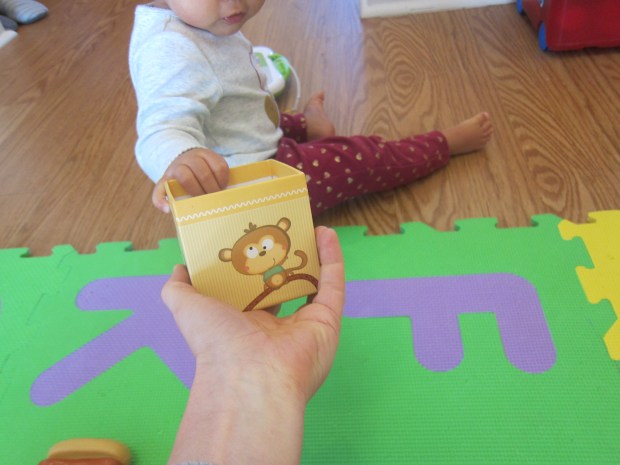
I thought it might be easiest to use toys all of one type, so picked a set of nesting boxes to start. Working with 1 box, I sat facing Veronika and said, “Mommy is giving you box.”

Give Me (3)

Well, she was happy to take it! But these days she’s very proud of her nesting and stacking skills, so when I asked, “Can you give the box back to mama?” she was busily nesting it into another box instead.

Give Me (4)

I tried several variations, first clearing the other boxes from the space. But then she only wanted to nest other toys inside a box. Next I tried a grocery food set. Again, she was happy to take a toy…

Give Me (2)

…but now she wanted to helpfully put the fruits into their grocery basket. Can’t argue with teaching her to clean up!

Give Me (5)

So this was a great reminder that Veronika isn’t yet understanding the directive to “please give me X”.  It’s one we’ll keep working on!

Give Me (1)

Step on Texture

Step on Texture (3)

Veronika is walking! Okay, maybe my girl can’t do so on her own yet, but holding on to her dolly stroller, nothing stands in her way.

To add some sensory fun to her new-found ability, I laid down a texture obstacle course for her today. Gather up a variety of different materials in your house and lay them in a line on the floor. Beginning walkers can simply toddle across. For Veronika, I set up her stroller at one end, and she instantly began pushing her way across.

Step on Texture (2)

There was a soft fluffy blanket to start…

Step on Texture (4)

…and then her little feet passed onto the nubby texture of a rubber floor mat.

I added in variety with cozy flannel and a velvet-like dress-up cape.

Step on Texture (5)

Perhaps most surprising for her little feet was a sequined dress at the end.

Step on Texture (6)

She sat down and let her little toes play on this one!

Step on Texture (1)

If your child is already talking, encourage him or her to describe how each material feels. For Veronika, I simply narrated as she walked. Off she goes!

Step on Texture (7)

Bathroom Exploration

Bathroom Explore (6)

You might think of the bathroom as a fairly boring room, but for your baby, it’s fascinating. Just think of all the things to hear, touch, and see! Today, I set aside some time just to explore the room with Veronika.

We started with toothpaste of course, because that tube just begs to be squeezed. I set out a layer of paper towels so she could do this with no mess, and then we squeezed onto an old toothbrush. Let your baby smell the minty scent or feel the toothbrush bristles.

Bathroom Explore (2)

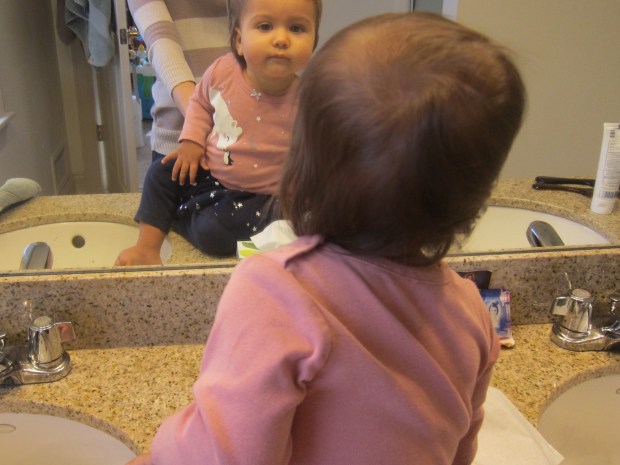
Next I sat her on the counter. Of course there’s the fun of mirror reflections. She’s learning to wave, so loved saying hello to the baby in the mirror! I let her choose objects to touch, including soft tissues to pull from the box.

Bathroom Explore (7)

Then I washed her hands under warm running water. Rub-a-dub-dub! Rinse off and towel dry for that nice sensation.

Bathroom Explore (4)

Next up: the shower! Turn on the water, either in a shower or tub. We watched the water swirl down the drain together.

Bathroom Explore (9)

And now the most splashy fun of all: flush the toilet a couple of times. She was entranced watching the water swirl down, even though the noise startled her a little.

Bathroom Explore (3)

In sum, your baby will find delight in even the most mundane parts of the house. This turned out to be a great sensory experience.

Fruit Ripening Science is Bananas

Fruit Ripe (5).JPG

Just before Halloween, Travis made Boo-Nana Bread form Raddish KidsSpooky Kitchen crate. Now we’re finally getting around to the fruit-ripening science lesson attached to it!

Before anything else, we needed to set in motion an experiment that would take 5 days. I purchased a bunch of (fairly) green bananas at the grocery store, as well as a few riper ones.

Ask your child to describe the differences they notice between the ripe and unripe bananas. Travis pointed out the obvious color difference, first. A little probing helped him go deeper: the ripe ones were softer, and smelled sweeter.

Fruit Ripe (1)

I asked him if a banana needed anything other than itself to ripen. Somehow he knew it needed air (oxygen). Smarty pants!

Fruit Ripe (3)

But for scientific backup to this hypothesis, we experimented by placing the following:

  • 1 green banana out on the counter
  • 2 green bananas in a paper bag, folded up tight
  • 1 green banana and 1 ripe banana (for ethylene) in a paper bag, folded up tight
  • 2 green bananas in a sealed plastic bag
  • 1 green banana wrapped in layers of plastic wrap

That last was Travis’s favorite, pretending we were making a banana mummy!

Fruit Ripe (4)

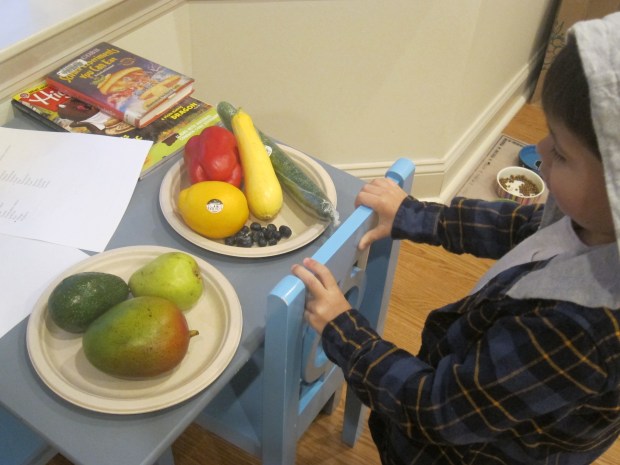
Meanwhile, it was time for a little science behind the lesson. I set out two plates for him, one featuring non-climacteric fruits i.e. they do not ripen after picking. Raddish provided a long list to choose from, and our plate included: a bell pepper, blueberries, cucumber, orange, and yellow squash.

The second plate had climacteric fruits i.e. ones that do ripen after picking. This plate held an avocado, a pear, and a mango.
Fruit Ripe (6)

“Can I eat it,” he asked right away of the mango. “Is it ripe?” At first he was stumped about how I had categorized them, guessing I had sorted them by color. But hmm, why wasn’t the cucumber on the green plate?

Fruit Ripe (7)

I loved watching him really ponder this! I guided him back to his very first comment about the mango. Was it ripe? Now he understood that one plate held fruits we needed to wait for; the other plate was fruits that wouldn’t ripen further after picking.

Fruit Ripe (10)

Time to explore! I let him have at the food just for fun. He loved peeling the squash and taking little nibbles of it, plus practicing his knife skills on the bell pepper…

Fruit Ripe (9)

…and crunching into the cucumber for a big bite.

Fruit Ripe (11)

He decided to wait until the mango was riper before peeling it. Good choice! Plus he gave the unripe avocado a big squeeze and it was solid as a rock.

Fruit Ripe (8)

Five days later, we finished with a little more science now that we had our banana results. Our finding weren’t quite as promising as hoped, likely because I had to start with green bananas on the verge of yellow and a yellow banana on the verge of green, based on what the grocery store had to sell. But we still could see that the countertop banana was the brownest/ripest and the plastic bag bananas had retained the most green.

Fruit Ripe alt

Interestingly, our plastic-wrapped banana had gotten quite ripe, so we must not have made the “mummy” tight enough.

The green bananas in the paper bag had ripened faster than the ones in plastic, since the porous paper gives them access to oxygen. But the one that also enjoyed the company of a ripe banana had both oxygen and extra ethylene, so that was riper still.

Fruit Ripe (12)

Enough science; as it turns out, leftover bananas are lots of fun to play with, even for little sister!

Fruit Ripe (13)

We enjoyed one final video of a similar experiment done with supermarket food. If your kids loved the banana experiment, try out an avocado one!

Travis and I also decided to check out the suggested book Science Experiments You Can Eat, by Vicki Cobb. We read through a couple of the experiments, but didn’t actually put any to the test.

Acorn Animal Craft Challenge

Acorn Animals (4).JPG

Travis’s craft challenge from Highlights this month was to make little animals using nothing more than acorns, wiggle eyes, and paint.

We collected a whole bunch of acorns (about 20) from oak trees nearby, which was no easy feat in 10 degree weather!

Acorn Challenge (1)

Inside, I asked him what colors he wanted to paint, thinking about what animals he might end up with. He opted for gray, so we mixed black and white together. Because he didn’t want to get his fingers messy on the small acorns, I held them while he painted.

Acorn Challenge (2)

For variety, we made a few pink acorns as well.

Once the paint dried, we glued together a few simple creatures. The stems on the acorn caps made us think of curly pig tails, so two pinkish acorns were glued together as pigs. Travis glued on the googly eyes, although the large size of the eyes made it hard for them to stick while the glue dried.

Acorn Animals (3)

The gray acorns made us think of little owls, who also received eyes.

Acorn Animals (5)

If Travis were older, I would have encouraged him to paint on little feathers, but I knew that sort of fine detail was too much for him. In sum, a cute project but not our favorite craft challenge to date.