Sticky-Treat Sushi

Sticky Sushi (8).JPG

There is an international festival coming up at Travis’s school, which has us talking about food from around the world. Here’s a sweet spin on the classic Japanese dish! This candy sushi was so fun for Travis to put together.

To start, make the “rice”: melt 2 tablespoons Earth Balance butter in a microwave-safe bowl, heating at 10 second intervals for a total for 30 seconds, or until melted.

Add 2 and 1/2 cups mini Dandies marshmallows. Microwave at 15 second intervals until melted (we needed about a minute total), stirring after each interval.

Sticky Sushi (9)

Stir in 3 cups rice cereal. If you need to use your hands, I recommend having a grown-up do so, as the sticky marshmallows will still be hot.

Sticky Sushi (1)

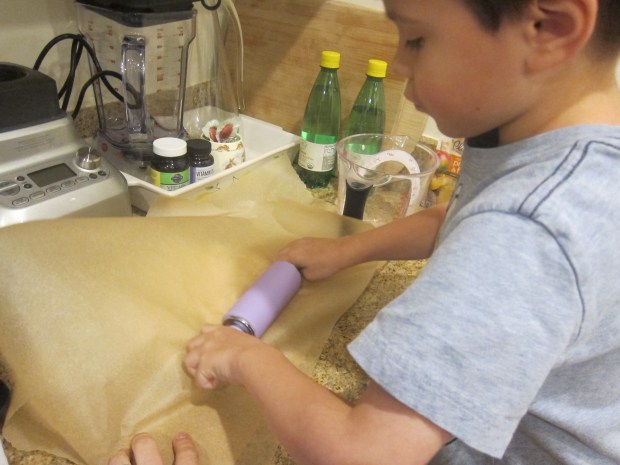
Spoon the mixture onto parchment paper. Cover with additional parchment paper and use a rolling pin to flatten about 1/4-inch thick.
Sticky Sushi (2)

The rolling pin ended up being a little tricky, so we found it easier to pat with our hands.

Use a pizza cutter to cut into rectangles. Travis was so proud I let him use this tool!

Sticky Sushi (3)

Now you can make sashimi or sushi rolls!

For “sashimi”, place a Swedish fish candy (Wholesome DelishFish are vegan) on top of a rice rectangle. Cut a strip of fruit leather with a pizza cutter and wrap around the fish.

Sticky Sushi (4)

For a rolled version, cut a strip of fruit leather and cover with a rice rectangle. Top with pieces of candy (Travis chose organic Red Vines) and roll up.

Sticky Sushi (5)

If you really want to get creative, tint a little vanilla frosting with green food coloring for “wasabi”!

Sticky Sushi (6)

Get Down On All Fours

Get On Fours (4)

Recently in our music class, Veronika’s instructor had the grown-ups get down on all fours for a train song, and the looks of surprise and delight on the babies’ faces were priceless! So today, I did something similar with Veronika at home. When you get down to crawl on baby’s level, it not only makes him or her feel special, but it also leads to lots of fun.

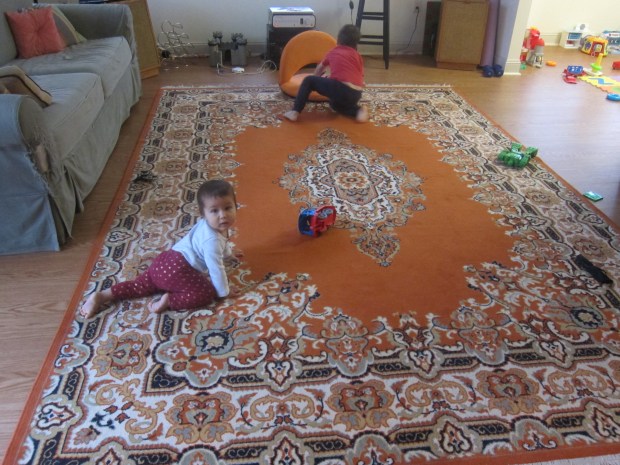
First, it was big brother’s turn to crawl. I challenged them to a “race” towards a toy. You’ll notice that he crawled so fast I barely had time to get in a picture of the race!

Get On Fours (1)

But Veronika was undaunted and giddily crawled over to join him.

Get On Fours (2)

Next, I set up an obstacle course. She thought it was so silly to see mommy zig and zag through the pillows on my knees. The obstacle course led us up and over, so not only were we having fun on all fours together, but she got to practice her climbing skills.

Get On Fours (3)

Then I copied that train game from our music class, pushing a toy train around while I crawled behind it.

Get On Fours (5)

It was plain to see she loved it! Definitely consider this game if your baby is close to trading a crawl for a walk.

Get On Fours (6)

Pack a Purse

Pack a Purse (1)

Forget toys: Babies always want to use our grown-up things, whether that’s keys, cell phones, wallets, or anything else off-limits. Control that urge by safely packing up a purse that baby can go through, in this cute game.

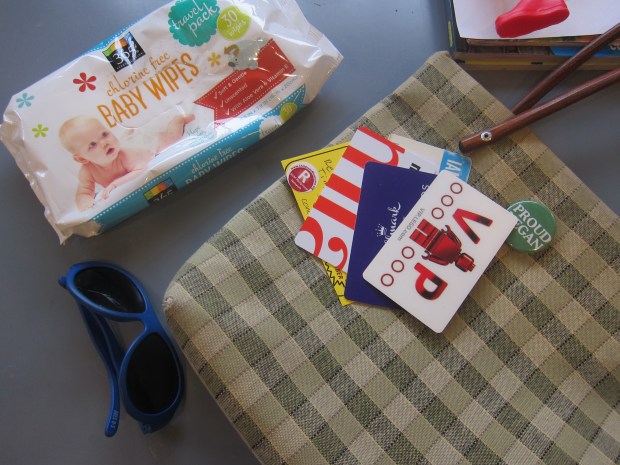
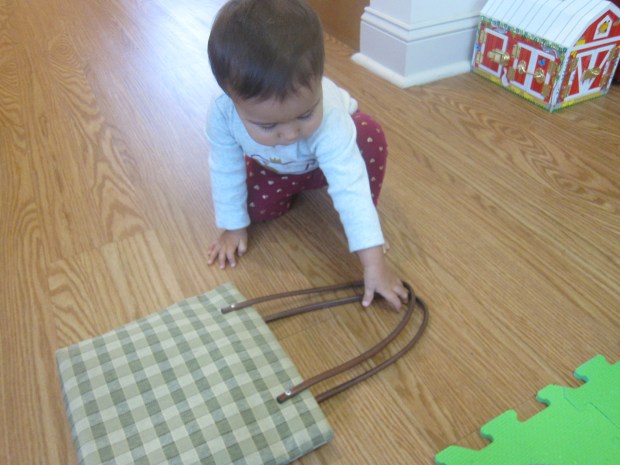
I grabbed an old purse that was small enough for Veronika to hold easily. I filled it with “mommy” things like a pack of wipes, sunglasses, old store cards, and a spare set of keys. She immediately wanted to know what was in there!

Pack a Purse (2)

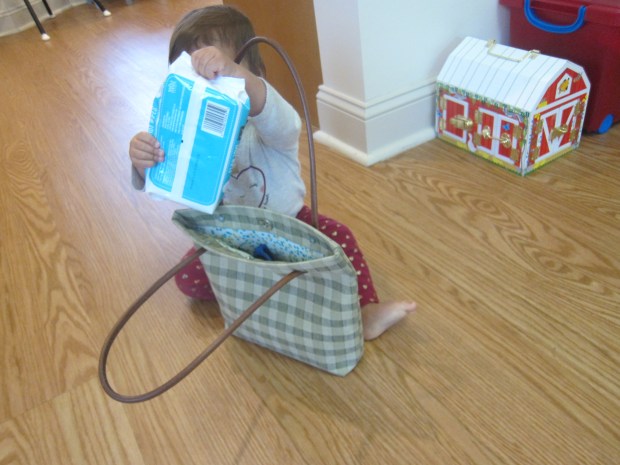
Ooh, wipes were fun!

Pack a Purse (3)

And sunglasses were a big hit.

Pack a Purse (4)

The more pockets the better. Veronika had to dig around a little to find the cards I’d hidden, and then loved playing with them.

Pack a Purse (5)

If you prefer, you can also buy little toy purses “just like mommy’s”. Veronika has a mini version with her own “cell phone” “car keys” and more!

Pack a Purse alt

Harvest Coasters

Harvest Coasters (6).JPG

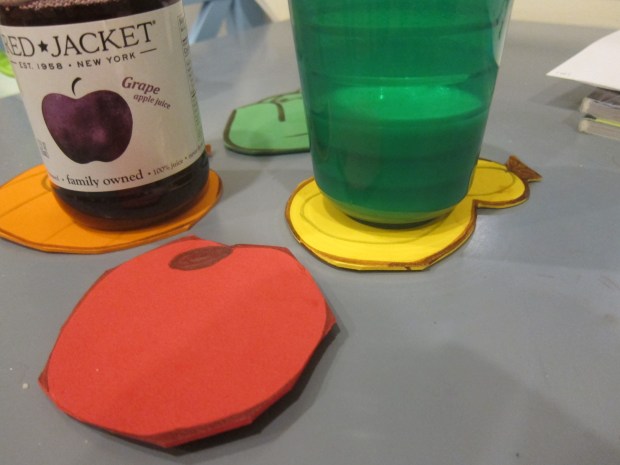
These coasters are a great project to have your kid feel involved in Thanksgiving prep, whether or you’re hosting and need extra coasters for guests, or whether you bring them as a hostess gift.

Harvest Coasters (2)

I helped Travis draw a few common fall fruits and veggies onto different colors of craft foam. He tackled a round red apple, while I made trickier shapes like a green bell pepper, yellow butternut squash, and orange pumpkin.

Harvest Coasters (1)

We added a few details like leaves and stems with marker, and cut out.

Harvest Coasters (3)

Cut circles from thin cardboard to fit the back of each shape and glue on with tacky glue.

Harvest Coasters (5)

Let dry completely before putting your festive drink on top.

Harvest Coasters (4)

Holiday nog anyone?

Harvest Coasters (7)

Mashed Potato Sculpture

Mashed Po Sculpture (2)

This is a great sensory activity… and a way to get your kid to try mashed potatoes!

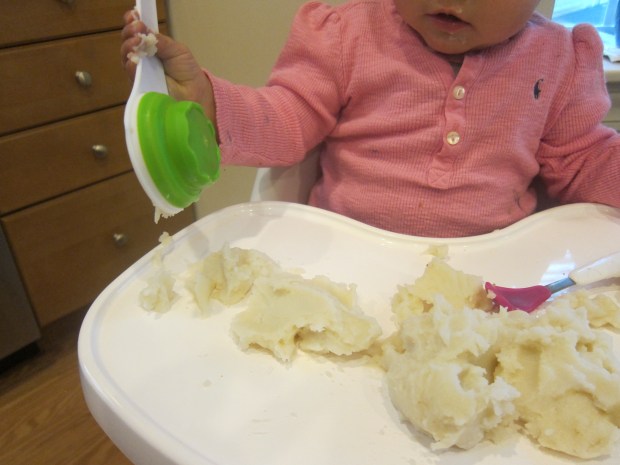
Start with instant mashed potatoes as the base. Yes, you can bake and mash your own, but the instant stuff has a sticky quality that makes it better suited to this “art” project. I whipped up a batch using almond milk, Earth Balance butter, and the potato flakes, and then let it cool completely.

Mashed Po Sculpture (1)

When Veronika was finished with lunch, I spooned a huge heap of this onto her tray. She looked instantly delighted!

Mashed Po Sculpture (3)

Set out a few props to encourage the artistic process. Veronika received a measuring cup and spoon, and soon was scooping, digging, and poking holes in it.

Mashed Po Sculpture (8)

I showed her how to make a few “sculptural” elements, including round balls and little snakes.

Mashed Po Sculpture (4)

I tried for a little mashed potato snowman, but Veronika didn’t let him last long!

Mashed Po Sculpture (7)

And of course she discovered that little bites of the stuff was delicious. Eager fingers kept digging in for more, both to eat and to play!

Mashed Po Sculpture (5)


Giraffe Cord Keeper

Giraffe Cord (7).JPG

Let’s face it: cords are a part of our kids lives these days, whether for tablets, toys, or any of a dozen other gadgets and games. This adorable cord keeper from Highlights magazine is the perfect way for Travis to wind up his favorite robot’s cord when it’s not charging.

To start, I drew a giraffe head and neck on thin cardboard (an old cereal box was perfect), and we glued it onto yellow felt. Let dry, then cut out.

Giraffe Cord (2)

I also cut out details from other colors of felt (big kids can do this themselves). We used brown for the nose and horns, orange for the ears, and a quirky purple for the giraffe’s spots!

Giraffe Cord (4)

Travis loved gluing everything down, especially a silly white tie.

Giraffe Cord (5)

Decorate with puffy paint for a few final touches. I loved the “smile” that Travis gave his giraffe.

Giraffe Cord (6)

Once dry, cut a slit in the giraffe’s neck. This is the notch to start winding your cord. Simply continue winding around the giraffe’s long neck until everything is nice and tidy.

Giraffe Cord alt.JPG

Where Game

Where Game (4).JPG

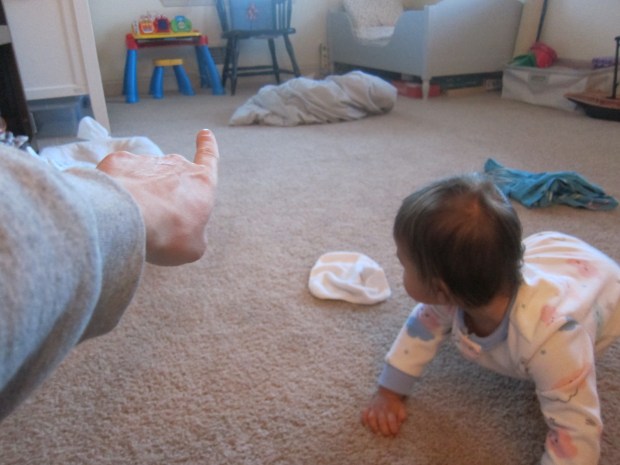
At her one year physical, the pediatrician asked if Veronika is pointing yet. This is one milestone she hasn’t hit, which isn’t a concern, but I realized it’s probably because I only rarely model the behavior. So today we played The Where Game!

This is the simplest game ever. Walk around any room in the house asking where things are. “Where is Veronika’s crib?” “Where is big brother’s bed?” “Where is the window?” As I asked each question, I pointed first and then exclaimed, “Here it is!”.

Where are her books? She found them.

Where Game (2)

When we were downstairs by the computer, I asked where it was. Her little hand began reaching out in a point, almost too fast to catch on camera. But she’s starting to ge tthe idea!

Where Game (1)


Rotini with Bolognese Sauce

Rotini Bolognese (2)

Serve this easy vegan bolognese with whole wheat pasta or any of the new chickpea or lentil pasta on the market. It’ll pack a big protein punch for little eaters.

Ingredients:

  • 2 tablespoons olive oil
  • 2 tablespoons Earth Balance butter
  • 1/2 Vidalia onion
  • 1 celery stalk
  • 12 ounces meatless crumbles (such as Lightlife)
  • 1 (15-ounce) can tomato sauce
  • 2 tablespoons tomato paste
  • Rotini pasta
  • Vegan Parmesan sprinkles
  1. Heat the olive oil and butter in a large saucepan over medium heat.
  2. Dice the onion and celery and add to the pot; cook for 5 minutes.
  3. Add the meatless crumbles; cook for 4 minutes.
  4. Stir in the tomato sauce and tomato paste; cook for a final 3 to 4 minutes, until heated through.
  5. Meanwhile, cook your favorite rotini pasta according to package directions. Serve the sauce over the pasta, and sprinkle with the Parmesan to taste.

For little ones who are Baby Led Weaning, you can serve piles of the sauce next to pieces of cooked pasta for a more deconstructed version.

Rotini Bolognese (1)


Baby’s Poem

Baby's Poem (3)

If your baby has older siblings, then he or she is likely eager for the day when a baby brother or sister can truly talk. Help keep things amusing in the meantime with this cute, family-friendly activity.

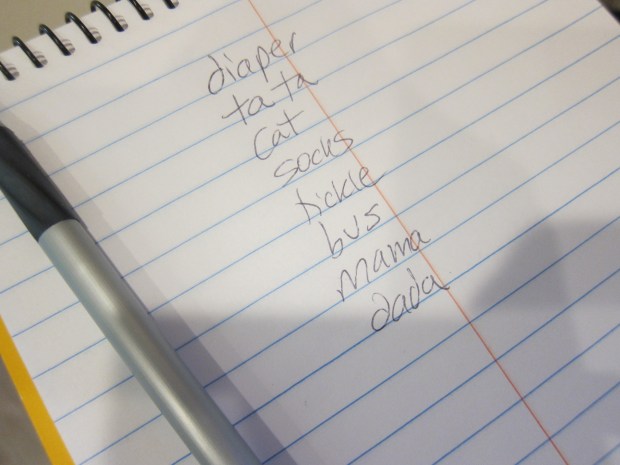
Make a list of the words your baby can say so far. For Veronika, this is a mix of vocalizations and baby signs, and she’s picked up some funny first ones. On our list we had:

  • diaper
  • cat
  • socks
  • tickle
  • bus
  • mama
  • dada

Big brother Travis loved brainstorming the list, adding the “ta ta” that she says for Travis.

Baby's Poem (1)

Now it was time to turn her words into a poem! Take turns as family members adding sentences. I started things off on a silly note with:

“The cat in socks likes to tickle the bus.”

Travis immediately latched on and added:

“The bus got to tickle the cat.”

Our poem ended with:

“Veronika put a diaper on ta ta

And mama and dada took it off.”

As you can see, there are no rules and no need to rhyme. But it had Travis laughing, had all of us marveling at the words she can say already, and now has us excited for what word comes next.

Baby's Poem (2)

What was your baby’s first word? Please share in the comments!


The Power of Protein

Power of Protein (6).JPG

When Travis gets home from school, man oh man is he tired. I’m dismayed, therefore, if I look in his lunchbox and find food that has gone uneaten, as he learns to make sure he gets enough before rushing off to recess.

So the timing of this lesson plan from Raddish Kids was perfect. It gave me an entry point to talk about why he needs to prioritize certain portions of his meal, and have enough energy for those long kindergarten days.

Start with this fun challenge: I asked him to balance on one leg, which he proudly did as he counted to 10.

Power of Protein (1)

But could he do it with his eyes closed??? Whoa, now he wobbled!

Power of Protein (2)

Raddish’s talking points explain how – just like in this exercise – our bodies need balance on the inside or we might wobble and tip. You can give examples like rest vs. activity and then launch into the idea of eating foods in balance.

The main focus here was on protein. Raddish provided a whole page full of protein facts, and we watched a suggested video. For our vegan family, I filled in a few gaps, explaining how we can get protein from tofu, beans, lentils, whole grains, and more.

Power of Protein (5)

Now it was time to see what he’d learned! We went through grocery fliers and I asked him to pinpoint the protein-rich foods. (Again, this was a bit odd for our family; when there was chicken or turkey, I pointed out that we can eat vegan versions of these). The activity helped him hone his understanding of protein after guessing wrongly on a few items (like tomatoes, or banana bread).

Now it was time to put our bodies to the test! I showed him the My Plate graphic and explained we’d be charting his food for five days. He loved making tally marks.

Power of Protein (4)

My formerly fantastic veggie eater has been nixing them lately, so this was also a nice way to show him where his balance was “tippy”. After a day with only one veggie serving, he was inspired to eat lots more the following day!

Power of Protein (7)

Older kids can extend the lesson by looking at food ads in magazines, and discussing how the advertiser persuades you to eat in a certain way. Your kids may even want to make their own ad!

Overall, this was a useful lesson, though perhaps not as “fun” as other Raddish lesson plans.

Power of Protein (3)