Listen Like a Whale

Listen Like Whale (2)

Talk about a milestone; my five year old is finally brave enough to tilt his head back in the tub and get his face underwater. This was a big step for Travis!

We celebrated the moment with a fun experiment I’d been telling him about for a while, ever since learning about whales with Kiwi Co’s baleen whale crate.

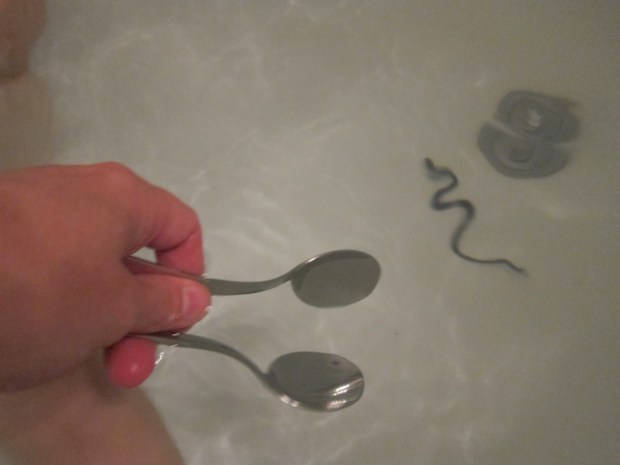
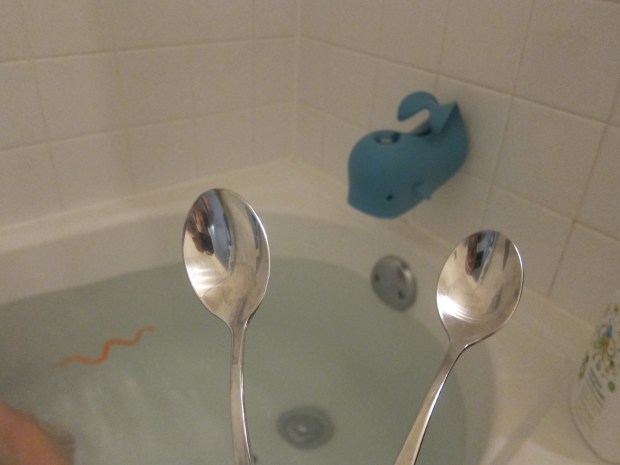
All you need to do is tap two spoons together in order to experiment with how sound travels both above and below water. First we tapped them out in the open air.

Listen Like Whale (1)

Next I tapped them underwater while his head was above water. The sound was quite muffled.

Listen Like Whale (4)

Now he leaned back until his ears were underwater, and he was able to hear the sounds much more clearly. “It also sounds deeper,” he commented, though I can’t say for sure if this was the case since my ears weren’t under there. Either way, he was quite happy to have done the experiment, and I think our little whale spout cover concurred!

Listen Like Whale (5)

The idea here is to illustrate why whale song can travel for hundreds of miles through ocean water; sound travels farther and faster in water than it does in air!

Bean Picture

Bean Pictures (6)

Engage your child’s budding artistic skills and fine motor skills with this quick project!

I invited Travis to draw anything he liked on thick watercolor paper, but suggested it needed to be something he could truly draw – not a “scribble scrabble” as he’ll do when he’s joking around. He thought about this and decided on a person.

Bean Pictures (1)

I love the way he draws people at age five: a very big head with round cheeks and small facial features, then tiny stick arms and legs.

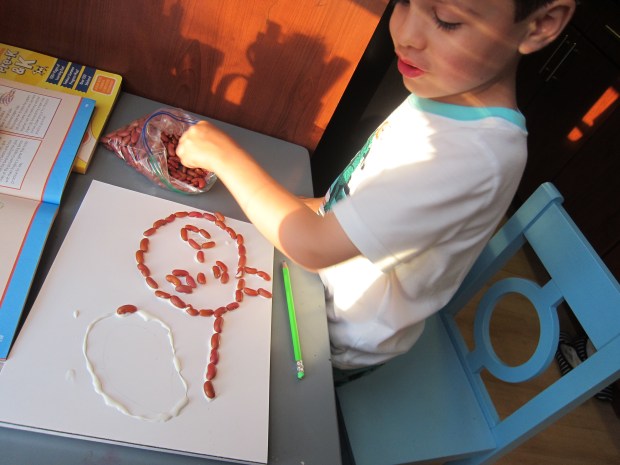
Next I had him squirt glue all along the lines he had drawn. He took this mission very seriously.

Bean Pictures (2)

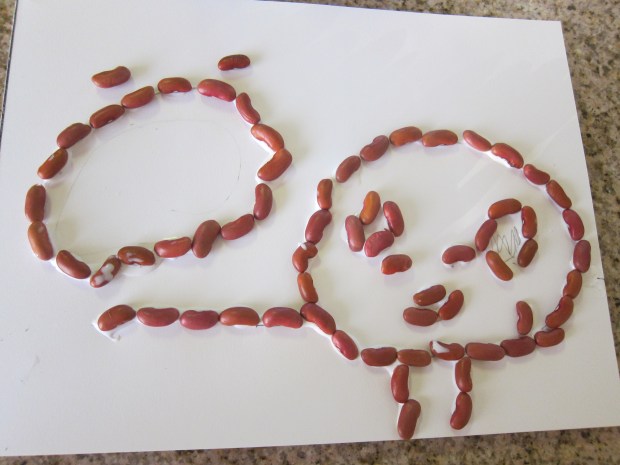
Finally, it was time to cover his person with dried beans. He laughed as he worked about “Mr. Bean,” and carefully added beans along every bit of glue.

Bean Pictures (3)

Near the end, he decided it wasn’t Mr. Bean after all… It was his baby sister!

Bean Pictures (4)

She needed a sun to stand under, so he penciled in a second circle, and insisted we cover that with glue and beans, too!

Bean Pictures (5)


Getting Used to Other Babies

Get Used to Babies (2)

Veronika is eight months old today! Eight months is a fantastic age to introduce the idea of parallel play; that is, playing alongside other babies or slightly older toddlers, even though children this young won’t play together yet.

The perfect candidates for this activity? Cousins! If you don’t have cousins nearby, seek out neighbors or friends whose children are close in age to your baby.

Other Babies (3)

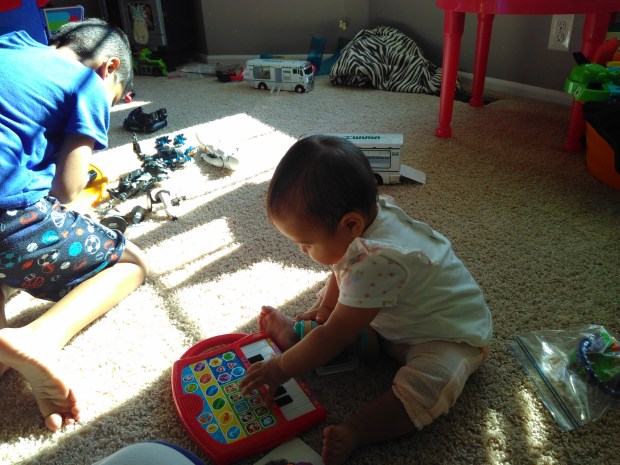
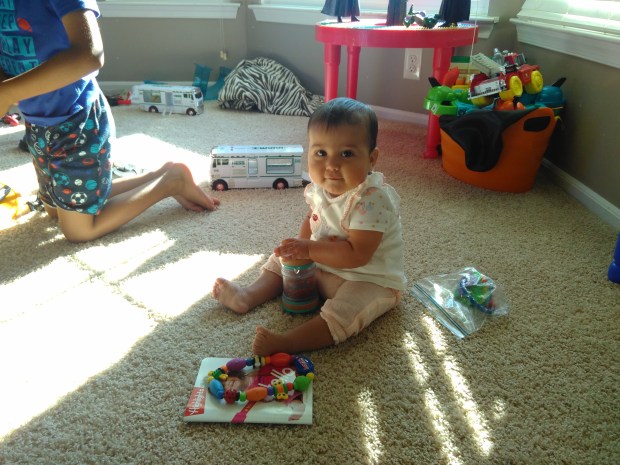
Just watching bigger kids is a lesson for a baby. Veronika loved to sit near her toddler cousins as they all played in the same room.

Other Babies (2)

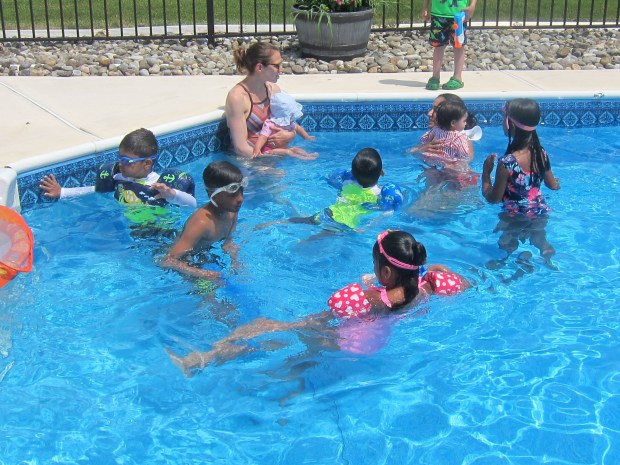
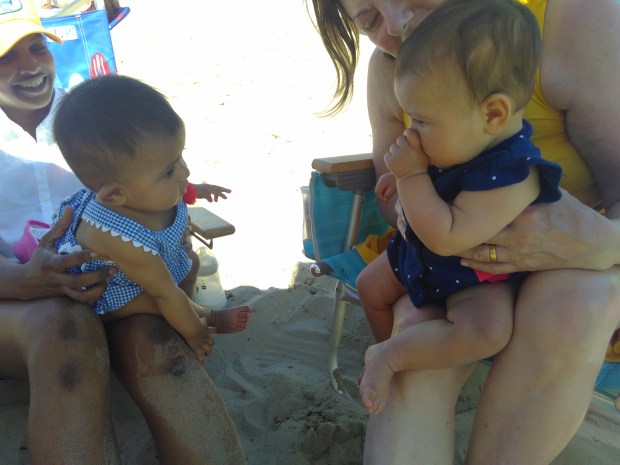
She’s been super-observant of cousins during summer get-togethers thus far, marveling at the big kids in the pool, playing by babies her age at the beach, watching older toddlers eat, and playing together in playrooms.

Other Babies (1)

Where does your child get to meet other babies and toddlers? Please share in the comments!

Water Work

Water Work (6)

This easy experiment will teach your preschooler or kindergartner about evaporation in an easy to see, hands-on way. Plus get you out into the sunshine each morning!

Travis filled two equal containers with 1 cup water each. We made sure to measure carefully before pouring, so our results would be accurate.

Water Work (1)

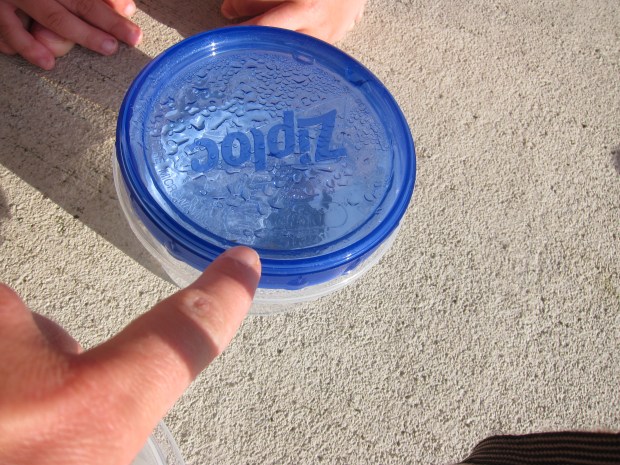
We screwed the lid tightly on one container but left the other container open. Place them somewhere that gets direct sunlight.

Water Work (2)

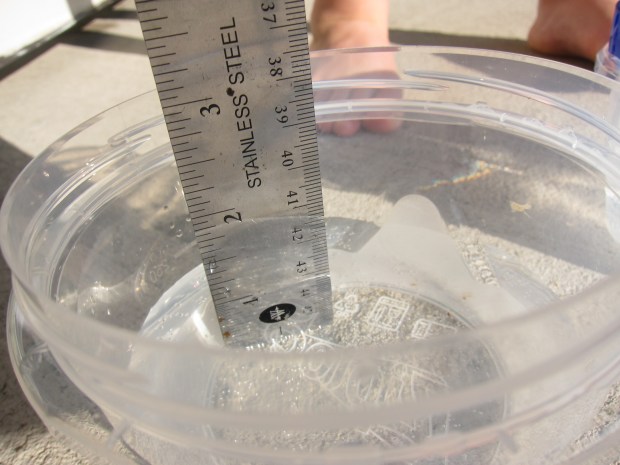
Each morning for a week, we headed out and measured the water. On the first day, the difference wasn’t that great, 1.5 inches of water in the lidded container, versus 1 inch in the open one.

Water Work (3)

By the next day, the results were 1.25 inches in the closed container (some had condensed on the lid!) versus only .75 inches in the open.

Water Work (5)

I asked Travis where the water was going and he correctly understood that some was evaporating into the air each day.

We continued to check on subsequent days, until a final reading of .25 inches in our open container. As a final component, Travis drew what had happened, showing a very full closed container and only a small layer of water in the open one. Those are three hot orange suns boiling off the water at the top!

Water Work (7)

A fantastic STEM/STEAM project for your summer!


Catch That Sound

Catch That Sound (4)

Here’s a game that combines reading and phonics skills with gross motor skills, but your kids will just think they’re having a blast! In other words: the perfect way to spend a summer morning.

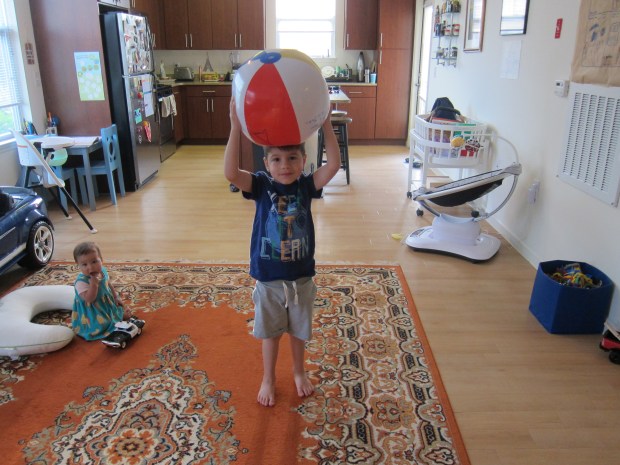
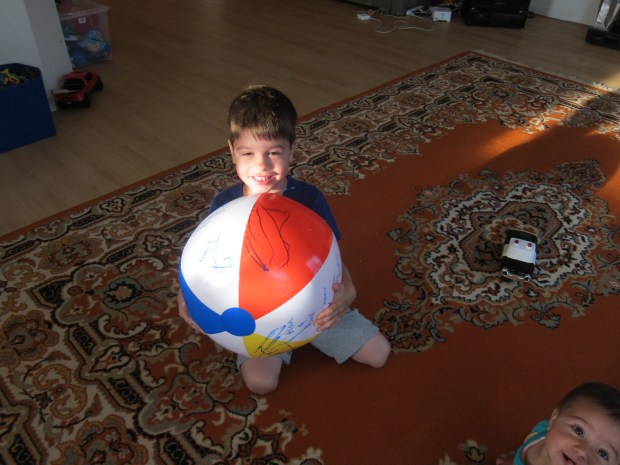
I pulled out the beach ball, which already had Travis excited, and explained the rules.

Pick a letter, and the person throwing the ball has to say a word that begins with that letter before each toss.

Catch That Sound (1)

Some of these were easy. B lent itself to books, babies, balls, and bees rapidly. Others made him stop and think between each throw. Eagle was his first confident answer for E, but then he was stuck until I prompted some words with the short-E vowel sound like elephant.

Catch That Sound (2)

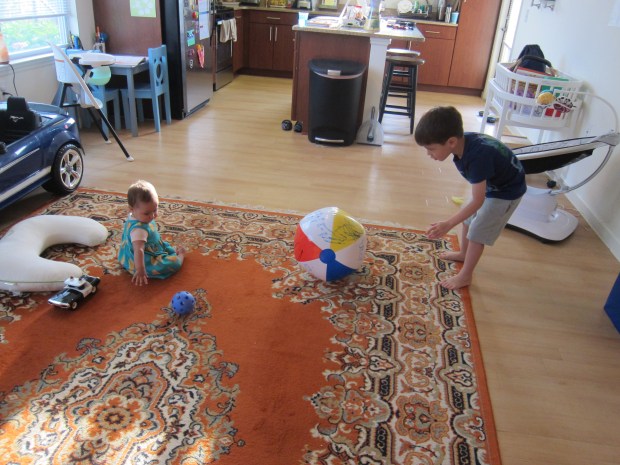
Travis also thought it was fun to roll the ball to little sister after saying each word, a great way to see the siblings play together.

Catch That Sound (3)

See which letter your kids can get the most for! And with every throw, they will be honing those gross motor catching and throwing skills, too. We might just have to play this one on the beach, next time!

Catch That Sound (5)

Jellybean J

Jellybean J (2)

Today’s letter of the day for tracing had an edible treat at the end – jellybeans!

Travis easily traced both upper case J and lower case j, and then I told him he was going to love our 3-D model today because it involved a favorite treat.

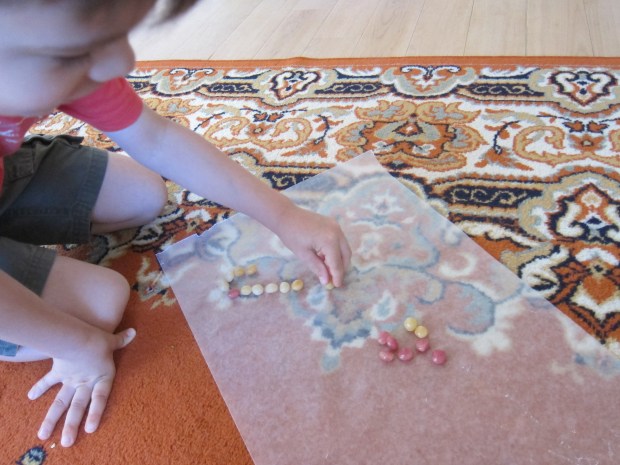
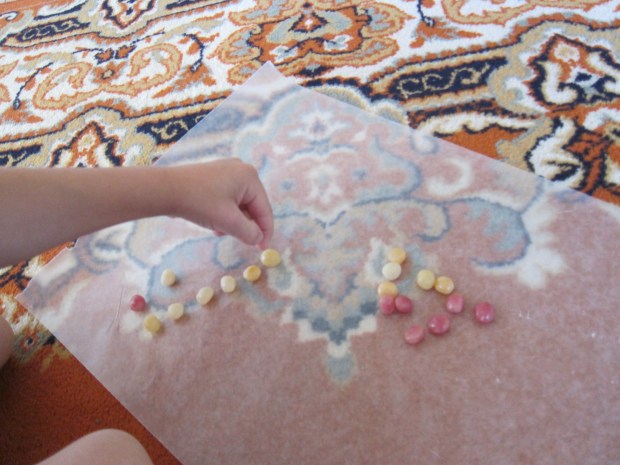
Place jellybeans on a sheet of parchment paper, and challenge your child to recreate the letter with the candies.

Jellybean J (1)

Travis didn’t even need to look at an example. I helped him make his dot a bit more precise…

Jellybean J (3)

…but then it was impishly gobbled up.

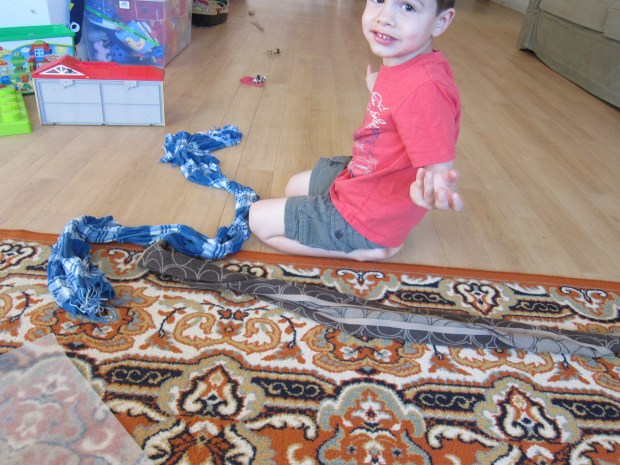
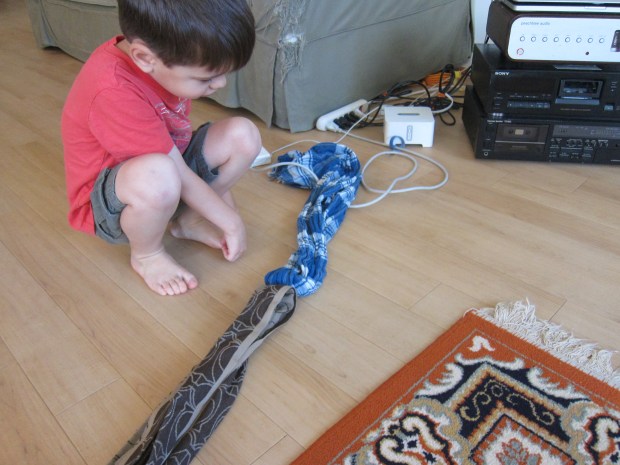
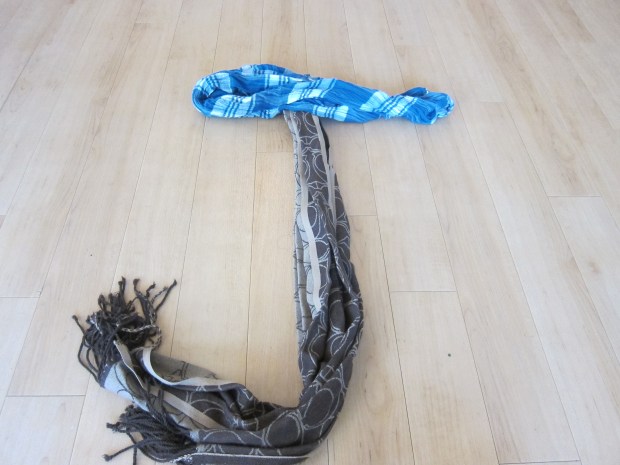
For the big J, I pulled out a few old winter scarves (how jolly!), and I asked him to make them into the upper case letter. This wasn’t as easy as the candy. He looked at me in amused confusion.

Jellybean J (4)

I helped him form one scarf into the hook. He still couldn’t quite see where the second should align…

Jellybean J (5)

Aha, now he saw how to cross it at the top.

Jellybean J (6)

As with the other letters we’ve tackled this summer, these hands-on models are fantastic for reinforcing the two-dimensional lesson of tracing on paper.

Take a Mini Break

Mini Break (1)

Today’s activity probably sounds like an easy one to most parents – but it’s the hardest kind for me! It challenged me to take a mini break, not only to help Veronika out as she enters the phase of separation anxiety, but also for me, the caregiver. We tend to forget to take care of ourselves, or quite simply don’t have the time to, but it’s important to remember to take a time-out every now and again.

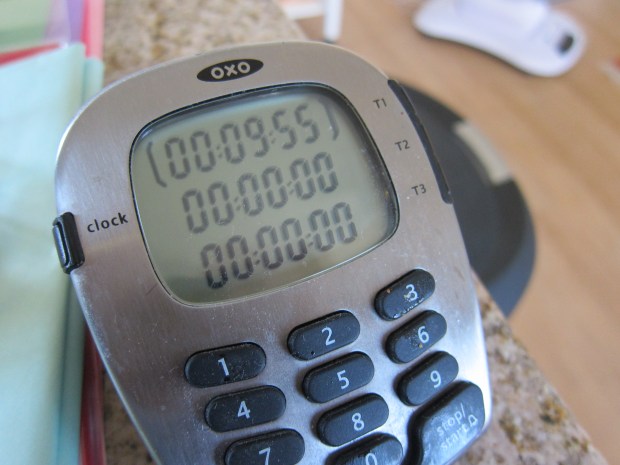
So I stunned my husband announcing I’d be taking a ten minute break.

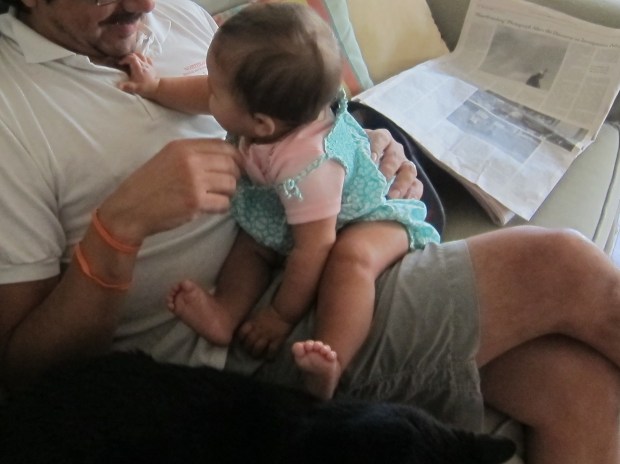
I waved bye bye to Veronika, who was playing on daddy’s lap. The goodbye is important here, instead of sneaking away.

Mini Break (6)

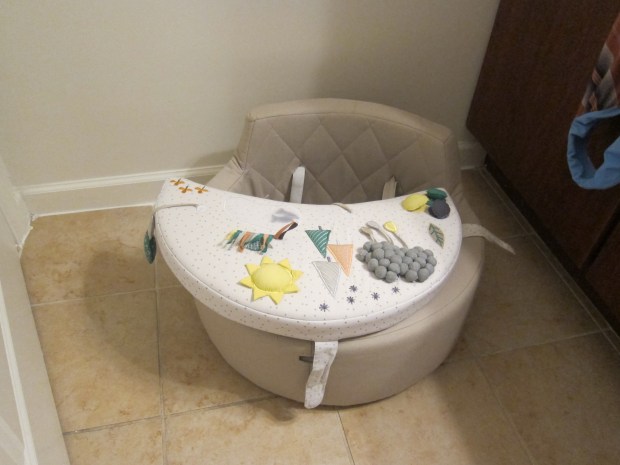
Then I shut the bedroom door, and this is the key; don’t be available for a full 10 minutes. Do something just for you. Here’s the chair where Veronika normally sits when I shower. It entertains her fantastically, but it also means I’m still “on” even during shower time, frequently singing ‘Wheels on the Bus’ from behind the curtain.  So wow, a baby-free shower!

Mini Break (3)

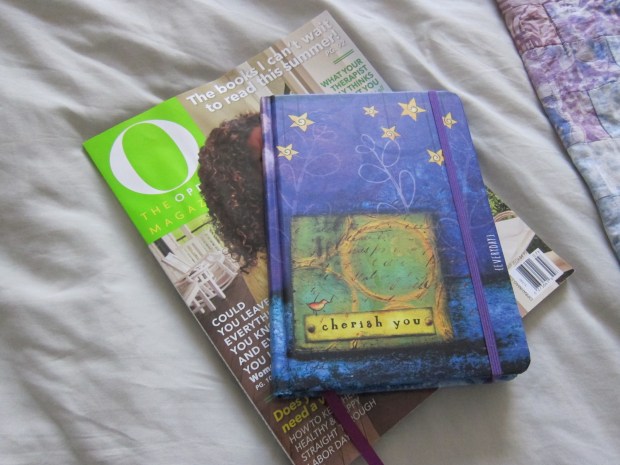
I had time to read a magazine and pen in a journal.

Mini Break (4)

Oh wow, this is almost relaxing. Are those my feet, up off the floor?

Mini Break (5)

I’m exaggerating somewhat, but you get the idea. That ten minute pause was amazing, and then I headed back out with renewed energy for my little one. And Veronika did great in the separation! If your spouse isn’t home, consider this activity with a grandparent or babysitter, and enjoy the pause.

Rainbow Breadcrumb Edible Sensory Tray

Rainbow Breadcrumb (9)

Aside from a simple bowl of cooked pasta, this was Veronika’s first sensory tray, and the first that I truly prepared for her. At this age, edible sensory trays are best, especially when you have a baby like Veronika who puts everything in the mouth.

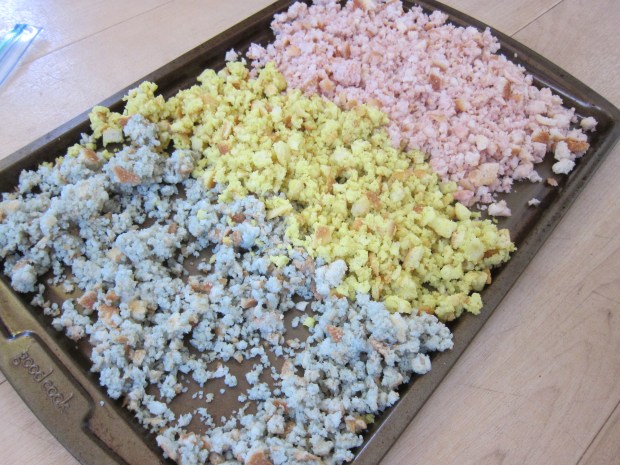
The prep for this was so fun. Divide a loaf of bread into equal portions – as many portions as you want colors. You can make a full rainbow, but I stuck with the primary colors: red, yellow, and blue.

Rainbow Breadcrumb (1)

Place 1/3 of the bread in a food processor and process until you have coarse crumbs. Stir 2 to 3 drops of natural food coloring into 2 tablespoons non-dairy milk. Add to the food processor and pulse until the crumbs are coated.

Rainbow Breadcrumb (2)

Transfer to a plastic bag and let dry out. Repeat for your remaining colors.

Rainbow Breadcrumb (3)

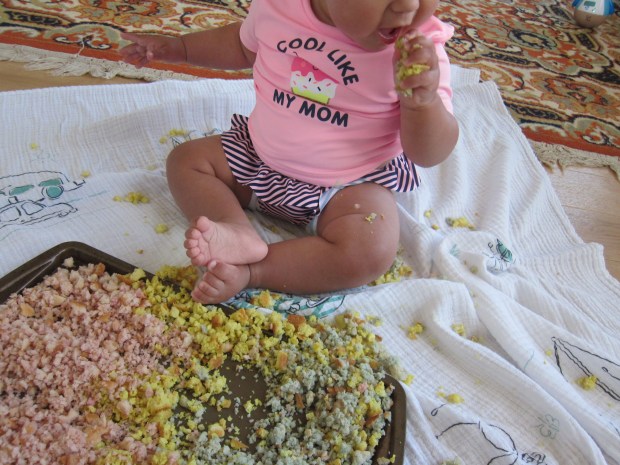
Once the bread had mostly dried, I arranged it on a baking tray for Veronika, and sat her down on a blanket; we were prepared for a mess!

Rainbow Breadcrumb (4)

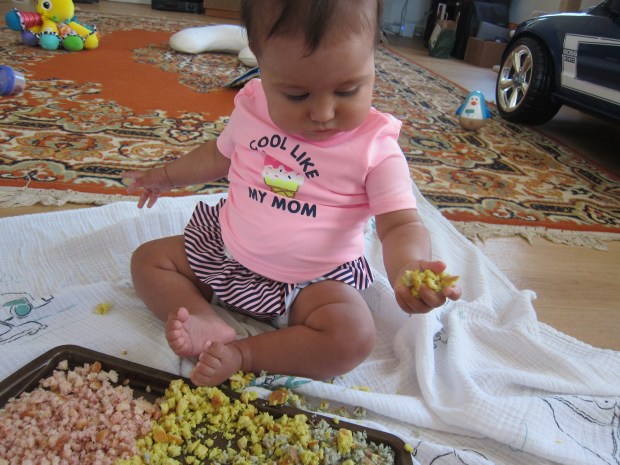
She knew what to do instantly.

Rainbow Breadcrumb (5)

Little hands pulled up big fistfuls of the crumbs.

Rainbow Breadcrumb (6)

They went right to her mouth, which was precisely the point, so I didn’t have to worry one bit.

Rainbow Breadcrumb (7)

I showed her how to run her hands through so that the colors mixed.

Rainbow Breadcrumb (10)

But mostly she was content to reach in, squish the mixture in her hands, have a nibble, and begin again. This one will keep your baby entertained for ages!

Rainbow Breadcrumb (8)

Edible Parts of the Plant

Parts of Plant (13)

To complement a recent Strawberry Shortcake recipe from Raddish Kids, Travis and I had fun with this homeschooling lesson on the various edible parts of a plant.

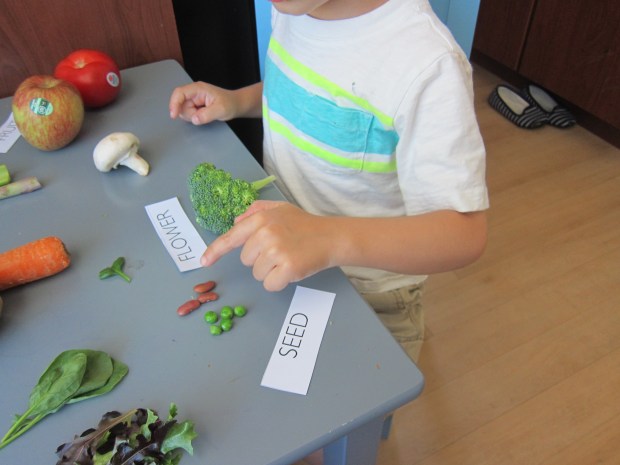
Ahead of time, I gathered two examples of each of these six plant categories:

  • Roots: carrot and potato
  • Stems: asparagus and celery
  • Flowers: broccoli and flowers
  • Seeds: peas and pinto beans
  • Leaves: spinach and lettuce
  • Fruit: tomato and apple

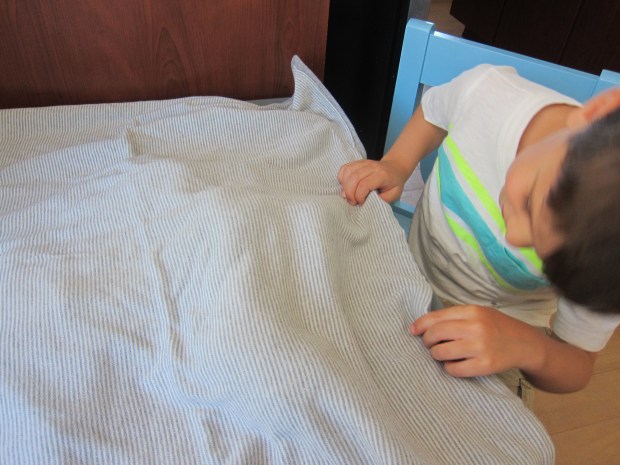
I hid all of these under a blanket, and called Travis over.
Parts of Plant (2)

He was immediately intrigued, of course, checking out the blanket with his hands and using his nose, too, when I invited him to use all his senses. Could he guess what was underneath? Tada! The big reveal.

Parts of Plant (3)

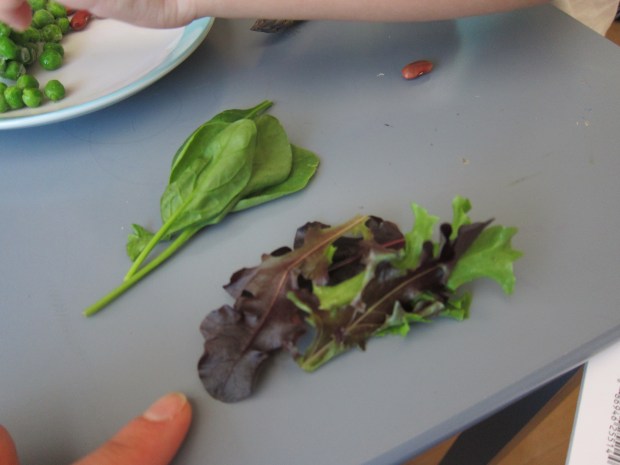
I challenged him to put the items into pairs, using whatever criteria made sense to him. This confused him a bit, but he began to match them up. Some he got correct without understanding why; it was easy to see that the spinach and lettuce leaves were similar, for example, or that the tomato and apple were both big and round.
Parts of Plant (4)

When he was finished, I shifted his answers around slightly. Aha, the asparagus and celery went together… because they were both the stems of plants. Same for the potato and carrot – both roots!
Parts of Plant (6)

I ran through a quick definition of each of the six parts. As a bonus, I asked him why the mushroom was leftover. Aha – a fungus!

Parts of Plant (7)

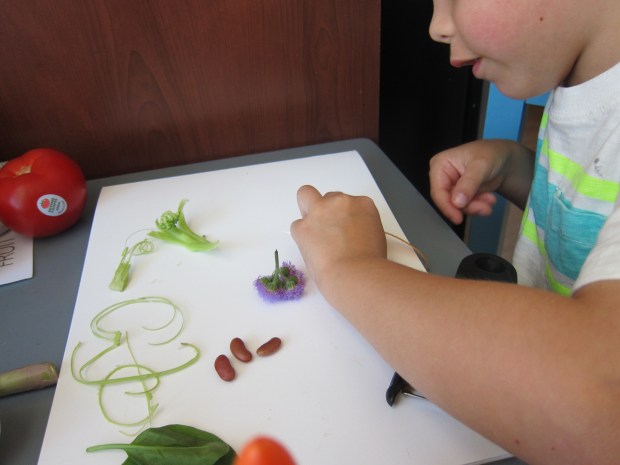
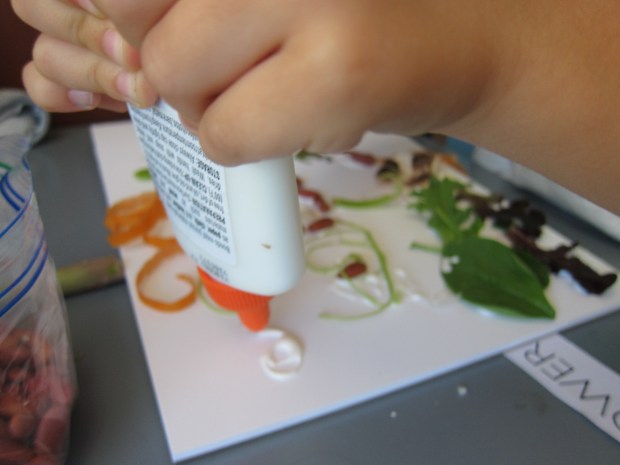
Big kids may want to pause here and make a chart and then brainstorm other foods that fit each of the six categories. But Travis and I hopped right along to the next activity: artwork! We used all of the items to make a picture. I gave him complete free reign, which meant that at first he wasn’t depicting anything, just enjoying the materials. He discovered, for example, that you can pull strings from the celery that glued down nicely.
Parts of Plant (8)

Then he got a bit more purposeful. There was a flower rimmed in pinto beans with a celery stem and mushroom center. And orange carrot curls for a sun.
Parts of Plant (11)

This, he proudly informed me, was a whale.

Parts of Plant (14)

Big kids may want to make a plant with their plants, or perhaps a funny plant person!

Parts of Plant (12)

We next checked out a few of Raddish’s suggested links, including a read-aloud of the very funny Tops and Bottoms. As he watched an informative clip about plants, Travis kept running over with tidbits. “Did you know rice is a seed??” I love seeing him so excited about learning!

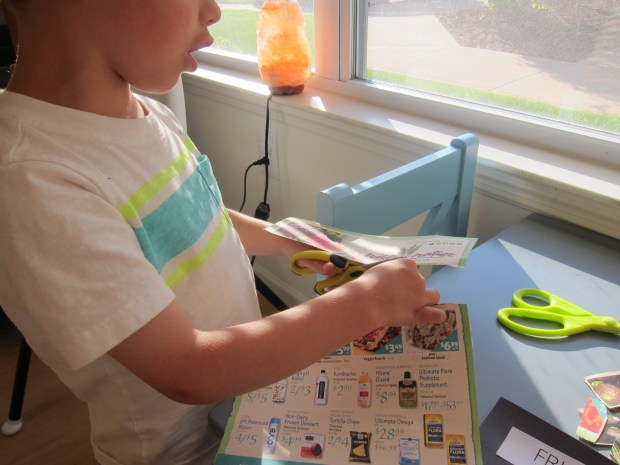
We next made an art collage of the six plant parts using a grocery store flyer.
Parts of Plant (15)

After he cut out all the pictures of fruits and veggies, we talked through where on our collage each item belonged.

Parts of Plant (16)

This was also great for sightreading words!

Parts of Plant (17)

As a bonus activity, we tested out Raddish’s suggested Kitchen Garden Experiment to regrow food scraps. We read about how plants can stockpile nutrients to keep growing for a short time, provided with water and sunlight, even if they no longer have soil.

I set out three different vegetable scraps for Travis: green onion bulbs, the bottom of a head of celery, and the bottom of a head of romaine lettuce.

Regrow Food (1)

We placed each in a container filled with water and set them on the windowsill. Travis’s hypothesis was that celery would grow fastest.

Regrow Food (3)

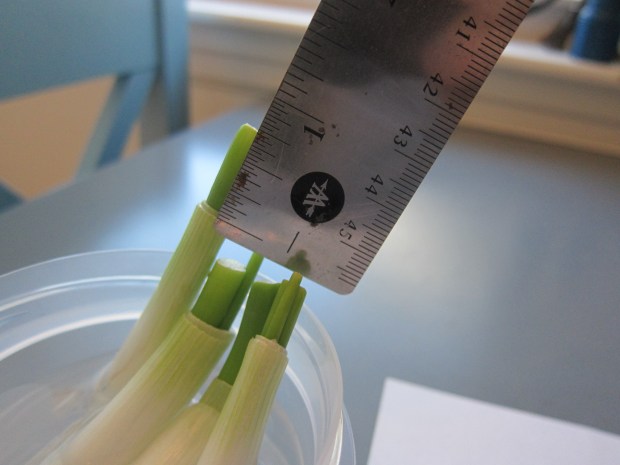
Each day we changed the water and observed. It was immediately apparent that green onion grew far faster than the other two.

Regrow Food (4)

After a couple of days, we measured the progress.
Regrow Food (8)

We also drew a picture of what he had observed. Then Travis wanted to eat the green onion, so that was the end of our scientific method!

Regrow Food (10)

There is so much more that older kids can do to learn about plants. Consider cooking a recipe that uses all 6 parts of a plant, or perhaps sprouting seeds.
Imaginative I

Imagine I (4).JPG

I is generally an easy letter to trace, and Travis enjoys the motions of this letter. But after tracing over it in his workbook, he and I stretched our imaginations to make 3-D versions of the letter!

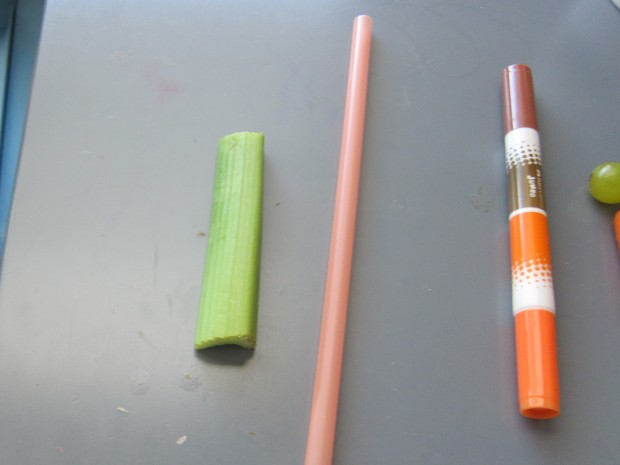
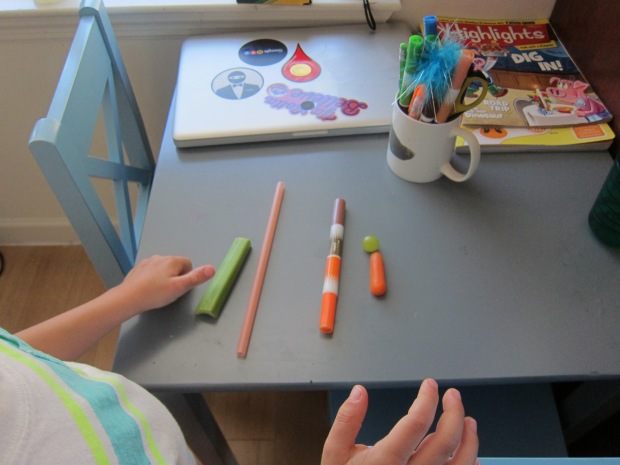
First, I challenged him to seek out three things in the house that resembled an I. Basically, this can mean anything that’s long and straight.

It took him some wandering around the apartment, but he settled on a straw, a marker, and a piece of celery.

Imagine I (3)

Other good finds might include a stick, pencil, or asparagus spear!

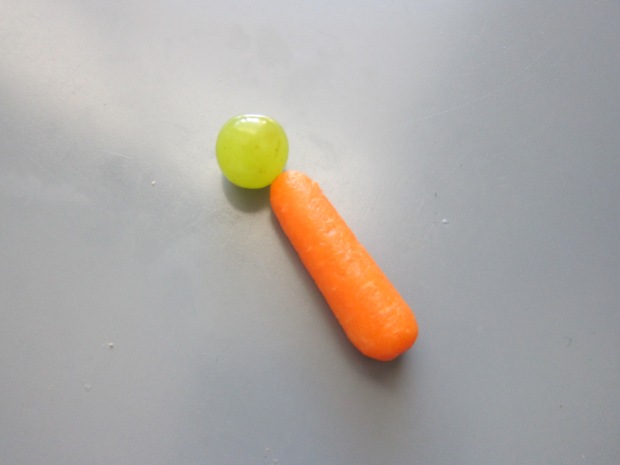
For lower case i, we needed to be sure to include the dot. A baby carrot plus a grape on top did the trick!

Imagine I (1)

There are so many cute ways to come up with an i using found objects. What will your child choose? Please share in the comments!