Magnetic Hearts

Magnetic Heart (10).JPG

This quick craft not only teaches about the topic of symmetry, but is also a fantastic way to explore the properties of magnets!

To cut out symmetrical hearts, fold cardstock in half and draw half a heart; cut out.

Magnetic Heart (1)

I thought to only have Travis help cut out the accompanying two long rectangles we would need from each color of cardstock, but he insisted on cutting out the heart himself – great practice along curves!

Magnetic Heart (2)

Open up the paper to reveal a symmetrical heart, then cut it in half.

Magnetic Heart (4)

Fold the rectangular strips you’ve cut out accordion style to form 5 pleats.

Magnetic Heart (5)

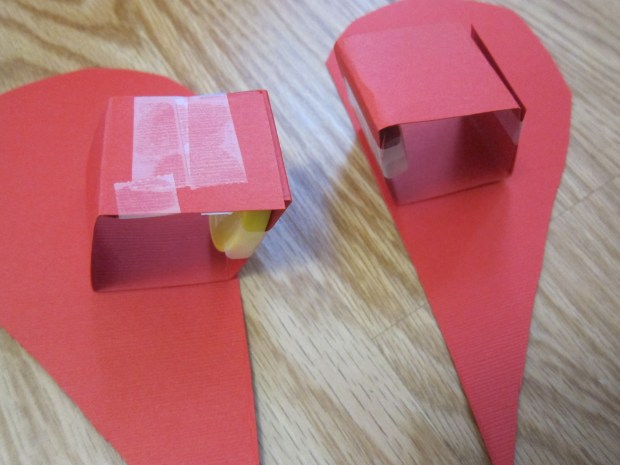
Fold this strip around itself to form a square and use tape or glue to adhere shut.

Magnetic Heart (6)

Tape a magnet to one side of the square, facing towards the center of your heart.

Magnetic Heart (7)

Tape down onto the heart and repeat on the other side.

Magnetic Heart (8)

Now, your two heart halves will snap together!

Magnetic Heart (9)

The other fun way to do this is to deliberately set up the magnets to repel each other. Travis loved chasing halves of hearts around the play room this way!

Magnetic Heart (13)

As you play, have a quick talk about attraction and repulsion in magnets, and you’ll have thrown a little learning into the fun.

Magnetic Heart (12)


Balancing Act

Balancing Act (4).JPG

Instead of tracing numbers today, Travis did a math project that was a little more hands-on, constructing a simple balance scale and testing it in various ways.

Balancing Act (1)

Punch three holes in each of two plastic cups. Add three strands of string or yarn to attach each cup to a hanger. By accident, our lengths of string were cut too short, so I ended up taping them on to the hanger.

Balancing Act (2)

The hanger should start out even. I gave Travis a bag of dried beans and had him start adding them to the cups any way he wanted. First the whole apparatus tilted one way…

Balancing Act (3)…then he quickly began adding beans to the other cup to even things out. After achieving a middle balance, he poured all the beans into the other cup, so things tilted the other way!

Balancing Act (5)

Your child may have fun playing around with different variations on this for quite some time. To mix things up, take out the beans and weigh toys or other objects, and see how many balanced combinations you can come up with!

Speedways

Speedways (4).JPG

This little experiment will challenge your child’s brain to think like an engineer, and teaches about angles, weight, speed, and more.

I tasked Travis with finding two balls that were the same and he came back with two squishy sports balls (Note: It turns out one might have been heavier than the other, but more on that later).

Speedways (1)

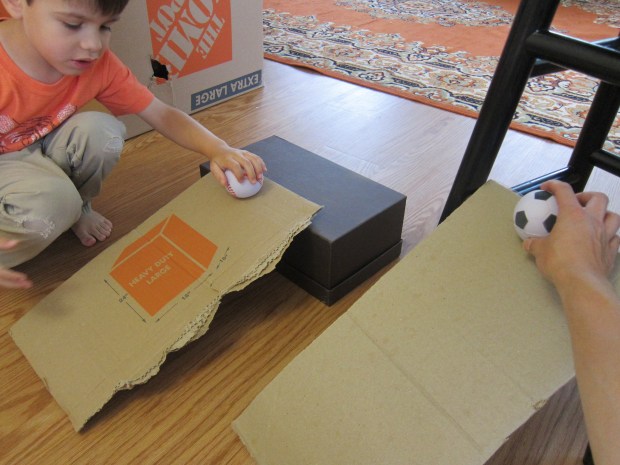
Next we needed to construct two ramps. Heavy duty cardboard cut to the same size were perfect. I helped Travis look around for what we could tilt them up against. He tried a few initial ideas, like baby toys, until we settled on a box for one and a stool for the other.

Speedways (2)

Counting to three, Travis and I released at the same time and watched the balls zoom down.

Speedways (5)

I asked him why the steeper one had rolled faster and further. He guessed because that ramp was shorter, so I showed him again how the ramps were the same length. But then we talked about the steepness, and he was quite interested. He said he found a way to make it roll even faster – from up above the ramp!

Speedways (3)

We tested out a few slightly more scientific variations, but then found that the “soccer” ball always rolled faster and further even when on the ramp with less of an incline. Holding both, I realized it was heavier than the “baseball”, which may have skewed our experiment. But we had speedy fun!


Listen Like a Whale

Listen Like Whale (2)

Talk about a milestone; my five year old is finally brave enough to tilt his head back in the tub and get his face underwater. This was a big step for Travis!

We celebrated the moment with a fun experiment I’d been telling him about for a while, ever since learning about whales with Kiwi Co’s baleen whale crate.

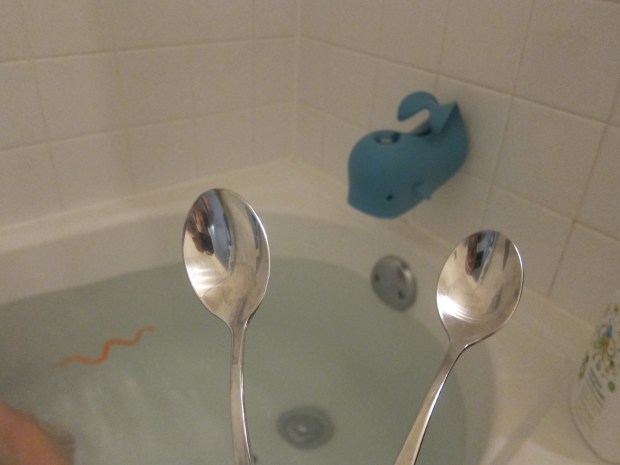
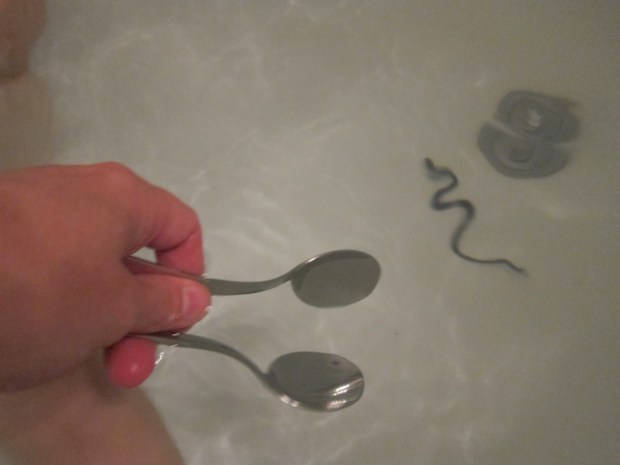
All you need to do is tap two spoons together in order to experiment with how sound travels both above and below water. First we tapped them out in the open air.

Listen Like Whale (1)

Next I tapped them underwater while his head was above water. The sound was quite muffled.

Listen Like Whale (4)

Now he leaned back until his ears were underwater, and he was able to hear the sounds much more clearly. “It also sounds deeper,” he commented, though I can’t say for sure if this was the case since my ears weren’t under there. Either way, he was quite happy to have done the experiment, and I think our little whale spout cover concurred!

Listen Like Whale (5)

The idea here is to illustrate why whale song can travel for hundreds of miles through ocean water; sound travels farther and faster in water than it does in air!

Water Work

Water Work (6)

This easy experiment will teach your preschooler or kindergartner about evaporation in an easy to see, hands-on way. Plus get you out into the sunshine each morning!

Travis filled two equal containers with 1 cup water each. We made sure to measure carefully before pouring, so our results would be accurate.

Water Work (1)

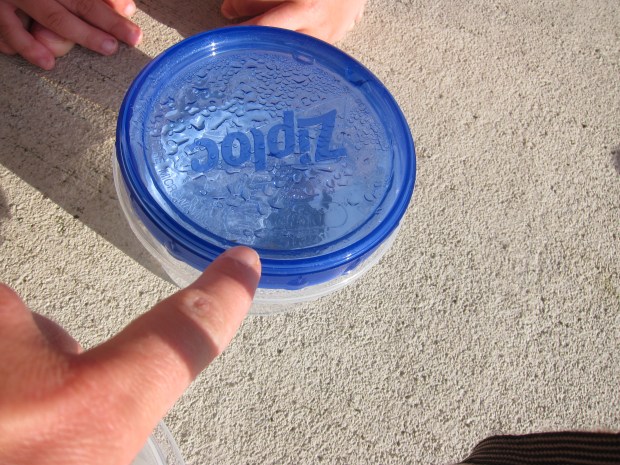
We screwed the lid tightly on one container but left the other container open. Place them somewhere that gets direct sunlight.

Water Work (2)

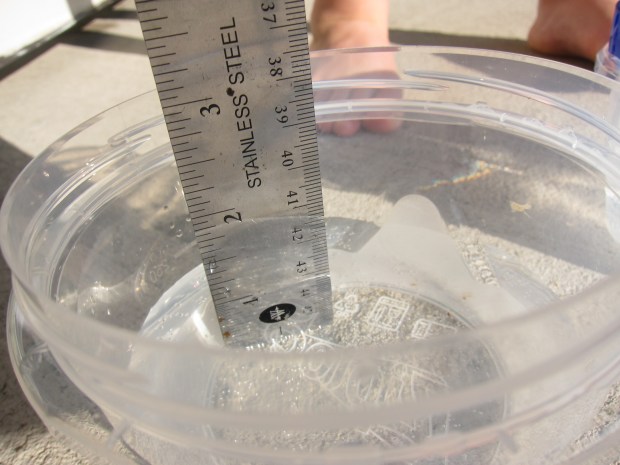
Each morning for a week, we headed out and measured the water. On the first day, the difference wasn’t that great, 1.5 inches of water in the lidded container, versus 1 inch in the open one.

Water Work (3)

By the next day, the results were 1.25 inches in the closed container (some had condensed on the lid!) versus only .75 inches in the open.

Water Work (5)

I asked Travis where the water was going and he correctly understood that some was evaporating into the air each day.

We continued to check on subsequent days, until a final reading of .25 inches in our open container. As a final component, Travis drew what had happened, showing a very full closed container and only a small layer of water in the open one. Those are three hot orange suns boiling off the water at the top!

Water Work (7)

A fantastic STEM/STEAM project for your summer!


Pollinators for Every Flower

Pollinators (11).JPG

The final lesson plan for the Garden Party kit from Raddish Kids was a huge hit, since Travis loves bugs and everything about them. He was a whiz already at much of this topic, but enjoyed the hands-on and artistic aspects of it!

When he came to the table for our lesson, he was surprised to find a flower waiting.

Pollinators (1)

We explored the flower in detail, including: rolling the leaves between his fingers to see how that changed the texture; smelling it; feeling the fluffy petals; and looking closely with his eyes.

Pollinators (3)

As he explored the flower, I read to him from a provided chart about plant anatomy. Much of it was a bit over a preschooler’s head, so focus on the bits your child will grasp. He liked the rather astounding fact that while people and animals are either a man (male) or woman (female), a plant is both!

Pollinators (10)

Some pollen ended up on the table… the perfect segue-way!
Pollinators (2)

I asked him to name pollinators he knew and he quickly rattled off butterflies and bees. After some prompting, he also guessed birds. I told him he was correct, especially hummingbirds, and then named a few surprises: bats, beetles, and the wind!

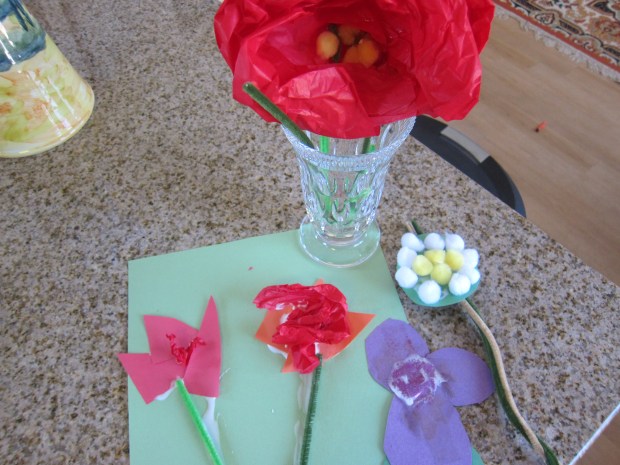
The next challenge was to pick a pollinator and make a flower with art supplies that was specific to that pollinator. First up was a bee! Thanks to the provided pollinator profile cards from Raddish, we learned that bees like flowers that smell sweet and in bright colors like yellow and purple.

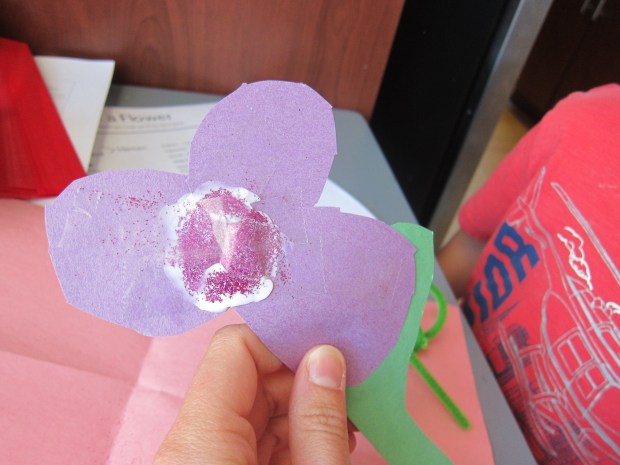
Travis chose construction paper for this flower, and added glittery “pollen” in the center. To make it smell sweet, we dabbed a vanilla extract-scented pom pom around the petals. Travis loved this!
Pollinators (6)

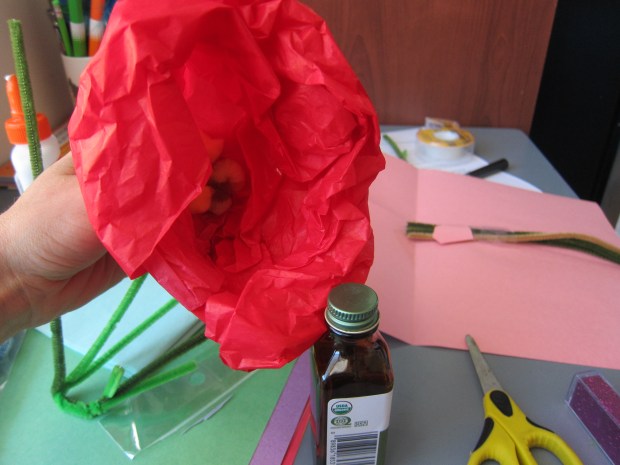
Next he wanted to make one for a hummingbird. Our card said the birds don’t land on the petals but instead dip in their beaks, so I helped him fashion a tube-shaped flower from tissue paper (we used red, since the birds like the bright colors). It was fun to add vanilla to the “pollen” pom poms in this one, too, even though the profile card said the birds had good vision but a poor sense of smell.
Pollinators (5)

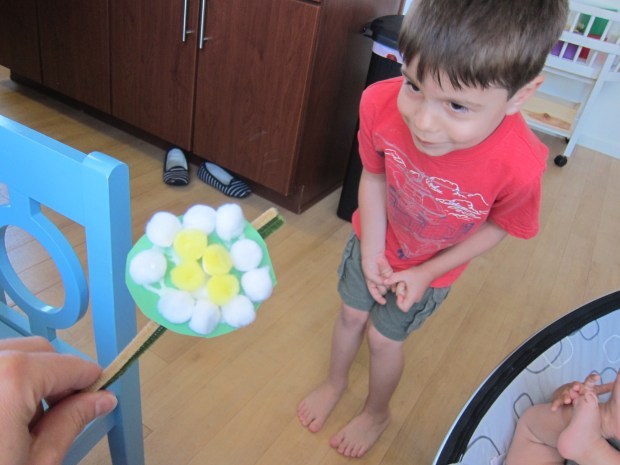
Travis next wanted beetles, delighting in the notes on the card that they like “unpleasant” smelling flowers or ones with no scent. We used white pom poms, since beetles prefer pale or dull colors, and added lots of yellow pollen in the center, which the beetle eats.
Pollinators (7)

He was so proud! I loved watching him think carefully about each pollinator, as well as use different materials each time.

Finally, he wanted a flower for butterflies! This one needed petals for the butterfly to rest on, bright reds and oranges, and no vanilla extract since the butterfly has good eyesight but a poor sense of smell.

Pollinators (9)

Overall, a fantastic lesson, with a little bit of art, a little bit of science, and important information about the role pollinators play in food crops thrown in there.

Snake Lengths

Snake Lengths (2).JPG

Travis has been quite into snakes lately and today I invited him to make a few from clay. Little did he know that I was sneaking in some math to prevent the “summer slide” with this little project!

First, he remembered that to make a snake coil, he needed to roll the clay between his palms.

Snake Lengths (1).JPG

I challenged him to make three different lengths and had him name for me which was long, which was medium, and which was short.

Snake Lengths (5).JPG

I suggested we measure the snakes next; of course we needed to check how long the biggest “python” was! First we used a traditional ruler, but then we grabbed other objects from around the house to see how the snakes stacked up.

Snake Lengths (3).JPG

Pennies were his favorite; I showed him how to carefully line up the pennies and make sure the line was straight. The big snake was 15 pennies long, medium was 9, and short was only 5.

Snake Lengths (4).JPG

We tried paper clips next and found that it was easiest to clip these into a chain so they didn’t slide around during measuring.

Snake Lengths (6).JPG

The possibilities here are almost endless. Will you measure your snakes in units of dried beans? Of pasta? Of buttons? Have fun with this one!

Flying Paper, Two Ways

Flipping Fish (6)

Here are two fun ways to harness the power of paper and watch things take flight.

Both of these projects are far less involved than the rockets and planes Travis and I have made recently, but sometimes you just need something simple to fill a lazy morning.

First we made a school of  “flipping fishies”.

Flipping Fish (2)

Draw rectangles on white paper and color in. The more colors the better!

Flipping Fish (3)

Cut out the rectangles, and cut a notch on each end, facing in opposite directions.

Flipping Fish (4)

Slot these notches together and you have fish. Soon we had mommies, daddies, and baby fish.

Flipping Fish (7)

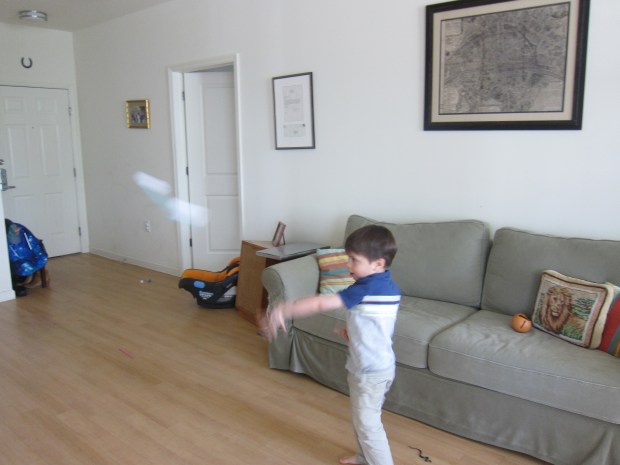
Toss them in the air and watch them whirl!

Flipping Fish (5)

Interestingly, we discovered that our baby fish swirled much better than the bigger ones we made.

Flipping Fish (8)

Next up, we did a repeat of a flying straw we’d made recently with a Kiwi Crate; as with our repeat of the Balloon Rocket, this time we used wide (“milkshake”) straws for better effect.

Cutting out rectangles was great practice for Travis to cut in straight lines!

Flying Straw (1)

For each straw, make one long rectangle, and one short; tape these into circles, and tape onto the straws.

Flying Straw (2)

Hold your straw so the small circle is at the front – and let it soar!

Flying Straw (4)

Those paper circles really catch the wind, and will carry your straw across a room. It’s fun to compare these to a plain old straw, which nose-dives right down.

Flying Straw (5)

Happy flying!

Paper Parachutes

Paper Parachutes (3).JPG

Travis and I recently made fabric parachutes that were a bit complicated and tangled easily while soaring down. Today we wanted something simpler, because the goal wasn’t so much about the parachute itself as it was to test how to make a parachute fall faster.

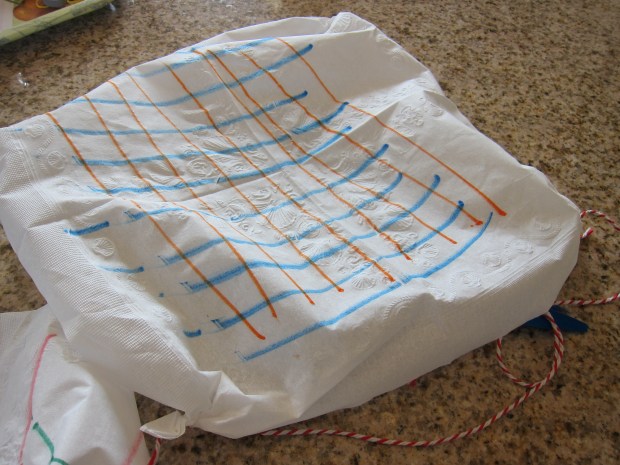
For our experiment, we quickly put together paper napkin parachutes.

Decorate your napkins with markers first.

Paper Parachutes (1)

Travis quickly learned that you need to be gentle drawing on napkins, and was proud when he got the hang of it!

Paper Parachutes (4)

Cut 4 equal lengths of string for each parachute, and tie around the napkin corners.

Paper Parachutes (2)

Gather the four lengths of string together in the center, and tie around any small object. Our “contestants” were a feather and a rock. But if you want, multiple toys can get in on the action; this game would be great with Lego people!

Paper Parachutes (5)

Travis made his hypothesis: that the rock parachute would fall faster than the feather one.  So we headed outside to test it out! A fenced-in overlook made the perfect launch site.

Paper Parachutes (6)

Even in a still photo you can see the feather parachute lazily drifting down as the rock plummets to the ground.

Paper Parachutes (7)

The difference here was extremely stark, of course. As mentioned, your kids might want to do multiple launches with items closer in weight. Enjoy the discoveries!

Sidewalk Constellations and Mini-Books

Sidewalk Constellation(5).JPG

It was a beautiful morning for sidewalk chalk art, and to add purpose to Travis’s art, I decided to throw in a little STEM learning, too!

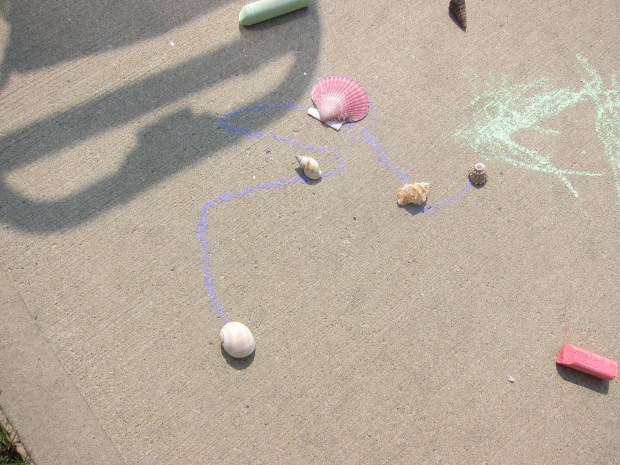
We headed outside with our book of constellations, and I challenged him to lay out shells (rocks would work well, too) to represent each star in the pictures. We started with the Big Dipper.

Sidewalk Constellation (6)

Could he now connect the lines, following along with the picture in our book? This was a bit of a challenge for Travis, who had to consult the picture between each line, but he ended up with a great dipper.

Sidewalk Constellation (7)

The Southern Cross was next. He loved using big shells for two of the stars, and had an a-ha moment when he figured out which way he should draw his chalk lines.

Sidewalk Constellation (8)

Then we got silly and made up new constellations. I let his imagination run wild, and soon we had a snake constellation:

Sidewalk Constellation (1)

And a ninja constellation:

Sidewalk Constellation (9)

Make sure you take pictures of all your artwork before you head inside! I then had these printed so we could put them into a booklet.

Sidewalk Constellation(3)

Add one picture per page, along with a fact or two about that constellation.

Sidewalk Constellation (b)

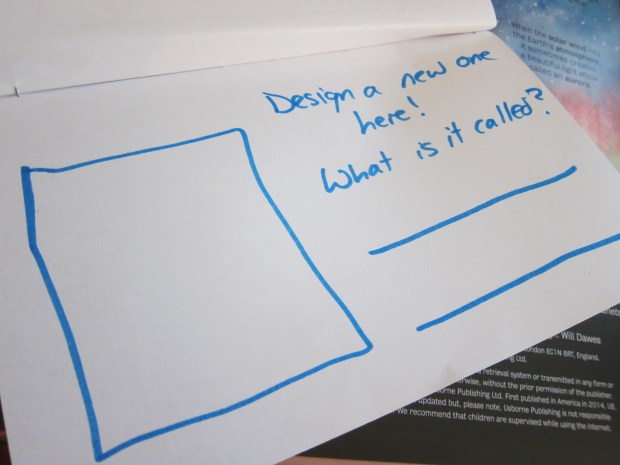
We left a page blank, for future imaginative additions!

Sidewalk Constellation (c)

These mini-books will serve both as a memory capsule of your day and for storytime down the road.

Sidewalk Constellation (d)