
Just before Halloween, Travis made Boo-Nana Bread form Raddish Kids‘ Spooky Kitchen crate. Now we’re finally getting around to the fruit-ripening science lesson attached to it!
Before anything else, we needed to set in motion an experiment that would take 5 days. I purchased a bunch of (fairly) green bananas at the grocery store, as well as a few riper ones.
Ask your child to describe the differences they notice between the ripe and unripe bananas. Travis pointed out the obvious color difference, first. A little probing helped him go deeper: the ripe ones were softer, and smelled sweeter.

I asked him if a banana needed anything other than itself to ripen. Somehow he knew it needed air (oxygen). Smarty pants!

But for scientific backup to this hypothesis, we experimented by placing the following:
- 1 green banana out on the counter
- 2 green bananas in a paper bag, folded up tight
- 1 green banana and 1 ripe banana (for ethylene) in a paper bag, folded up tight
- 2 green bananas in a sealed plastic bag
- 1 green banana wrapped in layers of plastic wrap
That last was Travis’s favorite, pretending we were making a banana mummy!

Meanwhile, it was time for a little science behind the lesson. I set out two plates for him, one featuring non-climacteric fruits i.e. they do not ripen after picking. Raddish provided a long list to choose from, and our plate included: a bell pepper, blueberries, cucumber, orange, and yellow squash.
The second plate had climacteric fruits i.e. ones that do ripen after picking. This plate held an avocado, a pear, and a mango.
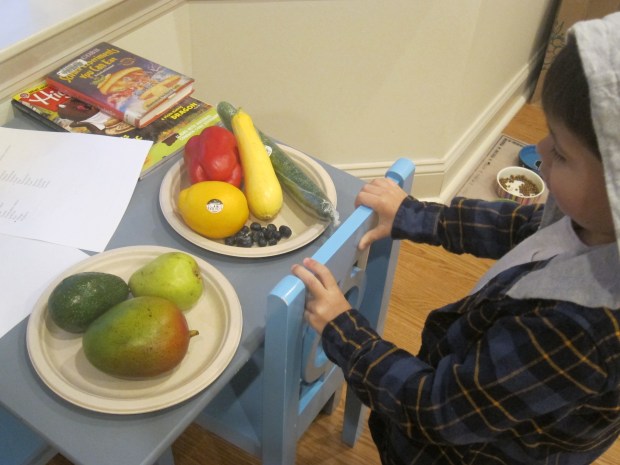
“Can I eat it,” he asked right away of the mango. “Is it ripe?” At first he was stumped about how I had categorized them, guessing I had sorted them by color. But hmm, why wasn’t the cucumber on the green plate?

I loved watching him really ponder this! I guided him back to his very first comment about the mango. Was it ripe? Now he understood that one plate held fruits we needed to wait for; the other plate was fruits that wouldn’t ripen further after picking.

Time to explore! I let him have at the food just for fun. He loved peeling the squash and taking little nibbles of it, plus practicing his knife skills on the bell pepper…

…and crunching into the cucumber for a big bite.

He decided to wait until the mango was riper before peeling it. Good choice! Plus he gave the unripe avocado a big squeeze and it was solid as a rock.

Five days later, we finished with a little more science now that we had our banana results. Our finding weren’t quite as promising as hoped, likely because I had to start with green bananas on the verge of yellow and a yellow banana on the verge of green, based on what the grocery store had to sell. But we still could see that the countertop banana was the brownest/ripest and the plastic bag bananas had retained the most green.

Interestingly, our plastic-wrapped banana had gotten quite ripe, so we must not have made the “mummy” tight enough.
The green bananas in the paper bag had ripened faster than the ones in plastic, since the porous paper gives them access to oxygen. But the one that also enjoyed the company of a ripe banana had both oxygen and extra ethylene, so that was riper still.

Enough science; as it turns out, leftover bananas are lots of fun to play with, even for little sister!

We enjoyed one final video of a similar experiment done with supermarket food. If your kids loved the banana experiment, try out an avocado one!
Travis and I also decided to check out the suggested book Science Experiments You Can Eat, by Vicki Cobb. We read through a couple of the experiments, but didn’t actually put any to the test.






 joyful parenting