Kindergarten Home School Week 8: Tuesday

Home School 36 d

We seem to have settled into a rhythm whereby Travis loves school in the morning, but protests anything I suggest after 1 p.m. or so. That’s why our schedule is so front-loaded, so feel free to space out activities more if you have kids who aren’t freshest first thing!

9-9.30: STEAM. Travis’s workbook page today involved reading the names of ocean animals and then coloring them in. We expanded on this ocean theme with porthole scratch art!

Home School 36 a

9.30-10: ELA. His workbook page involved sequencing a story about a coyote chasing a prairie dog.

Home School 36 b

He then invented what would happen next/last in the story with a drawing. I did try to entice him into writing this out, similar to a classroom Writers Workshop, but he only wanted to do the picture. That was fine, since he gamely sat for 20 minutes on Lexia. (Little sister was busy painting with trucks).

10-10.30: Snack/recess. (Li’l sis had a toddler sing-along class).

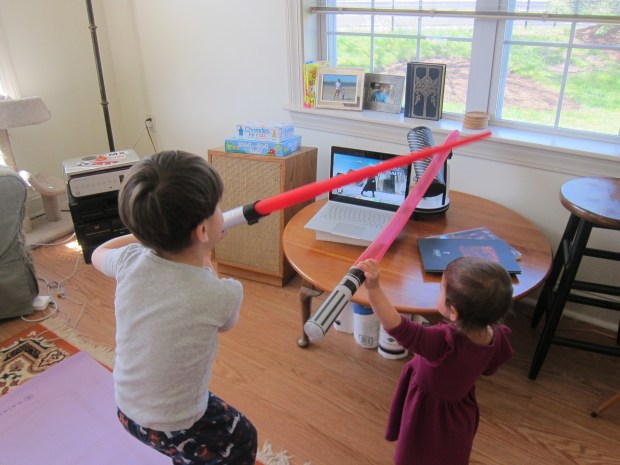
10.30-11: Social/emotional learning. We read an encyclopedia page about healthy bodies, which overlapped nicely with wellness questions sent home from the school counselor. The QR code took us to a link about yoga poses, so we followed up with yoga of our own… Jedi-style of course!

Home School 36 e

With Tuesday as his half day, we never got back into academics from here. The afternoon involved social time (Skype with a friend!), time outside (a leisurely neighborhood walk), and cooking!

His bedtime story was Leo the Late Bloomer.

Painting with Trucks

Painting with Trucks (12)

Veronika loves her little set of construction trucks, and she loves paint, so today I thought we’d combine the two. It turns out she was more into finger painting than truck painting, but at least we had good fun.

I started out by taping two pieces of construction paper in a shallow craft bin, and setting out her trucks. Add blobs of paint directly on the paper and show your toddler how to roll cars or trucks through.

Painting with Trucks (1)

Tire tracks!

Painting with Trucks (2)

I thought Veronika would be fascinated, but the paint blobs themselves were just too enticing. Soon we just had two very blue hands (“Hello fingers!” she said).

Painting with Trucks (5)

I did get her to drive the trucks back and forth a few times, but it was always quickly back to smearing her hands right through all those tire tracks.

Painting with Trucks (3)

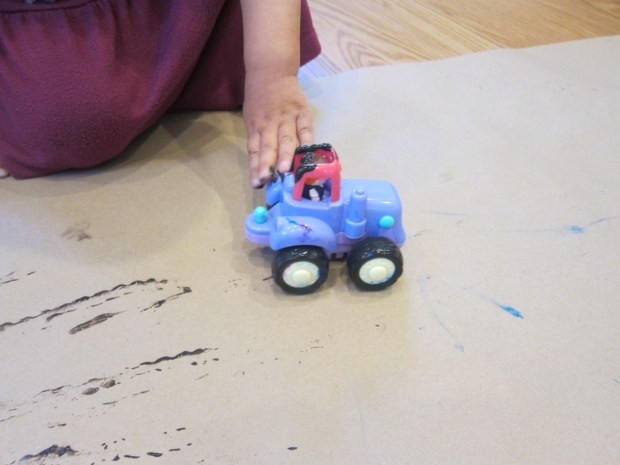
I thought she might get more into the tire tracks if she had a bigger surface to drive along. So we cleaned up the first version and set up a second. I taped a long piece of craft paper to the floor, and this time I only dabbed down a little black paint, just enough to drive through.

Painting with Trucks (8)

This time she did maneuver the cars for a few passes, and did seem to notice the tracks.

Painting with Trucks (10)

But even the little blobs of paint were irresistible for her fingers.

Painting with Trucks (9)

Soon we had smeary black hands!

Painting with Trucks (11)

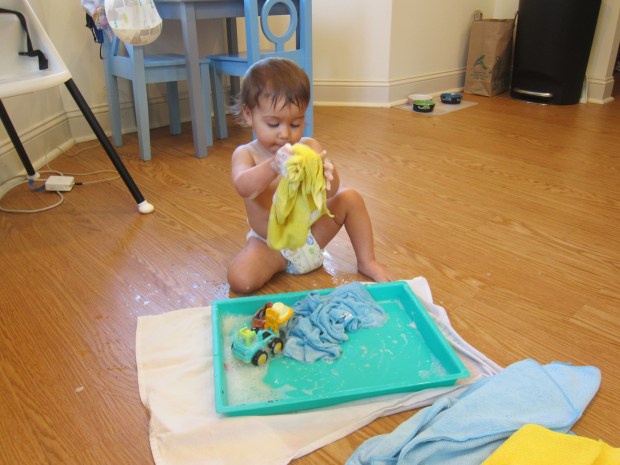
Well, she had a blast, and of course half the fun is the “car wash” at the end. We put the trucks in soapy water and I gave her a few rags. This was arguably even more enjoyable than the painting itself!

Painting with Trucks (14)

So start to finish, it made for a great project.

Painting with Trucks (15)

Porthole Scratch Art

Porthole Scratch Art (4)

This ocean-themed art project didn’t quite work as intended, but it still led to great artistic and creative play for Travis today!

The goal with scratch art is to have two layers of color, scratching off the top layer to reveal the shade underneath. To start, cut the center circle from two paper plates and set aside; these will be the rims of your submarine “portholes”.

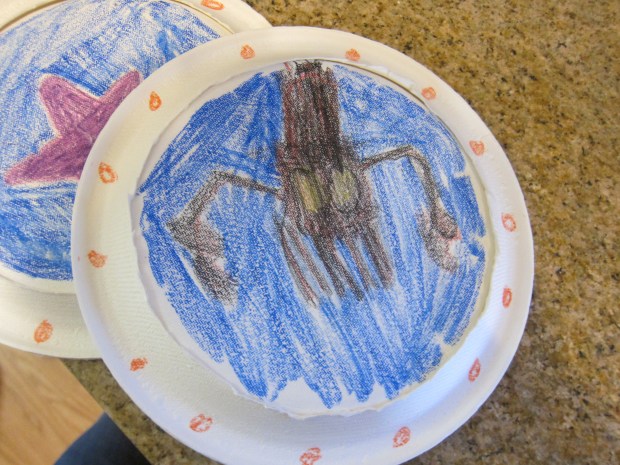
On a second set of paper plates, I asked Travis to draw his favorite sea creature. He chose a big red squid, and I was so proud of his drawing even though it wasn’t exactly easy to scratch off, as intended.

Porthole Scratch Art (1)

I made a nice fat starfish in the center of another plate as an easier option.

Porthole Scratch Art (2)

We then colored all around the sea creatures with white crayon. Layer a second color of crayon over everything, choosing a dark color to go over the sea animals and then blue crayon over your layer of white.

Using a penny, you now should be able to scratch off the top layer of crayon. If this works, you can make animal details like fins or scales, as well as water details like swirls and seaweed.

Unfortunately, our two colors of crayon just smudged together! Well, we were undeterred. Tape these plates underneath the first set of plates, and add details like bolts with more crayon.

Porthole Scratch Art (3)

Then we got inventive and played deep-sea diver on the couch! Travis loved pretending to be the squid outside my submarine.

Porthole Scratch Art (5)

We might try this again on a different brand of paper plates next time and see if we have more success.

Porthole Scratch Art (6)

Including a Toddler in Home School

Including Toddler (6)

Heading into the eighth week of home school, I have a much better idea now for how to entertain an 18 month old and teach kindergarten lessons at the same time. It felt like an apt time to share some of this newfound wisdom, breaking things down into six steps.

Step 1: Start with a “busy” activity. I’ve learned to find even mundane materials that keep little hands occupied, and this is usually enough to keep Veronika happy during the first lesson of the day. To wit: today she had construction paper to tear, put in a bin, and then attach to a sheet of sticky contact paper!

Including Toddler (5)

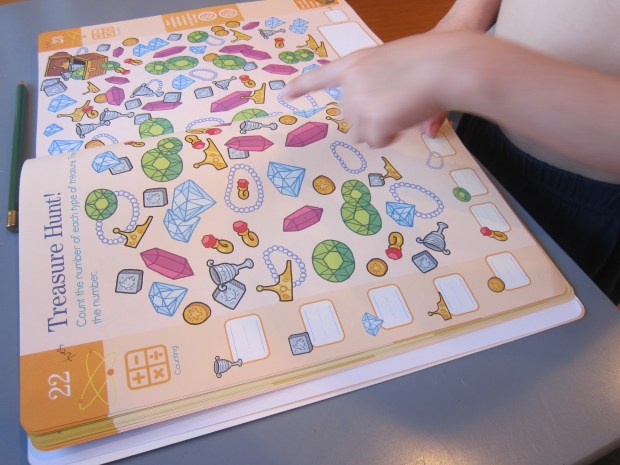
Step 2: Give them similar materials. This is usually the second tactic of the day to come into play, when Veronika tires of her busy activity. So, for example, today Travis had a math lesson involving gemstones. I gave Veronika an age-appropriate version: large wooden beads hidden in a set of nesting boxes that quickly became toddler gems and treasure!

Including Toddler (7)

Step 3: Give hugs. Inevitably about mid-morning, Veronika walks up to me and says, “Hug”. She’s tired just from watching all the home schooling!

Including Toddler (3)

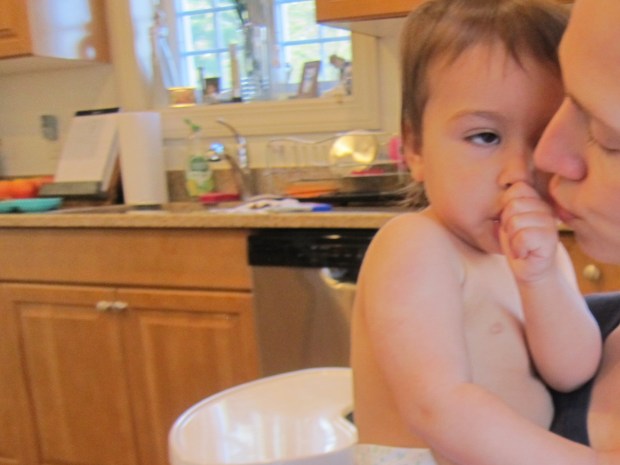
I sit her on my lap, and soon she’s feeling better. She might just suck her thumb and watch Travis work during this period, or flip through a toddler magazine quietly as we snuggle.

Including Toddler (4)

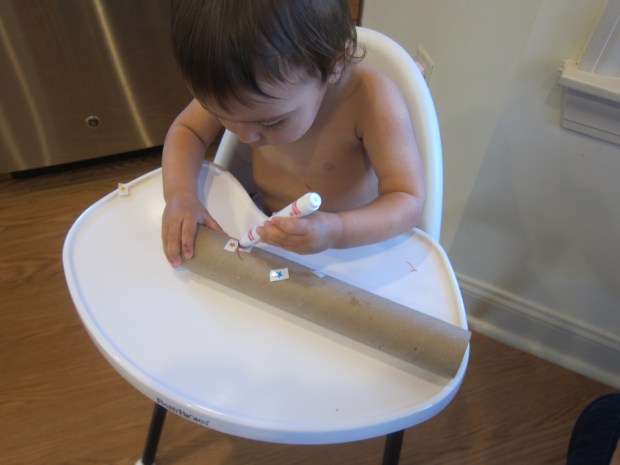
Step 4: Contain them in a high chair. If we’re involved with something messy, I strap Veronika into the high chair and make it her work station. Some go-to activities? An empty paper towel tube to scribble on with markers is perfect. Or stickers. Or both! Veronika can never have too many stickers.

Home School 35 c

But if she fusses about being contained we head to…

Step 5: Help them feel like a big kid. Give your toddler the same thing that the older sibling has, but once more in an age-appropriate way.  So if Travis is working with real scissors, she gets safety scissors. If Travis is using permanent marker, she gets crayons. You get the idea!

Including Toddler (10)

Step 6: Don’t forget the magic of food. I’ve learned to time Veronika’s snack around the lesson when Travis needs my focus the most each day. Set out favorites that your toddler can feed him- or herself. Favorite finger foods here are mini boxes of raisins, sliced olives, animal crackers, and juice boxes.

Including Toddler (9)

How are you keeping a baby or toddler occupied during coronavirus home schooling? Please share in the comments!

Including Toddler (8)

Kindergarten Home School Week 8: Monday

Home School 35 f

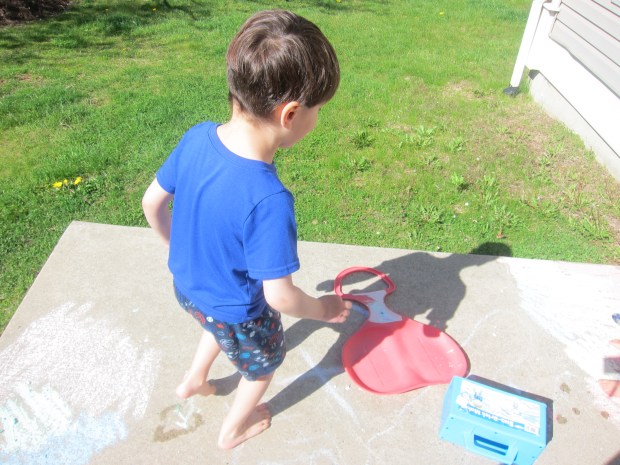
Before I dive into Monday, a quick note on the weekend! I had planned to do a shadow activity on the previous Friday but the weather was too cloudy. So it made for a nice Saturday morning activity instead. After tracing a maze in his summer workbook (helping a camel follow shadows to a shady oasis), Travis and I talked about shadows and then headed outside for a shadow chalk experiment. Full details are here.

Meanwhile, it’s Monday and we had a successful morning, once more going off-book from teacher suggestions.

9-9.30: Math: The corresponding page in his summer workbook involved counting jewels from a box of hidden treasure. This was great because all the numbers were in the teens, and he was due for a review.

Home School 35 a

There were so many ways to extend the play from there! We did a repeat craft of old “acorn jewels” (although to make it quicker I filled them with hot glue instead of waiting for white glue to dry) and then hid them all around the house. We also pulled out an old treasure box to play with.

Home School 35 b

9.30-10: STEM. Floating fish made for a quick lesson on density and buoyancy.

10-10.30: Snack/recess. We played a game of tag out in the yard, which counted both as play and exercise, since I knew he would nix any gym suggestions from the P.E. teacher.

Home School 35 d

10.30-11: 20 minutes on Lexia, once again working on story sequencing.

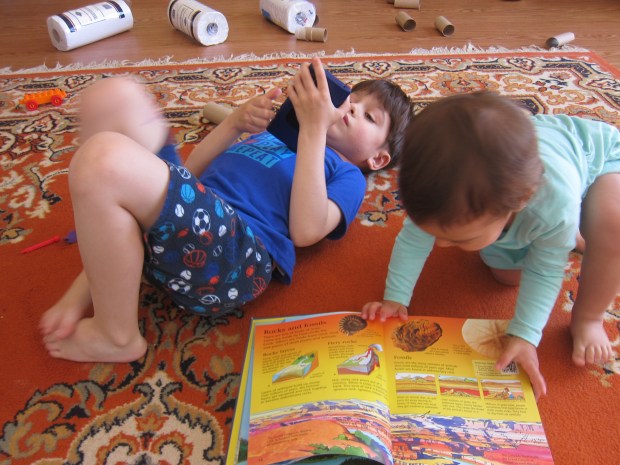
11-11.30: Science. Our encyclopedia page of the day focused on rocks.

Home School 35 e

After a quick watch of the QR code video, I pulled out an old set of rocks and a magnifying glass for further exploration. Just as I hoped, the props from the day were now coming together in imaginative free play. You’ll notice the rocks and minerals are being guarded as treasure, as the pirate ship comes to plunder!

Home School 35 9

11.30-1.30: Lunch/free play.

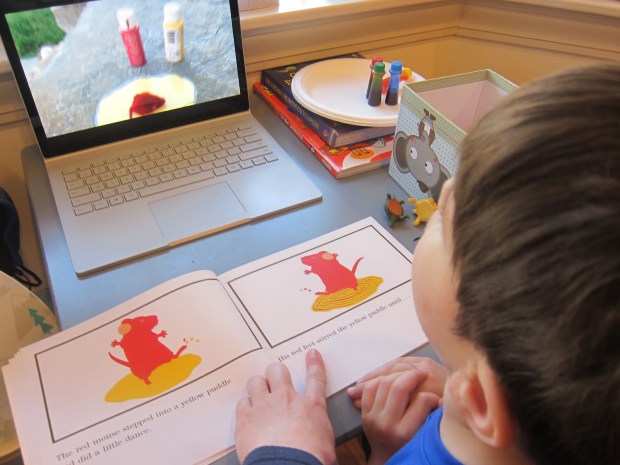
1.30-2: Spanish. His teacher had recorded a wonderful read of Mouse Paint using the Spanish words for colors. Travis flipped the pages of our home copy to follow along.

Home School 35 g

I didn’t want to deal with the mess of paints, so we mixed food coloring to see how this worked in real time, naming all the colors in Spanish as we went.

Home School 35 h

2-2.30: Outside. We walked in a local park and picked flowers for Teacher Appreciation Week!

Home School 35 i

2.30-3: Art. Back home, we fit in some last-minute art in a project that was actually intended for baby sister, since he wasn’t interested in his class’s standard “Over the weekend…” writing and drawing.

His bedtime story was Ira Sleeps Over.

Drawing on the Floor

Drawing on the Floor (5)

Usually both my kids love to color in pages that we print from the internet, but with our printer out of ink, I had two kids clamoring for an alternative! This art project saved the day, and can apply to either a toddler or an older child, depending how you tailor it. Either way, half the fun is the novelty of drawing on the floor!

First, I taped a long sheet of craft paper down to the floor. At intervals, I added some fabric prints we have of Van Gogh paintings, like Starry Night.

Drawing on the Floor (1)

For younger kids, these pictures can simply serve as visual stimulation; I had no expectation that Veronika would do anything other than scribble, but hopefully she was inspired by the beautiful artwork around her.

Drawing on the Floor (7)

Certainly she loves to talk about colors these days (“Yellow!” Purple!”) as she draws, and I could point out examples of them in the artwork.

Drawing on the Floor (6)

For older kids, encourage them to try and copy what they see in the famous paintings. Or, simply let the artwork act as a catalyst, and see where it takes them. Travis didn’t exactly copy Starry Night, but he did make big swirls of color in imitation.

Drawing on the Floor (9)

You could even use the project as a jumping-off point for deeper exploration into a certain artist or particular piece of art, as many museums are offering free tours these days. 

Drawing on the Floor (2)

Even if it just turns into messy scribbling on the floor, your kids will have had fun.

Drawing on the Floor (10)

Peach Raspberry Compote

Peach Raspberry Compote (2)

This easy compote is a nice alternative to maple syrup as a pancake topping: sweet, without any added sugar!

Ingredients:

  • 1 and 1/2 cups peaches
  • 1 and 1/2 cups raspberries
  • 1/4 cup apple juice
  1. Combine all of the ingredients in a saucepan. Simmer for about 10 minutes, until the fruit begins to soften and break down.

Serve with your favorite pancake recipe!

Peach Raspberry Compote (1)

Floating Fish

Floating Fish (4)

This little balloon project is a fun way to teach kids about buoyancy, and more specifically about how fish can swim in the water without either floating to the top or sinking to the bottom. As a bonus, it starts out as science and ends as a bath toy!

To set up, first insert a marble into each of three uninflated balloons. You’ll have to open the neck of the balloon wide to do this, which can be a bit tricky.

Floating Fish (1)

Using a funnel, fill one balloon with 1/3 cup vegetable oil. Fill the second ballon with 1/3 cup water. Blow up the final balloon with air until it’s roughly the same size as the balloons with liquid.

Floating Fish (2)

You can add fishy faces or fins with permanent marker, if desired! Next, fill a craft bin with water, and set your fish loose. Travis’s hypothesis was that the oil-filled “fish” would be the one to neither sink nor float, and he was so proud to be correct!

Floating Fish (3)

As you can probably guess, the water + marble sinks to the bottom. The oil + marble manages to be midway in the water, just like a fish swimming. The air + marble floats on top…not where a fish wants to be!

Floating Fish (5)

Once the science was done, we brought the fish upstairs at bath time, where they made for extra fun!

Little Passports: Australia

LP Australia (29)

Strangely, I feel as though Travis’s packages from Little Passports are arriving closer together than one month apart… but during home school, we’re not complaining! Travis couldn’t wait to read “Sam and Sofia’s” letter and do all the usual activities: a sticker for his passport, a pin on his map, a coin for his chart, and a tag on his suitcase.

LP Australia (2)

The booklet had a fun coloring activity about a coral reef, color-coded in such a way that my kindergartner could easily follow along.

LP Australia (3)

The word find, on the other hand, was tough even for this mama! Online featured great extras; Travis particularly enjoyed the photos and clips of Australian music. Australian phrases like “rug up” and “ankle biter” got quite a laugh.

Souvenir:

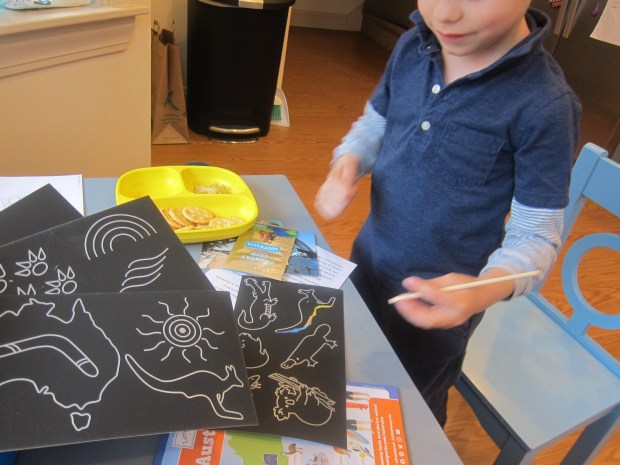
No sooner was the envelope open than Travis was testing out the scratch art kit. The idea is to introduce kids to Aboriginal dreamtime symbols, and Travis loved the rainbow colors that appeared.
LP Australia (1)

He learned a few symbols (“I get it, because a kangaroo jumps up!” he noted, spotting that one), and then designed his own, which had us veering off in a Star Wars direction.

LP Australia (10)

Further Activities:

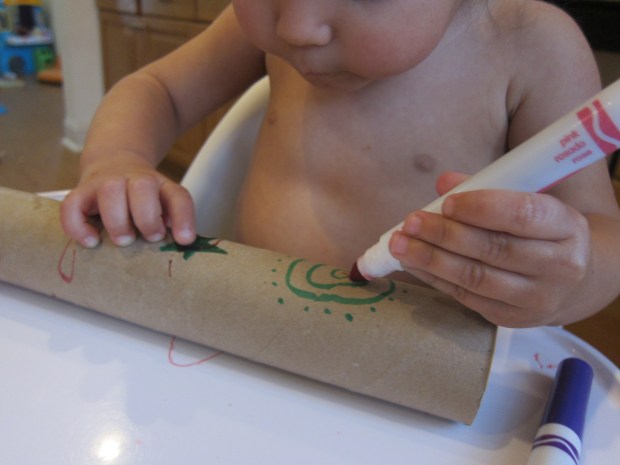
First up was a Didgeridoo Kazoo. Both kids enjoyed decorating an empty paper towel tube with markers.
LP Australia (21)

A lot of it was their own inventive scribbles, but we worked in some dreamtime symbols, too.

LP Australia (20)

As they colored, I read about how the didgeridoo dates back thousands of years. Place a square of wax paper over one end of the tube, and secure with a rubber band.

LP Australia (19)

Hum down into it for a deep, warbling sound. We put on some didgeridoo music to play along too!

LP Australia (18)

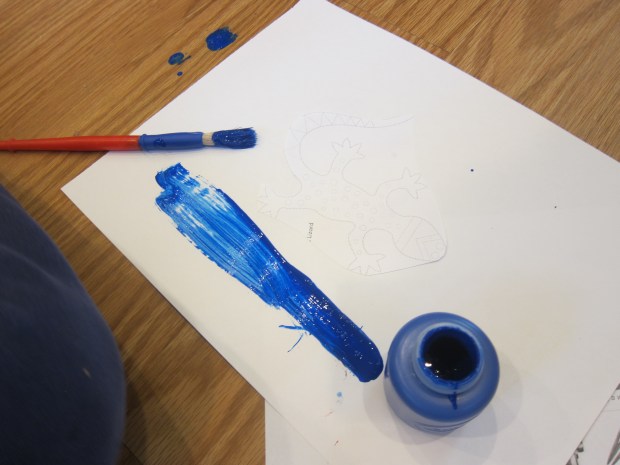
Next up was Animal Art. This project aimed to show the way indigenous Australian art shares stories about animals and nature. First, we cut out the provided animal templates and glued these onto thicker art paper. Travis chose the lizard.
LP Australia (12)

I encouraged him to use paints and markers to make a landscape for his animal. First he just painted water, and declared it done, but then he got more into the idea of adding traditional symbols (swirls, dots, stripes), and filling in the background.

LP Australia (22)

You can use cotton swabs for the dots for extra fun!

LP Australia (16)

Little sister wanted in on this project too, although her kangaroo was soon a bit of a mess!

LP Australia (14)

The add-on with this package was to grow a coral reef, similar in science to a crystal tree we made around the holidays. We read about coral reefs and what makes them so important as an ecosystem, and then Travis helped set up the provided absorbent paper in the stands.

LP Australia (4)

Mix the provided powder into warm water, then pour into the bottom of each tray. Whoops! One of corals collapsed right away, although perhaps this was a perfect illustration of how delicate these ecosystems are. Within an hour, we saw the first little crystals forming.

LP Australia (6)

By morning, they were a riotous display of crystal! We almost thought they looked like cauliflower.

LP Australia (8)

As the final touch, Travis colored in the Australian flag and we added it to the growing collection above his world map.

LP Australia (28)

Recipe:

To finish our journey, we baked a popular Australian dessert called Lamingtons, a cake coated in chocolate and coconut. I should note that Little Passport’s recipes aren’t as easy to follow as, say, those from Raddish Kids. As a result, a lot of them become mommy projects after a little help from my sous-chef.

LP Australia (23)

Ingredients:

For the cake:

  • 1 and 1/2 cups flour
  • 1 and 1/2 teaspoons baking powder
  • 1/4 teaspoon salt
  • 1/2 cup Earth Balance butter, softened
  • 3/4 cup sugar
  • 2 Ener-G eggs
  • 1 teaspoon vanilla extract
  • 1/2 cup plain almond milk

For the frosting:

  • 2 tablespoons melted Earth Balance butter
  • 1/2 cup plain almond milk
  • 4 cups powdered sugar
  • 1/3 cup cocoa powder
  • 2 cups shredded coconut
  1. To prepare the cake, sift together the flour, baking powder, and salt into a bowl; set aside.
  2. Beat 1/2 cup butter and the sugar in a stand mixer until creamy. Add the Ener-G eggs and vanilla. Alternate adding the flour mixture and 1/2 cup almond milk, beating until combined.
  3. Pour the batter into a 9×13-inch baking dish lined with foil. Bake at 350 degrees F for 28 minutes; a wooden pick inserted into the center should come out clean. Let cool for 10 minutes in the pan, then lift out the foil and cool the cake completely on a wire rack. Cover with plastic wrap and chill in the fridge.
  4. Once the cake is chilled, make the frosting: whisk together the melted butter and 1/2 cup almond milk in a large bowl. Whisk in the cocoa powder. Add the powdered sugar, stirring until smooth.
  5. Cut the cake into 2-inch squares. Working with one square at a time, dip in the chocolate frosting, then immediately coat in the coconut. Transfer to a wire rack or pan to set.

Because the frosting was thick and the cake was very delicate, I found it easier to work by hand instead of dipping pieces in on a fork. This got messy, but sure was yummy!

LP Australia (26)

Puffy Paint Clouds

Puffy Paint Clouds (8)

With so much attention going to big brother Travis during the school week, it was nice just to pause with Veronika for some messy art today! Shaving cream paint has so many uses, and today we focused on clouds. Veronika has been using lots of weather words like “rain” and “cloud” lately, and I figured I would seize the moment.
To make the paint, mix up about 3/4 cup foamy shaving cream and 1/4 cup white glue. I was entirely inexact about this, just eyeballing it, but you really can’t get it wrong.

Puffy Paint Clouds (1)

We used blue construction paper as the background for a pretty azure sky. Ideally we would have been dipped cotton balls in our “paint”, but I was all out! In a pinch, we wadded up tissue paper to make the clouds “fluffy”.

Puffy Paint Clouds (3)

If your child likes things neat, you can “paint” the shaving cream mixture onto the paper with a paintbrush and then add crumpled tissues on top. If your child likes to be messy, roll the tissue wads right in the gluey mixture, and then press onto the paper.

Puffy Paint Clouds (4)

We sort of did this both ways!

Puffy Paint Clouds (6)

Veronika was fascinated by the glue mixture, dipping her fingers into it often.

Puffy Paint Clouds (2)

I also sang about clouds as we played to make it a little weather lesson. So the project ends up being equal parts art, sensory play, and science for toddlers.

Puffy Paint Clouds (7)