Sensory Activity: Cool Whip

Cool Whip (6).JPG

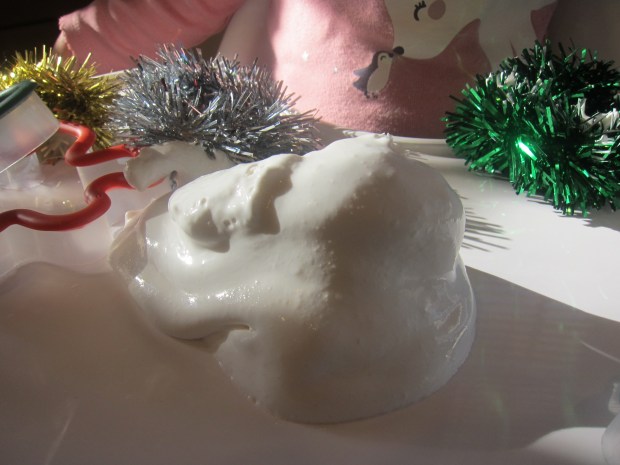
Older toddlers can safely play with shaving cream, a fantastic material for sensory play, but if you need something for a younger toddler who still wants to see how everything tastes, look no further than whipped cream as a substitute.

For this game, I used the vegan CocoWhip from Soy Delicious. You could also use soy or rice whip from a spray can, but I worried the sound would startle Veronika!

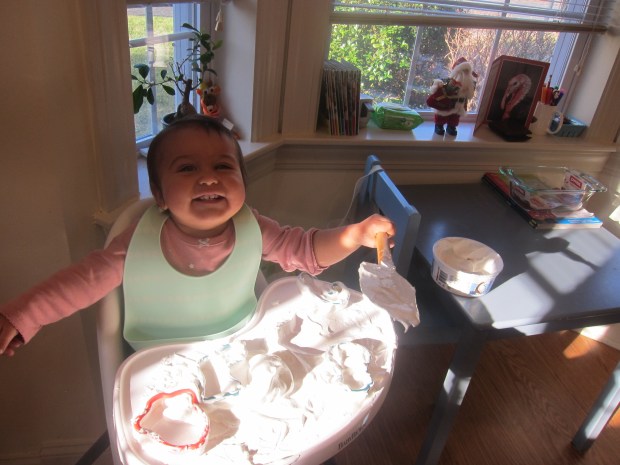
Instead, I sat her down in her high chair and dolloped a big blob of the CocoWhip in front of her.

Cool Whip (1)

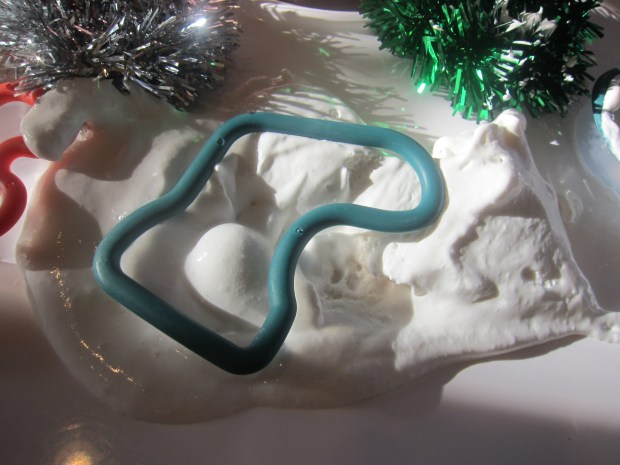
With December just around the corner, it was time to get in a snowy holiday spirit! So I added a few holiday items, like sparkly hair ties and Christmas cookie cutters.

Cool Whip (3)

She absolutely loved scooping the whipped cream into the cookie cutter shapes, almost like she was frosting them.

Cool Whip (5)

We also pretended her spatula was a snow plow, with fun sound effects, and I showed her how to spread the whipped cream thinly and thickly. Then we made whipped cream” cookies”!

Cool Whip (2)

The sparkly hair ties were fun to dip and dangle in it!

Cool Whip (8)

She had so much fun that when I asked if she was all done, she signed “more more”. A first!

Cool Whip (7)

I’d say this was one successful sensory experience. She had so much fun that we might try it again for other holiday themes, like Easter in the spring or with Halloween items in the fall.

Cool Whip (9)

Mashed Potato Sculpture

Mashed Po Sculpture (2)

This is a great sensory activity… and a way to get your kid to try mashed potatoes!

Start with instant mashed potatoes as the base. Yes, you can bake and mash your own, but the instant stuff has a sticky quality that makes it better suited to this “art” project. I whipped up a batch using almond milk, Earth Balance butter, and the potato flakes, and then let it cool completely.

Mashed Po Sculpture (1)

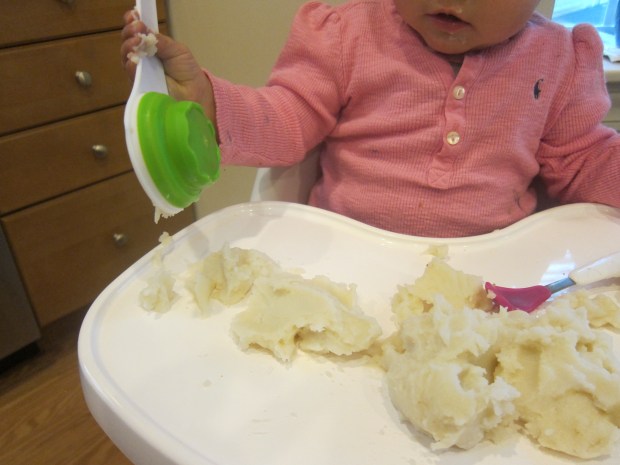
When Veronika was finished with lunch, I spooned a huge heap of this onto her tray. She looked instantly delighted!

Mashed Po Sculpture (3)

Set out a few props to encourage the artistic process. Veronika received a measuring cup and spoon, and soon was scooping, digging, and poking holes in it.

Mashed Po Sculpture (8)

I showed her how to make a few “sculptural” elements, including round balls and little snakes.

Mashed Po Sculpture (4)

I tried for a little mashed potato snowman, but Veronika didn’t let him last long!

Mashed Po Sculpture (7)

And of course she discovered that little bites of the stuff was delicious. Eager fingers kept digging in for more, both to eat and to play!

Mashed Po Sculpture (5)


Fruit Ripening Science is Bananas

Fruit Ripe (5).JPG

Just before Halloween, Travis made Boo-Nana Bread form Raddish KidsSpooky Kitchen crate. Now we’re finally getting around to the fruit-ripening science lesson attached to it!

Before anything else, we needed to set in motion an experiment that would take 5 days. I purchased a bunch of (fairly) green bananas at the grocery store, as well as a few riper ones.

Ask your child to describe the differences they notice between the ripe and unripe bananas. Travis pointed out the obvious color difference, first. A little probing helped him go deeper: the ripe ones were softer, and smelled sweeter.

Fruit Ripe (1)

I asked him if a banana needed anything other than itself to ripen. Somehow he knew it needed air (oxygen). Smarty pants!

Fruit Ripe (3)

But for scientific backup to this hypothesis, we experimented by placing the following:

  • 1 green banana out on the counter
  • 2 green bananas in a paper bag, folded up tight
  • 1 green banana and 1 ripe banana (for ethylene) in a paper bag, folded up tight
  • 2 green bananas in a sealed plastic bag
  • 1 green banana wrapped in layers of plastic wrap

That last was Travis’s favorite, pretending we were making a banana mummy!

Fruit Ripe (4)

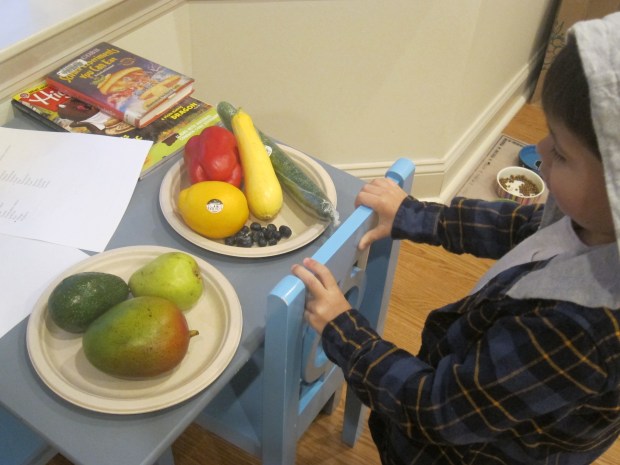
Meanwhile, it was time for a little science behind the lesson. I set out two plates for him, one featuring non-climacteric fruits i.e. they do not ripen after picking. Raddish provided a long list to choose from, and our plate included: a bell pepper, blueberries, cucumber, orange, and yellow squash.

The second plate had climacteric fruits i.e. ones that do ripen after picking. This plate held an avocado, a pear, and a mango.
Fruit Ripe (6)

“Can I eat it,” he asked right away of the mango. “Is it ripe?” At first he was stumped about how I had categorized them, guessing I had sorted them by color. But hmm, why wasn’t the cucumber on the green plate?

Fruit Ripe (7)

I loved watching him really ponder this! I guided him back to his very first comment about the mango. Was it ripe? Now he understood that one plate held fruits we needed to wait for; the other plate was fruits that wouldn’t ripen further after picking.

Fruit Ripe (10)

Time to explore! I let him have at the food just for fun. He loved peeling the squash and taking little nibbles of it, plus practicing his knife skills on the bell pepper…

Fruit Ripe (9)

…and crunching into the cucumber for a big bite.

Fruit Ripe (11)

He decided to wait until the mango was riper before peeling it. Good choice! Plus he gave the unripe avocado a big squeeze and it was solid as a rock.

Fruit Ripe (8)

Five days later, we finished with a little more science now that we had our banana results. Our finding weren’t quite as promising as hoped, likely because I had to start with green bananas on the verge of yellow and a yellow banana on the verge of green, based on what the grocery store had to sell. But we still could see that the countertop banana was the brownest/ripest and the plastic bag bananas had retained the most green.

Fruit Ripe alt

Interestingly, our plastic-wrapped banana had gotten quite ripe, so we must not have made the “mummy” tight enough.

The green bananas in the paper bag had ripened faster than the ones in plastic, since the porous paper gives them access to oxygen. But the one that also enjoyed the company of a ripe banana had both oxygen and extra ethylene, so that was riper still.

Fruit Ripe (12)

Enough science; as it turns out, leftover bananas are lots of fun to play with, even for little sister!

Fruit Ripe (13)

We enjoyed one final video of a similar experiment done with supermarket food. If your kids loved the banana experiment, try out an avocado one!

Travis and I also decided to check out the suggested book Science Experiments You Can Eat, by Vicki Cobb. We read through a couple of the experiments, but didn’t actually put any to the test.

Decorating Pancakes

Decorating Pancakes (11)

Anyone who follows this blog knows I love to cook with my kids, and I firmly believe in getting kids into the kitchen from the earliest age. It’s truly never too early; today Veronika helped me decorate pancakes, and she’s not quite 13 months old!

Okay, technically this was more of a sensory play activity than a real recipe, but we sure had fun. First, I whipped up a batch of pancakes. You can make some from scratch with your favorite recipe, but I took a shortcake with Cherrybrook Kitchen’s vegan and gluten-free mix. Veronika loved playing with extra measuring cups while I mixed the batter.

Decorating Pancakes (1)

For extra learning, I cooked the pancakes in heart- and star-shaped molds so I could talk about shapes with Veronika. Regular circles are just fine too, though!

Decorating Pancakes (2)

I set the pancakes down on the floor on paper plates along with a few pouches of baby food. Look for bright colors like pinks and reds for this activity.

Decorating Pancakes (4)

Veronika only needed me to demonstrate once before she was eagerly “decorating” her pancakes. She proudly pressed the spout of the pouch down on the pancakes, and I think even tried to say “squeeeeze” back to me.

Decorating Pancakes (6)

Of course there was the necessary tasting, too. Veronika: meet pancake.

Decorating Pancakes (5)

And the pouch itself got a sip or two.

Decorating Pancakes (10)

I had fun decorating right alongside her, creating a make-believe bakery game.

Decorating Pancakes (7)

When you’re done, you have breakfast or snack built right in to your day. Or if the pancakes get very mushy from all that baby food on top, just consider this a sensory play activity and it’s still a win-win.

Decorating Pancakes (8)

Even the wax paper we had on the floor for easy clean-up was fun!

Decorating Pancakes (12)

You’ll notice that I had Veronika do the activity without a shirt, which seemed the safest way to avoid stains. Plus, I love that little buddha belly these days!

Decorating Pancakes (9)

Jiggly Rainbow Cups

Jiggly Rainbow (8).JPG

Here’s a cute way to “taste the rainbow”, as the old slogan goes! You’ll need jel dessert in all colors of the rainbow. Jell-o of course comes available in everything from red to purple but is not vegan. Instead, I prepared a big batch of Lieber’s clear unflavored jel dessert. We divided it among 5 cups, and used food coloring to make:

  • red
  • yellow
  • green
  • blue
  • purple

This was a great refresher on color mixing, since I only had food coloring in primary colors!

Jiggly Rainbow (2)

I also had Simply Delish’s orange flavored jel dessert, so we used that for the orange layer.

Jiggly Rainbow (1)

Now you’ll need to layer your dessert. We spooned a layer of purple into a cup and placed in the freezer for about 15 minutes to speed up the setting process.

Jiggly Rainbow (3)

Continue adding layers and freezing briefly until you have a full rainbow.

Jiggly Rainbow (4)

Unfortunately our three dark layers (purple, blue, green) and three light layers (yellow, orange, red) sort of blended in with one another. Shining a flashlight helped reveal the distinction!

Jiggly Rainbow (6)

Meanwhile Travis thought this was just the best dessert ever. Of course there was the obligatory poking and squishing that must happen with jel desserts.

Jiggly Rainbow (7)

Then it was time to spoon through the layers, and he kept me updated on his progress: “Mom, I’m up to the yellow!”

Jiggly Rainbow (9)

A super fun way to play with rainbows.

Peanut Butter Play Dough

Peanut Butter Play Dough (8).JPG

I guarantee this is the yummiest play dough your kids will ever play with, and it’s unbelievably easy to make!

In a bowl, combine 6 large marshmallows (we use Dandies) and 4 tablespoons peanut butter. Microwave for about 15 to 20 seconds, until the marshmallows sotfen. Stir together.

Peanut Butter Play Dough (1)

Add about 2 to 3 tablespoons powdered sugar, stirring with a spoon to combine and then working the dough with your hands until it is no longer sticky. Although there were still some chunks of marshmallow visible, our dough worked great.

Peanut Butter Play Dough (2)

I had intended this as a sensory project for Veronika, but big brother Travis loved it, too! First Veronika just enjoyed picking up the dough…

Peanut Butter Play Dough (3)

…and was delighted when she noticed it tasted sweet!

Peanut Butter Play Dough (5)

Her favorite thing to do was poke at it with craft sticks, or tap it with her fingers.

Peanut Butter Play Dough (4)

Meanwhile, Travis had fun forming the dough. We rolled it into snakes and patted it into flat pancakes.

Peanut Butter Play Dough (7)

Then we used leftover Halloween cookie cutters. It made fantastic shapes!

Peanut Butter Play Dough (6)

Note: Make sure to cover the play dough if you want to play with it over multiple sessions, as it will dry out and become crumbly.

Peanut Butter Play Dough (9)

Sensory Activity: Dry Pasta Noodles

Sensory Dry Pasta (1)

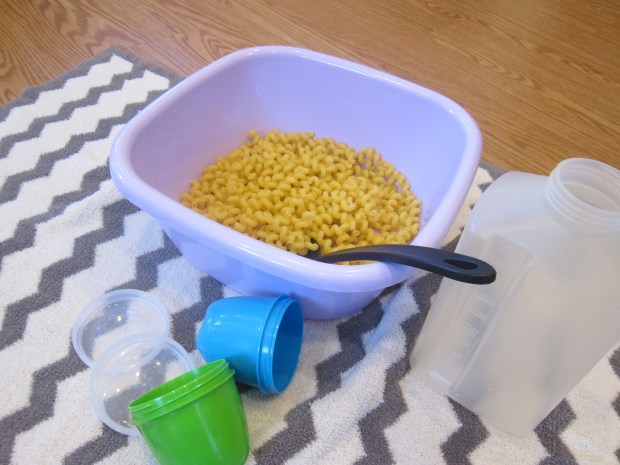
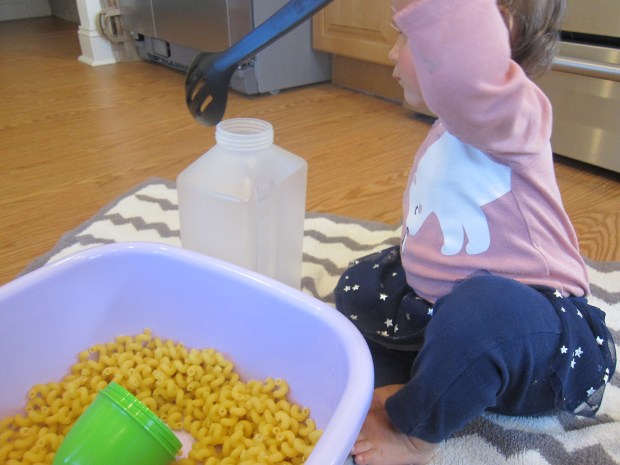
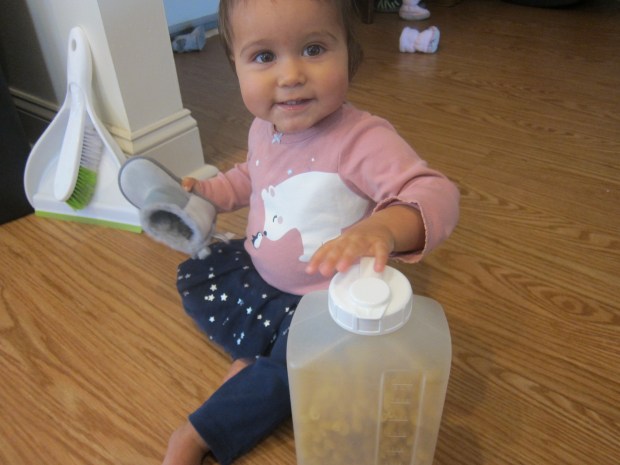
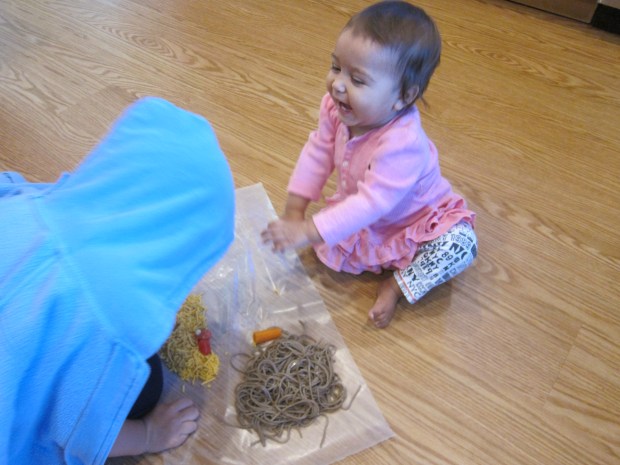
The last time I gave Veronika pasta as a sensory item, it was cooked and she was tiny (she looks so little even though this was only 5 months ago!) Now for my bigger girl, the item of the day was dry pasta! I’ve seen sensory bins like this done with dried macaroni, but I chose larger cavatappi noodles just in case she tried to eat one. Little did I know how much fun would be had with this simple activity!

I set out a bin with the pasta, along with a few containers that it could be scooped into, a big plastic spoon, and a larger jug.

Sensory Dry Pasta (1)

Veronika instantly knew she wanted to transfer the pasta to the jug but couldn’t quite figure out the mechanics.

Sensory Dry Pasta (2)

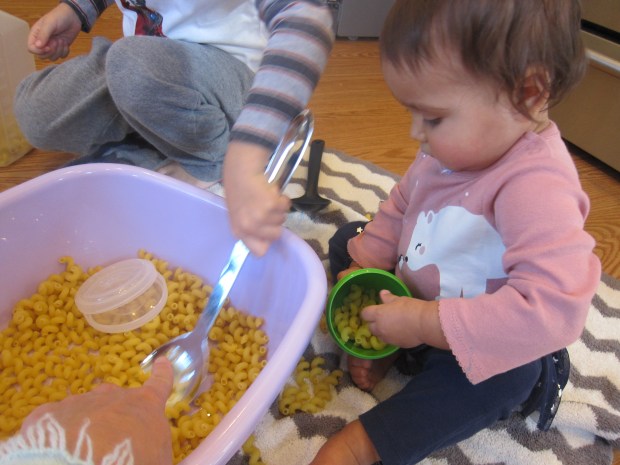
I helped her along with the ladle. What fun when it landed in the jug with a plink!

Sensory Dry Pasta (3)

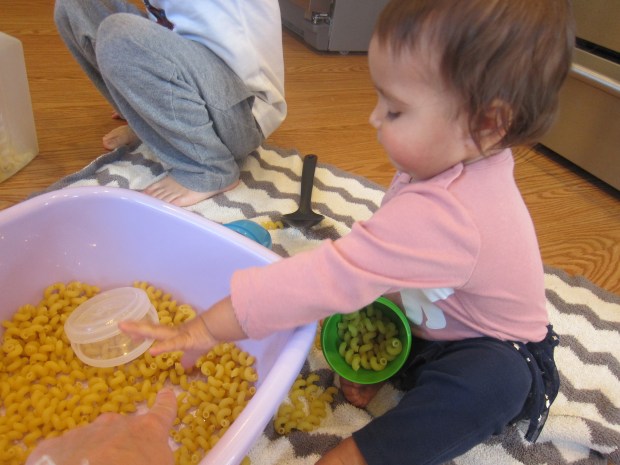
The smaller containers I had set out were great for scooping up pasta. With the lids on, these were just like maracas.

Sensory Dry Pasta (5)

Veronika also loved transferring pasta piece by piece from the small container back to the big bin. Over and over!

Sensory Dry Pasta (6)

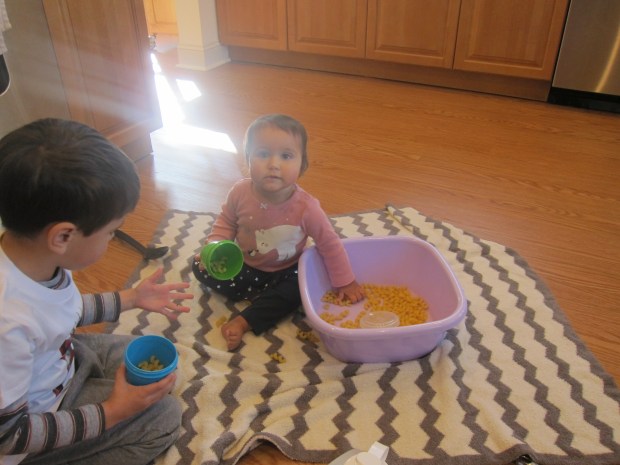
What I hadn’t anticipated was how much even my 5 year old would love this sensory tray!

Sensory Dry Pasta (7)

He loved filling the jug, shaking it, and playing some imaginary game involving the pasta pieces. Soon they were happily sharing, and I loved seeing them play together.

Sensory Dry Pasta (8)

Once the jug was all filled up, Veronika looked so pleased!

Sensory Dry Pasta (9)

Tic-Tac-Yum

Tic Tac Yum (3)

Here’s a novel way to play tic-tac-toe… and to have a healthy snack. Winner takes first bite!

To set up the game, wind yarn around a flat mirror until you’ve divided it into 9 squares like a tic-tac-toe board. Secure on the back with tape.

For the Os, cut celery hearts into slices in the shape of a C. For Xs, cut chunks of non-dairy cheese and then make a slit so each piece looks like a V.

Tic Tac Yum (2)

Once arranged on the mirror, Travis was delighted to find the C was now an O and the V was now an X!

Tic Tac Yum (1)

I challenged him to a match…

Tic Tac Yum (4)

…but it wasn’t long before the Vs began disappearing as a snack. Tic-tac-yum indeed!

Tic Tac Yum (5)


Food Faces

Foodie Faces (1)

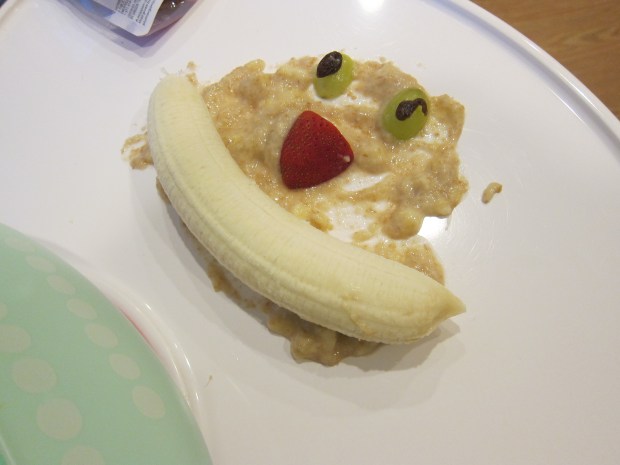
If you find that your 10-month-old is still playing with food more than eating it, you’re not alone; pediatricians point out that until age 1, any solids count as practice, with the main source of calories still coming from breast milk or formula. So practice away!

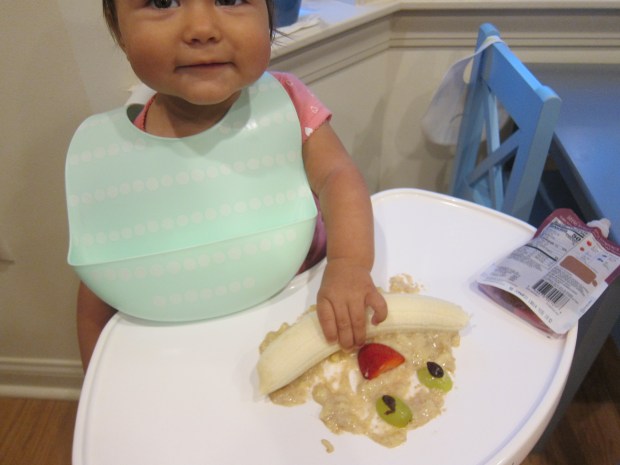
Now is the time for food to be fun, and today, I gave Veronika two “faces”, one at breakfast and one for a snack.

The breakfast face had a banana smile, strawberry nose, grape eyes, and raisin pupils (soak the raisins in water first, so they are less of a choking hazard). I pointed out each feature to her before she began smearing and picking up portions.

Foodie Faces (2)

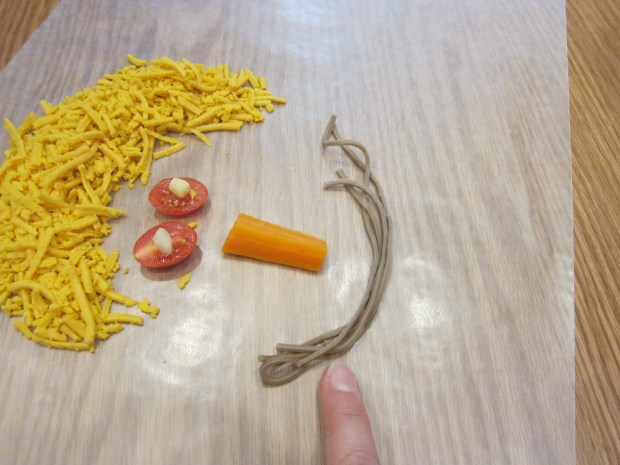
At snacktime, I laid out another silly face: cooked noodles for the mouth, cooked carrot for the nose, cherry tomatoes as eyes, corn as pupils, and shredded Daiya cheese as the hair.

Foodie Faces (3)

Again I pointed and named each feature, but soon her brother wanted to eat the cheese, which Veronika thought was hilarious. I added a pile of extra noodles and it turned into sensory play. Now that’s foodie fun!

Foodie Faces (4)

Shall I Pour?

Shall I Pour (7)

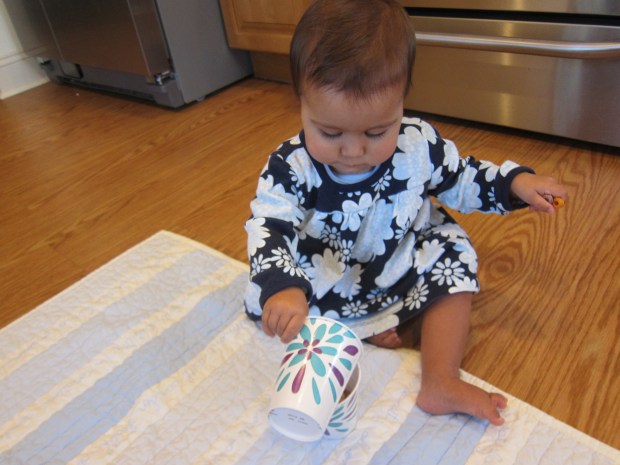
Pouring dry items from cup to cup is a fantastic way to build the fine motor skills that will one day allow your little one to pour liquids. Don’t expect your baby to be pouring his or her own water and juice after this game, but it is great practice and cute fun!

I put a soft blanket down on the kitchen floor, then filled two cups with O cereal and left two cups empty (one set for me, one for Veronika).

Shall I Pour (1)

Once I had her attention, I showed her how to pour the cereal from a full cup to an empty one.

Shall I Pour (2)

“Watch me pour!” I instructed.

Shall I Pour (4)

Well at first she was simply delighted to discover that the game involved a snack. Yum!

Shall I Pour (3)

She also seemed to love the visual of the cereal trickling from one cup to another.

Shall I Pour (8)

After showing her a few times, her hand reached out to mimic me, which I had anticipated; ten-month-olds are fantastic mimics!

Shall I Pour (9)

She tried her own hand at pouring…

Shall I Pour (5)

…and then just wanted to play with Os and cups. As I said, don’t expect your baby to be a pro after the game (your play space will probably look like mine, below), but your little one will have a blast!

Shall I Pour (10)