It’s a Goal!

Its a Goal (5)

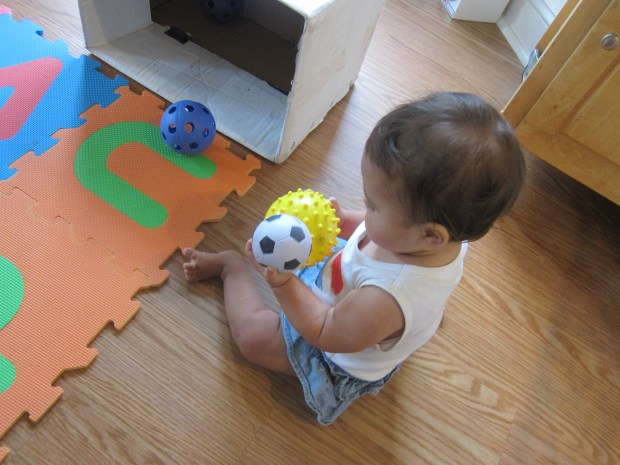
For some fun sport today, Veronika and I played her first round of soccer!

Lie a box on its side and present your baby with a selection of balls. Veronika was excited when she saw a growing pile of mini soccer balls, baby sensory balls, and other favorite toys.

Its a Goal (1)

rolled one toward the box, and as it rolled in I said a very excited, “It’s a goal!” Channel your inner futbol announcer for this!

Its a Goal (2)

She picked up on the excitement immediately. Her expression demanded a repeat.

Its a Goal (6)

Then I encouraged her to make the goal.

Its a Goal (4)

Even if her ball was close but not quite in, I repeated the excited, “It’s a goal!”

Its a Goal (7)

She looked so proud of herself.

Its a Goal (8)

This led to lots of further ball play in her own way, tapping them together, holding several at once, or following them around the room.

Its a Goal (9)

A great morning of sport, in sum.

Its a Goal (3)

Telephone Talk

Telephone Talk (5)

If one telephone is fun, then two telephones are twice as fun!

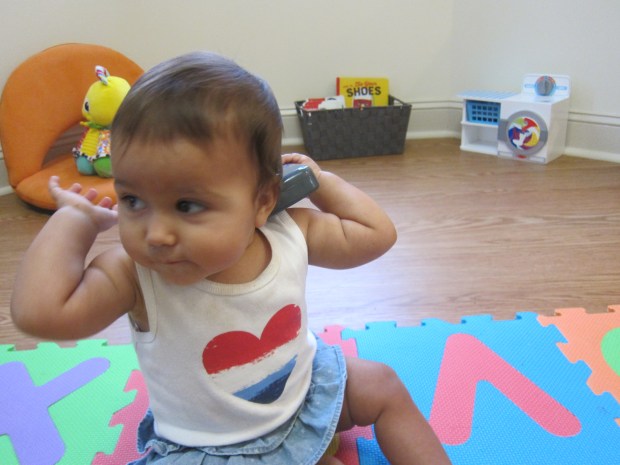
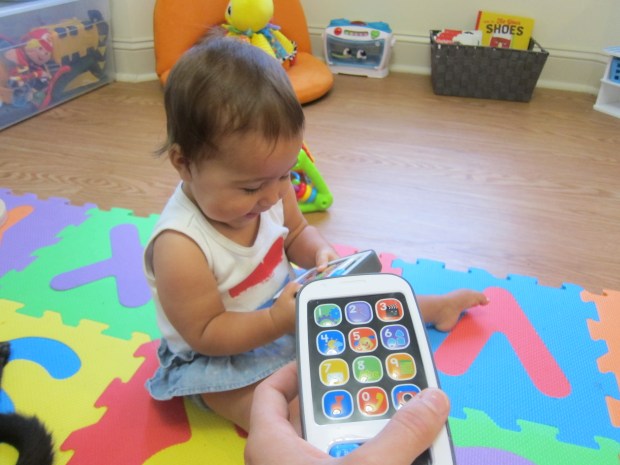
Smartphones are like catnip for babies, Veronika included, which is why I deliberately avoid my phone except for necessary calls. A far safer alternative is to buy baby a toy cell phone. We happen to have two versions of the same phone, which makes for perfect games of “phone call”.

Today I sat down with her and pretended to dial.

Telephone Talk (3)

I handed her the other phone and began a conversation. “What should we do today?”

Telephone Talk (2)

Wait for your baby to babble back, which will help encourage the idea of a two-way conversation. Oh my goodness, she looks too much like a teenager already!

Telephone Talk (4)

Then it was her turn to dial me!

Telephone Talk (6)

This kind of make-believe play might seem advanced for a 10 month old, but it’s exactly through such modeling that Veronika is learning about the world. Nice chatting with you!


Beat to the Rhythm

Beat to Rhythm (4)

No doubt you’ve pulled out pots and pans and Tupperware for your baby already, and discovered that it’s a fantastic way to keep little ones occupied in the kitchen. And while a free-for-all jam session is fun, don’t discount introducing real rhythms at this young an age; kids pick up on it much earlier than you think.

So today, I sat down with Veronika and first we simply banged on our saucepan “drum.” But then I showed her one beat with my hand.

Beat to Rhythm (2)

She banged her hand a few times, but I repeated until she, too, was doing one solitary beat.

Beat to Rhythm (3)

It may have been coincidence, but this worked when I moved up to two beats as well. If I tried for three, it became a free for all of tapping and banging.

Beat to Rhythm (6)

We also tried the game with a spoon, first one beat, then working up to two and three.

Beat to Rhythm (1)

Again, don’t expect your baby to be a maestro, but you’re introducing the idea of beats and rhythms, and your little one gets to have a blast! Big brother wanted to be a demonstrator, too, and loved making one beat with his hand and watching her copy.

Beat to Rhythm (5)

Needless to say, the spoon and pot entertained her so thoroughly that I was able to clean the kitchen undisturbed!

Fee Fi Fo Fum

Uh Oh GIant (4).JPG

Grown-ups are likely all familiar with the common syllables “fee fi fo fum” from the giant in Jack in the Beanstalk. But there’s no need to include the scary giant as you introduce this word play to your baby! The syllables echo a baby’s babble at about 10 months old, so today, I recited this classic for Veronika… with a twist.

Uh Oh GIant (1)

Sitting in front of her, I said:

Fee fi fo fum,

Here’s my fingers, here’s my thumb (open your fingers and then your thumb).

Fee fi fo fum,

Fingers gone, so is thumb (tuck fingers and then thumb away).

Uh Oh GIant (2)

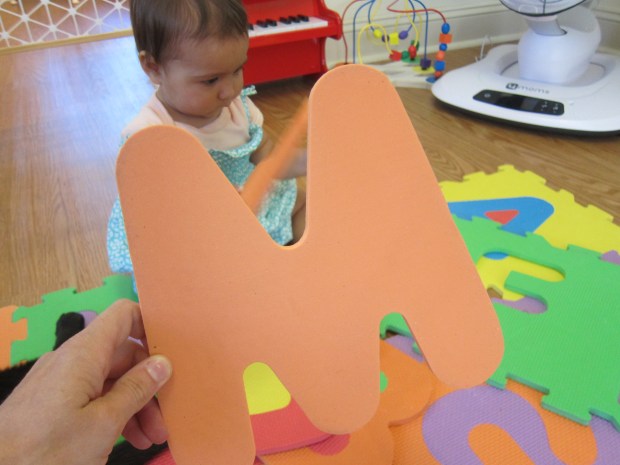
To add a little learning in, I then repeated the rhyme with a different first consonant. For each letter, I handed her the accompanying foam letter to play with – a little extra learning to absorb! So she played with a big foam B for “bee bi bo bum” and giggled over T for “tee ti to tum”,

Uh Oh GIant (4)

We also did the rhyme on “dee di do dum” and then finally on “mee mi mo mum.”

Uh Oh GIant (5)

A big hit, for little effort!

Uh Oh GIant (6)


Floating Toothpick Trick

Floating Toothpick (4)

After learning about how water molecules help each other up the roots of a tree (just imagine cute water droplets holding hands!) Travis and I tried this fun way to break those same water molecules apart. All you need is a bowl and toothpicks! My kindergartner found it slightly naughty to break the bonds, meaning he thought this experiment was hilarious!

Floating Toothpick (1)

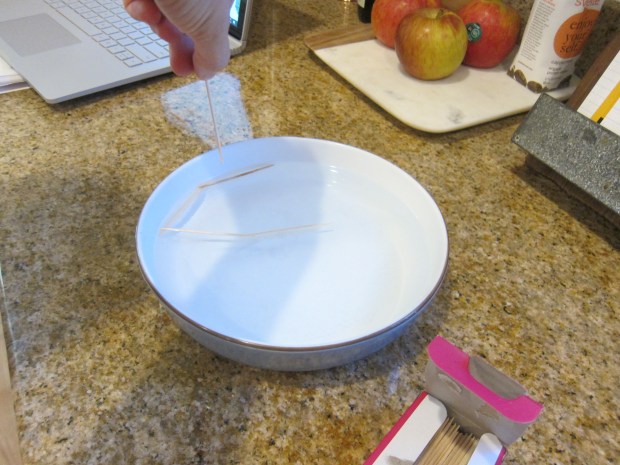
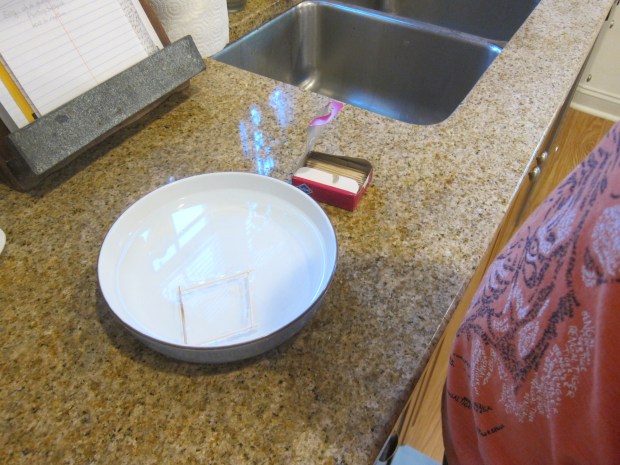
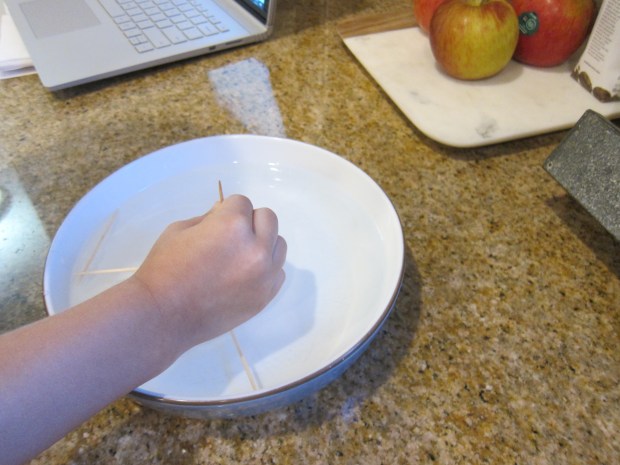
First, fill a shallow bowl with water. Wait for the water to be still, then very carefully arrange four toothpicks in a square. It helps to overlap them slightly, but not so much that they will stick together.

Floating Toothpick (2)

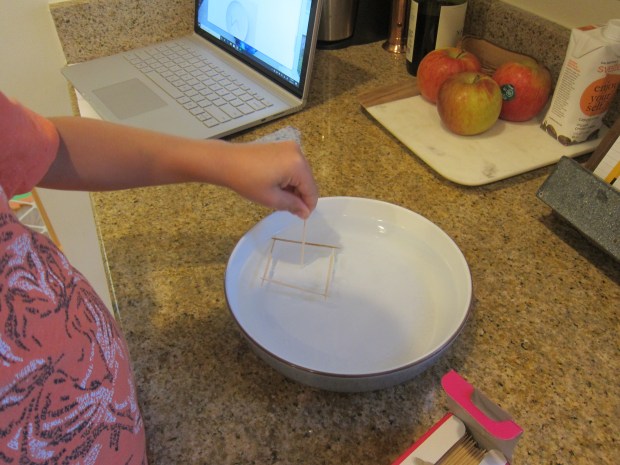
Dip a toothpick into the center of the square. Nothing happens! There is nothing to break up the water bonds.

Floating Toothpick (3)

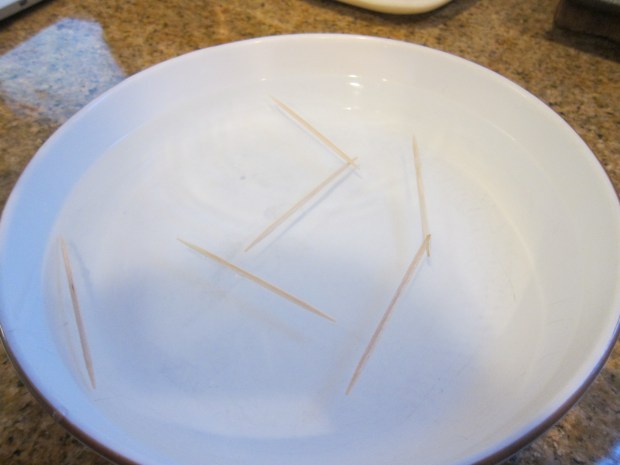
Now dip a second toothpick into dish soap. Dip into the center of the square and… the toothpicks run away from each other!

Floating Toothpick (7)

As stated above, Travis thought this was pretty hilarious, and he wanted to repeat with our toothpicks in different configurations. We tried a zig zag, although the results weren’t as pronounced.

Floating Toothpick (5)

So then we needed to repeat the square a few times (if you repeat, start with fresh water; once the water is soapy, the effect isn’t as pronounced).

Floating Toothpick (6)In sum, a very kid-friendly way to illustrate some big (or should I say, microscopic) scientific concepts!

Make a Night Sky Mobile

Night Mobile (7)

Talking about the moon and stars with Veronika prompted me to follow up with this cute mobile craft. There are two ways to make it, mine decidedly more of a hack, but it worked in a pinch!

For the easy version, I wanted to purchase a mobile frame with predrilled holes from the craft store. You’ll notice that the closest thing I could find was actually twisted in the shape of a soft pretzel, but Veronika didn’t know the difference!

With that on hand, I made a few simple night sky decorations to dangle from it. I traced a moon, star, and cloud onto cardboard.

Night Mobile (1)

Cut out the shapes and gave them a few coats of gold and silver paint. Let dry completely.

Night Mobile (2)

Once dry, hole punch the cardboard and thread from your frame with yarn or twine.

Night Mobile (3)

If you’re far craftier than me, you can instead trace your shapes onto tracing paper as templates, pin to colored felt, and cut two for each shape. Sew the felt together with a blanket stitch, leaving a hole to stuff in roving. Sew up and then attach to the mobile frame with thread.

But like I said, my baby girl didn’t mind my quick version; if anything she was entranced!

Night Mobile (5)

She loved grabbing onto the dangling pieces in the playroom.

Night Mobile (4)

For a true mobile, you’ll need to suspend it where your baby can’t reach it, not prop it up like I did.

Night Mobile (8)

Since we were just playing, I let Veronika grab at the tips of the moon and star.

Night Mobile (11)

Her expression was full of wonder at these glowing night objects.

Night Mobile (9)


Capillary Snack-tion Straw

Snack Straw (5).JPG

This straw has some serious action! After learning about how trees and plants drink their nutrients up from the soil in his latest Kiwi Crate, Travis discovered he too can sip in defiance of gravity: by slurping through a straw.

Cut a watermelon into thick slices. Use a flower-shaped cookie cutter to make a flower shape from the watermelon. Insert the “flower” onto a thick straw “stem”.

Snack Straw (1)

Give a quick blow into the straw to expel the watermelon piece inside. This earned a “whoa!” from Travis.

Snack Straw (2)

We filled a glass with lemonade – any drink will do, but lemonade is a favorite around here – and then tested it out.

Snack Straw (4)

Travis provided the power for his flower’s “roots”. What a delicious way to soak up nutrients! When the drink is finished, you can eat your “flower” of course.

Snack Straw (3)

Exploring the Night Sky

Explore Night (1)

It can feel funny sometimes to teach a baby about celestial objects – the stars, the moon, planets – because they are rarely awake to see nighttime! Especially here in the summer, Veronika is asleep long before stars come out or the moon shines.

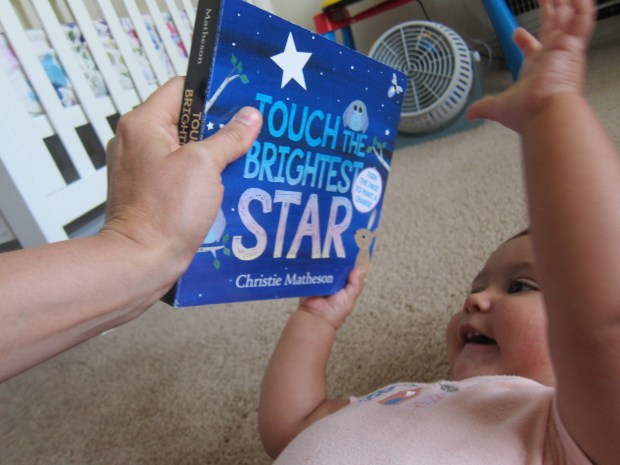
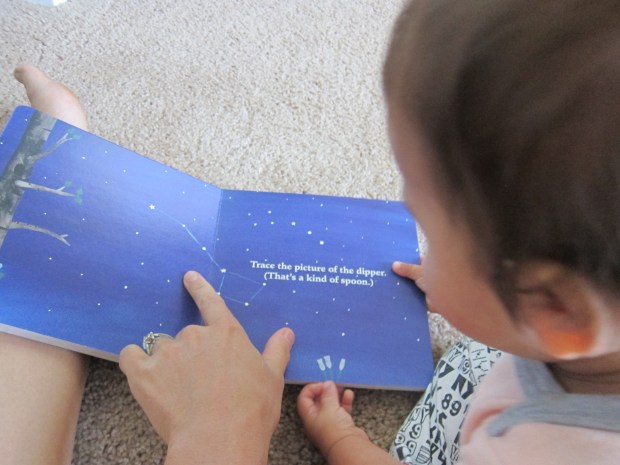
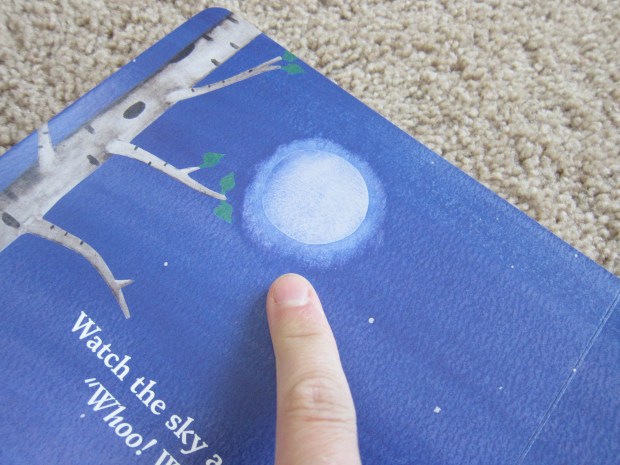
If your child also sleeps before dark, have fun pointing out these night objects in books instead! Today, instead of reading the words, I sang star and moon poems as we turned each page of a favorite book.

Explore Night (3)

When we came to a star, I pointed and sang:

Twinkle twinkle little star

How I wonder what you are.

Up above the world so high,

Like a diamond in the sky.

Twinkle twinkle little star

How I wonder what you are.

And here’s a rhyme to go with the moon page:

I see the moon

And the moon sees me

As is floats so high

Over mommy and me

I see the stars

And the stars see me

As they shine in the sky

Over Daddy and me

Explore Night (4)

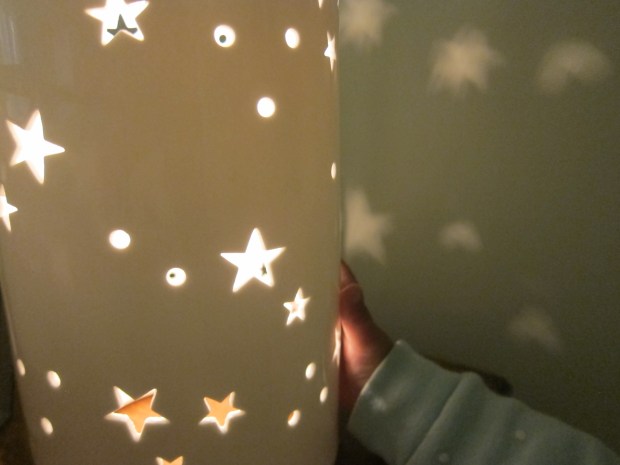
You can also point out stars wherever you may have them around the house. Veronika is transfixed by our nightlight.

Explore Night (5)

We tried going outside just before bedtime, but the sky was indeed still light.

Explore Night (6)

But then wouldn’t you know it; an unusually fussy bedtime had Veronika up later than usual, and look what was peeking at us just before she slept.

Explore Night (8)

Meanwhile, we’ll wait for the impending shorter days of autumn and winter, when I can truly take her out to marvel at these wonders of the night sky.

Explore Night (7)

Science of Trees Kiwi Crate

Kiwi Trees (1)

Travis’s crate from Kiwi Co. this month was about the way trees and plants take nutrients from the roots upwards, in seeming defiance of gravity. Travis loved every element of this “capillary action” crate… and for good reason!

First, we needed to see capillary action in, well, action, with Capillary Action Art. Using the provided double-sided tape dots and clear slides, Travis attached on three string stems and 3 coffee filter paper flowers.

Kiwi Trees (8)

He added the provided binder clips on either side of the slide’s bottom, and two additional clips to hold everything in place. Clever: now the blender clips meant the slide could stand upright over the provided paint tin.

Kiwi Trees (9)

He dripped liquid watercolors into three of the compartments. There was red and yellow watercolor, and his booklet suggested combining them in the third compartment to make orange.

Kiwi Trees (10)

Almost instantly, the color was bleeding up the stems.

Kiwi Trees (11)

Travis was practically shaking with amazement as he watched this, especially because of how fast it happened.

Kiwi Trees (4)

When it reached the tissue “flowers,” he was ecstatic.

Kiwi Trees (3)

Kiwi must have known this would be a big hit; there are enough materials to do the project twice. Needless to say, we repeated it instantly.

As a nice finishing touch, you can use additional double-sided tape dots to place the slides into a cardboard frame, and save your artwork. Talk about STEAM!

Kiwi Trees (15)

The second activity was to Build a Balancing Tree. This required slotting together two wooden pieces as the trunk, and inserting that into a wooden base.

Kiwi Trees (23)

Wood leaves and roots allow your little engineer to tip the tree one way or another.

Kiwi Trees (18)

At first, Travis seemed disappointed. But then we put the tree to the test in a Tilting Tree Game. Roll the dice to add leaves or roots to one of the four quadrants… but if you roll the (!) symbol, there’s a natural disaster! This can be a tornado (blowing on the tree), earthquake (shaking the box it sits on), or forest fire (removing the leaves from certain colored sections).

Kiwi Trees (19)

Travis cackled every time we thought our tree was nearly complete but then disaster struck.

Kiwi Trees (20)

Okay, so this isn’t perhaps the nicest way to teach kids about natural disasters, but it sure had him thinking about the stability that a tree’s roots provide, and was a ton of fun.

Kiwi Trees (22)

We concluded with two additional activities from the booklet. First, you can demonstrate the most mundane capillary action of all with a paper towel. Pretend to spill a little water or juice on the table (Travis thought it was quite funny that mom made a mess on purpose) and then quickly place a paper towel over it. The fibers act just like the root system of a plant!

Kiwi Trees (6)

Next, we repeated a classic flower-dyeing experiment, but with a slight twist. Use any white flowers for the game, such as carnations or roses. Trim the stems at an angle, then carefully slit the stems down the middle.

Kiwi Trees (12)

Fill two cups with lukewarm water and add 20 drops food coloring (in different colors) to each cup.

Kiwi Trees (13)

Arrange two flowers so that the halved stems dangle one into each cup. I found it useful to use a paper clip to hold them in place, so the flowers didn’t tip.

Within just an hour or two, we could already see a pretty tint… on each half of the flower!

Kiwi Trees (16)

By morning, the colors were vibrant and split evenly down the middle, a fantastic visual of capillary action.

Kiwi Trees (17)

We finished with two fun suggested reads: The Tree Lady by H. Joseph Hopkins and Tell Me Tree by Gail Gibbons. In sum, we loved this crate!