Make Handprint Keepsakes

Handprint Keepsake (6)

It’s been a couple of months since I last captured the size of Veronika’s hands and feet – si clearly it was time to do so again!

Use a non-toxic and washable paint and brush it gently onto your little one’s palms and the soles of his or her feet. Press firmly onto watercolor paper. You’ll probably get a little wiggling around, but that’s ok! Make sure you have wipes ready to go for quick clean up. Why are there no pictures of this process? Because paint + eight month old = lots of wrangling!

Handprint Keepsake (1)

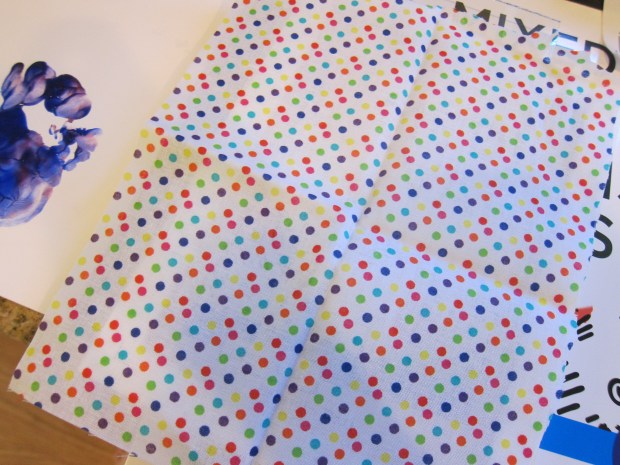
Once the prints dried, I used them in two ways. With the handprint, I made a framed keepsake. Cover the backing of a picture frame with decorative fabric, and secure the fabric in place with masking tape.

Handprint Keepsake (2)

Use double-sided tape to attach the handprint in the middle of the fabric. Slip back into the frame and display in the nursery – or give this as a gift to grandparents perhaps!

Handprint Keepsake (3)

The footprint simply went into her memory box which was a great trip down memory lane. There were a few mementos in there I had already forgotten about!

Handprint Keepsake (5)

As long as you don’t mind the mess of painting with a baby, this is a fun project with great keepsakes as a result.

Handprint Keepsake (4)

Homemade Rocket Pops and Picnic Celebration

Rocket Pop (4)

Travis and I originally intended to make these homemade rocket pops for the 4th of July, but we were short a couple of ingredients. But there’s no better time than a summer afternoon to declare a random family celebration. Prepare these fun popsicles, set up a picnic, and celebrate… whether it’s a true holiday, or just a hot afternoon! That’s precisely what we did today. Read on for the recipe… and a fantastic chance to win $1,000!

First up: Making the rocket pops:

In a blender, combine 1 cup strawberries, 1 tablespoon sugar, and 1 tablespoon water; blend until smooth. Pour into the bottoms of popsicle molds or small paper cups. We tried it both ways since I had a hunch our molds would work better and our 9 oz cups seemed too large. Small (5 oz) dixie cups would have been ideal!
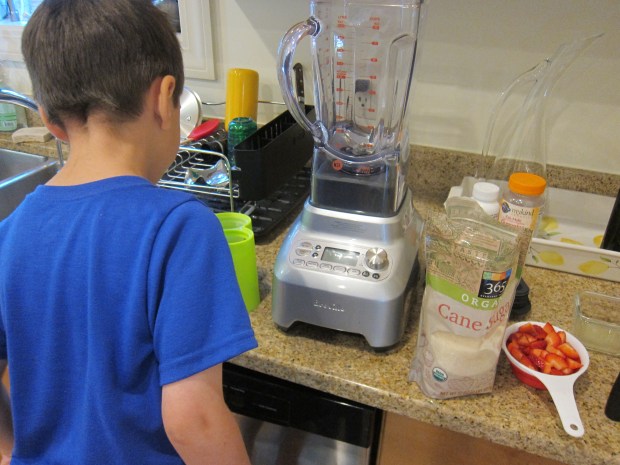
Rocket Pop (1)

Let the strawberry layer freeze for 30 minutes. Travis was quite intrigued about this layered method of preparation.

Meanwhile, make the blueberry layer; puree 1 cup blueberries, 1 tablespoon lime juice, and 1 tablespoon sugar. Set aside.

Rocket Pop (2)

Spoon 2 tablespoons vanilla non-dairy yogurt over each layer of strawberry mixture. Add 2 tablespoons blueberry mixture to the top of each pop. Insert the handles (or, if using cups, cover with foil and insert a popsicle stick). Return to the freezer for at least 6 hours.

Rocket Pop (3)

Now it was time for the picnic! We headed to a local national park, laid down a blanket and enjoyed our pops. Okay, so they got a bit melty on a 90 degree day, but that only added to the amusement.

Rocket Pop (5)

We decided ours were Bastille Day pops, since our picnic coincided with France’s day to celebrate red white and blue instead of America’s.
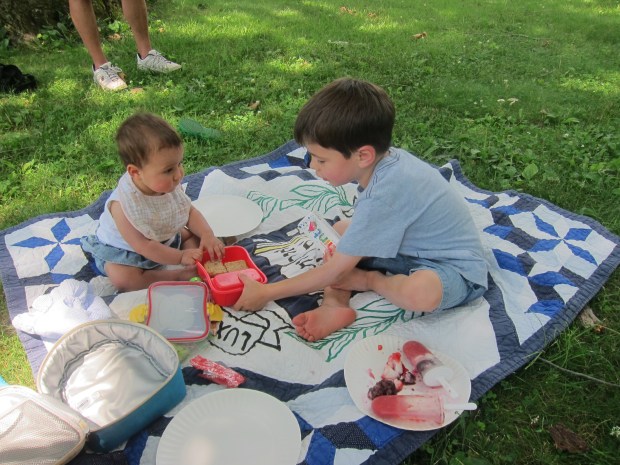
Rocket Pop (6)

Whatever the reason to celebrate, your child will love being involved in the picnic from start to finish, first by preparing a special recipe and then by helping to clean up at the end!

Rocket Pop (7)

I love projects like this that inspire kids to learn without even realizing it; they use their own creative process and enjoy tangible results. How does your child love learning while having fun? I’m so excited to announce the Limitless Learners Contest through Education.com, where your child can win $500 toward college, $1,000 for a school library, and a lifetime free membership to Education.com by explaining just that!

Children must be entering kindergarten through grade 5 and will think creatively about what education means to them. Using art or writing (depending on age), entrants describe a time they had so much fun they didn’t realize they were learning. A winner will be chosen from each grade level.

I hope my readers will tap into this amazing opportunity. Entries must be received by October 31, 2019. Further details are available at https://www.education.com/contests/

Sight Word Bean Bag Toss

Sight Word Bingo (6)

Travis is struggling a bit with the 40 sight words we’re working on over the summer, and grows impatient just sitting and looking at flashcards. So I switched things up! For this game, I used just 12 very basic words and then moved us outside and turned the sight words into a sport: beanbag toss, that is!

Sight Word Bingo (2)

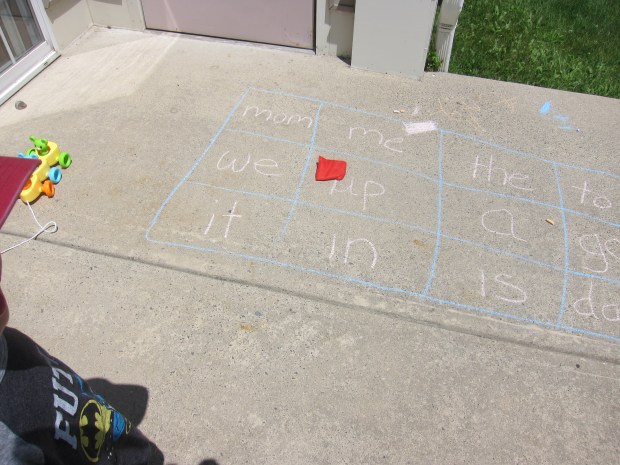
I made a 3 x 4 rectangular grid out of chalk on the patio and wrote in the 12 words.

Sight Word Bingo (1)

I handed Travis a beanbag and told him that the goal was to toss it into a square. For each one he landed in, he had to shout out the word.

Sight Word Bingo (3)

It was helpful for him that I took turns, too. He could hear me reiterate any word that he might have already landed on, making it ever more familiar. Or sometimes I aimed for ones I knew were particular tricky for him, like ‘the’.

Sight Word Bingo (5)

By the end, he was quick with some he has struggled over previously, like ‘up’ and the ‘in/is/it’ trio. We’ll be playing this one again!

Sight Word Bingo (4)


Starburst Symmetry

Starburst SYmmetry (10)

This quick project was a fantastic way to show Travis circular symmetry, slightly different from symmetry with two halves as we’ve explored late in symmetrical socks and paper doll projects. There was a lot of need for precision with this activity, so I was proud of Travis’s concentration level.

To start, fold a coffee filter in half. Then in half again, then in half again! Travis took the task of folding and making a good crease each time quite seriously. At the end, your filter will be the shape of an ice cream cone.

Starburst Symmetry (1)

Next he spritzed the filters with water until damp on each side, but not soaking.

Starburst Symmetry (2)

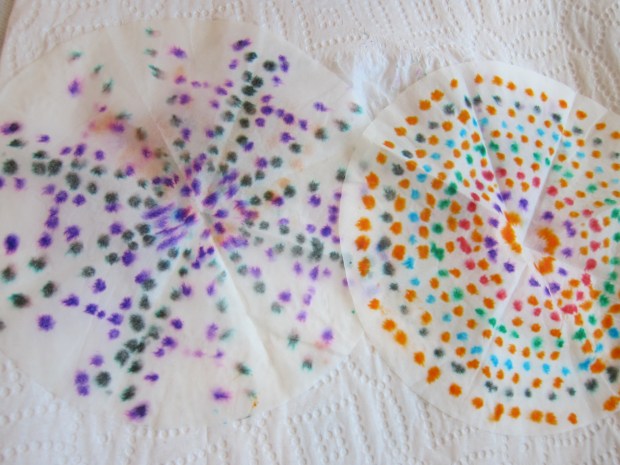
Use marker to make dots all over the filter, counting to three for each dot. This was a great little lesson in patience and also not scribbling (as he’d done recently for a different type of coffee filter project).

Starburst Symmetry (3)

Flip the filter over – wow! His pattern was waiting there on the other side.

Starburst Symmetry (4)

I showed him how to go over his dots again – slowly and carefully – to make the final result a little more clear.

Starburst Symmetry (5)

Now he opened it up for a big reveal. “Wow!”

Starburst Symmetry (6)

He wanted to know how the pattern had gotten there, but understood once I explained that the marker went through all 6 layers of the filter, resulting in perfect symmetry in all 6 segments.

Starburst Symmetry (8)

I loved how his pattern made a purple diamond, unintentinoally.

Starburst Symmetry (11)

These are beautiful hung on the wall or fridge once they dry!

Starburst Symmetry (9)

Make a Natural Wind Chime

Natural Chime (6).JPG

I’ve wanted to make this art project for Veronika for quite a while but wanted to wait until we were in our new home before doing so. With the unpacking done, it was time to get crafty!

Some of this wind chime was trial and error, but an eight-month-old baby doesn’t mind a few quirks in the end result.

To make the chime, first make a hole in small shells, whether those collected at the beach or ones from the craft store.

Natural Chime (1)

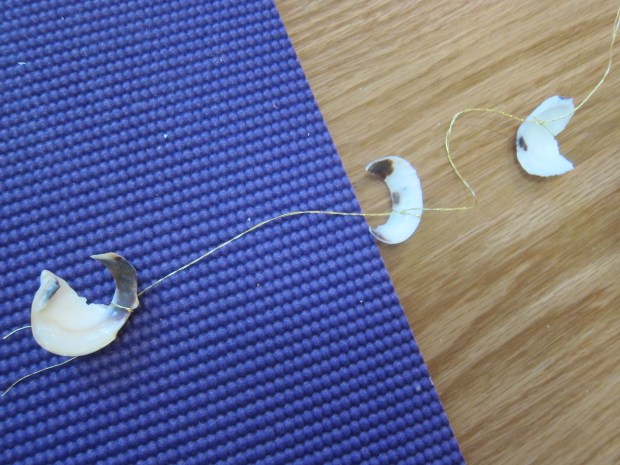
Instructions suggested that I could do this by twisting a pair of sharp nail scissors against each shell, but they were far too tough. Next I tried tapping them with a screwdriver, using gentle pressure with a hammer. But I wasn’t gentle enough, and any open-faced shells like clams shattered.

Natural Chime (2)

Turns out the screwdriver method worked great with any curled snail shells, though!

Natural Chime (3)

Once I had enough shells with holes, I threaded them onto gold string. Tie these to the arms of a decorative starfish. If you don’t have a starfish, a piece of bamboo or driftwood would be pretty, too.

Natural Chime (4)

I suspended the star fish from a low branch of a tree outside, and clicked the shells together for Veronika to hear the beautiful sound.

Natural Chime (7)

She was immediately entranced and wanted her own chance to clack the strings and shells together.

Natural Chime (8)

Next we lay down on a towel underneath the tree to enjoy way the shells looked from up above. We could watch the strings move and the leaves dance in the tree, and I talked about everything she could hear and see. All in all, this was a beautiful project!

Natural Chime (10)

Speedways

Speedways (4).JPG

This little experiment will challenge your child’s brain to think like an engineer, and teaches about angles, weight, speed, and more.

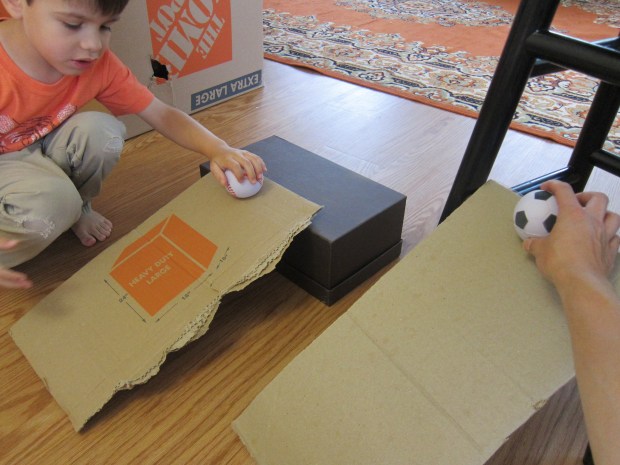
I tasked Travis with finding two balls that were the same and he came back with two squishy sports balls (Note: It turns out one might have been heavier than the other, but more on that later).

Speedways (1)

Next we needed to construct two ramps. Heavy duty cardboard cut to the same size were perfect. I helped Travis look around for what we could tilt them up against. He tried a few initial ideas, like baby toys, until we settled on a box for one and a stool for the other.

Speedways (2)

Counting to three, Travis and I released at the same time and watched the balls zoom down.

Speedways (5)

I asked him why the steeper one had rolled faster and further. He guessed because that ramp was shorter, so I showed him again how the ramps were the same length. But then we talked about the steepness, and he was quite interested. He said he found a way to make it roll even faster – from up above the ramp!

Speedways (3)

We tested out a few slightly more scientific variations, but then found that the “soccer” ball always rolled faster and further even when on the ramp with less of an incline. Holding both, I realized it was heavier than the “baseball”, which may have skewed our experiment. But we had speedy fun!


Kiss Chase

Kiss Chase (8).JPG

At eight months old, Veronika has made a big leap: the art of anticipation. This is why you may notice your baby holding out his or her arms now to be picked up, or anticipating a host of other moments in a daily routine.

One way to have fun with this? Be a kissy monster!

“I’m going to kiss you!” I say to Veronika. Wait for it…

Kiss Chase (1)

Wait for it…

Kiss Chase (3)

Kiss Chase (4)

Then I either swoop in and kiss her everywhere, or give raspberries to her belly, or pick her up and kiss all over her cheeks.

She giggles every time, because she knows what’s coming!

This game has only gotten more fun as Veronika attempts to crawl. Now it really can be a “chase.” I tease her by saying, “I’m coming for you!”

Kiss Chase (9)

Oh no, can she get away?

Kiss Chase (7)

Caught by the kissy monster again!

Kiss Chase (6)

Pillowcase P

Pillow P (3).JPG

Travis traced a few quick upper and lower case Ps today, and then put together these quick silly versions of the letter.

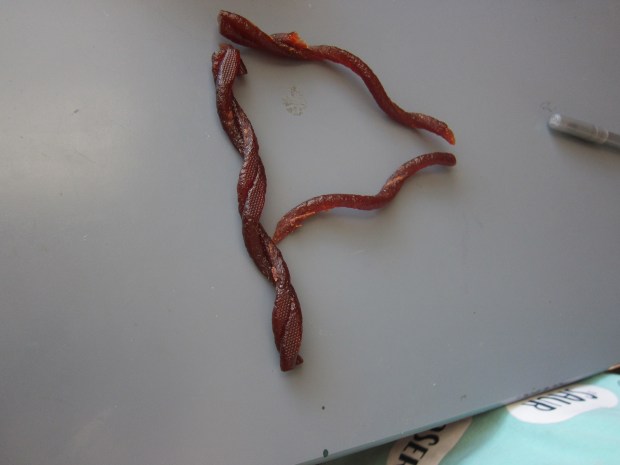
For upper case, we used pieces of licorice (actually: fruit chews from Clif Kids since I couldn’t find string licorice). Use a full piece of the fruit chew for the stem of the P, then uncoil one strand to make the loop.

Pillow P (1)

Next I gave Travis two empty pillowcases and challenged him to design a p. He actually had the shapes correct in moments…

Pillow P (2)

…just needed a little adjusting to twist the pillowcases tighter for a clearer result.

Sunshiny Art, Three Ways

Sunshine Art (11)

Baby it’s hot outside! But instead of lamenting the fact, Travis and I are using the sun as our accomplice in art.

First, we made suncatchers. This is a craft we’ve done before but it never loses its luster. Use markers to color over coffee filters – the more colors the better! Spritz with water to bleed the colors together.

Sunshine Art (2)

Once dry, we made paper frames by cutting rectangles out of white paper and taping around the filters. Place them in the window to catch the sun!

Sunshine Art (9)

Then we headed outside with a long roll of craft paper to make shadow portraits. Have your child stand so that the paper catches their shadow (you might have to lay it down a few times before you get the right angle). Trace around the shadow.

Sunshine Art (3)

Travis filled in his outline with a smile and clothes – all orange today!

Sunshine Art (5)

I challenged him to draw my shadow next. This task was tough, especially because he lost his place when the sun went behind a cloud, but it was great tracing practice.

Sunshine Art (7)

Finally, we returned to another oldie-but-goodie: sun prints. Place toys or other items on a piece of dark construction paper. Travis liked placing the items just so.

Sunshine Art (10)

Wait a few hours, then check and see if the image of the items remains on the paper. The longer the sun bleaches your paper, the more pronounced the effect will be.

Sunshine Art (13)

Thanks for helping out, Mr. Sun!

Wave Bye-Bye

Wave Bye (2)

The more you model the behavior of saying and waving bye-bye, the sooner your baby will understand this important gesture of human communication. Today, Veronika and I played a few fun “bye-bye” games.

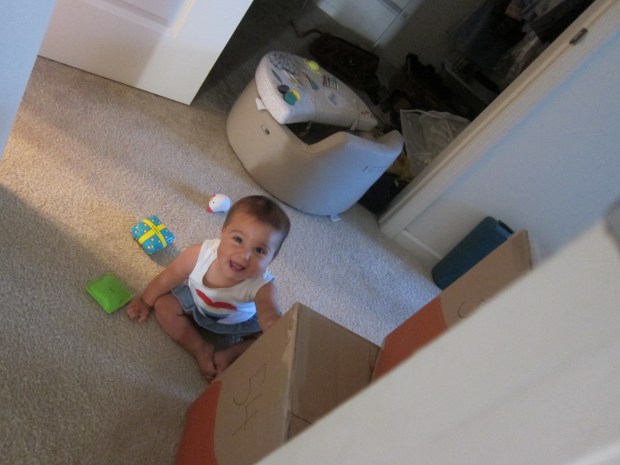
For the first, I hid a toy inside a box, first saying, “Bye-bye toy!” I made sure to give a little wave.

Wave Bye (1)

She eagerly reached right into the box each time to dig out the toy, and we repeated the process over and over until she tired of it.

Wave Bye (3)

Another adorable version is to sit your child on one side of a door frame. With a big smile and wave, say, “bye-bye!” and then disappear around the corner. Immediately pop back into view and say, “hello again!” I remember this getting huge smiles from Travis as a baby, and now it was Veronika’s turn.

Wave Bye (6)

Finally, say bye-bye all over the place throughout your day. You can do this when you leave a location (“bye-bye library!”) or a person (“bye-bye Grammy!”). Veronika looks like she wants to give a wave, and the more I model, the sooner she will.

On a personal note, we turn today to say “bye-bye” to our apartment, the only home Veronika has ever known. Here’s to new beginnings and many hellos to come!

Bye New York.jpg